This comprehensive guide examines the eight leading revenue intelligence platforms of 2025, providing RevOps leaders with the insights needed to make informed technology decisions. Through detailed platform comparisons, ROI analysis, and real-world case studies, we explore how these solutions are transforming revenue operations across industries.
The market for revenue intelligence software has experienced explosive growth, expanding from $3.7 billion in 2023 to an estimated $15.9 billion by 2033, representing a compound annual growth rate of 15.4%. This growth is driven by the increasing adoption of AI-powered analytics, the need for more accurate forecasting, and the demand for real-time insights into customer interactions.
Modern revenue intelligence platforms go beyond traditional CRM analytics, offering sophisticated capabilities including conversation intelligence, predictive deal scoring, automated risk detection, and AI-driven next best actions. These platforms are enabling organizations to achieve remarkable results, with leading implementations showing up to 481% return on investment over three years.
What is Revenue Intelligence
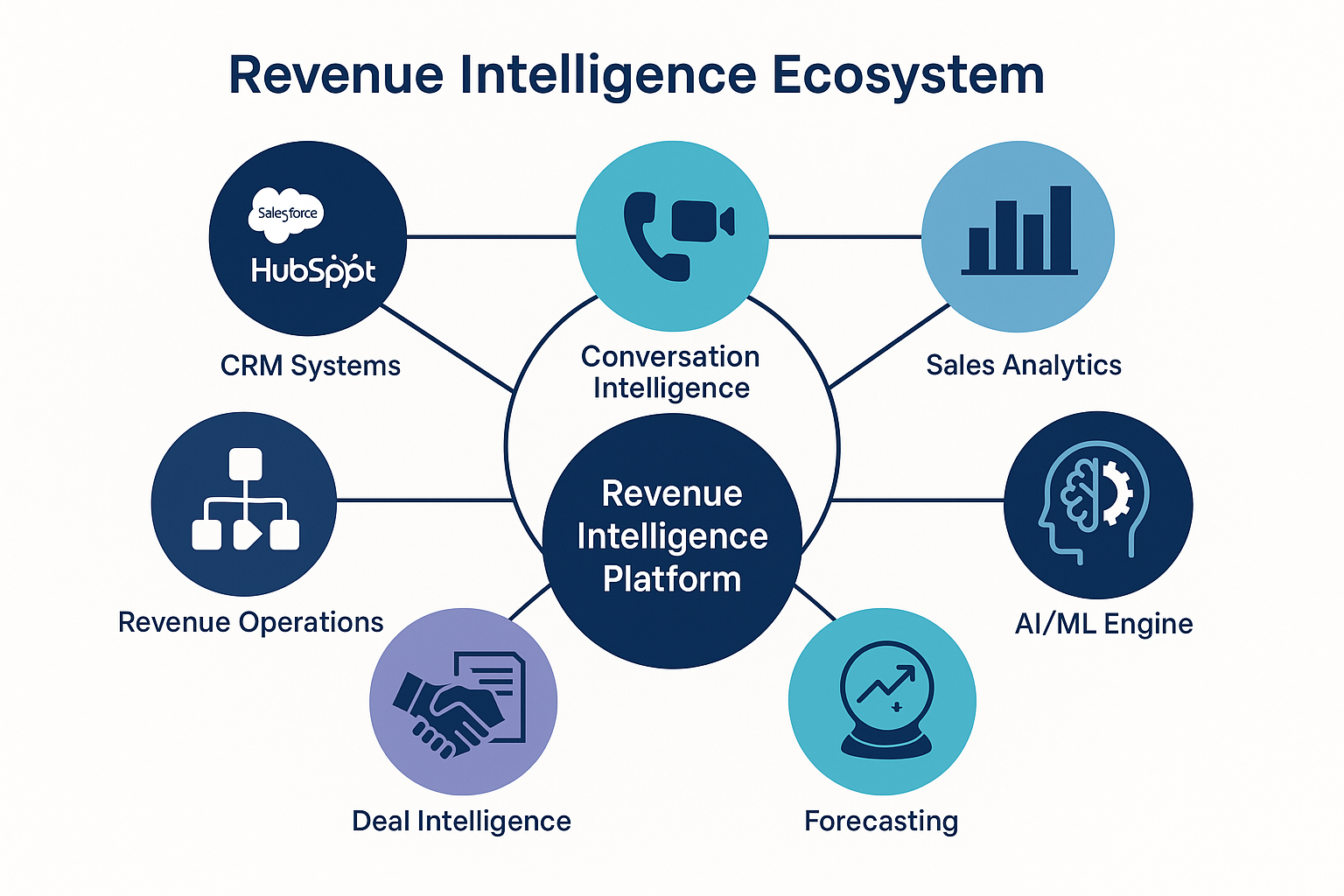
Revenue Intelligence Ecosystem
Revenue intelligence represents a fundamental shift in how organizations approach sales and revenue operations. At its core, revenue intelligence uses automation and machine learning algorithms to extract actionable insights from sales calls, CRM systems, and other revenue-related data sources. This technology democratizes insight generation by simplifying complex sales intelligence for users across the organization, enabling data-driven decision making at every level.
The evolution of revenue intelligence has been driven by significant changes in buyer behavior. According to recent research, 68% of buyers prefer to gather information independently, and 60% prefer not to interact with salespeople at all during their initial research phase. This shift means that when buyers do engage with sales teams, they are typically much further along in their purchasing journey, making every interaction critically important.
Traditional sales tools have struggled to keep pace with these changes. Sales representatives have historically relied on their email inboxes, memory, and ad hoc stories to discuss pipeline and deals with managers. This approach lacks the precision and data-driven insights necessary to optimize modern sales processes effectively.
Revenue intelligence platforms address these challenges by providing comprehensive visibility into buyer relationships and engagement activity across all touchpoints. These systems capture and analyze every customer interaction, from initial contact through deal closure and beyond, creating a complete picture of the revenue generation process.
Core Components of Revenue Intelligence
Conversation Intelligence forms the foundation of modern revenue intelligence platforms. This AI-powered technology automatically records, transcribes, and analyzes audio and video interactions between sales representatives and customers. The system derives real-time, actionable insights from sales conversations, providing data on customer pain points, objections, competitive mentions, and buying signals.
Deal Intelligence focuses specifically on understanding and optimizing the deal closure process. This component analyzes deal progression patterns, identifies risk factors, and provides recommendations for advancing opportunities through the sales pipeline. Deal intelligence helps sales teams understand what constitutes a healthy deal for their organization and warns when something problematic appears in the sales process.
Forecasting Intelligence uses machine learning algorithms to analyze historical data, current pipeline health, and market trends to generate more accurate revenue predictions. This goes beyond traditional forecasting methods by incorporating conversation data, engagement metrics, and behavioral patterns to improve prediction accuracy.
Sales Analytics provides comprehensive performance metrics across individuals, teams, and territories. This includes analysis of talk-to-listen ratios, conversion rates, win rates, sales cycle lengths, and other key performance indicators that drive revenue outcomes.
Revenue Operations Integration ensures that insights and data flow smoothly across sales, marketing, and customer success teams. This eliminates organizational silos and creates a unified view of the customer journey from initial awareness through renewal and expansion.
The Business Impact of Revenue Intelligence
Organizations implementing revenue intelligence platforms report significant improvements across multiple dimensions of sales performance. The technology enables sales teams to move from intuition-based decision making to data-driven strategies, resulting in more predictable and scalable revenue growth.
Revenue intelligence platforms help organizations discover the specific reasons behind lost sales opportunities. Rather than relying on subjective assessments or incomplete information, sales managers can analyze actual conversation data to understand where deals went off track. This capability enables more effective coaching and process improvements.
The technology also dramatically improves forecast accuracy by incorporating real-time data from customer interactions. Machine learning algorithms can identify patterns and signals that human analysts might miss, leading to more reliable revenue predictions and better resource allocation decisions.
Perhaps most importantly, revenue intelligence platforms enable more effective sales coaching and development programs. Sales managers can quickly identify specific areas where representatives need improvement, using actual conversation data rather than general observations. This targeted approach to coaching accelerates skill development and improves overall team performance.
The collaborative benefits of revenue intelligence extend beyond the sales organization. Marketing teams gain insights into which messages and content resonate most effectively with prospects. Product teams can understand customer needs and pain points more clearly. Customer success teams can identify expansion opportunities and potential churn risks earlier in the customer lifecycle.
Platform Comparison
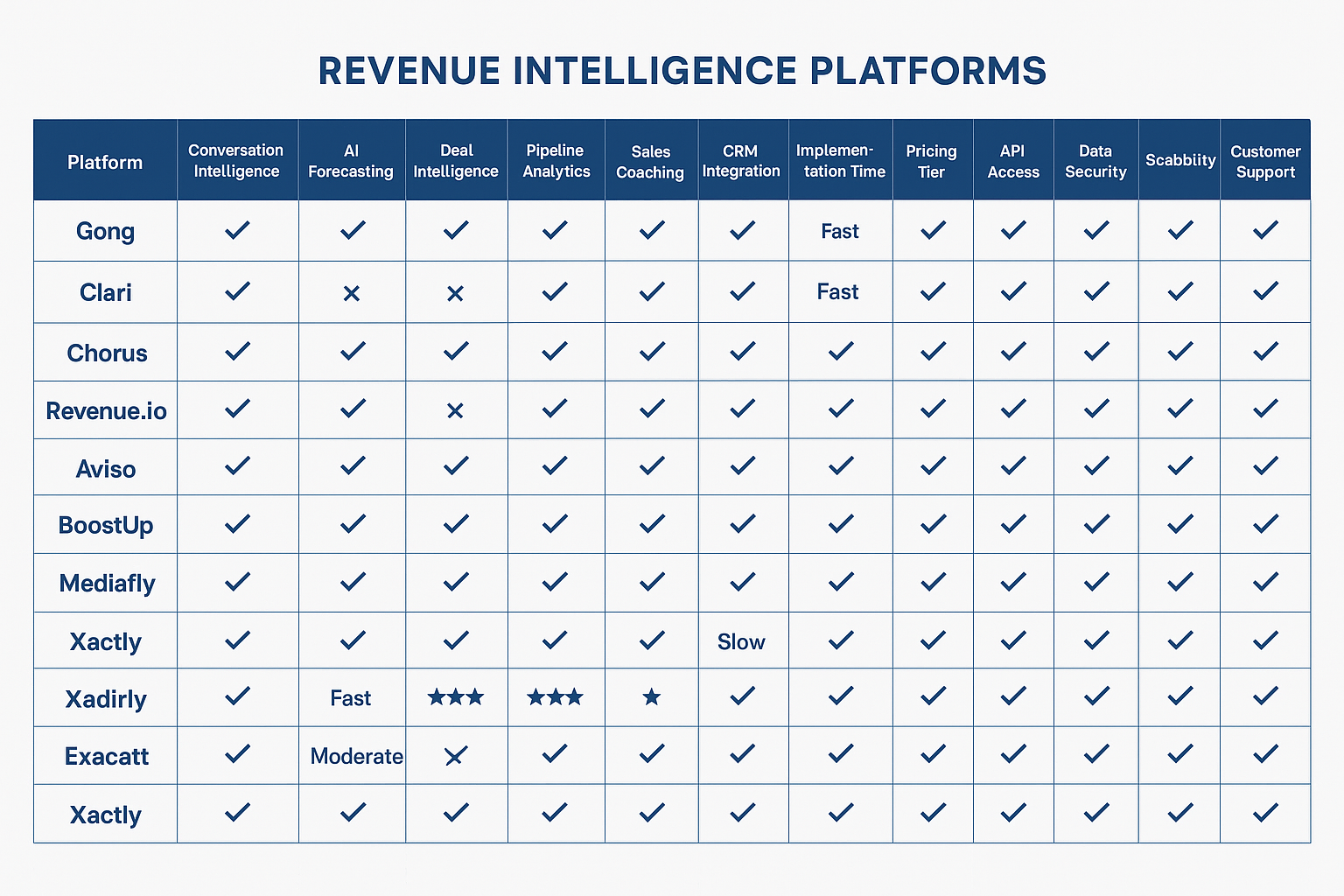
The revenue intelligence platform landscape in 2026 features eight leading solutions, each with distinct strengths and capabilities. This comprehensive analysis examines Gong, Clari, Chorus (ZoomInfo), Revenue.io, Aviso, BoostUp, Mediafly, and Xactly across more than twenty critical evaluation criteria.
Gong: The Conversation Intelligence Leader
Gong has established itself as the undisputed leader in conversation intelligence and revenue intelligence platforms. With over 4,500 customers including LinkedIn, PayPal, Shopify, and Zillow, Gong’s platform captures and understands every customer interaction, delivering insights at scale that empower revenue teams to make data-driven decisions.
The platform’s core strength lies in its patented Revenue Intelligence Platform™ that analyzes conversations across all channels and provides next best action recommendations. Gong’s AI technology can identify the anatomy of successful deals for each organization and warn when unhealthy patterns emerge, enabling sales representatives to intervene proactively.
Gong customers report impressive results, with an average 44% increase in win rates, 38% reduction in sales cycle length, and 60% reduction in time to ramp for new sales representatives. The platform’s comprehensive CRM integration capabilities, including native support for Microsoft Dynamics, make it particularly attractive for enterprise organizations with complex technology stacks.
However, Gong’s pricing can be steep for smaller teams, with annual costs ranging from $1,200 to $1,600 per user plus a $5,000 platform fee. For a ten-person sales team, this represents a significant investment that may be challenging for emerging companies to justify.
Clari: The Revenue Orchestration Pioneer
Clari positions itself as the first Revenue Orchestration Platform, using AI and Revenue Context to unify data, workflows, and cadences across the entire revenue process. The platform excels at turning every signal into confident action, providing revenue teams with total visibility into their business performance.
Clari’s Revenue Intelligence feature analyzes marketing and sales engagement across company revenue processes, offering automated CRM updates, time series analysis, and advanced revenue forecasting capabilities. The platform’s enterprise-class configurability and data snapshotting features make it particularly well-suited for large organizations with complex compliance requirements.
The platform’s strength in pipeline management and forecasting accuracy has made it a popular choice among revenue operations leaders. Clari’s smooth CRM syncing and sales-ready AI capabilities enable organizations to automate routine tasks while maintaining high levels of data quality and insight generation.
Chorus (ZoomInfo): Market Intelligence Focus
Chorus, now part of the ZoomInfo ecosystem, specializes in providing market intelligence data that helps organizations deeply understand their customers and competitive market. The platform’s market intelligence capabilities track how often competitors are mentioned in deals and at what stages, enabling sales teams to develop more effective competitive strategies.
The platform excels at analyzing customer conversations to understand feature preferences, conversion impacts, and deal outcomes. Product managers can use Chorus insights to prioritize development efforts, while sales teams can optimize their messaging and positioning based on actual customer feedback.
Chorus’s integration with ZoomInfo’s broader sales intelligence platform provides users with comprehensive buyer insights and contact data, creating a powerful combination for prospecting and deal advancement activities.
Revenue.io: Salesforce-Native Excellence
Revenue.io, formerly ringDNA, offers a complete AI Sales Engagement and Conversation Intelligence Platform with real-time guidance specifically designed for Salesforce customers. The platform’s native Salesforce integration provides smooth data flow and user experience for organizations already invested in the Salesforce ecosystem.
The platform’s real-time AI capabilities track deals, facilitate buyer conversations, provide in-the-moment coaching, and automate follow-up activities. Revenue.io’s granular call tracking and analytics features enable sales managers to monitor every aspect of sales conversations and identify improvement opportunities quickly.
Revenue.io’s strength lies in its ability to provide comprehensive revenue orchestration that combines sales engagement, conversation intelligence, and revenue operations in a single, powerful solution. The platform’s focus on real-time guidance helps sales representatives improve their performance during actual customer interactions.
Aviso markets itself as the industry’s only fully integrated AI Revenue Intelligence Platform, combining predictive forecasting, pipeline management, deal guidance, and conversational intelligence in a unified solution. The company achieved $12.8 million in revenue with a 270-person team in 2024, demonstrating strong market traction.
Aviso’s AI-guided Revenue Operating System helps sales and go-to-market teams accelerate growth, win more deals, and reduce risk through advanced predictive analytics. The platform was the first to deploy billion-dollar scale consumption forecasting for cloud data warehouses, showcasing its ability to handle enterprise-scale data processing requirements.
The platform’s mobile-first approach and conversational AI capabilities make it particularly appealing to sales teams that need access to insights and recommendations while in the field or traveling between customer meetings.
BoostUp: Revenue Command Center
BoostUp provides an AI-powered Revenue Command Center that helps RevOps leaders and CROs grow revenue efficiently through improved forecasting, sales coaching, and deal inspection capabilities. The platform recently launched native conversation intelligence to transform representative productivity and machine forecast accuracy.
BoostUp’s key differentiator is its ability to achieve up to 95% forecast accuracy within the first four weeks of each quarter, significantly outperforming traditional forecasting methods. The platform’s connected revenue operations and intelligence approach combines all functionality, data, and roles in a single location.
The platform’s focus on revenue command and control makes it particularly attractive to organizations that need tight oversight of their sales processes and want to minimize forecast variability.
Mediafly: Revenue Enablement Integration
Mediafly’s Revenue360 solution represents a unique approach that connects sales enablement, value selling, customer engagement, and revenue intelligence in a single platform. The company’s acquisition of InsightSquared has strengthened its revenue intelligence capabilities significantly.
The platform marries sales activity, buyer intent, and content engagement data to provide a 360-degree view of revenue operations. This comprehensive approach helps organizations understand not just what is happening in their sales processes, but why specific outcomes occur.
Mediafly’s strength lies in its ability to provide interactive, value-focused buying experiences that drive revenue while simultaneously capturing intelligence about buyer behavior and preferences.
Xactly: Sales Performance Integration
Xactly offers the only AI-powered platform that combines revenue intelligence and sales performance management, enabling organizations to unlock their full revenue potential. The company was recognized as a leader in IDC’s Revenue Intelligence Platforms 2024 report.
Xactly’s Intelligent Revenue Platform unifies sales planning, incentives, territories, and forecasting with AI-powered automation to drive predictable revenue growth. The platform’s focus on frontline AI and machine learning for sales forecasting and pipeline analytics makes it an excellent choice for organizations seeking to enhance their sales forecasting capabilities.
The platform’s integration of revenue intelligence with sales performance management provides a unique value proposition for organizations that want to align compensation and performance metrics with revenue outcomes.
AI Capabilities Deep Dive
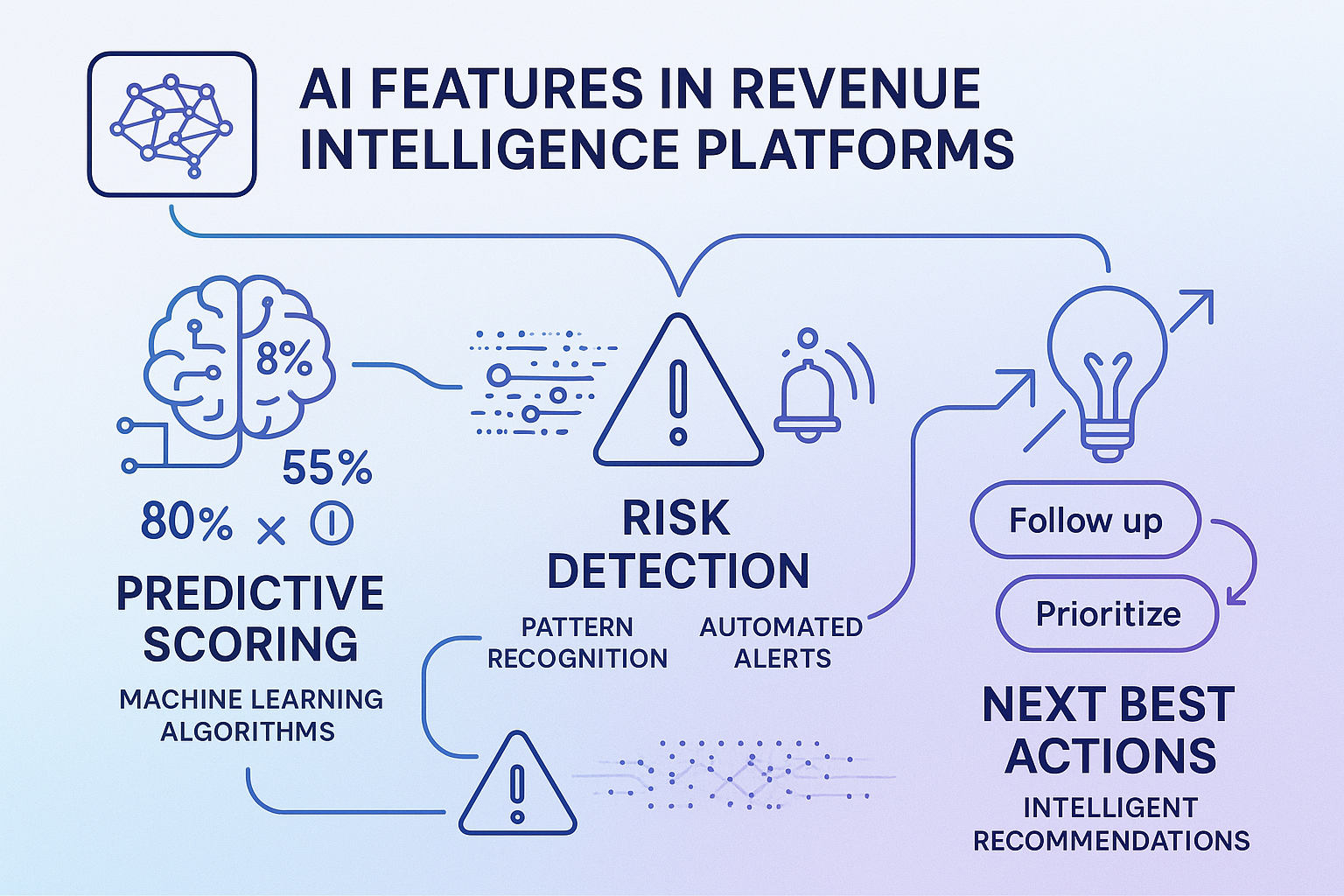
AI Capabilities Visual
The artificial intelligence capabilities embedded within modern revenue intelligence platforms represent the most significant advancement in sales technology in decades. These AI features transform raw conversation data and sales activities into actionable insights that drive measurable business outcomes.
Predictive Scoring: The Science of Deal Probability
Predictive scoring algorithms analyze hundreds of variables to determine the likelihood of deal closure, providing sales teams with objective assessments of opportunity health. These machine learning models examine historical deal patterns, conversation sentiment, engagement frequency, stakeholder involvement, and competitive dynamics to generate probability scores that are significantly more accurate than traditional subjective assessments.
Advanced predictive scoring systems can identify subtle patterns that human analysts might miss. For example, the AI might recognize that deals involving specific combinations of stakeholders, discussion topics, or engagement patterns have historically higher or lower success rates. This granular analysis enables sales representatives to focus their efforts on the most promising opportunities while identifying at-risk deals that require immediate attention.
The most sophisticated platforms continuously refine their predictive models based on new data and outcomes. As deals progress through the pipeline and ultimately close or are lost, the AI systems learn from these results and adjust their scoring algorithms accordingly. This continuous learning approach ensures that predictive accuracy improves over time and adapts to changing market conditions or sales process modifications.
Organizations implementing advanced predictive scoring report significant improvements in sales efficiency and forecast accuracy. Sales representatives can prioritize their activities more effectively, sales managers can allocate resources more strategically, and revenue operations teams can provide more reliable forecasts to executive leadership.
Risk Detection: Early Warning Systems for Revenue
AI-powered risk detection capabilities serve as early warning systems for potential deal problems, enabling proactive intervention before opportunities are lost. These systems analyze conversation patterns, engagement trends, and behavioral changes to identify deals that may be at risk of stalling or being lost to competitors.
Risk detection algorithms examine multiple dimensions of deal health simultaneously. They monitor changes in stakeholder engagement, shifts in conversation tone or content, delays in response times, and deviations from typical buying process patterns. When multiple risk indicators align, the system generates alerts that enable sales teams to take corrective action quickly.
The most advanced risk detection systems can identify specific types of risks and recommend appropriate responses. For example, if the AI detects that a key stakeholder has become less engaged, it might recommend scheduling a one-on-one meeting to address potential concerns. If competitive threats are identified in conversation analysis, the system might suggest specific competitive positioning strategies or content.
Pattern recognition capabilities enable these systems to learn from successful risk mitigation efforts. When sales teams successfully recover at-risk deals, the AI analyzes the interventions that were most effective and incorporates these learnings into future recommendations.
Next Best Actions: AI-Driven Sales Guidance
Next best action recommendations represent the culmination of AI analysis, providing sales representatives with specific, actionable guidance for advancing deals and improving outcomes. These recommendations are generated by analyzing successful deal patterns, current opportunity status, and optimal intervention strategies.
The AI systems examine successful deal progressions to identify the most effective actions at each stage of the sales process. They consider factors such as stakeholder involvement, content engagement, competitive dynamics, and timing to recommend specific next steps that have the highest probability of advancing the opportunity.
Advanced next best action systems provide contextual recommendations that consider the unique characteristics of each deal and customer. Rather than generic suggestions, the AI provides personalized guidance based on the specific situation, customer profile, and historical success patterns for similar opportunities.
These recommendations extend beyond simple task suggestions to include strategic guidance on messaging, stakeholder engagement, content sharing, and timing. The AI might recommend specific conversation topics, suggest optimal meeting participants, or identify the best time to introduce certain value propositions based on the current deal dynamics.
Natural Language Processing: Understanding Customer Intent
Natural language processing capabilities enable revenue intelligence platforms to extract meaningful insights from unstructured conversation data. These systems can identify customer pain points, buying signals, objections, competitive mentions, and sentiment changes that might not be apparent through traditional analysis methods.
Advanced NLP algorithms can recognize subtle linguistic patterns that indicate customer interest, concern, or decision-making progress. They can identify when customers use language that suggests they are moving toward a purchase decision or when they express concerns that might derail the sales process.
Sentiment analysis capabilities track emotional tone throughout the sales process, helping sales representatives understand how customer attitudes are evolving over time. This information enables more empathetic and effective customer interactions that address concerns proactively and reinforce positive momentum.
The most sophisticated NLP systems can identify specific topics and themes that correlate with successful deal outcomes. They can recognize when conversations focus on implementation details, budget discussions, or timeline planning – all indicators that suggest serious buying intent.
Machine Learning Model Optimization
The effectiveness of AI capabilities in revenue intelligence platforms depends heavily on the quality and sophistication of the underlying machine learning models. Leading platforms invest significantly in model development, training data quality, and continuous optimization to ensure maximum accuracy and relevance.
Model training requires extensive historical data sets that include successful and unsuccessful deals, conversation transcripts, engagement patterns, and outcome data. The quality and diversity of this training data directly impact the accuracy and applicability of the AI recommendations and insights.
Continuous model refinement ensures that AI capabilities remain effective as market conditions, customer behaviors, and sales processes evolve. The most advanced platforms implement automated model retraining processes that incorporate new data and outcomes to maintain optimal performance over time.
Feature engineering plays a critical role in model effectiveness, as the AI systems must identify and weight the most predictive variables from the vast array of available data points. This requires deep understanding of sales processes, customer behavior, and revenue dynamics to ensure that the models focus on the most relevant factors.
ROI Analysis
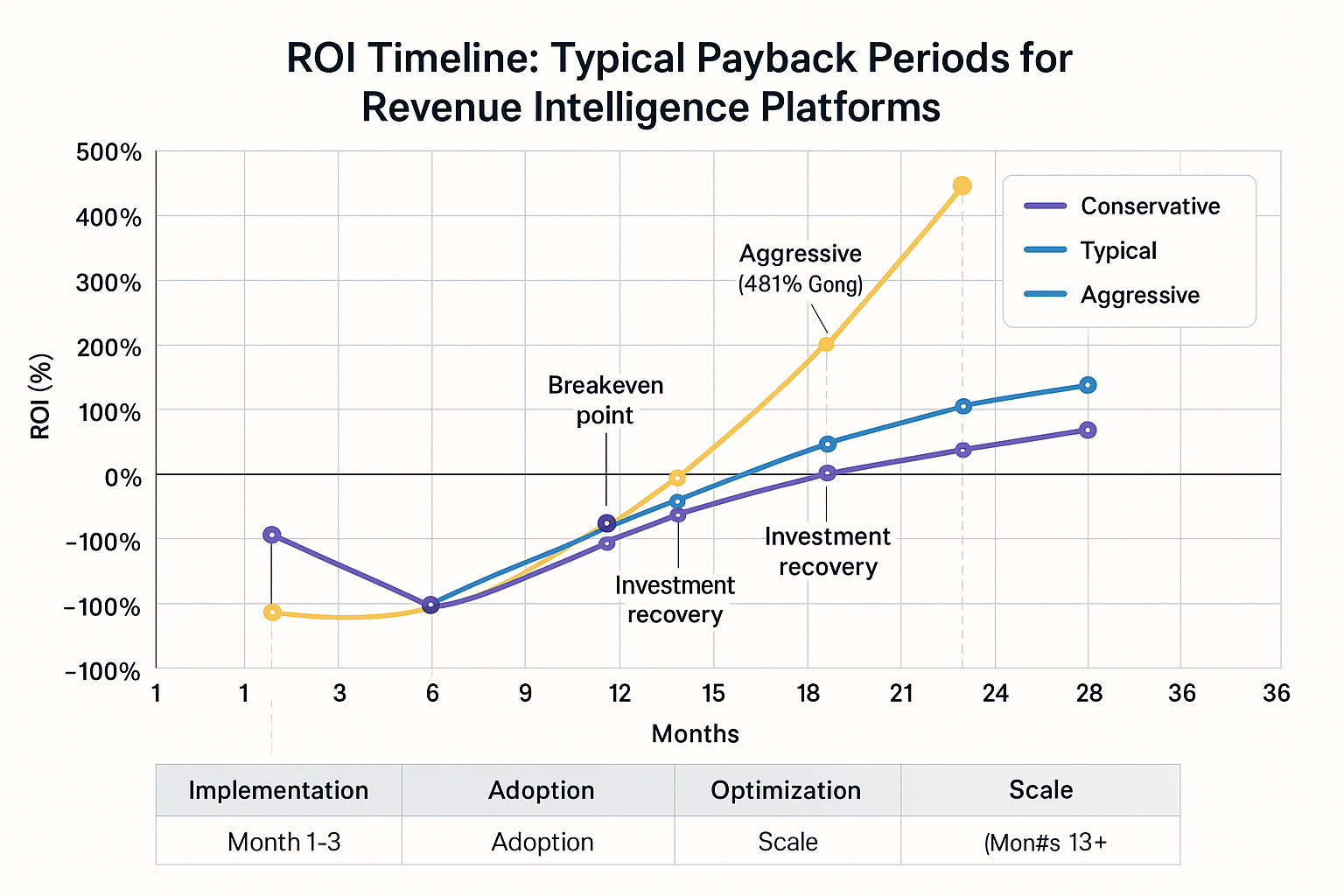
The return on investment for revenue intelligence platforms has been extensively documented through independent research and customer case studies. The most comprehensive analysis comes from a Forrester Consulting study commissioned to evaluate Gong’s Revenue Intelligence Platform, which found a remarkable 481% return on investment over three years.
The Forrester Total Economic Impact Study
The Forrester study analyzed a composite organization representative of typical Gong customers: a U.S.-headquartered B2B software-as-a-service company with annual revenues of $800 million, an average deal size of $20,000, and 750 people in the sales organization. This analysis provides a realistic benchmark for organizations evaluating revenue intelligence investments.
The study found that organizations experience benefits totaling $12.1 million over three years versus implementation and operational costs of $2 million, resulting in a net present value of $10 million. This exceptional ROI is driven by four primary benefit categories that demonstrate the comprehensive impact of revenue intelligence platforms.
Increased Incremental Profit represents the largest component of ROI, driven by improved win rates, larger deal sizes, and shorter sales cycles. The study found that revenue intelligence platforms enable sales teams to identify and replicate successful sales behaviors while avoiding patterns that lead to lost deals. This behavioral optimization translates directly into improved revenue outcomes.
Reduced Administrative Time provides significant productivity benefits as sales representatives spend less time on low-value activities such as manual data entry, report generation, and pipeline updates. The automation capabilities of revenue intelligence platforms free sales professionals to focus on high-value customer interactions and relationship building.
Accelerated Onboarding and Ramp-Up for new sales representatives delivers substantial cost savings and revenue acceleration. New hires can learn from recorded successful sales conversations, understand effective messaging and positioning, and identify best practices more quickly than through traditional training methods.
Enhanced Sales Manager Productivity through improved coaching capabilities enables more effective team development and performance optimization. Sales managers can identify specific areas for improvement, provide targeted feedback, and track progress more efficiently than through traditional observation and assessment methods.
Industry Benchmarks and Performance Metrics
Beyond the Forrester study, industry data reveals consistent patterns of improvement across organizations implementing revenue intelligence platforms. Companies using these solutions are more than twice as likely to significantly over-perform their sales goals compared to organizations relying solely on traditional CRM systems.
Forecasting accuracy improvements represent one of the most measurable benefits of revenue intelligence implementation. Organizations typically see 10-20% improvement in forecast accuracy, with some advanced implementations achieving up to 30% improvement compared to traditional forecasting methods. This enhanced predictability enables better resource allocation, more accurate financial planning, and improved investor confidence.
Sales cycle reduction is another consistent benefit, with organizations reporting average reductions of 38% in the time required to close deals. This acceleration is driven by better qualification, more effective stakeholder engagement, and improved deal progression strategies based on AI-powered insights.
Win rate improvements average 44% across organizations implementing comprehensive revenue intelligence platforms. These gains result from better opportunity qualification, more effective competitive positioning, and improved customer engagement strategies informed by conversation analysis and predictive insights.
Implementation Timeline and Payback Periods
The timeline for realizing ROI from revenue intelligence platforms varies based on implementation complexity, organizational readiness, and adoption rates. However, most organizations follow a predictable pattern of value realization that can be mapped across four distinct phases.
Implementation Phase (Months 1-3) involves initial setup, data integration, and basic user training. During this period, organizations typically experience negative ROI as they invest in platform costs, implementation services, and internal resources without yet realizing significant benefits.
Adoption Phase (Months 4-6) sees initial user adoption and early wins as sales teams begin using basic platform capabilities. Organizations typically reach breakeven during this phase as productivity improvements and early deal wins offset ongoing platform costs.
Optimization Phase (Months 7-12) delivers accelerating returns as users become proficient with advanced features and organizations optimize their processes based on platform insights. This phase typically generates the most rapid ROI growth as the full value of the platform becomes apparent.
Scale Phase (Months 13+) focuses on expanding usage across the organization and using advanced AI capabilities for strategic decision making. Organizations in this phase often achieve the highest ROI levels as they fully integrate revenue intelligence into their operational processes.
Cost Considerations and Budget Planning
Revenue intelligence platform costs vary significantly based on user count, feature requirements, and implementation complexity. Enterprise platforms typically range from $1,200 to $1,600 per user annually, with additional platform fees ranging from $5,000 to $25,000 depending on the vendor and feature set.
Implementation costs should include not only software licensing but also integration services, training programs, and internal resource allocation. Organizations should budget for 10-20% of annual software costs for implementation services, depending on the complexity of their existing technology stack and data integration requirements.
Ongoing operational costs include platform administration, user training, and continuous optimization efforts. Organizations should allocate internal resources for platform management and user support to ensure maximum value realization from their investment.
The most successful implementations involve dedicated revenue operations resources who can optimize platform configuration, analyze performance data, and drive continuous improvement initiatives. This investment in operational excellence typically pays for itself through improved platform utilization and enhanced business outcomes.
Measuring and Tracking ROI
Effective ROI measurement requires establishing baseline metrics before implementation and tracking improvements across multiple dimensions of sales performance. Key metrics include win rates, sales cycle length, forecast accuracy, deal sizes, and sales representative productivity measures.
Organizations should implement comprehensive measurement frameworks that capture both quantitative and qualitative benefits. While financial metrics provide clear ROI calculations, qualitative benefits such as improved sales team confidence, enhanced customer relationships, and better organizational alignment also contribute significantly to overall value.
Regular ROI assessments should be conducted quarterly to track progress and identify optimization opportunities. These reviews should examine platform utilization rates, feature adoption levels, and business outcome improvements to ensure that the organization is maximizing its investment value.
Implementation Roadmap
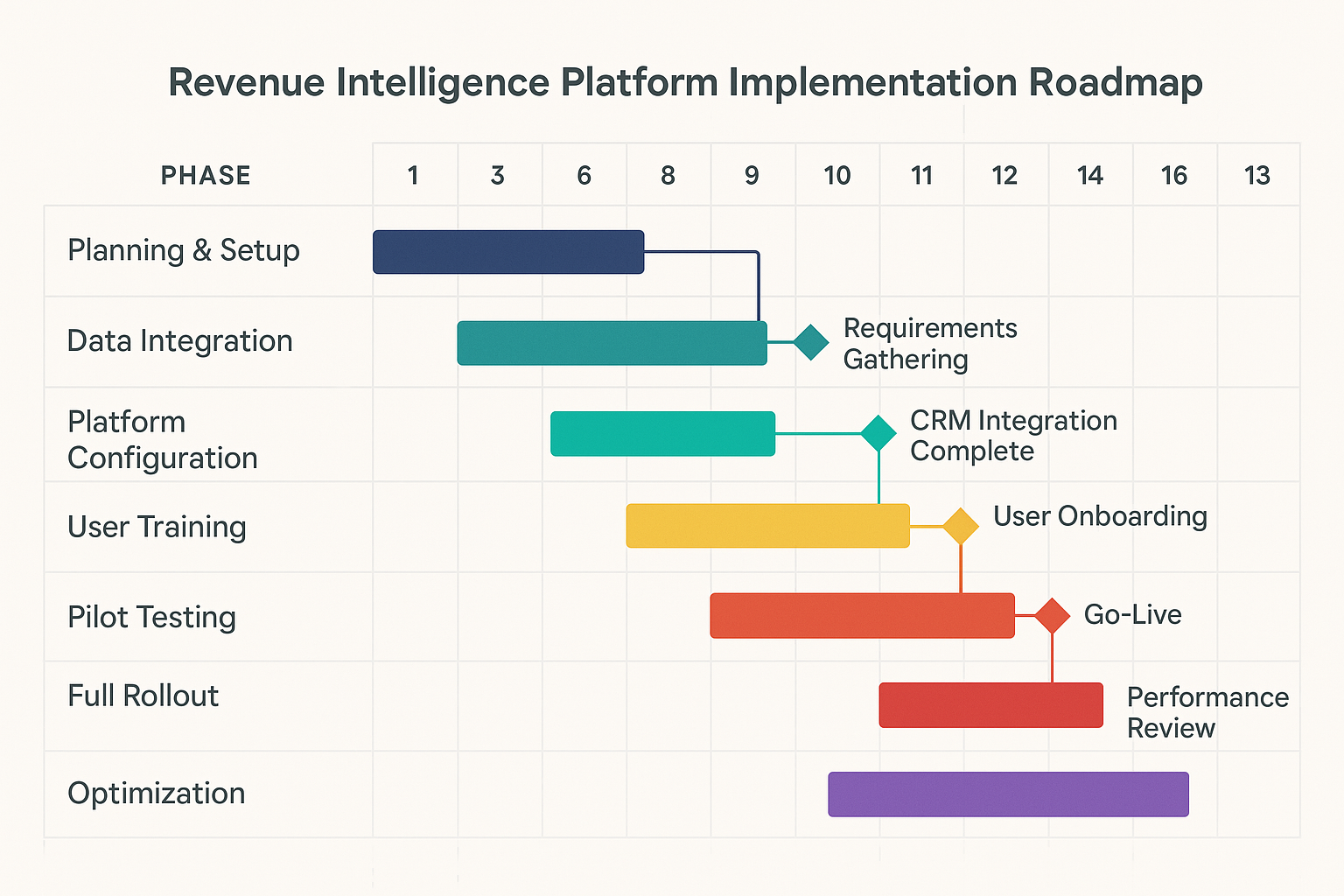
Successful revenue intelligence platform implementation requires careful planning, structured execution, and comprehensive change management. The typical implementation timeline spans 6-12 weeks, depending on organizational complexity and integration requirements. This roadmap provides a proven framework for maximizing implementation success and accelerating time to value.
Phase 1: Planning and Setup (Weeks 1-2)
The foundation of successful implementation begins with comprehensive planning and stakeholder alignment. This phase involves defining success criteria, establishing project governance, and preparing the organization for change.
Requirements Gathering forms the cornerstone of effective planning. Organizations must clearly define their revenue intelligence objectives, identify key use cases, and establish measurable success criteria. This process should involve stakeholders from sales, marketing, revenue operations, and IT to ensure comprehensive requirements capture.
The requirements gathering process should examine current sales processes, technology stack integration needs, data quality requirements, and user experience expectations. Organizations should also identify specific pain points they expect the revenue intelligence platform to address and establish baseline metrics for measuring improvement.
Stakeholder Alignment ensures that all relevant parties understand the implementation objectives, timeline, and their respective roles in the process. This includes executive sponsorship, sales leadership buy-in, and IT department cooperation for technical integration requirements.
Project governance structures should be established with clear decision-making authority, escalation procedures, and communication protocols. Regular status meetings and progress reviews should be scheduled to maintain momentum and address issues promptly.
Technical Architecture Planning involves designing the integration approach, data flow requirements, and security protocols. This includes CRM integration planning, conversation recording setup, and user access management configuration.
Phase 2: Data Integration (Weeks 3-4)
Data integration represents one of the most critical and complex aspects of revenue intelligence implementation. The quality and completeness of data integration directly impact the platform’s ability to generate accurate insights and recommendations.
CRM Integration typically requires the most extensive technical effort, as the revenue intelligence platform must synchronize with existing customer relationship management systems. This integration should include bidirectional data flow to ensure that insights generated by the revenue intelligence platform are reflected in the CRM system.
The integration process should address data mapping requirements, field synchronization protocols, and real-time update mechanisms. Organizations should also establish data governance policies to maintain data quality and consistency across systems.
Historical Data Migration enables the revenue intelligence platform to analyze past performance patterns and establish baseline metrics. This process should include deal history, conversation records, and performance data to provide comprehensive context for AI model training.
Data quality assessment and cleansing should be conducted during the migration process to ensure that the revenue intelligence platform has access to accurate and complete information. This may require significant effort to standardize data formats, resolve duplicate records, and fill missing information gaps.
Communication System Integration involves connecting the revenue intelligence platform to phone systems, video conferencing tools, and email platforms to enable comprehensive conversation capture and analysis.
Phase 3: Platform Configuration (Weeks 5-6)
Platform configuration involves customizing the revenue intelligence system to match organizational processes, terminology, and reporting requirements. This phase requires close collaboration between the vendor implementation team and internal stakeholders to ensure optimal system setup.
Sales Process Mapping aligns the platform configuration with existing sales methodologies and stage definitions. This includes opportunity stage mapping, deal qualification criteria, and sales activity tracking requirements.
The configuration process should reflect organizational terminology, sales stage definitions, and reporting hierarchies to ensure that the platform generates insights that are immediately relevant and actionable for users.
User Role Definition establishes access permissions, feature availability, and reporting capabilities for different user types. This includes sales representatives, sales managers, revenue operations professionals, and executive stakeholders.
Role-based configuration should balance information access with user experience simplicity, ensuring that each user type has access to relevant features without overwhelming complexity.
Reporting and Dashboard Setup involves creating customized views and analytics that align with organizational KPIs and management reporting requirements. This includes individual performance dashboards, team analytics, and executive summary reports.
Phase 4: User Training (Weeks 7-8)
Comprehensive user training is essential for driving adoption and maximizing platform value. The training program should address different user types, skill levels, and use cases to ensure that all stakeholders can effectively use the platform capabilities.
Sales Representative Training focuses on daily platform usage, conversation analysis features, and deal insight interpretation. This training should emphasize practical applications and demonstrate how the platform can help representatives improve their sales performance.
Training should include hands-on exercises using real deal data and conversation examples to provide practical experience with platform features. Representatives should understand how to interpret AI-generated insights and incorporate recommendations into their sales activities.
Sales Manager Training covers coaching capabilities, team performance analytics, and pipeline management features. Managers should understand how to use conversation analysis for coaching purposes and how to use predictive insights for resource allocation decisions.
The training should demonstrate how managers can identify coaching opportunities, track team performance trends, and use platform insights to improve overall team effectiveness.
Revenue Operations Training addresses advanced analytics, reporting capabilities, and platform administration features. RevOps professionals should understand how to configure dashboards, analyze performance trends, and optimize platform settings for maximum organizational benefit.
Phase 5: Pilot Testing (Weeks 9-10)
Pilot testing involves deploying the platform to a limited user group to validate configuration, identify issues, and refine processes before full organizational rollout. The pilot should include representative users from different roles and experience levels.
Pilot Group Selection should include high-performing sales representatives who can provide valuable feedback and serve as platform advocates during broader rollout. The pilot group should also include sales managers who can evaluate coaching and management features.
Pilot testing should focus on real-world usage scenarios and actual deal progression to provide authentic feedback on platform effectiveness and user experience.
Issue Identification and Resolution involves collecting user feedback, identifying technical issues, and refining platform configuration based on pilot results. This process should address both technical problems and user experience concerns.
Regular feedback sessions should be conducted with pilot users to understand their experiences, identify improvement opportunities, and address any concerns before broader deployment.
Process Refinement involves adjusting sales processes, training materials, and platform configuration based on pilot feedback. This may include modifying dashboard layouts, adjusting notification settings, or refining integration parameters.
Phase 6: Full Rollout (Weeks 11-12)
Full organizational rollout involves deploying the platform to all intended users while maintaining support for adoption and issue resolution. This phase requires careful change management to ensure smooth transition and high adoption rates.
Phased Deployment may be appropriate for large organizations, rolling out the platform to different teams or regions in stages to manage support requirements and minimize disruption.
The rollout should include comprehensive communication about platform benefits, training resources, and support availability to encourage adoption and address user concerns.
Support and Adoption Monitoring involves tracking platform usage, identifying users who need additional support, and addressing technical issues promptly. This includes monitoring login rates, feature utilization, and user feedback to ensure successful adoption.
Regular check-ins with users and managers should be conducted to address questions, provide additional training, and gather feedback for continuous improvement.
Phase 7: Optimization (Weeks 13+)
The optimization phase focuses on maximizing platform value through advanced feature utilization, process refinement, and continuous improvement initiatives. This ongoing phase should continue throughout the platform lifecycle.
Advanced Feature Adoption involves training users on sophisticated platform capabilities and encouraging utilization of AI-powered insights and recommendations. This may include predictive scoring, risk detection, and next best action features.
Performance Analysis involves regular assessment of platform impact on sales performance, forecast accuracy, and other key metrics. This analysis should identify areas for further optimization and demonstrate ROI to stakeholders.
Continuous Improvement involves ongoing platform configuration refinement, process optimization, and user training to maximize organizational benefit from the revenue intelligence investment.
Future Trends Timeline
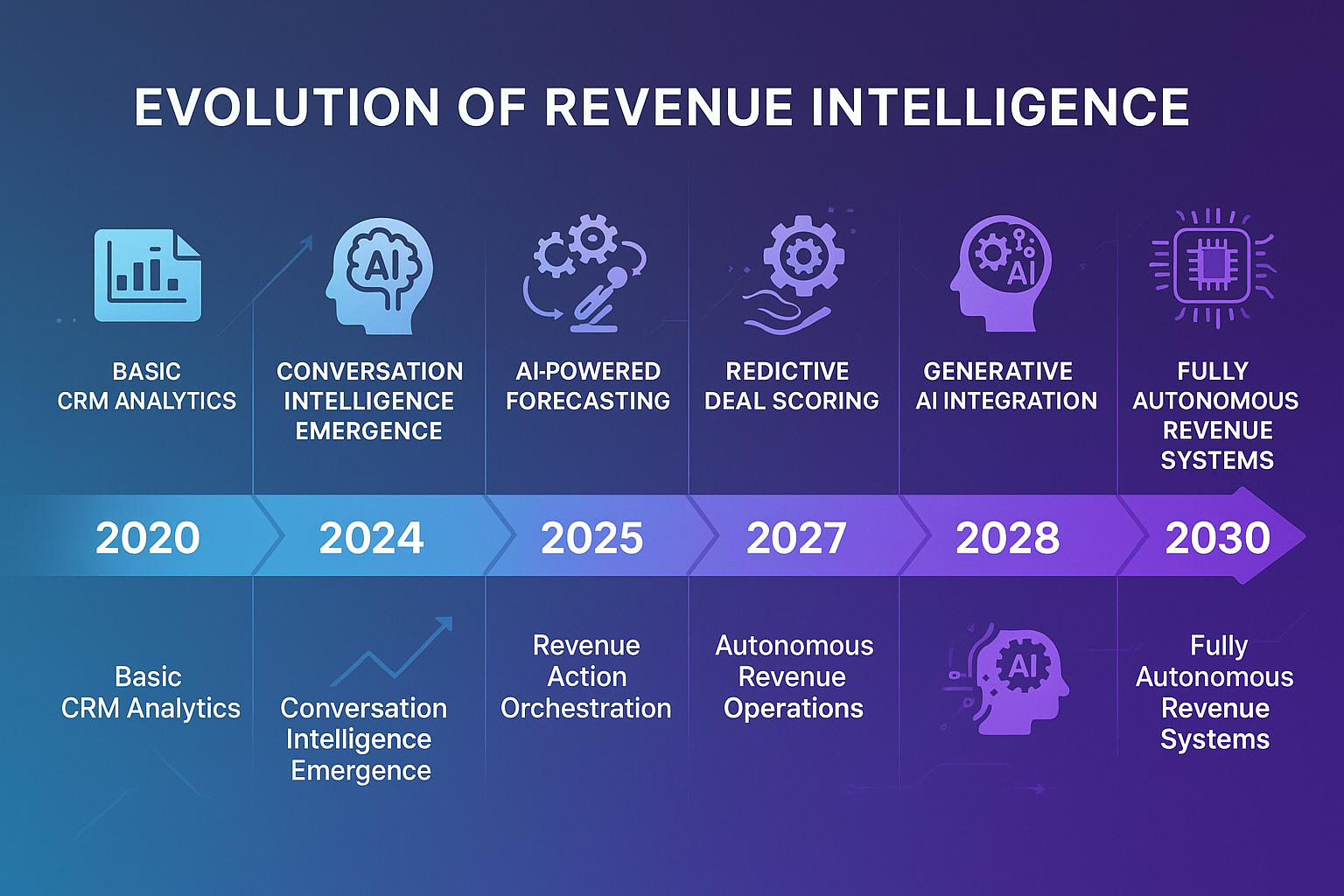
The revenue intelligence landscape continues to evolve rapidly, driven by advances in artificial intelligence, changing buyer behaviors, and increasing demand for predictable revenue growth. Understanding these trends is essential for organizations planning their revenue technology investments and preparing for the future of sales operations.
The Shift to Revenue Action Orchestration
Gartner has identified a significant trend in the evolution from traditional revenue intelligence to “Revenue Action Orchestration”. This shift represents a move beyond passive insight generation to active, automated intervention in revenue processes. Rather than simply providing analytics and recommendations, future platforms will automatically execute actions to optimize revenue outcomes.
Revenue Action Orchestration platforms will integrate more deeply with sales engagement tools, marketing automation systems, and customer success platforms to create smooth, automated workflows. These systems will not only identify opportunities for improvement but will also automatically implement corrective actions such as adjusting outreach sequences, modifying content recommendations, or triggering specific coaching interventions.
The implications of this shift are profound for revenue operations teams. Organizations will need to develop new competencies in workflow design, automation management, and performance optimization. The role of revenue operations professionals will evolve from data analysis and reporting to strategic automation design and continuous optimization.
This evolution will also require new approaches to change management and user adoption. As platforms become more autonomous, sales teams will need to develop trust in automated recommendations and actions while maintaining the human judgment necessary for complex customer interactions.
Generative AI Integration
The integration of generative artificial intelligence represents one of the most significant technological advances in revenue intelligence platforms. Generative AI capabilities will transform how sales teams create content, prepare for customer interactions, and respond to customer inquiries.
Content Generation will enable sales representatives to create personalized proposals, presentations, and follow-up communications based on conversation analysis and customer-specific insights. The AI will analyze customer pain points, preferences, and communication styles to generate highly relevant and persuasive content.
These capabilities will extend beyond simple template completion to sophisticated content creation that incorporates competitive intelligence, industry trends, and customer-specific value propositions. Sales representatives will be able to generate compelling business cases, ROI analyses, and implementation plans tailored to each customer’s unique situation.
Conversation Preparation will use generative AI to help sales representatives prepare for customer meetings by analyzing previous interactions, identifying key topics to address, and suggesting optimal conversation strategies. The AI will generate talking points, anticipate potential objections, and recommend specific questions to advance the sales process.
Real-Time Assistance during customer conversations will provide sales representatives with immediate support through AI-generated responses to customer questions, competitive positioning guidance, and next best action recommendations. This capability will be particularly valuable for complex technical sales where representatives need access to detailed product information and competitive intelligence.
Autonomous Revenue Operations
The ultimate evolution of revenue intelligence platforms points toward fully autonomous revenue operations systems that can manage entire aspects of the sales process with minimal human intervention. These systems will combine advanced AI capabilities with sophisticated automation to create self-optimizing revenue engines.
Autonomous Lead Qualification will use AI to analyze prospect behavior, engagement patterns, and fit criteria to automatically qualify and route leads to appropriate sales resources. The system will continuously learn from successful and unsuccessful qualification decisions to improve accuracy over time.
Automated Deal Progression will identify optimal next steps for advancing opportunities and automatically execute appropriate actions such as scheduling meetings, sending relevant content, or triggering specific outreach sequences. The AI will monitor deal health continuously and intervene when risk factors are detected.
Self-Optimizing Processes will analyze performance data across all revenue activities to identify improvement opportunities and automatically implement process modifications. This includes adjusting sales methodologies, modifying qualification criteria, and optimizing resource allocation based on performance outcomes.
The transition to autonomous revenue operations will require significant organizational change management and new governance frameworks. Organizations will need to establish clear boundaries for automated decision-making, maintain human oversight for strategic decisions, and develop new metrics for measuring autonomous system performance.
Predictive Customer Lifecycle Management
Future revenue intelligence platforms will extend their capabilities beyond initial deal closure to encompass the entire customer lifecycle, providing predictive insights for expansion, renewal, and churn prevention. This holistic approach will enable organizations to maximize customer lifetime value through proactive intervention and optimization.
Expansion Opportunity Prediction will analyze customer usage patterns, engagement levels, and business growth indicators to identify optimal timing and approaches for upselling and cross-selling initiatives. The AI will recommend specific products or services based on customer needs analysis and successful expansion patterns.
Churn Risk Detection will monitor customer health indicators across multiple touchpoints to identify accounts at risk of non-renewal or cancellation. The system will provide early warning alerts and recommend specific retention strategies based on successful churn prevention efforts.
Customer Success Optimization will integrate with customer success platforms to provide insights into customer onboarding effectiveness, adoption patterns, and satisfaction levels. This integration will enable proactive intervention to ensure customer success and maximize renewal probability.
Advanced Behavioral Analytics
The next generation of revenue intelligence platforms will incorporate sophisticated behavioral analytics that go beyond conversation analysis to understand subtle patterns in customer and sales representative behavior. These capabilities will provide deeper insights into what drives successful outcomes and how to replicate them consistently.
Micro-Expression Analysis in video conversations will provide insights into customer emotional responses, engagement levels, and decision-making confidence. This technology will help sales representatives understand when customers are genuinely interested versus merely being polite.
Communication Pattern Analysis will examine not just what is said in sales conversations but how it is communicated, including tone, pace, and linguistic patterns that correlate with successful outcomes. This analysis will enable more effective coaching and communication strategy development.
Decision-Making Process Mapping will analyze customer behavior patterns to understand how different organizations make purchasing decisions, including stakeholder involvement, evaluation criteria, and decision timelines. This insight will enable more effective sales process customization for different customer types.
Integration Ecosystem Evolution
The future of revenue intelligence platforms will be characterized by increasingly sophisticated integration ecosystems that connect with a broader range of business applications and data sources. This expanded connectivity will provide more comprehensive insights and enable more effective automation.
Marketing Technology Integration will connect revenue intelligence platforms with marketing automation, content management, and digital advertising systems to provide complete visibility into the customer journey from initial awareness through deal closure.
Financial System Integration will enable revenue intelligence platforms to incorporate financial data, pricing information, and profitability analysis into deal recommendations and forecasting models. This integration will help sales teams optimize not just for revenue but for profitable growth.
External Data Source Integration will incorporate market intelligence, competitive information, and industry trend data to provide broader context for sales decisions and strategy development. This external data will enhance the accuracy and relevance of AI-generated insights and recommendations.
The evolution toward more comprehensive integration will require new approaches to data governance, privacy protection, and system security. Organizations will need to develop sophisticated data management capabilities to ensure that expanded connectivity does not create new risks or compliance challenges.
Change Management Considerations
Implementing revenue intelligence platforms requires comprehensive change management to ensure successful adoption and maximize organizational benefits. The transformation from traditional sales processes to AI-driven revenue operations represents a fundamental shift that affects people, processes, and technology across the organization.
Overcoming Resistance to AI-Driven Insights
Sales professionals often exhibit initial resistance to AI-driven insights and recommendations, particularly when these suggestions conflict with their intuition or experience. This resistance stems from concerns about job security, skepticism about AI accuracy, and attachment to traditional sales methods that have previously been successful.
Effective change management addresses these concerns through education, demonstration, and gradual adoption approaches. Organizations should emphasize that AI capabilities are designed to augment human capabilities rather than replace sales professionals. The technology enables representatives to be more effective by providing data-driven insights that complement their relationship-building and strategic thinking skills.
Demonstrating quick wins and tangible benefits helps build confidence in AI recommendations. Organizations should identify early adopters who can serve as champions and share their success stories with broader teams. These advocates can provide peer-to-peer validation that is often more persuasive than management directives.
Training programs should focus on practical applications and hands-on experience with AI features. Sales representatives need to understand how to interpret AI-generated insights and incorporate them into their existing sales processes. This training should emphasize the competitive advantages that AI provides rather than the technical complexity of the underlying algorithms.
Cultural Transformation Requirements
Revenue intelligence implementation often requires significant cultural changes within sales organizations. Traditional sales cultures that emphasize individual achievement and intuition-based decision making must evolve to embrace data-driven collaboration and continuous learning.
Data-Driven Decision Making represents a fundamental cultural shift for many sales organizations. Representatives must learn to value objective data and AI insights alongside their personal experience and intuition. This requires developing new habits around data analysis, insight interpretation, and evidence-based strategy development.
Collaborative Knowledge Sharing becomes essential as revenue intelligence platforms capture and analyze successful sales behaviors that can be replicated across the organization. Sales representatives must be willing to share their techniques and learn from others’ successes rather than hoarding competitive advantages.
Continuous Learning Mindset is necessary as AI capabilities and market conditions continue to evolve. Sales professionals must embrace ongoing skill development and adaptation rather than relying solely on established methods and experience.
Leadership plays a critical role in driving cultural transformation by modeling desired behaviors, celebrating data-driven successes, and creating incentives that align with new cultural values. Sales managers must demonstrate their own commitment to AI-driven insights and collaborative learning to encourage similar behaviors from their teams.
Training and Skill Development
Comprehensive training programs are essential for successful revenue intelligence adoption. These programs must address different learning styles, experience levels, and role requirements to ensure that all users can effectively use platform capabilities.
Technical Skills Training covers platform navigation, feature utilization, and data interpretation. Users need to understand how to access relevant insights, configure dashboards, and interpret AI-generated recommendations. This training should include hands-on exercises and real-world scenarios to provide practical experience.
Analytical Skills Development helps sales professionals understand how to interpret data, identify patterns, and draw actionable conclusions from AI insights. Many sales representatives may need additional support in developing these analytical capabilities, particularly if they have primarily relied on intuition-based approaches.
Process Integration Training demonstrates how to incorporate AI insights into existing sales processes and methodologies. Representatives need to understand when and how to use different platform features throughout the sales cycle and how to combine AI recommendations with their relationship-building and strategic thinking skills.
Ongoing training and support are necessary as platform capabilities evolve and users develop more sophisticated requirements. Organizations should establish regular training schedules, provide access to learning resources, and create opportunities for peer-to-peer knowledge sharing.
Data Security and Compliance
Revenue intelligence platforms handle sensitive customer information, competitive intelligence, and proprietary sales data, making security and compliance critical considerations for implementation and ongoing operations. Organizations must ensure that their chosen platform meets industry standards and regulatory requirements while providing the access and functionality necessary for effective revenue operations.
Enterprise Security Requirements
Data Encryption must be implemented both in transit and at rest to protect sensitive information from unauthorized access. Revenue intelligence platforms should use industry-standard encryption protocols and maintain secure key management practices to ensure data protection.
Access Controls should implement role-based permissions that limit user access to appropriate data and functionality. This includes granular controls over conversation recordings, deal information, and performance analytics to ensure that sensitive information is only accessible to authorized personnel.
Audit Trails must capture all user activities, data access, and system modifications to support compliance requirements and security monitoring. These logs should be tamper-proof and retained according to organizational and regulatory requirements.
Network Security involves implementing appropriate firewalls, intrusion detection systems, and network monitoring to protect against external threats. Revenue intelligence platforms should integrate with existing security infrastructure and support enterprise security protocols.
Regulatory Compliance Considerations
GDPR Compliance requires careful attention to data collection, processing, and retention practices, particularly for organizations operating in European markets. Revenue intelligence platforms must provide capabilities for data subject requests, consent management, and data portability requirements.
Industry-Specific Regulations such as HIPAA for healthcare organizations or SOX for public companies may impose additional requirements on data handling and system controls. Organizations should ensure that their chosen platform can support these specific compliance needs.
Call Recording Regulations vary by jurisdiction and may require specific consent procedures, notification requirements, or retention limitations. Organizations must ensure that their conversation intelligence implementation complies with applicable laws in all relevant jurisdictions.
Data Residency Requirements may restrict where customer data can be stored or processed. Revenue intelligence platforms should provide options for data localization and support compliance with data sovereignty requirements.
Conclusion and Recommendations
The revenue intelligence platform landscape in 2026 offers unprecedented opportunities for organizations to transform their revenue operations through AI-driven insights and automation. The eight platforms examined in this guide each provide unique strengths and capabilities that can drive significant business value when properly implemented and adopted.
Platform Selection Recommendations
For Conversation Intelligence Leadership: Gong remains the clear market leader with the most comprehensive conversation analysis capabilities and proven track record of customer success. Organizations prioritizing conversation intelligence should strongly consider Gong despite its premium pricing.
For Revenue Orchestration: Clari offers the most advanced revenue orchestration capabilities with strong forecasting and pipeline management features. Organizations seeking comprehensive revenue process automation should evaluate Clari’s platform carefully.
For Salesforce Integration: Revenue.io provides the most smooth Salesforce integration with native functionality and real-time guidance capabilities. Salesforce-centric organizations should prioritize Revenue.io for its deep platform integration.
For Predictive Analytics: Aviso offers sophisticated AI-powered forecasting and predictive capabilities with strong mobile functionality. Organizations requiring advanced predictive analytics should consider Aviso’s end-to-end platform.
For Forecast Accuracy: BoostUp provides exceptional forecasting accuracy with its AI-powered Revenue Command Center. Organizations struggling with forecast reliability should evaluate BoostUp’s specialized capabilities.
Implementation Success Factors
Successful revenue intelligence implementation requires executive sponsorship, comprehensive change management, and sustained commitment to adoption and optimization. Organizations should allocate sufficient resources for training, support, and continuous improvement to maximize their platform investment.
The most successful implementations involve dedicated revenue operations resources who can optimize platform configuration, analyze performance data, and drive continuous improvement initiatives. This investment in operational excellence typically pays for itself through improved platform utilization and enhanced business outcomes.
Organizations should establish clear success metrics and measurement frameworks before implementation to track progress and demonstrate value. Regular ROI assessments should be conducted to ensure that the platform continues to deliver expected benefits and identify optimization opportunities.
Future Preparation
The evolution toward Revenue Action Orchestration and autonomous revenue operations will require organizations to develop new competencies in workflow design, automation management, and AI governance. Organizations should begin preparing for these changes by developing internal expertise and establishing governance frameworks for AI-driven decision making.
The integration of generative AI capabilities will transform how sales teams create content and prepare for customer interactions. Organizations should consider how these capabilities will impact their sales processes and begin developing strategies for effective adoption and utilization.
Revenue intelligence platforms represent a critical investment in the future of sales operations. Organizations that successfully implement and optimize these platforms will gain significant competitive advantages through improved forecast accuracy, enhanced sales performance, and more effective customer engagement strategies.
Call-to-Action
Ready to transform your revenue operations with AI-powered intelligence?
Get Revenue Intelligence Readiness Assessment
Evaluate your organization’s readiness for revenue intelligence implementation with our comprehensive assessment tool. This evaluation examines your current sales processes, technology infrastructure, and organizational capabilities to provide personalized recommendations for platform selection and implementation planning.
Start Your Readiness Assessment →
See How We Implement Revenue Intelligence Platforms
Learn from our proven implementation methodology and best practices developed through dozens of successful revenue intelligence deployments. Our expert team can guide you through platform selection, implementation planning, and change management to ensure maximum value from your investment.
How Delverise Can Help
Choosing the right tools and strategy is only the first step — executing effectively is what separates high-growth teams from the rest. At Delverise, we help B2B SaaS companies build and optimize their revenue engines, from tool selection and implementation to full GTM execution.
Whether you’re evaluating best revenue intelligence platforms, building your sales tech stack, or scaling your go-to-market operations, our team combines RevOps strategy with hands-on engineering to deliver measurable results.
Ready to build a revenue engine that actually scales? Reach out to Delverise about your GTM strategy.
Related Articles
- Gong vs Chorus Conversation Intelligence
- Best Sales Intelligence Tools
- Why Every Scaling Startup Needs RevOps
- Why Your B2B SaaS CAC Is Too High
- How AI Is Reshaping B2B Growth