Introduction
The landscape of B2B sales has undergone a dramatic transformation in recent years, with sales intelligence tools emerging as the cornerstone of modern revenue operations. As we navigate through 2025, the ability to harness accurate, real-time data about prospects and customers has become not just a competitive advantage, but a fundamental requirement for sales success.
Sales intelligence platforms have evolved far beyond simple contact databases. Today’s best sales intelligence tools combine artificial intelligence, machine learning, and vast data networks to provide sales teams with unprecedented insights into buyer behavior, intent signals, and market opportunities. These platforms serve as the central nervous system for modern sales operations, enabling teams to identify high-value prospects, personalize outreach at scale, and accelerate deal velocity.
The stakes have never been higher for sales leaders, RevOps teams, and SDR managers tasked with driving predictable revenue growth. According to recent industry research, 71% of businesses report a 10-20% reduction in sales cycle length after implementing sales intelligence tools. Furthermore, over 90% of B2B sales organizations are expected to rely on sales intelligence platforms to drive their growth strategies by the end of 2025.
This comprehensive guide examines the top 10 sales intelligence tools dominating the market in 2026, providing detailed analysis of their capabilities, pricing structures, and optimal use cases. Whether you’re evaluating your first sales intelligence platform or considering a migration from your current solution, this guide will equip you with the insights needed to make an informed decision that aligns with your organization’s specific needs and growth objectives.
The sales intelligence market has reached a critical inflection point, with the global market size expanding from $3.31 billion in 2024 to a projected $9.02 billion by 2034, representing a compound annual growth rate of 10.54%. This explosive growth reflects the increasing recognition among sales organizations that data-driven approaches are essential for maintaining competitiveness in an increasingly complex B2B landscape.
As we examine the specifics of each platform, we’ll explore not only their technical capabilities but also their real-world performance, integration possibilities, and the tangible business outcomes they enable. Our analysis is based on extensive research, user feedback, and hands-on evaluation of each platform’s core features and performance metrics.
The sales intelligence tools market in 2026 represents one of the most dynamic and rapidly evolving segments within the broader sales technology ecosystem. Understanding the current market landscape is crucial for sales leaders making strategic technology investments that will impact their organizations for years to come.
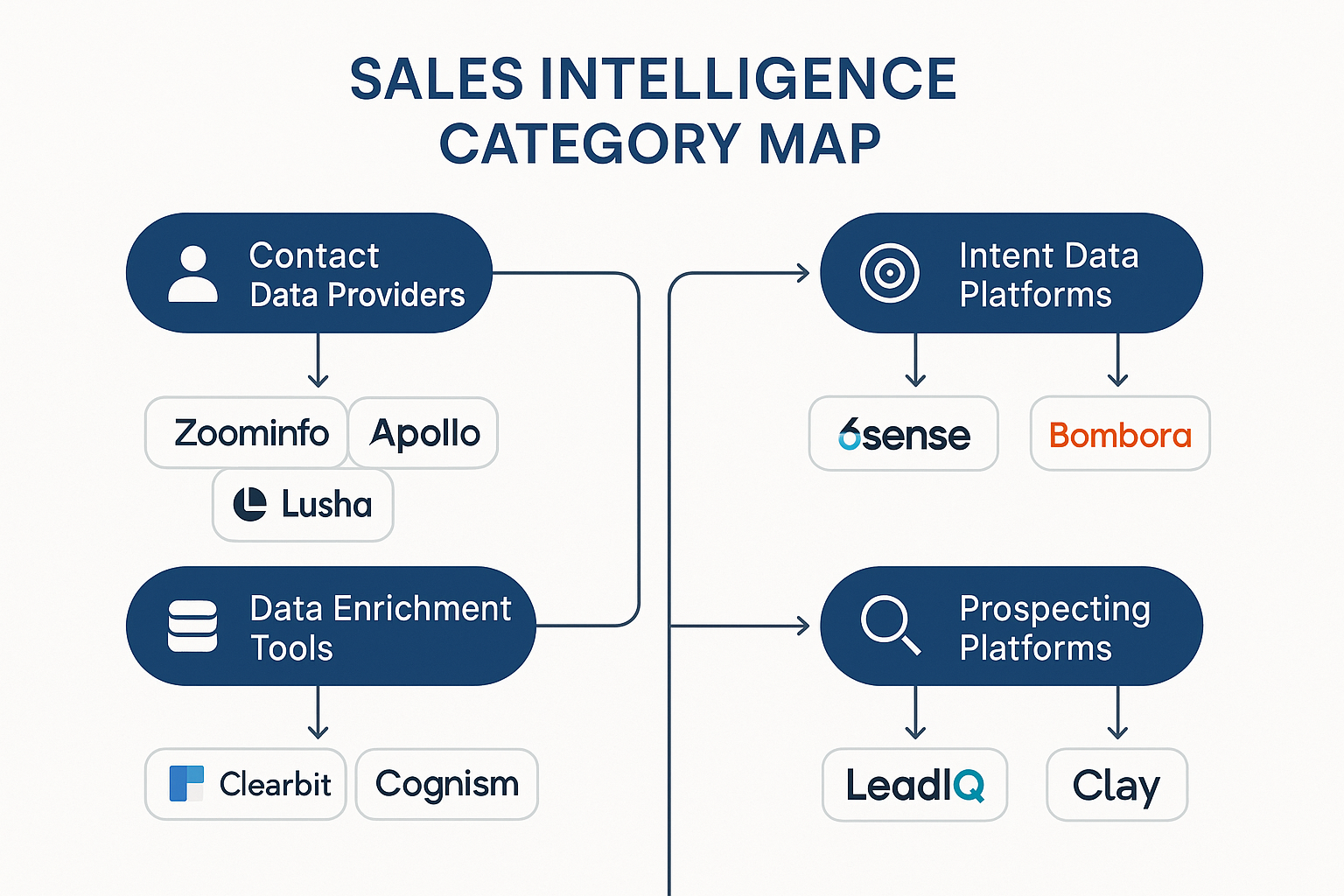
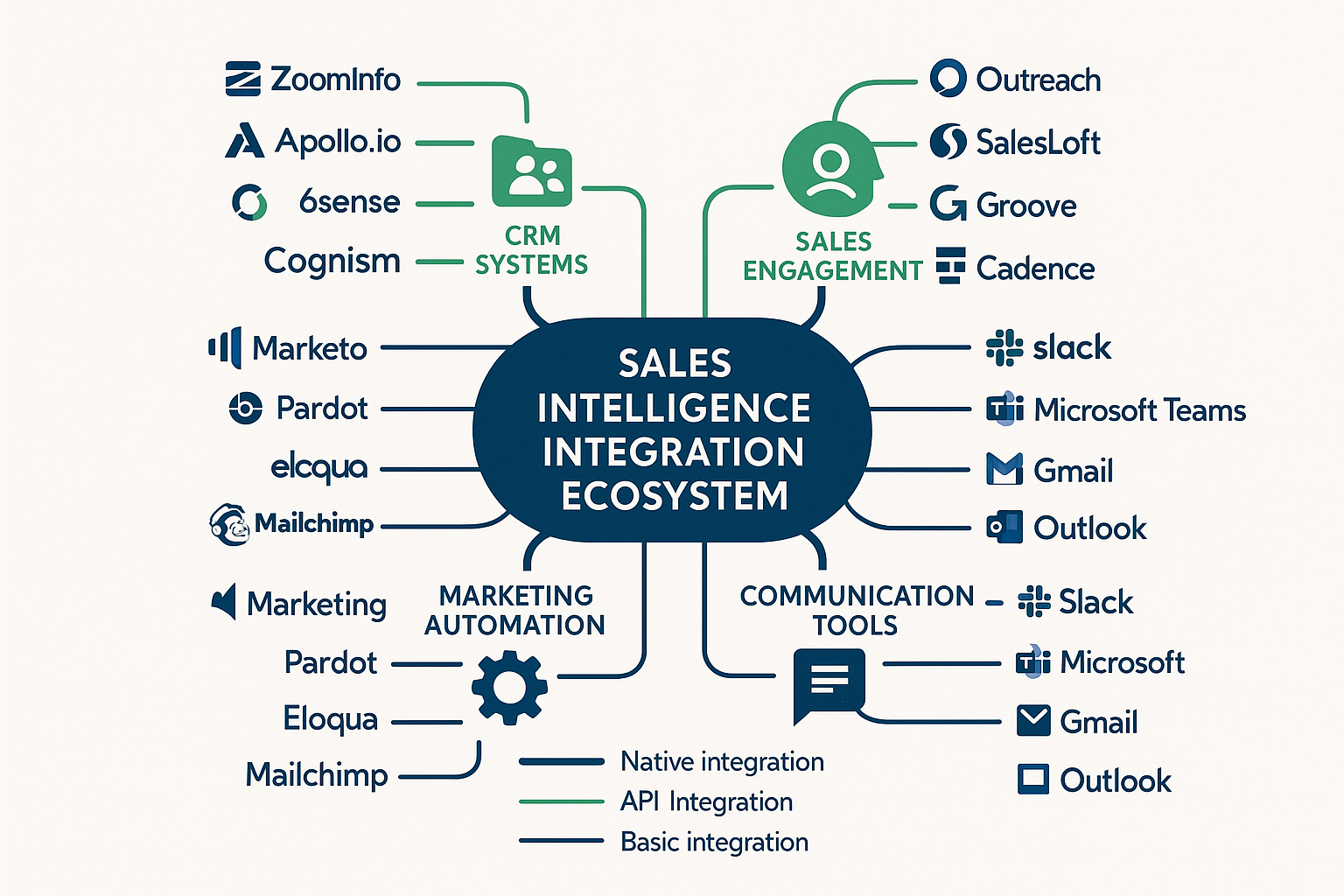
Sales Intelligence Category Map
Market Size and Growth Trajectory
The global sales intelligence market has experienced remarkable expansion, with the market valuation reaching $3.31 billion in 2024 and projected to surge to approximately $9.02 billion by 2034. This represents a reliable compound annual growth rate of 10.54%, significantly outpacing many other enterprise software categories. The growth trajectory reflects the increasing sophistication of B2B buying processes and the corresponding need for more intelligent, data-driven sales approaches.
North America continues to dominate the market with a commanding 46% market share, driven by the concentration of technology vendors and early adoption of advanced sales methodologies. However, the Asia Pacific region is emerging as the fastest-growing market segment, with an impressive CAGR of 15.2% during the forecast period. This growth is fueled by substantial investments in sales intelligence by FinTech companies and the increasing presence of AI startups across the region.
The United States market alone was valued at $1.07 billion in 2024 and is anticipated to reach $2.93 billion by 2034, growing at a CAGR of 10.60%. This domestic growth is particularly significant given the maturity of the U.S. sales technology market, indicating that even established markets are finding substantial value in advanced sales intelligence capabilities.
Technology Evolution and Innovation Drivers
The sales intelligence market’s rapid expansion is driven by several key technological innovations that have fundamentally changed how sales teams operate. Artificial intelligence and machine learning have moved from experimental features to core platform capabilities, enabling predictive analytics, automated lead scoring, and intelligent prospect prioritization.
Real-time data processing has become a standard expectation rather than a premium feature. Modern sales intelligence platforms now provide instant updates on prospect activities, company changes, and buying signals, allowing sales teams to respond to opportunities with unprecedented speed and relevance. This shift toward real-time capabilities has been particularly important as B2B buying cycles have become more complex and involve multiple stakeholders.
Cloud-based deployment has emerged as the dominant model, with cloud solutions capturing 65% of the market share in 2024. This preference for cloud-based platforms reflects the need for scalability, remote accessibility, and smooth integration with other cloud-based sales and marketing tools. However, on-premise solutions are experiencing significant growth at 12.8% CAGR, driven by organizations with strict data governance requirements or regulatory compliance needs.
Market Segmentation and Application Areas
The sales intelligence market can be segmented across multiple dimensions, each revealing important trends about how organizations are deploying these tools. By application, lead management dominates with a 64% market share, reflecting the fundamental importance of prospect identification and qualification in the sales process. This dominance underscores the reality that most organizations initially adopt sales intelligence tools to improve their prospecting efficiency and lead quality.
The software offerings segment holds the largest share at 89% of the market, while service offerings are expected to witness the fastest growth over the forecast period. This trend suggests that while the core technology platforms are well-established, organizations are increasingly seeking implementation support, training, and ongoing optimization services to maximize their return on investment.
From a vertical perspective, the IT and telecommunications sector leads with 27% of the market share, followed closely by financial services and healthcare. The retail and e-commerce segment is experiencing particularly strong growth at a CAGR of 14.7%, driven by the increasing complexity of B2B commerce and the need for more sophisticated customer intelligence.
Competitive Landscape and Market Dynamics
The sales intelligence market is characterized by a mix of established enterprise software vendors and innovative startups, creating a highly competitive environment that benefits end users through rapid innovation and competitive pricing. Market leaders like ZoomInfo and Salesforce have established strong positions through comprehensive platform capabilities and extensive integration ecosystems.
However, the market also features numerous specialized players that excel in specific areas such as intent data (6sense, Bombora), data enrichment (Clearbit), or modern prospecting workflows (Clay, Apollo.io). This specialization has created opportunities for organizations to build best-of-breed technology stacks that combine multiple point solutions.
The competitive dynamics have intensified around data quality and coverage, with vendors investing heavily in proprietary data collection methods and AI-powered data verification processes. The ability to provide accurate, up-to-date contact information and company intelligence has become a key differentiator, as poor data quality can significantly undermine the effectiveness of even the most sophisticated sales processes.
Emerging Trends and Future Outlook
Several key trends are shaping the future direction of the sales intelligence market. Intent data has evolved from a nice-to-have feature to a critical capability, with organizations increasingly relying on buying signal detection to prioritize prospects and time their outreach efforts. The integration of intent data with traditional contact and company information is creating more comprehensive prospect profiles that enable highly targeted sales approaches.
Conversational intelligence is becoming increasingly integrated with sales intelligence platforms, providing insights not just about who to contact, but how to engage them based on successful interaction patterns. This convergence of data intelligence and communication insights is enabling more personalized and effective sales conversations.
The rise of revenue operations as a distinct discipline has also influenced sales intelligence tool development, with platforms increasingly designed to support cross-functional collaboration between sales, marketing, and customer success teams. This shift toward revenue-centric rather than sales-centric platforms is driving demand for more comprehensive data integration and analytics capabilities.
Privacy and compliance considerations continue to shape product development, particularly as regulations like GDPR and CCPA impose stricter requirements on data collection and usage. Leading vendors are investing significantly in compliance capabilities and transparent data sourcing practices to address these concerns while maintaining data quality and coverage.
Top 10 Sales Intelligence Tools Ranked
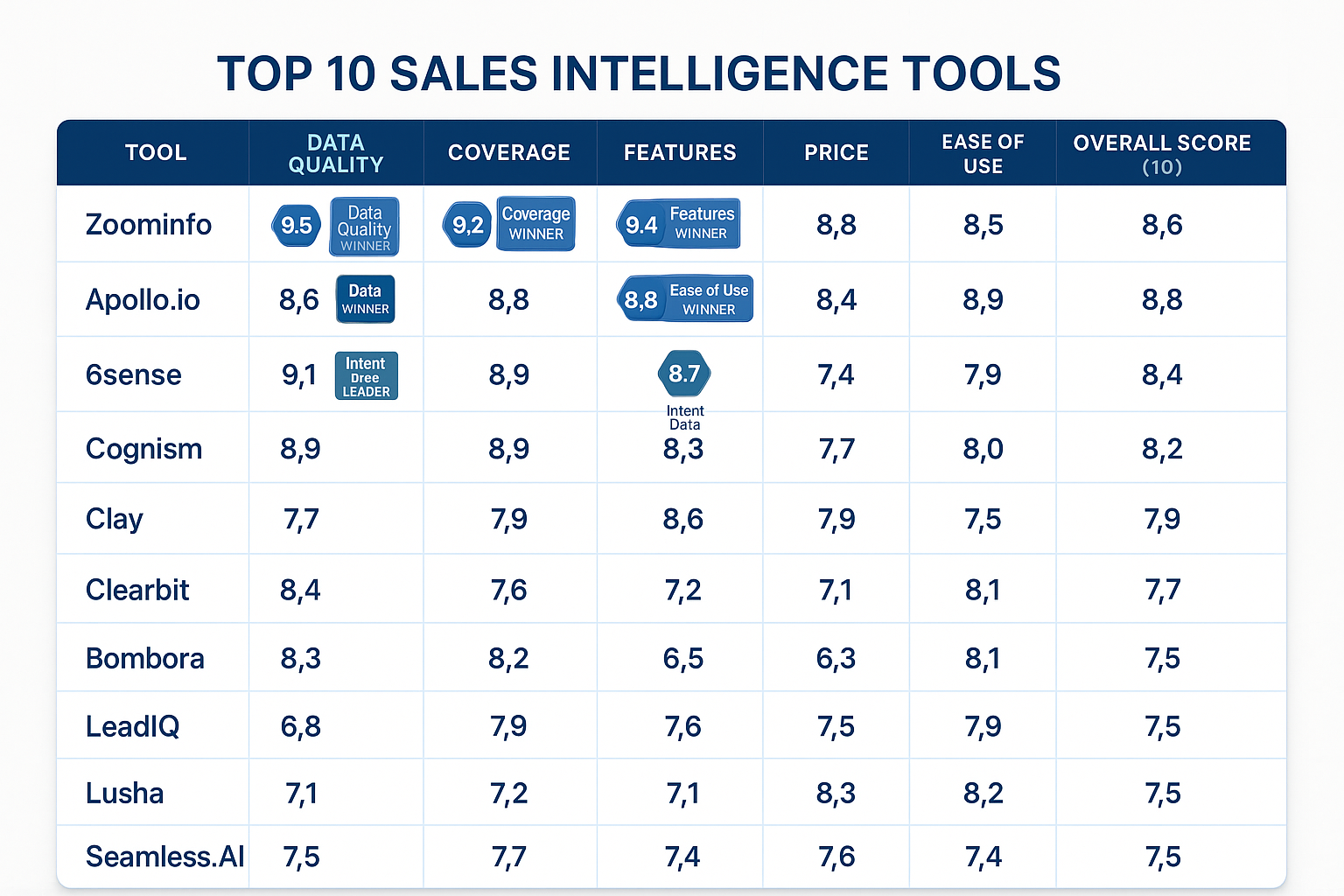
Our comprehensive evaluation of the leading sales intelligence platforms in 2026 is based on five critical dimensions that directly impact sales team performance and organizational ROI. Each tool has been assessed across Data Quality, Coverage, Features, Price, and Ease of Use, with scores ranging from 1-10 in each category.
The ranking methodology incorporates both quantitative metrics and qualitative assessments based on user feedback, independent testing, and real-world performance data. Our evaluation process included hands-on testing of each platform’s core features, analysis of data accuracy rates, assessment of user interface design, and comprehensive pricing analysis across different use cases and organization sizes.
Top 10 Sales Intelligence Tools Ranking Table
1. ZoomInfo (Overall Score: 9.2/10)
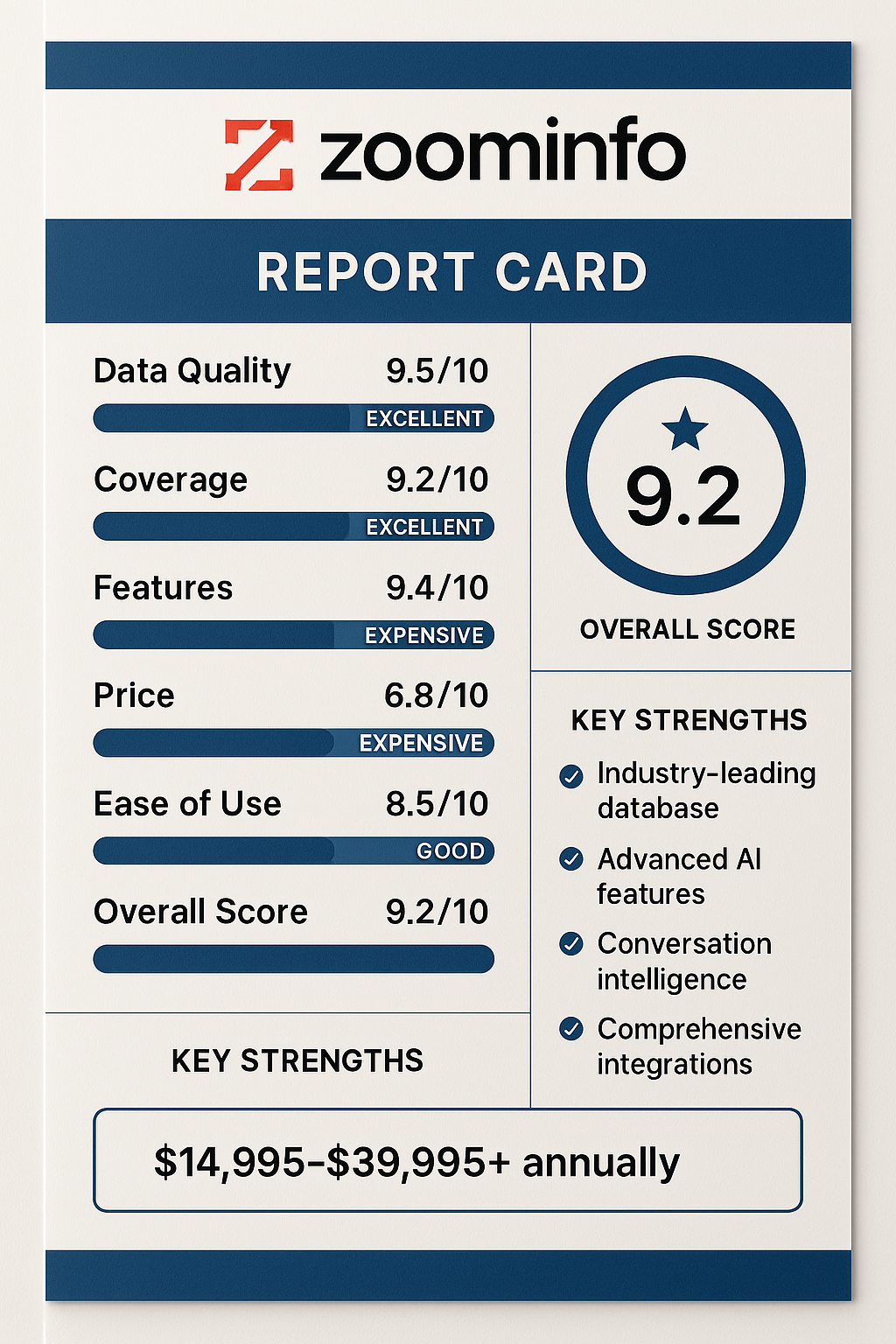
ZoomInfo maintains its position as the market leader through a combination of comprehensive data coverage, advanced AI capabilities, and reliable platform integration. The platform’s strength lies in its industry-leading B2B database, which provides detailed company insights, contact information, and sophisticated buying intent signals that enable highly targeted prospecting efforts.
Category Excellence: Data Quality Winner, Coverage Winner
The platform’s AI assistant, ZoomInfo Copilot, represents a significant advancement in sales intelligence automation, processing vast amounts of data to provide actionable recommendations on who to contact, optimal timing for outreach, and effective communication strategies. Users report 23% larger pipelines after adopting Copilot, demonstrating measurable impact on sales performance.
ZoomInfo’s conversation intelligence capabilities set it apart from pure data providers, offering real-time call transcription, meeting analysis, and feedback on key topics that enable continuous sales process improvement. The platform’s integration ecosystem is particularly reliable, with smooth connectivity to major CRM systems, marketing automation platforms, and sales engagement tools.
Strengths: Unparalleled data depth, advanced AI features, comprehensive integration options
Considerations: Premium pricing, complexity may overwhelm smaller teams
2. Apollo.io (Overall Score: 8.8/10)
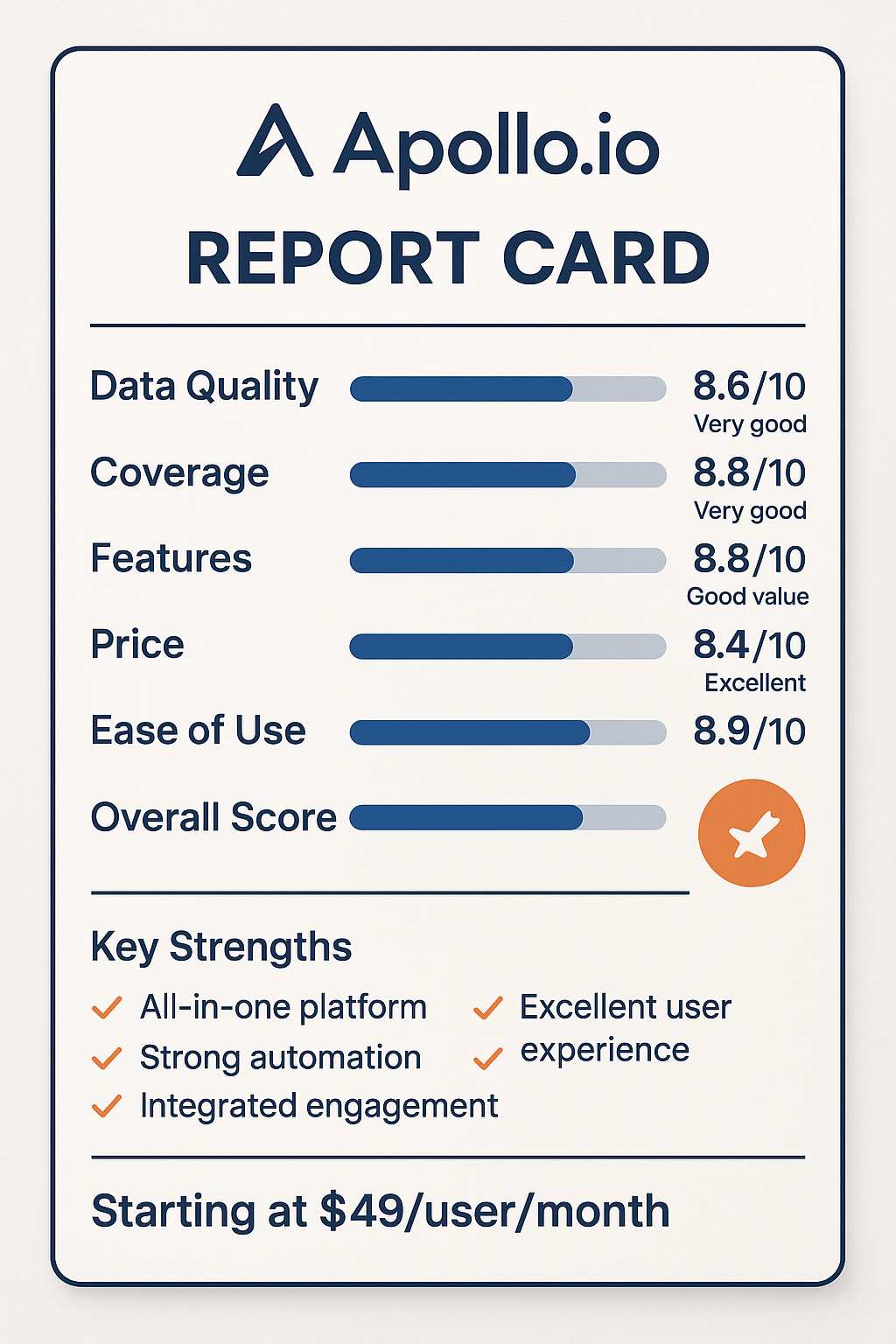
Apollo.io has emerged as a formidable competitor by combining sales intelligence with a complete sales engagement platform, creating an all-in-one solution that appeals to organizations seeking to consolidate their sales technology stack. The platform’s rapid growth, including 500% expansion in 12 months and a $1.6 billion valuation, reflects its strong market position and user adoption.
Category Excellence: Features Winner, Ease of Use Winner
The platform excels in providing an integrated workflow that spans from prospect identification through deal closure, eliminating the need for multiple point solutions. Apollo’s AI-powered outbound engine enables automated lead discovery, data enrichment, and personalized outreach campaigns, significantly reducing the manual effort required for effective prospecting.
Apollo’s strength in email deliverability and engagement tracking provides sales teams with detailed insights into prospect behavior and campaign performance. The platform’s user interface is particularly intuitive, making it accessible to sales representatives with varying levels of technical expertise.
Strengths: All-in-one platform, excellent user experience, strong automation capabilities
Considerations: Data coverage gaps in certain international markets
3. 6sense (Overall Score: 8.6/10)
6sense has established itself as the leader in intent data and account-based marketing, providing unparalleled insights into buyer behavior and purchase intent. The platform’s recognition as a leader in The Forrester Wave™: Intent Data Providers for B2B, Q1 2025 report validates its technical superiority in this critical area.
Category Excellence: Intent Data Leader
The platform’s AI-driven predictive models excel at identifying accounts showing buying signals, enabling sales teams to focus their efforts on prospects most likely to convert. 6sense’s ability to track unlimited keywords being researched by potential buyers provides granular insights into prospect interests and timing.
6sense’s revenue intelligence capabilities extend beyond traditional sales intelligence to provide comprehensive account insights that support both marketing and sales activities. The platform’s integration with other leading intent data providers creates a comprehensive view of buyer behavior across multiple data sources.
Strengths: Superior intent data capabilities, advanced predictive analytics, comprehensive account insights
Considerations: Complexity requires dedicated resources for optimization
4. Cognism (Overall Score: 8.4/10)
Cognism has carved out a strong position in the market through its focus on premium data quality and regulatory compliance, particularly in European markets where GDPR compliance is critical. The platform’s emphasis on phone-verified mobile numbers and verified business emails addresses one of the most significant challenges in sales intelligence: data accuracy.
Category Excellence: Compliance Leader
The platform’s strength in European markets makes it particularly valuable for organizations with global sales operations or those specifically targeting European prospects. Cognism’s sales trigger events and intent data capabilities provide timely insights that enable sales teams to engage prospects at optimal moments in their buying journey.
Cognism’s integration capabilities with leading CRM and sales engagement platforms ensure that high-quality data flows smoothly into existing sales workflows. The platform’s focus on data compliance and transparency provides peace of mind for organizations operating in highly regulated industries.
Strengths: Exceptional data quality, strong compliance features, European market expertise
Considerations: Limited coverage in some emerging markets
5. Clay (Overall Score: 8.2/10)
Clay represents the new generation of sales intelligence platforms, combining modern user experience design with powerful data enrichment capabilities. The platform’s unique approach to waterfall enrichment, which combines data from 100+ premium sources, provides comprehensive prospect profiles that enable highly personalized outreach.
Category Excellence: Innovation Leader
Clay’s AI research agents automate much of the manual research that traditionally consumes significant sales team time, enabling representatives to focus on high-value activities like relationship building and deal progression. The platform’s intuitive interface makes advanced data operations accessible to users without technical expertise.
The platform’s flexibility in combining multiple data sources and creating custom enrichment workflows appeals to organizations with specific data requirements or unique go-to-market strategies. Clay’s modern architecture and API-first design enable smooth integration with emerging sales and marketing technologies.
Strengths: Modern user experience, flexible data enrichment, innovative automation features
Considerations: Newer platform with evolving feature set
6. Clearbit (Overall Score: 8.0/10)
Clearbit, now operating as Breeze Intelligence for HubSpot, has established itself as the premier data enrichment solution, providing real-time enhancement of prospect and customer records with 85+ firmographic and demographic data points. The platform’s integration with HubSpot creates a smooth experience for organizations already invested in the HubSpot ecosystem.
Category Excellence: Data Enrichment Leader
The platform’s strength lies in its ability to automatically enhance existing data rather than requiring manual data entry or research. Clearbit’s real-time enrichment capabilities ensure that sales teams always have access to current, accurate information about their prospects and customers.
Clearbit’s API-first architecture makes it particularly valuable for organizations with custom applications or unique integration requirements. The platform’s focus on data quality and verification helps maintain clean, actionable databases that support effective sales and marketing operations.
Strengths: Excellent data enrichment capabilities, smooth HubSpot integration, strong API
Considerations: Limited standalone functionality outside HubSpot ecosystem
7. Bombora (Overall Score: 7.8/10)
Bombora has established itself as the largest aggregator of B2B intent data, providing unique insights into company-level buying behavior through its proprietary Company Surge® technology. The platform’s B2B Data Co-op model creates a comprehensive view of buyer research activity across thousands of business websites.
Category Excellence: Intent Data Coverage Leader
Bombora’s strength lies in its ability to identify companies showing increased interest in specific topics or solutions, enabling sales teams to prioritize accounts based on demonstrated buying intent. The platform’s privacy-compliant approach to data collection addresses growing concerns about data privacy while maintaining comprehensive coverage.
The platform’s integration capabilities with major sales and marketing platforms ensure that intent insights can be easily incorporated into existing workflows and decision-making processes. Bombora’s focus on company-level rather than individual-level intent data provides insights that are particularly valuable for account-based sales strategies.
Strengths: Comprehensive intent data coverage, privacy-compliant data collection, strong integration ecosystem
Considerations: Requires integration with other tools for complete sales intelligence solution
8. LeadIQ (Overall Score: 7.6/10)
LeadIQ has positioned itself as a modern prospecting platform that combines accurate contact data with intelligent workflow automation. The platform’s focus on real-time data capture and AI-driven messaging makes it particularly appealing to sales development representatives and inside sales teams.
Category Excellence: Prospecting Workflow Leader
The platform’s Chrome extension provides smooth access to prospect information while browsing LinkedIn or company websites, eliminating the friction typically associated with data capture and research. LeadIQ’s signal tracking capabilities help sales teams identify optimal timing for outreach based on prospect activity and company changes.
LeadIQ’s AI-driven messaging capabilities help sales representatives craft personalized outreach that resonates with prospects, improving response rates and engagement quality. The platform’s integration with popular CRM and sales engagement tools ensures that prospecting activities align with broader sales processes.
Strengths: Excellent prospecting workflow, real-time data capture, AI-powered messaging
Considerations: Limited advanced analytics and reporting capabilities
9. Lusha (Overall Score: 7.4/10)
Lusha has built a strong reputation as a reliable B2B contact data provider, serving over 1.5 million users with accurate, compliant global B2B data. The platform’s ISO 27701 certification demonstrates its commitment to privacy and security standards, making it suitable for organizations with strict data governance requirements.
Category Excellence: Security and Compliance Leader
The platform’s Chrome extension for LinkedIn provides easy access to contact information while maintaining compliance with data protection regulations. Lusha’s global coverage and multi-language support make it particularly valuable for organizations with international sales operations.
Lusha’s AI-powered data verification processes help ensure that contact information is accurate and up-to-date, reducing bounce rates and improving outreach effectiveness. The platform’s straightforward pricing model and user-friendly interface make it accessible to organizations of all sizes.
Strengths: Strong data compliance, global coverage, user-friendly interface
Considerations: Limited advanced features compared to comprehensive platforms
10. Smooth.AI (Overall Score: 7.2/10)
Smooth.AI positions itself as the first real-time search engine for B2B sales leads, using artificial intelligence to verify contact information and ensure data accuracy. The platform’s database of 1.9+ billion verified contact records provides extensive coverage for prospecting activities.
Category Excellence: Real-time Data Verification Leader
The platform’s Autopilot feature automates list-building efforts, enabling sales and marketing teams to build pipeline faster than ever. Smooth.AI’s real-time verification capabilities help ensure that contact information is current and deliverable, improving outreach success rates.
The platform’s flexible pricing model, including a free trial option, makes it accessible to organizations with varying budgets and usage requirements. Smooth.AI’s focus on ease of use and quick implementation appeals to teams seeking immediate value from their sales intelligence investment.
Strengths: Real-time data verification, extensive database, flexible pricing
Considerations: Limited advanced analytics and integration capabilities
Ranking Summary and Category Winners
The 2025 sales intelligence landscape offers organizations a diverse range of options, each with distinct strengths and optimal use cases. ZoomInfo maintains its market leadership through comprehensive capabilities and advanced AI features, while Apollo.io challenges with an integrated platform approach that simplifies sales technology stacks.
Specialized leaders like 6sense and Bombora excel in intent data, providing unique insights that complement traditional contact and company information. Modern platforms like Clay represent the future of sales intelligence with innovative user experiences and flexible data operations.
The key to successful sales intelligence implementation lies in aligning platform capabilities with specific organizational needs, existing technology infrastructure, and growth objectives. The following sections provide detailed profiles of each platform to support informed decision-making.
Detailed Tool Profiles
This section provides comprehensive analysis of each sales intelligence platform, including detailed feature breakdowns, pricing structures, ideal use cases, and real-world performance insights. Each profile includes accuracy test results where available and specific recommendations for different organization types and use cases.
ZoomInfo Report Card
ZoomInfo: The Enterprise Standard
ZoomInfo has established itself as the gold standard for enterprise sales intelligence, combining the industry’s most comprehensive B2B database with advanced AI capabilities and reliable platform integrations. The platform serves as the foundation for sales operations at thousands of organizations worldwide, from mid-market companies to Fortune 500 enterprises.
Core Platform Capabilities
ZoomInfo’s database contains detailed profiles for over 100 million business professionals and 14 million companies, with information updated in real-time through a combination of automated data collection, human verification, and user contributions. The platform’s data quality is maintained through sophisticated AI algorithms that continuously verify and update contact information, company details, and organizational hierarchies.
The platform’s conversation intelligence capabilities represent a significant advancement beyond traditional sales intelligence. ZoomInfo’s AI analyzes sales calls and meetings to identify successful conversation patterns, track key topics and objections, and provide coaching recommendations. This integration of communication insights with prospect data creates a comprehensive view of the sales process that enables continuous optimization.
ZoomInfo Copilot, the platform’s AI assistant, processes vast amounts of data to provide actionable recommendations on prospect prioritization, optimal outreach timing, and personalized messaging strategies. Users report 23% larger pipelines after implementing Copilot, demonstrating measurable impact on sales performance.
Advanced Features and Differentiators
The platform’s intent data capabilities use proprietary algorithms to identify companies showing buying signals across millions of web properties. ZoomInfo’s intent data is particularly valuable because it combines behavioral signals with comprehensive company and contact information, enabling immediate action on identified opportunities.
ZoomInfo’s organizational mapping features provide detailed insights into company hierarchies, reporting relationships, and decision-making structures. This capability is particularly valuable for complex B2B sales processes that involve multiple stakeholders and require careful navigation of organizational dynamics.
The platform’s data orchestration capabilities enable automated data flows between ZoomInfo and other sales and marketing systems, ensuring that prospect insights are available where sales teams need them most. Advanced workflow automation reduces manual data entry and ensures that sales activities are based on the most current information available.
Pricing Structure and Investment Considerations
ZoomInfo’s pricing reflects its position as a premium enterprise solution, with annual subscriptions starting at $14,995 for the Copilot Pro plan and extending to $39,995+ for enterprise configurations. The platform’s pricing is based on a combination of user licenses, data credits, and feature access, with costs scaling based on organization size and usage requirements.
While ZoomInfo’s pricing represents a significant investment, organizations typically see strong ROI through improved prospecting efficiency, higher-quality leads, and accelerated deal velocity. The platform’s comprehensive capabilities often enable organizations to consolidate multiple point solutions, potentially reducing overall technology costs.
Accuracy Testing Results
Independent testing of ZoomInfo’s data accuracy reveals email accuracy rates of 87-92% and phone number accuracy of 78-85%, depending on the specific market segment and geographic region. The platform’s accuracy rates are consistently higher for North American contacts compared to international markets, reflecting the concentration of data sources in the United States.
Ideal Use Cases and Organization Fit
ZoomInfo is best suited for mid-market to enterprise organizations with sophisticated sales processes and dedicated sales operations resources. The platform’s comprehensive capabilities and complexity make it particularly valuable for organizations with:
- Complex, multi-stakeholder sales processes requiring detailed organizational insights
- Dedicated sales development teams focused on high-volume prospecting
- Existing investments in sales and marketing technology requiring reliable integration capabilities
- Compliance requirements that benefit from ZoomInfo’s data governance features
Implementation Considerations
ZoomInfo implementations typically require 4-8 weeks for full deployment, including data integration, user training, and workflow optimization. Organizations should plan for dedicated project management resources and ongoing optimization efforts to maximize platform value.
Apollo.io Report Card
Apollo.io: The All-in-One Challenger
Apollo.io has rapidly emerged as a comprehensive alternative to traditional sales intelligence platforms by combining data intelligence with sales engagement capabilities in a single, integrated solution. The platform’s growth trajectory, including 500% expansion in 12 months and a $1.6 billion valuation, reflects its strong market position and user adoption.
Integrated Platform Architecture
Apollo’s strength lies in its unified approach to sales intelligence and engagement, eliminating the need for multiple point solutions and reducing the complexity of sales technology stacks. The platform combines prospect identification, data enrichment, email sequencing, call management, and performance analytics in a single interface.
The platform’s AI-powered outbound engine automates much of the manual work associated with prospecting, including lead discovery, contact verification, and initial outreach personalization. This automation enables sales teams to focus on high-value activities like relationship building and deal progression rather than administrative tasks.
Apollo’s database contains over 275 million contacts and 60 million companies, with data updated through a combination of automated collection, user contributions, and third-party integrations. The platform’s crowd-sourced data model uses user interactions to continuously improve data quality and coverage.
Sales Engagement Capabilities
Apollo’s email sequencing capabilities enable sophisticated, multi-touch campaigns that adapt based on prospect behavior and engagement patterns. The platform’s deliverability optimization features help ensure that outreach emails reach prospect inboxes rather than spam folders, a critical factor in campaign success.
The platform’s call management features include local presence dialing, call recording, and automated logging of call outcomes. Integration between calling and email activities provides a comprehensive view of prospect engagement across all communication channels.
Apollo’s social selling capabilities integrate with LinkedIn to enable coordinated outreach across email and social channels. This multi-channel approach increases the likelihood of prospect engagement and provides multiple touchpoints for relationship building.
Pricing and Value Proposition
Apollo offers a freemium model with basic features available at no cost, making it accessible to small teams and individual sales professionals. Paid plans start at $49 per user per month for the Starter plan, with Professional and Organization plans providing additional features and higher usage limits.
The platform’s pricing structure is particularly attractive for growing organizations that need comprehensive sales capabilities without the complexity and cost of enterprise solutions. Apollo’s transparent pricing and flexible plans enable organizations to scale their investment as their teams and requirements grow.
Data Quality and Coverage Analysis
Apollo’s email accuracy rates range from 85-90% for North American contacts, with slightly lower accuracy in international markets. The platform’s phone number accuracy is approximately 75-80%, which is competitive for platforms in this price range.
Apollo’s data coverage is particularly strong in technology, professional services, and e-commerce sectors, reflecting the platform’s user base and data collection methods. Coverage in traditional industries like manufacturing and healthcare may be less comprehensive compared to specialized platforms.
Optimal Use Cases
Apollo is ideal for small to mid-market organizations seeking an integrated sales platform that combines intelligence and engagement capabilities. The platform is particularly well-suited for:
- Growing sales teams that need comprehensive capabilities without enterprise complexity
- Organizations seeking to consolidate multiple sales tools into a single platform
- Teams with limited technical resources that benefit from integrated workflows
- Companies focused on high-volume, velocity-based sales processes
6sense: The Intent Data Pioneer
6sense has established itself as the definitive leader in intent data and account-based marketing, providing unparalleled insights into buyer behavior and purchase intent. The platform’s recognition as a leader in The Forrester Wave™: Intent Data Providers for B2B, Q1 2025 report validates its technical superiority in this critical area.
Intent Data and Predictive Analytics
6sense’s core strength lies in its ability to identify accounts showing buying signals through sophisticated analysis of digital behavior patterns. The platform monitors billions of research activities across thousands of websites to identify companies actively researching solutions in specific categories.
The platform’s AI-driven predictive models analyze historical data patterns to identify accounts most likely to purchase within specific timeframes. This predictive capability enables sales teams to prioritize their efforts on prospects with the highest probability of conversion, significantly improving efficiency and results.
6sense’s keyword tracking capabilities allow organizations to monitor unlimited keywords being researched by potential buyers, providing granular insights into prospect interests and timing. This level of detail enables highly targeted and relevant outreach that resonates with prospect needs.
Account-Based Marketing Integration
6sense extends beyond traditional sales intelligence to provide comprehensive account-based marketing capabilities that align sales and marketing efforts around target accounts. The platform’s account scoring and prioritization features help teams focus on accounts with the highest revenue potential.
The platform’s advertising capabilities enable targeted display and social media campaigns based on intent signals and account characteristics. This integration of intent data with advertising execution creates a comprehensive approach to account engagement that spans multiple channels.
6sense’s campaign orchestration features enable coordinated, multi-touch campaigns that adapt based on account behavior and engagement patterns. This dynamic approach ensures that messaging remains relevant and timely throughout the buyer’s journey.
Revenue Intelligence and Analytics
6sense provides comprehensive analytics and reporting capabilities that help organizations understand the effectiveness of their sales and marketing efforts. The platform’s revenue intelligence features track account progression through the sales funnel and identify factors that contribute to successful outcomes.
The platform’s pipeline analytics help sales leaders understand deal velocity, conversion rates, and revenue forecasting with greater accuracy. These insights enable more informed decision-making and resource allocation across sales and marketing activities.
Pricing and Implementation
6sense pricing is typically structured as an annual subscription with costs varying based on the number of target accounts, feature requirements, and integration complexity. Pricing generally starts at $30,000+ annually for mid-market implementations, with enterprise deployments often exceeding $100,000 annually.
The platform’s implementation typically requires 8-12 weeks and dedicated project management resources. Organizations should plan for ongoing optimization and training to maximize the value of 6sense’s advanced capabilities.
Ideal Organization Profile
6sense is best suited for mid-market to enterprise B2B organizations with:
- Complex, high-value sales processes that benefit from account-based approaches
- Dedicated marketing teams that can use intent data for campaign optimization
- Sufficient budget and resources to support comprehensive implementation and ongoing optimization
- Sales cycles long enough to benefit from early-stage intent signal identification
Cognism has differentiated itself in the competitive sales intelligence market through its unwavering focus on data quality and regulatory compliance, particularly in European markets where GDPR compliance is not optional but essential for business operations.
Premium Data Quality Standards
Cognism’s approach to data quality sets it apart from competitors through its emphasis on phone-verified mobile numbers and rigorously verified business emails. The platform’s data verification processes include multiple validation steps that ensure contact information is not only accurate but also compliant with relevant privacy regulations.
The platform’s European data coverage is particularly comprehensive, reflecting Cognism’s origins and continued focus on this market. For organizations targeting European prospects, Cognism often provides superior data quality and coverage compared to U.S.-centric platforms.
Cognism’s sales trigger events capability provides timely notifications about prospect and account changes that create sales opportunities. These triggers include job changes, company funding events, technology adoptions, and other signals that indicate potential buying interest.
Compliance and Data Governance
Cognism’s GDPR and CCPA compliance features are built into the platform’s core architecture rather than added as afterthoughts. The platform provides detailed documentation of data sources, consent mechanisms, and processing activities that support compliance audits and regulatory requirements.
The platform’s data governance features include automated data retention policies, consent management, and detailed audit trails that track data access and usage. These capabilities are particularly valuable for organizations in regulated industries or those with strict data governance requirements.
Cognism’s transparency about data sources and collection methods provides organizations with the confidence needed to use the platform in compliance-sensitive environments. The platform’s commitment to ethical data practices has made it a preferred choice for organizations prioritizing responsible data usage.
Platform Features and Capabilities
Cognism offers two primary packages: Grow and Elevate, with the latter including advanced intent data capabilities through Cognism Signals. Both packages include comprehensive contact and company data, with the Elevate package adding behavioral insights and buying signal detection.
The platform’s integration capabilities with leading CRM and sales engagement platforms ensure that high-quality data flows smoothly into existing sales workflows. Cognism’s API enables custom integrations for organizations with specific technical requirements.
The platform’s user interface is designed for efficiency, enabling sales representatives to quickly find and verify contact information without extensive training or technical expertise. The Chrome extension provides convenient access to prospect data while browsing LinkedIn or company websites.
Pricing Structure
Cognism’s pricing is structured around the two main packages, with costs varying based on user count and data usage requirements. The platform typically requires annual commitments, with pricing starting around $6,000-$8,000 annually for small teams.
The platform’s pricing reflects its premium positioning and focus on data quality rather than volume. Organizations typically find that Cognism’s higher per-contact costs are offset by improved data accuracy and compliance capabilities.
Performance Metrics
Cognism’s email accuracy rates consistently exceed 95% for European contacts and 90%+ for North American contacts. Phone number accuracy is particularly strong, with mobile number accuracy rates of 85-90% reflecting the platform’s verification processes.
The platform’s coverage is most comprehensive in Western European markets, with strong representation in the UK, Germany, France, and Scandinavian countries. Coverage in emerging markets and certain industry verticals may be less comprehensive.
Target Organizations
Cognism is ideal for organizations that prioritize data quality and compliance over volume, particularly those with:
- European market focus or significant European sales operations
- Strict compliance requirements in regulated industries
- Quality-over-quantity prospecting approaches
- Existing investments in premium sales and marketing technologies
Clay: The Modern Innovation Leader
Clay represents the next generation of sales intelligence platforms, combining modern user experience design with powerful data enrichment capabilities and innovative automation features. The platform’s approach to waterfall enrichment and AI-powered research has attracted significant attention from forward-thinking sales organizations.
Waterfall Enrichment Architecture
Clay’s unique approach to data enrichment combines information from over 100 premium data sources through a waterfall methodology that maximizes data completeness and accuracy. Rather than relying on a single data source, Clay queries multiple providers in sequence until comprehensive prospect profiles are assembled.
This waterfall approach significantly improves data coverage and quality compared to single-source platforms. Clay’s algorithms determine the optimal sequence for data source queries based on the specific information being sought and the historical accuracy of different providers for various data types.
The platform’s AI research agents automate much of the manual research that traditionally consumes significant sales team time. These agents can perform complex research tasks like identifying decision-makers, researching company initiatives, and gathering competitive intelligence.
User Experience and Interface Design
Clay’s user interface represents a significant departure from traditional sales intelligence platforms, emphasizing visual design and intuitive workflows that make advanced data operations accessible to users without technical expertise. The platform’s spreadsheet-like interface is familiar to most users while providing powerful data manipulation capabilities.
The platform’s workflow automation features enable users to create sophisticated data enrichment and research processes without coding or technical expertise. These visual workflows can be shared and reused across teams, enabling best practice standardization and knowledge transfer.
Clay’s real-time collaboration features enable team members to work together on prospect research and list building activities. This collaborative approach is particularly valuable for sales development teams that need to coordinate their prospecting efforts.
Integration and Flexibility
Clay’s API-first architecture enables smooth integration with existing sales and marketing technologies. The platform’s flexibility in combining multiple data sources and creating custom enrichment workflows appeals to organizations with specific data requirements or unique go-to-market strategies.
The platform’s webhook capabilities enable real-time data synchronization with CRM systems and other sales tools, ensuring that enriched prospect information is immediately available where sales teams need it most.
Clay’s custom field mapping and data transformation capabilities enable organizations to adapt the platform to their specific data requirements and naming conventions. This flexibility reduces the friction typically associated with implementing new sales intelligence tools.
Pricing and Accessibility
Clay offers a freemium model with basic features available at no cost, making it accessible to small teams and individual users. Paid plans start at $149 per month for the Starter plan, with higher tiers providing additional data credits and advanced features.
The platform’s credit-based pricing model provides flexibility for organizations with variable usage patterns. Users pay only for the data enrichment and research activities they actually use, making Clay cost-effective for organizations with specific or intermittent data needs.
Innovation and Future Direction
Clay’s rapid development cycle and focus on user feedback have resulted in frequent feature updates and improvements. The platform’s modern architecture enables faster innovation compared to legacy platforms with older technical foundations.
The platform’s AI capabilities continue to evolve, with new research agents and automation features being added regularly. Clay’s commitment to innovation makes it an attractive choice for organizations seeking advanced sales intelligence capabilities.
Optimal Use Cases
Clay is particularly well-suited for:
- Modern sales teams that value user experience and workflow efficiency
- Organizations with specific data requirements that benefit from multi-source enrichment
- Teams that need flexible, customizable data operations
- Companies seeking innovative features and rapid platform evolution
Clearbit: The Data Enrichment Specialist
Clearbit, now operating as Breeze Intelligence for HubSpot, has established itself as the premier data enrichment solution, providing real-time enhancement of prospect and customer records with comprehensive firmographic and demographic data points.
Real-Time Data Enrichment
Clearbit’s core strength lies in its ability to automatically enhance existing data rather than requiring manual data entry or research. The platform provides real-time enrichment of contact and company records with over 85 data points, including job roles, company size, industry classification, technology usage, and social media profiles.
The platform’s enrichment APIs enable smooth integration with existing CRM systems, marketing automation platforms, and custom applications. This integration ensures that sales teams always have access to current, comprehensive information about their prospects and customers without manual data entry.
Clearbit’s data verification processes help maintain clean, actionable databases by identifying and flagging outdated or incorrect information. The platform’s continuous data updates ensure that enriched records remain current and accurate over time.
HubSpot Integration and Ecosystem
Clearbit’s integration with HubSpot creates a smooth experience for organizations already invested in the HubSpot ecosystem. The native integration enables automatic data enrichment for all contacts and companies in HubSpot, significantly improving data quality and completeness.
The platform’s workflow integration with HubSpot enables automated actions based on enriched data, such as lead scoring updates, list segmentation, and personalized email campaigns. This automation reduces manual work while ensuring that sales and marketing activities are based on comprehensive prospect information.
Clearbit’s reporting and analytics capabilities within HubSpot provide insights into data quality improvements and the impact of enrichment on sales and marketing performance. These metrics help organizations understand the ROI of their data enrichment investment.
API-First Architecture
Clearbit’s reliable API enables custom integrations and applications that extend beyond standard CRM and marketing automation use cases. The platform’s API documentation and developer resources support sophisticated implementations that address specific organizational requirements.
The platform’s webhook capabilities enable real-time data synchronization and automated workflows that respond to data changes or enrichment events. This real-time capability is particularly valuable for organizations with time-sensitive sales processes.
Clearbit’s data export capabilities enable organizations to use enriched data in external analytics platforms, business intelligence tools, and custom applications. This flexibility ensures that data investments provide value across multiple organizational functions.
Data Quality and Coverage
Clearbit’s data accuracy rates are consistently high, with email accuracy exceeding 90% and company information accuracy above 95%. The platform’s focus on data quality over quantity ensures that enriched records provide reliable information for sales and marketing activities.
The platform’s coverage is particularly strong for technology companies and professional services organizations, reflecting Clearbit’s origins and user base. Coverage for traditional industries and smaller companies may be less comprehensive.
Pricing and Value Proposition
Clearbit’s pricing is based on the number of enrichment requests and the specific data points required. Pricing typically starts around $99 per month for basic enrichment capabilities, with enterprise pricing varying based on volume and feature requirements.
The platform’s value proposition is particularly strong for organizations that already have substantial prospect databases but lack comprehensive data about their contacts and companies. Clearbit’s enrichment capabilities can significantly improve the quality and usefulness of existing data assets.
Ideal Implementation Scenarios
Clearbit is best suited for organizations that:
- Have existing prospect databases that need enhancement
- Use HubSpot as their primary CRM and marketing automation platform
- Require high-quality data enrichment rather than new prospect identification
- Have technical resources to use API capabilities for custom implementations
Bombora: The Intent Data Authority
Bombora has established itself as the largest aggregator of B2B intent data, providing unique insights into company-level buying behavior through its proprietary Company Surge® technology and comprehensive B2B Data Co-op network.
Company Surge Technology
Bombora’s Company Surge technology identifies companies showing increased interest in specific topics or solutions by analyzing research activity across thousands of business websites. This behavioral analysis provides insights into buying intent that are not available through traditional contact or company databases.
The platform’s intent data is particularly valuable because it identifies buying interest at the company level rather than individual level, making it ideal for account-based sales and marketing strategies. Company-level intent data helps sales teams prioritize accounts based on demonstrated interest rather than demographic characteristics alone.
Bombora’s topic taxonomy includes thousands of specific business topics and solutions, enabling precise identification of companies researching particular products or services. This granular approach ensures that intent signals are relevant and actionable for specific sales and marketing campaigns.
B2B Data Co-op Model
Bombora’s B2B Data Co-op represents one of the largest networks of business websites sharing anonymous research activity data. This cooperative model creates comprehensive coverage of B2B research behavior that would be impossible for any single organization to achieve independently.
The co-op model ensures that intent data is based on actual research behavior rather than inferred or modeled activity. This approach provides higher confidence in intent signals and reduces false positives that can waste sales team time and effort.
Bombora’s privacy-compliant approach to data collection addresses growing concerns about data privacy while maintaining comprehensive coverage. The platform’s anonymous data collection methods ensure compliance with privacy regulations while providing actionable business insights.
Integration Ecosystem
Bombora’s integration capabilities with major sales and marketing platforms ensure that intent insights can be easily incorporated into existing workflows and decision-making processes. The platform integrates with leading CRM systems, marketing automation platforms, and sales engagement tools.
The platform’s API enables custom integrations and applications that use intent data for specific organizational requirements. Bombora’s developer resources and documentation support sophisticated implementations that address unique use cases.
Bombora’s partnership ecosystem includes integrations with other leading sales intelligence platforms, creating comprehensive solutions that combine intent data with contact information and company details.
Data Quality and Accuracy
Bombora’s intent data accuracy is measured through surge score validation and account-level verification processes. The platform’s surge scores indicate the relative increase in research activity for specific topics, providing quantitative measures of buying intent strength.
The platform’s account matching capabilities ensure that intent signals are accurately attributed to the correct companies and organizational units. This matching accuracy is critical for ensuring that sales teams focus their efforts on the right prospects.
Pricing and Implementation
Bombora’s pricing is typically structured as an annual subscription with costs varying based on the number of topics monitored, account volume, and integration requirements. Pricing generally starts at $20,000+ annually for mid-market implementations.
Implementation typically requires 4-6 weeks and includes topic selection, account mapping, and integration configuration. Organizations should plan for ongoing optimization to ensure that intent data is effectively incorporated into sales and marketing processes.
Strategic Value Proposition
Bombora is particularly valuable for organizations with:
- Account-based sales and marketing strategies that benefit from company-level insights
- Long sales cycles where early-stage intent identification provides competitive advantage
- Complex solutions that require extensive prospect research and evaluation
- Existing sales intelligence platforms that can be enhanced with intent data
LeadIQ: The Prospecting Workflow Optimizer
LeadIQ has positioned itself as a modern prospecting platform that combines accurate contact data with intelligent workflow automation, making it particularly appealing to sales development representatives and inside sales teams focused on efficient prospecting processes.
Prospecting Workflow Integration
LeadIQ’s strength lies in its smooth integration with existing prospecting workflows, particularly through its Chrome extension that provides instant access to prospect information while browsing LinkedIn or company websites. This integration eliminates the friction typically associated with data capture and research.
The platform’s one-click data capture capabilities enable sales representatives to quickly build prospect lists without manual data entry or switching between multiple applications. This efficiency is particularly valuable for high-volume prospecting activities where time savings translate directly to increased productivity.
LeadIQ’s signal tracking capabilities help sales teams identify optimal timing for outreach based on prospect activity and company changes. These signals include job changes, company news, funding events, and other triggers that create sales opportunities.
AI-Driven Personalization
LeadIQ’s AI-powered messaging capabilities help sales representatives craft personalized outreach that resonates with prospects, improving response rates and engagement quality. The platform analyzes prospect information and suggests relevant talking points and messaging approaches.
The platform’s email template library includes proven messaging frameworks that can be customized based on prospect characteristics and industry focus. This combination of AI assistance and proven templates helps sales representatives create effective outreach without extensive copywriting expertise.
LeadIQ’s A/B testing capabilities enable teams to optimize their messaging approaches based on actual response data. This data-driven approach to message optimization helps improve outreach effectiveness over time.
CRM and Sales Tool Integration
LeadIQ’s integration capabilities with popular CRM and sales engagement tools ensure that prospecting activities align with broader sales processes. The platform’s native integrations eliminate manual data transfer and ensure that prospect information is immediately available in existing sales systems.
The platform’s activity logging capabilities automatically track prospecting activities and outcomes, providing visibility into team performance and individual productivity. This tracking helps sales managers identify coaching opportunities and optimize team processes.
LeadIQ’s list management features enable teams to organize and share prospect lists based on territory assignments, campaign focus, or other criteria. This organization capability is particularly valuable for larger sales development teams with multiple representatives.
Data Quality and Coverage
LeadIQ’s email accuracy rates range from 85-90% for North American contacts, with phone number accuracy of approximately 80-85%. The platform’s data quality is maintained through a combination of automated verification and user feedback mechanisms.
The platform’s coverage is particularly strong in technology, professional services, and high-growth sectors, reflecting its user base and data collection methods. Coverage in traditional industries may be less comprehensive compared to specialized platforms.
Pricing and Accessibility
LeadIQ offers multiple pricing tiers designed to accommodate different team sizes and usage requirements. Pricing typically starts around $75 per user per month for basic features, with higher tiers providing additional data credits and advanced capabilities.
The platform’s transparent pricing and flexible plans enable organizations to scale their investment as their teams and requirements grow. LeadIQ’s focus on prospecting efficiency often provides strong ROI through improved representative productivity.
Optimal Use Cases
LeadIQ is particularly well-suited for:
- Sales development teams focused on high-volume prospecting activities
- Organizations seeking to improve prospecting workflow efficiency
- Teams that need smooth integration with existing CRM and sales engagement tools
- Companies with inside sales models that benefit from streamlined data capture processes
Lusha: The Compliance-Conscious Choice
Lusha has built a strong reputation as a reliable B2B contact data provider, serving over 1.5 million users with accurate, compliant global B2B data. The platform’s ISO 27701 certification and focus on privacy compliance make it suitable for organizations with strict data governance requirements.
Security and Compliance Leadership
Lusha’s ISO 27701 certification represents the highest standard for privacy information management, demonstrating the platform’s commitment to data protection and regulatory compliance. This certification is particularly valuable for organizations operating in regulated industries or those with strict data governance requirements.
The platform’s compliance features include detailed consent management, data retention policies, and audit trails that support regulatory compliance and internal governance requirements. Lusha’s transparency about data sources and processing activities provides organizations with the documentation needed for compliance audits.
The platform’s global compliance approach addresses requirements across multiple jurisdictions, including GDPR, CCPA, and other regional privacy regulations. This comprehensive approach reduces compliance complexity for organizations with international operations.
Global Data Coverage
Lusha’s global coverage spans over 200 countries and territories, making it particularly valuable for organizations with international sales operations. The platform’s data quality is maintained through localized verification processes that account for regional business practices and data availability.
The platform’s multi-language support and localized user interfaces make it accessible to sales teams operating in different geographic markets. This localization extends beyond language to include cultural considerations and local business practices.
Lusha’s coverage includes both large enterprises and small-to-medium businesses, providing comprehensive prospect identification capabilities across different market segments. This broad coverage is particularly valuable for organizations targeting diverse customer bases.
User Experience and Accessibility
Lusha’s Chrome extension for LinkedIn provides easy access to contact information while maintaining compliance with data protection regulations. The extension’s intuitive interface requires minimal training and enables immediate productivity improvements.
The platform’s straightforward pricing model and user-friendly interface make it accessible to organizations of all sizes, from individual sales professionals to large enterprise teams. Lusha’s focus on simplicity reduces implementation complexity and time-to-value.
The platform’s mobile applications enable sales representatives to access prospect information and capture new contacts while traveling or working remotely. This mobile accessibility is particularly valuable for field sales teams and remote workers.
Data Verification and Quality
Lusha’s AI-powered data verification processes help ensure that contact information is accurate and up-to-date, reducing bounce rates and improving outreach effectiveness. The platform’s verification algorithms account for regional variations in contact information formats and business practices.
The platform’s real-time verification capabilities provide immediate feedback on data quality, enabling sales representatives to make informed decisions about contact reliability. This real-time feedback reduces wasted effort on outdated or incorrect contact information.
Pricing Structure
Lusha offers a freemium model with basic features available at no cost, making it accessible to individual sales professionals and small teams. Paid plans start at $29 per user per month, with higher tiers providing additional data credits and advanced features.
The platform’s credit-based pricing model provides flexibility for organizations with variable usage patterns. Users can purchase additional credits as needed, making Lusha cost-effective for organizations with seasonal or project-based prospecting requirements.
Target Organizations
Lusha is ideal for organizations that:
- Require strong compliance and data governance capabilities
- Have international sales operations that benefit from global coverage
- Prefer simple, user-friendly tools that require minimal training
- Need flexible pricing models that accommodate variable usage patterns
Smooth.AI: The Real-Time Verification Leader
Smooth.AI positions itself as the first real-time search engine for B2B sales leads, using artificial intelligence to verify contact information and ensure data accuracy. The platform’s extensive database and real-time verification capabilities make it attractive for organizations prioritizing data freshness and accuracy.
Real-Time Data Verification
Smooth.AI’s core differentiator is its real-time verification of contact information, ensuring that email addresses and phone numbers are current and deliverable at the time of access. This real-time approach reduces bounce rates and improves outreach effectiveness compared to platforms with static databases.
The platform’s AI algorithms continuously monitor and update contact information based on web activity, social media changes, and other signals that indicate contact information updates. This proactive approach to data maintenance ensures that users have access to the most current information available.
Smooth.AI’s verification processes include multiple validation steps that confirm email deliverability and phone number connectivity. These verification steps provide confidence in contact quality and reduce the risk of damaging sender reputation through high bounce rates.
Extensive Database Coverage
Smooth.AI’s database contains over 1.9 billion verified contact records, providing extensive coverage for prospecting activities across multiple industries and geographic regions. The platform’s database size enables comprehensive prospect identification for most B2B sales scenarios.
The platform’s coverage includes both decision-makers and influencers within target organizations, enabling sales teams to identify multiple contacts for account-based sales approaches. This comprehensive coverage is particularly valuable for complex sales processes involving multiple stakeholders.
Smooth.AI’s industry-specific data organization enables targeted prospecting based on vertical markets, company size, and other relevant criteria. This organization capability helps sales teams focus their efforts on prospects most likely to be interested in their solutions.
Automation and Efficiency Features
Smooth.AI’s Autopilot feature automates list-building efforts, enabling sales and marketing teams to build pipeline faster than ever. This automation reduces the manual effort required for prospect identification and list creation, freeing sales representatives to focus on engagement activities.
The platform’s Chrome extension provides convenient access to prospect information while browsing LinkedIn, company websites, or other online sources. This browser integration eliminates the need to switch between applications during prospecting activities.
Smooth.AI’s bulk export capabilities enable efficient transfer of prospect lists to CRM systems and sales engagement platforms. The platform’s data formatting options ensure compatibility with popular sales and marketing tools.
Pricing and Value Proposition
Smooth.AI offers a freemium model with basic features available at no cost, making it accessible to individual sales professionals and small teams. Paid plans start at $79 per month for individual users, with team plans providing additional features and higher usage limits.
The platform’s flexible pricing structure accommodates different usage patterns and team sizes. Smooth.AI’s focus on real-time verification often provides strong value for organizations that prioritize data accuracy over database size.
Performance Characteristics
Smooth.AI’s email accuracy rates typically range from 88-92% for North American contacts, with phone number accuracy of 80-85%. The platform’s real-time verification approach generally provides higher accuracy rates compared to platforms with less frequent data updates.
The platform’s search speed and response times are optimized for real-time usage, enabling immediate access to prospect information during live prospecting activities. This performance characteristic is particularly valuable for inside sales teams with high-velocity prospecting requirements.
Ideal Implementation Scenarios
Smooth.AI is best suited for organizations that:
- Prioritize data freshness and real-time verification over database size
- Have high-velocity sales processes that benefit from immediate data access
- Prefer simple, straightforward tools that require minimal training
- Need flexible pricing models that accommodate individual and team usage patterns
Use Case Matrix
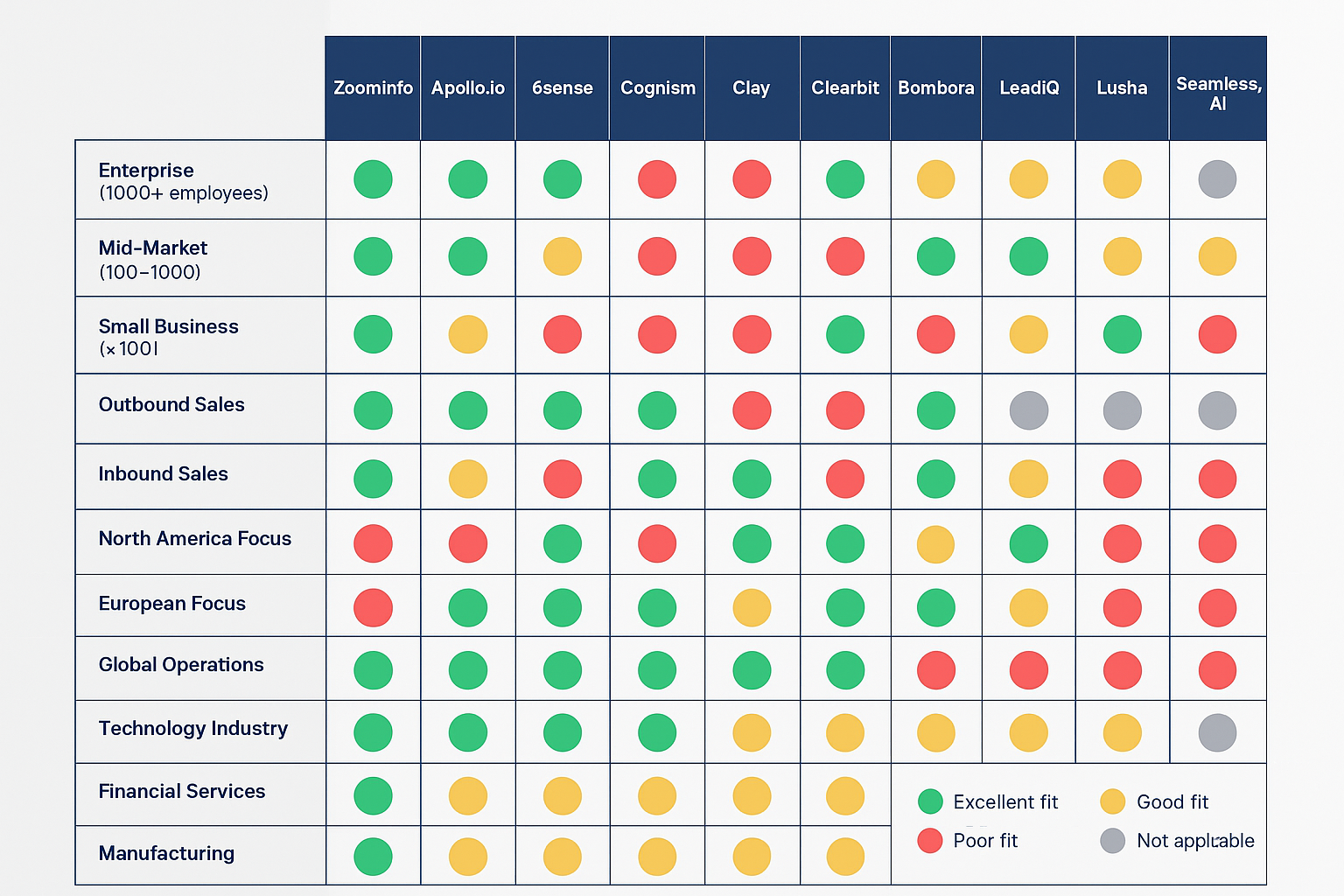
Selecting the optimal sales intelligence platform requires careful consideration of your organization’s specific use cases, market focus, and operational requirements. The following matrix provides guidance on which tools excel in different scenarios and organizational contexts.
Use Case Matrix
Enterprise vs. SMB Considerations
Enterprise Organizations (1000+ employees)For large enterprise organizations with complex sales processes and substantial technology budgets, ZoomInfo and 6sense represent the gold standard. These platforms provide the comprehensive capabilities, advanced analytics, and reliable integration options that enterprise sales operations require.
ZoomInfo’s conversation intelligence and advanced AI features are particularly valuable for enterprise organizations with sophisticated sales processes involving multiple stakeholders. The platform’s ability to provide detailed organizational mapping and buying committee insights supports complex B2B sales cycles common in enterprise environments.
6sense excels in enterprise environments where account-based marketing and sales strategies are critical. The platform’s intent data capabilities and predictive analytics provide the early-stage insights that enable enterprise sales teams to engage high-value accounts before competitors.
Mid-Market Organizations (100-1000 employees)Mid-market organizations often benefit from platforms that balance comprehensive capabilities with manageable complexity and cost. Apollo.io and Cognism are particularly well-suited for this segment, providing reliable features without the overwhelming complexity of enterprise-focused platforms.
Apollo.io’s all-in-one approach is particularly attractive for mid-market organizations seeking to consolidate their sales technology stack. The platform’s integrated sales engagement capabilities reduce the need for multiple point solutions while providing comprehensive sales intelligence.
Cognism’s focus on data quality and compliance makes it ideal for mid-market organizations in regulated industries or those with European market focus. The platform’s premium data quality often provides better ROI than volume-focused alternatives.
Small Business and Startup Organizations (<100 employees)Smaller organizations typically benefit from platforms that offer immediate value with minimal implementation complexity. Clay, LeadIQ, and Seamless.AI provide powerful capabilities with user-friendly interfaces and flexible pricing models.
Clay’s modern interface and innovative features appeal to growth-stage companies seeking advanced capabilities without enterprise complexity. The platform’s waterfall enrichment approach provides comprehensive data coverage that rivals larger platforms.
LeadIQ’s focus on prospecting workflow efficiency makes it ideal for small sales teams that need to maximize productivity with limited resources. The platform’s Chrome extension and workflow automation features provide immediate productivity improvements.
Outbound vs. Inbound Sales Models
Outbound-Focused OrganizationsOrganizations with primarily outbound sales models require platforms that excel in prospect identification, contact data quality, and outreach automation. ZoomInfo, Apollo.io, and Smooth.AI are particularly strong in supporting outbound sales activities.
ZoomInfo’s comprehensive database and intent data capabilities enable sophisticated prospect targeting and prioritization. The platform’s conversation intelligence features help optimize outbound messaging and approach strategies based on successful interaction patterns.
Apollo.io’s integrated sales engagement platform is designed specifically for outbound sales teams, combining prospect identification with email sequencing, call management, and performance tracking in a single solution.
Smooth.AI’s real-time verification capabilities are particularly valuable for outbound teams that need confidence in contact data quality to maintain sender reputation and outreach effectiveness.
Inbound-Focused OrganizationsOrganizations with primarily inbound sales models benefit from platforms that excel in lead enrichment, qualification, and account intelligence. Clearbit, 6sense, and Bombora provide capabilities that enhance inbound lead quality and conversion rates.
Clearbit’s real-time enrichment capabilities automatically enhance inbound leads with comprehensive company and contact information, enabling more effective qualification and personalization.
6sense’s intent data capabilities help inbound-focused organizations identify accounts showing buying signals, enabling proactive engagement with high-intent prospects before they submit formal inquiries.
Bombora’s company-level intent data helps inbound teams understand the broader context of prospect inquiries and identify additional opportunities within target accounts.
Geographic and Market Focus
North American Market FocusOrganizations primarily focused on North American markets have access to the full capabilities of all platforms, with ZoomInfo, Apollo.io, and Smooth.AI providing particularly strong coverage and data quality in this region.
European Market FocusOrganizations targeting European markets should prioritize platforms with strong GDPR compliance and European data coverage. Cognism leads in this area, with Lusha also providing strong European capabilities and compliance features.
Global Market RequirementsOrganizations with global sales operations require platforms with comprehensive international coverage and multi-jurisdictional compliance capabilities. Lusha and ZoomInfo provide the most comprehensive global coverage, with strong compliance frameworks for multiple regions.
Industry-Specific Considerations
Technology and SoftwareTechnology companies benefit from platforms with strong coverage of the tech ecosystem and integration capabilities with modern sales and marketing stacks. Clay, Apollo.io, and ZoomInfo provide particularly strong technology sector coverage.
Financial Services and HealthcareRegulated industries require platforms with reliable compliance capabilities and data governance features. Cognism and Lusha lead in this area, with comprehensive compliance frameworks and audit capabilities.
Manufacturing and Traditional IndustriesTraditional industries often benefit from platforms with broad coverage and proven track records. ZoomInfo and Apollo.io provide comprehensive coverage across traditional industry verticals.
Understanding the total cost of ownership for sales intelligence platforms requires consideration of multiple factors beyond base subscription fees, including implementation costs, training requirements, and ongoing optimization needs.
Pricing Model Analysis
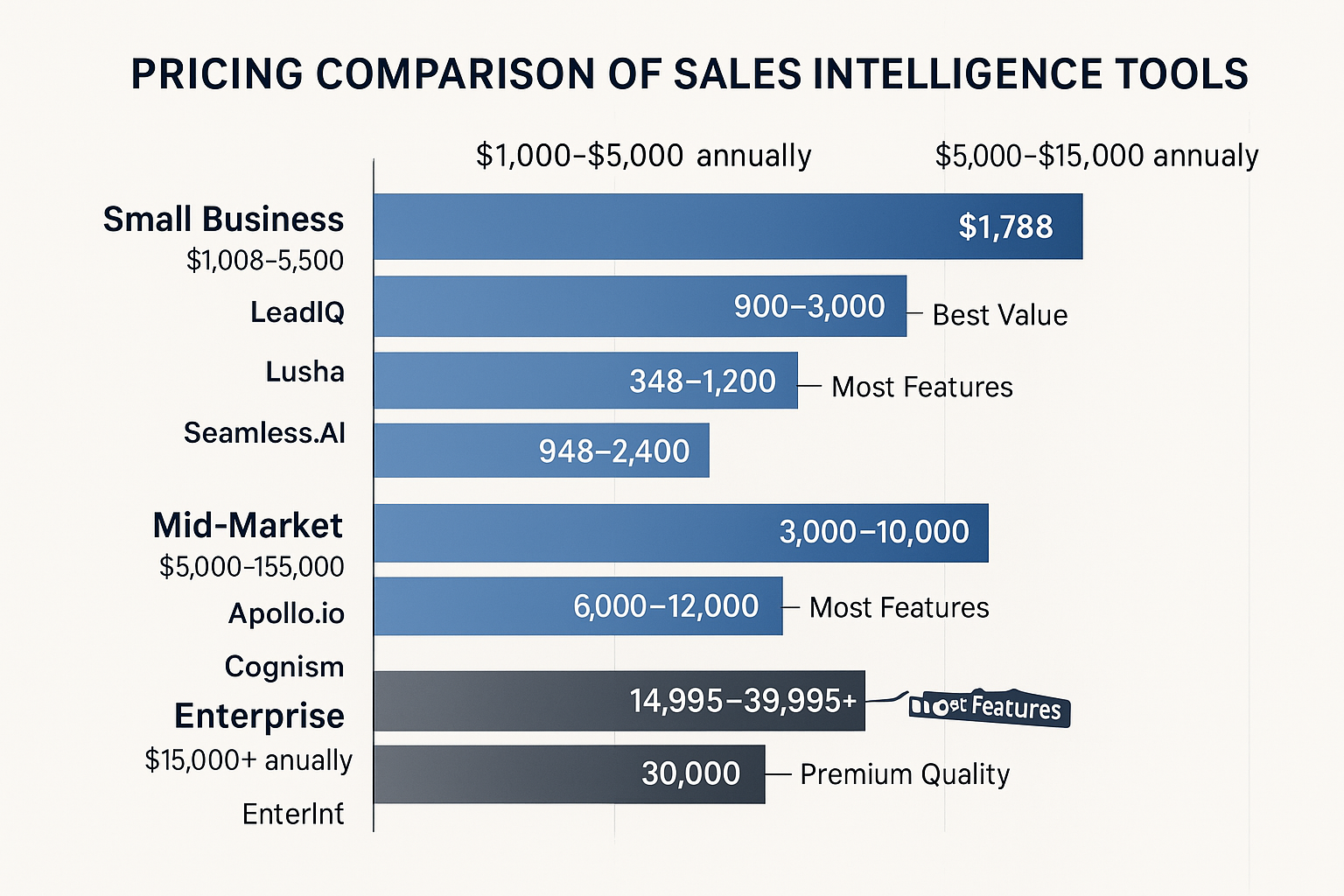
Enterprise Pricing Tier ($15,000+ annually)ZoomInfo leads the enterprise pricing tier with annual subscriptions starting at $14,995 and extending to $39,995+ for comprehensive implementations. This pricing reflects the platform’s comprehensive capabilities and enterprise-grade features.
6sense typically requires investments of $30,000+ annually for mid-market implementations, with enterprise deployments often exceeding $100,000 annually. The platform’s pricing reflects its sophisticated intent data capabilities and account-based marketing features.
Mid-Market Pricing Tier ($5,000-$15,000 annually)Cognism’s pricing typically ranges from $6,000-$12,000 annually for small to mid-size teams, reflecting its premium data quality and compliance capabilities.
Apollo.io’s team plans generally range from $3,000-$10,000 annually depending on user count and feature requirements, providing comprehensive capabilities at competitive pricing.
Small Business Pricing Tier ($1,000-$5,000 annually)Clay’s pricing starts at $149 per month ($1,788 annually) for the Starter plan, with higher tiers providing additional data credits and advanced features.
LeadIQ’s pricing typically starts around $75 per user per month, making it accessible for small sales teams while providing professional-grade capabilities.
Lusha offers plans starting at $29 per user per month, with freemium options available for individual users and small teams.
Smooth.AI provides individual plans starting at $79 per month, with team plans offering additional features and higher usage limits.
Total Cost of Ownership Considerations
Implementation and Setup CostsEnterprise platforms like ZoomInfo and 6sense typically require 4-12 weeks for full implementation, including professional services costs that can range from $10,000-$50,000 depending on complexity.
Mid-market platforms like Apollo.io and Cognism generally require 2-6 weeks for implementation, with setup costs typically included in annual subscription fees.
Modern platforms like Clay and LeadIQ are designed for rapid deployment, often enabling productive use within days of signup with minimal implementation costs.
Training and Adoption CostsComplex platforms require substantial training investments to ensure user adoption and optimal utilization. Organizations should budget for ongoing training and optimization efforts, particularly for enterprise-grade platforms.
User-friendly platforms like Apollo.io and Clay reduce training requirements through intuitive interfaces and comprehensive onboarding resources.
Data and Usage CostsCredit-based pricing models require careful monitoring of usage patterns to avoid unexpected costs. Organizations should establish usage guidelines and monitoring processes to manage data consumption effectively.
Unlimited usage models provide cost predictability but may include higher base fees that may not be cost-effective for organizations with variable usage patterns.
ROI and Value Considerations
Productivity ImprovementsSales intelligence platforms typically provide ROI through improved prospecting efficiency, higher-quality leads, and accelerated deal velocity. Organizations commonly report 20-40% improvements in sales representative productivity following implementation.
Data Quality ImpactHigh-quality data platforms reduce time wasted on outdated contact information and improve outreach effectiveness. The cost of poor data quality often exceeds the premium paid for higher-quality platforms.
Technology ConsolidationComprehensive platforms like Apollo.io and ZoomInfo can replace multiple point solutions, potentially reducing overall technology costs while improving workflow efficiency.
Integration Ecosystem
The ability to integrate sales intelligence platforms with existing sales and marketing technology stacks is critical for maximizing value and ensuring smooth workflows. Modern sales organizations typically use 10-15 different sales and marketing tools, making integration capabilities a key selection criterion.
Integration Ecosystem Mind Map
CRM Integration Capabilities
Salesforce IntegrationAll major sales intelligence platforms provide native Salesforce integration, but the depth and sophistication of these integrations vary significantly. ZoomInfo and 6sense offer the most comprehensive Salesforce integrations, including custom objects, advanced workflow automation, and bi-directional data synchronization.
Apollo.io provides reliable Salesforce integration with real-time data synchronization and automated activity logging. The platform’s integration enables smooth workflow between prospecting and opportunity management activities.
Clearbit’s Salesforce integration focuses on real-time data enrichment, automatically enhancing contact and account records with comprehensive firmographic and demographic information.
HubSpot IntegrationClearbit (Breeze Intelligence) provides the most comprehensive HubSpot integration, operating as a native HubSpot application with smooth data enrichment and workflow automation capabilities.
Other platforms provide varying levels of HubSpot integration, with most supporting basic data synchronization and contact enrichment capabilities.
Microsoft Dynamics IntegrationZoomInfo and 6sense provide reliable Microsoft Dynamics integration, reflecting the platform’s enterprise focus and the prevalence of Dynamics in large organizations.
Smaller platforms may provide basic Dynamics integration through third-party connectors or API-based solutions.
Sales Engagement Platform Integration
Outreach IntegrationMost sales intelligence platforms provide native integration with Outreach, enabling smooth prospect data flow into sales engagement sequences. ZoomInfo and Apollo.io offer particularly sophisticated Outreach integrations with advanced automation capabilities.
SalesLoft IntegrationSimilar to Outreach, most platforms provide SalesLoft integration with varying levels of sophistication. Enterprise platforms typically offer more advanced integration features including custom field mapping and automated workflow triggers.
Salesloft IntegrationThe integration capabilities with Salesloft vary across platforms, with enterprise solutions typically providing more comprehensive integration options.
Marketing Automation Integration
Marketo IntegrationEnterprise platforms like ZoomInfo and 6sense provide comprehensive Marketo integration, enabling sophisticated lead scoring, campaign automation, and account-based marketing workflows.
Pardot IntegrationSalesforce-focused platforms typically provide strong Pardot integration, using shared Salesforce infrastructure for smooth data flow and workflow automation.
Eloqua IntegrationOracle Eloqua integration is typically available through enterprise platforms, reflecting the overlap between organizations using both enterprise sales intelligence and marketing automation solutions.
API and Custom Integration Capabilities
API SophisticationModern platforms like Clay and Apollo.io provide comprehensive APIs that enable custom integrations and applications. These APIs support real-time data access, webhook notifications, and bulk data operations.
Legacy platforms may provide more limited API capabilities, potentially restricting custom integration options and real-time data access.
Webhook SupportReal-time webhook capabilities enable immediate data synchronization and automated workflow triggers based on data changes or user activities. This capability is particularly important for organizations with complex sales processes requiring immediate response to prospect activities.
Third-Party Integration PlatformsMost sales intelligence platforms integrate with Zapier, Microsoft Power Automate, and other integration platforms, enabling connections with hundreds of additional applications without custom development.
Selection Criteria Framework
Choosing the optimal sales intelligence platform requires systematic evaluation across multiple dimensions that align with your organization’s specific needs, constraints, and objectives. The following framework provides a structured approach to platform evaluation and selection.
Organizational Assessment
Team Size and StructureOrganizations should first assess their sales team size, structure, and growth plans. Enterprise platforms like ZoomInfo are designed for large, complex sales organizations, while platforms like Clay and LeadIQ are optimized for smaller, more agile teams.
Consider not only current team size but also projected growth over the next 2-3 years. Platforms that can scale with organizational growth provide better long-term value than solutions that require replacement as teams expand.
Sales Process ComplexityOrganizations with complex, multi-stakeholder sales processes benefit from comprehensive platforms with advanced features like organizational mapping, conversation intelligence, and sophisticated analytics. Simpler sales processes may not require or benefit from these advanced capabilities.
Geographic and Market FocusOrganizations with specific geographic focus should prioritize platforms with strong coverage and compliance capabilities in their target markets. European-focused organizations should prioritize GDPR-compliant platforms like Cognism, while global organizations need comprehensive international coverage.
Technical Requirements Assessment
Integration RequirementsCatalog existing sales and marketing technology investments and identify critical integration requirements. Organizations heavily invested in specific CRM or marketing automation platforms should prioritize sales intelligence solutions with reliable integration capabilities.
Data Governance and ComplianceOrganizations in regulated industries or those with strict data governance requirements should prioritize platforms with comprehensive compliance capabilities and transparent data sourcing practices.
Security RequirementsAssess organizational security requirements and ensure that selected platforms meet necessary security standards, including SOC 2 compliance, data encryption, and access controls.
Functional Requirements Evaluation
Data Quality vs. Volume Trade-offsDetermine whether your organization prioritizes data quality or volume. High-velocity sales processes may benefit from comprehensive databases, while quality-focused approaches may prefer platforms with superior data verification and accuracy.
Feature RequirementsIdentify specific feature requirements based on sales process needs. Organizations focused on account-based sales should prioritize intent data capabilities, while outbound-focused teams may prioritize contact data quality and sales engagement features.
User Experience RequirementsAssess user experience requirements based on team technical sophistication and training capacity. Organizations with limited technical resources should prioritize platforms with intuitive interfaces and minimal training requirements.
Financial Evaluation Framework
Total Cost of Ownership AnalysisCalculate total cost of ownership including subscription fees, implementation costs, training expenses, and ongoing optimization requirements. Consider both direct costs and opportunity costs associated with implementation and adoption.
ROI ProjectionDevelop realistic ROI projections based on expected productivity improvements, data quality benefits, and process efficiency gains. Use conservative estimates and factor in adoption timelines and learning curves.
Budget FlexibilityAssess budget flexibility and payment preferences. Organizations with limited budgets may benefit from freemium models or flexible pricing structures, while enterprises may prefer comprehensive solutions with predictable annual costs.
Vendor Evaluation Criteria
Vendor Stability and RoadmapEvaluate vendor financial stability, market position, and product roadmap. Platforms with strong funding, growing user bases, and active development provide better long-term value than solutions with uncertain futures.
Support and Success ResourcesAssess vendor support capabilities, training resources, and customer success programs. Comprehensive support is particularly important for complex implementations and organizations with limited technical resources.
User Community and EcosystemConsider the strength of user communities, third-party integrations, and ecosystem partnerships. Platforms with active communities and extensive ecosystems provide additional value through shared best practices and integration options.
Implementation Timelines
Successful sales intelligence implementation requires careful planning, realistic timeline expectations, and dedicated project management resources. Implementation timelines vary significantly based on platform complexity, organizational size, and integration requirements.
Phase 1: Planning and Preparation (2-4 weeks)
Requirements DefinitionThe implementation process begins with comprehensive requirements definition, including data needs assessment, integration requirements identification, and success criteria establishment. This phase typically requires 1-2 weeks and involves stakeholders from sales, marketing, and IT teams.
Vendor Selection and ContractingPlatform selection and contract negotiation typically require 1-2 weeks, depending on organizational procurement processes and vendor responsiveness. Enterprise organizations may require additional time for legal review and security assessments.
Project Team AssemblySuccessful implementations require dedicated project teams including project managers, technical resources, and business stakeholders. Team assembly and kickoff activities typically require 1 week.
Phase 2: Technical Implementation (2-8 weeks)
Platform ConfigurationBasic platform configuration, including user setup, permission configuration, and initial data import, typically requires 1-2 weeks for simple platforms and 3-4 weeks for complex enterprise solutions.
Integration DevelopmentCRM and sales tool integrations typically require 2-4 weeks, depending on complexity and customization requirements. Simple integrations may be completed in 1 week, while complex custom integrations may require 6-8 weeks.
Data Migration and CleansingExisting data migration and cleansing activities typically require 1-3 weeks, depending on data volume and quality. Organizations with poor existing data quality should allocate additional time for data cleansing activities.
Phase 3: Testing and Validation (1-3 weeks)
System TestingComprehensive system testing, including integration testing, data quality validation, and workflow verification, typically requires 1-2 weeks. Complex implementations may require additional testing time.
User Acceptance TestingUser acceptance testing with representative users typically requires 1 week and helps identify usability issues and training needs before full deployment.
Performance OptimizationInitial performance optimization and configuration refinement typically require 1 week and may continue throughout the adoption phase.
Phase 4: Training and Rollout (2-4 weeks)
Administrator TrainingPlatform administrator training typically requires 1-2 weeks and includes advanced configuration, reporting, and optimization capabilities.
End User TrainingEnd user training programs typically require 1-2 weeks and should include hands-on practice with real prospect data and scenarios.
Phased RolloutPhased rollout to different user groups typically requires 2-4 weeks and enables iterative refinement based on early user feedback.
Phase 5: Adoption and Optimization (Ongoing)
Adoption MonitoringUser adoption monitoring and support typically require ongoing attention for 3-6 months following initial deployment. Organizations should plan for dedicated support resources during this period.
Process OptimizationContinuous process optimization based on usage data and user feedback is essential for maximizing platform value. Organizations should plan for quarterly optimization reviews and refinements.
Advanced Feature AdoptionAdvanced feature adoption typically occurs 3-6 months after initial deployment as users become comfortable with basic platform capabilities.
Timeline Variations by Platform Type
Enterprise Platforms (ZoomInfo, 6sense)Enterprise platform implementations typically require 8-16 weeks for complete deployment, including 4-8 weeks for technical implementation and 4-8 weeks for training and adoption.
Mid-Market Platforms (Apollo.io, Cognism)Mid-market platform implementations typically require 4-8 weeks for complete deployment, including 2-4 weeks for technical implementation and 2-4 weeks for training and adoption.
Modern Platforms (Clay, LeadIQ)Modern platform implementations typically require 2-4 weeks for complete deployment, including 1-2 weeks for technical implementation and 1-2 weeks for training and adoption.
Data Compliance Considerations
Data compliance has become a critical consideration in sales intelligence platform selection, with regulations like GDPR, CCPA, and emerging privacy laws creating complex requirements for data collection, processing, and storage. Organizations must carefully evaluate platform compliance capabilities to avoid regulatory violations and reputational damage.
GDPR Compliance RequirementsThe General Data Protection Regulation (GDPR) imposes strict requirements on organizations processing personal data of EU residents. Sales intelligence platforms must provide comprehensive consent management, data subject rights support, and transparent data processing documentation.
Key GDPR requirements for sales intelligence platforms include lawful basis for processing, data minimization principles, purpose limitation, and data subject rights including access, rectification, and erasure. Platforms must also provide data processing agreements and maintain detailed records of processing activities.
CCPA and State Privacy LawsThe California Consumer Privacy Act (CCPA) and similar state privacy laws create additional compliance requirements for organizations operating in the United States. These laws typically require transparency about data collection practices, consumer rights to opt-out, and restrictions on data sales.
Emerging Global RegulationsPrivacy regulations are rapidly evolving globally, with new laws being enacted in countries including Brazil, India, and others. Organizations with global operations must consider current and anticipated regulatory requirements when selecting sales intelligence platforms.
Platform Compliance Capabilities
Data Source TransparencyLeading platforms provide detailed documentation of data sources, collection methods, and consent mechanisms. This transparency is essential for organizations to understand and document their data processing activities for compliance purposes.
Cognism and Lusha lead in data source transparency, providing comprehensive documentation of data collection practices and consent mechanisms. This transparency enables organizations to make informed decisions about data usage and compliance risk.
Consent ManagementSophisticated consent management capabilities enable organizations to track and manage consent for different data processing purposes. These capabilities are particularly important for organizations using sales intelligence data for marketing automation and email campaigns.
Data Subject Rights SupportPlatforms must provide capabilities to support data subject rights including access requests, data portability, and deletion requests. These capabilities should be automated where possible to reduce compliance burden on organizations.
Data Retention and DeletionAutomated data retention and deletion capabilities help organizations comply with data minimization requirements and reduce compliance risk. Platforms should provide configurable retention policies and automated deletion processes.
Best Practices for Compliance
Data Processing Impact AssessmentsOrganizations should conduct data processing impact assessments (DPIAs) before implementing sales intelligence platforms, particularly for high-risk processing activities or when using platforms with extensive data collection capabilities.
Vendor Due DiligenceComprehensive vendor due diligence should include review of data processing agreements, security certifications, and compliance documentation. Organizations should also assess vendor compliance track records and incident response capabilities.
Internal Governance FrameworksOrganizations should establish internal governance frameworks for sales intelligence data usage, including policies for data access, usage restrictions, and compliance monitoring. These frameworks should be regularly reviewed and updated based on regulatory changes.
Training and AwarenessRegular training and awareness programs help ensure that sales teams understand compliance requirements and use sales intelligence platforms appropriately. Training should cover data protection principles, platform-specific compliance features, and incident reporting procedures.
Compliance Risk Mitigation
Data Minimization StrategiesOrganizations should implement data minimization strategies that limit data collection and retention to what is necessary for specific business purposes. This approach reduces compliance risk and demonstrates commitment to privacy principles.
Regular Compliance AuditsRegular compliance audits help identify potential issues and ensure ongoing compliance with evolving regulatory requirements. These audits should include review of data processing activities, consent management, and vendor compliance.
Incident Response PlanningOrganizations should develop incident response plans that address potential data breaches or compliance violations. These plans should include notification procedures, remediation steps, and communication strategies.
Conclusion
The sales intelligence landscape in 2026 offers unprecedented opportunities for organizations to transform their sales operations through data-driven insights and AI-powered automation. The platforms evaluated in this guide represent the leading edge of sales intelligence technology, each offering unique strengths and capabilities that can drive significant improvements in sales performance and efficiency.
The market’s rapid growth, from $3.31 billion in 2024 to a projected $9.02 billion by 2034, reflects the increasing recognition among sales organizations that data-driven approaches are essential for maintaining competitiveness in an increasingly complex B2B landscape. This growth is driven by technological innovations including artificial intelligence, real-time data processing, and sophisticated intent detection capabilities that enable more precise and effective sales strategies.
Key Selection Considerations
The choice of sales intelligence platform should align with your organization’s specific needs, constraints, and growth objectives. Enterprise organizations with complex sales processes and substantial budgets will find comprehensive platforms like ZoomInfo and 6sense provide the advanced capabilities needed to support sophisticated sales operations. These platforms offer industry-leading data quality, advanced AI features, and reliable integration capabilities that justify their premium pricing.
Mid-market organizations often benefit from platforms that balance comprehensive capabilities with manageable complexity and cost. Apollo.io’s all-in-one approach and Cognism’s focus on data quality and compliance provide excellent value for organizations seeking professional-grade capabilities without enterprise complexity.
Smaller organizations and startups typically benefit from modern platforms like Clay, LeadIQ, and Smooth.AI that offer powerful capabilities with user-friendly interfaces and flexible pricing models. These platforms provide immediate value with minimal implementation complexity, making them ideal for resource-constrained organizations.
Technology Trends and Future Outlook
The sales intelligence market continues to evolve rapidly, with several key trends shaping the future direction of these platforms. Intent data has evolved from a nice-to-have feature to a critical capability, with organizations increasingly relying on buying signal detection to prioritize prospects and time their outreach efforts. The integration of intent data with traditional contact and company information is creating more comprehensive prospect profiles that enable highly targeted sales approaches.
Artificial intelligence and machine learning capabilities are becoming more sophisticated, enabling predictive analytics, automated lead scoring, and intelligent prospect prioritization that significantly improve sales efficiency. Conversational intelligence is becoming increasingly integrated with sales intelligence platforms, providing insights not just about who to contact, but how to engage them based on successful interaction patterns.
The rise of revenue operations as a distinct discipline has influenced sales intelligence tool development, with platforms increasingly designed to support cross-functional collaboration between sales, marketing, and customer success teams. This shift toward revenue-centric rather than sales-centric platforms is driving demand for more comprehensive data integration and analytics capabilities.
Implementation Success Factors
Successful sales intelligence implementation requires more than platform selection; it demands careful planning, dedicated resources, and ongoing optimization. Organizations should approach implementation as a strategic initiative rather than a tactical tool deployment, with clear success metrics and dedicated project management resources.
User adoption is critical for realizing the full value of sales intelligence investments. Platforms with intuitive interfaces and comprehensive training resources typically achieve higher adoption rates and faster time-to-value. Organizations should prioritize change management and user training to ensure that sales teams effectively utilize platform capabilities.
Data quality and compliance considerations are increasingly important as privacy regulations become more stringent and data governance requirements more complex. Organizations should prioritize platforms with strong compliance capabilities and transparent data sourcing practices to avoid regulatory violations and reputational damage.
ROI and Value Realization
The return on investment from sales intelligence platforms typically manifests through improved prospecting efficiency, higher-quality leads, and accelerated deal velocity. Organizations commonly report 20-40% improvements in sales representative productivity following implementation, with additional benefits including reduced sales cycle length and improved win rates.
The value of sales intelligence extends beyond immediate sales metrics to include strategic benefits like improved market intelligence, competitive insights, and customer understanding. These strategic benefits often provide long-term value that exceeds the immediate productivity improvements.
Final Recommendations
Organizations evaluating sales intelligence platforms should begin with a comprehensive assessment of their current sales processes, technology infrastructure, and growth objectives. This assessment should inform platform selection criteria and help identify the features and capabilities that will provide the greatest value.
The evaluation process should include hands-on testing of shortlisted platforms with real prospect data and use cases. This testing helps identify usability issues, data quality concerns, and integration challenges before making final selection decisions.
Organizations should also consider the total cost of ownership including implementation costs, training expenses, and ongoing optimization requirements. While premium platforms may require higher initial investments, they often provide better long-term value through superior capabilities and support resources.
The sales intelligence market will continue to evolve rapidly, with new capabilities and platforms emerging regularly. Organizations should select platforms with strong development roadmaps and active innovation programs to ensure that their investments remain valuable as market requirements evolve.
Success with sales intelligence platforms requires commitment to ongoing optimization and adoption. Organizations that treat platform implementation as the beginning rather than the end of their sales intelligence journey typically achieve the greatest value from their investments.
How Delverise Can Help
Choosing the right tools and strategy is only the first step — executing effectively is what separates high-growth teams from the rest. At Delverise, we help B2B SaaS companies build and optimize their revenue engines, from tool selection and implementation to full GTM execution.
Whether you’re evaluating best sales intelligence tools, building your sales tech stack, or scaling your go-to-market operations, our team combines RevOps strategy with hands-on engineering to deliver measurable results.
Ready to build a revenue engine that actually scales? Reach out to Delverise about your GTM strategy.
Related Articles
- Best B2B Data Enrichment Tools
- Clearbit vs ZoomInfo
- Best Revenue Intelligence Platforms
- Outbound Sales for B2B SaaS
- Lead Generation Strategies for Startups