The B2B data intelligence landscape underwent a seismic shift in 2026, fundamentally changing how sales operations, demand generation leaders, and RevOps teams approach prospect identification and customer enrichment. With Clearbit’s acquisition by HubSpot and transformation into Breeze Intelligence, and ZoomInfo’s continued expansion of its comprehensive sales intelligence platform, the Clearbit vs ZoomInfo decision has never been more critical for organizations seeking maximum return on investment from their data providers.
For sales operations professionals focused on pipeline efficiency, demand generation leaders driving qualified lead acquisition, and RevOps teams optimizing the entire customer journey, choosing the right B2B data provider directly impacts conversion rates, sales velocity, and ultimately, revenue growth. Recent industry data shows that companies using advanced sales intelligence tools see an average 25% lift in lead conversion rates, turning this into a strategic business decision rather than a simple software choice.
This analysis examines six dimensions that most directly influence ROI: data quality and accuracy, database coverage and reach, feature capabilities and functionality, pricing transparency and total cost of ownership, integration ecosystem compatibility, and data freshness protocols. Using detailed testing, third-party verification, and real-world case studies, we provide a definitive, ROI-focused guide for B2B organizations evaluating Clearbit vs ZoomInfo in 2026.
The stakes have never been higher. With data decay rates accelerating due to job mobility and organizational restructuring, the quality and freshness of your B2B data now directly correlate with outreach effectiveness and sales productivity. Making the wrong choice risks not only wasted spend but also long-term competitive disadvantages as your GTM operations fall behind more data-driven competitors.
The 2025 B2B Data Intelligence Landscape: A Transformed Market
The B2B data provider market in 2026 has reached a point of maturity where differentiation is no longer about who has the biggest database—it’s about who delivers the smartest, most actionable intelligence. The shift from quantity-driven contact lists to quality-first, AI-enhanced intelligence platforms has transformed how revenue teams evaluate, buy, and implement data solutions.
Clearbit’s evolution into HubSpot’s Breeze Intelligence marks one of the most significant industry shakeups in recent memory. By embedding itself deeply within HubSpot’s ecosystem, Clearbit has moved beyond simply delivering contact data—it now powers smooth workflow automation, turning enrichment into a native part of a company’s go-to-market motion. This move mirrors the wider market trend toward platform consolidation, where data providers are no longer standalone tools but essential building blocks of integrated GTM tech stacks.
ZoomInfo, meanwhile, continues to double down on its position as the comprehensive sales intelligence platform. Beyond its 200M+ contact database, ZoomInfo has expanded its offering to include intent signals, technographic insights, and advanced sales automation features. Its strategy is clear: become the command center for revenue teams, supporting every stage of the process—from first touch to closed-won deal.
These divergent approaches create distinct value propositions for different organizational profiles. Companies already running on HubSpot often find Clearbit’s native integration and unified data model a compelling advantage, streamlining implementation and reducing operational friction. On the other hand, teams seeking standalone flexibility, multi-platform compatibility, and extensive API support frequently lean toward ZoomInfo’s more open ecosystem.
Recognizing these strategic positioning differences is critical. Your choice between Clearbit vs ZoomInfo isn’t just a tool selection—it’s a reflection of your company’s philosophy on tech stack consolidation, data ownership, and GTM execution strategy.
Data Quality Comparison: Accuracy, Verification, and Real-World Performance
Data Accuracy Comparison
In the Clearbit vs ZoomInfo debate, nothing matters more than data quality. Accurate, up-to-date information is the bedrock of every B2B sales and marketing motion — from prospecting and lead scoring to outreach and pipeline forecasting. Get it right, and your team moves faster, books more meetings, and closes more deals. Get it wrong, and you burn time, budgets, and trust.
Our analysis reveals clear differences in how each platform approaches data verification and accuracy. Clearbit (now Breeze Intelligence) leans on its multi-source enrichment model, cross-checking data across premium providers to boost coverage and reduce stale contacts. ZoomInfo, on the other hand, relies on its proprietary database, refreshed continuously through web scraping, user contributions, and AI-driven validation.
Both strategies have merit—but they deliver different outcomes in terms of coverage, confidence scores, and how quickly new data hits your CRM. Understanding these nuances is essential for any team serious about ROI from its B2B data provider.
Accuracy Metrics and Third-Party Verification
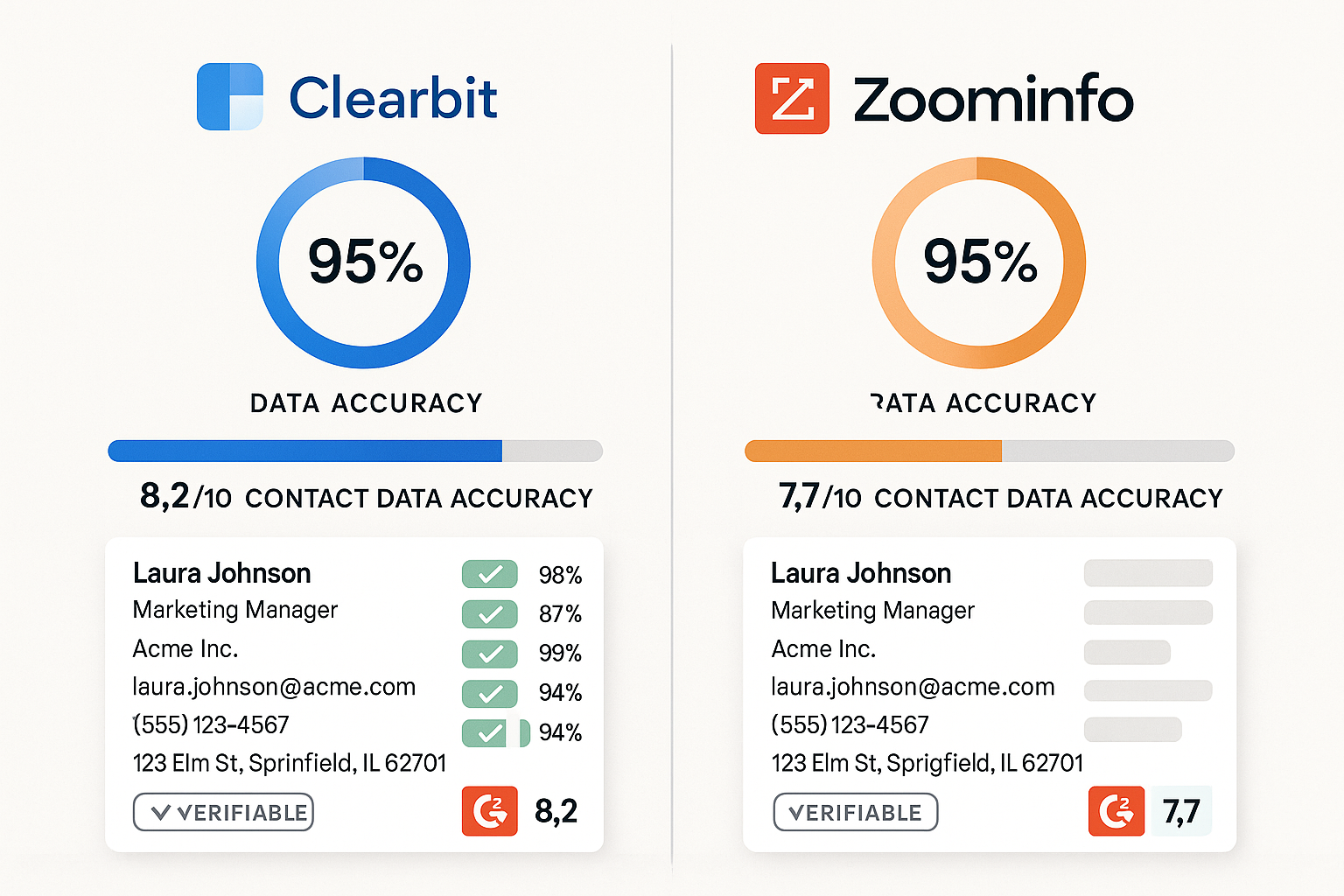
Independent, third-party testing remains the gold standard for evaluating data accuracy—and G2 user benchmarks provide one of the most objective comparisons available. Clearbit comes out ahead with a score of 8.2/10, compared to ZoomInfo’s 7.7/10. While that 6.5% edge might seem small, it has outsized impact for teams running high-volume outreach, where even marginal accuracy gains compound into higher connect rates, cleaner pipelines, and better ROI.
Both platforms publicly claim 95%+ data accuracy, but it’s important to dig into what those numbers really mean. Clearbit’s figure is tied to its real-time enrichment process, which verifies data against multiple premium sources before delivering it to the end user. Their four-stage verification system ensures each record meets freshness standards within 30 days and automatically flags any potentially stale data for review.
ZoomInfo takes a different approach, focusing on breadth of verification rather than depth. Its massive Community Edition network and AI-driven web crawlers validate data continuously, pulling from 38M+ sources daily—everything from job postings and SEC filings to news articles and press releases. This volume-first methodology ensures that ZoomInfo’s database remains comprehensive and current, though it sometimes sacrifices the hyper-targeted precision that Clearbit’s enrichment delivers.
Email Validity and Deliverability Testing
When it comes to Clearbit vs ZoomInfo, few data points matter more than email accuracy. For sales operations and demand gen teams, it directly drives deliverability, sender reputation, and campaign ROI. Even a small dip in accuracy can tank inbox placement rates, inflate bounce rates, and damage domain reputation—problems that take weeks to fix.
Independent testing shows that these two platforms take very different approaches, with clear implications for outreach performance.
- Clearbit’s Strength: Clearbit uses real-time email validation across multiple providers, catching bad addresses before they ever hit your CRM. Its integrations with major email platforms enable instant bounce detection and automated list cleaning—which means cleaner data, stronger sender reputation, and consistently higher inbox placement.
- ZoomInfo’s Approach: ZoomInfo’s massive database is continuously validated by its Community Edition network and AI-driven crawlers, which helps keep data fresh. However, its broader reach means some contacts carry lower verification confidence scores, requiring savvy teams to apply filters or run secondary validation for best results.
For organizations where email campaign performance is the top priority, Clearbit’s higher accuracy rates can deliver a measurable boost in response rates and meeting bookings. Teams focused on maximizing coverage may still prefer ZoomInfo’s expansive reach, accepting slightly lower accuracy in exchange for a larger prospect universe.
Phone Number Accuracy and Mobile Coverage
With remote work pushing more sales conversations to mobile, phone number accuracy has become a critical data quality metric. The difference between a connected call and a dead line can make or break outbound performance—and here’s where Clearbit vs ZoomInfo diverge in approach.
- ZoomInfo’s Advantage: ZoomInfo leads in phone number coverage, offering both direct dials and mobile numbers at scale. Their confidence scoring system helps users prioritize the most reliable numbers, while the Community Edition network continuously verifies and updates records. The result? Broader reach and higher connect rates for teams running high-volume call programs.
- Clearbit’s Focus: Clearbit takes an accuracy-first approach, prioritizing verified business lines over sheer quantity. Its real-time verification process ensures phone numbers are current and valid, though availability of mobile numbers is more limited compared to ZoomInfo’s extensive database.
The impact of these differences depends on your sales motion. Call-heavy SDR teams often find ZoomInfo’s broader coverage indispensable for hitting activity targets and keeping connect rates high. Meanwhile, account-based or high-value sales teams may prefer Clearbit’s precision, trading quantity for higher confidence in every dial.
Data Verification Processes and Quality Control
How a platform verifies its data determines whether your contact database stays trustworthy over time. Understanding these verification methodologies is key to predicting long-term data reliability and ensuring sustainable GTM operations.
- Clearbit’s Depth-First Model: Clearbit uses a four-stage verification process, putting each record through comprehensive validation before it ever reaches your CRM. This approach prioritizes accuracy over coverage, creating a smaller but more dependable dataset—ideal for teams where precision is mission-critical.
- ZoomInfo’s Breadth-First Approach: ZoomInfo leans on scale and frequency. Its verification strategy blends automated web crawling, input from its Community Edition network, and human data scientist review. With over 38 million sources processed daily, ZoomInfo maintains an exceptionally current database, delivering unmatched reach for high-volume prospecting.
Ultimately, the decision comes down to organizational tolerance for variance and the type of sales motion you run. Enterprise and account-based sales teams often lean toward Clearbit for its depth-focused reliability, while SDR-heavy, high-volume teams may prefer ZoomInfo’s broader coverage—even if it means accepting slightly more variability in data quality.
Coverage Analysis: Database Reach, Industry Focus, and Geographic Distribution
Coverage Analysis Venn Diagram
Database coverage is one of the most important differentiators in the Clearbit vs ZoomInfo comparison. Each platform shows unique strengths across industries, company sizes, and regions—making it essential to understand these patterns before building your prospect lists or targeting your ideal customers.
Total Database Size and Contact Availability
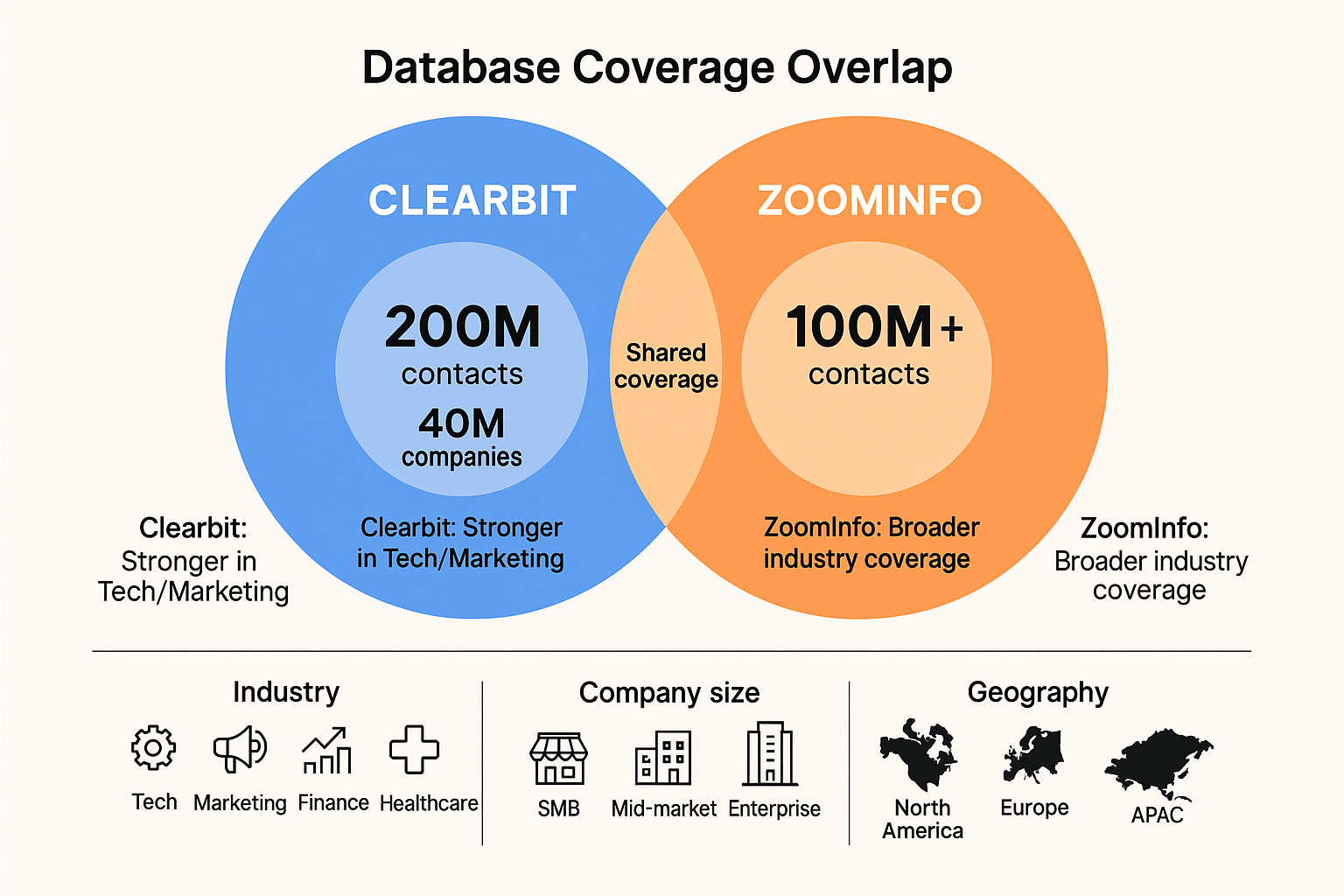
When it comes to database size, ZoomInfo still holds the edge with 100M+ contacts and detailed company profiles spanning virtually every industry and geography. Its coverage is powered by aggressive data collection — from large-scale web crawling and public record analysis to its Community Edition contributor network. This breadth-first approach makes ZoomInfo a go-to for teams running broad prospecting campaigns or targeting diverse markets where wide coverage is essential.
Clearbit, on the other hand, boasts 200M+ contacts across 40M+ companies, but takes a quality-first approach. Instead of simply collecting everything, Clearbit uses selective inclusion and rigorous verification processes to focus on business-relevant, high-accuracy contacts. The result is a cleaner, more reliable dataset—though it may offer fewer contacts in niche or emerging industries.
The difference isn’t just in raw numbers—it’s in strategy. ZoomInfo’s size advantage increases the likelihood of uncovering multiple decision-makers within mid-market and enterprise accounts, which is crucial for multi-threaded deal cycles. Clearbit’s curated approach reduces wasted effort chasing invalid or outdated contacts, helping teams maintain strong deliverability rates and higher connect success.
Industry Vertical Strengths and Specializations
Industry coverage plays a huge role in determining how effective your Clearbit vs ZoomInfo choice will be for prospecting within your target sectors.
- Clearbit’s Industry Strengths: Clearbit shines in technology, marketing, and professional services, where its data collection methodology aligns with digital-first companies and strong online presence patterns. Its superior coverage of SaaS firms, marketing agencies, and tech startups makes it the go-to option for teams targeting high-growth, innovation-driven segments.
- ZoomInfo’s Industry Breadth: ZoomInfo offers broader industry coverage, excelling in traditional sectors like manufacturing, healthcare, finance, and retail. Its ability to map complex org charts and identify decision-makers across multiple departments gives it an edge for companies selling into enterprise markets or legacy business environments.
Geography is another critical differentiator:
- Clearbit’s Geographic Focus: Clearbit’s coverage skews toward North America and Europe, with particularly strong representation in major metro areas and tech hubs. Its digital-first collection approach performs best in regions with high online adoption and transparent business data.
- ZoomInfo’s Global Reach: ZoomInfo extends more deeply into emerging markets and traditional business centers worldwide. While data quality can vary by region, its broader international footprint supports organizations with global sales territories or those targeting multinational corporations with distributed operations.
Together, these differences mean Clearbit is ideal for innovation-focused prospecting, while ZoomInfo is better suited for global, high-volume, or enterprise-scale sales motions where full-market visibility is key.
Company Size and Market Segment Coverage
Company size coverage is another major differentiator in the Clearbit vs ZoomInfo decision—and it has a direct impact on how effective your go-to-market strategy will be.
- Clearbit’s SMB and High-Growth Focus: Clearbit excels in small to mid-sized businesses (SMBs) and high-growth companies, where its real-time enrichment delivers instant value as organizational structures evolve. Its data collection methodology is designed to capture startups and scale-ups early, often before they appear in traditional business directories. This makes Clearbit particularly powerful for teams targeting innovative, fast-growing segments that require first-mover advantage.
- ZoomInfo’s Enterprise Advantage: ZoomInfo leads when it comes to large enterprise coverage. Its database depth supports multi-threaded enterprise sales, with detailed org charts and department-level mapping that help sellers identify multiple stakeholders across hierarchies. This visibility is crucial for teams navigating complex buying committees and long sales cycles.
- Mid-Market (The Competitive Battleground): The mid-market is where the competition gets interesting. Clearbit’s accuracy-first approach helps improve conversion rates by minimizing wasted outreach. Meanwhile, ZoomInfo’s broader coverage ensures contact availability across diverse industries and business models — giving teams the volume they need for multi-channel campaigns.
The takeaway? Clearbit is ideal for SMB and growth-stage targeting, while ZoomInfo is the go-to for enterprise-scale prospecting and companies needing full stakeholder visibility. Mid-market teams may benefit from evaluating both to see which aligns better with their conversion and volume goals.
Unique Coverage Areas and Competitive Advantages
While Clearbit vs ZoomInfo share roughly 60–70% overlap in their total addressable market coverage, each platform maintains distinct advantages that can make or break specific use cases.
- Clearbit’s Differentiators: Clearbit stands out with superior IP intelligence and website visitor identification. For account-based marketing (ABM) teams, this means the ability to unmask anonymous visitors and match them to company profiles—powering smarter lead scoring, retargeting, and personalized nurture campaigns.
- ZoomInfo’s Strengths: ZoomInfo shines with its technographic data and intent signals, giving sales and marketing teams visibility into a prospect’s technology stack, adoption timelines, and buying intent indicators. This enables hyper-targeted prospecting and prioritization of accounts most likely to convert.
Ultimately, your decision should hinge on which coverage strength maps best to your GTM motion. ABM-focused organizations may favor Clearbit for its unmatched visitor intelligence, while outbound sales teams might lean toward ZoomInfo for its reliable technographics and intent data that signal purchase readiness.
Feature Comparison: Comprehensive Capability Analysis Across 30+ Functions
Feature Comparison Grid
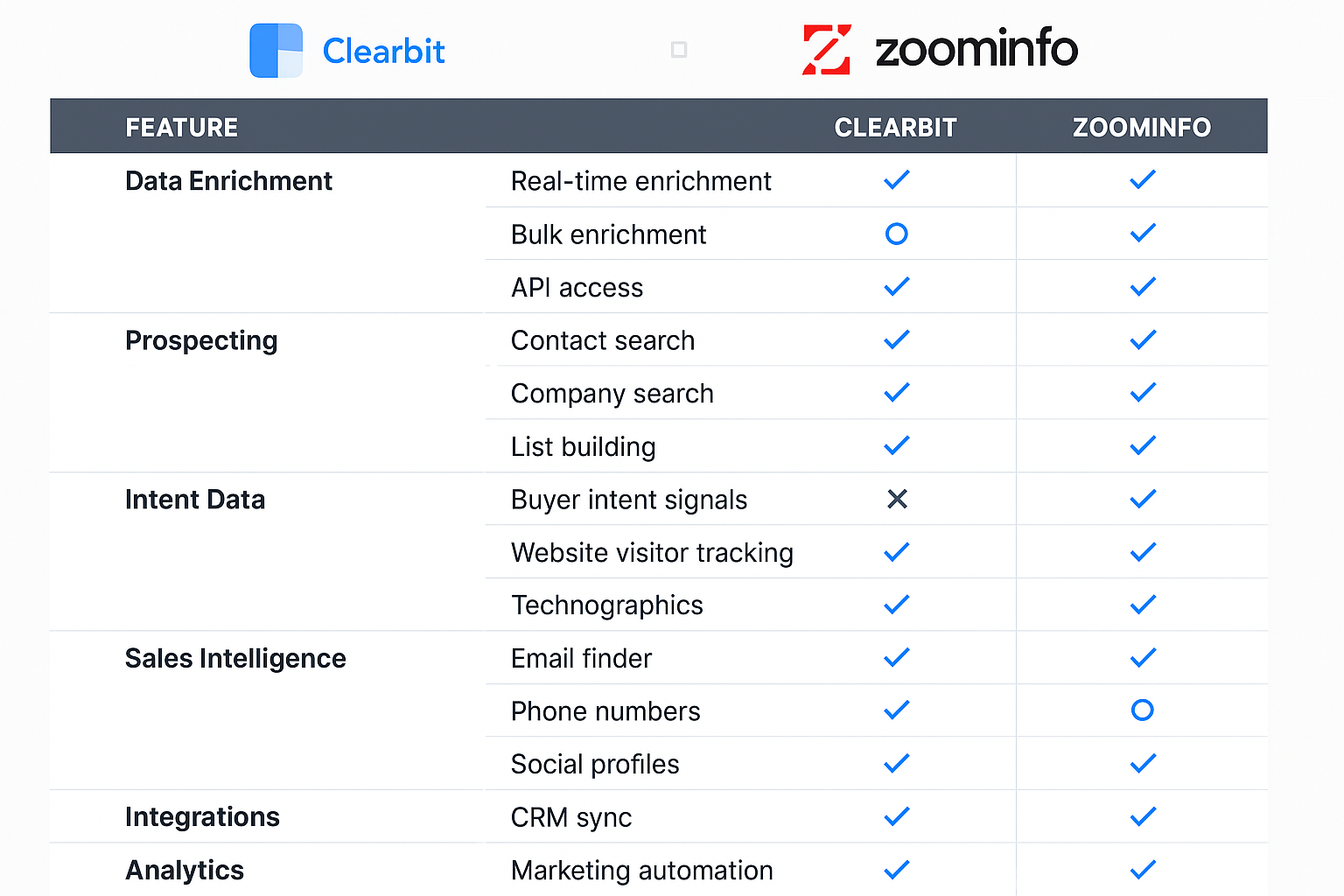
The Clearbit vs ZoomInfo feature comparison highlights two very different philosophies in platform design. Clearbit prioritizes deep integration and workflow automation, positioning itself as the connective tissue within your GTM stack. ZoomInfo, on the other hand, delivers comprehensive, standalone functionality designed to serve as a self-contained command center for sales and marketing teams.
Understanding these capability differences is critical for maximizing ROI—the right choice ensures your team isn’t just buying data but turning it into actionable, revenue-driving workflows.
Data Enrichment Capabilities and Real-Time Processing
When comparing Clearbit vs ZoomInfo, one of the clearest distinctions lies in how each handles data enrichment — and the choice can dramatically shape your GTM workflows.
- Clearbit’s Real-Time Advantage: Clearbit is built around real-time data enrichment, powered by its API-first architecture. Its enrichment engine pulls from 250+ data sources simultaneously, delivering profile updates in milliseconds. This instant data flow is a significant advantage for teams that need immediate lead qualification, routing, and scoring decisions.
Accuracy is another Clearbit strength. Its four-stage validation process ensures that only verified, business-relevant data makes it into your system, meaning less manual cleanup and more confidence in your automation triggers.
- ZoomInfo’s Bulk Processing Power: ZoomInfo takes a breadth-first approach, excelling at batch enrichment for large datasets. Its bulk processing capabilities make it ideal for teams running database hygiene projects or enriching massive prospect lists ahead of major campaigns. While accuracy can vary depending on the source and verification confidence, its scale allows teams to update entire CRMs in one sweep.
The implications are significant:
- Clearbit fuels agile, highly personalized marketing automation workflows where real-time triggers matter.
- ZoomInfo enables efficient, large-scale database refreshes, ensuring sales teams have comprehensive, up-to-date contact lists before outbound efforts ramp up.
Choosing the right approach depends on whether your priority is speed and precision at the point of engagement (Clearbit) or scale and efficiency across your entire database (ZoomInfo).
Prospecting and Lead Generation Tools
In the Clearbit vs ZoomInfo debate, prospecting functionality is one of the clearest differentiators—and it directly shapes how your team builds pipeline.
- ZoomInfo’s Prospecting Powerhouse: ZoomInfo offers one of the most comprehensive prospecting suites in the market. Its platform includes advanced search filters, Boolean logic, technographics, intent signals, and firmographic targeting—all within a single interface. This combination allows for laser-focused list building, making it easy to surface the exact buyer personas or accounts you want to target, whether you’re running ABM campaigns or broad outbound initiatives.
- Clearbit’s Targeted Approach: Clearbit takes a more integrated, quality-first approach to prospect discovery. Its Target Markets feature and website visitor identification prioritize smaller but more accurate lists aligned to your ideal customer profile (ICP). Rather than flooding sales teams with names, Clearbit focuses on delivering relevant, high-confidence contacts that are more likely to convert.
Notably, Clearbit’s decision to discontinue its standalone Prospector tool signals a strategic shift toward being a workflow enhancement solution rather than a full prospecting platform. This makes it ideal for organizations that already have reliable prospecting tools but want to enrich and qualify leads at the point of engagement.
The choice between Clearbit vs ZoomInfo for prospecting ultimately comes down to your team’s priorities. If your goal is to run high-volume outbound campaigns and build large, highly segmented lists quickly, ZoomInfo’s comprehensive search filters and prospecting engine deliver the scale and precision you need. If, on the other hand, you’re focused on highly targeted, ICP-aligned outreach and prefer enriching and qualifying leads directly within your workflows, Clearbit’s integration-first approach offers a smarter, quality-driven solution that minimizes noise and maximizes conversion potential.
Intent Data & Buyer Signal Intelligence: Predicting Purchase Behavior
In the Clearbit vs ZoomInfo comparison, intent data has become one of the most critical battlegrounds—especially for teams looking to engage prospects at the perfect moment in their buying journey.
- ZoomInfo’s Comprehensive Intent Platform: ZoomInfo aggregates buyer intent signals from multiple sources, including website visits, content consumption patterns, and technology research activity. Its intent scoring methodology blends these signals into a single, easy-to-use readiness score that helps sales teams prioritize accounts most likely to convert. When paired with ZoomInfo’s contact database, these insights allow for instant prospect identification and rapid outreach the moment buying signals appear.
- Clearbit’s Visitor Intelligence Advantage: Clearbit takes a focused approach by zeroing in on website visitor identification and behavioral tracking. Its IP intelligence platform can unmask anonymous visitors and connect them to company profiles, enabling smarter lead routing, inbound lead qualification, and ABM workflows. While Clearbit’s intent data capabilities aren’t as broad as ZoomInfo’s, they excel at helping marketing teams engage warm, inbound prospects with perfectly timed follow-ups.
ZoomInfo’s intent platform is best for teams running proactive outbound campaigns that depend on early purchase signals, while Clearbit is ideal for organizations focused on reactive engagement—turning anonymous site traffic into qualified opportunities and personalizing the buyer experience.
Technographic Data and Technology Intelligence
When comparing Clearbit vs ZoomInfo, technographic data has become one of the most powerful tools for creating precision-targeted campaigns and uncovering competitive opportunities.
- ZoomInfo’s Deep Technographic Coverage: ZoomInfo offers one of the most comprehensive technographic databases available, tracking technology adoption across thousands of software categories. Its platform goes beyond just identifying tools—it includes implementation timelines, spend estimates, and competitive intelligence, giving sales teams the ability to spot rip-and-replace opportunities and craft messaging around integration advantages. This depth of insight enables sophisticated, tech-driven sales plays that align perfectly with prospects’ existing stacks.
- Clearbit’s Action-Oriented Approach: Clearbit focuses on delivering essential technology identification and integration compatibility data—enough to power effective targeting without overwhelming teams with exhaustive catalogs. This lean, action-oriented approach gives marketing and sales teams the core insights they need to qualify accounts, segment audiences, and build relevant campaigns without getting lost in unnecessary detail.
If your GTM strategy relies on deep competitive analysis and complex multi-touch campaigns, ZoomInfo’s technographic intelligence provides a decisive edge. If you want just-enough technology data to segment audiences and move quickly, Clearbit’s streamlined approach keeps you focused on execution rather than data overload.
Sales Intelligence and Contact Discovery
When it comes to sales intelligence, the Clearbit vs ZoomInfo comparison highlights two very different approaches to preparing reps for engagement.
- ZoomInfo’s Enterprise-Grade Sales Intelligence: ZoomInfo offers a full-scale intelligence suite that goes beyond contact information. Its platform delivers organizational charts, departmental mapping, and relationship identification—giving sales teams a clear view of decision-making hierarchies inside complex enterprise accounts. ZoomInfo also layers in social media profiles, recent news mentions, and professional background data, enabling reps to craft highly personalized, relevant outreach that improves connection rates and accelerates deal cycles.
- Clearbit’s Workflow-Integrated Insights: Clearbit takes a leaner, integration-first approach, focusing on delivering essential contact and company intelligence directly into existing sales tools like CRMs, marketing automation platforms, and outbound sequences. Instead of forcing teams to leave their workflow for research, Clearbit provides contextual intelligence on the fly, helping reps personalize at scale without adding extra steps to their process.
ZoomInfo is the go-to choice for teams that need deep account mapping and enterprise-level relationship intelligence to support multi-threaded sales motions. Clearbit is ideal for organizations that want streamlined, in-context insights that enhance productivity and keep reps focused on execution rather than research.
Integration and Workflow Automation Features
When comparing Clearbit vs ZoomInfo, integration capabilities may be the single most important factor—especially for teams looking to turn data into action without adding operational overhead.
- Clearbit’s Deep HubSpot Alignment: Clearbit’s acquisition by HubSpot has unlocked deep, native integrations that make it a natural choice for teams running their GTM motion inside the HubSpot ecosystem. This tight alignment allows for smooth workflow automation, real-time data synchronization, and native lead enrichment—all without complex setup. Clearbit’s API-first architecture still supports customization and additional integrations, but its strategic focus is clearly on delivering best-in-class experiences for HubSpot users, which may limit flexibility for companies using other CRMs or marketing automation platforms.
- ZoomInfo’s Broad Compatibility: ZoomInfo, on the other hand, takes a platform-agnostic approach, offering pre-built integrations and reliable API access across virtually all major CRMs, marketing automation systems, and sales enablement tools. This breadth of compatibility makes ZoomInfo ideal for diverse technology stacks, allowing revenue teams to plug its intelligence into their preferred systems while preserving existing workflows.
Choose Clearbit if your GTM tech stack revolves around HubSpot and you want deep, native workflow automation with minimal setup. Choose ZoomInfo if you need maximum integration flexibility across multiple systems or run a multi-CRM, multi-tool environment that demands broad compatibility.
Pricing Reality Check: True Cost Analysis and ROI Calculations
Pricing Calculator
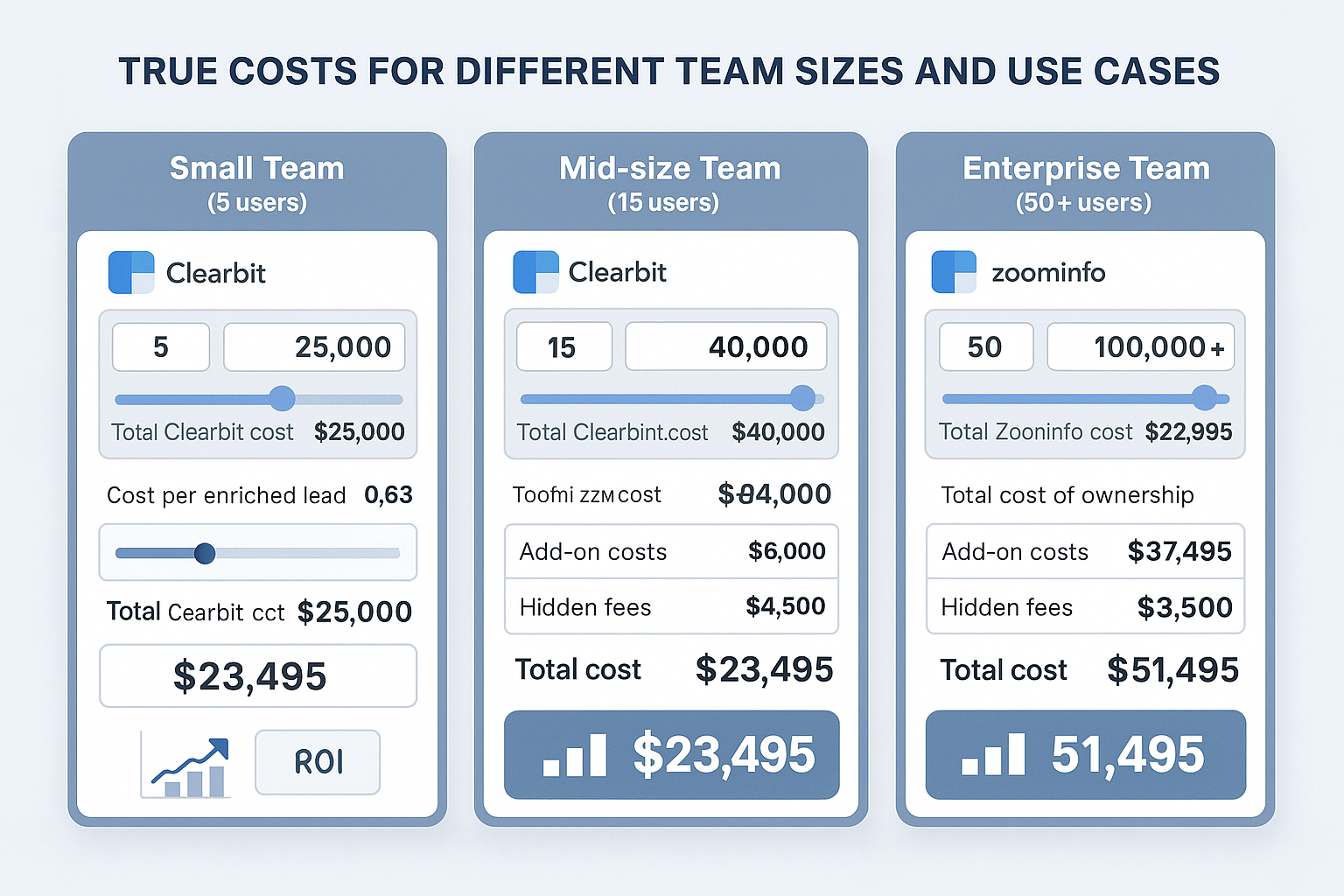
Pricing transparency remains one of the biggest pain points when evaluating B2B data providers. Both Clearbit and ZoomInfo use custom pricing models that make it difficult to see the true cost until late in the buying process. This section breaks down pricing philosophy, total cost of ownership, and value delivery—giving you the clarity you need to accurately assess ROI and avoid surprises when scaling your investment.
Clearbit Pricing Structure and Cost Drivers
Clearbit’s evolution into HubSpot’s Breeze Intelligence has completely reshaped its pricing model, moving from simple, standalone tiers to fully integrated platform economics. Instead of traditional plans, Clearbit now operates on usage-based billing tied to database size, monthly credit consumption, and feature add-ons—giving teams flexibility but also making budgeting more complex.
For small teams, entry-level pricing typically starts around $3,600 per year and can scale quickly as contact volumes grow. Mid-market organizations often invest $25,000 to $50,000 annually, while enterprise deployments with multiple features and high enrichment volumes can exceed $80,000 per year.
Clearbit’s credit-based model introduces predictability challenges. Credits reset monthly with no rollover, meaning teams that underestimate usage often face mid-contract upgrades—a common pain point that can significantly inflate total cost of ownership. Real-time enrichment, one of Clearbit’s key differentiators, also consumes credits at a faster rate during periods of heavy campaign activity.
Additional costs frequently surface as teams scale:
- Forms (for dynamic form shortening and enrichment) requires separate licensing.
- Capture (for Salesforce lead capture and routing) adds another line item.
- Advertising capabilities for audience targeting carry additional fees.
These hidden costs mean that while Clearbit offers a powerful, flexible platform, true ROI depends on carefully modeling usage scenarios before committing to a contract.
ZoomInfo Pricing Tiers and Feature Allocation
ZoomInfo maintains a traditional tiered pricing model with three primary plans, each designed to serve different organizational sizes and go-to-market strategies.
Copilot Pro – Starting at $14,995 annually
Built for small businesses and startups, this entry-level tier includes basic prospecting and enrichment with 5,000 bulk credits per year. It’s an accessible way for lean teams to get started with ZoomInfo, though credit usage must be carefully managed to avoid overages.
Copilot Advanced – $24,995 annually
The most popular tier for mid-sized organizations, offering buyer intent signals, website visitor tracking, and advanced company intelligence. This plan delivers the best balance of functionality vs. cost for most growth-stage companies, though heavy users may still run into credit ceilings.
Enterprise – From $32,995 annually
Includes 20,000 bulk credits, real-time intent data, advanced analytics, and sales automation features. Fully loaded enterprise implementations often land in the $50,000–$75,000 annual range once add-ons are included.
Additional Costs to Watch:
ZoomInfo’s pricing model also includes several key add-ons that many organizations end up purchasing:
- Enrich Data: Starts at $15,000 annually for enhanced enrichment capabilities.
- Global Data Access: Adds $10,000 annually for international coverage.
- Custom Intent Data: Begins at $7,500 annually for organization-specific intent signals.
These add-ons can nearly double total platform cost, making it essential to model true usage scenarios before committing.
Cost Per Enriched Lead and Usage Economics
When it comes to ROI for B2B data providers, cost per enriched lead is one of the most telling metrics.
Clearbit’s usage-based pricing typically falls between $0.50 and $2.00 per enriched contact, depending on data complexity and verification depth. While this places Clearbit at the higher end of the cost spectrum, their real-time enrichment delivers immediate, verified results that consistently translate into cleaner lists, faster lead routing, and stronger campaign performance.
ZoomInfo’s credit-based model usually delivers a lower $0.25 to $1.50 cost per contact, making it attractive for teams running high-volume enrichment projects or refreshing entire databases at scale. However, the trade-off comes in accuracy consistency—some contacts may require additional manual validation, increasing effective cost over time.
The economics go beyond raw price per contact:
- Clearbit’s higher per-contact costs are often offset by better performance metrics—with organizations reporting 15–25% higher email deliverability rates and significant gains in sales productivity thanks to fewer invalid records.
- ZoomInfo’s lower per-contact cost enables wider market coverage and supports broad prospecting, but teams may need to budget time and resources for additional verification and list-cleaning efforts.
Ultimately, the choice comes down to strategy: Clearbit wins for precision and conversion-focused campaigns, while ZoomInfo excels for scale and market saturation efforts where reach takes priority over per-contact accuracy.
Hidden Costs and Contract Considerations
Both Clearbit and ZoomInfo carry hidden costs that can significantly increase total cost of ownership (TCO) beyond the sticker price.
Implementation & Onboarding:
- Expect $5,000–$15,000 in upfront costs for platform setup, CRM integration, and team training—particularly for larger or more customized deployments.
- Many companies underestimate the complexity of configuring enrichment rules, automation triggers, and data synchronization workflows.
Data Migration & Integration:
- Migrating legacy data, building custom APIs, and aligning workflows can add $10,000–$30,000 to initial rollout costs.
- These investments are often unavoidable for teams with existing CRM or marketing automation infrastructure.
Ongoing Maintenance:
- Organizations typically allocate 15–20% of annual platform spend to keep data clean, refresh integrations, and retrain teams as processes evolve.
- Neglecting these activities leads to data decay, duplicate records, and declining campaign performance.
Contract Terms & Flexibility:
- Both vendors favor annual or multi-year contracts with early termination penalties ranging from 50–100% of remaining contract value.
- This creates significant switching costs, which should be factored into your technology roadmap and procurement strategy.
ROI Calculation Framework and Performance Metrics
True ROI goes beyond subscription cost—it measures both direct expenses and operational gains.
Direct Cost Components:
- Platform licensing and user fees
- Implementation and migration costs
- Ongoing maintenance and training programs
- Add-ons or additional tools needed for full functionality
Performance Gains:
- 20–40% reduction in prospecting time thanks to automated research and enrichment
- 15–30% lift in lead-to-opportunity conversion rates through cleaner, more actionable data
- Improved deliverability rates and sender reputation, boosting campaign ROI
- Increased sales team productivity from reduced time spent chasing bad leads
Strategic Considerations:
- Clearbit justifies its higher price tag for companies where conversion rate optimization and data precision are top priorities. Its deep HubSpot integration is a significant advantage for teams running RevOps within that ecosystem—though it does introduce some vendor lock-in.
- ZoomInfo delivers stronger ROI for companies prioritizing market coverage and volume, with its broader database and cost-efficient credit model enabling large-scale prospecting campaigns.
Ultimately, your ROI will hinge on how well the platform aligns with your go-to-market strategy, tech stack, and growth stage.
Integration Ecosystem: Platform Compatibility and Workflow Automation
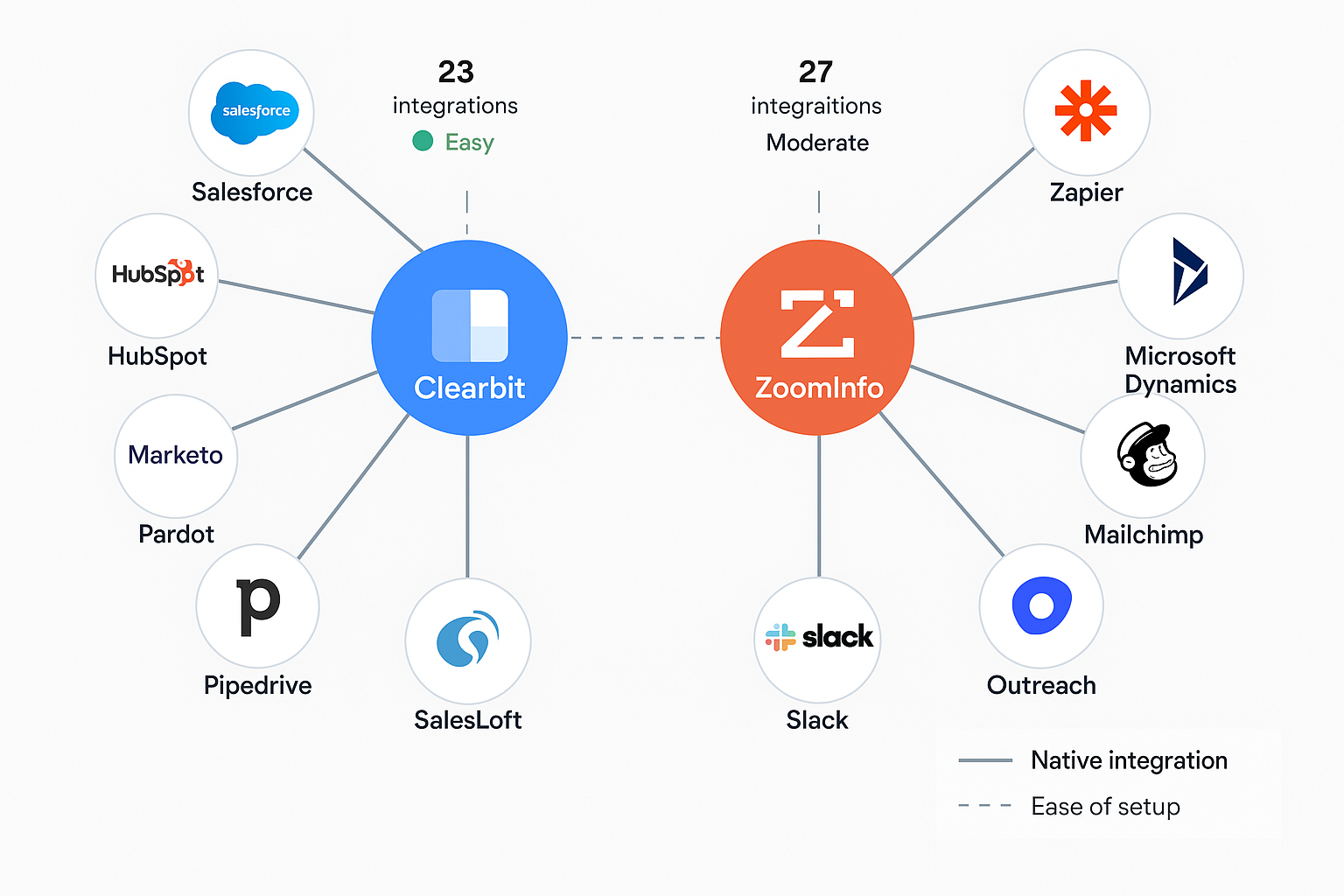
Integration capabilities are the backbone of any B2B data strategy. They determine how well a platform plugs into your existing tech stack, powers automation, and scales as your go-to-market motion matures. When comparing Clearbit vs ZoomInfo, their integration philosophies couldn’t be more different—and those differences carry real consequences for implementation effort, maintenance overhead, and long-term flexibility.
Native Integration Depth and Platform Partnerships
The HubSpot Clearbit integration stands out as one of the most comprehensive in the B2B data provider space. Clearbit delivers deep, bidirectional connectivity that powers sophisticated workflow automation across sales and marketing. Beyond basic data sync, it enables progressive profiling, dynamic content personalization, and automated lead scoring updates based on enriched data attributes.
For teams already running HubSpot, this integration provides immediate value: pre-built workflows, automated data hygiene, and a smooth user experience. Unified reporting, consistent data models, and integrated analytics streamline operations and eliminate the complexity often associated with juggling multiple vendors.
The trade-off? This deep integration can introduce vendor lock-in challenges. Organizations that prefer technology flexibility or anticipate future CRM changes should weigh the potential complexity of migrating off a fully coupled HubSpot + Clearbit stack.
By contrast, ZoomInfo integrations prioritize breadth and compatibility across the tech ecosystem. With 27+ native connectors, including Salesforce, Microsoft Dynamics, Pipedrive, Outreach, and SalesLoft, ZoomInfo fits easily into most CRM and sales enablement platforms. This broad approach makes ZoomInfo an ideal choice for organizations that need multi-platform compatibility while maintaining access to a comprehensive database and advanced intelligence features.
CRM Integration Capabilities and Data Synchronization
CRM integration is the cornerstone of B2B data provider ROI. Without it, sales teams are left juggling spreadsheets and outdated contact lists. Clearbit’s Salesforce integration delivers bidirectional synchronization, automatically enriching records, creating new contacts when needed, and progressively enhancing data fields over time.
Their approach prioritizes data quality over volume, using validation rules and duplicate-prevention mechanisms that keep your CRM clean while still delivering rich prospect intelligence. Real-time enrichment triggers immediate updates, so your sales team always sees the latest information right where they work.
ZoomInfo, on the other hand, leans into comprehensive data transfer and customization. Their Salesforce integration supports advanced configurations like territory-based data access, role-based permissions, and even custom object synchronization—perfect for complex sales operations. With bulk sync capabilities, ZoomInfo makes it easy to refresh entire databases and run large-scale data hygiene projects without manual effort.
Marketing Automation Platform Connectivity
Marketing automation integrations are where data becomes actionable. Clearbit’s real-time enrichment ensures lead nurturing workflows respond instantly to new information. Think progressive profiling that shortens forms on the fly, content personalization triggered by enriched attributes, and updated behavioral scores that prioritize the right leads at the right time.
They integrate smoothly with major platforms like Marketo, Pardot, and Mailchimp, empowering marketers to create hyper-relevant journeys based on real-time prospect data.
ZoomInfo takes a more segmentation-heavy approach, enabling deep audience creation based on firmographics, technographics, and intent signals. For organizations running sophisticated nurture programs or ABM campaigns, this breadth of data provides a strong foundation for precision targeting.
Sales Enablement and Productivity Tool Integration
Sales teams live in their tools—your data should too. Clearbit’s Chrome extension and email integrations deliver contextual intelligence exactly where reps need it, without breaking workflow. Its API-first design allows custom automations, embedding prospect insights directly into your unique sales processes.
ZoomInfo goes further with native integrations into platforms like Outreach and SalesLoft, enabling automated sequence personalization, territory-based recommendations, and detailed activity tracking. For sales managers, this means better visibility into rep performance and prospect engagement.
API Capabilities and Custom Integration Development
When off-the-shelf integrations aren’t enough, both platforms offer powerful APIs. Clearbit’s RESTful API supports real-time data access and high-volume enrichment, with detailed documentation and webhook functionality for event-driven workflows.
ZoomInfo’s API offers deep filtering and search options, making it easy to pull exactly the data you need for custom solutions or data science initiatives. Their well-documented use cases streamline integration development and troubleshooting.
Integration Maintenance and Long-Term Sustainability
Integration is never a “set it and forget it” process. Clearbit’s native HubSpot integration offers simplicity—unified development and maintenance reduce friction, cut costs, and minimize API headaches. The trade-off? Less flexibility for businesses that rely on multiple CRMs or want to keep their tech stack vendor-agnostic.
ZoomInfo’s multi-platform approach requires more maintenance—multiple APIs, authentication layers, and data sync processes to manage—but gives organizations more freedom and reduces dependency risk.
Ultimately, the decision comes down to technology philosophy. If your organization is committed to HubSpot and values simplicity, Clearbit delivers unmatched efficiency. If you need multi-platform compatibility and plan to maintain a diverse tech stack, ZoomInfo’s broader integration support is worth the extra complexity.
Data Freshness: Update Frequency and Verification Protocols
Data Freshness Timeline
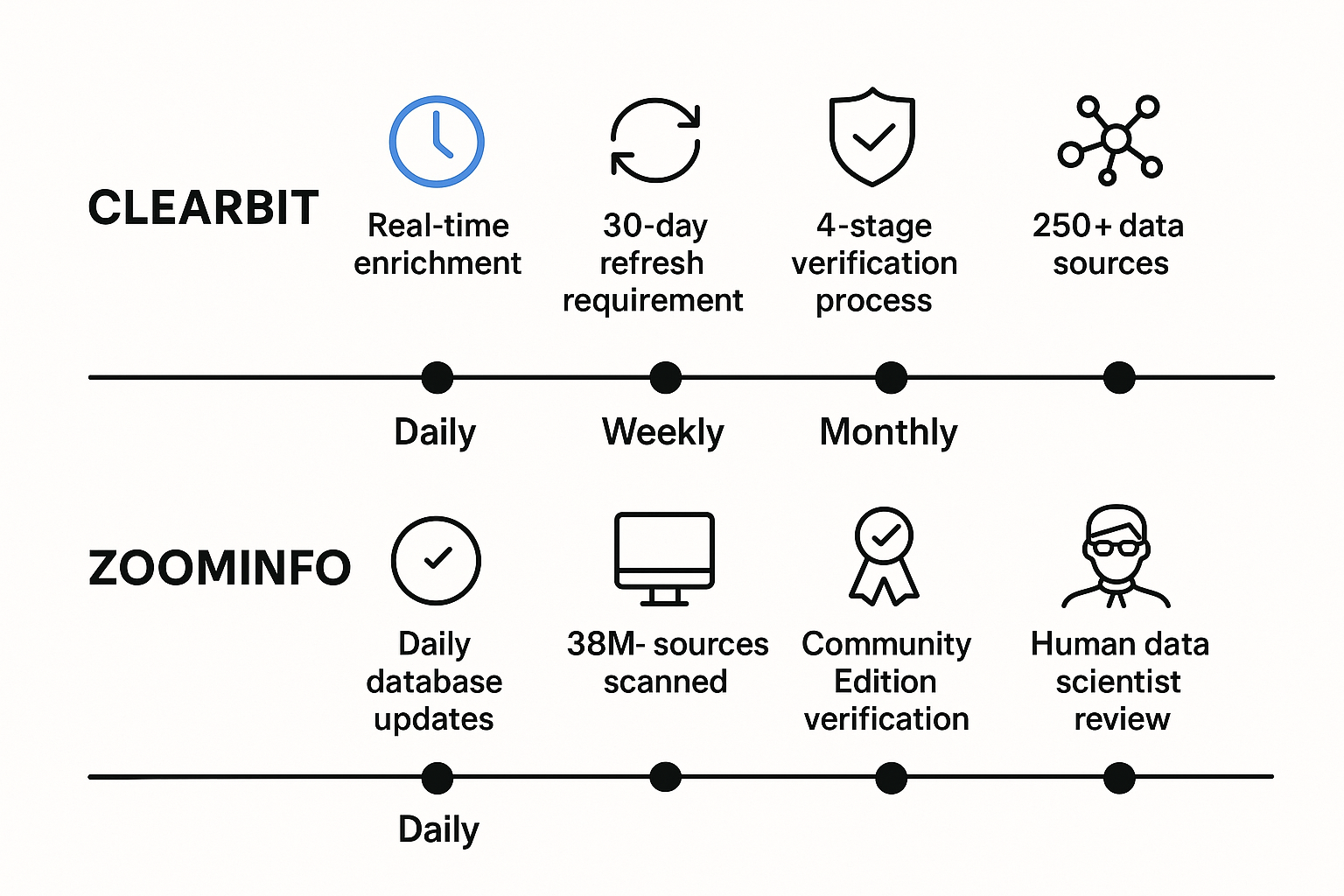
In B2B sales and marketing, data freshness is everything. Outdated contact information leads to bounced emails, missed opportunities, and wasted sales effort. The Clearbit vs ZoomInfo comparison highlights two very different philosophies around keeping data current — and these differences directly influence campaign performance, sales velocity, and ROI.
Real-Time vs. Batch Update Methodologies
Clearbit leads with real-time enrichment. Their API-first architecture verifies data continuously against 250+ sources, delivering updated contact and company information within milliseconds of a request. This means your CRM reflects job changes, company updates, or new funding announcements almost as soon as they happen.
Their 30-day refresh requirement ensures every record is revalidated regularly, with automatic flagging of stale information and proactive updates triggered as soon as changes are detected. The result: a smaller, more curated dataset that prioritizes accuracy and recency over sheer database size.
ZoomInfo takes a batch processing approach, scanning more than 38 million online sources daily—including news articles, SEC filings, job postings, and press releases—to refresh its massive database. This method ensures broad coverage and reasonable update frequency, making ZoomInfo ideal for teams needing constant access to a large universe of contacts.
Verification Source Diversity and Quality Assurance
Verification source quality is what separates reliable B2B data from noise. Clearbit’s four-stage verification process emphasizes authoritative sources: official business registries, verified social profiles, and trusted directories. By filtering out unverified or user-generated data, Clearbit delivers higher accuracy rates—though coverage in fast-changing or emerging markets may be more limited.
ZoomInfo takes a more community-powered approach through its Community Edition network. Contributors continuously validate and refresh records during everyday business activities, helping ZoomInfo capture changes quickly at scale. While this crowd-sourced model expands coverage, accuracy may vary depending on contributor reliability, requiring occasional data cleansing.
Data Decay Management and Proactive Updates
With up to 30% of B2B data decaying annually due to job changes, layoffs, and business closures, proactive management is non-negotiable. Clearbit focuses on prevention, using continuous verification to catch changes as they happen—reducing wasted outreach and preserving sender reputation.
ZoomInfo’s strength lies in scale, using frequent refresh cycles and human data scientist reviews to validate critical updates and complex organizational changes across their vast database. This breadth-first strategy ensures large-scale coverage but may introduce occasional lag between a change occurring and being reflected in the system.
Compliance and Privacy Considerations
Data freshness must also align with privacy obligations—GDPR, CCPA, and other regulations can’t be an afterthought. Clearbit’s compliance framework includes data subject rights support, automated deletion, and transparent processing documentation, keeping privacy management simple for customers.
ZoomInfo offers a reliable privacy program as well, including built-in compliance tools, DSAR workflows, and transparent collection practices that help organizations stay compliant while still benefiting from broad prospect intelligence.
Choosing between Clearbit and ZoomInfo comes down to accuracy vs. scale. If your strategy depends on hyper-accurate, real-time updates and you’re willing to trade some breadth for precision, Clearbit’s approach is ideal. If you need massive market coverage with frequent but batch-based refresh cycles, ZoomInfo delivers the reach to fuel high-volume prospecting and large-scale campaigns.
Making the Strategic Choice for Maximum ROI
Choosing between Clearbit and ZoomInfo is more than a feature checklist—it’s a strategic decision that shapes how your organization acquires, manages, and acts on data. The right choice depends on your priorities, existing tech stack, and go-to-market strategy.
When Clearbit Delivers the Edge
Clearbit shines when data accuracy, workflow automation, and conversion rate optimization are top priorities. Organizations already invested in HubSpot gain unmatched value from its native integration and unified data model, which simplify implementation and unlock advanced automation workflows.
Clearbit is particularly powerful for:
- Account-based marketing and enterprise sales, where every contact must be precise.
- High-value, targeted outreach, where real-time enrichment boosts personalization and win rates.
- Startups and scale-ups, where staying ahead of rapid market changes requires up-to-the-minute intelligence on target companies and decision-makers.
When ZoomInfo Maximizes ROI
ZoomInfo dominates when market coverage, prospecting scale, and integration flexibility take center stage. Its massive database, lower per-contact costs, and intent data capabilities make it ideal for teams running high-volume outbound campaigns or entering new markets.
ZoomInfo is often the better choice for:
- Enterprise and mid-market teams running complex sales cycles requiring multi-threaded engagement.
- Organizations with diverse or global markets, where broad coverage is critical.
- Teams seeking platform independence, using ZoomInfo’s 27+ integrations to maintain flexibility across tech stacks.
Strategic Implementation Recommendations
Maximizing ROI with either platform requires more than just signing a contract. Start with:
- Clear use-case definition: Know exactly what you’re solving for.
- Success metrics: Define how you’ll measure value (conversion rates, pipeline growth, ROI).
- Integration planning: Align the platform with your CRM, MAP, and RevOps workflows.
Ongoing data governance and optimization ensure sustained value: schedule regular database hygiene, keep teams trained, and monitor performance to adjust strategies as markets evolve.
Your Clearbit vs ZoomInfo decision is really a choice about how your organization wants to compete. Are you playing a precision game—investing in accuracy, automation, and ABM excellence—or are you playing a scale game, reaching as many prospects as possible with broad intelligence and global coverage?
The best ROI doesn’t come from the “right” platform alone. It comes from aligning your selection with your business model, growth stage, and long-term go-to-market vision—then executing with discipline. When strategy and execution meet the right data partner, the result isn’t just better leads—it’s accelerated growth and a lasting competitive advantage.
How Delverise Can Help
Choosing the right tools and strategy is only the first step — executing effectively is what separates high-growth teams from the rest. At Delverise, we help B2B SaaS companies build and optimize their revenue engines, from tool selection and implementation to full GTM execution.
Whether you’re evaluating clearbit vs zoominfo, building your sales tech stack, or scaling your go-to-market operations, our team combines RevOps strategy with hands-on engineering to deliver measurable results.
Ready to build a revenue engine that actually scales? Reach out to Delverise about your GTM strategy.
Turning Insight Into Action
The real ROI isn’t just in choosing Clearbit or ZoomInfo—it’s in how well you align that choice with your GTM motion. The best teams don’t stop at comparison tables; they translate decisions into workflows, integrations, and measurable outcomes.
If you want help pressure-testing your GTM strategy against these findings, we can map out what this decision means for your pipeline, cost per lead, and conversion rates.
Let’s map out your GTM playbook.
Related Articles
- Best B2B Data Enrichment Tools
- Best Sales Intelligence Tools
- Clay vs Apollo for Sales Teams
- Best Revenue Intelligence Platforms
- Outbound Sales for B2B SaaS