Your B2B SaaS website generates thousands of visits per month. Paid campaigns are running, organic traffic is growing, content is ranking. But your free trial conversion rate sits at 2.3%. Demo requests trickle in. Visitors browse your pricing page and leave without taking action.
You know you should be testing. So you run an A/B test on your CTA button color. Then another on headline copy. Then a third on hero image placement. Three months later, none of them produced a statistically significant result, and your conversion rate hasn’t moved.
This is the CRO testing trap most B2B SaaS teams fall into: running tests without a framework, without statistical rigor, and without a clear connection between what you’re testing and the revenue you’re trying to generate. The problem is rarely a lack of testing — it’s testing the wrong things, in the wrong order, with too little traffic to detect meaningful differences.
This guide covers how to run CRO tests that actually move the needle for B2B SaaS companies. Not cosmetic tweaks. Not button color experiments. Tests that are designed around your funnel’s real bottlenecks, prioritized by revenue impact, and executed with enough statistical discipline to trust the results.
Why Most B2B SaaS CRO Tests Fail
Before diving into test types and frameworks, it’s worth understanding why the majority of A/B tests at B2B SaaS companies produce inconclusive results. Knowing these failure modes will help you avoid them.
Insufficient traffic for statistical significance. Most B2B SaaS websites don’t have the traffic volume of consumer e-commerce sites. If your pricing page gets 500 visitors per month, an A/B test needs to run for months to detect anything less than a dramatic difference. Many teams call winners after two weeks with 200 visitors per variant — that’s noise, not signal.
Testing cosmetic elements instead of structural ones. Button colors, font sizes, and image swaps rarely produce measurable conversion lifts in B2B. The changes that move B2B SaaS conversion rates are structural: removing form fields, changing the offer itself, repositioning value propositions to match buyer objections, or fundamentally redesigning a signup flow. These tests are harder to run but far more likely to produce results worth acting on.
No hypothesis connecting the test to buyer behavior. Every test should start with a hypothesis: “We believe [change] will improve [metric] because [reason based on evidence].” Without this, you’re generating random experiments instead of systematically learning about your buyers. The evidence should come from qualitative data — session recordings, customer interviews, support tickets, sales call notes — not assumptions.
Optimizing the wrong stage of the funnel. If your trial-to-paid conversion rate is 3% but your visitor-to-trial rate is 0.5%, testing onboarding flows is premature. Fix the biggest leak first. A complete CRO strategy maps your entire funnel before deciding where to test.
The CRO Testing Framework: ICE Prioritization for B2B SaaS
Not all tests are created equal. The ICE framework helps you prioritize tests by three criteria, scoring each from 1 to 10:
- Impact: If this test wins, how much will it move the target metric? A pricing page redesign scores higher than a footer link change.
- Confidence: How confident are you that this change will produce a measurable improvement? Confidence should be based on evidence: session recordings showing users dropping off, customer feedback about confusion, competitive benchmarks, or data from conversion tracking tools.
- Ease: How quickly and cheaply can you implement and run this test? A headline swap takes hours; a full checkout redesign takes weeks.
Score each potential test on all three dimensions, multiply or average the scores, and work through your backlog from highest to lowest. This prevents the common trap of running easy but low-impact tests while high-impact opportunities sit in the backlog.
Example ICE scores for a typical B2B SaaS site:
| Test | Impact | Confidence | Ease | ICE Score |
|---|---|---|---|---|
| Remove 4 form fields from demo request | 8 | 9 | 9 | 8.7 |
| Add customer logos to pricing page | 6 | 7 | 10 | 7.7 |
| Rewrite hero headline to match ICP pain | 8 | 6 | 9 | 7.7 |
| Redesign onboarding email sequence | 7 | 7 | 5 | 6.3 |
| Change CTA button color | 2 | 3 | 10 | 5.0 |
Notice how the button color test — the most common CRO experiment teams run — scores lowest. The form field reduction, backed by session recording data showing users abandoning mid-form, scores highest because it’s high-impact, high-confidence, and easy to implement.
7 Types of CRO Tests for B2B SaaS
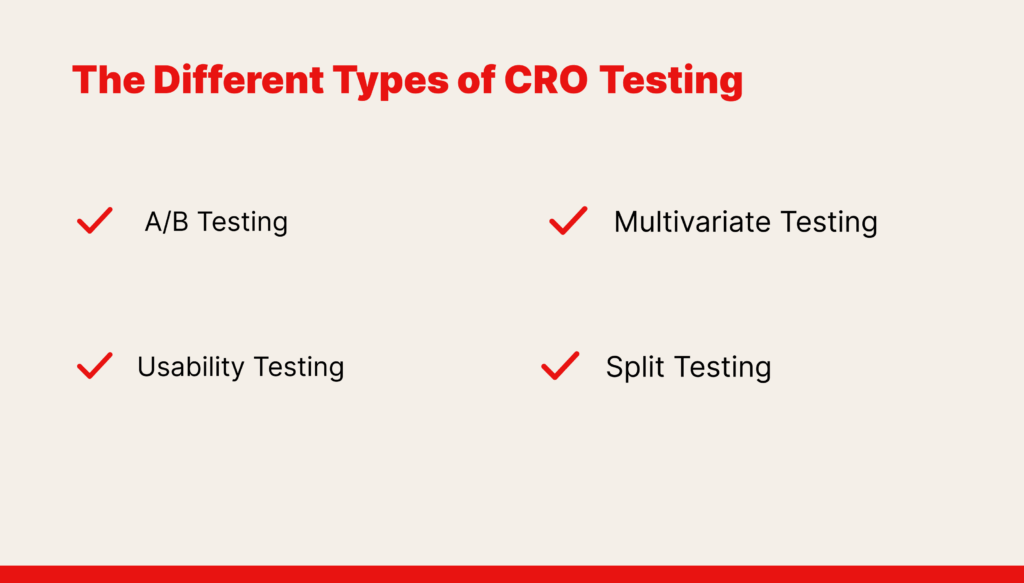
Each test type serves a different purpose and works best at different traffic levels and funnel stages. Understanding when to use each one prevents wasted effort.
1. A/B Testing (Split Testing)
A/B testing compares two versions of a page — the original (control) and a variation — by splitting traffic between them and measuring which converts better. This is the foundation of CRO testing because it isolates the effect of a single change.
Best for: Testing one specific element (headline, CTA, form layout, social proof placement) on pages with enough traffic to reach statistical significance within 2-4 weeks.
B2B SaaS example: Testing whether “Start Free Trial” or “See It in Action” produces more trial signups on your homepage. You need at least 1,000 visitors per variant to detect a 10-15% relative improvement with 95% confidence.
2. Multivariate Testing (MVT)
Multivariate testing simultaneously tests multiple combinations of elements on a page. If you want to test 3 headlines × 2 CTAs × 2 hero images, MVT will evaluate all 12 combinations to find the optimal mix.
Best for: High-traffic pages where you want to understand interaction effects between elements. Requires significantly more traffic than A/B testing — often 10x or more — because you’re splitting visitors across many more variants.
B2B SaaS reality check: Most B2B SaaS sites don’t have enough traffic for MVT outside of the homepage or top-of-funnel blog posts. If your pricing page gets fewer than 5,000 monthly visitors, stick with sequential A/B tests instead.
3. Redirect (Split URL) Testing
Redirect testing sends visitors to entirely different page URLs rather than swapping elements on the same page. This lets you test fundamentally different designs, layouts, or page structures that can’t be achieved with simple element swaps.
Best for: Testing completely redesigned pages — a new pricing page layout, a new landing page architecture, or a different signup flow structure.
B2B SaaS example: Testing a long-form pricing page with feature comparison tables against a short-form page with a single CTA to “Talk to Sales.” This tests a fundamentally different buying experience, not just a design variation.
4. Qualitative Testing (Session Recordings + Heatmaps)
Qualitative testing uses tools like Hotjar, FullStory, or Microsoft Clarity to observe actual user behavior through session recordings, heatmaps, and scroll maps. This isn’t A/B testing — it’s diagnostic work that generates the hypotheses your A/B tests will validate.
Best for: Identifying friction points, understanding why users abandon forms or pages, and building evidence-backed hypotheses before running quantitative tests.
B2B SaaS example: Watching 50 session recordings of users who visited the pricing page but didn’t start a trial. You notice 60% of them scroll past the feature comparison table without engaging — this suggests the table isn’t helping the buying decision and might need restructuring.
5. Usability Testing
Usability testing puts real users in front of your product or website and asks them to complete specific tasks while you observe. Unlike session recordings (which capture natural behavior), usability tests are structured to evaluate specific flows.
Best for: Evaluating onboarding flows, signup processes, and complex multi-step interactions before and after redesigns.
B2B SaaS example: Asking 5-10 target users to sign up for a free trial and complete the first three onboarding steps. Where do they hesitate? What questions do they ask? What’s the average time to complete each step? These qualitative insights are invaluable for understanding different customer segments and their specific friction points.
6. Personalization Testing
Personalization testing serves different page experiences to different visitor segments based on firmographic data, behavior, or traffic source. Instead of finding one version that works for everyone, you optimize for specific audiences.
Best for: Mature CRO programs where A/B tests have plateaued. Requires enough traffic per segment to validate results independently.
B2B SaaS example: Showing enterprise visitors (identified by company size via reverse IP lookup) a “Talk to Sales” CTA, while showing SMB visitors a “Start Free Trial” button. Testing whether this segmentation increases overall conversion rate compared to a single universal CTA.
7. Funnel Testing
Funnel testing optimizes across multiple connected steps rather than a single page. Instead of testing your trial signup page in isolation, you test the entire sequence: ad click → landing page → signup form → email confirmation → first login → onboarding → activation.
Best for: Identifying which stage of your funnel has the biggest drop-off and testing improvements to the full path rather than isolated pages.
B2B SaaS example: Your funnel data shows: Landing page → signup (8%) → email confirmed (65%) → first login (40%) → activated (25%). The biggest drop-off is between email confirmation and first login. Testing a redesigned welcome email with a direct login link and setup checklist could move this number more than any landing page test.
Statistical Rigor: When to Trust Your Results
The most common CRO testing mistake in B2B SaaS is calling winners too early. Unlike e-commerce sites with thousands of daily transactions, B2B SaaS conversion events are relatively rare. This means you need discipline around statistical significance.
Key principles:
- Set your sample size before running the test. Use a sample size calculator to determine how many visitors per variant you need based on your baseline conversion rate, the minimum detectable effect you care about, and your desired confidence level (95% is standard). If the calculator says you need 4,000 visitors per variant and your page gets 1,000 per month, your test needs to run for at least 4 months — or you need to test a bigger change.
- Don’t peek at results early. “Peeking” — checking results daily and stopping when they look good — inflates your false positive rate dramatically. If you check a test 10 times before completion, your actual false positive rate jumps from 5% to over 25%. Use tools that adjust for sequential testing (like VWO’s Bayesian engine) or commit to the full sample size.
- Run tests for at least one full business cycle. B2B SaaS traffic patterns vary by day of week. A test that starts on Monday and ends on Wednesday captures different behavior than one running a full week. Always run tests in complete weekly cycles to account for this variation.
- Focus on practical significance, not just statistical significance. A test that shows a 0.3% improvement with 95% confidence is statistically significant but practically meaningless. Before running any test, define the minimum improvement that would make it worth the engineering effort to implement permanently.
Quick reference — minimum visitors per variant to detect a given improvement (at 95% confidence, 80% power):
| Baseline Rate | Detect 10% Lift | Detect 20% Lift | Detect 50% Lift |
|---|---|---|---|
| 2% (trial signup) | ~39,000 | ~10,000 | ~1,700 |
| 5% (demo request) | ~15,000 | ~3,900 | ~670 |
| 10% (email opt-in) | ~7,000 | ~1,800 | ~320 |
This table explains why button-color tests rarely reach significance for B2B SaaS. If your trial signup rate is 2% and you’re looking for a 10% relative lift (from 2.0% to 2.2%), you need ~39,000 visitors per variant. Most B2B SaaS sites simply don’t have that volume on conversion-critical pages.
The solution: test bigger changes. A complete pricing page redesign might produce a 50% lift, requiring only ~1,700 visitors per variant — achievable within a few months for most sites.
The B2B SaaS CRO Testing Playbook
Based on patterns across B2B SaaS companies, here’s where to focus your CRO testing effort, ordered by typical impact. This isn’t a rigid sequence — use the ICE framework above to adjust based on your specific funnel data.
1. Reduce Form Friction
Every unnecessary field on a demo request or trial signup form costs conversions. HubSpot found that reducing form fields from 4 to 3 increased conversion rates by 50%. For B2B SaaS, the fields that matter most for qualification (company size, job title, use case) can often be collected after the initial conversion rather than before it.
Test: Current form vs. a version with only email + company name. Collect the rest via a post-signup survey or progressive profiling during onboarding.
2. Rewrite Headlines Around Pain Points
Most B2B SaaS homepage headlines describe what the product does. Effective CRO headlines describe the problem the product solves, in the buyer’s own language. Mine customer interviews, G2 reviews, and support tickets for the exact phrases your ICP uses to describe their pain.
Test: Feature-focused headline (“AI-Powered Revenue Intelligence”) vs. pain-focused headline (“Stop Losing Deals to Competitors You Didn’t Know About”).
3. Optimize Pricing Page Architecture
The pricing page is the highest-intent page on most B2B SaaS sites. Common improvements: adding a FAQ section below the pricing table (addresses objections), positioning the recommended plan in the center or with visual emphasis, adding social proof from recognizable customers directly on the pricing page, and including a “Talk to Sales” escape hatch for visitors who aren’t ready to self-serve.
Test: Current pricing page vs. a version with an embedded 60-second product video above the pricing table. Video can address the “do I need this?” question that keeps visitors from committing.
4. Add Social Proof at Decision Points
Social proof is most effective when placed at the exact moment of a conversion decision — next to signup forms, on pricing pages, and in email onboarding sequences. Generic logo bars at the top of the homepage have diminishing returns; specific, relevant proof at point-of-decision matters more.
Test: Add a customer quote and company logo directly next to your demo request form. Test whether this increases form completion rate compared to the form alone.
5. Optimize Onboarding-to-Activation
The most impactful CRO work for product-led SaaS companies happens after signup. Map the activation milestones for your product (the 3-5 actions that correlate with long-term retention), then build and test in-app and email nudges that guide users through each step.
Test: Current onboarding email sequence vs. a redesigned sequence where each email focuses on one specific activation action with a direct link to complete it.
6. Test CTA Copy and Placement
According to HubSpot, personalized CTAs perform 202% better than generic ones. Beyond personalization, test the specificity and urgency of your CTA language. “Start Your Free Trial” outperforms “Submit” or “Get Started” in most B2B contexts because it tells the user exactly what happens next and what they’ll get.
Test: Generic CTA (“Get Started”) vs. specific CTA (“Start Your 14-Day Free Trial — No Credit Card Required”). Include the objection-handling directly in the CTA text.
7. Improve Page Load Speed
Page speed impacts conversion rates directly. According to Portent, a site that loads in 1 second has a conversion rate 3x higher than a site that loads in 5 seconds. Use tracking tools and Google PageSpeed Insights to identify and fix load time bottlenecks on your highest-traffic conversion pages.
Building Your CRO Testing Stack
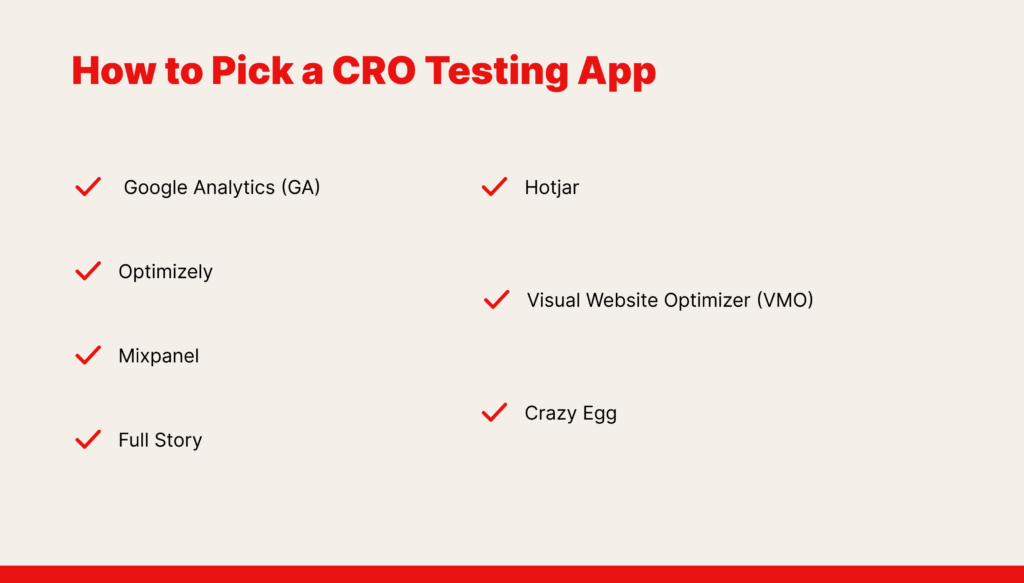
Your CRO testing stack needs to cover four functions: analytics, qualitative insight, experimentation, and personalization. Here’s how the major tools map to each function in 2026:
Analytics (What’s Happening)
- Google Analytics 4: Free. Funnel analysis, traffic patterns, conversion path reporting. The foundation of any CRO stack. GA4’s exploration reports let you build custom funnels to identify exactly where users drop off.
- Mixpanel: Product analytics focused on user behavior within your app. Stronger than GA4 for tracking post-signup activation and retention events. Best for product-led SaaS with complex onboarding flows.
Qualitative Insight (Why It’s Happening)
- Hotjar: Session recordings, heatmaps, and on-page surveys. The free tier covers basic needs. Start here if you’re not yet watching how users interact with your key pages.
- Microsoft Clarity: Free alternative to Hotjar with session recordings and heatmaps. No traffic limits. A strong option for early-stage companies watching their tooling budget.
- FullStory: Enterprise-grade session analytics with excellent mobile tracking and frustration signal detection (rage clicks, dead clicks, error clicks). Higher price point, but powerful diagnostic capabilities.
Experimentation (Testing Changes)
- VWO: Full-featured A/B testing, multivariate testing, and split URL testing. VWO’s Bayesian statistical engine handles the “peeking problem” better than frequentist tools, which matters for B2B’s lower traffic volumes.
- Optimizely: Enterprise-grade experimentation platform. Excellent for companies running complex, multi-page experiments across large product surfaces. Feature flags, server-side testing, and deep analytics integrations.
- Google Optimize (sunset → alternatives): Google Optimize was sunset in 2023. If you’re looking for a lightweight free option, consider using Google Tag Manager-based experiments or Growthbook (open-source).
Personalization (Targeting Segments)
- Mutiny: AI-powered website personalization for B2B. Uses firmographic data (company size, industry, tech stack) to serve different page experiences to different visitor segments without engineering effort.
- Intellimize: Automated personalization that uses machine learning to continuously test and optimize page elements for different audiences. Reduces the manual test-design burden.
For most B2B SaaS companies under $10M ARR, start with: GA4 (free) + Hotjar or Clarity (free) + VWO (paid). This gives you analytics, qualitative insight, and experimentation without overcomplicating your stack. Add personalization tools only after you’ve exhausted the gains from standard A/B testing.
What to Test First: A Decision Framework
If you’re starting a CRO testing program from scratch, here’s a practical sequence that works for most B2B SaaS companies:
Month 1: Diagnose. Install qualitative tools (Hotjar/Clarity). Watch 100+ session recordings across your homepage, pricing page, and signup flow. Document every friction point, confusion moment, and abandonment pattern. Build your initial test backlog.
Month 2: Fix obvious friction. Before running any A/B tests, fix the obvious problems: broken links, slow-loading pages, confusing navigation, form fields that shouldn’t exist. These aren’t tests — they’re fixes. You don’t need to A/B test whether a broken form should be repaired.
Month 3-4: Run your first 2-3 A/B tests. Pick the highest-ICE-scored tests from your backlog. Focus on structural changes (form redesign, headline rewrite, pricing page architecture) rather than cosmetic tweaks. Run each test for at least 2 full weeks, ideally 4.
Month 5+: Build cadence. Aim for 2-4 tests running per month. Document every result — including failures — in a shared test log. Use growth frameworks to connect CRO learnings to your broader growth marketing strategy. Over time, your test log becomes one of the most valuable assets your marketing team owns.
Turn Testing Into Revenue
CRO testing for B2B SaaS isn’t about running more tests. It’s about running the right tests — grounded in qualitative evidence, prioritized by revenue impact, and executed with statistical discipline. A single well-designed test on your pricing page can deliver more revenue impact than a dozen button-color experiments.
Start by watching your users. Identify where they struggle, where they drop off, and where your messaging fails to match their buying intent. Build hypotheses from that evidence. Prioritize ruthlessly with the ICE framework. And resist the temptation to call winners before the data supports it.
The B2B SaaS companies that win at CRO are the ones that treat testing as a systematic CRO strategy rather than a one-off project. Every test — whether it wins or loses — teaches you something about your buyers that makes the next test more likely to succeed.
At Delverise, we build data-driven CRO programs for B2B SaaS companies that turn traffic into pipeline. From inbound lead optimization to full-funnel conversion strategy, we help lean growth teams maximize the revenue potential of every visitor.