The conversational marketing landscape has evolved dramatically in 2026, with businesses recognizing that real-time, personalized customer interactions are no longer optional—they are essential for pipeline growth. For marketing leaders and demand generation managers at B2B SaaS companies, the pressure to deliver qualified leads and accelerate sales cycles has made the choice of conversational marketing platform more critical than ever.
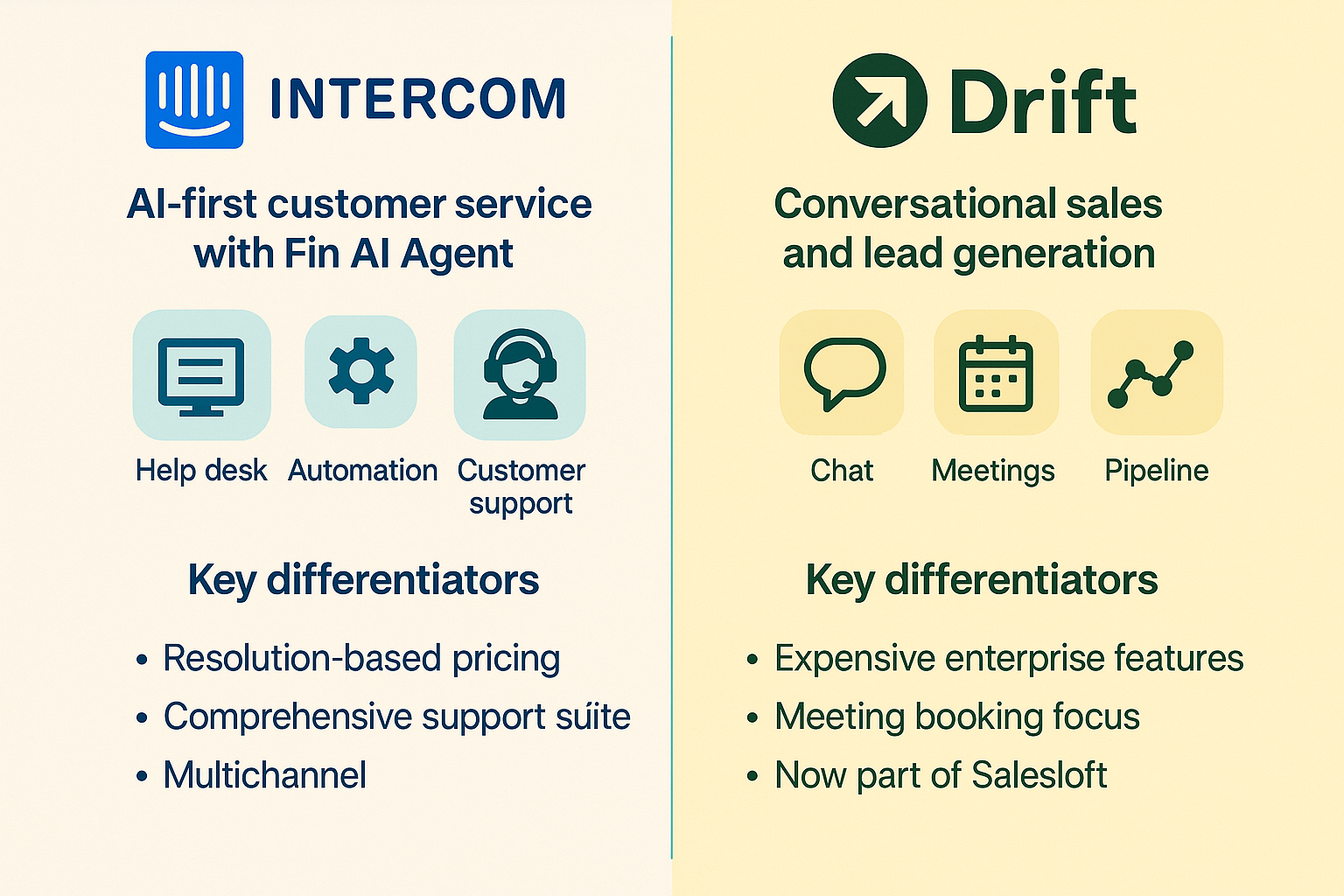
Two solutions have emerged as dominant players in this space: Intercom, with its AI-first customer engagement model powered by the Fin AI Agent, and Drift, now part of the Salesloft ecosystem, with a focus on conversational sales and lead generation. Both platforms aim to transform website visitors into pipeline opportunities, yet they approach this goal in fundamentally different ways.
Industry research highlights the stakes of this decision. Companies that adopt conversational marketing strategies often report double-digit improvements in conversion rates, while the majority of B2B marketers confirm that chatbots and conversational sales tools significantly improve lead-to-customer conversion. With most consumers now expecting instant interactions with brands, selecting the right platform directly impacts a company’s ability to capture leads, accelerate deals, and drive revenue growth.
This analysis compares Intercom vs Drift through the lens of pipeline generation, examining features, pricing, implementation complexity, and real-world performance. Whether you are a startup adopting your first conversational marketing solution or an enterprise optimizing a mature strategy, this guide will help you make an informed decision aligned with your growth objectives.
Platform Overview Comparison
Platform Overview: Two Distinct Philosophies
The differences between Intercom and Drift start with their philosophies. While both operate in the conversational marketing space, they’ve taken very different paths—leading to overlapping but distinct solutions for businesses seeking stronger pipeline growth.
Intercom: The AI-First Customer Service Evolution
Intercom has established itself as the leader in AI-powered customer engagement, with conversational marketing built as an extension of its broader support suite. At the heart of its offering is the Fin AI Agent, a powerful tool capable of handling complex customer queries without human intervention—all while staying true to a brand’s voice.
One of Intercom’s boldest moves is its resolution-based pricing model: $0.99 per conversation successfully resolved by AI. This shifts costs from headcount to actual outcomes, giving B2B SaaS companies predictable scaling that grows with success rather than team size.
Intercom also thrives as a multichannel platform. From live chat and email automation to in-app messaging and knowledge base management, it unifies customer interactions across the entire journey—from the first site visit to post-purchase support. For businesses focused on customer lifetime value and retention alongside lead generation, this breadth is a major advantage.
Recent innovations like workflow automation, multilingual support, and advanced reporting strengthen its appeal to SaaS companies looking to scale customer engagement without ballooning their support teams.
Drift: Conversational Sales and Pipeline Acceleration
Drift, on the other hand, has doubled down on its identity as a conversational sales platform, laser-focused on turning website visitors into qualified opportunities. Now part of the Salesloft Revenue Orchestration Platform, Drift offers deep integration with sales engagement and revenue intelligence tools.
Its standout strength lies in meeting booking automation and lead qualification. Drift’s chatbots are designed to spot high-intent visitors, qualify them instantly, and hand them off to sales reps without delay. This makes it a favorite for teams where pipeline acceleration and sales enablement take center stage.
The Salesloft integration is a strategic edge. Conversation data flows directly into sales workflows, arming reps with buyer insights and helping them act on signals faster. The result? Shorter sales cycles and higher conversion rates.
That said, Drift comes with an enterprise-level price tag. Plans start at $2,500 per month and climb quickly, with advanced features like ABM targeting and complex automation often locked behind higher tiers. Smaller organizations or teams with leaner conversational marketing budgets may find it harder to justify.
Market Positioning and Target Audiences
Ultimately, Intercom vs Drift comes down to philosophy and audience. Intercom is a comprehensive customer communication platform that excels at conversational marketing while supporting broader customer engagement. Drift is a specialized sales-focused solution, built for enterprises where pipeline velocity and high-value deal cycles dominate strategy.
For early-stage SaaS companies with lean teams, Intercom offers flexibility, cost predictability, and the ability to cover support, marketing, and sales in one platform. For larger organizations with dedicated sales and marketing teams, Drift’s enterprise focus and deep Salesloft integration make it the stronger choice for lead generation and sales qualification.
Recognizing these philosophical differences isn’t just a matter of preference. It shapes pricing, implementation complexity, scalability, and how well each platform aligns with your long-term revenue goals.
Feature Deep Dive: Capabilities That Drive Pipeline
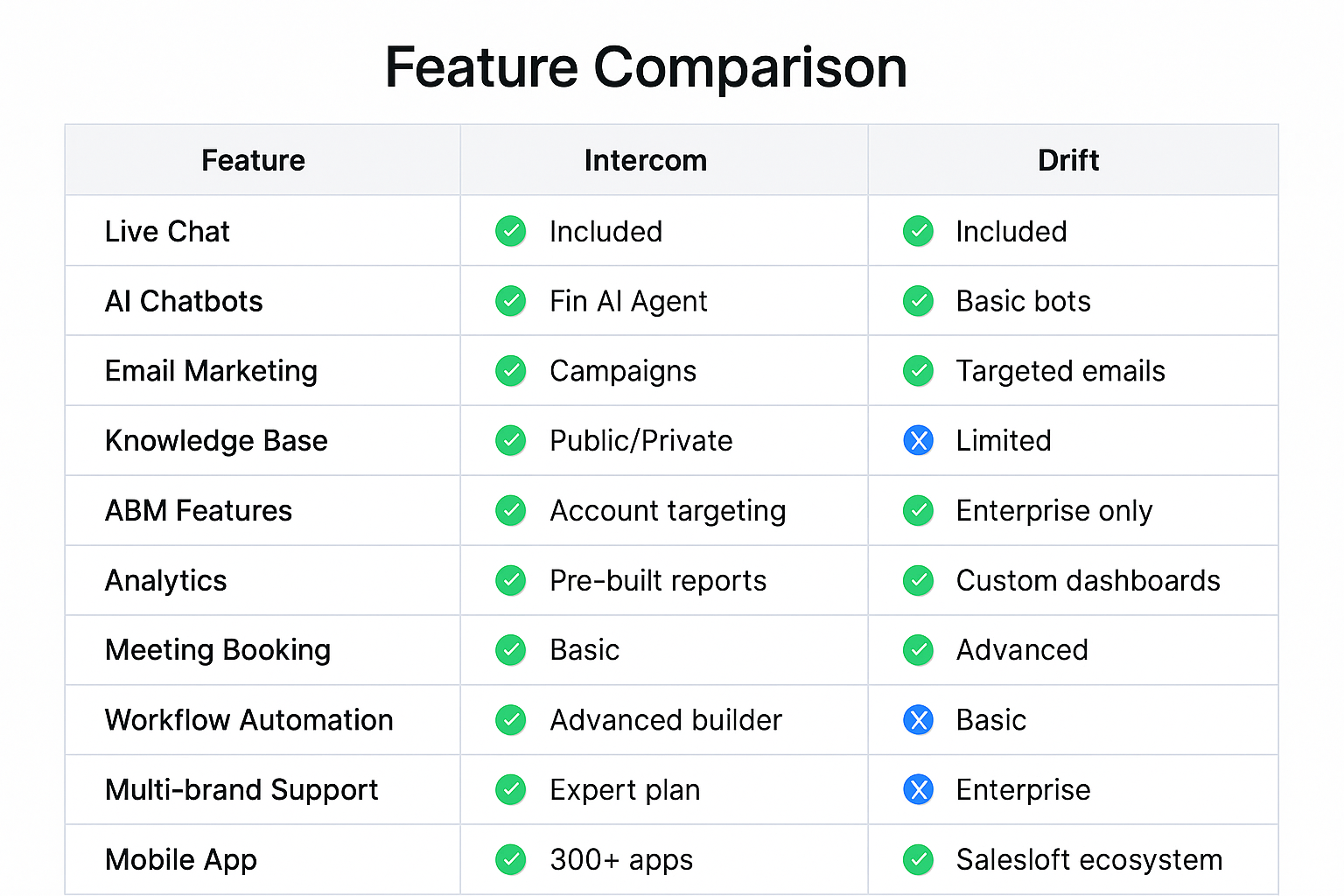
The power of any conversational marketing platform comes down to its features—and how well those features translate into pipeline growth. Both Intercom and Drift bring reliable functionality to the table, but their distinct philosophies shape how each platform approaches live chat, AI, email, knowledge bases, and integrations.
Live Chat and Real-Time Engagement
Both platforms shine at live chat, yet their implementations highlight key differences. Intercom’s live chat is tightly integrated with its customer service suite, creating smooth transitions between automated responses, AI-driven support, and human agents. Its shared inbox ensures full visibility across teams, opening doors for collaboration between marketing, sales, and support.
Customization is another strength. Intercom’s widget can be branded to match company design systems, while its advanced targeting and segmentation enable tailored chat experiences based on firmographics or interaction history. For B2B SaaS businesses juggling diverse customer segments, this level of personalization can lift conversion rates significantly.
Drift’s live chat, meanwhile, is engineered with sales in mind. Its real-time visitor intelligence arms reps with context—company data, prior interactions, and behavioral signals—so they can jump straight into informed conversations. Drift’s chatbots excel at qualifying leads and booking meetings quickly, giving sales teams a pipeline-ready edge.
The difference comes down to intent. Intercom prioritizes context-rich experiences across multiple functions, while Drift zeroes in on rapid qualification and sales enablement. If chat is a cross-functional tool, Intercom may deliver more long-term value; if it’s purely about accelerating pipeline, Drift takes the lead.
AI and Automation Capabilities
This is where the two platforms diverge most sharply. Intercom’s Fin AI Agent is built to handle complexity. It can autonomously resolve up to 86% of customer queries, tackling everything from account management to troubleshooting—even early-stage sales qualification. Its strength lies in natural language processing, contextual memory, and smooth escalation when human support is needed. For SaaS companies, that means initial inquiries are handled intelligently, with qualified leads handed to sales complete with conversation context.
Drift’s AI is more narrowly focused on sales qualification. Its chatbots specialize in asking the right questions, identifying decision-makers, and locking in meetings based on sales rep availability. While less versatile in general service, Drift’s AI is ruthlessly efficient at converting visitors into opportunities.
Beyond chat, Intercom offers a powerful workflow builder that automates across email, in-app messaging, and chat—nurturing leads with content, education, and timely triggers. Drift’s automation doubles down on sales enablement: lead scoring, CRM sync, and instant alerts that empower reps to act on buyer signals.
Email Marketing and Campaign Management
Intercom positions itself as a full-featured email marketing platform. Its campaign builder supports segmentation, automated drips, personalization, A/B testing, and analytics—all designed to complement live chat and in-app messaging. This coordination creates a multi-channel experience that nurtures leads and keeps messaging consistent across touchpoints.
Drift’s email capabilities are leaner. They’re tailored for follow-ups and sales workflows: reminders after chats, personalized outreach tied to meeting scheduling, and email coordination with reps. It may not replace a full marketing automation system, but for teams focused squarely on sales conversations, Drift’s email features deliver where it counts.
Knowledge Base and Self-Service Options
Self-service is critical for reducing chat volume while boosting satisfaction. Intercom’s knowledge base is extensive, supporting public help centers and internal documentation alike. It integrates directly into chat, allowing Fin AI to surface relevant articles on the fly. With multilingual support, it’s ideal for global SaaS companies managing scale.
Drift’s knowledge base tools are more basic. It can pull simple FAQ responses into conversations but lacks the structured content management Intercom provides. The difference reflects philosophy: Intercom prioritizes holistic customer engagement; Drift emphasizes direct sales interactions.
Integration Ecosystem and Extensibility
Integrations determine how smoothly a platform fits into existing tech stacks. Intercom offers 300+ integrations, from Salesforce and HubSpot to analytics and customer success tools. These connections allow for rich data sync, workflow automation, and unified insights across marketing, sales, and support.
Drift’s integration ecosystem is narrower but powerful for companies already on Salesloft. Its native tie-ins let conversation data flow directly into sales cadences, prospect intelligence, and revenue orchestration workflows. For non-Salesloft users, Drift still integrates with major CRMs and marketing systems, but the breadth is more limited compared to Intercom.
Bot Builder Comparison: Ease vs. Sophistication
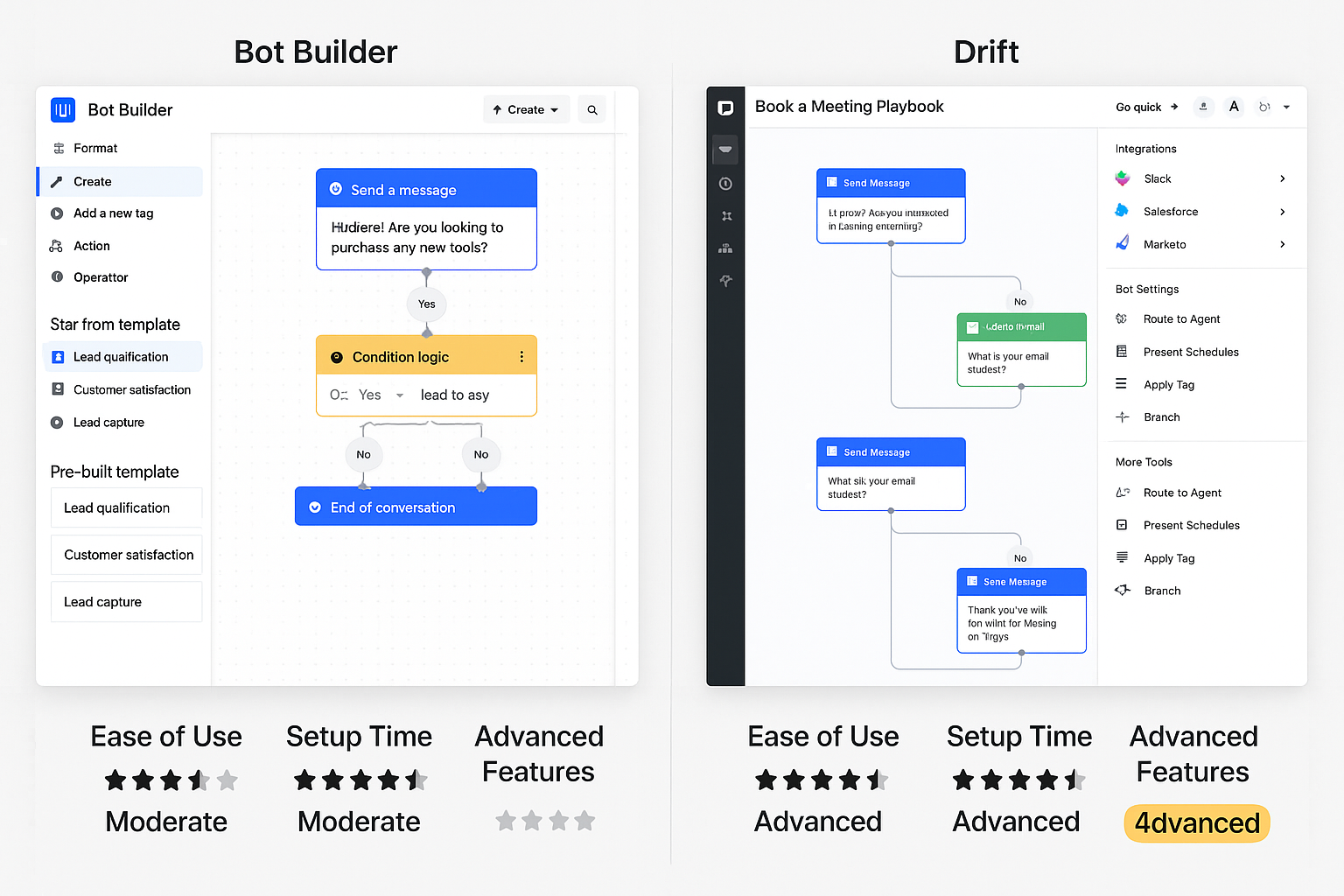
The bot-building experience is often the make-or-break factor in a conversational marketing platform. How quickly your team can implement automation—and how sophisticated those workflows become—depends largely on the builder’s usability, flexibility, and intelligence. Both Intercom and Drift deliver powerful bot-building capabilities, but their approaches reflect very different philosophies.
Bot Builder Comparison
Intercom’s Approach: Simplicity with Power
Intercom has designed its bot builder to be accessible for non-technical teams while still reliable enough to handle complex use cases. Its visual drag-and-drop workflow builder makes it easy to connect message types, conditions, and actions, enabling marketing teams to spin up automated flows without developer support.
What sets Intercom apart is its pre-built templates and guided setup process. Businesses can deploy bots for lead qualification, customer support, or product demos within hours, then customize flows to align with brand voice and goals. This gives teams quick wins while laying the foundation for more advanced automation.
Behind the simplicity is real power. Intercom’s builder supports sophisticated conditional logic based on user behavior, company size, industry, or geography. A startup visitor might see a product demo offer, while an enterprise visitor gets routed to sales immediately. This personalized targeting can dramatically improve engagement and lead quality.
Intercom also gains a unique edge through its integration with the Fin AI Agent. Bots can smoothly hand off conversations to AI when queries become too complex, then escalate to human agents if needed. This tiered approach ensures users always get the right level of support while keeping workflows efficient.
Finally, Intercom makes iteration easy. With built-in analytics on completion rates, drop-offs, and conversions, teams can test, optimize, and improve their bots continuously—a crucial advantage for scaling SaaS businesses.
Drift’s Enterprise-Focused Builder
Drift takes a more advanced, enterprise-oriented approach. Its bot builder is highly customizable, with decision trees that can handle nuanced qualification scenarios across multiple product lines or customer segments. For organizations with complex sales processes, this sophistication is invaluable.
Drift’s integration with the Salesloft Revenue Orchestration Platform takes things further. Bots can access real-time prospect data, update lead scores automatically, and feed conversation insights directly into sales cadences. This means routing decisions aren’t just based on chat responses—they’re powered by comprehensive prospect intelligence.
Meeting scheduling is another standout. Drift’s bots can check real-time calendar availability, resolve conflicts, and send automated confirmations. For sales-focused organizations, this level of automation removes friction, accelerating the path from visitor to booked meeting.
The trade-off? Complexity. Drift’s advanced features often come with a steeper learning curve, requiring more technical expertise or dedicated training. For companies with simpler needs, this sophistication might feel like overkill. But for sales-heavy teams with resources to implement it fully, Drift’s builder unlocks tremendous pipeline potential.
Implementation Complexity and Time-to-Value
When it comes to deployment, the platforms diverge again. Intercom prioritizes quick wins—most businesses can launch functional bots within days using its template library. From trial signups to feature explanations and lead qualification, these pre-built flows accelerate time-to-value while teams learn the platform’s deeper capabilities. Guided setup and best-practice recommendations help avoid common pitfalls.
Drift’s implementation often requires more planning, especially for organizations integrating Salesloft or building complex qualification flows. The setup process may demand dedicated resources or professional services, adding to the initial lift. Yet for companies willing to invest, the payoff is significant: Drift’s bots deliver highly targeted experiences that align closely with sales strategies.
Customization and Brand Alignment
Both platforms offer customization, but with different priorities. Intercom emphasizes brand consistency—customizable chat widgets, branded CSS, and personalized messaging ensure bots feel like a natural extension of a company’s identity. For B2B SaaS brands where credibility matters, this consistency can directly boost conversions.
Drift, meanwhile, leans toward functional customization. While visual options exist, the focus is on building conversation flows that mirror complex sales processes. In practice, Drift prioritizes sales enablement over aesthetics, making it ideal for teams more concerned with performance than brand polish.
Analytics and Optimization Capabilities
Optimization is key to long-term pipeline success. Both platforms provide analytics and A/B testing, but their focus areas differ.
Intercom’s analytics cover broad customer engagement metrics: resolution rates, satisfaction scores, funnel progression, and retention. These insights connect bot performance to the larger customer journey—from trial signups to feature adoption.
Drift’s analytics stay tightly tied to sales outcomes. Metrics include qualification rates, booked meetings, and pipeline contribution. Through Salesloft, Drift also tracks how conversations influence deal progression and revenue attribution.
The result: both platforms empower continuous optimization, but with different lenses — Intercom through customer engagement and lifecycle insights, Drift through pipeline acceleration and revenue outcomes.
Pricing Breakdown: Total Cost of Ownership Analysis
Evaluating the true cost of a conversational marketing platform means looking beyond headline pricing. Implementation, scaling, and hidden costs can all dramatically shape the total cost of ownership. Intercom and Drift take very different approaches to pricing, reflecting their distinct philosophies and target markets. The impact extends far beyond subscription fees.
Intercom’s Resolution-Based Pricing Model
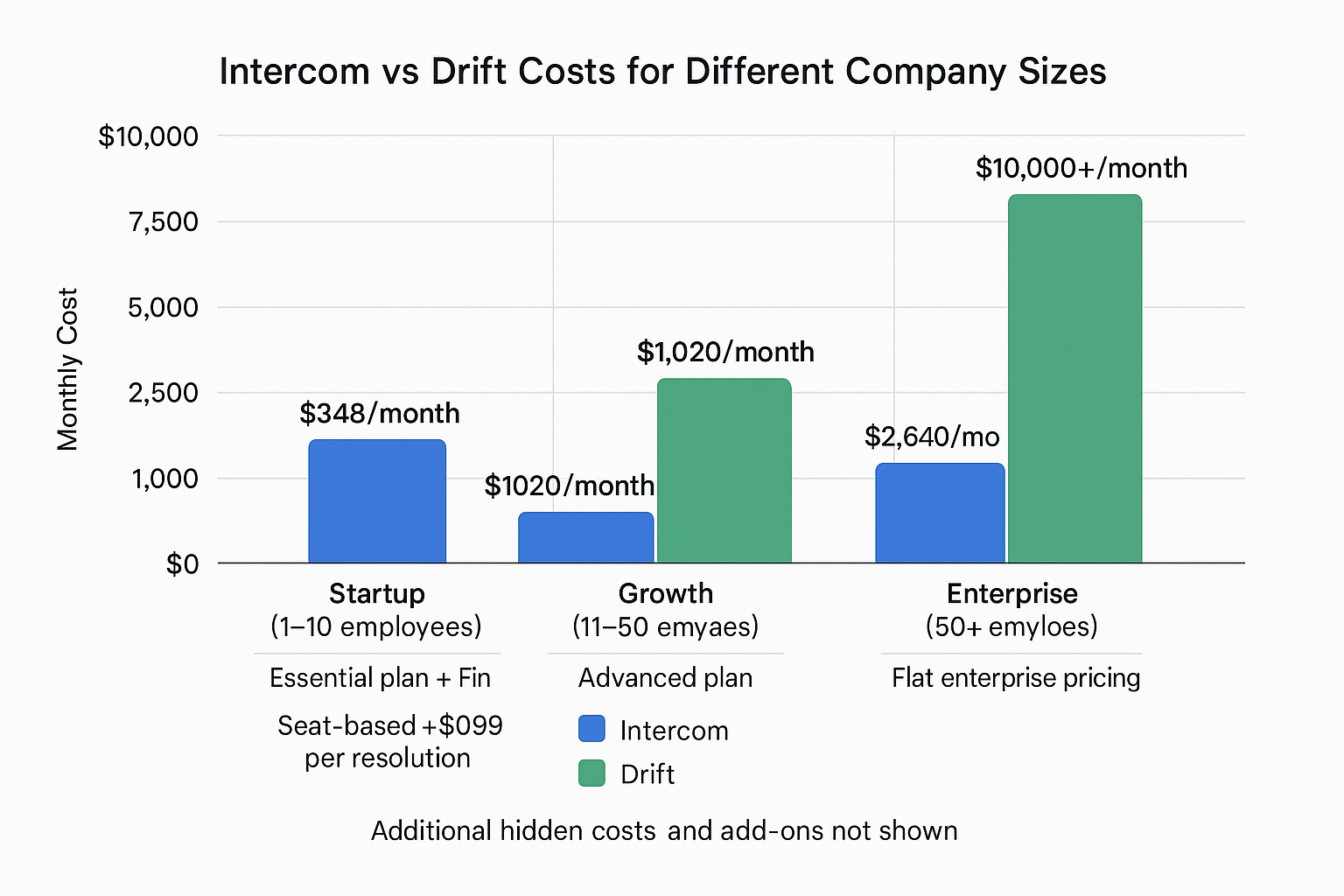
Intercom has redefined platform pricing with its resolution-based model. Instead of charging solely per seat, the company bills $0.99 per AI-resolved conversation alongside seat-based access fees. This ties costs directly to outcomes, making the model appealing for B2B SaaS companies chasing measurable value.
For smaller teams, Intercom’s Essential plan starts at $29 per seat per month (billed annually). It includes the Fin AI Agent, basic live chat, a shared inbox, and reporting tools. Because fees scale with successful AI resolutions, costs remain predictable—and efficiency is rewarded.
The Advanced plan at $85 per seat monthly adds workflow builders, advanced automation, and multiple team inboxes. With 20 free lite seats, it suits growing teams that need broader access without full-feature pricing.
At the top, the Expert plan ($132 per seat monthly) unlocks enterprise-grade capabilities: HIPAA compliance, SSO, multi-brand support, and 50 free lite seats. These features make it viable for enterprises with complex compliance and security needs.
The economics hinge on AI performance. Industry benchmarks suggest well-designed Intercom deployments achieve 70–87% AI resolution rates, making $0.99 per resolution highly cost-effective. For companies that optimize their bots and workflows, this model can generate significant cost savings compared to traditional per-seat models.
Drift’s Enterprise-Focused Pricing
Drift positions itself as a premium, enterprise-first solution—and its pricing reflects that. Costs typically range from $10,000 to $150,000 annually, depending on organization size and feature mix. Its entry-level Premium plan starts at $2,500 per month, signaling a substantial commitment but bundling in advanced automation, ABM, and deep Salesloft integration.
This pricing works best for organizations with dedicated sales teams and sizable lead generation budgets. Drift justifies its higher entry point with sophisticated meeting booking, advanced qualification workflows, and enterprise-grade integrations. For companies chasing high-value deals, the potential returns can outweigh the upfront spend.
At the enterprise tier, Drift layers on features such as custom integrations, advanced ABM, and dedicated success managers. For large-scale operations, these features can be indispensable. For smaller SaaS companies, however, the lack of flexible lower-tier options makes Drift harder to justify.
Hidden Costs and Implementation Considerations
Both platforms involve costs that don’t appear on pricing pages.
Intercom is generally fast to implement, often delivering usable bots within days. But maximizing ROI requires investing in content creation (knowledge base articles, conversation flows) and workflow design. Additional costs may arise from premium integrations or external consulting to fine-tune AI performance.
Drift’s implementation demands more upfront resources. Organizations aiming to exploit Salesloft integrations or complex automation will likely need professional services and extensive training. Salesloft licensing can also add costs for companies not already in its ecosystem, increasing total cost of ownership.
Scaling Considerations and Long-Term Costs
TScaling dynamics are another key distinction:
- Intercom: Resolution-based pricing rewards efficiency. Companies with high AI resolution rates benefit as costs grow only with successful outcomes, not headcount. However, organizations with complex queries or industries where automation struggles may find costs less predictable. Seat-based fees also rise with team expansion, though free lite seats in higher tiers help offset growth.
- Drift: Flat enterprise pricing favors large teams. Costs don’t rise directly with user count, making it more predictable at scale. But the high entry point limits flexibility for smaller organizations, and the lack of budget-friendly tiers restricts adoption for companies with lighter needs.
ROI Considerations and Value Justification
ROI ultimately determines whether a platform is worth the spend. Conversational marketing as a category delivers strong results: industry studies show conversion rate increases averaging 42% after implementation.
Intercom justifies costs through a mix of support efficiency, improved customer satisfaction, and higher lead conversion rates. With its detailed analytics, companies can track ROI across multiple touchpoints—from first interaction to retention.
Drift demands greater returns to offset its premium pricing, but it shines in the right context. For businesses with complex sales cycles and high deal values, Drift’s focus on sales qualification and meeting booking can accelerate revenue enough to validate the investment.
The lesson is clear: achieving ROI depends less on the sticker price and more on implementation quality, continuous optimization, and strategic alignment. Companies that treat conversational marketing as a revenue-driving initiative, not just a tactical tool, are the ones that consistently justify platform spend.
Performance Metrics: Real-World Results and Benchmarks
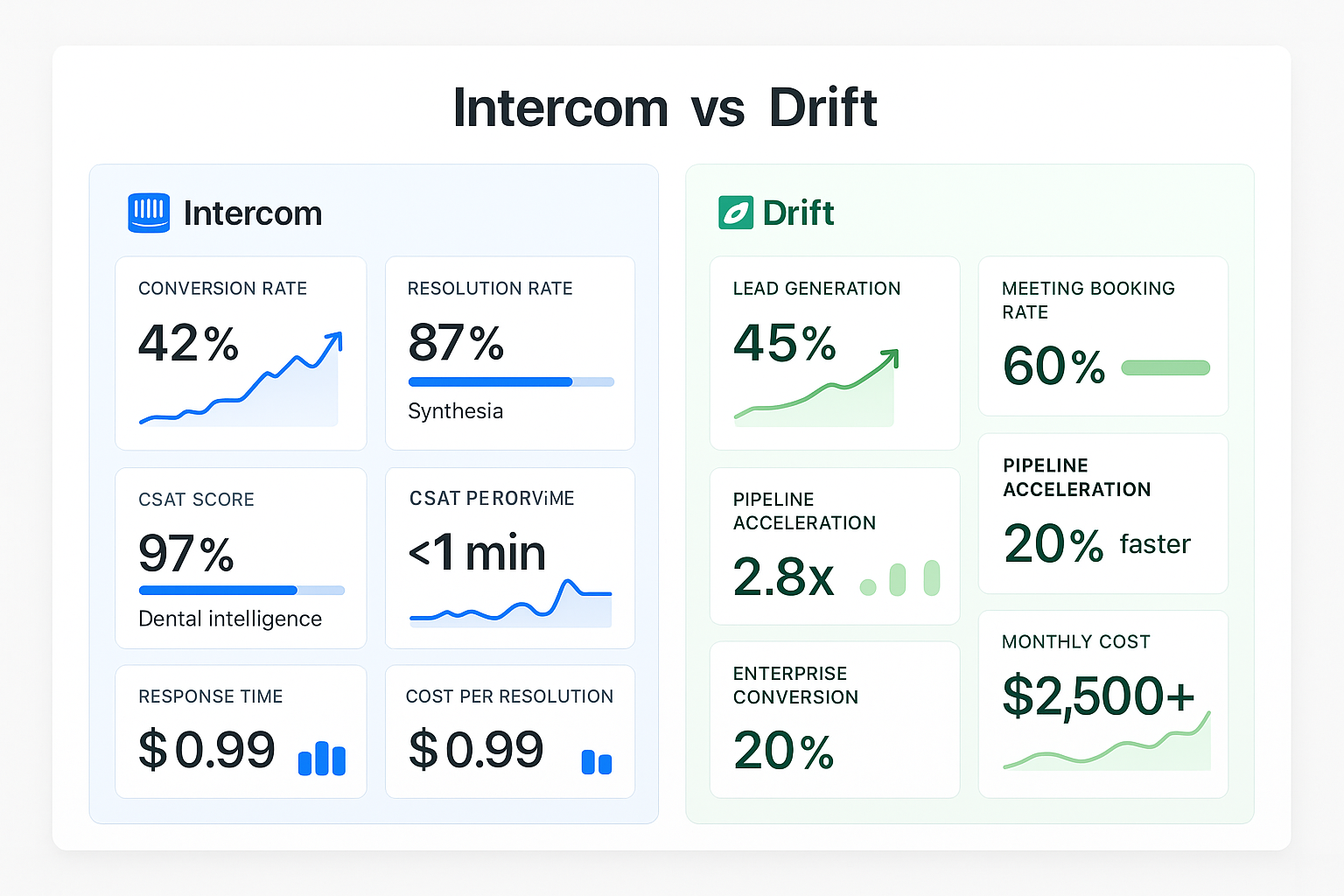
The true value of a conversational marketing platform is measured by outcomes. Both Intercom and Drift have extensive performance data from customers across industries, offering a clear picture of how these tools influence pipeline generation and revenue growth.
Conversion Rate Performance and Industry Benchmarks
Conversion rates are the clearest proof point for conversational marketing success. Industry data shows companies see an average 42% lift when adopting conversational strategies, with live chat alone driving 40% conversion rates among engaged visitors.
Intercom delivers notable wins here. Synthesia, the AI video platform, achieved outstanding results within six months: 6,000+ conversations resolved by Fin AI and self-serve support rates climbing to 87%. The outcome? Higher customer satisfaction and freed-up agents able to focus on complex sales opportunities.
In financial services, Sharesies, an investment platform, hit a 70% resolution rate with Fin AI, cutting response times while keeping satisfaction high. Faster onboarding translated directly into more account signups and stronger conversion outcomes.
Drift, in contrast, emphasizes sales-driven benchmarks. Customers frequently report meeting booking rates above 60% for qualified conversations. Integrated with Salesloft, Drift enables attribution analysis that links chat activity to broader sales outcomes. Many users report 2.8x faster pipeline acceleration and 20%+ improvements in enterprise conversion rates when chat data feeds directly into revenue workflows.
Customer Satisfaction and Experience Metrics
Customer satisfaction scores (CSAT) are equally critical—they influence retention, referrals, and long-term value.
Intercom’s AI-first model has delivered standout CSAT results across sectors. Dental Intelligence achieved a 97% CSAT score for AI-handled interactions, proving automation can be both efficient and high-quality. Culture Amp reported a 95% global CSAT score across AI and human conversations, underscoring how Intercom’s unified system maintains consistency across channels.
Speed also matters. With 69% of customers valuing fast replies above all else, Intercom’s ability to respond in under one minute for most queries sets a strong benchmark.
Drift approaches satisfaction through a sales lens. Its strongest CSAT results come from prospects engaging with sales-focused chatbots, particularly when conversations end in successful meeting bookings.
Lead Quality and Sales Impact Metrics
Quantity of leads is one thing; quality determines ROI. Research shows 99% of B2B marketers report chatbots improve lead-to-customer conversion, with 56% seeing 10%+ gains and 17% seeing 20%+ gains.
Intercom combines AI screening with human handoffs, ensuring reps receive well-qualified leads enriched with context. With CRM sync and automated scoring, conversational data becomes fuel for broader sales strategies.
Drift takes a direct route: its chatbots excel at spotting high-intent visitors and routing them to sales immediately. This focus leads to higher meeting show rates and improved conversion among chat-generated opportunities.
Cost Efficiency and Resource Optimization
Operational efficiency is another measure of impact. Chatbot automation can cut support costs by up to 30% and handle 80% of repetitive queries, according to industry data.
For Intercom, resolution-based pricing ties directly to these efficiencies. Synthesia, for example, saved 1,300+ hours in just six months, reallocating resources from routine tasks to strategic initiatives.
The result is more than cost savings. Support teams can prioritize complex problem-solving, while sales reps focus on nurturing and closing high-value prospects instead of sifting through raw inquiries.
Implementation Speed and Time-to-Value
Time-to-value can make or break ROI.
Intercom’s guided setup and template library allow most organizations to deploy bots within days. Linktree saw Fin resolving 42% of conversations within six days, a striking example of how quickly value can be realized. Its pre-built integrations and strong documentation shorten the path to ROI even further.
Drift requires more upfront planning. Configuring advanced automation and Salesloft integrations takes time and resources. But for organizations that commit, the payoff is substantial: highly tailored sales workflows that deliver a competitive edge.
Long-Term Performance Trends
Both platforms demonstrate lasting value when optimized over time.
Intercom’s AI improves with use, learning from conversations and steadily boosting resolution rates. Many companies see performance gains increase the longer they run the platform.
Drift’s Salesloft integration powers continuous sales workflow refinement. As teams optimize qualification flows and handoffs, conversion rates climb further—proving Drift’s depth pays off in sales-driven environments.
The takeaway: long-term success depends on continuous optimization. Businesses that treat conversational marketing as a living strategy, not a one-time setup, achieve the strongest results with both Intercom and Drift.
ABM Capabilities: Account-Based Marketing Excellence
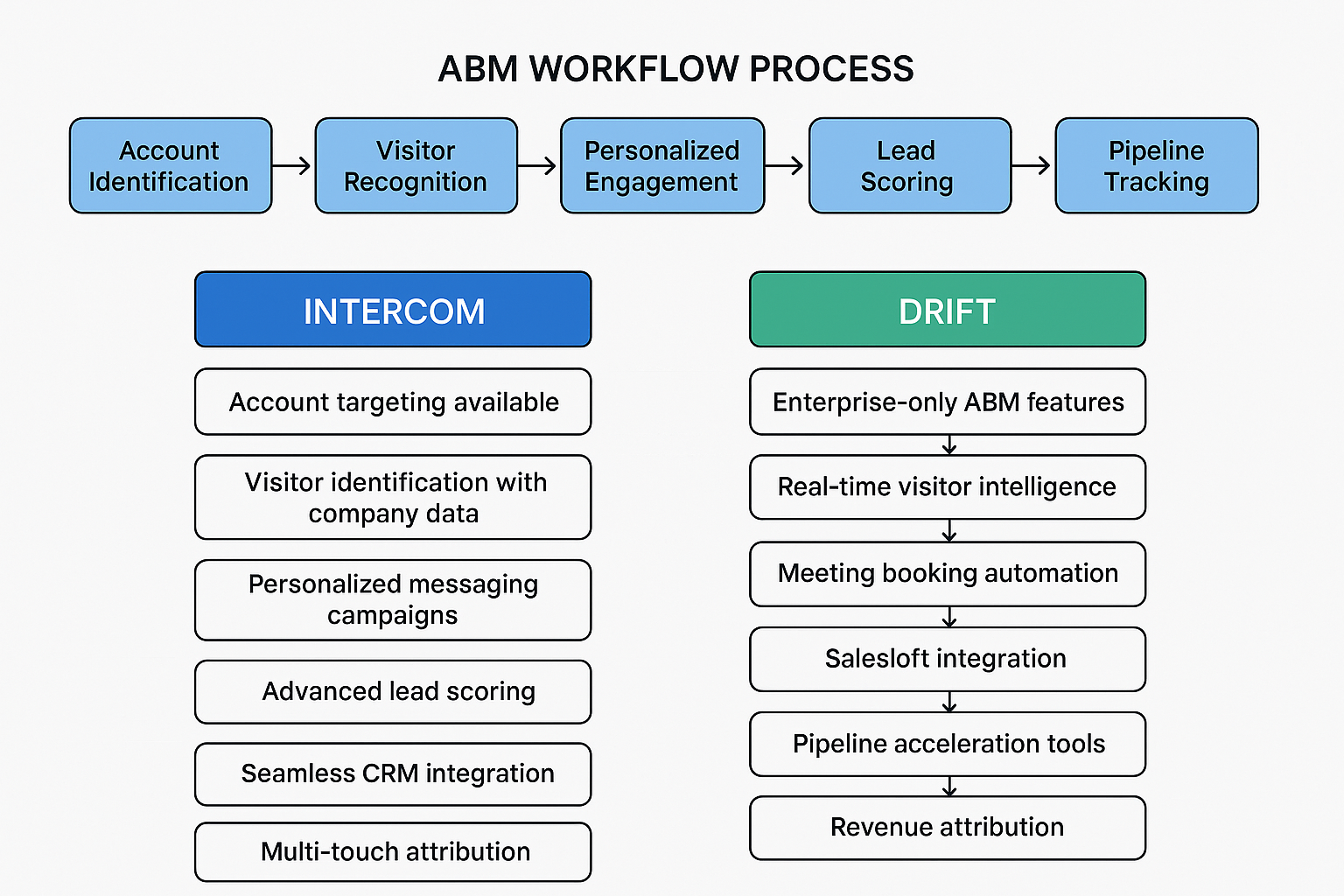
Account-based marketing (ABM) has become essential for B2B SaaS companies targeting enterprise customers. Conversational marketing platforms now play a pivotal role in ABM execution. The ability to identify, engage, and nurture high-value accounts through personalized chat experiences can dramatically affect pipeline quality and deal velocity.
ABM Capabilities Flowchart
Account Identification and Visitor Intelligence
ABM starts with knowing who’s on your site and what context they bring. Both Intercom and Drift offer visitor identification, but their depth and execution differ.
Intercom integrates account identification into its broader customer data platform. It recognizes visitors through email addresses, company domains, IPs, and past interactions, creating a multi-layered view of account context. This enables personalized conversations from the very first touch.
Its integrations with ABM leaders like Demandbase and 6sense enrich data further with firmographics, technographics, and intent signals. That means a chatbot can reference industry-specific challenges or even competitive context when engaging with key accounts.
Drift, meanwhile, emphasizes real-time visitor intelligence. It alerts sales reps instantly when someone from a target account lands on the site, arming them with company data, past conversations, and behavioral insights. Integrated with Salesloft, Drift extends this intelligence with email engagement history, account progression, and prior sales touches—ensuring conversations build on established relationships rather than starting cold.
Personalized Engagement Strategies
Personalization is the lifeblood of ABM. Both platforms deliver, but with different strengths.
Intercom offers cross-channel personalization—chat, email, in-app messaging, and targeted content. Workflows adapt conversation paths based on account traits, past interactions, or engagement signals. For enterprises, Intercom can reference company-specific details, industry challenges, or competitive positioning, crafting conversations that feel uniquely tailored.
Fin AI enhances this further, dynamically adjusting tone, depth, and call-to-action timing depending on visitor responses. This adaptability helps create conversations that resonate with decision-makers at enterprise accounts.
Drift zeroes in on sales-focused personalization. Its bots adapt qualification questions by account size, industry, or interaction history. With Salesloft context, Drift can reference earlier sales calls, specific pain points, or known stakeholders, ensuring continuity in sales-driven conversations.
Lead Scoring and Qualification
Lead scoring is critical in ABM, and here the platforms diverge again.
Intercom combines conversation insights with broader customer data to build holistic profiles. It tracks engagement across multiple channels and dynamically adjusts scores based on conversation quality, response depth, and behavior. Integrated with marketing automation systems, Intercom enables long-term nurturing campaigns—ideal for multi-touch enterprise sales cycles.
Drift’s lead scoring focuses tightly on sales readiness. Its algorithms analyze conversation patterns and engagement signals to highlight accounts most likely to convert. Salesloft integration adds another layer, factoring in prior outreach and account progression. This approach gives sales teams a prioritized list of accounts with the highest immediate revenue potential.
Sales Handoff and Coordination
The moment when marketing passes leads to sales can make or break ABM. Both platforms handle handoffs differently.
Intercom emphasizes context-rich collaboration. Its shared inbox ensures all teams see conversation history, while workflows automatically update CRM records, create tasks, and send alerts. Sales teams inherit full context—not just a name and email—ensuring smoother follow-up.
Drift optimizes for speed and efficiency. Bots route qualified accounts instantly to the right rep, based on territory, expertise, or ownership. With Salesloft, handoff becomes even more powerful: prospects are enrolled directly into cadences, follow-ups are scheduled, and opportunity records updated automatically. No manual handoff required, no leads slipping through the cracks.
Account-Based Reporting and Analytics
Measurement drives ABM success. Both platforms provide analytics, but with different emphases.
Intercom delivers account-level insights across channels. Dashboards track engagement trends, conversation quality, and progression through ABM stages. Integrated with ABM platforms, it provides attribution analysis, linking conversations to pipeline movement and revenue outcomes.
Drift keeps its lens tighter on sales impact. Its dashboards prioritize metrics like meeting booking rates, qualification efficiency, and pipeline contribution. Salesloft integration adds attribution tied to deal progression, cycle length, and win rates—metrics enterprise sales leaders care about most.
Integration with ABM Technology Stack
A conversational marketing platform’s ABM power often depends on how well it integrates with the broader tech stack.
Intercom boasts a wide ecosystem with Demandbase, 6sense, Terminus, and more. These integrations enrich targeting and enable coordinated campaigns across multiple channels. Its API gives flexibility for custom ABM integrations, supporting organizations with unique data needs.
Drift, while narrower, offers deep alignment with Salesloft. For companies invested in that ecosystem, the synergy is unmatched—chat data flows directly into sales workflows. Drift also supports other ABM and CRM tools but leans heavily toward sales enablement rather than broad marketing orchestration.
Use Case Analysis: Support, Sales, and Marketing Applications
The versatility of conversational marketing platforms makes them applicable across multiple business functions. However, the degree of effectiveness differs depending on the platform, the use case, and organizational priorities. Evaluating how Intercom and Drift perform across support, sales, and marketing is essential to making an informed decision.
Customer Support Excellence
Customer support is one of the most established applications for conversational marketing, with clear success metrics and proven best practices. The ability to deliver instant answers, automate repetitive queries, and escalate complex issues appropriately has a direct impact on both customer satisfaction and operational efficiency.
Intercom’s support strengths reflect its AI-first philosophy. The Fin AI Agent can resolve complex issues by pulling in customer data, referencing knowledge base articles, and even performing account-level actions—all without human intervention. Customers benefit from fast, accurate responses while agents are freed to focus on nuanced or high-value inquiries.
Support conversations in Intercom can also transition smoothly across channels. A customer may start with a chatbot on the website, continue via in-app messaging, and finish over email—with the full conversation history intact. This flexibility ensures consistency and context, regardless of channel.
The shared inbox is another advantage. It fosters collaboration with features like internal notes, conversation assignment, and escalation workflows, ensuring that complicated issues are routed quickly to the right people. On the reporting side, Intercom provides insights into response times, resolution rates, CSAT scores, and agent productivity, enabling managers to fine-tune support processes continuously.
For B2B SaaS companies, these support capabilities can directly affect retention and expansion. Intercom not only prevents churn but also enables upsell opportunities. By surfacing potential sales signals during support interactions, it helps turn service conversations into revenue-generating moments.
Drift’s support capabilities are intentionally lighter. The platform can handle FAQs and basic queries, and it allows routing to human reps for complex issues, but it does not have Intercom’s depth in customer service. Still, for organizations that already have a dedicated support system, Drift may suffice as a supplemental tool. Its real edge is in spotting sales opportunities within support chats and routing them instantly to the sales team.
Sales Enablement and Lead Generation
Sales enablement is Drift’s core strength. The platform is designed to capture visitors, qualify leads, and accelerate meetings. Its chatbots guide prospects through structured qualification conversations, automatically route them to the right rep, and even handle scheduling in real time. This reduces friction and ensures reps spend more time with high-intent buyers.
The real-time visitor intelligence built into Drift is especially powerful for sales teams. Representatives can see company details, behavioral signals, and past interactions while a visitor is live on the site, enabling informed engagement in the moment. The meeting booking automation is highly sophisticated—bots check rep calendars, resolve conflicts, send confirmations, and trigger reminders. For companies where deals hinge on sales conversations, these features are game-changing.
Drift’s Salesloft integration takes this further by feeding chat data into broader sales workflows. Prospects can be automatically enrolled into cadences, and chat transcripts can inform personalized follow-up. This synergy between conversational marketing and sales orchestration drives efficiency and accelerates deal cycles.
Intercom’s sales enablement is less narrowly focused but broader in scope. It identifies opportunities across touchpoints—whether in support conversations, marketing campaigns, or direct inquiries—and provides sales teams with context-rich handoffs. Intercom’s strength lies in nurturing prospects across longer B2B buying cycles, where multiple touchpoints and extended engagement are the norm.
Its AI capabilities add further value by scoring leads, analyzing conversations, and surfacing buying signals. This helps sales teams prioritize follow-ups while keeping nurturing efforts aligned with the customer’s stage in the journey.
Marketing Automation and Campaign Management
Marketing automation showcases another sharp contrast between the two platforms. The ability to coordinate conversations with broader campaigns determines how well companies can nurture leads and build pipeline momentum.
Intercom functions as a comprehensive marketing automation system. It orchestrates campaigns across chat, email, in-app messaging, and targeted content delivery. Workflows adapt based on visitor behavior, engagement signals, and conversation outcomes, enabling complex, multi-step campaigns tailored to account context.
Its segmentation capabilities are advanced, supporting targeting by customer profile, behavior, and interaction history. This precision makes ABM campaigns more effective by ensuring that messaging is consistently relevant. Intercom’s analytics provide cross-channel attribution and performance tracking, giving marketers visibility into how conversations contribute to campaign goals and revenue.
Drift, meanwhile, stays true to its sales-first DNA. Its marketing automation is streamlined, with a clear emphasis on lead generation and sales handoff. Drift is excellent at surfacing marketing qualified leads (MQLs), qualifying them, and routing them directly to reps. It does not attempt to be a full marketing automation platform, but in organizations with shorter sales cycles and direct deal processes, this focused approach delivers strong results.
Implementation Complexity and Best Practices
The success of any conversational marketing initiative depends on more than just technology. Proper implementation, ongoing optimization, and alignment with broader business goals are essential. Both Intercom and Drift can be deployed relatively quickly, but their requirements, complexity, and best practices differ based on use cases and organizational maturity.
Technical Implementation Requirements
Both platforms support straightforward deployment, though the level of complexity depends on the functionality desired and the integrations required. Planning resources and timelines upfront ensures smoother rollout.
Intercom’s implementation typically starts with embedding a basic chat widget via a simple JavaScript snippet or CMS plugin. Guided setup walks organizations through initial configuration and offers best-practice recommendations, enabling quick wins from day one.
More advanced use cases—such as AI automation, workflow orchestration, and large-scale integrations—may require additional technical resources. Fortunately, Intercom’s reliable API documentation and developer tools support custom integrations for organizations with unique requirements. Its extensive ecosystem of 300+ integrations also means most businesses can connect their existing stack without custom development. For companies with proprietary tools or niche systems, however, custom integration work may still be necessary.
Drift’s implementation tends to be more complex, particularly for organizations planning to use Salesloft integration or sophisticated automation workflows. Its enterprise orientation often necessitates professional services or dedicated technical staff to configure the system properly. While powerful, the Salesloft integration introduces another layer of setup—organizations must coordinate between both platforms to ensure data synchronization, sales cadence alignment, and accurate reporting.
Organizational Change Management
Technical setup is only half the challenge. Success also requires organizational change management to align people, workflows, and metrics.
Intercom demands cross-functional coordination across marketing, sales, and customer success. Teams must establish clear rules for conversation routing, escalation, and collaboration, since conversations may span multiple departments. Its AI-driven model also requires upfront investment in content creation and conversation design—building knowledge base articles, structured conversation flows, and escalation procedures to maintain automation quality.
Training requirements are moderate. Most users can become proficient quickly, but maximizing the platform’s AI, workflows, and reporting features may require more specialized training and ongoing optimization.
Drift’s organizational change requirements are more sales-centric. Implementation revolves around sales team workflows, lead qualification, and meeting booking protocols. Organizations must clearly define qualification criteria, ownership rules, and follow-up responsibilities.
Because Drift’s advanced features are designed for conversational sales enablement, training often needs to be more extensive, especially for teams unfamiliar with real-time chat engagement. Many organizations benefit from structured training programs or professional services to ensure sales reps adopt best practices and maximize performance.
Success Metrics and Optimization
No conversational marketing rollout is complete without defining success metrics and implementing a process for continuous improvement. Both Intercom and Drift provide reliable analytics, but their emphasis reflects their different philosophies.
Common success metrics include conversation volume, conversion rates, lead quality, CSAT scores, and revenue attribution. Organizations should tailor KPIs to their primary goals whether those are support efficiency, marketing impact, or sales acceleration.
Intercom’s analytics cover a wide spectrum of use cases. Businesses can measure support efficiency, track marketing campaign effectiveness, and evaluate sales conversion rates—all within a unified platform. Its funnel analysis also helps tie conversational data to larger customer lifecycle outcomes.
Drift’s analytics, by contrast, are optimized for sales performance. Its dashboards track meeting booking rates, qualification efficiency, and pipeline contribution. With Salesloft integration, organizations gain attribution insights that connect conversations directly to deal progression, sales cycle length, and revenue outcomes.
Sustained success requires continuous optimization. Regularly reviewing data, running A/B tests on conversation flows, and refining automation rules ensure bots and workflows remain effective. Organizations that treat conversational marketing as a living capability, not a one-time deployment, consistently achieve stronger results over time.
The key to long-term success lies in establishing regular review cadences, ongoing training, and staying updated on best practices. Platforms like Intercom and Drift evolve rapidly, and organizations that evolve with them will see the greatest ROI.
Customer Success Stories: Real-World Impact
The most convincing evidence of a conversational marketing platform’s value comes from real-world results. Both Intercom and Drift showcase compelling case studies that illustrate how their solutions drive measurable impact on pipeline generation, customer satisfaction, and overall business growth.
Intercom Success Stories
Synthesia: Scaling AI Video Platform Support
Synthesia, a leading AI video generation platform, needed to scale customer support rapidly without compromising quality. By deploying Intercom’s Fin AI Agent, the company was able to handle a growing volume of inquiries while keeping its support team lean.
Within six months, Fin had resolved over 6,000 conversations, saving more than 1,300 hours of manual work. AI-driven automation pushed self-serve support rates to 87%, allowing human agents to focus on complex technical queries and relationship building.
Response times improved dramatically, with customers receiving immediate answers instead of waiting for agent availability. This led to stronger customer experiences, higher retention rates, and positive referrals—directly supporting Synthesia’s rapid growth objectives.
Culture Amp: Global Customer Success at Scale
Culture Amp, a people analytics platform with a worldwide customer base, needed consistent, high-quality support across time zones and languages. Using Intercom’s customer communication suite, the company delivered smooth support experiences regardless of location or complexity.
The results were striking: a 95% global CSAT score across both AI and human-assisted interactions, proving that automated and human conversations could maintain consistently high standards. Intercom’s multilingual support capabilities further ensured customers felt understood and supported.
Beyond support metrics, Culture Amp leveraged Intercom to identify upsell opportunities during service interactions. Coordinating these with sales teams led to higher customer lifetime value and expansion revenue, highlighting Intercom’s ability to turn service into a growth driver.
Dental Intelligence: Healthcare Industry Excellence
Dental Intelligence, a provider of dental practice management software, required a support solution capable of resolving complex technical issues while meeting the high standards expected in healthcare technology. By adopting Intercom’s AI-powered support, the company delivered fast, accurate, and compliant assistance.
The results included a 97% CSAT score for AI-handled conversations, validating that automation could match healthcare’s rigorous quality requirements. Intercom’s ability to access customer data and personalize responses strengthened trust and improved relationships.
At scale, Dental Intelligence balanced efficiency with a personal touch—reducing manual workloads while maintaining the attentive service healthcare customers expect. Insights from Intercom’s analytics also helped the company identify recurring issues, feeding directly into product improvements and customer success strategies.
Drift Success Stories
Enterprise SaaS Lead Generation
A large enterprise software provider turned to Drift to improve website conversions and accelerate its sales funnel. Previously reliant on static forms and delayed follow-ups, the company faced significant lead leakage and slow cycles.
After implementation, Drift delivered a 45% lift in lead generation and a 60% increase in meeting bookings. Real-time engagement with high-intent visitors drastically reduced delays between interest and sales outreach.
By integrating with Salesloft, the company coordinated chat insights with broader engagement workflows. This synergy accelerated pipeline progression by 20% and boosted sales team efficiency, proving Drift’s power as a pipeline acceleration tool.
B2B Technology Company Pipeline Acceleration
A B2B tech company specializing in data analytics needed to improve its ABM programs and shorten enterprise sales cycles. With Drift’s advanced qualification features, the company identified decision-makers and technical evaluators early in the process, reducing time spent in initial discovery.
Automated meeting booking workflows eliminated scheduling friction and improved show rates, enabling sales teams to focus on closing rather than chasing appointments.
The results: 2.8x faster pipeline acceleration and a 20% improvement in enterprise conversion rates. Analytics also revealed prospect behaviors and preferences, helping refine both sales and marketing strategies moving forward.
Professional Services Firm Client Acquisition
A professional services firm specializing in digital transformation consulting adopted Drift to modernize its client acquisition process. Previously dependent on referrals and networking, the firm needed scalable outreach.
Drift’s conversational approach enabled consultative, expertise-driven conversations with prospects. Its advanced qualification logic filtered out poor fits while surfacing those with real transformation needs and budgets.
The payoff: a 35% increase in qualified leads and a 50% boost in consultation bookings. The firm also gained actionable insights into market trends and client pain points from chat data, shaping future service offerings and positioning.
How Delverise Can Help
Choosing the right tools and strategy is only the first step — executing effectively is what separates high-growth teams from the rest. At Delverise, we help B2B SaaS companies build and optimize their revenue engines, from tool selection and implementation to full GTM execution.
Whether you’re evaluating intercom vs drift, building your sales tech stack, or scaling your go-to-market operations, our team combines RevOps strategy with hands-on engineering to deliver measurable results.
Ready to build a revenue engine that actually scales? Reach out to Delverise about your GTM strategy.
Making the Right Choice for Your Organization
The decision between Intercom and Drift depends on your organization’s specific needs, priorities, and long-term objectives. Both platforms deliver powerful conversational marketing capabilities, but their different philosophies and strengths make them better suited to different business models and use cases.
When to Choose Intercom
Intercom is the right choice for organizations seeking a comprehensive customer communication platform that goes beyond sales. Its strength lies in unifying customer interactions across support, marketing, and sales within one cohesive system.
Choose Intercom if you:
- Prioritize consistent customer experiences across multiple channels.
- Need reliable support capabilities alongside conversational marketing.
- Want predictable, outcome-based pricing through its resolution-based model.
Intercom is particularly attractive for B2B SaaS companies in growth mode, where scaling customer interactions efficiently is crucial. Its extensive integration ecosystem, flexible seat-based pricing tiers, and AI-first approach make it accessible to organizations of various sizes and technical maturity.
For companies willing to invest in content creation and proper implementation, the rewards can be significant. High AI resolution rates mean costs scale with success—not headcount—making Intercom especially cost-effective for teams that optimize their workflows.
When to Choose Drift
Drift excels as a specialized conversational sales platform, designed for organizations with dedicated sales teams, larger budgets, and complex deal cycles. Its focus on sales enablement makes it invaluable for companies closing high-value deals that demand rapid engagement and qualification.
Choose Drift if you:
- Operate sophisticated sales operations with advanced qualification needs.
- Have existing investments in Salesloft or want deep integration with a sales engagement ecosystem.
- Require enterprise-level ABM capabilities and reliable meeting booking automation.
Drift’s premium positioning reflects its specialization. It’s best suited for established B2B enterprises with substantial technology budgets, dedicated sales and marketing teams, and the resources to implement advanced workflows. For organizations that maximize its specialized capabilities, Drift often delivers pipeline acceleration and ROI that justify the higher upfront cost.
Implementation Recommendations
Regardless of which platform you choose, success depends on careful planning, proper resourcing, and ongoing optimization.
- Start with clear objectives and defined success metrics.
- Deploy basic functionality first, then expand to advanced automation over time for quick wins and long-term value.
- Invest in training and change management—even the most advanced platform will underperform if teams don’t know how to use it effectively.
- Establish regular review processes to refine conversation flows, workflows, and success metrics.
The most successful organizations treat conversational marketing not as a one-off implementation but as an evolving capability that matures with ongoing optimization.
Future Considerations
The conversational marketing landscape continues to evolve rapidly. Advances in AI, natural language processing, conversation intelligence, and automation will expand platform potential in the coming years. Both Intercom and Drift are investing heavily in these areas, promising ongoing improvements in capability and accuracy.
Integration ecosystems will also grow in importance. Platforms that connect smoothly with CRM, ABM, marketing automation, and sales orchestration tools will provide more long-term value as customer engagement strategies become increasingly connected.
Finally, customer expectations are rising fast. Buyers now demand instant, personalized, and smooth conversations with brands. Organizations that invest in conversational marketing today—whether through Intercom, Drift, or a combination of tools — will be best positioned to meet these evolving expectations, accelerate pipeline generation, and sustain growth in the years ahead.
Optimize Your Conversational Marketing Strategy
Selecting between Intercom and Drift is only part of the equation. The real challenge—and opportunity—lies in implementing conversational marketing in a way that drives measurable pipeline growth, aligns with sales processes, and adapts to evolving customer expectations.
If you’re considering how to translate this analysis into a tailored strategy for your organization, it may be worth talking it through with experts who’ve guided similar decisions. A short conversation can help clarify which platform fits best, what to prioritize first, and how to avoid common pitfalls.
[a]Alternative Meta Title:
Intercom vs Drift Comparison: Pipeline ROI Analysis 2025
Alternative Meta Description:
Comprehensive Intercom vs Drift comparison for marketing leaders. Real conversion data, pricing breakdown, feature analysis, and customer success stories.
Related Articles
- Lead Generation Strategies for Startups
- Inbound Lead Generation for B2B SaaS
- How to Create a Successful CRO Strategy
- ActiveCampaign vs HubSpot
- Why Marketing Automation Is A Game Changer