Most B2B SaaS companies treat brand marketing and performance marketing as separate functions. Brand builds awareness. Performance drives pipeline. They share a budget, rarely share a strategy, and often compete for the same resources.
The result is predictable: brand campaigns that can’t prove ROI get cut when budgets tighten, and performance campaigns that optimize for clicks produce leads that never convert because no one trusts the company behind the ad.
Performance branding solves this by treating brand and demand as a single system. Every campaign builds recognition and drives measurable pipeline. Every piece of content strengthens positioning and captures intent.
This guide covers how B2B SaaS companies implement performance branding — including the framework, the metrics, the common mistakes, and when it makes sense to bring in outside help.
What Is Performance Branding?
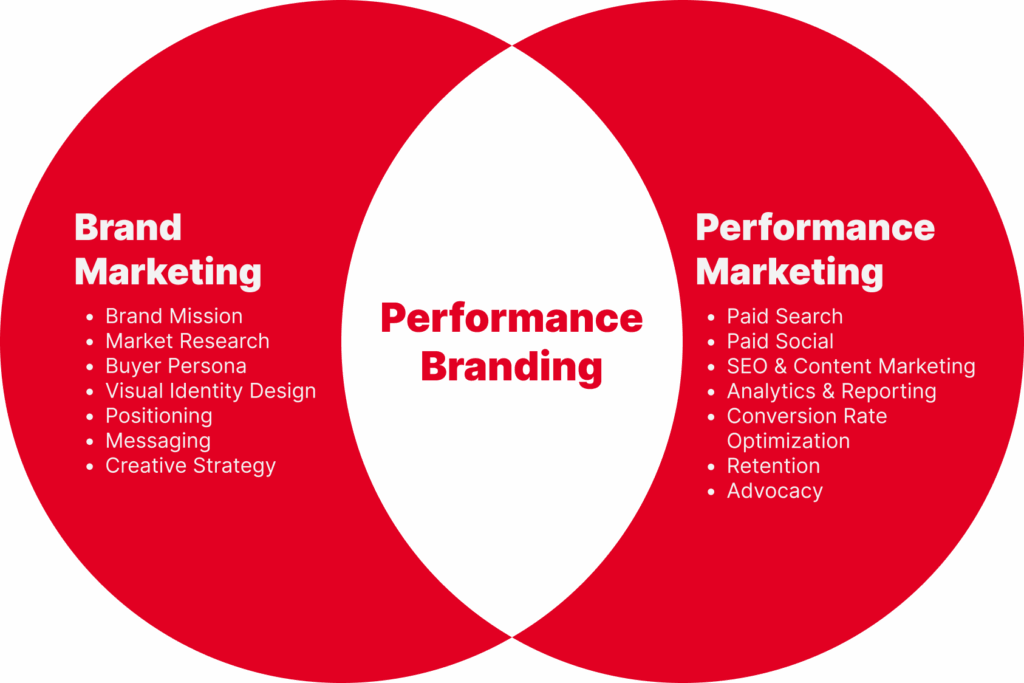
Performance branding is a marketing strategy that merges brand-building with data-driven demand generation. Instead of running brand campaigns and performance campaigns independently, you design every marketing activity to accomplish both simultaneously.
Brand marketing alone builds recognition, trust, and emotional connection — but struggles to prove direct revenue impact. The KPIs (brand awareness, sentiment, share of voice) are real but hard to tie to pipeline.
Performance marketing alone drives measurable actions — clicks, sign-ups, demos — but burns out quickly when nobody knows or trusts your company. You end up paying more for every conversion because you’re starting from zero credibility each time.
Performance branding aligns both: every campaign builds brand equity while driving measurable outcomes. The key insight is that brand and performance aren’t opposing forces — they’re compounding growth levers that make each other more effective over time.
For B2B SaaS companies specifically, this matters because:
- Long sales cycles — Enterprise deals take 3-12 months. Buyers need to trust your brand long before they request a demo.
- Multiple stakeholders — The average B2B purchase involves 6-10 decision makers. Brand recognition shortens internal selling.
- High switching costs — SaaS buyers commit to tools for years. Trust reduces perceived risk.
- Crowded categories — Most SaaS categories have 20+ competitors. Brand is the tiebreaker when features are comparable.
Why B2B SaaS Companies Get Performance Branding Wrong
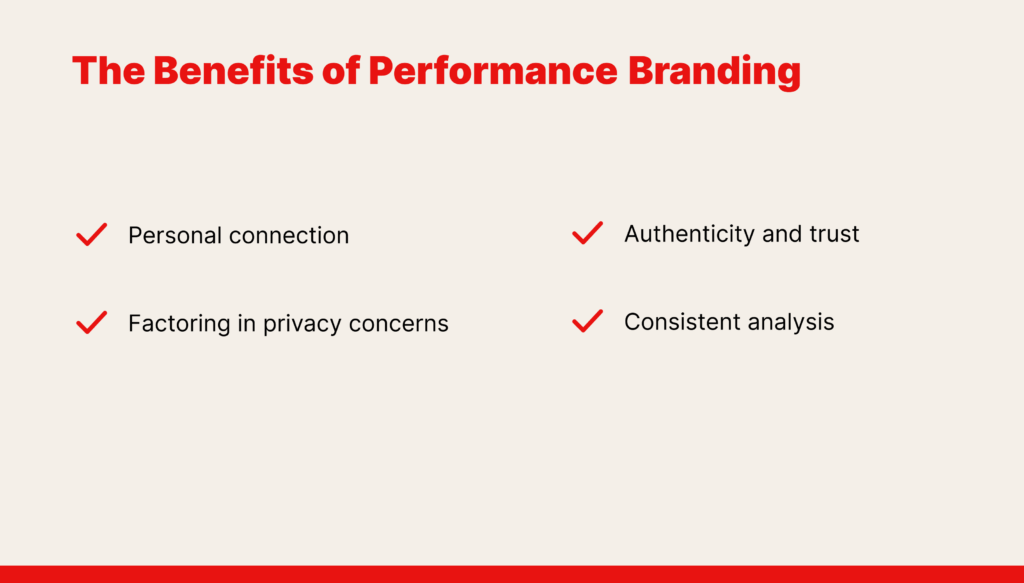
Before covering the framework, it’s worth understanding why most B2B SaaS companies fail at performance branding — because these mistakes inform the solution.
Mistake 1: Separating Brand and Demand Teams
When brand marketing and demand gen report to different leaders with different KPIs, they optimize against each other. Brand creates beautiful campaigns that don’t include CTAs. Demand gen creates ugly ads that convert but erode brand perception. The fix: unified ownership with shared metrics.
Mistake 2: Measuring Brand with Vanity Metrics
Impressions, followers, and “brand lift studies” don’t tell you whether brand investment drives revenue. If you can’t connect brand activity to pipeline, the CFO will eventually cut the budget. You need leading indicators that correlate with downstream revenue — like branded search volume, direct traffic growth, and win rate changes.
Mistake 3: Treating Content as Either Brand or Performance
Blog posts “for SEO” that read like keyword-stuffed filler damage your brand. Thought leadership “for brand” that ignores search intent wastes distribution potential. Every piece of content should reinforce expertise and capture demand through conversion-optimized pathways.
Mistake 4: Copying Consumer Brand Playbooks
B2B SaaS is not consumer goods. You don’t need Super Bowl ads or influencer partnerships with millions of followers. You need to be trusted by 500-5,000 people in your ICP. This changes everything about channel selection, creative approach, and measurement.
Mistake 5: Optimizing Performance Campaigns for Volume Over Quality
Maximizing lead volume with bottom-funnel ads generates MQLs that sales can’t close. Performance branding focuses on qualified pipeline value, not lead count. The CRO strategy should optimize for revenue, not form fills.
The BRIDGE Framework for Performance Branding
BRIDGE is a practical framework for building a performance branding system. Each element addresses a specific failure mode that kills most B2B SaaS brand-building efforts.
| Element | What It Means | Why It Matters |
|---|---|---|
| Brand Positioning | Define your category, your difference, and your buyer’s language | Without clear positioning, every campaign fights for attention from scratch |
| Revenue Alignment | Connect every brand activity to a pipeline metric | Prevents brand from becoming a cost center that gets cut |
| Integrated Channels | Run brand and demand through the same channels simultaneously | Eliminates the “brand vs. performance” budget war |
| Data Feedback Loops | Measure leading brand indicators weekly, not quarterly | Enables optimization instead of “wait and hope” |
| Gated + Ungated Content | Mix freely available thought leadership with conversion-ready assets | Builds trust (ungated) and captures intent (gated) simultaneously |
| Executive Visibility | Amplify founder and leadership voices as brand assets | B2B buyers trust people more than logos |
How to Apply BRIDGE at Each Stage
Seed to Series A (building initial brand):
- Focus on B (positioning) and E (executive visibility) — founder-led content is your highest-ROI brand investment
- Keep R simple — track branded search and demo-to-close rate
- One or two Integrated channels only (LinkedIn + SEO is the most common starting point)
Series A to B (scaling brand + demand):
- Build Data feedback loops — connect brand metrics to revenue in your CRM
- Expand Gated content library — build the conversion assets that capture the demand your brand generates
- Add channels to I — paid social retargeting, events, community
Series B+ (compounding brand moat):
- Full BRIDGE operational — brand and demand fully unified
- Invest in original research and proprietary data (the strongest brand moat)
- Measure customer segmentation to identify which brand messages resonate with highest-LTV segments
Performance Branding Metrics That Actually Matter
The measurement gap is what kills most performance branding programs. Brand teams track impressions. Demand gen tracks MQLs. Nobody tracks the overlap. Here’s a measurement system that connects brand activity to pipeline.
Leading Indicators (Weekly Tracking)
| Metric | What It Tells You | Target Trend |
|---|---|---|
| Branded search volume | Are more people actively looking for you by name? | 10-20% QoQ growth |
| Direct traffic | Are people typing your URL directly? | Steady increase |
| Share of voice (SOV) | How much of category conversation mentions you? | SOV > market share |
| Content engagement depth | Are people reading/watching your content fully? | Time on page > 3 min |
| Social follower quality | Are the right people (ICP) following you? | ICP % > 40% |
Pipeline Indicators (Monthly Tracking)
| Metric | What It Tells You | Target Trend |
|---|---|---|
| Brand-attributed pipeline | Pipeline from branded search, direct, organic | Growing % of total pipeline |
| Win rate by source | Do brand-sourced leads close better? | Brand leads > paid leads |
| Sales cycle length | Does brand recognition shorten deals? | Decreasing for brand-sourced |
| CAC by channel | Is brand reducing customer acquisition cost? | Blended CAC declining |
| Inbound demo requests | Are inbound leads growing without proportional ad spend increase? | Inbound % increasing |
Lagging Indicators (Quarterly Review)
| Metric | What It Tells You | Target Trend |
|---|---|---|
| Net Revenue Retention | Does your brand keep customers expanding? | > 120% NRR |
| Referral pipeline % | Do customers advocate for your brand unprompted? | Growing % of total pipeline |
| Category association | When buyers think “[your category],” do they think of you? | Top 3 unaided recall |
The key is tracking these together, not in isolation. A spike in branded search that doesn’t correlate with pipeline growth tells you something different than a spike that does. Build a single dashboard that shows brand and pipeline metrics side by side, and review weekly.
Building Your Performance Brand: A B2B SaaS Playbook
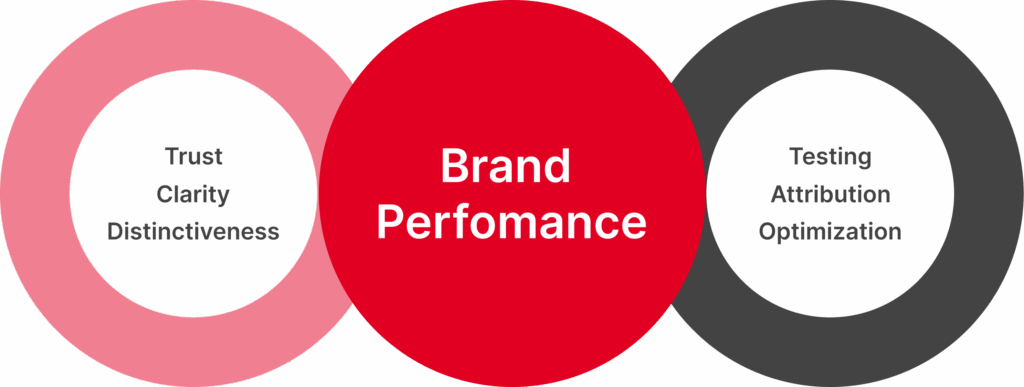
Here’s a practical playbook for implementing performance branding, broken into 90-day sprints.
Days 1-30: Foundation
- Audit your current state. Map every marketing activity to either “brand,” “performance,” or “both.” Most companies find 80% falls into one bucket. That’s the gap.
- Define your brand positioning. One sentence: “We help [ICP] achieve [outcome] through [unique mechanism].” If your team can’t agree on this, nothing else will work.
- Set up measurement. Create the dashboard with leading, pipeline, and lagging indicators above. Use conversion tracking that connects brand touchpoints to pipeline.
- Identify your highest-leverage channel. For most B2B SaaS, this is LinkedIn + SEO content. Pick the one channel where your ICP already spends time and your brand can add genuine value.
Days 31-60: Integration
- Redesign content for dual purpose. Every blog post, social update, and email should build brand positioning and include a clear next step. A thought leadership post on LinkedIn should link to a relevant ungated asset. An SEO article should include a growth marketing CTA matched to the reader’s awareness stage.
- Launch executive visibility program. Your founder or CRO posts 3-5x/week on LinkedIn about real challenges in your category. Not corporate announcements — genuine operational insights. This builds brand faster than any ad campaign.
- Retarget with brand + offer. Build retargeting audiences from content consumers. Serve them ads that reinforce brand positioning and include a conversion offer. This is where brand and performance literally merge into one ad.
Days 61-90: Optimization
- Analyze the data. Which content drives both engagement and pipeline? Double down on those formats and topics. Which channels build brand but don’t convert? Add conversion pathways. Which convert but don’t build brand? Upgrade the creative.
- Build your content moat. Start producing original research, proprietary data, or unique frameworks that competitors can’t replicate. This becomes your strongest long-term brand asset and your best lead magnet.
- Systematize the flywheel. Create templates for dual-purpose campaigns. Build a go-to-market calendar that treats every campaign as both brand and demand. Make performance branding the default, not the exception.
Channel Strategy: Where Performance Branding Works Best
Not every channel serves performance branding equally. Here’s how the major B2B SaaS channels rank for combined brand + pipeline impact:
| Channel | Brand Impact | Pipeline Impact | Performance Branding Fit |
|---|---|---|---|
| SEO Content | High (thought leadership, expertise) | High (captures intent) | Excellent — best dual-purpose channel |
| LinkedIn (Organic) | High (executive visibility) | Medium (drives awareness → pipeline) | Excellent — strongest B2B brand channel |
| LinkedIn (Paid) | Medium (retargeting reinforces brand) | High (targeting precision) | Strong — best for retargeting brand-aware leads |
| Webinars/Events | High (expertise + face time) | High (intent signal) | Strong — highest engagement per lead |
| Email Nurture | Medium (stays top of mind) | High (drives conversion) | Good — extends brand after initial touch |
| Podcasts | High (long-form trust building) | Low (indirect pipeline) | Good for brand, needs funnel pairing |
| Google Ads (Search) | Low (transactional) | High (captures demand) | Performance only — pair with brand channels |
| Display/Programmatic | Medium (awareness) | Low (weak conversion) | Brand support only — don’t rely on for pipeline |
The optimal performance branding stack for most B2B SaaS companies at Series A-B:
- SEO + Content as the foundation (builds brand authority, captures search intent)
- LinkedIn organic for executive visibility (builds trust with ICP)
- LinkedIn paid retargeting to convert brand-aware visitors (bridges brand → pipeline)
- Email nurture to deepen relationships post-first-touch
When to Hire a Performance Branding Agency
Not every company needs an agency. But performance branding requires expertise across brand strategy, demand generation, content, and analytics — which is a rare combination to hire for internally.
Build in-house when:
- You have a senior marketer who understands both brand and demand
- Your marketing team has bandwidth to run integrated campaigns
- You’ve already established product-market fit and have baseline data
- Your category is small enough that 1-2 channels are sufficient
Bring in an agency when:
- You need speed — agencies compress the learning curve from 6+ months to weeks
- Your team is strong on product marketing but weak on execution
- You’re entering a new market or category where brand-building is critical
- You need the cross-industry pattern recognition that comes from working across multiple companies
- You want to find the right marketing partner who treats brand and demand as one system
What to look for in a performance branding agency:
- Unified approach — They shouldn’t have separate “brand” and “performance” teams. That recreates the exact problem you’re hiring them to solve.
- Revenue-connected reporting — They should report on pipeline impact, not just impressions and reach.
- B2B SaaS experience — Consumer branding is a different discipline. Make sure they understand long sales cycles, multiple stakeholders, and technical buyers.
- Content capability — Performance branding runs on content. The agency should produce high-quality thought leadership that drives both brand and demand.
- Measurement rigor — Ask how they prove brand investment drives revenue. If they can’t answer clearly, keep looking.
Performance Branding vs. Other Strategies
How does performance branding compare to the strategies you might already be running?
| Strategy | Focus | Strength | Weakness |
|---|---|---|---|
| Pure Brand Marketing | Awareness, positioning, trust | Long-term equity | Can’t prove ROI, gets cut first |
| Pure Performance Marketing | Leads, conversions, revenue | Measurable, scalable | Rising CAC, no brand moat |
| Growth Marketing | Experimentation, acquisition loops | Data-driven, agile | Often ignores brand entirely |
| Product-Led Growth | Self-serve, product as marketing | Low CAC, organic growth | Needs brand for enterprise expansion |
| Performance Branding | Brand + pipeline unified | Compounds over time, defensible | Requires cross-functional integration |
Performance branding isn’t a replacement for current SaaS marketing approaches — it’s a layer that connects them. You can run product-led growth and performance branding. You can do growth marketing experiments within a performance branding framework. The difference is that every experiment, every campaign, and every channel reinforces a coherent brand.
Getting Started: Your First 5 Actions
Performance branding is a strategic shift, but it starts with small, concrete actions. Here are five things you can do this week:
- Audit one campaign — Pick your highest-spend campaign. Does it build brand and drive pipeline? If it only does one, redesign it to do both.
- Set up branded search tracking — Add your company name and key product names to Google Search Console. Track volume weekly. This is your single best brand health metric.
- Merge your reports — Combine brand metrics and pipeline metrics into one dashboard. The act of seeing them together changes how you think about marketing.
- Write one dual-purpose piece — Create a blog post or LinkedIn article that demonstrates genuine expertise (brand) and includes a relevant, non-pushy CTA (performance).
- Brief your team — Share this framework with your marketing team. The biggest barrier to performance branding is organizational — brand and demand people thinking they have different jobs.
If you’re building a B2B SaaS company and want help implementing performance branding, talk to our team about building a unified brand and pipeline system.