←Back to blog
Growth & Demand GenerationGuideMay 25, 202611 min read
From Awareness to Action: Mastering the Modern Marketing Funnel
Build a marketing funnel that compounds pipeline instead of leaking it. A practical framework for CROs and VPs to fix conversion economics at every stage.
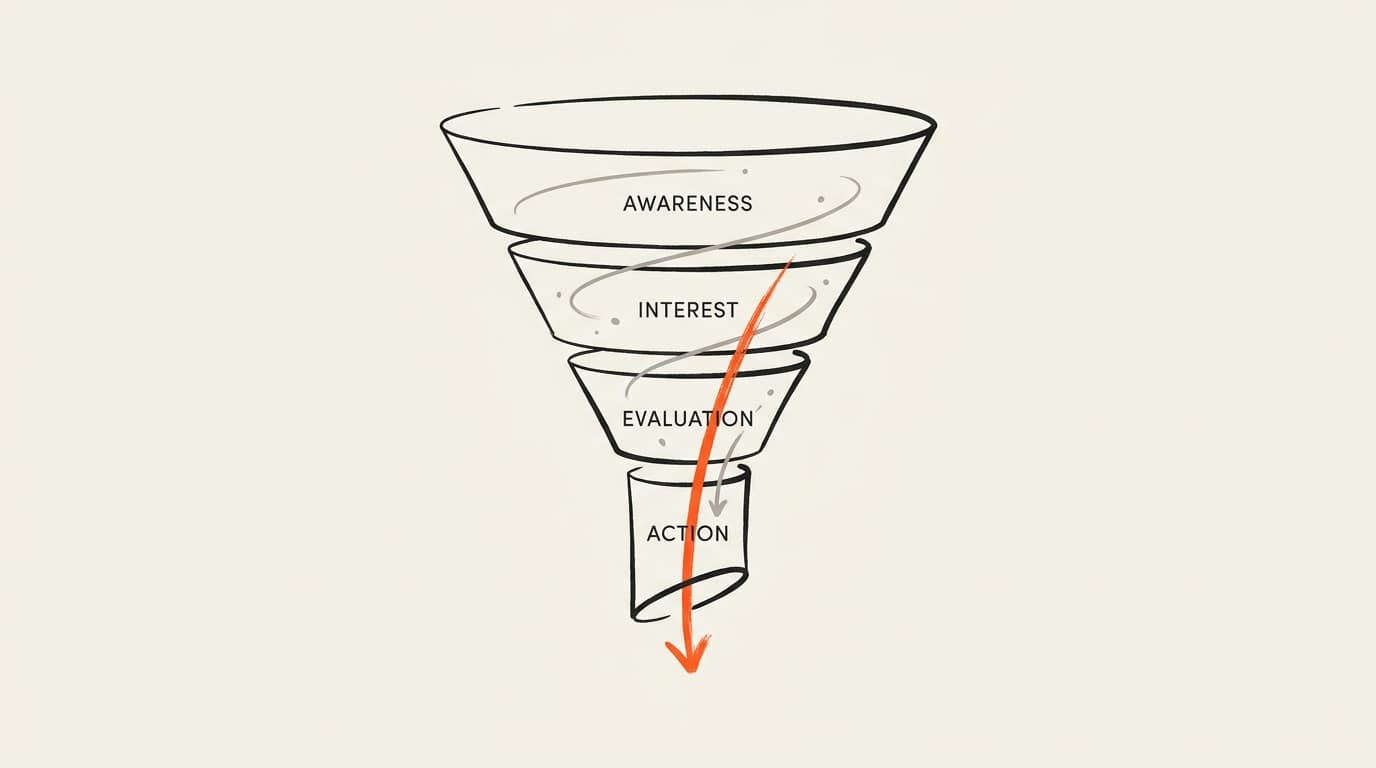
Most revenue leaders treat the marketing funnel as a slide in a board deck. It isn’t. It is the operating system that determines how many qualified opportunities reach the pipeline, how efficiently they convert, and how predictable next quarter’s bookings actually are. When the funnel is designed well, it compounds. When it is built on intuition and stitched-together tactics, it leaks revenue at every stage and forces sales to compensate with brute force.
For a CRO or VP Marketing, the funnel is not a metaphor. It is the conversion economics of the business. Gartner’s research on the B2B buying journey shows just how complex this has become. According to Gartner, “When B2B buyers are considering a purchase, they spend only 17% of that time meeting with potential suppliers.” That single statistic reframes the funnel from a linear sales process into a self-directed buyer journey that marketing has to architect deliberately. This article walks through how the modern funnel works, why each stage matters for revenue, and where most teams quietly lose pipeline.
What is a Marketing Funnel?
A marketing funnel is the structured journey a prospective buyer takes from first contact with a brand to closed revenue. For revenue leaders, it is the connective tissue between demand generation spend and pipeline outcomes. The funnel is wide at the top, where attention is captured, and narrows as buyers self-qualify through stages of interest, evaluation, and decision. Each stage has its own conversion rate, its own cost, and its own failure modes.
The four canonical stages are:
- Awareness
- Interest
- Consideration
- Decision
The reason the funnel matters is economic. McKinsey’s research on B2B growth notes that “companies that personalize at scale outperform peers by 40% in revenue from those activities.” That outperformance comes from understanding what a buyer needs at each stage and delivering it precisely, rather than treating every prospect like a fresh lead. The funnel is the framework that makes personalization at scale operationally possible.
In the awareness stage, the job is to be discoverable to buyers who do not yet know the category or the brand. In the interest stage, it is to convert that attention into engagement. In the consideration stage, it is to equip the buyer with the evidence they need to shortlist the vendor. In the decision stage, it is to remove the final friction between intent and signed contract. Each transition is a conversion event that can be measured, modeled, and improved.
The History of Marketing Funnels
The funnel concept predates digital marketing by more than a century. Elias St. Elmo Lewis, an advertising pioneer, introduced the AIDA model (Attention, Interest, Desire, Action) in 1898 to describe how print advertising should move a reader toward purchase. The underlying logic, that buyers move through cognitive and emotional stages on the way to a transaction, has held up remarkably well.
What has changed is the buyer’s control of the journey. Forrester’s research on the modern B2B buyer notes that “buyers complete more than two-thirds of their purchase decisions before engaging with a sales representative.” That shift means the funnel can no longer be operated by sales alone. Marketing now owns the majority of the buyer’s information environment, and the funnel has to be designed to influence decisions before any human conversation happens.
The digital era added measurement to the funnel. Marketers can now attribute behavior, model conversion rates, and instrument every stage. According to research from Harvard Business Review, “firms in the top quartile of analytics maturity are twice as likely to be top financial performers in their industries.” The funnel is the structure that makes that analytics maturity actionable: without defined stages, there is nothing to measure.
The Four Stages of the Marketing Funnel and Why They Matter
Each stage of the funnel has a distinct conversion job, a distinct set of metrics, and a distinct failure mode. Revenue leaders who understand the economics of each stage can diagnose pipeline problems by stage rather than blaming sales or marketing as a whole.
Awareness Stage
The awareness stage is where the brand becomes discoverable to in-market buyers and to the latent demand that will be in-market later. The goal is volume and category fit, measured by reach, share of search, and assisted conversions over time. For revenue leaders, the awareness stage is where the cost of customer acquisition is set: a brand that competes only on bottom-funnel intent pays whatever the auction demands, while a brand that has invested in awareness pays less for the same buyers downstream.
Research from the LinkedIn B2B Institute and IPA shows that the most efficient B2B brands allocate roughly 46% of budget to brand-building and 54% to activation, because brand investment compounds into pricing power and conversion efficiency. Underinvesting at the top of the funnel is the most common reason CACs creep up year over year.
Interest Stage
The interest stage is where attention converts into engagement. Buyers download a guide, attend a webinar, subscribe to a newsletter, or follow the brand on LinkedIn. The conversion job is to earn permission to keep marketing to the buyer over the weeks or months before they are ready to evaluate.
This is the stage where most funnels quietly break. We have seen this with a Series A SaaS team whose paid acquisition was performing on paper but whose pipeline never moved. The leak was the interest stage: the team was driving traffic to a gated whitepaper with no follow-up sequence, no segmentation, and no signal capture beyond email. Fixing the interest stage doubled MQL-to-SQL conversion within a quarter, with no change to acquisition spend. The lesson is that interest-stage infrastructure (nurture flows, behavioral scoring, content sequencing) is leverage on every dollar spent at the top.
Consideration Stage
In the consideration stage, buyers actively evaluate options. They read case studies, compare features, talk to peers, and build internal consensus. According to Gartner, “the typical buying group for a complex B2B solution involves six to 10 decision makers, each armed with four or five pieces of information they’ve gathered independently.” The funnel has to serve all of them, not just the champion.
The conversion job here is to equip the buyer to sell internally. That means proof assets (customer case studies, ROI calculators, security documentation, comparison content) that travel inside the buying organization without the seller present. Revenue leaders who underinvest in consideration-stage content force their sales teams to manufacture proof on every deal, which lengthens sales cycles and drops win rates.
Decision Stage
The decision stage is where the buyer commits. Pricing pages, demo bookings, free trials, security reviews, and procurement workflows all live here. The conversion job is to remove friction.
Bain & Company’s research on B2B buying notes that “suppliers that deliver a superior buying experience are two times more likely to be shortlisted, win the deal, and retain the customer.” Friction at the decision stage (a confusing pricing model, a slow demo-booking flow, a security questionnaire that takes weeks) destroys conversion rates that took the entire funnel to build. Revenue leaders should treat the decision stage as a conversion rate optimization problem with measurable upside, not as the inevitable end of a long sales process.
The “TOFU-MOFU-BOFU” shorthand (top, middle, bottom of funnel) is a useful operational grouping when assigning content, channels, and ownership across teams. Many modern models also add a retention or expansion stage, recognizing that for subscription businesses, the revenue is in the years after the first close, not the first transaction itself. Net revenue retention is, for most SaaS companies, the single largest lever on enterprise value.
Integrating SEO into Each Stage of Your Marketing Funnel
Search is the most durable demand channel in B2B. Unlike paid media, organic visibility compounds, and unlike outbound, it captures buyers at the moment of intent. For revenue leaders, SEO is not a marketing tactic; it is a long-duration asset that determines the cost of pipeline for years to come.
According to BrightEdge research, organic search drives roughly 53% of all website traffic and accounts for the majority of trackable B2B pipeline at companies that have invested seriously in content. SEO touches every stage of the funnel, and the integration looks different at each.
Awareness Stage: Attracting Visitors
At the top of the funnel, SEO captures the unbranded category demand that paid media has to pay for repeatedly. The job is to rank for the questions buyers ask before they know any vendor names.
- Keyword research: use tools like Ahrefs, SEMrush, and Google Keyword Planner to identify high-volume, low-competition queries with commercial relevance.
- Content optimization: create articles, videos, and resources mapped to those queries, with keywords placed naturally in titles, headers, and meta descriptions.
- Technical SEO: site speed, mobile responsiveness, and a crawlable site architecture determine whether the content can actually rank.
Interest Stage: Engaging and Nurturing
Once a buyer lands on the site, SEO infrastructure keeps them moving. Internal linking, content clusters, and on-page optimization compound a single visit into multiple sessions.
- On-page SEO: optimize each page for a defined target query, with strong internal links to deeper resources.
- Content clusters: pillar articles and supporting cluster content build topical authority, which improves rankings across the cluster and signals expertise to evaluators.
Consideration Stage: Building Trust
In the consideration stage, SEO surfaces the evaluation-grade content that buyers and their buying committees actually look for: comparisons, alternatives, integrations, pricing-related searches, and category overviews.
- Long-form content: detailed guides, case studies, and benchmark reports rank for long-tail queries and establish authority with evaluators.
- Schema markup: structured data enhances search listings with rich snippets, which lifts click-through rates on already-ranking content.
Decision Stage: Conversion Optimization
At the bottom of the funnel, SEO ensures that the highest-intent pages (product, pricing, demo, integration, location-specific) are both discoverable and optimized to convert.
- Conversion rate optimization: pair SEO with structured A/B testing on headlines, CTAs, and page layouts to compound the value of every ranking page.
- Local SEO: where geography matters, optimize for local intent to capture buyers already ready to transact.
Continuous Improvement: Analyzing and Optimizing
SEO is a flywheel, not a project. The teams that win compounding organic results treat it as a continuous instrumentation problem.
- Analytics: Google Analytics and Search Console reveal traffic patterns, query performance, and on-site behavior that should feed back into content decisions.
- Testing: structured experiments on keywords, meta descriptions, and content formats identify what drives ranking and conversion, rather than relying on best-practice assumptions.
Integrated into every funnel stage, SEO turns the website itself into a pipeline engine that runs without per-click cost. For revenue leaders, that is the difference between a marketing budget that compounds and one that resets every quarter.
What are the Different Types of Funnels?
The four-stage model is the underlying logic, but in practice, revenue teams operate several distinct funnels in parallel, each tuned to a specific motion. Confusing them is one of the more common reasons pipeline forecasts miss.
Sales Funnel
The classic conversion funnel, from first touch to closed deal. In B2B SaaS, the sales funnel typically spans paid acquisition or organic discovery, content engagement, demo booking, evaluation, and commercial close. It is the funnel most revenue dashboards track by default.
Lead Generation Funnel
A lead generation funnel is optimized for capturing contact information at scale, usually in exchange for a high-value asset (a benchmark report, an industry guide, a tool). The output feeds nurture sequences and sales follow-up. Revenue leaders should evaluate lead-gen funnels on downstream conversion to pipeline, not on raw MQL volume, which is often vanity.
Webinar Funnel
Webinar funnels are built around a live or on-demand event as the conversion mechanism. They work well for considered B2B purchases because the format earns 30 to 60 minutes of attention from buyers who have already self-qualified by registering.
Product Launch Funnel
A product launch funnel orchestrates a coordinated burst of attention around a new offering, with sequenced content, partner amplification, and time-boxed incentives. Revenue leaders use launch funnels to compress demand creation that would otherwise take quarters into a few weeks.
Content Funnel
A content funnel uses publishing (blog, podcast, newsletter, video, social) to move readers through awareness, interest, and consideration without a paid trigger. It is the slowest funnel to build and the cheapest to operate once it compounds.
Membership and Loyalty Funnels
For subscription and community businesses, the funnel does not end at the first transaction. Membership funnels are designed for onboarding, activation, and recurring engagement; loyalty funnels are designed for expansion and advocacy. Both feed net revenue retention, which is where most enterprise value in SaaS actually accumulates.
Practical Tips for Mastering the Marketing Funnel
The teams that operate funnels well share a few habits that distinguish them from teams that treat marketing as a series of disconnected campaigns.
- Instrument before you optimize. Define the conversion event at every stage and measure it. A funnel you cannot measure stage by stage is a funnel you cannot improve.
- Segment by buyer, not by channel. The same buyer behaves differently on LinkedIn than on Google. Build segments around the buyer, then map channels to where that buyer actually is.
- Match content to stage. Top-of-funnel content earns attention; bottom-of-funnel content earns trust. Sending a buyer the wrong content for their stage is the most common cause of stalled pipeline.
- Tighten the marketing-to-sales handoff. Most leaks happen at the seam between the two functions. Define what qualifies a lead for sales, when sales picks it up, and what triggers a return to nurture.
- Run the funnel as a system, not as campaigns. Campaigns end; the funnel runs continuously. The asset is the system, not any individual launch.
Common Pitfalls and How to Avoid Them
Most underperforming funnels share the same handful of failure modes. Diagnosing them early avoids the more painful diagnosis later, which is a missed quarter.
- Over-indexing on bottom-of-funnel spend. Pouring budget into branded search and retargeting harvests demand that already exists but creates none. When the harvest runs dry, CAC climbs.
- Confusing leads with pipeline. A funnel optimized for MQL volume can hit every marketing target and still produce no revenue. Tie funnel metrics to qualified opportunities and closed-won, not form fills.
- Ignoring the buying committee. The champion is not the only decision maker. Funnels that serve only one persona stall when the deal escalates to procurement, security, or finance.
- Treating attribution as truth. No attribution model captures the full picture. Use attribution as a directional input, then triangulate with incrementality tests and qualitative buyer feedback.
- Letting the funnel drift. Buyer behavior changes. Channels saturate. Conversion rates decay. The funnel needs quarterly review, not annual.
Building the Funnel, or Buying the Build
A well-engineered marketing funnel is one of the highest-leverage assets a revenue organization can own. It lowers CAC, shortens sales cycles, improves win rates, and produces forecast accuracy that the rest of the business can plan against. Built well, it compounds for years.
The path to that funnel can be walked internally. Hiring the demand, content, RevOps, and lifecycle talent, instrumenting the stack, and iterating to a state where the funnel actually runs as a system is a multi-quarter build, sometimes longer. For revenue teams that want to skip the learning curve, delverise builds and operates the funnel end to end: the strategy, the content, the SEO, the lead generation engine, the CRO instrumentation, and the GTM systems that hold it together. The choice is not whether a high-functioning funnel is worth having. It is whether to spend the time learning to build one, or to bring in a team that has already built dozens.
Read next