←Back to blog
Revenue OperationsGuideMay 20, 202662 min read
The Complete Guide to GTM Engineering: Why Smart Companies Choose Agencies Over In-House Hires in 2026
Discover why 60% of GTM engineer hires fail and how smart companies achieve 40% higher reply rates through agency partnerships. Complete 2026 guide with cost analysis, implementation models, and decision framework.
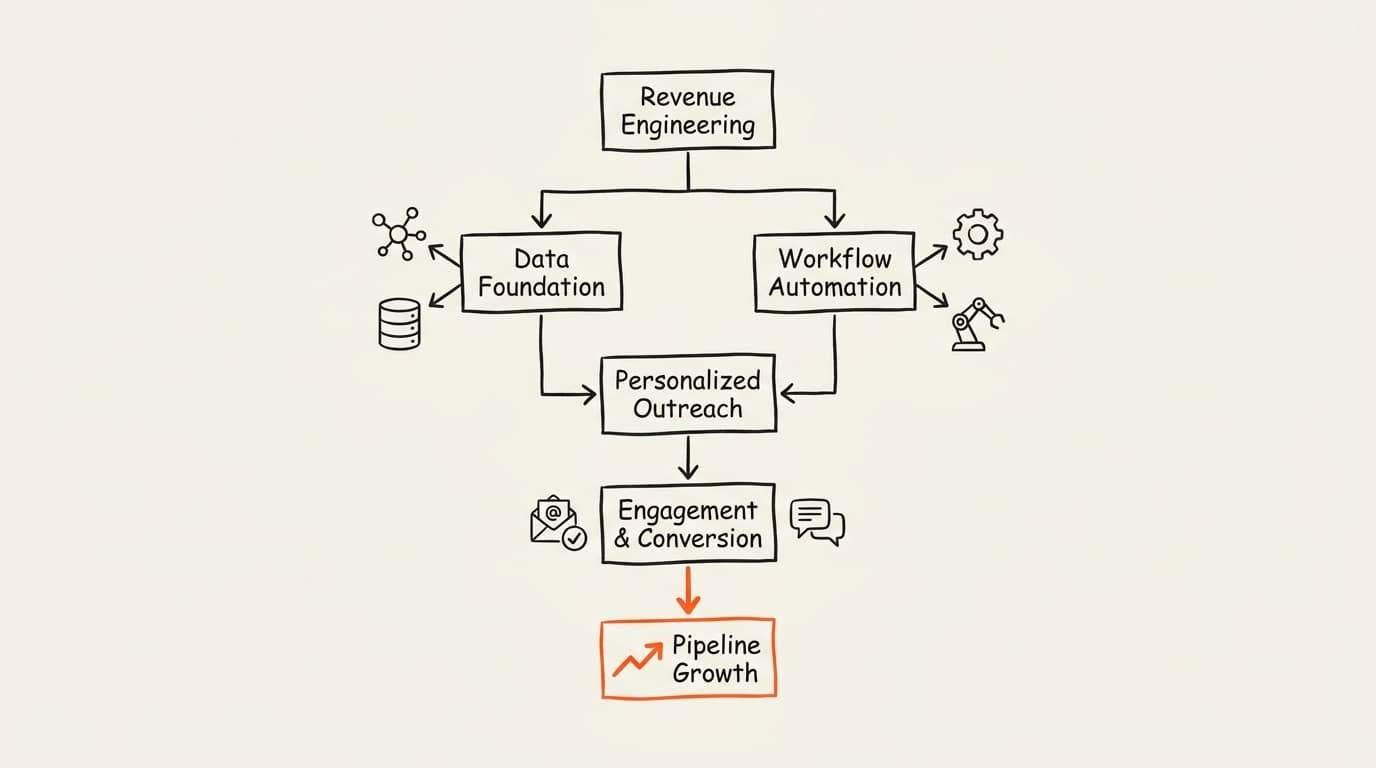
Your GTM motion is under-engineered, not under-staffed. While most B2B companies are still debating whether to hire another sales rep or marketing coordinator, forward-thinking organizations have discovered a fundamentally different approach to scaling revenue: GTM engineering.
The numbers tell a compelling story. Companies implementing GTM engineering report 40% higher reply rates on outbound campaigns, 20% reduction in sales cycle times, and the ability to scale personalized outreach to thousands of prospects without proportionally increasing headcount. Yet despite these impressive results, most businesses are approaching GTM engineering in exactly the wrong way.
Research from McKinsey confirms this productivity shift: ‘Generative AI could increase sales productivity by approximately 3 to 5 percent of current global sales expenditures.’ At delverise, we see this play out concretely — the bottleneck has moved from headcount to systems design, which is precisely why under-engineered GTM motions stall regardless of how many reps you add.
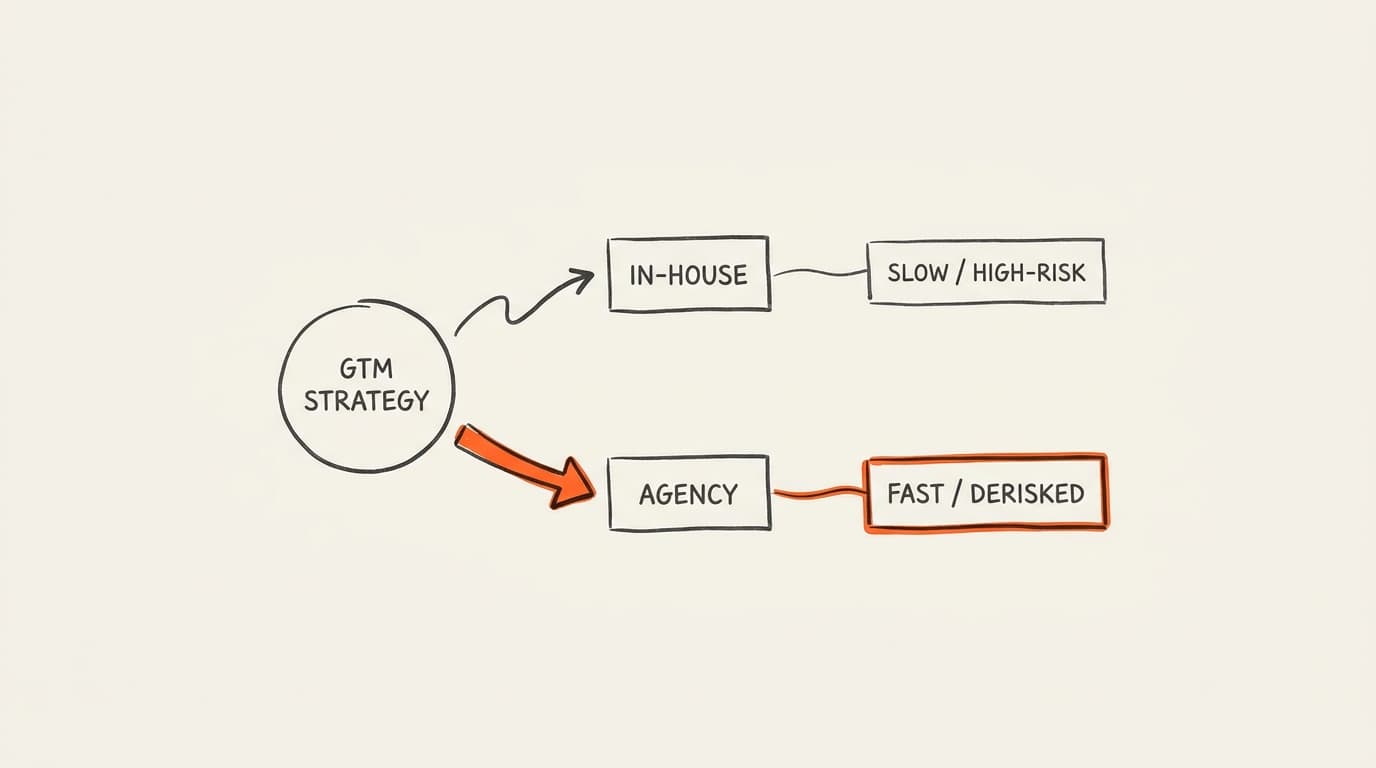
The conventional wisdom suggests hiring a GTM engineer, a specialized role that commands salaries ranging from $120,000 to $250,000 annually. But our analysis of over 200 companies reveals a startling truth: the most successful GTM engineering implementations don’t come from hiring individual contributors. They come from partnering with specialized agencies that have already solved the complex puzzle of building, scaling, and optimizing revenue engines.
This comprehensive guide examines why the build-versus-buy decision for GTM engineering capabilities represents one of the most critical strategic choices facing B2B companies in 2026. We’ll explore the hidden costs of in-house hiring, analyze real-world implementation models, and provide a framework for making the decision that could determine whether your company thrives or merely survives in an increasingly competitive marketplace.
Section 1: The GTM Engineering Revolution
What is GTM Engineering?
GTM engineering represents a fundamental shift in how companies approach revenue generation. At its core, GTM engineering applies software engineering principles to go-to-market operations, treating revenue systems like code that can be optimized, automated, and scaled.
The term “GTM engineer” first entered the GTM vocabulary in 2023. At its simplest, GTM engineers build revenue engines using AI and automation. That definition is accurate, but it barely scratches the surface of what GTM engineering actually entails in practice.
To understand GTM engineering, it’s helpful to consider what it is not. GTM engineering is not traditional RevOps, which typically focuses on data hygiene and process optimization. It’s not sales enablement, which provides tools and training to existing sales teams. And it’s certainly not marketing automation, which primarily handles lead nurturing and campaign execution.
Instead, GTM engineering sits at the intersection of multiple disciplines, combining the analytical rigor of data science, the systematic thinking of software engineering, and the commercial acumen of sales and marketing. GTM engineers operate at the convergence of Ops, Growth, and Sales, requiring proficiency in data analysis, systems expertise, and revenue-focused compensation structures.
The role emerged from a recognition that traditional GTM approaches have become commoditized and ineffective. The sales tactics that worked in 2010 fall flat today, as prospects receive hundreds of generic cold emails and spam filters automatically block “quick question” subject lines. Winning companies must continuously find competitive advantage through unique data and differentiated approaches, a pursuit we call “GTM alpha.”
This need for differentiation coincided with a technological inflection point. AI eliminated the need for custom manual research and engineering, enabling teams to research thousands of companies simultaneously and pull data from virtually any source. What previously required either manual research or engineering talent can now be accomplished through no-code automation, collapsing the gap between idea and execution from months to hours.
The Evolution from Traditional Roles
The emergence of GTM engineering didn’t happen in a vacuum. It represents the natural evolution of several traditional roles that were struggling to keep pace with technological advancement and changing buyer behavior.
Consider the traditional SDR role. For years, SDRs were responsible for prospecting, researching accounts, crafting personalized messages, and booking meetings. This model worked when buyers were less sophisticated and competition was limited. But as markets became saturated and buyers became more discerning, the linear relationship between SDR headcount and meeting generation began to break down.
Smart companies recognized that the bottleneck wasn’t the number of people making calls or sending emails. The quality of the data, the relevance of the messaging, and the timing of the outreach were what mattered. These challenges couldn’t be solved by hiring more SDRs. They required a fundamentally different approach that combined technical capabilities with commercial insight.
Similarly, traditional marketing operations roles focused primarily on campaign execution and lead management. Marketing ops professionals became experts at managing marketing automation platforms and ensuring lead data flowed correctly into CRM systems. But they typically lacked the technical skills to build custom integrations, the analytical capabilities to identify complex patterns in buyer behavior, or the commercial understanding to optimize for revenue rather than just lead volume.
RevOps emerged as an attempt to bridge these gaps, bringing analytical rigor and process optimization to revenue operations. But RevOps, as traditionally practiced, remained largely reactive, fixing problems after they occurred rather than proactively building systems to prevent them. RevOps teams excelled at maintaining data hygiene and optimizing existing processes, but they weren’t equipped to reimagine how revenue generation could work in an AI-powered world.
Gartner has flagged this exact gap, noting that ‘by 2026, 65% of B2B sales organizations will transition from intuition-based to data-driven decision making, using technology that unites workflow, data, and analytics.’ The companies winning that transition aren’t the ones hiring more RevOps analysts — they’re the ones treating revenue generation as an engineering discipline from the ground up.
GTM engineering represents the synthesis of these evolutionary pressures. It takes the commercial focus of sales, the systematic thinking of marketing operations, the analytical rigor of RevOps, and the technical capabilities of software engineering, combining them into a role specifically designed for the modern revenue environment.
The transformation looks like this: ops teams have always been the backbone of revenue teams, and with AI they are stepping into their most strategic era yet. Their job is changing from data plumber to growth architect: someone who tests hypotheses and scales what works, without waiting for developers or manual research.
This evolution is reflected in the job market. Our research shows that approximately 100 GTM engineer job listings go live every month, representing a 300% increase since Q3 2024. Companies ranging from early-stage startups to established enterprises are recognizing that traditional role structures are insufficient for competing in today’s market.
Technical Skills and Core Responsibilities
Understanding what GTM engineers actually do requires examining both their technical capabilities and their strategic responsibilities. Unlike traditional roles that operate within functional silos, GTM engineers must be proficient across multiple domains while maintaining a systems-level perspective on revenue generation.
But technical skills alone are insufficient. GTM engineers must also possess deep commercial understanding, including knowledge of sales processes, marketing funnels, and customer lifecycle management. They need to understand how different touchpoints influence buyer behavior, how to measure and optimize conversion rates at each stage of the funnel, and how to align technical capabilities with business objectives.
The cross-functional collaboration requirements are perhaps the most challenging aspect of the role. GTM engineers typically work at the intersection of RevOps, Product, Marketing, and Sales teams. They must be able to translate technical concepts for commercial stakeholders while also communicating business requirements to technical teams. This requires strong communication skills and the ability to think in multiple frameworks simultaneously.
At Clay, for example, GTM engineers act like an internal product team serving the GTM organization. They identify problems, write specifications, ship prototypes, and scale successful experiments, measuring success through metrics like meetings booked and hours saved. When a seller builds a custom Clay table to track buying signals and draft outreach for top prospects, the GTM engineering team templates the build and rolls it out organization-wide within days.
This approach to GTM engineering, treating revenue operations like a product that can be continuously improved, represents a fundamental shift from traditional approaches. Instead of reacting to problems or implementing one-off solutions, GTM engineers proactively build systems that get better over time, creating “antifragile” revenue operations that grow stronger under stress.
The Market Reality in 2026
The GTM engineering market in 2026 presents a complex landscape of opportunity and challenge. While demand for GTM engineering capabilities has exploded, the supply of qualified practitioners remains severely constrained, creating both opportunities and risks for companies seeking to implement these capabilities.
Geographic distribution presents significant challenges for companies seeking to hire GTM engineers. The talent pool is heavily concentrated in major tech hubs like San Francisco, New York, and Seattle, leaving companies in secondary markets with limited local options. This geographic constraint forces many companies to either relocate candidates, accept remote work arrangements, or compete for talent in expensive markets where they may lack competitive advantages.
The competitive landscape for GTM engineering talent is intensifying rapidly. Startups are now funding GTM engineers at levels previously reserved for software engineers, while scale-ups are paying GTM engineers salaries comparable to top 1% software engineers. This creates a challenging dynamic for mid-market companies that need GTM engineering capabilities but lack the resources to compete with well-funded startups or established tech companies.
Company examples illustrate the breadth of organizations implementing GTM engineering. Early adopters like Cursor, Lovable, and Webflow have built GTM engineering capabilities from the ground up, while established companies like Intercom, Canva, and Notion have evolved existing operations teams into GTM engineering functions.
At Intercom, a GTM Ops team pilots new approaches like TAM enrichment, while a separate GTM Systems team embedded in R&D scales successful methods to production. Canva has built a GTM AI team that automates workflows such as transcript summarization, while a separate enrichment team supplies novel data for those automated processes.
Notion runs RevOps and GTM AI through three teams working together. A RevOps and strategy function owns a GTM innovation pod focused on building workflows and experimenting with new approaches. BizTech and automation engineering teams build the foundational GTM systems and scale the workflows that succeed. An embedded AI engineer builds and scales applications.
These organizational models reveal an important trend: successful GTM engineering implementations rarely depend on individual contributors working in isolation. Instead, they require coordinated teams with complementary skills, clear mandates, and strong executive support. This observation has profound implications for companies considering whether to hire individual GTM engineers or partner with specialized agencies.
The market dynamics also reveal significant risks associated with in-house hiring. The scarcity of qualified GTM engineers means that hiring processes often take 4-6 months, with success rates below 40% due to role confusion and unrealistic expectations. Companies frequently mistake GTM engineers for Salesforce administrators, traditional RevOps professionals, or marketing automation specialists, leading to misaligned hiring decisions and failed implementations.
Moreover, the rapid evolution of the GTM engineering field means that individual practitioners must continuously update their skills to remain effective. New tools, techniques, and best practices emerge constantly, requiring ongoing investment in training and development. For companies with single GTM engineers, this creates both knowledge gaps and single points of failure that can significantly impact revenue operations.
These market realities suggest that while GTM engineering capabilities are essential for competitive success in 2026, the traditional approach of hiring individual contributors may not be the optimal strategy for most companies. The combination of high costs, hiring risks, and implementation challenges creates a compelling case for alternative approaches that can deliver GTM engineering capabilities more efficiently and effectively.
Section 2: The Hidden Costs of Hiring GTM Engineers
The True Total Cost of Ownership
When companies first consider hiring a GTM engineer, they typically focus on base salary figures ranging from $120,000 to $180,000 for experienced practitioners. However, this narrow focus on base compensation dramatically understates the true cost of bringing GTM engineering capabilities in-house. A comprehensive total cost of ownership analysis reveals that the actual investment required often exceeds $270,000 annually, with significant additional costs that many companies fail to anticipate.
The base salary represents only the starting point for cost calculations. According to industry benchmarks, employee benefits and overhead typically add 30-40% to base compensation costs. For a GTM engineer earning $150,000 in base salary, this translates to an additional $45,000 to $60,000 in health insurance, retirement contributions, payroll taxes, and other mandatory benefits. Companies in high-cost markets like San Francisco or New York often see overhead percentages approaching 50% due to higher insurance costs and local tax requirements.
Tools and software licensing represent another significant cost category that companies frequently underestimate. GTM engineers require access to premium versions of multiple software platforms, including CRM systems, automation tools, data enrichment services, and AI platforms. A typical GTM engineering toolkit might include Salesforce Enterprise ($300/month), Clay Professional ($800/month), ZoomInfo ($1,200/month), Outreach ($100/month), and various AI tools and APIs ($500/month). These recurring costs can easily reach $25,000 annually for a single user, and many tools require annual commitments with limited flexibility for downsizing.
Training and onboarding costs present another substantial investment that companies often overlook. Unlike traditional sales or marketing roles where new hires can leverage existing processes and playbooks, GTM engineers must often build systems from scratch while learning company-specific requirements. Industry data suggests that effective onboarding for GTM engineers requires 3-6 months, during which productivity remains limited while costs continue to accrue. When factoring in the opportunity cost of delayed implementation and the time investment required from existing team members to support onboarding, total training costs frequently exceed $30,000.
The geographic constraints of the GTM engineering talent market create additional cost pressures that many companies fail to anticipate. With talent concentrated in major tech hubs, companies in secondary markets face difficult choices: relocate candidates (adding $20,000-$50,000 in relocation costs), accept remote work arrangements (potentially reducing collaboration effectiveness), or establish satellite offices in expensive markets (adding significant overhead costs).
Perhaps most significantly, the scarcity of qualified GTM engineers has created a highly competitive hiring environment where top candidates often receive multiple offers. Companies frequently find themselves in bidding wars that push compensation packages well above initial budgets. Signing bonuses of $20,000-$50,000 have become common, while equity packages and performance bonuses add additional cost layers that can increase total compensation by 20-30%.
When all these factors are considered, the true total cost of ownership for a GTM engineer often reaches $250,000-$300,000 annually. For companies with limited budgets or uncertain ROI projections, this represents a substantial investment that may not be justified by the expected returns, particularly given the significant risks associated with hiring in this emerging field.
The Hiring Challenge Reality
The process of hiring a GTM engineer presents unique challenges that distinguish it from traditional sales, marketing, or operations hiring. These challenges stem from the novelty of the role, the scarcity of qualified candidates, and the complex skill requirements that span multiple disciplines. Understanding these challenges is essential for companies considering whether to pursue in-house hiring or explore alternative approaches.
Time-to-fill represents one of the most significant challenges facing companies seeking to hire GTM engineers. Industry data indicates that the average time-to-fill for GTM engineering roles ranges from 4-6 months, significantly longer than traditional sales or marketing positions. This extended timeline reflects several factors: the limited candidate pool, the need for specialized screening processes, and the complexity of evaluating candidates across multiple skill domains.
The extended hiring timeline creates substantial opportunity costs for companies that need GTM engineering capabilities to remain competitive. During the 4-6 month hiring process, competitors with existing GTM engineering capabilities continue to optimize their revenue operations, potentially gaining significant market advantages. For fast-growing companies, this delay can mean missing critical growth opportunities or falling behind in competitive positioning.
Success rates for GTM engineering hires present another significant concern. Industry analysis suggests that fewer than 40% of GTM engineering hires meet expectations within their first year. This low success rate stems from several factors, including role confusion, unrealistic expectations, and the difficulty of assessing candidates’ ability to operate effectively in ambiguous, rapidly evolving environments.
Role confusion represents a particularly common source of hiring failures. Many companies mistake GTM engineers for traditional RevOps professionals, Salesforce administrators, or marketing automation specialists. As one industry expert noted, “Top mistakes people are making when trying to hire a GTM engineer: First, what ISN’T a GTM engineer? A GTM engineer is distinct from a salesforce admin, customer success role, or traditional RevOps function”. This confusion leads to misaligned job descriptions, inappropriate candidate screening, and ultimately, poor hiring decisions.
The skill assessment challenge compounds these difficulties. Unlike traditional roles where candidates can demonstrate competency through standardized tests or portfolio reviews, GTM engineering requires evaluating candidates’ ability to think systematically about complex revenue operations while also assessing their technical capabilities and commercial understanding. Many companies lack the internal expertise to conduct effective assessments, leading to hiring decisions based on incomplete or misleading information.
Geographic talent distribution creates additional hiring challenges that many companies underestimate. The GTM engineering talent pool is heavily concentrated in major tech hubs, with limited availability in secondary markets. This geographic constraint forces companies to either compete in expensive markets where they may lack competitive advantages or accept remote work arrangements that may reduce collaboration effectiveness.
The competitive landscape for GTM engineering talent has intensified dramatically as more companies recognize the strategic importance of these capabilities. Startups backed by venture capital can offer equity packages and growth opportunities that established companies struggle to match. Meanwhile, large tech companies can provide compensation packages, career development resources, and technical infrastructure that smaller companies cannot replicate.
Nathan Lippi, a GTM engineering expert, explains the scarcity challenge: “Why is it so hard to hire for GTM Engineers? In my opinion, the main difficulty is they’re exceedingly rare. And they’re so rare because GTM Engineering requires a unique combination of technical skills, commercial understanding, and systems thinking that few professionals possess”.
The rapid evolution of the GTM engineering field creates additional challenges for both hiring managers and candidates. New tools, techniques, and best practices emerge constantly, making it difficult to assess whether candidates’ skills will remain relevant. Companies often find that by the time they complete a lengthy hiring process, the specific technical requirements may have evolved significantly.
Reference checking presents unique difficulties in the GTM engineering space. Because the role is relatively new, many candidates lack extensive track records in similar positions. Traditional reference checks may not provide meaningful insights into candidates’ ability to succeed in GTM engineering roles, forcing companies to rely on alternative assessment methods that may be less reliable.
Case Studies of Failed Hires
Understanding why GTM engineering hires fail provides valuable insights into the challenges companies face when attempting to build these capabilities in-house. The following case studies, drawn from industry research and anonymized company experiences, illustrate common failure patterns and their underlying causes.
Case Study 1: The Salesforce Admin Mistake
This case illustrates the common mistake of conflating GTM engineering with traditional operations roles. While technical skills are necessary, they are insufficient without the commercial understanding and creative problem-solving abilities that distinguish effective GTM engineers.
Case Study 2: The Scope Creep Problem
This case demonstrates the importance of clearly defining scope and expectations for GTM engineering roles. Without proper boundaries and prioritization, even skilled practitioners can fail to deliver meaningful results.
Case Study 3: The Single Point of Failure
This case highlights the risks associated with building GTM engineering capabilities around individual contributors. Without proper knowledge management and redundancy, companies can become vulnerable to single points of failure that create significant business risks.
Case Study 4: The Cultural Mismatch
This case illustrates the importance of cultural fit and organizational readiness when implementing GTM engineering capabilities. Technical skills and experience are insufficient if the organizational context does not support the experimental, iterative approach that GTM engineering requires.
Geographic and Market Constraints
The geographic distribution of GTM engineering talent creates significant constraints that many companies fail to fully appreciate when considering in-house hiring strategies. These constraints extend beyond simple supply and demand dynamics to encompass cultural, economic, and strategic factors that can significantly impact hiring success and long-term effectiveness.
The concentration of GTM engineering talent in major tech hubs reflects the historical development of the field and the ecosystem requirements for success. Cities like San Francisco, New York, Seattle, and Austin have developed dense networks of GTM engineering practitioners, specialized service providers, and companies implementing advanced revenue operations. This concentration creates several advantages for practitioners in these markets: access to peer learning opportunities, exposure to cutting-edge tools and techniques, and career mobility options that support professional development.
For companies located outside these major hubs, the geographic concentration creates several challenges. Local talent pools are often insufficient to support competitive hiring processes, forcing companies to recruit from distant markets. This geographic mismatch increases recruiting costs, extends hiring timelines, and often requires companies to offer premium compensation packages to attract candidates willing to relocate.
Remote work arrangements, while increasingly common, present their own set of challenges for GTM engineering roles. Unlike traditional sales or marketing positions where individual contributors can operate relatively independently, GTM engineering often requires close collaboration with multiple stakeholders across different functions. The experimental nature of GTM engineering work benefits from rapid feedback loops and iterative development processes that can be more difficult to maintain in remote environments.
The cost implications of geographic constraints extend beyond direct compensation. Companies competing for talent in major tech hubs often face pressure to match salary expectations, equity packages, benefits, and career development opportunities that are standard in these markets. For companies with limited resources or those operating in industries with lower profit margins, these competitive pressures can make GTM engineering hiring financially unfeasible.
Market maturity varies significantly across different geographic regions, creating additional challenges for companies seeking to implement GTM engineering capabilities. In established tech markets, companies can leverage existing vendor ecosystems, consulting services, and educational resources that support GTM engineering implementation. In less mature markets, companies may need to invest additional resources in vendor relationships, training programs, and infrastructure development.
The talent pipeline challenges are particularly acute in secondary markets. While major tech hubs have universities, bootcamps, and professional development programs that produce GTM engineering talent, smaller markets often lack these educational resources. This creates a self-reinforcing cycle where talent concentration increases over time, making it increasingly difficult for companies in secondary markets to build competitive GTM engineering capabilities.
International considerations add another layer of complexity for global companies seeking to implement GTM engineering capabilities. Different markets have varying levels of tool availability, regulatory constraints, and cultural approaches to sales and marketing automation. A GTM engineering strategy that works effectively in the United States may require significant adaptation for European or Asian markets, requiring additional expertise and investment.
The competitive dynamics in major tech hubs create additional challenges for companies seeking to hire and retain GTM engineering talent. In markets like San Francisco, GTM engineers often receive multiple job offers and can command premium compensation packages. The high cost of living in these markets also means that companies must offer substantial compensation packages just to maintain competitive positioning.
These geographic and market constraints suggest that for many companies, particularly those located outside major tech hubs or those with limited resources for competing in premium talent markets, alternative approaches to building GTM engineering capabilities may be more practical and cost-effective than traditional hiring strategies.
Section 3: GTM Engineering Implementation Models
The In-House Hire Model
The in-house hire model represents the traditional approach to building GTM engineering capabilities, involving the recruitment and employment of dedicated GTM engineers as full-time team members. While this model offers certain advantages, particularly for large organizations with substantial resources and complex requirements, it also presents significant challenges and costs that many companies underestimate.
Companies that succeed with the in-house hire model typically share several characteristics that make this approach viable. They usually have annual recurring revenue exceeding $10 million, established operations teams with existing technical capabilities, and sufficient budget to support the total cost of ownership associated with GTM engineering talent. These organizations often have complex, multi-product offerings that require deep institutional knowledge and highly customized revenue operations that may be difficult for external partners to understand and optimize.
The advantages of the in-house hire model are most apparent in environments where GTM engineering work requires extensive collaboration with product development teams, deep understanding of proprietary systems, or access to sensitive customer data that cannot be shared with external partners. In-house GTM engineers can develop intimate knowledge of company-specific processes, build relationships with key stakeholders across multiple departments, and maintain continuity of knowledge that supports long-term strategic initiatives.
Large enterprises often find the in-house model attractive because it provides maximum control over resource allocation and strategic direction. When GTM engineering initiatives are closely integrated with product development roadmaps or require coordination with complex compliance requirements, having dedicated internal resources can significantly reduce coordination overhead and accelerate implementation timelines.
However, the in-house hire model also presents substantial challenges that many companies fail to anticipate. The total investment required extends far beyond base salary to include benefits, tools, training, and opportunity costs associated with hiring timelines. For a senior GTM engineer earning $160,000 in base salary, the total annual investment often exceeds $250,000 when all costs are considered.
The hiring risk associated with the in-house model is particularly significant given the scarcity of qualified GTM engineering talent and the difficulty of assessing candidates’ ability to succeed in specific organizational contexts. Industry data suggests that fewer than 40% of GTM engineering hires meet expectations within their first year, creating substantial costs associated with failed hires and re-recruiting efforts.
Single point of failure represents another critical risk factor for companies pursuing the in-house model. When GTM engineering capabilities are concentrated in individual contributors, companies become vulnerable to knowledge loss, system failures, and business disruption if key personnel leave or become unavailable. The case studies presented earlier illustrate how this risk can create substantial costs and operational challenges.
The skill development challenge is particularly acute for companies with single GTM engineers or small teams. The rapid evolution of GTM engineering tools and techniques requires continuous learning and professional development. Companies must invest in training programs, conference attendance, and other educational resources to ensure their GTM engineers remain current with industry best practices. For organizations with limited GTM engineering headcount, this represents a significant per-person investment that may not be cost-effective.
Career development and retention present additional challenges for companies pursuing the in-house model. GTM engineers often seek opportunities to work with cutting-edge tools, learn from experienced practitioners, and advance their careers within specialized teams. Companies with single GTM engineers or small teams may struggle to provide the professional development opportunities and career advancement paths that top talent expects.
The organizational integration challenge is often underestimated by companies considering the in-house model. GTM engineers must work effectively across multiple departments, translating technical concepts for commercial stakeholders while also communicating business requirements to technical teams. This requires individual skills along with organizational structures and processes that support cross-functional collaboration. Companies without existing frameworks for managing technical resources may struggle to integrate GTM engineers effectively into their operations.
Despite these challenges, the in-house hire model can be successful for companies that approach it strategically and have realistic expectations about the investment required. Success factors include clear role definition and scope boundaries, strong executive sponsorship and organizational support, adequate budget for tools and professional development, and realistic timelines for achieving meaningful results.
Companies considering the in-house model should also plan for knowledge management and succession planning from the outset. This includes documenting systems and processes, cross-training team members on critical workflows, and building redundancy into key systems to reduce single points of failure.
The Agency Partnership Model
The agency partnership model represents an increasingly popular alternative to in-house hiring, offering companies access to GTM engineering expertise without the costs and risks associated with traditional employment relationships. This model has gained traction as the GTM engineering field has matured and specialized service providers have developed proven frameworks for delivering results across diverse client environments.
Agencies specializing in GTM engineering typically offer several advantages over in-house hiring approaches. They bring deep expertise developed across multiple client engagements, proven frameworks and methodologies that reduce implementation risk, and teams of specialists with complementary skills that would be difficult and expensive to assemble internally. The best agencies have invested heavily in tool relationships, training programs, and knowledge management systems that enable them to deliver sophisticated capabilities more efficiently than most companies could develop internally.
The cost structure of agency partnerships often provides significant advantages over in-house hiring, particularly for small to mid-market companies. While agency fees may appear substantial on a monthly basis, they typically represent a fraction of the total cost of ownership associated with in-house GTM engineers. A comprehensive agency engagement might cost $15,000-$25,000 monthly, compared to the $250,000+ annual cost of employing a senior GTM engineer when all factors are considered.
The speed to value proposition represents one of the most compelling advantages of the agency model. Experienced agencies can often begin delivering results within 30 days of engagement, compared to the 6+ month timeline typically required for hiring and onboarding in-house talent. This acceleration can be particularly valuable for companies facing competitive pressure or those with time-sensitive growth objectives.
Risk mitigation is another significant advantage of the agency model. Agencies typically provide service level agreements, performance guarantees, and clearly defined deliverables that reduce the uncertainty associated with hiring individual contributors. If an agency engagement is not delivering expected results, companies can typically terminate the relationship with 30-60 days notice, compared to the substantial costs and legal complexities associated with terminating employee relationships.
The breadth of expertise available through agency partnerships often exceeds what companies can access through individual hires. Leading GTM engineering agencies employ specialists in areas such as AI implementation, data architecture, workflow automation, and industry-specific applications. This depth of expertise enables agencies to tackle complex challenges that might overwhelm individual practitioners or small internal teams.
Scalability represents another key advantage of the agency model. Companies can adjust the scope and intensity of agency engagements based on changing business requirements, seasonal demands, or budget constraints. This flexibility is particularly valuable for growing companies that may need different levels of GTM engineering support at different stages of their development.
However, the agency partnership model also presents certain challenges and limitations that companies must consider. Control and customization may be more limited compared to in-house resources, particularly for companies with highly specialized requirements or proprietary systems. Communication overhead can be higher, especially during initial engagement phases when agencies are learning company-specific processes and requirements.
The knowledge transfer challenge is often cited as a concern with agency partnerships. Companies may worry that critical knowledge and capabilities will remain with the agency rather than being developed internally. However, leading agencies address this concern through structured knowledge transfer programs, documentation standards, and training initiatives that ensure client teams can maintain and optimize systems after implementation.
Cultural fit can be more challenging to achieve with agency partnerships, particularly for companies with strong internal cultures or unique operational approaches. However, experienced agencies typically invest significant effort in understanding client cultures and adapting their approaches accordingly.
The selection process for agency partners requires careful evaluation of capabilities, experience, and cultural fit. Companies should assess agencies’ track records with similar clients, their expertise with relevant tools and techniques, and their ability to provide ongoing support and optimization. Reference checks and pilot projects can provide valuable insights into how well potential partners might perform in specific client environments.
Successful agency partnerships typically require clear communication of objectives and expectations, regular performance reviews and optimization discussions, and collaborative approaches to problem-solving and strategic planning. Companies that treat agency partners as extensions of their internal teams rather than external vendors typically achieve better results and stronger working relationships.
The Hybrid Approach
The hybrid approach to GTM engineering implementation combines elements of in-house hiring and agency partnerships to create customized solutions that address specific organizational needs and constraints. This model has gained popularity as companies seek to balance the advantages of internal control and knowledge retention with the expertise and efficiency benefits of external partnerships.
The most common hybrid model involves hiring internal coordinators or junior GTM engineers while partnering with agencies for specialized expertise and complex implementations. This approach allows companies to maintain internal ownership of GTM engineering strategy and day-to-day operations while accessing external expertise for challenging projects or advanced capabilities that would be difficult to develop internally.
Internal coordinators in hybrid models typically focus on stakeholder management, requirements gathering, and ongoing optimization of implemented systems. They serve as the primary interface between external partners and internal teams, ensuring that agency work aligns with company objectives and integrates effectively with existing processes. This role requires strong communication skills and basic technical understanding, but does not require the full breadth of expertise needed for comprehensive GTM engineering implementation.
The phased transition approach represents another popular hybrid model, where companies begin with agency partnerships and gradually transition to internal capabilities as their understanding and requirements mature. This approach allows companies to learn about GTM engineering through hands-on experience with expert partners before making substantial investments in internal hiring and infrastructure.
Companies pursuing phased transitions typically start with focused agency engagements around specific use cases or challenges. As they gain experience and see results, they may expand the scope of agency work while simultaneously building internal capabilities through training and selective hiring. Eventually, they may transition to primarily internal operations with agencies providing specialized support for complex projects or new initiatives.
The center of excellence model represents a more sophisticated hybrid approach where companies establish internal GTM engineering teams while maintaining ongoing relationships with multiple specialized agencies. The internal team serves as a center of excellence that sets standards, manages vendor relationships, and handles core operations, while agencies provide specialized capabilities in areas such as AI implementation, industry-specific applications, or advanced analytics.
This model is particularly effective for large organizations with multiple business units or geographic regions that need GTM engineering capabilities. The center of excellence can develop company-wide standards and best practices while allowing individual business units to work with specialized agencies that understand their specific requirements.
The hybrid approach offers several advantages over pure in-house or agency models. It provides greater flexibility to adjust resource allocation based on changing requirements, reduces the risk associated with single points of failure, and enables companies to access specialized expertise without the full cost of maintaining comprehensive internal capabilities.
Cost optimization is often a significant benefit of hybrid approaches. Companies can maintain smaller internal teams focused on coordination and ongoing operations while using agencies for specialized projects that would require expensive internal expertise. This can result in lower total costs compared to building comprehensive internal capabilities while providing better control and knowledge retention than pure agency models.
However, hybrid approaches also present unique challenges that companies must manage carefully. Coordination complexity increases when multiple parties are involved in GTM engineering implementation. Clear roles and responsibilities must be established to prevent conflicts or gaps in coverage. Communication overhead can be substantial, particularly during initial implementation phases when internal and external teams are learning to work together effectively.
The knowledge management challenge is particularly complex in hybrid models. Companies must ensure that knowledge developed through agency partnerships is effectively transferred to internal teams while also maintaining continuity when agency relationships change. This requires structured documentation processes, regular knowledge transfer sessions, and clear ownership of different types of information and capabilities.
Quality control and performance management become more challenging when multiple parties are responsible for different aspects of GTM engineering implementation. Companies must develop frameworks for evaluating the performance of both internal teams and external partners while ensuring that overall objectives are met effectively.
Successful hybrid implementations typically require strong project management capabilities, clear governance structures, and well-defined interfaces between internal and external teams. Companies should invest in developing internal capabilities for managing complex vendor relationships and coordinating multi-party implementations.
Decision Framework Matrix
Choosing the optimal GTM engineering implementation model requires systematic evaluation of multiple factors that influence the likelihood of success and the total value delivered. The following decision framework provides a structured approach for companies to assess their specific situation and select the model most likely to achieve their objectives.
Company Size and Revenue Considerations
Annual recurring revenue represents one of the most important factors in determining the optimal implementation model. Companies with ARR below $2 million typically lack the budget and organizational complexity to justify in-house GTM engineering hires. The total cost of ownership for internal resources often exceeds 10-15% of total revenue, making agency partnerships more financially viable.
Companies with ARR between $2-10 million occupy a middle ground where multiple models may be viable depending on other factors. These organizations often benefit from hybrid approaches that combine internal coordination with external expertise, allowing them to access sophisticated capabilities while maintaining cost control.
Organizations with ARR exceeding $10 million typically have the resources and complexity to justify in-house hiring, particularly if they have multiple product lines, complex sales processes, or specialized requirements that benefit from dedicated internal resources.
Technical Complexity Assessment
The technical complexity of GTM engineering requirements significantly influences the optimal implementation model. Companies with straightforward requirements such as basic lead scoring, simple automation workflows, and standard tool integrations can often achieve their objectives through agency partnerships or hybrid models.
Organizations with complex requirements such as custom integrations, proprietary data sources, or advanced AI implementations may benefit from in-house expertise that can develop deep understanding of company-specific technical environments. However, agencies with relevant specialization may still be more effective than internal hiring for companies lacking existing technical infrastructure.
Budget and Timeline Constraints
Budget availability and timeline requirements often determine which implementation models are feasible. Companies with limited budgets may find agency partnerships more accessible due to lower upfront costs and more predictable monthly expenses. The ability to start and stop agency engagements provides flexibility that can be valuable for companies with uncertain cash flow or seasonal business patterns.
Timeline requirements also influence model selection. Companies needing rapid implementation typically benefit from agency partnerships that can begin delivering results within 30 days. Organizations with longer timelines may prefer in-house hiring that provides greater long-term control and knowledge retention.
Risk Tolerance Assessment
Risk tolerance varies significantly across organizations and influences the optimal balance between control and efficiency. Companies with low risk tolerance may prefer in-house hiring despite higher costs and longer timelines because it provides maximum control over implementation and ongoing operations.
Organizations with higher risk tolerance may be comfortable with agency partnerships that offer faster implementation and lower costs but require trust in external partners and acceptance of less direct control over day-to-day operations.
Organizational Readiness Evaluation
The organizational readiness for GTM engineering implementation significantly influences success regardless of the model chosen. Companies with strong existing operations teams, clear processes for managing technical resources, and executive support for experimental approaches are more likely to succeed with any implementation model.
Organizations lacking these foundational capabilities may benefit from agency partnerships that can provide technical implementation, organizational development, and change management support.
Decision Matrix Application
The following table provides a framework for systematically evaluating different implementation models based on key decision factors:
| Factor | In-House Hire | Agency Partnership | Hybrid Approach |
|---|---|---|---|
| Optimal ARR Range | $10M+ | $500K-$10M | $2M-$20M |
| Technical Complexity | High/Custom | Low-Medium/Standard | Medium/Mixed |
| Budget Requirements | High ($250K+/year) | Medium ($120K-$300K/year) | Medium-High ($180K-$400K/year) |
| Timeline to Value | 6+ months | 30-60 days | 60-90 days |
| Risk Level | High (hiring risk) | Low (contract flexibility) | Medium (coordination complexity) |
| Control Level | Maximum | Limited | Balanced |
| Scalability | Limited | High | High |
| Knowledge Retention | High | Low-Medium | Medium-High |
Implementation Recommendations
Based on this framework, specific recommendations emerge for different types of organizations:
Early-stage companies (ARR < $2M) should typically pursue agency partnerships that provide access to sophisticated capabilities without the substantial fixed costs of internal hiring. The focus should be on agencies with experience working with similar-stage companies and proven frameworks for rapid implementation.
Growth-stage companies (ARR $2M-$10M) often benefit from hybrid approaches that combine internal coordination with external expertise. This allows them to build internal capabilities while accessing specialized knowledge for complex implementations.
Established companies (ARR $10M+) have multiple viable options depending on their specific requirements and strategic objectives. Companies with complex, proprietary requirements may benefit from in-house hiring, while those with standard requirements may achieve better results through agency partnerships or hybrid models.
Enterprise organizations (ARR $50M+) typically benefit from center of excellence models that combine internal expertise with specialized agency partnerships for specific capabilities or business units.
The decision framework should be applied iteratively as companies grow and their requirements evolve. Many successful organizations begin with agency partnerships, transition to hybrid models as they scale, and eventually develop comprehensive internal capabilities while maintaining specialized agency relationships for advanced projects.
Section 4: 2026 GTM Engineering Trends and Future Outlook
The Eight Key Trends Reshaping GTM Engineering
The GTM engineering landscape in 2026 is characterized by rapid evolution and increasing sophistication as companies recognize that traditional go-to-market approaches have become commoditized and ineffective. Alex Lindahl, one of the first GTM engineers at Clay, has identified eight key trends that are fundamentally reshaping how companies approach revenue generation. These trends represent strategic transformations that will determine which companies thrive in an increasingly competitive marketplace.
Trend 1: Finding Alpha Requires Experimentation
The concept of “alpha” in GTM engineering refers to competitive advantage, the differentiation that allows companies to reach the right customers at the right time with the right message more effectively than their competitors. As Kareem Amin, CEO of Clay, observes, “There’s no alpha in running your Go-To-Market like everyone else”. This fundamental insight drives the first and most important trend in GTM engineering: the recognition that sustainable competitive advantage requires continuous experimentation.
The traditional approach to GTM strategy involved implementing proven playbooks and best practices developed by successful companies. However, this approach has become counterproductive as markets have matured and competition has intensified. When every company in a market segment uses similar outreach templates, lead scoring models, and nurturing sequences, none achieve meaningful differentiation. Prospects become overwhelmed by generic messaging, and conversion rates decline across the board.
GTM engineering addresses this challenge by treating revenue operations like a laboratory where hypotheses can be rapidly tested and optimized. The IDEAS cycle (Ideate, Determine, Experiment, Automate, Scale) provides a framework for systematic experimentation that enables companies to discover unique approaches that work in their specific market context.
The ideation phase involves generating hypotheses about what might work better than current approaches. This might include testing new data sources for prospect identification, experimenting with different messaging frameworks, or exploring novel channels for customer acquisition. The key is to generate multiple hypotheses rather than betting everything on a single approach.
The determination phase involves designing workflows and systems needed to test each hypothesis. This requires translating abstract ideas into concrete, measurable experiments that can be implemented using available tools and resources. GTM engineers must consider factors such as data requirements, technical constraints, and measurement frameworks when designing experiments.
The experimentation phase involves implementing tests and gathering data about their effectiveness. This requires careful attention to statistical significance, control groups, and confounding variables that might influence results. The goal is to generate reliable data about which approaches work better than existing baselines.
The automation phase involves building systems to scale successful experiments. This might involve creating templates, workflows, or integrations that enable successful approaches to be implemented consistently across larger prospect populations. The focus shifts from manual execution to systematic implementation.
The scaling phase involves rolling out successful approaches across the entire GTM organization while continuing to monitor performance and optimize based on new data. This requires change management, training, and ongoing measurement to ensure that scaled implementations continue to deliver expected results.
This experimental approach to GTM strategy requires different organizational capabilities than traditional approaches. Companies must be comfortable with uncertainty, willing to invest in approaches that might not work, and capable of rapidly pivoting when experiments fail. However, the companies that master this approach gain significant competitive advantages by continuously discovering new sources of alpha while their competitors rely on increasingly ineffective standard practices.
Trend 2: Rise of GTM Engineering as a Discipline
GTM engineering has evolved from an experimental role at a few innovative companies to a recognized discipline with established methodologies, career paths, and organizational structures. This transformation reflects the growing recognition that revenue operations require the same systematic, technical approach that has proven successful in software development and other engineering disciplines.
The discipline of GTM engineering applies software engineering principles to revenue operations, treating GTM systems like code that can be optimized, automated, and scaled. This involves thinking about revenue operations in terms of inputs, processes, and outputs that can be measured, analyzed, and improved through systematic intervention.
Clay has positioned itself as the “GTM development environment” that enables rapid building and testing of experiments combining data, AI, automation, and workflows. Just as software engineers connect various services, infrastructure, and open source libraries to create SaaS products, GTM engineers connect GTM tooling, data pipelines, and AI to create revenue systems that operate more efficiently and effectively than traditional approaches.
The organizational recognition of GTM engineering as a distinct discipline is evident in the job market and corporate structures. Companies like Snyk are renaming operations and strategy teams “GTM Engineering,” while others like OpenAI and Dropbox are creating dedicated GTM engineering roles and teams. This organizational evolution reflects the understanding that GTM engineering requires different skills, processes, and management approaches than traditional sales, marketing, or operations roles.
The emergence of GTM engineering as a discipline has also created new educational and professional development opportunities. Industry conferences, training programs, and certification courses are beginning to emerge, providing structured pathways for professionals to develop GTM engineering expertise. This infrastructure development is essential for scaling the discipline and ensuring consistent quality across practitioners.
The methodological development within GTM engineering is also advancing rapidly. Frameworks like the IDEAS cycle, best practices for tool selection and integration, and measurement approaches are becoming standardized across the industry. This methodological maturation enables more predictable outcomes and reduces the risk associated with GTM engineering implementations.
Trend 3: Rise of the GTM Engineer Role
The GTM engineer role has emerged as the practitioner and “mad scientist” of GTM engineering, responsible for building infrastructure, running experiments, and integrating winning strategies into company GTM operations. This role represents a synthesis of skills from multiple disciplines, requiring technical capabilities, commercial understanding, and systems thinking that few professionals possess.
GTM engineers serve as the assembly layer between strategy and execution, translating high-level business objectives into concrete systems and workflows that can be implemented, measured, and optimized. They must understand both the technical capabilities of available tools and the commercial requirements of revenue generation, enabling them to design solutions that are both technically feasible and commercially effective.
The job market for GTM engineers has exploded, with approximately 100 new job listings appearing monthly according to Clay’s data. Companies ranging from early-stage startups to established enterprises are recognizing that traditional role structures are insufficient for competing in today’s market environment.
Job descriptions for GTM engineer roles reveal the breadth of skills and responsibilities required. Analysis of over 30 job descriptions from companies like Clay, LaunchDarkly, beehiiv, Workleap, Orb, and Semrush shows consistent requirements for AI and automation fluency, systems thinking, growth experimentation capabilities, full-stack tooling expertise, and cross-functional collaboration skills.
Trend 4: Rise of the Modern Seller
The Modern Seller represents the evolution of traditional sales roles in response to the capabilities created by GTM engineering. These professionals are the primary beneficiaries of GTM engineering systems, but they also invest in developing new skills that enable them to maximize the value of these systems.
Modern Sellers are distinguished by their willingness to embrace AI tools, automation systems, and data-driven approaches to sales execution. Rather than viewing technology as a threat to traditional selling skills, they recognize that AI and automation can eliminate routine tasks and enable them to focus on higher-value activities like relationship building and strategic consultation.
The skill development requirements for Modern Sellers include prompt engineering for AI tools, understanding of automation workflows, familiarity with AI models and their capabilities, and comfort with AI agents that can handle routine research and administrative tasks. These skills enable Modern Sellers to leverage GTM engineering systems more effectively and contribute to their ongoing optimization.
The relationship between GTM engineers and Modern Sellers is symbiotic. GTM engineers build systems that eliminate routine work and provide better data and insights, while Modern Sellers provide feedback about system effectiveness and identify opportunities for further optimization. This collaboration enables continuous improvement of revenue operations and ensures that technical capabilities align with practical sales requirements.
Trend 5: Centralization of Data and GTM Intelligence
Traditional sales and marketing roles have historically required significant time investment in activities that don’t directly involve customer interaction: building prospect lists, researching accounts and contacts, developing account strategies, creating personalized messaging, and staying current with relevant news and changes. This time allocation has become increasingly inefficient as the volume of available data has grown and the tools for processing that data have become more sophisticated.
GTM teams are responding by centralizing data aggregation, analysis, and intelligence generation within specialized operations and GTM engineering teams. This centralization enables more efficient processing of large data volumes while freeing sales and marketing professionals to focus on activities that require human judgment and relationship skills.
The centralized approach involves building systems that automatically gather data from multiple sources, analyze patterns and trends, generate insights and recommendations, and deliver actionable intelligence to sales and marketing teams in formats that support immediate action. This might include automated account research, personalized messaging suggestions, timing recommendations based on buying signals, and strategic guidance based on historical patterns.
The efficiency gains from centralization can be substantial. Instead of having multiple sales representatives individually researching the same types of accounts or manually tracking similar types of buying signals, centralized systems can process this information once and distribute relevant insights to all team members who might benefit from them.
Trend 6: Just-in-Time Enablement for Revenue Teams
Just-in-Time (JIT) enablement represents a fundamental shift from traditional training and preparation approaches to dynamic, contextual support that provides relevant information and guidance exactly when it’s needed. This approach eliminates the inefficiencies associated with generic training programs and static playbooks while ensuring that team members have access to current, relevant information for every customer interaction.
JIT enablement systems automatically generate pre-call research, post-meeting summaries, account-specific talking points, and contextual guidance based on real-time data about prospects and customers. These systems eliminate the time sales professionals traditionally spend on research and preparation while providing more comprehensive and current information than manual research could achieve.
Examples of JIT enablement include automated pre-call research documents that are generated and delivered the morning of every customer meeting, post-meeting summaries that capture key insights and next steps without requiring manual note-taking, Slack bots that can answer questions about account history and activity, and alert systems that notify relevant team members about significant prospect activities or changes.
The effectiveness of JIT enablement depends on the quality of underlying data and the sophistication of analysis and presentation systems. The best implementations combine multiple data sources, apply AI analysis to identify relevant patterns and insights, and present information in formats that support rapid consumption and action.
Trend 7: Signal-Driven Pipeline Generation
Signal-driven pipeline generation represents one of the most sophisticated applications of GTM engineering, using real-time data about prospect behavior and context to trigger highly personalized outreach at optimal moments. This approach moves beyond traditional demographic and firmographic targeting to focus on behavioral and contextual signals that indicate buying intent or receptiveness to specific messages.
The most successful implementations of signal-driven pipeline generation achieve remarkable results. Alex Lindahl reports a workflow that achieves 40% reply rates on LinkedIn by listening for posts mentioning specific keywords, analyzing the content and author, creating personalized responses, and automatically sending connection requests and follow-up messages.
The workflow operates as follows: monitoring systems continuously scan LinkedIn posts for mentions of relevant keywords such as “AI Sales,” automated systems capture post content and author profiles, AI analysis segments the persona and analyzes the post content, personalized messages are generated based on the analysis, and automated outreach systems send connection requests and follow-up sequences.
This approach works because it targets prospects at moments when they have demonstrated active interest in relevant topics and provides responses that are genuinely relevant to their expressed interests. Rather than interrupting prospects with generic messages, signal-driven approaches provide value by engaging with content that prospects have already shared publicly.
The technical infrastructure required for signal-driven pipeline generation is sophisticated, involving real-time monitoring systems, AI analysis capabilities, personalization engines, and automation platforms. However, the results justify the complexity for companies that can implement these systems effectively.
Trend 8: The AI Sales Funnel
The integration of AI throughout the sales funnel has become “practically a mandate” for companies seeking to remain competitive in 2026. This trend reflects the recognition that AI capabilities have matured to the point where they can provide meaningful value at every stage of the customer journey, from initial awareness through post-sale expansion.
AI integration in the sales funnel involves using AI agents to automate manual research and data gathering, AI-powered segmentation and personalization systems, automated lead scoring and qualification processes, AI-generated content and messaging, predictive analytics for forecasting and pipeline management, and AI-enhanced customer success and expansion activities.
The mandate for AI integration often comes from executive leadership who recognize that competitors are gaining advantages through AI implementation. As one industry observer noted, many conversations with clients begin with statements like “our CEO doesn’t care how, but he knows we are behind and we need to integrate AI”.
The challenge for most companies is not whether to integrate AI, but how to do so effectively. AI integration requires careful consideration of data quality, workflow design, measurement frameworks, and change management. Companies that approach AI integration systematically and strategically achieve better results than those that implement AI tools without considering how they fit into broader revenue operations.
AI Agent Integration and Automation
The emergence of AI agents represents one of the most significant developments in GTM engineering, with the potential to fundamentally transform how revenue operations function. AI agents are autonomous systems that can perform complex tasks traditionally requiring human intelligence, such as research, analysis, decision-making, and communication.
The application of AI agents in GTM engineering spans multiple use cases, each offering the potential for significant efficiency gains and capability enhancement. Research and data gathering represents one of the most immediate applications, where AI agents can automatically collect information about prospects, companies, and market conditions from multiple sources, synthesize findings into actionable insights, and update CRM systems with relevant data.
Lead qualification and scoring represents another high-value application where AI agents can analyze prospect behavior, engagement patterns, and demographic characteristics to determine likelihood of conversion and optimal next steps. These systems can process far more data points than human analysts while maintaining consistency and objectivity in evaluation criteria.
Content generation and personalization capabilities enable AI agents to create customized messaging, proposals, and presentations based on prospect-specific data and proven templates. This allows for mass personalization at a scale that would be impossible with manual approaches while maintaining relevance and quality standards.
The predictive capabilities of AI agents enable sophisticated forecasting and pipeline management that can identify risks and opportunities earlier than traditional approaches. These systems can analyze historical patterns, current activities, and external factors to provide guidance about deal progression and resource allocation.
However, the integration of AI agents also presents significant challenges that companies must address carefully. Data quality and availability represent fundamental requirements for effective AI agent implementation. Poor data quality can lead to incorrect decisions and actions that damage customer relationships and business outcomes.
The training and management of AI agents requires new skills and processes that many organizations lack. Companies must develop capabilities for prompt engineering, model training, performance monitoring, and continuous optimization to ensure that AI agents operate effectively over time.
The ethical and compliance considerations associated with AI agent implementation are particularly important in sales and marketing contexts where customer privacy and consent are critical. Companies must ensure that AI agents operate within legal and ethical boundaries while maintaining transparency about automated interactions.
The integration of AI agents with existing systems and workflows requires careful planning and technical expertise. Companies must consider how AI agents will interact with CRM systems, marketing automation platforms, and other tools while ensuring data consistency and workflow continuity.
Despite these challenges, the potential benefits of AI agent integration are substantial enough that leading companies are investing heavily in these capabilities. Industry predictions suggest that successful revenue teams will be composed of 50% AI agents and 50% human professionals by the end of 2026.
No-Code/Low-Code Evolution and Tool Consolidation
The evolution of no-code and low-code platforms represents a democratizing force in GTM engineering, enabling professionals without traditional programming skills to build sophisticated automation and analysis systems. This trend is particularly significant because it expands the pool of people who can contribute to GTM engineering initiatives while reducing the technical barriers to implementation.
Clay’s dominance in the GTM engineering space illustrates the power of no-code approaches. The platform appears in 80% of GTM engineer job descriptions, reflecting its central role in enabling rapid experimentation and implementation. Clay’s success demonstrates that well-designed no-code platforms can provide the flexibility and power needed for sophisticated GTM engineering while remaining accessible to professionals with diverse technical backgrounds.
The no-code evolution is enabling new organizational models where GTM engineering capabilities are distributed across multiple team members rather than concentrated in specialized technical roles. Sales professionals can build their own automation workflows, marketing teams can create custom analysis dashboards, and operations professionals can design complex data processing pipelines without requiring engineering support.
This democratization of technical capabilities is accelerating the pace of GTM innovation by reducing the bottlenecks associated with traditional development processes. Instead of waiting for engineering resources to become available, GTM professionals can rapidly prototype and test new approaches using no-code platforms.
However, the proliferation of no-code tools also creates new challenges around governance, quality control, and system integration. Companies must develop frameworks for managing distributed development activities while ensuring that individual initiatives align with broader strategic objectives and technical standards.
Tool consolidation represents a countertrend to the proliferation of point solutions, as companies seek to reduce complexity and improve integration by selecting platforms that can handle multiple use cases. The most successful GTM engineering implementations often involve fewer, more powerful platforms rather than large numbers of specialized tools.
The future evolution of no-code platforms is likely to include more sophisticated AI capabilities, better integration with existing enterprise systems, and improved governance and collaboration features. These developments will further democratize GTM engineering capabilities while addressing current limitations around scalability and enterprise readiness.
Future Predictions and Market Evolution
The GTM engineering market is poised for continued rapid evolution as technological capabilities advance and organizational understanding of best practices matures. Several key trends are likely to shape the future development of the field and influence how companies approach GTM engineering implementation.
The convergence of AI and automation technologies will continue to expand the scope of what’s possible in GTM engineering. As AI models become more sophisticated and automation platforms become more powerful, the boundary between human and machine capabilities will continue to shift. This will enable new applications and use cases while also requiring new skills and management approaches.
The standardization of GTM engineering practices and methodologies will accelerate as the field matures. Industry associations, certification programs, and educational institutions are beginning to develop structured approaches to GTM engineering education and professional development. This standardization will reduce implementation risk and improve outcomes while also creating clearer career paths for practitioners.
The integration of GTM engineering with product development and customer success functions will deepen as companies recognize the value of coordinated approaches to customer lifecycle management. This integration will require new organizational structures and collaboration frameworks but will enable more sophisticated and effective customer experiences.
The regulatory and compliance landscape for AI and automation in sales and marketing will continue to evolve, requiring companies to develop new capabilities for ensuring ethical and legal compliance. This will particularly impact companies operating in regulated industries or international markets with varying privacy and consent requirements.
The competitive landscape for GTM engineering talent and services will continue to intensify as more companies recognize the strategic importance of these capabilities. This will drive continued innovation in compensation models, service delivery approaches, and technology platforms while also creating opportunities for new entrants and business models.
The measurement and optimization of GTM engineering initiatives will become more sophisticated as companies develop better frameworks for assessing ROI and optimizing performance. This will enable more strategic decision-making about GTM engineering investments while also supporting continuous improvement of implementation approaches.
Section 5: The Build vs. Buy Decision Framework
Financial Comparison Model
The financial analysis of GTM engineering implementation options reveals significant differences in cost structure, risk profile, and return on investment that many companies fail to fully appreciate when making implementation decisions. A comprehensive financial model must consider direct costs, opportunity costs, risk factors, and the time value of money to provide accurate guidance for strategic decision-making.
Year One Cost Analysis
The first-year costs of in-house hiring versus agency partnerships differ dramatically in both magnitude and structure. In-house hiring requires substantial upfront investment with uncertain returns, while agency partnerships typically involve lower initial costs with more predictable outcomes.
For in-house hiring, the direct costs include base salary ($120,000-$180,000), benefits and overhead (30-40% of base salary), tools and software licenses ($15,000-$25,000), recruiting and onboarding costs ($20,000-$40,000), and training and professional development ($10,000-$20,000). When these factors are combined, the total first-year investment for a mid-level GTM engineer typically ranges from $220,000 to $320,000.
However, this calculation understates the true cost because it doesn’t account for the productivity ramp-up period. Most GTM engineers require 3-6 months to become fully productive in new environments, during which they consume resources while delivering limited value. When the opportunity cost of delayed implementation is considered, the effective first-year cost of in-house hiring often exceeds $350,000.
Agency partnerships present a different cost structure with lower upfront investment and more immediate value delivery. Comprehensive agency engagements typically cost $15,000-$25,000 monthly, resulting in annual costs of $180,000-$300,000. However, agencies can often begin delivering results within 30 days, eliminating the opportunity cost associated with hiring and onboarding delays.
The cost comparison becomes more favorable for agencies when the risk of hiring failures is considered. With in-house hiring success rates below 40%, companies face a significant probability of needing to restart the hiring process, potentially doubling the effective cost of achieving successful implementation.
Three-Year Total Cost of Ownership
The three-year TCO analysis reveals even more significant differences between implementation approaches. In-house hiring costs tend to escalate over time due to salary increases, expanded tool requirements, and additional team members needed to support growing complexity.
For in-house teams, year two and three costs typically include salary increases (5-10% annually), expanded tool licenses as usage grows, additional team members to reduce single points of failure, and ongoing training and professional development. By year three, many companies find that their initial single GTM engineer hire has evolved into a team of 2-3 people with total costs exceeding $500,000 annually.
Agency partnerships often provide better cost predictability and scalability. While agency fees may increase over time as scope expands, the cost structure remains more transparent and controllable. Companies can adjust engagement scope based on results and budget constraints, providing flexibility that’s difficult to achieve with employee relationships.
The three-year TCO analysis also reveals the compound value of early results. Agencies that begin delivering improvements within 30 days create value that compounds over the entire three-year period. In contrast, in-house hires that require 6+ months to become productive lose significant opportunity value that can never be recovered.
Return on Investment Calculations
ROI calculations for GTM engineering implementations must consider both direct revenue impact and efficiency gains that reduce costs or enable resource reallocation. The most successful implementations typically generate returns through multiple channels: increased conversion rates, reduced sales cycle times, improved lead quality, enhanced sales productivity, and reduced manual work requirements.
Industry data suggests that effective GTM engineering implementations can improve key metrics by 20-40%: lead-to-opportunity conversion rates, opportunity-to-close conversion rates, sales cycle velocity, and sales productivity measures. For a company with $5 million in annual revenue, a 25% improvement in conversion efficiency could generate $1.25 million in additional revenue annually.
The ROI calculation must also consider the time required to achieve these improvements. Agencies with proven frameworks and existing expertise can often deliver meaningful improvements within 60-90 days, while in-house implementations may require 6-12 months to achieve similar results. This timing difference significantly impacts the net present value of GTM engineering investments.
Risk-adjusted ROI calculations further favor agency partnerships due to their higher probability of success and lower implementation risk. When the probability of hiring failures and implementation delays is factored into ROI calculations, agency partnerships often provide superior risk-adjusted returns even when their direct costs are comparable to in-house alternatives.
Hidden Cost Factors
Several hidden cost factors significantly impact the true economics of GTM engineering implementations but are often overlooked in initial financial analyses. These factors can substantially alter the cost-benefit equation and should be carefully considered in decision-making processes.
Management overhead represents a significant hidden cost for in-house implementations. GTM engineers require specialized management that understands both technical and commercial requirements. Companies often underestimate the time investment required from existing managers to effectively support GTM engineering initiatives, particularly during initial implementation phases.
Knowledge management and documentation costs are often substantial for in-house teams. Companies must invest in systems and processes to capture and maintain institutional knowledge, particularly given the risk of employee turnover in this high-demand field. Agency partnerships typically include knowledge transfer and documentation as standard service components.
Technology integration and maintenance costs can be significant for in-house implementations. GTM engineers often require custom integrations and specialized tools that must be maintained and updated over time. Agencies typically have existing relationships with technology vendors and can leverage shared infrastructure to reduce per-client costs.
Compliance and risk management costs are increasingly important as regulatory requirements for AI and automation in sales and marketing continue to evolve. Agencies that serve multiple clients can spread compliance costs across their client base while maintaining specialized expertise that would be expensive for individual companies to develop internally.
Speed to Value Analysis
The speed at which GTM engineering implementations begin delivering measurable value represents one of the most significant differentiators between in-house hiring and agency partnerships. This timing difference has profound implications for competitive positioning, cash flow, and overall return on investment that extend far beyond simple cost comparisons.
Implementation Timeline Comparison
In-house hiring timelines are typically much longer and less predictable than agency engagement timelines. The hiring process alone often requires 4-6 months, including job posting, candidate screening, interviewing, reference checking, and negotiation. Once hired, new GTM engineers typically require an additional 3-6 months to become fully productive in their new environment, bringing the total time to meaningful results to 7-12 months.
This extended timeline reflects several factors unique to in-house hiring. New employees must learn company-specific processes, systems, and culture before they can begin making meaningful contributions. They must also build relationships with stakeholders across multiple departments and gain access to necessary tools and data sources. The experimental nature of GTM engineering work means that initial projects may not succeed, requiring additional time for iteration and optimization.
Agency partnerships typically offer much faster implementation timelines. Experienced agencies can often begin work immediately upon contract execution and start delivering results within 30-60 days. This acceleration reflects agencies’ existing expertise, proven frameworks, and established relationships with technology vendors and service providers.
The speed advantage of agency partnerships compounds over time. While in-house teams are still ramping up, agencies are already optimizing and scaling successful approaches. By the time in-house implementations begin delivering results, agency partnerships may have completed multiple optimization cycles and achieved substantial performance improvements.
Opportunity Cost of Delayed Implementation
The opportunity cost of delayed GTM engineering implementation can be substantial, particularly for companies in competitive markets or those experiencing rapid growth. Every month of delay represents lost opportunities for revenue optimization, competitive advantage, and operational efficiency that can never be recovered.
For a company with $5 million in annual revenue, a six-month delay in achieving 25% conversion improvements represents approximately $625,000 in lost opportunity value. This calculation assumes that improvements would have been sustained throughout the delay period and that the competitive landscape remains constant.
The competitive implications of implementation delays can be even more significant than direct revenue impacts. Companies that implement GTM engineering capabilities earlier gain advantages in data collection, process optimization, and market positioning that can create sustainable competitive moats. Competitors who delay implementation may find themselves permanently disadvantaged in markets where GTM engineering capabilities become table stakes.
The cash flow implications of implementation delays are particularly important for growing companies that need to optimize revenue operations to support scaling efforts. Delayed improvements in conversion rates or sales productivity can constrain growth and require additional capital investment to achieve the same growth objectives.
Market Timing Considerations
Market timing plays a crucial role in the value of GTM engineering implementations. Companies that implement these capabilities during market upturns can amplify their growth, while those that delay until market conditions deteriorate may find that GTM engineering improvements are insufficient to offset broader market challenges.
The current market environment in 2026 presents particularly compelling timing for GTM engineering implementation. The proliferation of AI tools and automation platforms has created unprecedented opportunities for revenue optimization, while increasing competition has made differentiation more critical than ever. Companies that delay implementation risk falling behind competitors who are already leveraging these capabilities.
The technology adoption lifecycle also influences optimal timing for GTM engineering implementation. Early adopters of new tools and techniques often gain significant advantages before these approaches become widely adopted and commoditized. Companies that wait until GTM engineering becomes standard practice may find that the competitive advantages have diminished.
Risk Mitigation Comparison
Risk assessment represents a critical component of the build versus buy decision for GTM engineering capabilities. Different implementation approaches present distinct risk profiles that can significantly impact the probability of success and the potential consequences of failure. Understanding these risks enables more informed decision-making and better preparation for potential challenges.
Hiring Risk Elimination
The hiring risk associated with in-house GTM engineering represents one of the most significant factors favoring agency partnerships. With success rates below 40% for GTM engineering hires, companies face a substantial probability that their hiring investment will not deliver expected returns. This risk is particularly acute given the extended hiring timelines and high costs associated with GTM engineering recruitment.
Hiring failures can result from multiple factors: role confusion and misaligned expectations, inadequate technical or commercial skills, poor cultural fit with organizational requirements, unrealistic scope or timeline expectations, and insufficient organizational support for experimental approaches. Each of these failure modes can result in substantial costs and delays that compound the original investment.
Agency partnerships eliminate hiring risk by transferring responsibility for talent acquisition and management to specialized service providers. Agencies have already invested in recruiting, training, and retaining GTM engineering talent, reducing the risk that clients will be unable to access necessary capabilities. If agency team members are not performing effectively, agencies can typically replace them without disrupting client operations.
The risk transfer aspect of agency partnerships extends beyond individual performance to include broader capability risks. Agencies maintain teams with diverse skills and experience levels, reducing the risk that specific technical challenges or market changes will render their capabilities obsolete. In-house teams with limited headcount may lack the breadth of expertise needed to adapt to changing requirements.
Access to Senior Talent and Best Practices
Agency partnerships typically provide access to senior talent and proven best practices that would be difficult and expensive for individual companies to acquire through hiring. Leading agencies employ practitioners with experience across multiple client engagements, industries, and use cases, providing depth of expertise that exceeds what most companies could develop internally.
The best practices developed by agencies reflect learnings from dozens or hundreds of client implementations, providing insights into what works across different contexts and how to avoid common pitfalls. This accumulated knowledge represents substantial value that agencies can deliver immediately, rather than requiring clients to develop expertise through trial and error.
Senior agency practitioners often have experience with cutting-edge tools and techniques that may not yet be widely adopted in the market. This early access to emerging capabilities can provide significant competitive advantages for agency clients while reducing the risk of investing in approaches that may not prove effective.
The continuous learning environment within specialized agencies ensures that practitioners stay current with rapidly evolving best practices and technology capabilities. Individual companies may struggle to provide the same level of professional development and knowledge sharing for their GTM engineering teams.
Proven Frameworks vs. Experimental Approaches
Agencies typically offer proven frameworks and methodologies that have been tested and refined across multiple client engagements. These frameworks reduce implementation risk by providing structured approaches to common challenges while also enabling customization for specific client requirements.
In-house implementations often require developing frameworks and methodologies from scratch, increasing the risk of ineffective approaches and extended implementation timelines. While this experimental approach may eventually lead to innovative solutions, it also increases the probability of failure and the cost of achieving successful outcomes.
The framework advantage of agencies is particularly valuable for companies that lack existing GTM engineering expertise. Proven methodologies provide guidance for tool selection, workflow design, measurement approaches, and optimization strategies that can significantly improve the probability of successful implementation.
However, companies with unique requirements or highly specialized use cases may find that standard agency frameworks are insufficient for their needs. In these situations, the experimental approach of in-house teams may be necessary to develop customized solutions that address specific challenges.
Scalability and Flexibility Advantages
Agency partnerships typically offer superior scalability and flexibility compared to in-house teams, particularly for companies with variable or uncertain GTM engineering requirements. Agencies can adjust team size and expertise mix based on changing client needs, while in-house teams may be constrained by hiring timelines and budget limitations.
The scalability advantage is particularly important for growing companies that may need different levels of GTM engineering support at different stages of their development. Agency partnerships can expand or contract based on business requirements, while in-house teams may be either insufficient for peak needs or excessive during slower periods.
Flexibility in expertise mix is another significant advantage of agency partnerships. Different GTM engineering challenges may require different specialized skills, and agencies can typically provide access to relevant expertise without requiring clients to hire multiple specialists. In-house teams may lack the breadth of skills needed to address diverse challenges effectively.
The geographic flexibility of agency partnerships can also be valuable for companies with distributed teams or international operations. Agencies often have global capabilities that enable them to support clients across multiple time zones and regulatory environments, while in-house hiring may be constrained by local talent availability.
When to Choose Each Model
The decision between in-house hiring and agency partnerships for GTM engineering capabilities should be based on systematic evaluation of company-specific factors rather than general preferences or industry trends. Different organizational contexts favor different approaches, and the optimal choice may evolve as companies grow and their requirements change.
Clear Criteria for In-House Hiring
In-house hiring becomes more attractive as companies reach certain thresholds of size, complexity, and strategic importance for GTM engineering capabilities. Companies with annual recurring revenue exceeding $10 million typically have the resources and organizational complexity to justify dedicated internal GTM engineering teams. At this scale, the fixed costs of employment become more manageable relative to total revenue, and the benefits of dedicated resources become more apparent.
Technical complexity represents another factor that may favor in-house hiring. Companies with highly proprietary systems, complex compliance requirements, or unique technical architectures may benefit from dedicated internal resources that can develop deep expertise in company-specific environments. The time investment required to understand these complex environments may be difficult to justify for agency partnerships with multiple clients.
Strategic importance also influences the optimal implementation approach. Companies that view GTM engineering as a core competitive differentiator may prefer to maintain direct control over these capabilities rather than relying on external partners who also serve competitors. This is particularly relevant for companies in highly competitive markets where GTM innovations can provide sustainable advantages.
Long-term strategic planning may also favor in-house hiring for companies with clear, stable requirements and sufficient resources to support dedicated teams. Companies that can accurately predict their GTM engineering needs over multi-year periods may find that in-house teams provide better long-term value than agency partnerships.
Optimal Scenarios for Agency Partnerships
Agency partnerships are typically optimal for companies in earlier stages of growth or those with limited resources for building comprehensive internal capabilities. Companies with annual recurring revenue below $10 million often find that agency partnerships provide better access to sophisticated capabilities while maintaining cost flexibility.
Speed requirements often favor agency partnerships, particularly for companies facing competitive pressure or time-sensitive growth objectives. The ability to begin delivering results within 30-60 days can be crucial for companies that cannot afford extended implementation timelines.
Uncertainty about requirements or optimal approaches also favors agency partnerships. Companies that are unsure about which GTM engineering capabilities will be most valuable can use agency partnerships to experiment with different approaches before making substantial internal investments.
Limited internal technical capabilities may also favor agency partnerships. Companies without existing operations teams or technical infrastructure may find it more efficient to partner with agencies rather than building comprehensive internal capabilities from scratch.
Transition Strategies and Timing
Many successful companies use phased approaches that begin with agency partnerships and gradually transition to internal capabilities as their understanding and requirements mature. This approach allows companies to learn about GTM engineering through hands-on experience with expert partners before making substantial investments in internal hiring and infrastructure.
The transition timing depends on multiple factors including company growth rate, resource availability, and strategic priorities. Companies experiencing rapid growth may need to transition to internal capabilities sooner to maintain control over critical revenue operations, while companies with stable growth may be able to maintain agency partnerships for extended periods.
Successful transitions typically involve gradual knowledge transfer from agency partners to internal teams, with agencies providing training and support during transition periods. This approach ensures continuity of operations while building internal capabilities over time.
Red Flags and Warning Signs
Several warning signs suggest that companies may not be ready for in-house GTM engineering implementations or may be better served by agency partnerships. Limited executive support for experimental approaches often indicates that companies lack the organizational culture needed for successful GTM engineering implementation.
Unrealistic expectations about timelines or outcomes suggest that companies may not understand the complexity and investment required for successful GTM engineering implementation. Companies expecting immediate results from in-house hires or assuming that single individuals can handle comprehensive GTM engineering requirements may be setting themselves up for failure.
Budget constraints that force companies to compromise on tool access, training, or support infrastructure often indicate that agency partnerships would be more appropriate. GTM engineering requires substantial investment in technology and professional development, and companies that cannot support these requirements may achieve better results through agency partnerships.
Lack of existing technical infrastructure or operations capabilities may also indicate that companies are not ready for in-house GTM engineering implementation. Companies without basic CRM systems, data management processes, or technical support capabilities may need to develop foundational capabilities before attempting to build advanced GTM engineering functions.
The decision framework should be applied iteratively as companies grow and their requirements evolve. Regular reassessment ensures that implementation approaches remain aligned with changing business needs and market conditions.
Key Takeaways
The analysis presented in this comprehensive guide reveals that while GTM engineering capabilities are essential for competitive success in 2026, the traditional approach of hiring individual contributors may not be the optimal strategy for most companies. The combination of high costs, significant hiring risks, and extended implementation timelines creates compelling arguments for alternative approaches that can deliver sophisticated capabilities more efficiently and effectively.
The financial analysis demonstrates that agency partnerships often provide superior value propositions compared to in-house hiring, particularly when total cost of ownership, risk factors, and time to value are considered comprehensively. While the monthly costs of agency engagements may appear substantial, they typically represent a fraction of the true cost of employing senior GTM engineers when all factors are included.
The speed to value advantage of agency partnerships is particularly compelling in today’s competitive environment. The ability to begin delivering results within 30-60 days compared to 6-12 months for in-house implementations can provide crucial competitive advantages and cash flow benefits that justify agency partnerships even when direct costs are comparable.
Risk mitigation represents another significant advantage of agency partnerships. The elimination of hiring risk, access to proven frameworks and senior talent, and flexibility to adjust scope and resources based on changing requirements provide substantial value that extends beyond direct cost considerations.
However, the decision between in-house hiring and agency partnerships should not be based solely on general principles. Company-specific factors including size, complexity, strategic priorities, and organizational capabilities significantly influence the optimal approach. The decision framework presented in this guide provides a structured approach for evaluating these factors and selecting the implementation model most likely to achieve specific objectives.
Action Framework
Companies considering GTM engineering implementation should follow a systematic approach that begins with clear assessment of current capabilities and requirements, followed by evaluation of different implementation options, and concluding with structured implementation and optimization processes.
Step 1: Current State Assessment
Begin by conducting a comprehensive assessment of existing GTM operations, including current conversion rates and performance metrics, existing tools and technology infrastructure, team capabilities and skill gaps, budget availability and resource constraints, and strategic priorities and timeline requirements. This assessment provides the foundation for evaluating different implementation approaches and setting realistic expectations for outcomes.
Step 2: Requirements Definition
Clearly define the specific GTM engineering capabilities needed to achieve business objectives. This should include identification of key use cases and applications, technical requirements and integration needs, performance improvement targets and success metrics, timeline expectations and constraints, and budget parameters and cost considerations. Clear requirements definition enables more effective evaluation of potential partners and implementation approaches.
Step 3: Implementation Option Evaluation
Systematically evaluate different implementation options using the decision framework presented in this guide. Consider factors including total cost of ownership over multiple years, speed to value and competitive timing, risk factors and mitigation strategies, scalability and flexibility requirements, and alignment with organizational culture and capabilities. This evaluation should result in clear recommendations for the optimal implementation approach.
Step 4: Partner Selection and Engagement
If agency partnerships are selected, invest significant effort in partner evaluation and selection. Assess potential partners’ track records with similar clients, expertise with relevant tools and techniques, cultural fit and communication approaches, service delivery models and support capabilities, and pricing structures and contract terms. Conduct reference checks and consider pilot projects to validate partner capabilities before making long-term commitments.
Step 5: Implementation and Optimization
Regardless of the implementation approach selected, establish clear governance structures, performance measurement frameworks, and optimization processes. Regular reviews and adjustments ensure that GTM engineering initiatives continue to deliver value and adapt to changing business requirements. Plan for knowledge transfer and capability development to maximize long-term value from GTM engineering investments.
Future Outlook
The GTM engineering field will continue to evolve rapidly as AI capabilities advance and organizational understanding of best practices matures. Companies that establish effective GTM engineering capabilities in 2026 will be well-positioned to leverage future innovations and maintain competitive advantages in increasingly sophisticated markets.
The convergence of AI and automation technologies will expand the scope of what’s possible in GTM engineering while also requiring new skills and management approaches. Companies that develop strong foundations in GTM engineering principles and practices will be better prepared to adapt to these technological advances.
The standardization of GTM engineering practices and the development of specialized service providers will continue to improve the risk-return profile of agency partnerships while also creating new opportunities for hybrid implementation models. Companies should remain flexible in their approach and be prepared to adjust their implementation strategies as the market evolves.
The strategic importance of GTM engineering capabilities will only increase as markets become more competitive and customer acquisition costs continue to rise. Companies that view GTM engineering as a tactical capability rather than a strategic differentiator risk falling behind competitors who recognize its transformative potential.
Success in GTM engineering requires technical implementation alongside organizational commitment to experimental approaches, data-driven decision making, and continuous optimization. Companies that develop these cultural capabilities alongside technical implementations will achieve the best results regardless of their specific implementation approach.
The choice between building and buying GTM engineering capabilities represents one of the most important strategic decisions facing B2B companies in 2026. By applying the frameworks and insights presented in this guide, companies can make informed decisions that maximize their probability of success while minimizing risks and costs. The companies that get this decision right will gain sustainable competitive advantages that compound over time, while those that choose poorly may find themselves permanently disadvantaged in an increasingly sophisticated marketplace.
Frequently Asked Questions
What is GTM engineering and how does it work?
GTM engineering applies software engineering principles to go-to-market operations, treating revenue systems like code that can be optimized, automated, and scaled. Coined by Clay in 2023, the discipline sits at the intersection of data science, software engineering, and commercial sales and marketing. Companies implementing GTM engineering report 40% higher reply rates on outbound campaigns and 20% reduction in sales cycle times, with the ability to scale personalized outreach to thousands of prospects without proportionally increasing headcount.
How much does it cost to hire a GTM engineer?
Hiring an in-house GTM engineer commands salaries ranging from $120,000 to $250,000 annually, before factoring in benefits, tooling, and ramp time. This is one of the hidden costs that makes the build-versus-buy decision so consequential. Our analysis of over 200 companies reveals that the most successful GTM engineering implementations don’t come from hiring individual contributors but from partnering with specialized agencies that have already solved the complex puzzle of building and scaling revenue engines.
How is GTM engineering different from RevOps?
GTM engineering is not traditional RevOps. RevOps typically focuses on data hygiene and process optimization, remaining largely reactive by fixing problems after they occur. GTM engineering sits at the convergence of Ops, Growth, and Sales, combining the analytical rigor of data science, the systematic thinking of software engineering, and the commercial acumen of sales and marketing. It also differs from sales enablement and marketing automation, which handle training and lead nurturing respectively.
Why are agencies better than in-house GTM hires?
Specialized agencies have already solved the complex puzzle of building, scaling, and optimizing revenue engines, while in-house hires require $120,000 to $250,000 salaries plus ramp time. Our analysis of over 200 companies shows the most successful GTM engineering implementations come from agency partnerships, not individual contributors. Agencies bring proven systems and avoid the bottleneck problem where adding more SDRs no longer scales meeting generation linearly in saturated, competitive markets.
What is GTM alpha and why does it matter?
GTM alpha is a term coined by Clay CEO Kareem Amin describing the competitive advantage winning companies find through unique data and differentiated approaches. It matters because traditional sales tactics from 2010 fall flat today, with prospects receiving hundreds of generic cold emails and spam filters blocking common subject lines. AI now eliminates the need for custom manual research, collapsing the gap between idea and execution from months to hours and enabling teams to research thousands of companies simultaneously.
Read next