←Back to blog
Revenue OperationsGuideMay 20, 202612 min read
GTM Engineering Best Practices: How to Build Revenue Systems That Scale
GTM engineering best practices for building revenue systems that scale: revenue architecture, ICP design, automated workflows, clean data, and continuous optimization.
GTM engineering best practices are the operating principles that keep pipeline systems from turning into disconnected tools, manual handoffs, and untrusted reporting. For B2B SaaS teams, the work usually spans enrichment, scoring, routing, outbound activation, CRM automation, reporting, and QA.
GTM Engineering applies an engineering mindset to the systems behind revenue execution. It turns the GTM decisions a team has already made into workflows that can run every day, be measured, and improve without depending on heroic manual effort.
Short answer: the best GTM engineering systems start with revenue architecture, design around a single source of truth, use clean data to drive prioritization, automate repeatable work, and maintain a weekly optimization loop.
- Architecture: define lifecycle stages, owners, entry criteria, and system handoffs before building.
- Data: standardize account, contact, and activity fields so scoring and routing can be trusted.
- Activation: connect enrichment, CRM, sequencer, and reporting workflows around the same operating model.
- QA: review outputs before workflows move into production and keep documentation current after launch.
This guide breaks down the best practices delverise uses to judge whether a GTM system is built to scale, where the common failure points appear, and what a strong operating model should deliver.
The GTM Engineering Framework
At its core, GTM Engineering is built on five interconnected pillars that form a continuous cycle of improvement. Each pillar is essential for building a robust and scalable revenue engine.
- Strategy: This is the foundation. It involves defining your Ideal Customer Profile (ICP), understanding your market, and mapping the entire customer journey. It’s about setting clear goals and aligning the entire organization around a single vision of success.
- Systems: These are the tools and technologies that power your GTM motion. A GTM Engineer connects the CRM, marketing automation, sales engagement, and data enrichment platforms into a seamless, integrated ecosystem.
- Processes: These are the repeatable workflows that your teams execute every day. From lead routing and scoring to sales handoffs and customer onboarding, well-defined processes ensure consistency and efficiency.
- Data: Data is the lifeblood of a modern GTM engine. This pillar focuses on data quality, governance, and accessibility, ensuring that every decision is backed by clean, reliable, and real-time insights.
- Optimization: This is the continuous feedback loop that drives improvement. It involves testing, measuring, and iterating on every aspect of the GTM strategy to maximize performance and ROI.

Best Practice #1: Start with Revenue Architecture
Just as you wouldn’t build a house without a blueprint, you can’t build a scalable revenue engine without a clear architecture. Revenue architecture is the practice of mapping your entire revenue process, from the first touchpoint with a potential lead to the moment they become a loyal, expanding customer.

This blueprint should visualize every stage of the customer lifecycle, the handoffs between teams, the data that flows between systems, and the key metrics that define success at each step. It provides a shared understanding of how the entire revenue engine works, exposing points of friction, and highlighting opportunities for improvement.
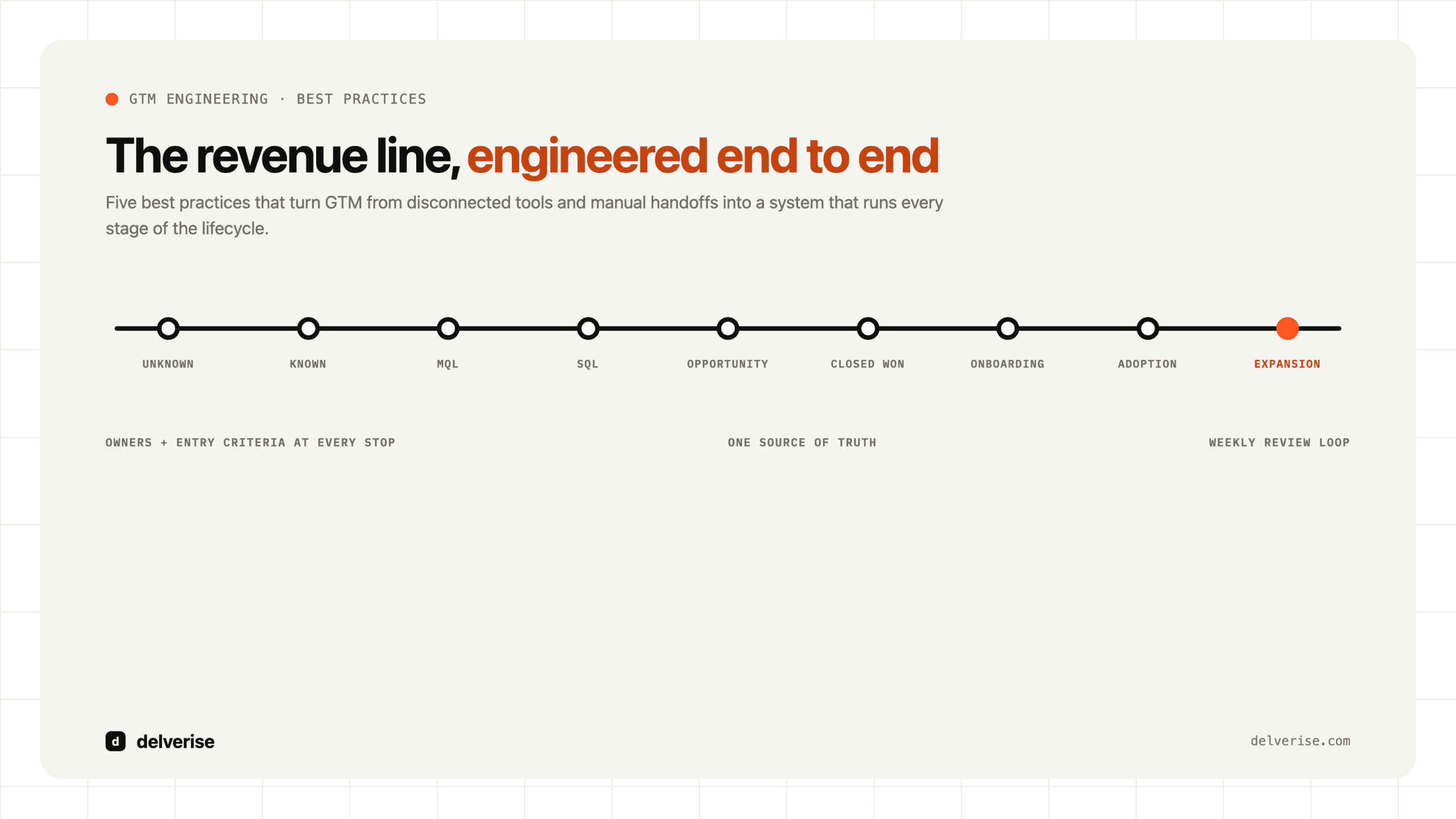
Example: A B2B SaaS company might map its revenue architecture to include stages like: Unknown > Known > MQL > SQL > Opportunity > Closed Won > Onboarding > Adoption > Expansion. For each stage, they would define the owner, the entry/exit criteria, the systems involved (e.g., HubSpot, Salesforce, Outreach), and the key metrics (e.g., conversion rates, velocity).
Actionable Checklist:
- Assemble a cross-functional team of stakeholders from marketing, sales, customer success, and finance.
- Whiteboard the entire customer journey, from initial awareness to post-sale expansion.
- Identify every touchpoint, handoff, and system involved in the process.
- Define clear, unambiguous definitions for each stage of the funnel (e.g., what constitutes an MQL?).
- Document the data that needs to be captured at each stage and how it flows between systems.
Common Pitfalls:
- Focusing only on the sales funnel: A true revenue architecture encompasses the entire customer lifecycle, including post-sale adoption, retention, and expansion.
- Working in silos: Without cross-functional input, the resulting architecture will be incomplete and lead to misalignment.
- Creating a static document: The revenue architecture should be a living document that is regularly reviewed and updated as the business evolves.
Metrics to Track Success:
- Funnel Conversion Rates: The percentage of leads that move from one stage to the next.
- Sales Velocity: The speed at which deals move through the pipeline.
- Customer Lifetime Value (CLV): The total revenue a customer generates over their entire relationship with your company.
Best Practice #2: Design for Scale from Day 1
Many early-stage companies build their GTM systems in an ad-hoc manner, solving immediate problems without considering the long-term implications. This often leads to a brittle, overly complex tech stack that is difficult to manage and impossible to scale. A core principle of GTM Engineering is to design for scale from the very beginning.

Research from McKinsey confirms the cost of this sprawl: ‘companies that rationalize and integrate their sales technology stack see 1.5x higher revenue growth than peers running fragmented tooling.’ The lesson for delverise clients is clear — designing for scale isn’t a tech preference, it’s a growth lever.
Scalable design prioritizes simplicity, flexibility, and a single source of truth. It involves choosing tools that can grow with the business, building integrations that are robust and well-documented, and establishing a data model that can accommodate future needs. It’s the difference between a system that requires constant manual intervention and one that runs smoothly and efficiently, even as the business grows exponentially.
Example: A company might initially use a spreadsheet to track leads. A scalable approach would be to implement a CRM from day one, even if it’s a simple, free version. This establishes a central repository for customer data and provides a foundation for future automation and analysis.
Actionable Checklist:
- Choose a CRM as your central system of record and build your tech stack around it.
- Prioritize tools with robust APIs and a strong ecosystem of integrations.
- Document every integration, including the data that is being passed and the logic that governs the sync.
- Establish a clear data governance policy to ensure data quality and consistency.
- Regularly review your tech stack to identify and remove redundant or underutilized tools.
Common Pitfalls:
- Tool-centric thinking: Don’t let your tools dictate your process. Define your ideal process first, then choose the tools that support it.
- Lack of documentation: Undocumented systems are impossible to troubleshoot and maintain. Document everything.
Metrics to Track Success:
- Lead to Opportunity Velocity: The time it takes for a lead to become a qualified opportunity.
- System Downtime/Errors: The frequency and duration of system failures.
- Time to Implement New Tools/Integrations: The agility of your tech stack.
Best Practice #3: Data-First Decision Making
In a GTM Engineering model, data is the fuel that drives the entire engine, rather than merely a byproduct of activity. A data-first approach means that every strategic decision, from ICP definition to campaign messaging, is informed by quantitative insights rather than gut feelings or anecdotal evidence.

This requires a commitment to data hygiene, a robust data infrastructure, and a culture of data literacy across the organization. GTM Engineers are responsible for building the systems that capture, clean, and surface the data that matters, empowering leaders to make smarter, faster decisions.
Example: A marketing team might believe that a particular channel is performing well based on the number of leads it generates. A data-first approach would involve analyzing the entire funnel, from lead to close, to determine the actual ROI of that channel. This might reveal that while the channel generates a high volume of leads, they are low quality and rarely convert, leading to a decision to reallocate resources to more profitable channels.
Actionable Checklist:
- Establish a single source of truth for all GTM data, typically your CRM.
- Implement automated data enrichment to ensure that your data is accurate and complete.
- Develop a set of standardized dashboards and reports that track the key metrics for each team.
- Train your team on how to interpret the data and use it to make decisions.
- Schedule regular data review meetings to discuss performance and identify areas for improvement.
Common Pitfalls:
- Dirty data: Garbage in, garbage out. Without clean, reliable data, your insights will be meaningless.
- Vanity metrics: Focusing on metrics that look good but don’t actually impact the bottom line (e.g., social media likes).
- Analysis paralysis: Getting bogged down in the data and failing to take action.
Metrics to Track Success:
- Data Quality Score: The percentage of records in your CRM that are complete and accurate.
- Time to Insight: The time it takes to answer a business question with data.
- Adoption of Data Tools: The percentage of your team that regularly uses your data and analytics platforms.
Best Practice #4: Automate the Repeatable
One of the biggest drains on a GTM team’s productivity is the time spent on manual, repetitive tasks. From data entry and lead routing to sending follow-up emails, these tasks are time-consuming and also prone to human error. GTM Engineering seeks to automate these repeatable processes, freeing up the team to focus on high-value activities like building customer relationships and closing deals.

Automation is about efficiency, and it’s also about creating a better customer experience. By automating lead routing, for example, you can ensure that leads are contacted within minutes rather than hours, dramatically increasing the likelihood of conversion.
Example: A sales team might be spending hours each day manually researching leads and enriching their CRM records. A GTM Engineer could automate this process by using a workflow layer such as Clay, Zapier, or a native CRM automation to connect the CRM to a data enrichment provider. When a new lead is created, the system would automatically pull in data like company size, industry, and funding, saving the sales team valuable time.
Actionable Checklist:
- Identify the most time-consuming, repetitive tasks in your GTM process.
- Prioritize automation opportunities based on their potential ROI.
- Start with simple, low-risk automations, such as lead assignment rules.
- Use a combination of native CRM features and third-party automation tools to build your workflows.
- Document and test every automation to ensure that it is working as expected.
Common Pitfalls:
- Automating a bad process: If your underlying process is flawed, automating it will only make things worse.
- Over-automation: Not every process should be automated. Don’t lose the human touch where it matters most.
- Lack of monitoring: Automations can break. You need to have a system in place to monitor them and alert you to any issues.
Metrics to Track Success:
- Time Saved per Rep: The amount of time that your team saves each week through automation.
- Speed to Lead: The time it takes for a new lead to be contacted by a sales rep.
- Reduction in Human Error: The decrease in the number of errors caused by manual data entry.
Best Practice #5: Continuous Optimization Loops
The final pillar of GTM Engineering is a commitment to continuous optimization. The GTM landscape is constantly changing, and what works today may not work tomorrow. A continuous optimization loop is a process of constantly testing, measuring, and iterating on every aspect of your GTM strategy to ensure that it is always performing at its peak.

This requires a culture of experimentation, a willingness to challenge assumptions, and a commitment to data-driven decision making. GTM Engineers play a critical role in this process by building the systems that enable rapid experimentation and providing the data that is needed to measure the results.
Example: A marketing team might want to test a new messaging strategy. A GTM Engineer could help them set up an A/B test in their marketing automation platform, sending one version of the message to a control group and the new version to a test group. They would then track the results of the test, such as open rates, click-through rates, and conversion rates, to determine which message was more effective.
Actionable Checklist:
- Foster a culture of experimentation where failure is seen as a learning opportunity.
- Develop a prioritized backlog of optimization ideas.
- Use a structured framework for running experiments, such as the test → measure → optimize → scale cycle.
- Ensure that every experiment has a clear hypothesis and a set of success metrics.
- Share the results of your experiments with the entire organization to promote learning.
Common Pitfalls:
- Testing too many things at once: This makes it impossible to determine what is actually driving the results.
- Not running tests for long enough: You need to collect enough data to ensure that your results are statistically significant.
- Ignoring qualitative feedback: Quantitative data can tell you what is happening, but qualitative feedback can tell you why.
Metrics to Track Success:
- Number of Experiments Run: A measure of your team’s commitment to optimization.
- Win Rate of Experiments: The percentage of experiments that lead to a positive result.
- Impact of Winning Experiments: The cumulative impact of your optimization efforts on your key GTM metrics.
Implementation Maturity Model
Implementing GTM Engineering is a journey, not a destination. The RevOps Maturity Model provides a framework for assessing your current capabilities and a roadmap for continuous improvement. The model consists of five levels, each with its own set of characteristics and requirements.

- Level 1: Foundational: At this stage, the focus is on establishing a basic data foundation, connecting core systems, and encouraging CRM adoption.
- Level 2: Measured: Once the foundation is in place, the focus shifts to measurement. This involves tracking key performance indicators (KPIs), monitoring playbook adoption, and assessing the effectiveness of the core data model.
- Level 3: Optimized: At this level, the focus is on optimization. This involves regularly reviewing KPIs, identifying and fixing revenue leaks, and training the team to improve performance.
- Level 4: Forecasting: With a well-optimized system, the focus shifts to forecasting. This involves using historical data to predict future performance and improve the accuracy of revenue forecasts.
- Level 5: Predictive: The final stage of maturity is predictive. At this level, the GTM engine is a well-oiled machine, with real-time visibility into performance, proactive leak detection, and the ability to use predictive analytics to drive strategic decisions.
Build the System Behind Your GTM Motion
delverise builds GTM systems for B2B teams that need cleaner enrichment, sharper scoring, faster routing, outbound activation, CRM automation, reporting, and QA. If your team has the strategy but the operating system is still manual, start with the GTM Engineering page or apply to work with us.
Frequently Asked Questions
What is GTM Engineering?
GTM Engineering is the practice of applying an engineer’s mindset to designing, building, and scaling a company’s entire revenue engine. It transforms go-to-market from a series of disconnected activities into a unified, automated, and optimized system. The discipline is built on five interconnected pillars: Strategy, Systems, Processes, Data, and Optimization. It is the solution for scaling businesses confronting silos, leaking pipelines, and tangled tech stacks that cause growth to stall.
What are the five pillars of the GTM Engineering Framework?
The GTM Engineering Framework rests on five interconnected pillars that form a continuous improvement cycle. Strategy defines the ICP, market, and customer journey. Systems connect the CRM, marketing automation, sales engagement, and data enrichment platforms. Processes are the repeatable workflows like lead routing and sales handoffs. Data ensures quality, governance, and accessibility for real-time decisions. Optimization is the feedback loop of testing, measuring, and iterating to maximize performance and ROI.
How do you build a revenue architecture?
Start by assembling a cross-functional team from marketing, sales, customer success, and finance, then whiteboard the entire customer journey from awareness to post-sale expansion. Map every touchpoint, handoff, and system involved, and define unambiguous criteria for each funnel stage. For example, a B2B SaaS company might map: Unknown to Known to MQL to SQL to Opportunity to Closed Won to Onboarding to Adoption to Expansion. Document the data captured at each stage and how it flows between systems.
Why should you design GTM systems for scale from day one?
Many early-stage companies build GTM systems ad-hoc, solving immediate problems without long-term thinking, which creates a brittle, overly complex tech stack that is difficult to manage and impossible to scale. Designing for scale from the start prioritizes simplicity, flexibility, and a single source of truth. It means choosing tools that grow with the business rather than constantly re-platforming. This avoids the chaos of disconnected tools that causes growth to stall as the company expands.
Which metrics measure revenue architecture success?
Three core metrics measure whether a revenue architecture is working. Funnel Conversion Rates track the percentage of leads that move from one stage to the next, exposing friction points in the pipeline. Sales Velocity measures the speed at which deals move through the pipeline, indicating process efficiency. Customer Lifetime Value (CLV) captures the total revenue a customer generates over their entire relationship with your company, validating that the architecture drives long-term value beyond initial close.
What should a GTM engineering best-practices checklist include?
A practical checklist should include lifecycle stage definitions, CRM field governance, enrichment rules, fit and priority scoring, routing logic, outbound activation rules, dashboard ownership, QA criteria, and a weekly review loop. The checklist should describe what is built, who owns it, and how the team knows whether the workflow is still working after launch.
Read next