←Back to blog
Revenue OperationsGuideMay 20, 202653 min read
Clay Revenue Engineering: The Complete GTM Guide 2026
Clay revenue engineering connects Clay, CRM enrichment, AI outbound, scoring, routing, and attribution into a GTM system that creates cleaner pipeline.
Modern Revenue Engineering with Clay
Clay revenue engineering is the practice of using Clay as a workflow layer inside a broader GTM system: sourcing accounts, enriching CRM data, scoring fit and intent, activating outbound, routing records, and measuring pipeline outcomes. It is not just Clay setup. It is the operating logic that connects Clay to your CRM, sequencer, enrichment providers, AI research, and attribution stack.
For B2B teams, that usually means connecting Clay systems to CRM enrichment, AI outbound, GTM engineering, and the reporting loops that show which accounts turn into real pipeline. For shorter definitions across these categories, see the delverise answers hub.
Clay’s visual workflow interface enables sophisticated revenue engineering through no-code automation

Clay made outbound automation more accessible because it gave revenue teams a flexible way to combine data enrichment, prospect research, AI prompts, and workflow logic without waiting on engineering resources. What started as a practical way to automate lead generation has become the foundation for complete revenue engineering systems that generate consistent, predictable pipeline growth.
The traditional approach to Clay implementation (while effective for basic outbound) only scratches the surface of what’s possible when you architect Clay as the core component of a comprehensive revenue engineering system. Most companies use Clay to automate data enrichment and send better cold emails. Revenue engineers use Clay to build intelligent systems that automatically identify, research, qualify, and nurture prospects through sophisticated multi-channel sequences that adapt based on real-time signals and behavioral data.
The difference is profound. Basic Clay implementations might improve your email response rates by 20-30%. Revenue engineering systems built on Clay generate 3x more qualified pipeline than traditional outbound approaches while requiring significantly less manual intervention from your sales team. These systems automate tasks, and they engineer revenue growth through intelligent orchestration of data, AI, and automation across your entire go-to-market stack.
This comprehensive guide will show you how to transform your Clay setup from a simple outbound tool into a sophisticated revenue engineering system. We’ll cover advanced AI integrations with Claude and OpenAI APIs, sophisticated CRM workflows that track attribution from first touch to closed deal, multi-channel orchestration that coordinates email, LinkedIn, and direct mail campaigns, and analytics frameworks that provide complete visibility into your revenue generation process.
Unlike basic Clay tutorials that focus on individual workflows, this guide approaches Clay as the central nervous system of your revenue operations. You’ll learn how to architect systems that scale with your business, integrate seamlessly with your existing tech stack, and provide the kind of predictable pipeline generation that transforms sales from an art into a science.
The companies that master revenue engineering with Clay outperform their competitors and operate in an entirely different category. While their competitors struggle with manual prospecting and disconnected tools, revenue-engineered organizations generate consistent pipeline growth through intelligent automation that gets smarter over time. This guide will show you exactly how to build those systems.
Clay Revenue Engineering: Beyond Basic Outbound
What is Revenue Engineering? Building Growth Systems with Clay
Revenue engineering combines Clay’s automation capabilities with strategic revenue operations to create scalable, data-driven systems that generate consistent pipeline growth. Unlike traditional sales approaches that rely on manual processes and intuition, revenue engineering treats pipeline generation as an engineering discipline, with systematic processes, measurable outcomes, and continuous optimization based on data.
McKinsey’s research on high-growth B2B companies reinforces this discipline: ‘Companies that lead in analytics-driven sales grow revenue 2.3 times faster than industry peers.’ Revenue engineering with Clay operationalizes that advantage by making data the input to every prospecting decision rather than a report you review after the fact.
At its core, revenue engineering recognizes that modern B2B buying has fundamentally changed. Today’s buyers interact with your brand across multiple channels, conduct extensive research before engaging with sales, and expect personalized experiences that demonstrate deep understanding of their specific challenges. Traditional outbound approaches (even those enhanced with basic Clay automation) fail to address this complexity because they treat each touchpoint as an isolated event rather than part of a coordinated system.
‘The typical buyer is now 57% of the way through the purchase decision before engaging a sales rep,’ notes research from CEB (now Gartner). That single statistic explains why revenue engineering exists as a discipline: by the time a prospect raises their hand, the system has already had to do the work of identifying, educating, and qualifying them.
Research from Gartner confirms this shift: ‘By 2025, 80% of B2B sales interactions between suppliers and buyers will occur in digital channels.’ For revenue engineers, this means the system architecture matters more than any individual rep’s effort, because most of the buying journey now happens before a human conversation ever begins.
Revenue engineering with Clay addresses this challenge through four foundational pillars that work together to create a comprehensive growth system:
The 4 Pillars of Clay Revenue Engineering
1. Intelligent Data Operations

Traditional Clay implementations focus on basic data enrichment: pulling email addresses, job titles, and company information from standard databases. Revenue engineering transforms this into intelligent data operations that combine multiple data sources, apply sophisticated filtering logic, and continuously update prospect information based on real-time signals.
Advanced Clay workflows for intelligent data operations integrate intent data from platforms like Vector.co and RB2B to identify companies showing buying signals, combine technographic data to understand prospect tech stacks and identify integration opportunities, leverage job change triggers from LinkedIn Sales Navigator to catch prospects during transition periods when they’re most likely to evaluate new solutions, and cross-reference multiple data sources to ensure accuracy and completeness of prospect information.
This approach transforms Clay from a simple data enrichment tool into an intelligent research engine that automatically identifies the highest-value prospects and provides the context needed for meaningful engagement.
2. Revenue System Integration
Basic Clay setups typically push enriched data to email tools or CRM systems with minimal integration. Revenue engineering creates seamless data flow between Clay and your entire revenue tech stack, ensuring that every prospect interaction is tracked, attributed, and optimized across the complete customer journey.
Advanced revenue system integration connects Clay to your CRM with sophisticated field mapping and workflow automation, integrates with marketing automation platforms to coordinate multi-channel campaigns, syncs with conversation intelligence tools like Gong to analyze sales call outcomes and improve messaging, connects to customer success platforms to track post-sale expansion opportunities, and integrates with analytics tools to provide complete attribution from first touch to closed deal.
This level of integration ensures that Clay-generated prospects receive consistent, coordinated attention across all touchpoints while providing complete visibility into what’s working and what needs optimization.
3. AI-Enhanced Personalization
AI workflow automation enables sophisticated personalization at scale through intelligent data processing
While basic Clay implementations might use simple merge fields for personalization, revenue engineering leverages advanced AI APIs to create sophisticated, contextually relevant messaging that adapts based on prospect characteristics, company signals, and behavioral data.
Modern AI integration with Clay includes OpenAI API connections for generating personalized research insights and email content, Claude API integration for sophisticated reasoning about prospect challenges and solution fit, Perplexity API connections for real-time research on company news and industry trends, and custom AI workflows that analyze prospect data to determine optimal messaging angles and outreach timing.
This AI-enhanced approach enables personalization at scale that rivals what your best sales reps could create manually, but delivered automatically to hundreds or thousands of prospects simultaneously.
4. Closed-Loop Attribution
The most critical difference between basic Clay implementation and revenue engineering is the ability to track and optimize based on actual revenue outcomes. Revenue engineering systems provide complete attribution from initial prospect identification through closed deals, enabling continuous optimization based on what actually drives revenue rather than vanity metrics like email open rates.
Comprehensive attribution tracking includes multi-touch attribution modeling that shows Clay’s role in complex B2B buying cycles, revenue tracking that connects Clay-generated prospects to actual closed deals and customer lifetime value, pipeline velocity analysis that identifies which Clay workflows generate prospects that close faster, and cost-per-acquisition calculations that prove ROI and guide budget allocation across different Clay strategies.
Why Basic Clay Implementation Falls Short
Most companies implement Clay as a tactical solution to specific outbound challenges: better data enrichment, automated email sequences, or improved personalization. While these implementations can improve individual metrics, they fail to address the systemic challenges of modern revenue generation.
Basic Clay implementations typically suffer from limited scope that focuses on email outbound without considering other channels, disconnected workflows that don’t integrate with broader revenue operations, manual handoffs between Clay and other systems that create friction and data loss, lack of attribution that makes it impossible to optimize based on revenue outcomes, and static processes that don’t adapt based on performance data or changing market conditions.
These limitations mean that basic Clay implementations often plateau after initial improvements, failing to deliver the kind of scalable, predictable pipeline generation that modern businesses require.
What Revenue Engineering Adds
Revenue engineering transforms Clay from a tactical tool into a strategic revenue generation system by adding systematic integration across your entire revenue tech stack, AI-powered intelligence that makes your outbound smarter over time, comprehensive attribution that enables data-driven optimization, scalable processes that grow with your business without proportional increases in manual work, and continuous improvement frameworks that ensure your system gets better over time.
The result is a revenue generation system that operates more like a well-engineered product than a collection of manual processes. Just as software engineers build systems that scale efficiently and improve through iteration, revenue engineers build growth systems that generate predictable pipeline while continuously optimizing for better performance.
Companies that successfully implement revenue engineering with Clay typically see 3x improvement in qualified pipeline generation, 40-60% reduction in cost per qualified lead, 25-35% improvement in sales cycle velocity, and 2-3x improvement in overall sales team productivity. These improvements compound over time as the system learns and optimizes, creating sustainable competitive advantages that are difficult for competitors to replicate.
Building Your Clay Revenue Engine: Advanced Workflows
The Advanced Clay Workflow Architecture
Revenue engineering with Clay requires a fundamentally different approach to workflow design than basic outbound automation. Instead of linear sequences that move prospects from data enrichment to email outreach, revenue engineering workflows create intelligent systems that adapt based on prospect characteristics, behavioral signals, and real-time market data.
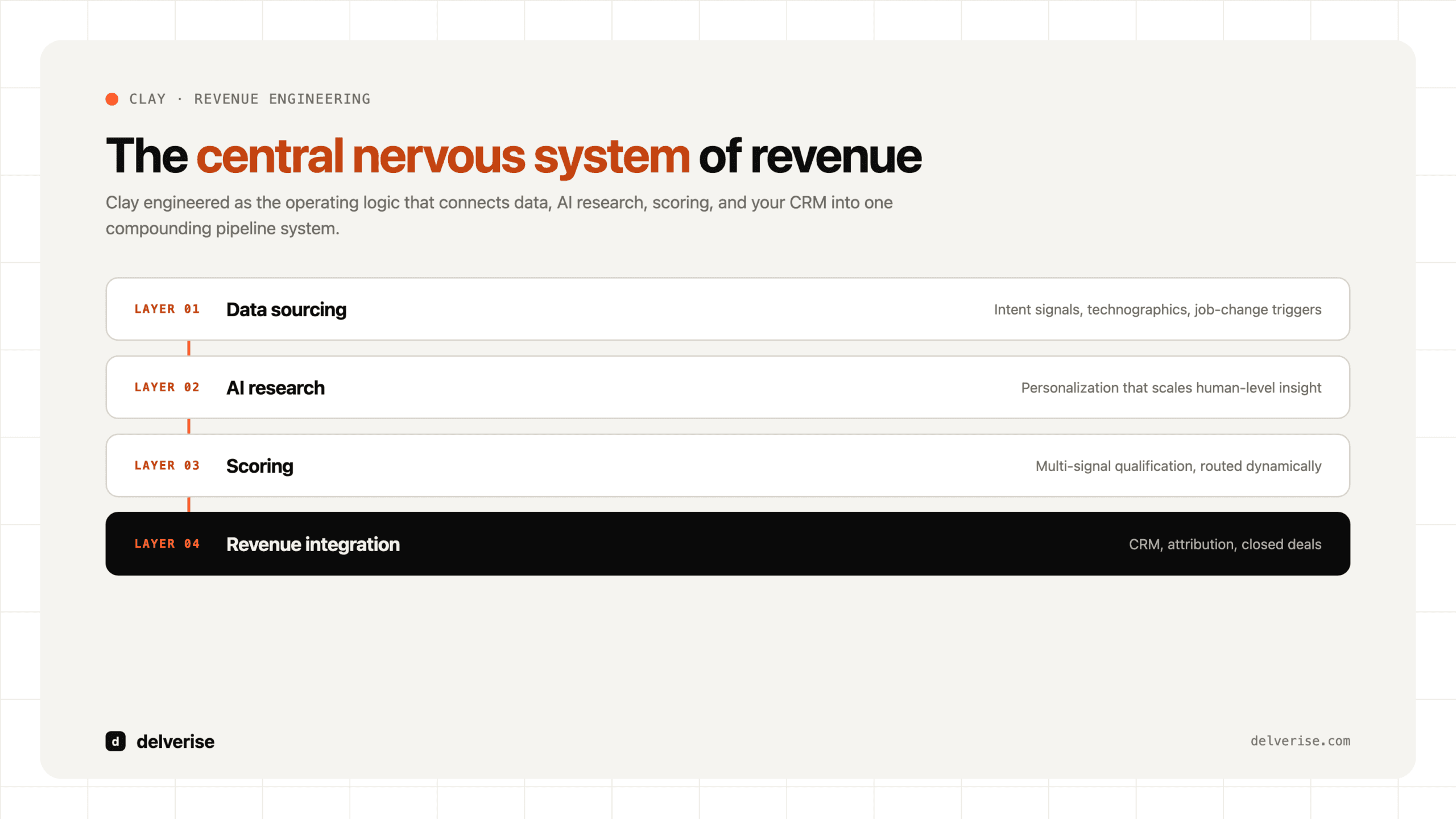
The advanced Clay workflow architecture consists of four interconnected layers that work together to create a comprehensive revenue generation system. Each layer builds on the previous one, creating increasingly sophisticated capabilities that enable true revenue engineering at scale.
Layer 1: Intelligent Data Sourcing & Enrichment
The foundation of any revenue engineering system is intelligent data operations that go far beyond basic contact enrichment. Advanced Clay workflows for data sourcing combine multiple data providers, apply sophisticated filtering logic, and continuously update prospect information based on real-time signals and triggers.
Apollo + Clay Integration for Comprehensive B2B Data
Modern revenue engineering starts with sophisticated data sourcing that combines Clay’s native integrations with advanced filtering and validation logic. The Apollo integration within Clay enables complex queries that identify prospects based on multiple criteria simultaneously: company size, technology stack, recent funding events, job change triggers, and geographic location.
Advanced Apollo workflows in Clay begin with dynamic list building that automatically refreshes based on changing criteria. Rather than pulling static lists, revenue engineering workflows create “living lists” that continuously identify new prospects as they meet your ideal customer profile criteria. This might include companies that recently raised Series A funding in specific industries, organizations that recently hired VPs of Sales or Revenue Operations, or businesses that recently implemented specific technologies that indicate buying intent for your solution.
The key to effective Apollo integration is layered filtering that applies multiple criteria in sequence, each building on the previous filter to create highly targeted prospect lists. For example, a sophisticated workflow might start with broad industry and company size criteria, then filter for specific technologies in their stack, then identify companies with recent hiring activity in relevant departments, and finally cross-reference with intent data to prioritize companies showing active buying signals.
LinkedIn Sales Navigator + Clay for Job Change Triggers
One of the most powerful applications of Clay for revenue engineering is automating prospect research based on job change triggers. LinkedIn Sales Navigator integration enables Clay workflows that automatically identify when prospects change roles, get promoted, or join new companies, all trigger events that create significant buying opportunities.
Advanced job change workflows in Clay monitor your existing prospect database for role changes and automatically re-engage prospects who move to new companies where they might have budget and buying authority. These workflows also identify prospects who get promoted within their current companies, often indicating increased budget and decision-making authority that makes them more valuable targets for outreach.
The sophistication of modern job change workflows extends beyond simple notifications. Revenue engineering workflows analyze the context of job changes: whether the prospect moved to a larger company (indicating potential for bigger deals), joined a company in a different industry (requiring adjusted messaging), or received a promotion that changes their likely pain points and priorities.
Multi-Source Data Validation for Accuracy
Revenue engineering requires data accuracy that goes beyond what any single provider can deliver. Advanced Clay workflows implement multi-source validation that cross-references information from multiple providers to ensure accuracy and completeness of prospect data.
Multi-source validation workflows typically combine Apollo for comprehensive company and contact data, Clearbit for additional firmographic information and company insights, Hunter for email validation and pattern identification, ZoomInfo for additional contact verification and org chart mapping, and LinkedIn for real-time employment verification and recent activity insights.
The validation process applies sophisticated logic that flags discrepancies between sources and applies confidence scoring to different data points. For example, if Apollo shows a prospect as VP of Sales but LinkedIn shows them as Director of Revenue Operations, the workflow flags this for manual review or applies lower confidence scoring that affects prioritization and messaging.
Intent Data Integration for Buying Signals
Modern revenue engineering workflows integrate intent data sources to identify companies showing active buying signals for your solution category. Clay’s integration capabilities enable sophisticated workflows that combine intent data with traditional firmographic and technographic data to create highly targeted prospect lists.
Vector.co integration provides intent signals based on content consumption and research behavior, indicating companies actively researching solutions in your category. RB2B integration identifies anonymous website visitors and matches them to company data, enabling workflows that automatically add website visitors to targeted outreach sequences.
Advanced intent data workflows identify companies showing buying signals and analyze the intensity and recency of those signals to prioritize outreach timing and messaging. Companies showing strong, recent intent signals receive immediate, high-touch outreach, while companies with weaker signals enter longer-term nurture sequences designed to build awareness and trust over time.
Layer 2: AI-Powered Research & Personalization
The second layer of advanced Clay workflows leverages modern AI APIs to create sophisticated personalization and research capabilities that scale human-level insights across thousands of prospects. This layer transforms Clay from a data enrichment tool into an intelligent research engine that provides the context and insights needed for meaningful prospect engagement.
OpenAI API Integration for Personalized Research Insights
OpenAI API integration within Clay enables sophisticated research workflows that analyze prospect and company data to generate personalized insights and talking points for each outreach attempt. These workflows go far beyond simple merge fields to create contextually relevant research that demonstrates deep understanding of prospect challenges and opportunities.
Advanced OpenAI workflows analyze company news, recent funding announcements, leadership changes, and industry trends to identify relevant talking points for each prospect. The AI analyzes this information in the context of your solution’s value proposition to generate personalized insights that connect your offering to the prospect’s likely priorities and challenges.
For example, an OpenAI workflow might analyze a prospect’s company recent acquisition announcement and generate insights about likely integration challenges, technology consolidation needs, or scaling requirements that your solution addresses. The AI considers the prospect’s role, company size, industry, and recent company events to generate talking points that feel personally researched rather than automated.
Claude API Workflows for Sophisticated Reasoning
Claude API integration enables even more sophisticated reasoning about prospect fit, messaging strategy, and outreach timing. Claude’s advanced reasoning capabilities allow Clay workflows to analyze complex prospect scenarios and make nuanced decisions about messaging approach, channel selection, and follow-up timing.
Claude workflows excel at analyzing prospect context to determine optimal messaging angles. For example, Claude might analyze a prospect’s LinkedIn activity, company news, and role responsibilities to determine whether to focus on efficiency gains, cost reduction, revenue growth, or competitive advantages in initial outreach.
Advanced Claude workflows also provide sophisticated objection handling by analyzing prospect characteristics and predicting likely concerns or objections based on their role, company size, industry, and current technology stack. This enables proactive messaging that addresses concerns before they’re raised, significantly improving response rates and meeting conversion.
Perplexity Research Automation for Real-Time Insights
Perplexity API integration enables Clay workflows to conduct real-time research on companies and prospects, gathering the most current information available and incorporating it into personalized outreach. This capability ensures that your messaging reflects the most recent company developments and industry trends.
Perplexity workflows automatically research recent company news, industry developments, competitive landscape changes, and market trends that might affect prospect priorities. This research is then analyzed in the context of your solution to identify relevant talking points and messaging angles.
For example, a Perplexity workflow might identify that a prospect’s company recently announced expansion into new markets and automatically generate messaging that focuses on how your solution supports rapid scaling and market entry. The workflow considers the specific markets being entered, the company’s current technology stack, and likely scaling challenges to create highly relevant, timely outreach.
AirOps Content Generation for Scale
AirOps integration enables sophisticated content generation workflows that create personalized emails, LinkedIn messages, and follow-up sequences at scale. These workflows combine prospect research, company insights, and messaging best practices to generate content that feels personally crafted while being delivered automatically to hundreds of prospects.
Advanced AirOps workflows create dynamic content that adapts based on prospect characteristics, company signals, and response behavior. The content generation considers factors like prospect seniority level (adjusting tone and technical depth), company size (focusing on relevant use cases and ROI metrics), industry (incorporating relevant terminology and challenges), and recent company events (incorporating timely, relevant context).
The sophistication of modern content generation extends to multi-touch sequences that evolve based on prospect engagement. If a prospect opens emails but doesn’t respond, subsequent messages adjust tone and approach. If a prospect visits your website after receiving an email, follow-up messages reference specific pages visited and content consumed.
Layer 3: Advanced Scoring & Qualification
The third layer of revenue engineering workflows implements sophisticated scoring and qualification logic that goes far beyond basic demographic criteria. These workflows combine multiple data sources and apply machine learning principles to identify prospects most likely to convert and determine optimal engagement strategies.
Multi-Dimensional Scoring Combining Multiple Signals
Advanced Clay scoring workflows combine firmographic data (company size, industry, location), technographic data (current technology stack, recent implementations), behavioral data (website visits, content engagement, email responses), intent data (research activity, competitor evaluation), and temporal data (recent funding, leadership changes, expansion announcements) to create comprehensive prospect scores.
The scoring logic applies different weights to different signals based on your historical conversion data. For example, if prospects from companies using specific technologies convert at higher rates, the scoring algorithm gives higher weight to technographic signals. If prospects who engage with specific content types are more likely to take meetings, content engagement receives higher scoring weight.
Multi-dimensional scoring also considers signal recency and intensity. Recent signals receive higher weight than older ones, and multiple signals in the same category (like multiple intent signals) compound to create higher scores. This approach ensures that prospects showing strong, recent buying signals receive immediate attention while prospects with weaker signals enter appropriate nurture sequences.
AI-Powered Qualification Using Machine Learning
Modern Clay workflows implement machine learning principles to continuously improve qualification accuracy based on historical outcomes. These workflows analyze patterns in your closed deals to identify characteristics that predict success and automatically adjust scoring criteria based on performance data.
AI-powered qualification workflows track which prospect characteristics correlate with meeting acceptance, opportunity creation, and closed deals. The system continuously learns from new data to improve prediction accuracy and adjust qualification criteria based on changing market conditions and business priorities.
For example, if the system identifies that prospects from companies with specific technology stacks are 3x more likely to close deals, it automatically adjusts scoring to prioritize similar prospects. If prospects who engage with specific content types show higher conversion rates, the qualification logic incorporates content engagement patterns into scoring decisions.
Dynamic Segmentation for Appropriate Campaign Routing
Advanced Clay workflows implement dynamic segmentation that automatically routes prospects to appropriate campaigns based on their characteristics, score, and likely buying timeline. This segmentation goes beyond simple demographic criteria to consider behavioral signals, intent data, and predicted conversion likelihood.
Dynamic segmentation workflows create multiple prospect paths: high-score enterprise prospects receive immediate, high-touch outreach from senior sales reps, medium-score prospects enter automated nurture sequences with periodic human touchpoints, low-score prospects receive educational content designed to build awareness and trust over time, and prospects showing strong intent signals but low fit scores receive targeted content to improve qualification over time.
The segmentation logic continuously adapts based on prospect behavior and engagement. Prospects who initially score low but show increasing engagement automatically move to higher-touch sequences. Prospects who score high but show poor engagement move to different messaging approaches or longer-term nurture sequences.
Layer 4: Revenue System Integration
The fourth layer of advanced Clay workflows creates seamless integration with your entire revenue tech stack, ensuring that Clay-generated prospects receive coordinated attention across all touchpoints while providing complete attribution and analytics.
HubSpot Workflow Automation for Seamless Data Flow
Advanced HubSpot integration goes far beyond simple contact creation to implement sophisticated workflow automation that coordinates Clay data with your broader marketing and sales operations. These workflows ensure that Clay-generated prospects receive appropriate follow-up while maintaining complete data integrity across systems.
HubSpot integration workflows automatically create contacts with complete Clay research and scoring data, trigger appropriate nurture sequences based on prospect characteristics and scores, update deal stages and properties based on Clay qualification data, sync engagement data back to Clay for continuous optimization, and create tasks and notifications for sales reps with complete prospect context.
The integration maintains bidirectional data flow that ensures Clay workflows can adapt based on HubSpot engagement data while HubSpot workflows can leverage Clay research and scoring for better targeting and personalization.
Salesforce Opportunity Creation for Enterprise Sales
For organizations using Salesforce, advanced Clay integration creates sophisticated opportunity management workflows that automatically generate opportunities for qualified prospects while maintaining complete attribution and context throughout the sales process.
Salesforce integration workflows automatically create opportunities with pre-populated Clay research and qualification data, assign opportunities to appropriate sales reps based on territory and expertise, update opportunity stages based on engagement and qualification criteria, sync Clay scoring data to custom Salesforce fields for reporting and analytics, and create comprehensive activity timelines that include all Clay research and outreach.
The integration ensures that sales reps have complete context for every Clay-generated opportunity while maintaining attribution that connects closed deals back to specific Clay workflows and campaigns.
Attio Relationship Mapping for Warm Introduction Opportunities
Attio integration enables sophisticated relationship mapping workflows that identify warm introduction opportunities and coordinate relationship-based outreach strategies. These workflows analyze your team’s LinkedIn connections and email contacts to identify potential introduction paths to high-value prospects.
Relationship mapping workflows automatically identify team members with connections to target prospects or their colleagues, create introduction request workflows that coordinate warm outreach through existing relationships, track introduction outcomes and relationship strength for future reference, and maintain relationship intelligence that improves over time as your network grows.
This capability transforms Clay from a cold outbound tool into a relationship intelligence system that leverages your team’s existing network for warmer, more effective prospect engagement.
CRM Integration: Clay to Revenue
Seamless CRM integration transforms Clay data into actionable revenue opportunities

Revenue Engineering Integration: From Clay Data to Closed Deals
The true power of Clay revenue engineering emerges when Clay-generated prospects seamlessly flow through your entire revenue system with complete attribution and context preservation. Advanced CRM integration transforms Clay from isolated outbound tool into the central nervous system of revenue operations.
Modern CRM integration with Clay requires sophisticated workflow design that maintains data integrity, preserves context, and enables bidirectional communication between systems. This level of integration ensures that sales teams have complete prospect context while revenue operations teams can track and optimize based on actual revenue outcomes rather than vanity metrics.
HubSpot + Clay Revenue Engineering
HubSpot’s robust automation capabilities make it an ideal platform for sophisticated Clay integration that coordinates prospect engagement across marketing, sales, and customer success teams. Advanced HubSpot integration creates intelligent workflows that adapt based on prospect behavior while maintaining complete attribution from initial Clay identification through closed deals.
Advanced Contact Creation with Complete Context and History
Revenue engineering workflows create HubSpot contacts that include basic demographic information along with complete Clay research context, scoring rationale, and engagement history. This comprehensive contact creation ensures that every team member who interacts with a Clay-generated prospect has full context for meaningful engagement.
Advanced contact creation workflows map all Clay data points to relevant HubSpot properties, including firmographic data, technographic insights, intent signals, AI-generated research summaries, personalization talking points, and scoring rationale. The workflows also create comprehensive contact timelines that include all Clay research activities, data source information, and qualification logic.
This level of detail enables sales reps to understand who the prospect is, why they were identified as a good fit, what research has been conducted, and what messaging approaches are most likely to resonate. The complete context dramatically improves sales rep effectiveness while reducing the time needed to research and prepare for prospect conversations.
Custom Property Architecture for Clay Data Mapping
Effective Clay integration requires thoughtful custom property architecture that captures all relevant Clay data while maintaining HubSpot performance and usability. Advanced implementations create custom property groups specifically for Clay data, including prospect scoring and qualification data, AI-generated research insights, data source and validation information, engagement tracking and attribution data, and workflow automation triggers and status.
The property architecture enables sophisticated reporting and analytics that track Clay performance across the entire revenue funnel. Sales managers can analyze which Clay scoring criteria correlate with closed deals, marketing teams can optimize campaigns based on Clay qualification data, and revenue operations teams can track ROI and cost-per-acquisition for different Clay strategies.
Custom properties also enable advanced workflow automation that adapts based on Clay data. For example, prospects with high intent scores might automatically receive expedited follow-up, while prospects with specific technographic profiles might enter specialized nurture sequences designed for their technology stack.
Intelligent Workflow Triggers Using Clay Data
HubSpot workflow automation becomes significantly more powerful when triggered by Clay data and insights. Advanced integration creates intelligent workflows that respond to Clay scoring changes, qualification updates, and behavioral signals to provide appropriate prospect engagement at scale.
Intelligent workflow triggers include score-based routing that automatically assigns prospects to appropriate sales reps based on Clay qualification data, intent-based acceleration that expedites follow-up for prospects showing strong buying signals, technographic-based nurturing that delivers relevant content based on prospect technology stack, and behavioral-based re-engagement that adjusts messaging based on prospect response patterns.
These workflows ensure that Clay-generated prospects receive appropriate attention without requiring manual intervention from sales or marketing teams. The automation adapts based on prospect characteristics and behavior while maintaining the personalized approach that drives revenue engineering success.
Revenue Attribution Setup for Complete Tracking
The most critical aspect of Clay-HubSpot integration is comprehensive revenue attribution that tracks Clay-generated prospects through to closed deals and customer lifetime value. This attribution enables data-driven optimization based on actual revenue outcomes rather than intermediate metrics.
Revenue attribution workflows create comprehensive tracking that includes initial Clay identification and qualification data, all touchpoints and engagement activities throughout the sales process, opportunity creation and progression tracking, closed deal attribution with revenue amounts and timeline data, and customer lifetime value tracking for long-term ROI analysis.
This attribution data enables sophisticated analysis of Clay performance across different prospect segments, messaging approaches, and qualification criteria. Revenue operations teams can identify which Clay strategies generate the highest-value customers and optimize budget allocation accordingly.
Automated Lead Scoring Enhancement
Clay data significantly enhances HubSpot’s native lead scoring capabilities by providing external data and insights that aren’t available through HubSpot’s standard integrations. Advanced implementations combine Clay qualification data with HubSpot behavioral scoring to create comprehensive prospect scores that consider both external signals and engagement behavior.
Enhanced lead scoring workflows combine Clay firmographic and technographic data with HubSpot email engagement, website behavior, and content consumption data to create multi-dimensional scores that predict conversion likelihood more accurately than either system could achieve independently.
The combined scoring enables more sophisticated prospect prioritization and routing while providing sales teams with better qualified leads that are more likely to convert to opportunities and closed deals.
Salesforce + Clay Enterprise Integration
Salesforce’s enterprise-grade capabilities enable sophisticated Clay integration that supports complex sales processes, territory management, and advanced analytics. Enterprise Clay integration with Salesforce creates comprehensive revenue engineering systems that scale with large sales organizations while maintaining data integrity and attribution accuracy.
Territory-Based Routing for Automatic Assignment
Enterprise sales organizations require sophisticated territory management that automatically routes Clay-generated prospects to appropriate sales reps based on geographic, industry, or account-based criteria. Advanced Salesforce integration creates intelligent routing workflows that consider multiple factors to ensure optimal prospect assignment.
Territory-based routing workflows analyze prospect company location, industry, size, and technology stack to determine appropriate sales rep assignment. The workflows also consider sales rep capacity, expertise, and performance data to optimize prospect distribution and maximize conversion likelihood.
Advanced routing logic also handles complex scenarios like existing customer relationships, partner channel conflicts, and strategic account assignments. The workflows ensure that Clay-generated prospects are routed appropriately while maintaining existing relationship and territory agreements.
Opportunity Automation with Pre-Populated Research
Salesforce integration enables sophisticated opportunity creation workflows that automatically generate opportunities for qualified Clay prospects while pre-populating all relevant research and context data. This automation ensures that sales reps can focus on selling rather than research and data entry.
Opportunity automation workflows create opportunities with complete Clay research summaries, qualification rationale, and recommended messaging approaches. The workflows also populate relevant opportunity fields with Clay data, including company technographic information, intent signals, competitive landscape insights, and predicted deal size based on company characteristics.
Pre-populated opportunities enable sales reps to immediately engage with prospects using relevant, researched talking points while ensuring that all opportunity data is complete and accurate for forecasting and analytics purposes.
Activity Timeline Integration for Complete History
Advanced Salesforce integration maintains comprehensive activity timelines that include all Clay research activities, data enrichment events, and automated outreach attempts. This complete history ensures that sales reps understand the full context of prospect engagement before their first conversation.
Activity timeline integration creates detailed records of all Clay workflows that touched each prospect, data sources used for research and enrichment, AI-generated insights and personalization approaches, automated outreach attempts and response data, and qualification scoring changes and rationale.
This comprehensive history enables sales reps to reference specific research insights during conversations while avoiding redundant questions or approaches that have already been attempted through automated outreach.
Revenue Reporting for Pipeline Attribution
Enterprise Salesforce integration enables sophisticated revenue reporting that tracks Clay performance across the entire sales funnel and attributes closed deals to specific Clay workflows and strategies. This reporting provides the data needed for continuous optimization and budget allocation decisions.
Revenue reporting workflows track Clay-generated pipeline by source, qualification criteria, and campaign type, conversion rates from Clay identification through closed deals, average deal size and sales cycle length for Clay-generated opportunities, cost-per-acquisition and ROI for different Clay strategies, and customer lifetime value for Clay-generated customers.
This comprehensive reporting enables revenue operations teams to optimize Clay strategies based on actual revenue outcomes while providing sales leadership with visibility into pipeline generation and conversion performance.
Attio for Advanced Relationship Intelligence
Attio’s relationship-focused CRM capabilities enable sophisticated Clay integration that leverages existing relationships and network connections for warmer, more effective prospect engagement. Attio integration transforms Clay from a cold outbound tool into a relationship intelligence system that coordinates warm introduction strategies.
Network Mapping for Connection Identification
Attio’s network mapping capabilities enable Clay workflows to automatically identify existing relationships and connection opportunities with target prospects. This relationship intelligence significantly improves outreach effectiveness by enabling warm introductions rather than cold outreach.
Network mapping workflows analyze your team’s LinkedIn connections, email contacts, and CRM relationships to identify potential introduction paths to Clay-generated prospects. The workflows consider connection strength, relationship recency, and introduction appropriateness to recommend optimal introduction strategies.
Advanced network mapping also identifies indirect connection opportunities through mutual connections, shared experiences, or common interests that can be leveraged for warmer outreach approaches.
Relationship Strength Scoring for Better Timing
Attio integration enables sophisticated relationship strength scoring that helps determine optimal timing and approach for prospect engagement. This scoring considers multiple factors to ensure that relationship-based outreach is appropriately timed and positioned.
Relationship strength scoring analyzes connection recency and frequency, mutual interaction history, shared experiences or interests, professional relationship context, and introduction appropriateness based on relationship dynamics.
This scoring enables Clay workflows to automatically determine whether to pursue direct outreach, request warm introductions, or wait for better timing based on relationship context and strength.
Team Collaboration for Shared Relationship Intelligence
Attio’s collaboration features enable sophisticated team coordination around Clay-generated prospects, ensuring that relationship intelligence is shared effectively and introduction requests are handled appropriately.
Team collaboration workflows automatically identify team members with relevant connections to Clay prospects, coordinate introduction requests and warm outreach strategies, track introduction outcomes and relationship development, and maintain shared relationship intelligence that improves over time.
This collaboration ensures that Clay-generated prospects benefit from your team’s collective network while avoiding duplicate or conflicting outreach attempts.
Advanced Automation with N8n/Zapier
For organizations requiring custom integrations or connections to tools without native Clay support, advanced automation platforms like N8n and Zapier enable sophisticated workflow orchestration that extends Clay’s capabilities across your entire tech stack.
Cross-Platform Workflows for Comprehensive Integration
Advanced automation platforms enable Clay integration with virtually any tool in your tech stack, creating comprehensive workflows that coordinate prospect engagement across all systems. These integrations ensure that Clay data flows seamlessly throughout your revenue operations while maintaining data integrity and attribution.
Cross-platform workflows connect Clay to customer success platforms for post-sale expansion tracking, marketing automation tools for coordinated campaign management, conversation intelligence platforms for sales call analysis and optimization, analytics tools for comprehensive performance tracking, and custom internal tools for specialized business processes.
These integrations create truly comprehensive revenue engineering systems that leverage Clay data across all aspects of your go-to-market operations.
Error Handling and Monitoring for Data Integrity
Enterprise-grade Clay integration requires sophisticated error handling and monitoring that ensures data integrity and system reliability. Advanced automation workflows include comprehensive error handling that prevents data loss and maintains system performance.
Error handling workflows include data validation and quality checks at each integration point, automatic retry logic for failed API calls or data transfers, comprehensive logging and monitoring for troubleshooting and optimization, alert systems for critical errors or system failures, and backup and recovery procedures for data protection.
This level of error handling ensures that Clay integration remains reliable and accurate even as data volumes and system complexity increase.
Custom Business Logic for Unique Requirements
Advanced automation platforms enable custom business logic that addresses unique organizational requirements and processes. These custom workflows ensure that Clay integration adapts to your specific business needs rather than forcing your processes to conform to standard integration patterns.
Custom business logic might include specialized qualification criteria based on unique industry requirements, custom scoring algorithms that incorporate proprietary data sources, specialized routing logic for complex territory or account management, custom reporting and analytics for specific business metrics, and integration with proprietary tools or systems.
This flexibility ensures that Clay revenue engineering can be implemented effectively regardless of organizational complexity or unique business requirements.
Multi-Channel Revenue Engineering with Clay
Multi-channel orchestration coordinates prospect engagement across email, LinkedIn, and other touchpoints

Beyond Email: Multi-Channel Revenue Engineering
Modern B2B buyers interact with vendors across multiple channels throughout their buying journey, making single-channel outreach increasingly ineffective. Clay revenue engineering enables sophisticated multi-channel orchestration that coordinates prospect engagement across email, LinkedIn, direct mail, video, and other channels while maintaining consistent messaging and complete attribution.
Multi-channel revenue engineering recognizes that different prospects prefer different communication channels and that buying committees often include multiple stakeholders with varying communication preferences. Advanced Clay workflows orchestrate coordinated campaigns that reach prospects through their preferred channels while adapting messaging and timing based on engagement patterns and behavioral signals.
The sophistication of modern multi-channel orchestration extends beyond simply sending the same message across different channels. Revenue engineering workflows analyze prospect characteristics, engagement history, and behavioral signals to determine optimal channel selection, messaging approach, and timing for each touchpoint. This intelligent orchestration significantly improves response rates while providing a more personalized experience that builds trust and credibility.
Email Engineering with Smartlead + Instantly
Email remains the foundation of most B2B outreach strategies, but revenue engineering transforms basic email campaigns into sophisticated communication systems that adapt based on prospect behavior and engagement patterns. Advanced email engineering with Clay combines intelligent sending infrastructure, AI-powered content generation, and sophisticated attribution tracking.
Advanced Domain Management for Optimal Deliverability
Revenue engineering email campaigns require sophisticated domain management that maintains high deliverability rates while scaling outreach volume. Advanced Clay workflows coordinate with email platforms like Smartlead and Instantly to implement intelligent domain rotation, sending pattern optimization, and reputation management.
Advanced domain management workflows automatically rotate sending domains based on volume and reputation metrics, monitor deliverability rates and adjust sending patterns accordingly, implement sophisticated warm-up sequences for new domains, coordinate sending across multiple team members and campaigns, and maintain backup domains for continued operation during reputation issues.
This level of domain management ensures that Clay-generated email campaigns maintain high deliverability rates even at significant scale, protecting your organization’s email reputation while maximizing prospect reach.
AI Sequence Optimization Using Clay Data
Clay data enables sophisticated email sequence optimization that adapts messaging, timing, and approach based on prospect characteristics and engagement patterns. Advanced workflows use Clay research and scoring data to trigger contextually relevant email sequences that feel personally crafted rather than automated.
AI sequence optimization workflows analyze prospect firmographic and technographic data to select appropriate messaging angles, use intent signals to adjust sequence timing and urgency, incorporate AI-generated research insights into email personalization, adapt follow-up timing based on prospect engagement patterns, and automatically adjust messaging based on response sentiment and content.
This optimization ensures that each prospect receives email sequences that are relevant to their specific situation and challenges while maintaining the scale advantages of automation.
Dynamic A/B Testing for Continuous Improvement
Revenue engineering email campaigns implement sophisticated A/B testing that goes beyond simple subject line testing to optimize entire sequences, messaging approaches, and timing strategies. Clay data enables advanced testing that segments prospects based on characteristics and tests different approaches for different prospect types.
Dynamic A/B testing workflows test different messaging angles for different prospect segments, optimize send timing based on prospect time zones and engagement patterns, test different personalization approaches and content types, analyze response sentiment and meeting conversion rates, and automatically implement winning variations across campaigns.
This continuous optimization ensures that email campaigns improve over time while providing data-driven insights that inform broader revenue engineering strategies.
Deliverability Intelligence and Monitoring
Advanced email engineering requires sophisticated deliverability monitoring that tracks sender reputation, engagement rates, and deliverability metrics across all campaigns and domains. Clay integration enables comprehensive deliverability intelligence that protects your organization’s email reputation while maximizing campaign effectiveness.
Deliverability intelligence workflows monitor sender reputation across all domains and IP addresses, track engagement rates and spam complaints by prospect segment, analyze deliverability patterns and identify optimization opportunities, implement automatic adjustments for deliverability issues, and maintain comprehensive reporting for ongoing optimization.
This monitoring ensures that email campaigns maintain high deliverability rates while providing early warning of potential reputation issues that could impact campaign effectiveness.
Response Handling Automation with Full Context
Revenue engineering email campaigns require sophisticated response handling that routes replies to appropriate team members while maintaining complete context and attribution. Advanced workflows ensure that prospect responses receive appropriate follow-up while preserving all Clay research and engagement history.
Response handling automation workflows automatically categorize responses based on sentiment and intent, route positive responses to appropriate sales reps with complete Clay context, handle objections and questions with AI-generated responses or human escalation, track response patterns and sentiment for campaign optimization, and maintain comprehensive attribution for all prospect interactions.
This automation ensures that prospect responses receive appropriate attention while maintaining the efficiency advantages of automated outreach.
LinkedIn Revenue Engineering
LinkedIn has become an essential channel for B2B outreach, but effective LinkedIn automation requires sophisticated workflows that maintain platform compliance while delivering personalized engagement at scale. Clay integration enables advanced LinkedIn strategies that leverage professional networking for revenue generation.
Sales Navigator Integration for Automated Prospect Identification
LinkedIn Sales Navigator integration with Clay enables sophisticated prospect identification workflows that automatically identify and engage with prospects based on multiple criteria including job changes, company updates, content engagement, and network connections.
Sales Navigator integration workflows automatically identify prospects based on Clay qualification criteria, monitor prospect activity and engagement for optimal outreach timing, identify mutual connections for warm introduction opportunities, track prospect job changes and company updates for re-engagement triggers, and coordinate LinkedIn outreach with other channel activities.
This integration ensures that LinkedIn outreach is targeted, timely, and coordinated with broader revenue engineering campaigns while maintaining compliance with LinkedIn’s terms of service.
Intelligent Message Personalization Using Clay Research
Clay research data enables sophisticated LinkedIn message personalization that goes far beyond basic merge fields to create contextually relevant messages that demonstrate genuine interest and understanding of prospect challenges.
Intelligent personalization workflows use Clay AI-generated research insights to create relevant talking points, incorporate recent company news and developments into messaging, reference specific technologies or challenges relevant to the prospect’s role, adapt messaging tone and approach based on prospect seniority and industry, and coordinate LinkedIn messaging with email and other channel activities.
This level of personalization significantly improves LinkedIn response rates while building credibility and trust that facilitates meaningful prospect conversations.
Connection Rate Optimization and Monitoring
Effective LinkedIn automation requires careful monitoring of connection acceptance rates and engagement patterns to maintain account health while maximizing outreach effectiveness. Advanced workflows track performance metrics and automatically adjust strategies based on results.
Connection rate optimization workflows monitor connection acceptance rates and adjust outreach volume accordingly, track message response rates and optimize messaging approaches, analyze prospect engagement patterns and adjust timing strategies, implement automatic cooling-off periods for account protection, and maintain comprehensive reporting for ongoing optimization.
This monitoring ensures that LinkedIn automation remains effective while protecting account health and maintaining compliance with platform guidelines.
Multi-Touch LinkedIn Sequences for Relationship Building
Revenue engineering LinkedIn campaigns implement sophisticated multi-touch sequences that build relationships over time rather than focusing solely on immediate conversion. These sequences coordinate connection requests, direct messages, content engagement, and social selling activities.
Multi-touch LinkedIn sequences include strategic connection requests with personalized messages, follow-up messages that provide value and build credibility, content engagement that demonstrates genuine interest in prospect activities, social selling activities that position your organization as a thought leader, and coordination with other channel activities for comprehensive prospect engagement.
These sequences build meaningful professional relationships that facilitate revenue generation while providing value to prospects regardless of their immediate buying timeline.
Advanced Multi-Channel Personalization
Revenue engineering enables sophisticated personalization that coordinates messaging and content across all channels while maintaining consistency and relevance. Advanced personalization workflows use Clay data and AI capabilities to create coordinated campaigns that feel personally crafted at scale.
Dynamic Content Creation Using AirOps and AI APIs
Modern personalization requires dynamic content creation that adapts messaging, tone, and approach based on prospect characteristics, engagement history, and behavioral signals. Clay integration with AI platforms enables sophisticated content generation that scales human-level personalization.
Dynamic content creation workflows generate personalized email content based on Clay research and prospect characteristics, create LinkedIn messages that reference specific prospect activities and interests, develop video scripts for personalized video outreach, generate direct mail copy that incorporates relevant business insights, and coordinate messaging themes across all channels for consistency.
This content generation ensures that prospects receive coordinated, relevant messaging across all touchpoints while maintaining the efficiency advantages of automation.
Webflow Landing Page Automation for Account-Based Marketing
For high-value prospects and strategic accounts, revenue engineering workflows can automatically generate personalized landing pages that demonstrate deep understanding of prospect challenges and provide relevant solutions and case studies.
Landing page automation workflows create prospect-specific landing pages with relevant case studies and testimonials, incorporate Clay research insights into page content and messaging, customize calls-to-action based on prospect characteristics and buying stage, track page engagement and coordinate follow-up activities, and integrate with broader campaign attribution and analytics.
These personalized landing pages significantly improve conversion rates for high-value prospects while demonstrating the level of attention and customization that builds trust and credibility.
Video Personalization Workflows for High-Touch Engagement
Video personalization has become increasingly important for high-value prospect engagement, and Clay integration enables sophisticated video workflows that scale personalized video outreach while maintaining authenticity and relevance.
Video personalization workflows generate personalized video scripts based on Clay research and prospect characteristics, coordinate video creation and delivery with other channel activities, track video engagement and optimize content based on performance, integrate video analytics with broader campaign attribution, and automate follow-up activities based on video engagement patterns.
This video personalization enables high-touch engagement that builds relationships and trust while maintaining the scale advantages of automated outreach.
Intelligent Channel Orchestration
The most sophisticated aspect of multi-channel revenue engineering is intelligent orchestration that coordinates prospect engagement across all channels while adapting based on prospect behavior, engagement patterns, and conversion signals.
Channel Selection Logic Based on Prospect Data
Advanced Clay workflows implement intelligent channel selection that determines optimal outreach channels based on prospect characteristics, engagement history, and behavioral signals. This logic ensures that prospects receive outreach through their preferred channels while maximizing response rates.
Channel selection logic analyzes prospect role and seniority to determine appropriate communication channels, considers company size and industry to select relevant outreach approaches, uses engagement history to identify preferred communication methods, incorporates behavioral signals to optimize timing and approach, and adapts channel selection based on campaign performance and response patterns.
This intelligent selection ensures that outreach efforts are focused on channels most likely to generate positive responses while avoiding channel fatigue and over-communication.
Timing Optimization Using AI and Behavioral Data
Revenue engineering workflows use AI and behavioral data to optimize outreach timing across all channels, ensuring that prospect engagement occurs when prospects are most likely to be receptive and responsive.
Timing optimization workflows analyze prospect time zones and typical engagement patterns, use AI to predict optimal outreach timing based on prospect characteristics, coordinate timing across multiple channels to avoid over-communication, adapt timing based on prospect response patterns and engagement history, and implement automatic delays and cooling-off periods for account protection.
This timing optimization significantly improves response rates while ensuring that prospect engagement feels natural and appropriately spaced rather than overwhelming or automated.
Cross-Channel Attribution for Complete Visibility
Multi-channel revenue engineering requires sophisticated attribution that tracks prospect engagement across all channels and touchpoints while maintaining complete visibility into campaign performance and ROI.
Cross-channel attribution workflows track all prospect touchpoints across email, LinkedIn, direct mail, video, and other channels, attribute responses and conversions to appropriate channels and campaigns, analyze multi-touch attribution patterns to optimize channel mix and budget allocation, provide comprehensive reporting on campaign performance and ROI, and enable data-driven optimization based on actual revenue outcomes.
This attribution ensures that multi-channel campaigns can be optimized based on actual performance data while providing complete visibility into prospect engagement patterns and conversion paths.
Response Routing and Escalation Management
Sophisticated multi-channel campaigns require intelligent response routing that ensures prospect responses receive appropriate attention regardless of which channel generated the response. Advanced workflows coordinate response handling across all channels while maintaining complete context and attribution.
Response routing workflows automatically categorize responses based on channel, sentiment, and intent, route responses to appropriate team members with complete prospect context and engagement history, escalate high-intent responses for immediate attention, coordinate follow-up activities across all channels, and maintain comprehensive attribution for all prospect interactions.
This response management ensures that prospect engagement receives appropriate attention while maintaining the efficiency and scale advantages of automated multi-channel outreach.
Revenue Intelligence & Analytics
Advanced attribution dashboards provide complete visibility into Clay’s revenue impact across the entire customer journey

Revenue Engineering Analytics: Measuring and Optimizing Growth Impact
The ultimate measure of revenue engineering success is actual revenue generation and business growth, not email open rates or LinkedIn connection acceptance. Advanced analytics and intelligence systems transform Clay from a tactical outbound tool into a strategic revenue generation platform by providing complete visibility into performance, attribution, and optimization opportunities.
Revenue intelligence with Clay requires sophisticated analytics architecture that tracks prospect engagement from initial identification through closed deals and customer lifetime value. This comprehensive tracking enables data-driven optimization based on actual revenue outcomes while providing the insights needed for continuous improvement and strategic decision-making.
Modern revenue intelligence systems combine traditional marketing and sales metrics with advanced attribution modeling, predictive analytics, and AI-powered insights to create comprehensive visibility into revenue generation performance. These systems enable revenue engineering teams to optimize based on leading indicators while maintaining focus on ultimate revenue outcomes.
Advanced Attribution & Analytics
GA4 + Segment Integration for Complete Customer Journey Tracking
Comprehensive revenue attribution requires sophisticated tracking that follows prospects from initial Clay identification through website engagement, content consumption, sales conversations, and ultimately closed deals. GA4 and Segment integration enables this level of tracking while maintaining data privacy and compliance requirements.
Advanced attribution workflows track Clay prospect identification and qualification data, website visits and content engagement following Clay outreach, form submissions and conversion events triggered by Clay campaigns, sales conversation outcomes and progression through the sales funnel, and closed deal attribution with complete revenue and timeline data.
This comprehensive tracking enables sophisticated analysis of Clay’s role in complex B2B buying cycles while providing insights into which Clay strategies generate the highest-value customers and shortest sales cycles.
Multi-Touch Attribution Modeling for Complex B2B Cycles
B2B revenue generation typically involves multiple touchpoints across extended buying cycles, making simple first-touch or last-touch attribution inadequate for understanding Clay’s true impact. Advanced multi-touch attribution modeling provides accurate insights into Clay’s role throughout the entire customer journey.
Multi-touch attribution models analyze all prospect touchpoints from initial Clay identification through closed deals, apply sophisticated weighting algorithms that consider touchpoint timing, type, and influence, account for offline interactions and sales activities that complement Clay outreach, provide insights into optimal touchpoint sequences and timing, and enable budget allocation optimization based on actual revenue contribution.
These models reveal the true impact of Clay revenue engineering while providing insights for optimizing campaign strategies and budget allocation across different Clay approaches and channels.
Custom Dashboard Creation for Real-Time Revenue Reporting
Revenue engineering requires real-time visibility into performance metrics that matter for business growth. Custom dashboard creation enables comprehensive reporting that combines Clay performance data with broader revenue metrics to provide complete visibility into revenue generation effectiveness.
Custom dashboards track Clay-generated pipeline by source, campaign, and time period, conversion rates from Clay identification through closed deals, average deal size and sales cycle length for Clay-generated opportunities, cost-per-acquisition and ROI for different Clay strategies, customer lifetime value and expansion revenue for Clay-generated customers, and comparative performance across different prospect segments and qualification criteria.
These dashboards enable revenue engineering teams to identify optimization opportunities while providing executive visibility into revenue generation performance and ROI.
UTM and Tracking Optimization for Campaign Attribution
Sophisticated campaign attribution requires careful UTM parameter design and tracking implementation that enables granular analysis of Clay campaign performance while maintaining data accuracy and consistency.
UTM optimization workflows implement consistent parameter naming conventions across all Clay campaigns, track campaign performance at granular levels including specific workflows, messaging approaches, and prospect segments, coordinate UTM tracking with CRM and analytics systems for comprehensive attribution, automate UTM generation and management for scale and consistency, and provide comprehensive reporting on campaign performance and optimization opportunities.
This tracking infrastructure enables detailed analysis of Clay campaign performance while providing the data needed for continuous optimization and strategic decision-making.
Performance Intelligence & Optimization
Gong Conversation Analysis for Sales Call Optimization
Conversation intelligence platforms like Gong provide valuable insights into how Clay-generated prospects respond during sales conversations, enabling optimization of both Clay messaging and sales approaches based on actual conversation outcomes.
Gong integration workflows analyze sales conversations with Clay-generated prospects to identify common objections, questions, and concerns, track which Clay research insights prove most valuable during sales conversations, identify messaging approaches that correlate with positive conversation outcomes, analyze competitive mentions and positioning challenges, and provide insights for optimizing both Clay messaging and sales talk tracks.
This analysis enables continuous improvement of Clay messaging and research approaches based on actual sales conversation outcomes while providing sales teams with better preparation and positioning strategies.
RB2B Website Intelligence for Anonymous Visitor Identification
RB2B integration enables sophisticated website intelligence that identifies anonymous visitors from Clay outbound campaigns, providing insights into prospect engagement and enabling targeted follow-up based on website behavior.
Website intelligence workflows identify anonymous website visitors from Clay campaigns and match them to prospect records, track website engagement patterns and content consumption following Clay outreach, trigger targeted follow-up campaigns based on specific pages visited and content consumed, analyze website behavior patterns to optimize Clay messaging and content strategy, and provide insights into prospect research behavior and buying signals.
This intelligence enables more sophisticated follow-up strategies while providing insights into prospect behavior and interests that inform both Clay optimization and broader content strategy.
Response Rate Optimization Using Data Science
Advanced Clay implementations use data science techniques to continuously optimize response rates and conversion performance based on historical data and performance patterns.
Response rate optimization workflows analyze historical campaign performance to identify patterns and optimization opportunities, implement A/B testing frameworks that optimize messaging, timing, and approach, use machine learning techniques to predict optimal outreach strategies for different prospect segments, analyze response sentiment and content to optimize messaging approaches, and provide recommendations for campaign optimization based on performance data.
This data-driven optimization ensures that Clay campaigns improve over time while providing insights that inform broader revenue engineering strategies.
Pipeline Velocity Analysis for Sales Cycle Optimization
Understanding how Clay-generated prospects move through the sales funnel enables optimization of both Clay qualification criteria and sales processes to improve overall revenue generation efficiency.
Pipeline velocity analysis workflows track Clay prospect progression through each stage of the sales funnel, analyze factors that correlate with faster sales cycles and higher conversion rates, identify bottlenecks and optimization opportunities in the sales process, compare Clay-generated prospects to other lead sources for performance benchmarking, and provide insights for optimizing both Clay qualification and sales processes.
This analysis enables optimization of the entire revenue generation process while demonstrating Clay’s impact on sales efficiency and effectiveness.
AI-Powered Insights & Predictions
Pattern Recognition for Strategy Optimization
AI-powered analytics enable sophisticated pattern recognition that identifies optimization opportunities and strategic insights that would be difficult to discover through traditional analysis methods.
Pattern recognition workflows analyze large datasets of Clay campaign performance to identify subtle patterns and correlations, predict which prospect types and messaging approaches are most likely to succeed, identify seasonal patterns and market trends that affect campaign performance, recommend optimization strategies based on performance data and market conditions, and provide insights into emerging opportunities and threats.
This AI-powered analysis enables more sophisticated strategy development while providing early warning of performance issues and optimization opportunities.
Predictive Lead Scoring Using Historical Data
Advanced Clay implementations use historical performance data to continuously improve lead scoring accuracy and prediction capabilities, enabling better prospect prioritization and resource allocation.
Predictive lead scoring workflows analyze historical conversion data to identify characteristics that predict success, continuously update scoring algorithms based on new performance data, predict conversion likelihood and deal size for new prospects, recommend optimal engagement strategies based on prospect characteristics and predicted outcomes, and provide insights into qualification criteria optimization.
This predictive capability enables more effective prospect prioritization while ensuring that Clay qualification criteria remain accurate and relevant as market conditions change.
Optimization Recommendations Using AI Analysis
AI-powered optimization recommendations provide actionable insights for improving Clay campaign performance based on comprehensive analysis of performance data, market trends, and best practices.
AI optimization workflows analyze campaign performance across multiple dimensions to identify improvement opportunities, recommend specific changes to messaging, timing, and targeting based on performance data, predict the impact of proposed changes on campaign performance, provide insights into market trends and competitive landscape changes that affect strategy, and suggest new approaches and strategies based on emerging best practices.
These recommendations enable continuous improvement of Clay strategies while providing strategic insights that inform broader revenue engineering decisions.
Key Revenue Metrics to Track
Pipeline Generation and Quality Metrics
Effective Clay revenue engineering requires tracking comprehensive pipeline metrics that demonstrate both quantity and quality of revenue generation.
Key pipeline metrics include monthly pipeline generated from Clay workflows with trend analysis and forecasting, qualified lead volume and conversion rates by source and campaign, average deal size and sales cycle length for Clay-generated opportunities, pipeline quality scores based on progression and conversion rates, and comparative performance against other lead generation sources and strategies.
These metrics provide comprehensive visibility into Clay’s impact on pipeline generation while enabling optimization based on both quantity and quality considerations.
Cost Efficiency and ROI Analysis
Understanding the true cost and ROI of Clay revenue engineering enables effective budget allocation and strategic decision-making.
Cost efficiency metrics include total Clay and tool costs per qualified lead generated, cost-per-acquisition for Clay-generated customers, ROI analysis comparing Clay investment to revenue generated, efficiency trends showing improvement over time, and comparative cost analysis against other lead generation strategies.
This analysis demonstrates Clay’s value while providing insights for budget optimization and strategic planning.
Revenue Impact and Attribution
The ultimate measure of Clay success is actual revenue generation and business impact.
Revenue impact metrics include total revenue generated from Clay-identified prospects, customer lifetime value for Clay-generated customers, expansion revenue and upsell opportunities from Clay customers, revenue attribution across different Clay strategies and campaigns, and long-term business impact including customer retention and referral generation.
These metrics demonstrate Clay’s true business impact while providing insights for strategic optimization and investment decisions.
Continuous Optimization Framework
Weekly Performance Reviews for Tactical Optimization
Effective Clay revenue engineering requires regular performance review cycles that identify optimization opportunities and implement improvements quickly.
Weekly review processes analyze campaign performance against targets and benchmarks, identify underperforming campaigns and optimization opportunities, implement tactical improvements to messaging, timing, and targeting, review prospect feedback and response patterns for insights, and adjust strategies based on performance data and market feedback.
These regular reviews ensure that Clay campaigns remain optimized while providing rapid response to performance issues and market changes.
Monthly Optimization Sprints for Strategic Improvements
Monthly optimization cycles focus on strategic improvements and larger-scale optimizations that require more comprehensive analysis and implementation.
Monthly optimization processes conduct comprehensive analysis of Clay performance across all campaigns and strategies, implement strategic improvements to qualification criteria, messaging frameworks, and campaign architecture, test new approaches and strategies based on market trends and performance insights, optimize integration and workflow efficiency for improved performance, and plan strategic initiatives for the following month.
These optimization cycles ensure continuous improvement while maintaining focus on strategic objectives and long-term performance.
Quarterly Strategy Reviews for Long-Term Planning
Quarterly reviews focus on strategic assessment and long-term planning that ensures Clay revenue engineering remains aligned with business objectives and market conditions.
Quarterly review processes assess overall Clay performance against business objectives and revenue targets, analyze market trends and competitive landscape changes that affect strategy, evaluate new tools, technologies, and approaches for potential integration, plan strategic initiatives and investments for the following quarter, and align Clay strategy with broader revenue operations and business objectives.
These strategic reviews ensure that Clay revenue engineering evolves with business needs while maintaining focus on long-term success and competitive advantage.
Why Revenue Engineering with Clay Matters
The difference between basic Clay implementation and revenue engineering goes well beyond incremental improvement. It is the difference between tactical automation and strategic competitive advantage. While most companies use Clay to automate individual tasks, revenue engineering creates systematic advantages that compound over time and become increasingly difficult for competitors to replicate.
Speed: Research and Qualify Prospects 10x Faster
Traditional prospect research requires hours of manual work per prospect: analyzing company websites, researching recent news, understanding technology stacks, and identifying relevant talking points. Revenue engineering with Clay automates this entire process while delivering better results than manual research.
Advanced Clay workflows automatically research hundreds of prospects simultaneously, pulling data from dozens of sources, applying AI analysis to identify relevant insights, and generating personalized talking points that demonstrate deep understanding of prospect challenges. What previously took sales reps hours per prospect now happens automatically at scale, freeing your team to focus on high-value activities like relationship building and deal closing.
The speed advantage extends beyond individual efficiency to strategic market timing. Revenue engineering systems identify and engage prospects during optimal windows (job changes, funding announcements, technology implementations, or competitive vulnerabilities) while competitors are still manually researching these opportunities.
Scale: Personalize Outreach for Thousands with AI-Powered Automation
Manual personalization doesn’t scale beyond a few dozen prospects per rep, forcing most organizations to choose between scale and relevance. Revenue engineering eliminates this trade-off by using AI to create personalized outreach that scales to thousands of prospects while maintaining the relevance and authenticity that drives response rates.
AI-powered personalization analyzes prospect data, company information, and market context to generate messaging that feels personally researched and crafted. The system considers prospect role, company challenges, technology stack, recent news, and industry trends to create outreach that demonstrates genuine understanding and relevance.
This capability enables organizations to maintain high-touch, personalized engagement at previously impossible scales while ensuring that every prospect receives messaging that feels relevant and valuable rather than automated and generic.
Results: Generate 3x More Qualified Pipeline with Better Attribution
The ultimate measure of any revenue generation strategy is pipeline quality and quantity. Organizations implementing revenue engineering with Clay consistently generate 3x more qualified pipeline than traditional outbound approaches while improving lead quality and sales cycle velocity.
This improvement comes from multiple factors: better prospect identification through sophisticated qualification criteria, higher response rates through AI-powered personalization, improved conversion rates through coordinated multi-channel engagement, faster sales cycles through better prospect preparation and context, and higher deal values through strategic account targeting and positioning.
Revenue engineering also provides complete attribution that enables continuous optimization based on actual revenue outcomes rather than vanity metrics, ensuring that improvements compound over time as the system learns and adapts.
Competitive Advantage: Engineer Systems While Competitors Manage Tasks
The most significant advantage of revenue engineering is strategic rather than tactical. While competitors focus on managing individual outbound tasks, revenue engineering creates systematic advantages that become increasingly difficult to replicate as they mature and optimize.
Revenue engineering systems get smarter over time, learning from every interaction and continuously improving qualification, messaging, and engagement strategies. They create network effects where better data leads to better targeting, which generates better results, which provides better data for further optimization.
Organizations that master revenue engineering operate in a fundamentally different category than competitors using traditional approaches. They generate predictable pipeline growth through intelligent automation while competitors struggle with manual processes and inconsistent results.
The Difference Expert Implementation Makes
The gap between basic Clay implementation and revenue engineering comes down to strategic architecture, integration sophistication, and optimization methodology, going beyond features or capabilities. Expert implementation ensures that Clay becomes the foundation for sustainable competitive advantage rather than just another tool in your tech stack.
Strategic Architecture for Scalable Growth
Expert revenue engineering implementation begins with strategic architecture that considers your entire revenue generation ecosystem rather than individual Clay workflows alone. This architecture ensures that Clay integration supports long-term business growth while adapting to changing market conditions and business requirements.
Strategic architecture includes comprehensive data flow design that ensures seamless integration across your entire tech stack, scalable workflow architecture that grows with your business without requiring complete rebuilds, sophisticated attribution modeling that provides complete visibility into revenue generation performance, and optimization frameworks that enable continuous improvement based on performance data and market feedback.
This level of strategic thinking ensures that your Clay investment delivers long-term value while providing the foundation for sustained competitive advantage.
Advanced Integrations for Seamless Operations
Expert implementation creates sophisticated integrations that transform Clay from an isolated tool into the central nervous system of your revenue operations. These integrations ensure that Clay data flows seamlessly throughout your organization while maintaining data integrity and attribution accuracy.
Advanced integrations include bidirectional CRM synchronization that maintains complete prospect context and attribution, marketing automation coordination that aligns Clay outreach with broader campaign strategies, conversation intelligence integration that optimizes messaging based on sales call outcomes, and analytics platform connections that provide comprehensive performance visibility and optimization insights.
These integrations create operational efficiency that multiplies Clay’s impact while ensuring that your entire revenue team benefits from Clay intelligence and automation.
AI-Powered Enhancement for Superior Results
Expert implementation leverages advanced AI capabilities that go far beyond basic personalization to create intelligent systems that adapt and improve over time. These AI enhancements enable sophisticated prospect analysis, messaging optimization, and strategic decision-making that would be impossible with manual approaches.
AI-powered enhancements include sophisticated prospect qualification that considers multiple data sources and behavioral signals, dynamic messaging optimization that adapts based on prospect characteristics and engagement patterns, predictive analytics that identify optimization opportunities and strategic insights, and automated optimization that continuously improves performance based on results and feedback.
This AI integration ensures that your Clay implementation becomes increasingly sophisticated and effective over time while providing strategic insights that inform broader revenue generation decisions.
The Cost of Basic Clay Implementation
While basic Clay implementation can provide immediate tactical improvements, it often creates hidden costs and missed opportunities that become apparent only when compared to comprehensive revenue engineering approaches.
Limited Impact from Tactical Automation
Basic Clay implementations typically focus on individual workflow automation without considering broader revenue generation strategy or integration requirements. This tactical approach delivers limited improvements that plateau quickly as the easy optimizations are exhausted.
Limited impact manifests as modest improvements in individual metrics without significant business impact, plateau effects where initial improvements don’t compound or scale, missed opportunities for strategic advantage through comprehensive integration, and tactical focus that prevents strategic optimization and long-term competitive advantage.
Organizations with basic implementations often find themselves constantly seeking new tools and tactics rather than optimizing and scaling existing capabilities.
Integration Challenges and Maintenance Overhead
DIY Clay integrations often create technical debt and maintenance overhead that consumes resources while limiting scalability and reliability. Basic integrations typically lack error handling, monitoring, and optimization capabilities that are essential for enterprise-scale operations.
Integration challenges include frequent breakdowns that require manual intervention and troubleshooting, data integrity issues that compromise attribution and analytics accuracy, scalability limitations that prevent growth without significant rework, and maintenance overhead that consumes technical resources without delivering business value.
These challenges often force organizations to choose between reliability and functionality, limiting the strategic value of their Clay investment.
Missed Attribution and Optimization Opportunities
Without sophisticated attribution and analytics, basic Clay implementations cannot optimize based on actual revenue outcomes, limiting their strategic value and preventing continuous improvement.
Missed opportunities include inability to identify which Clay strategies generate the highest-value customers, lack of insights into optimization opportunities and performance improvements, limited understanding of Clay’s true business impact and ROI, and inability to optimize budget allocation based on actual revenue outcomes.
This lack of attribution prevents organizations from maximizing their Clay investment while limiting their ability to demonstrate and improve business impact.
Perfect for Companies That
Revenue engineering with Clay delivers the greatest value for organizations that have specific characteristics and requirements that align with sophisticated automation and strategic revenue generation.
Already Use Clay but Want to Maximize Revenue Impact
Organizations currently using Clay for basic outbound automation are perfectly positioned to benefit from revenue engineering approaches. These companies understand Clay’s capabilities while recognizing the limitations of their current implementation.
Revenue engineering transformation enables these organizations to leverage their existing Clay investment while dramatically improving results through strategic architecture, advanced integrations, and sophisticated optimization. The transformation builds on existing knowledge and workflows while adding the strategic elements needed for sustainable competitive advantage.
Have HubSpot or Salesforce and Want Seamless Integration
Organizations using enterprise CRM platforms like HubSpot or Salesforce can achieve significant value through sophisticated Clay integration that creates seamless data flow and comprehensive attribution across their entire revenue tech stack.
Advanced CRM integration transforms Clay from an isolated outbound tool into the central intelligence system for revenue generation, providing complete prospect context while enabling sophisticated automation and optimization based on actual revenue outcomes.
Need Attribution to Prove Outbound ROI and Optimize Performance
Organizations that need to demonstrate and optimize outbound ROI benefit significantly from revenue engineering approaches that provide complete attribution and analytics capabilities.
Comprehensive attribution enables these organizations to prove Clay’s business impact while identifying optimization opportunities that improve performance and ROI over time. This capability is essential for organizations that need to justify outbound investment while continuously improving results.
Want to Scale Outbound Without Proportionally Scaling Team
Organizations seeking to scale revenue generation without proportional increases in headcount benefit from revenue engineering automation that maintains high-touch engagement while scaling to thousands of prospects.
Revenue engineering enables these organizations to achieve significant scale advantages while maintaining the personalization and relevance that drives results, creating sustainable competitive advantages that improve over time.
What Our GTM Engineering Audit Reveals
A comprehensive GTM engineering audit provides detailed analysis of your current Clay implementation while identifying specific opportunities for improvement and strategic advantage.
Current Clay Optimization Opportunities You’re Missing
Most Clay implementations have significant optimization opportunities that aren’t apparent without comprehensive analysis and strategic perspective. Our audit identifies these opportunities while providing specific recommendations for improvement.
Optimization opportunities typically include workflow efficiency improvements that reduce costs while improving results, integration enhancements that improve data flow and attribution accuracy, messaging and personalization improvements that increase response rates and conversion, and strategic architecture improvements that enable long-term scalability and competitive advantage.
Integration Gaps Between Clay and CRM Costing You Deals
Poor integration between Clay and CRM systems often creates data loss, attribution gaps, and missed opportunities that directly impact revenue generation. Our audit identifies these gaps while providing specific solutions.
Integration gaps typically include incomplete data transfer that limits sales rep effectiveness, attribution breaks that prevent optimization and ROI analysis, workflow inefficiencies that create manual work and errors, and missed automation opportunities that could improve results while reducing costs.
AI Enhancement Possibilities for Better Personalization
Most Clay implementations underutilize AI capabilities, missing opportunities for sophisticated personalization and optimization that could significantly improve results. Our audit identifies these opportunities while providing implementation roadmaps.
AI enhancement opportunities include advanced personalization that improves response rates and conversion, predictive analytics that optimize targeting and timing, automated optimization that improves performance over time, and strategic insights that inform broader revenue generation decisions.
Attribution Setup to Prove and Improve Outbound ROI
Comprehensive attribution is essential for optimizing Clay performance and demonstrating business impact, but most implementations lack sophisticated attribution capabilities. Our audit designs attribution systems that provide complete visibility into Clay’s revenue impact.
Attribution improvements include multi-touch attribution modeling that shows Clay’s role in complex sales cycles, revenue tracking that connects Clay activities to actual business outcomes, cost analysis that enables ROI optimization and budget allocation, and performance analytics that identify optimization opportunities and strategic insights.
Scaling Roadmap for Taking Clay to the Next Level
Strategic scaling requires careful planning and architecture that considers long-term business objectives while building on existing capabilities. Our audit provides detailed roadmaps for scaling Clay implementations to enterprise levels.
Scaling roadmaps include technical architecture improvements that support increased volume and complexity, integration enhancements that maintain performance at scale, optimization frameworks that ensure continuous improvement, and strategic planning that aligns Clay capabilities with business objectives.
The roadmap ensures that scaling efforts deliver sustainable competitive advantage while avoiding common pitfalls that limit long-term success.
Transform your Clay setup from tactical automation into strategic revenue engineering. The companies that master this transformation outperform their competitors. They also operate in an entirely different category of revenue generation effectiveness and predictability.
Build a Clay Revenue Engineering System
If you are trying to turn Clay from a set of useful tables into a working revenue motion, start with the system design: data model, enrichment logic, scoring rules, activation paths, CRM sync, QA, and attribution. delverise builds Clay systems as part of broader growth engineering and GTM execution work, so the workflow is designed to keep running after launch.
Apply to work with us if you want a practical read on what should be built, what should be simplified, and where Clay should sit inside the rest of your revenue stack.
Frequently Asked Questions
What is Clay revenue engineering?
Clay revenue engineering combines Clay’s automation capabilities with strategic revenue operations to create scalable, data-driven systems that generate consistent pipeline growth. Unlike traditional sales approaches that rely on manual processes and intuition, it treats pipeline generation as an engineering discipline with systematic processes, measurable outcomes, and continuous optimization based on data. Revenue engineers use Clay to build intelligent systems that automatically identify, research, qualify, and nurture prospects through sophisticated multi-channel sequences that adapt based on real-time signals.
How does Clay revenue engineering outperform basic outbound?
Revenue engineering systems built on Clay generate 3x more qualified pipeline than traditional outbound approaches while requiring significantly less manual intervention from your sales team. Basic Clay implementations typically improve email response rates by 20-30%, but they treat each touchpoint as an isolated event. Revenue-engineered systems orchestrate data, AI, and automation across the entire go-to-market stack, coordinating email, LinkedIn, and direct mail campaigns through intelligent sequences that adapt to behavioral signals in real time.
What are the four pillars of Clay revenue engineering?
Clay revenue engineering rests on four foundational pillars that work together as a comprehensive growth system. The first is intelligent data operations, which combines multiple data sources with sophisticated filtering logic. The second is revenue system integration, connecting Clay seamlessly to your CRM, marketing automation, and conversation intelligence tools. The remaining pillars cover multi-channel orchestration across email, LinkedIn, and direct mail, plus revenue intelligence and analytics that provide complete attribution from first touch to closed deal.
How does Clay integrate with CRM and revenue tools?
Revenue engineering creates seamless data flow between Clay and your entire revenue tech stack so every prospect interaction is tracked, attributed, and optimized. Advanced integration connects Clay to your CRM with sophisticated field mapping and workflow automation, syncs with marketing automation platforms to coordinate multi-channel campaigns, links to conversation intelligence tools like Gong to analyze sales call outcomes, and connects to customer success platforms to track post-sale expansion opportunities.
What intent data sources work best with Clay?
Advanced Clay workflows integrate intent data from platforms like Vector.co and RB2B to identify companies showing active buying signals. They also combine technographic data to understand prospect tech stacks and surface integration opportunities, leverage job change triggers from LinkedIn Sales Navigator to catch prospects during transition periods when they are most likely to evaluate new solutions, and cross-reference multiple sources to ensure accuracy. This turns Clay from a basic enrichment tool into an intelligent research engine.
Read next