←Back to blog
Growth & Demand GenerationPlaybookMay 20, 202614 min read
B2B Lead Generation Strategies: 10 Research-Backed Approaches That Fill Pipeline
B2B lead generation case studies from 10 companies hitting $2M+ pipeline, 80% lead-to-demo rates, and $200K MRR using data, AI, and multi-channel plays.
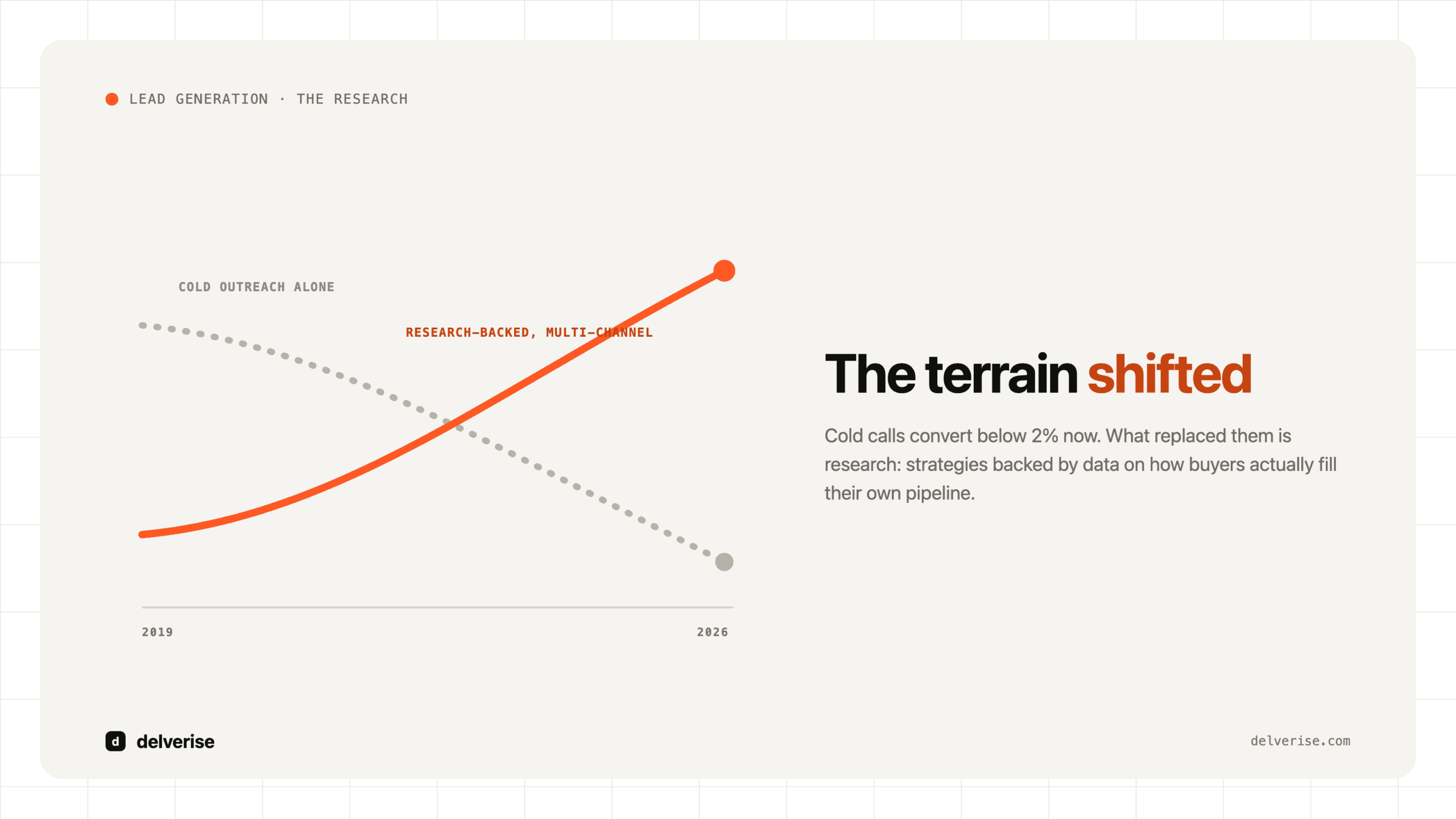
Revenue leaders are losing patience with lead generation programs that produce volume without pipeline. Buyer behavior has shifted while most go-to-market playbooks have lagged behind, and the gap between what works and what teams ship keeps widening. Gartner’s B2B buyer research finds that “77% of B2B buyers stated that their latest purchase was very complex or difficult,” and most go-to-market motions still treat lead generation as if a single email sequence can carry the load.
This guide steps through ten research-backed strategies that consistently move pipeline for B2B SaaS teams. Each section names the strategy, explains why it works according to published research, and lays out how a revenue leader can evaluate whether it deserves the next quarter of investment.
Short answer: B2B lead generation works when ICP definition, account engagement, buying-committee coverage, content, outbound, channel orchestration, data hygiene, and attribution operate as one pipeline system. The goal is not more leads; it is more qualified pipeline with clear source, fit, intent, and next action.
- Start with fit and intent: define who should enter the system and what signal makes them worth actioning.
- Build around accounts: multi-thread the buying committee instead of treating one form fill as the deal.
- Close the loop: connect campaigns to opportunity creation and revenue, not only MQL volume.
What Changed in B2B Lead Generation

The most important shift is who controls the buying process. Forrester research on B2B buying behavior shows that buyers now complete most of their evaluation independently, talking to sellers later in the cycle and from a more informed position. Gartner’s CSO research describes the buying group as “six to ten decision makers, each armed with four or five pieces of information they have gathered independently,” which means a single thread to a single contact rarely moves a deal forward.
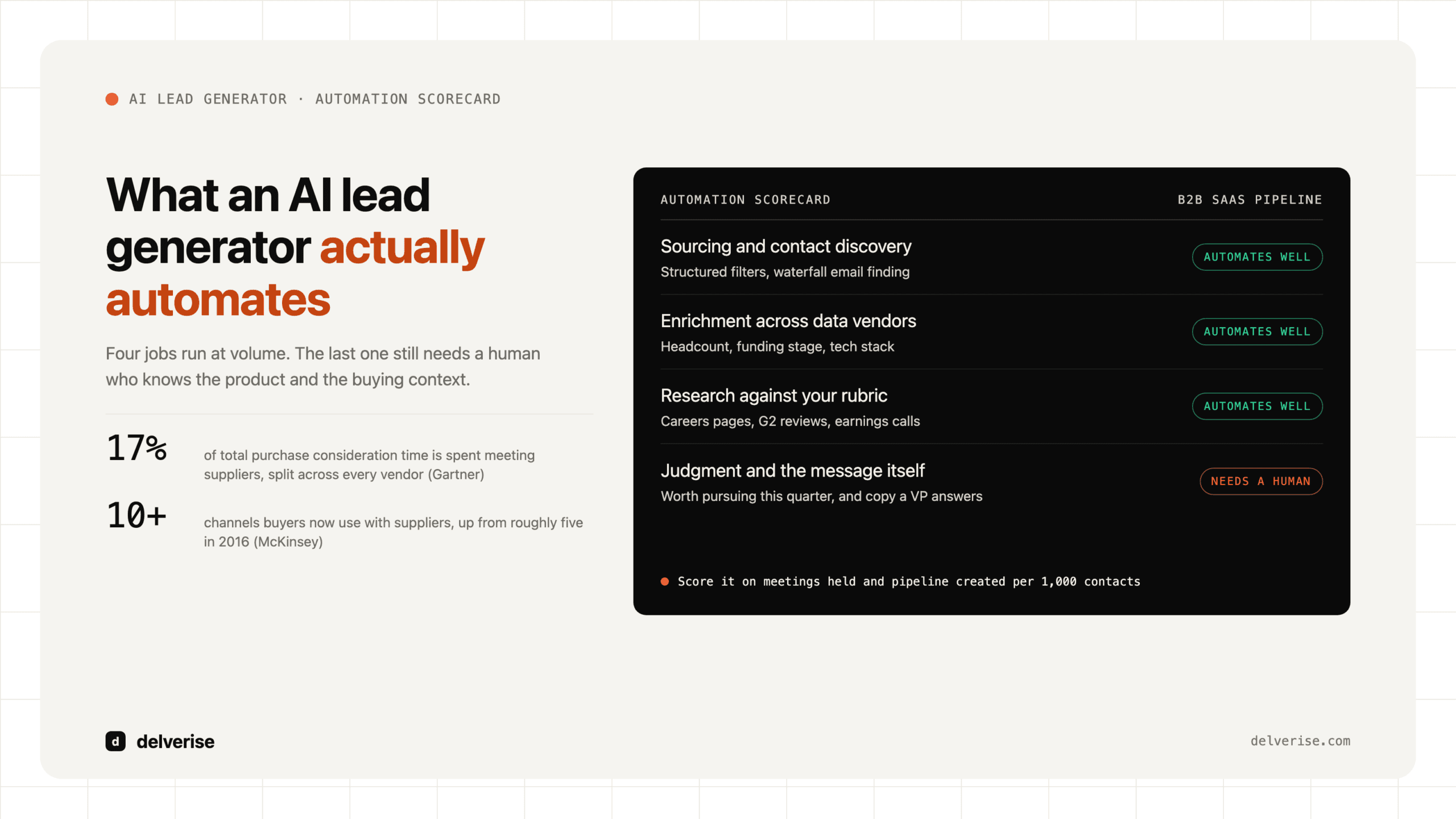
At the same time, channel saturation has reshaped engagement economics. The LinkedIn-Edelman B2B Thought Leadership Impact Study reports that “73% of decision-makers say a piece of thought leadership has led them to research a brand they were not previously considering,” while McKinsey’s B2B Pulse survey finds buyers “using an average of ten channels through a purchase cycle, up from five in 2016.” The leaders winning pipeline are the ones treating those ten channels as one coordinated system where messages flow between them.
The Modern Lead Generation Framework
Five components show up consistently in the research as the foundation of lead generation programs that produce pipeline rather than activity.
| Component | What It Covers | What the Research Shows |
|---|---|---|
| ICP precision | Defining the buyer with fit and intent signals | ITSMA: ABM accounts deliver materially higher ROI than non-ABM programs |
| Buying-group coverage | Multi-threading six to ten stakeholders per deal | Gartner: six to ten decision makers per B2B purchase |
| Thought leadership | Content that earns consideration before outreach | LinkedIn-Edelman: 73% reconsidered a brand after reading |
| Channel orchestration | Email, LinkedIn, ads, calls in one cadence | McKinsey: buyers use roughly ten channels per cycle |
| Closed-loop measurement | Pipeline attribution back to source | Forrester: aligned teams grow revenue 19% faster |
1. Define Your ICP With Both Fit and Intent Signals

Most teams ship an ideal customer profile that names a vertical, a band of company sizes, and a job title. That definition tells you who could buy. It says little about who is about to. The gap shows up in pipeline coverage.
Gartner’s CSO research is direct on the cost of imprecise targeting: “Sellers who attempt to engage the entire buying group with the same content lose deals at twice the rate of sellers who personalize content by role.” That penalty applies upstream of the deal as well. An ICP without intent signals forces SDRs to spray across accounts that match a static profile.
The stronger pattern is a layered ICP: firmographic fit (industry, size, geography), technographic fit (tools, stack, integrations), and behavioral or intent signal (recent hiring, funding round, leadership change, third-party intent topic). TOPO research on demand generation (now part of Gartner) finds that the highest-converting outbound segments combine all three layers, with the intent signal carrying the most weight in pipeline conversion. Lead generation platforms that surface intent data make this layered model easier to operate at scale.
To evaluate whether your ICP is doing its job, ask two questions. First, can you explain the trigger that makes an account worth touching this quarter versus next quarter? Second, can your SDR team rank a list of accounts by likelihood to engage, or are they working it top to bottom? If either answer is fuzzy, the ICP is fit only, and pipeline will reflect that.
2. Move From Lead Generation to Account Engagement

The single-lead model belongs to a buying process that no longer exists. The ITSMA ABM Benchmark Study has shown for several cycles that “87% of marketers say ABM outperforms other marketing investments in terms of ROI,” and that lift comes from organizing around the account as the unit of work.
Forrester’s analyst commentary on B2B demand has been consistent: when revenue teams report on individual leads, most of the buying committee stays invisible to sales. The implication for a revenue leader is structural. Reporting on lead volume rewards SDRs for activity that may never translate to opportunity. Reporting on engaged accounts rewards them for advancing buying groups toward a sales conversation.
Account engagement looks different on the ground. Marketing serves coordinated content to the buying committee. SDRs prioritize accounts where multiple personas have touched recent content. Sales gets briefed on the full account before the first call. The reporting metric shifts from MQLs delivered to accounts engaged, weighted by how many personas have touched the conversation.
We see this pattern with Series A and Series B SaaS teams where the SDR org is scaling faster than the data foundation underneath it. Volume targets climb, conversion sags, and leadership concludes the SDRs are the problem. The actual constraint is usually the unit of work the team is measuring against.
3. Multi-Thread the Buying Committee Early

Gartner’s B2B buying research is unambiguous on committee size: the typical complex SaaS purchase involves “six to ten decision makers.” Single-threaded deals are fragile because any one stakeholder can stall the conversation, and most will at some point in the cycle.
Sales Benchmark Index research has consistently found that opportunities with multiple engaged contacts in the account close at materially higher rates than single-threaded deals. Multi-threading is the single highest-leverage behavior change available to outbound SDR teams that already have basic targeting in place.
The practical pattern starts at the top of the funnel. Outbound cadences should target three personas per account in parallel rather than in sequence. Marketing should serve ads and content to the full account once any contact engages. Sales should ask, on every discovery call, who else is involved and what would block a decision, then verify those names by mapping the buying committee in LinkedIn before the next meeting.
Evaluating multi-threading is straightforward. Pull a sample of your open opportunities and count the number of contacts in each account with a meaningful touch in the last 30 days. If most show one or two, the team is single-threading, and the close rate will reflect it.
4. Build a Thought Leadership Engine That Earns Consideration

The LinkedIn-Edelman B2B Thought Leadership Impact Study has tracked the same finding for several cycles: “54% of decision-makers say they spend more than one hour per week consuming thought leadership content, and 73% say a piece of thought leadership has led them to consider a brand they had not previously been considering.”
The same study reports the inverse risk. “Forty percent of decision-makers say a piece of weak or poorly executed thought leadership made them lose respect for the organization that produced it.” The lesson for a revenue leader is that the bar for content is high, and shipping volume without substance does measurable damage to brand consideration.
Programs that earn consideration share three traits. The point of view is specific to a buyer problem, the author is an operator with credible scars, and the publishing cadence is consistent enough that the audience expects the next piece. Harvard Business Review’s research on B2B branding finds that consistency of voice across senior leaders and over time predicts brand consideration more reliably than total content volume.
The right evaluation of a thought leadership engine sits at the level of buyer consideration, with traffic as a downstream signal. Are buyers citing your content in discovery calls? Do prospects arrive with a clear sense of what you believe? If sales is still explaining the company’s point of view from scratch on every call, the content engine is producing volume without the consideration the LinkedIn-Edelman study describes.
5. Personalize Outbound With Account-Level Context
Salesforce’s State of Sales Report tracks the same arc year after year: response rates on generic outbound have decayed steadily, while personalized, context-rich outreach holds steady or improves. The report notes that “sales reps spend only 28% of their week actually selling, with the rest absorbed by research, admin, and data work,” and the share of selling time spent on personalization is the variable most correlated with reply rates.
McKinsey’s Next in Personalization research frames the upside more directly: “Companies that grow faster drive 40% more of their revenue from personalization than their slower-growing counterparts.” Personalization works because it signals that the sender did the research. Generic merge fields fail because the prospect can tell they are merge fields.
Context-driven personalization references something specific to the prospect that the sender could only have learned by paying attention: a recent product launch, a hiring pattern, a pricing page change, a podcast appearance, a job change. The bar is whether the opener would still make sense if the prospect’s name were removed. If it would, the message is templated. AI tooling raises the ceiling on what one SDR can personalize in a given hour, and the underlying research discipline remains the binding constraint.
The fastest evaluation is to pull a week of your team’s sent outbound and ask whether the opener could have been sent to any other account on the list. If the answer is yes for most of it, the team is templating, and reply rates will sit at the floor of the industry distribution.
6. Orchestrate Channels in a Single Cadence
McKinsey’s B2B Pulse survey reports that “B2B buyers now use an average of ten channels through a purchase cycle, up from five in 2016.” A channel-by-channel approach asks the buyer to assemble your message themselves, which most will not do.
Orchestration is the discipline of running one cadence across channels with messaging that builds touch by touch. A pattern might combine an email, a LinkedIn view, a connection request, a programmatic ad served to the account, and a call, all sequenced over two to three weeks, with each step referencing what the buyer has already seen. Gartner’s research on buyer enablement reports that consistent messaging across channels correlates with higher purchase confidence and lower post-purchase regret.
The systems implication is meaningful. Orchestration requires a single source of truth for account state, shared between marketing and sales tools. Most B2B teams have the components without the integration that makes them work as a system. The CRM knows about emails, the ads platform knows about impressions, LinkedIn knows about connection requests, and no system holds all three in one view.
Evaluate orchestration by asking whether your team can show a timeline of every touch on a target account in the last 60 days, across every channel, in one place. If the answer requires three logins and a spreadsheet, the channels are running in parallel without orchestration.
7. Treat Data Hygiene as an Operating System
Gartner’s data quality research reports that “the average financial impact of poor data quality on organizations is $12.9 million annually.” On a B2B revenue team, the impact shows up as bounced emails, mis-routed leads, dead phone numbers, and SDRs working accounts that closed, churned, or were never real.
Email list decay is the most cited example. ZoomInfo’s data shows that “B2B contact data decays at roughly 30% per year through job changes, departures, and role shifts,” which means a contact list left unrefreshed loses a third of its value annually without anyone noticing. The cost compounds because the bad data is still in the cadence, hurting deliverability for the good data that remains.
A working data hygiene system has three properties. It runs on a recurring schedule with refresh windows built into the operating cadence. It covers fit data (firmographics, technographics), contact data (email, title, role), and engagement data (recent activity, opt-out status). It writes back to the CRM as the authoritative store, with enrichment vendors as inputs and the CRM as the system of record.
Revenue leaders can evaluate their data system with one check. Pull 100 random contacts from the active outbound list and verify the title, employer, and email against LinkedIn. If more than 20% are stale, the cadence is burning sender reputation and SDR time on accounts that no longer exist in the form your CRM thinks they do.
8. Align Sales and Marketing Around Pipeline
Forrester’s B2B research has been consistent for a decade: “Companies with tightly aligned sales and marketing functions achieve 19% faster revenue growth and 15% higher profitability than companies with misaligned teams.” The mechanism is usually a shared definition of what counts as pipeline.
Misalignment shows up as marketing celebrating MQL volume while sales discards most of them. The fix is upstream of the handoff. Sales and marketing agree on the criteria that make an account worth a meeting, marketing reports on those criteria, and the handoff happens at a state both teams trust. The MQL becomes a leading indicator of qualified pipeline that both teams agree is worth working on.
Forrester’s analyst team has written for several planning cycles that definitions of a qualified lead need to be set jointly, documented, and reviewed quarterly. Most teams set them once and let them drift. The drift creates the gap that becomes the alignment problem leadership later tries to solve with a workshop.
Evaluating alignment is concrete. Ask the head of sales and the head of marketing, separately, to define a qualified lead. If the definitions differ, the alignment problem is real. If they match, ask each to estimate the conversion rate from MQL to opportunity. If those estimates differ by more than five points, the teams are looking at the same funnel through different lenses, and pipeline is leaking at the seam.
9. Optimize Owned Channels for Conversion
The owned web property is the channel revenue leaders control most directly and optimize least systematically. HubSpot’s State of Marketing research has reported a wide spread between median and top-quartile B2B website conversion rates, with top performers converting roughly double the visitors of the median. That gap translates to roughly double the pipeline from the same traffic.
The conversion rate gap most often comes down to how the page asks for the conversion. A site that offers one clear CTA per page, with a credible value exchange, and friction-appropriate forms (short forms for early-stage content, longer forms for high-intent demos) consistently outperforms a site optimized for content depth and visitor education alone. The Baymard Institute’s research on form design finds that completion rates drop noticeably with each additional field beyond a minimal set.
Conversion optimization compounds when it runs as a recurring habit. The teams that produce the strongest results run a small backlog of tests every quarter, on the pages that matter, with a measurement system that can detect a 10% lift inside a reasonable window. Most B2B sites have one or two high-traffic pages doing the lifting, and a quarterly test cadence on those pages produces more pipeline than a full redesign every two years.
Evaluate your owned channels by asking three questions. What is the conversion rate on the highest-traffic pages? What was the last test that ran on them? What did the team learn from it? If those questions do not have crisp answers, the site is functioning as a brochure when it could be operating as a pipeline asset.
10. Close the Loop With Pipeline Attribution
The final strategy is the one most revenue teams put off. Attribution that ties campaigns to closed pipeline, rather than to leads alone, changes what the team optimizes for. Without it, marketing optimizes for the metric closest to its tooling, which is usually lead volume or cost per lead.
Bain’s research on commercial excellence is direct on the consequence: B2B companies with closed-loop revenue attribution invest growth dollars more efficiently than companies that rely on top-of-funnel metrics alone. Efficiency here means dollars of pipeline per dollar of program spend, the metric a CFO actually cares about.
Closed-loop attribution does not require a perfect model. It requires a usable one. The most workable pattern for B2B is multi-touch attribution at the account level, with first touch and last touch as the anchors and weighted credit distributed across touches in between. The value of the model sits in visibility. Every touch on a closed-won account becomes legible, which lets the team see which campaigns produced revenue and which produced reports.
Evaluating attribution starts with one question: for the last five closed-won deals, can you list every marketing and sales touch in the buyer journey, in order, with dates? If the answer requires guessing, the loop is open, and the team is making investment decisions on incomplete data.
Build It In-House or Bring In Help
The ten strategies above are tractable. None of them require exotic tools. All of them require sustained attention from a revenue team that already has more on its plate than it can ship. That is the honest tension at the center of B2B lead generation in 2026.
Running these strategies in-house works when the team has the bandwidth, the operating cadence, and a leader willing to compound the gains over several quarters. Many revenue teams do exactly this, and the results justify the investment. For revenue teams that want to skip the learning curve and start with the playbook already running, delverise builds and operates the full system through AI lead generation, AI outbound, Growth Engineering, and GTM Engineering. We design the ICP layer, set up the data foundation, run multi-channel outbound, build the thought leadership engine, and instrument the loop back to pipeline. The handoff back to your team happens when the system is running predictably and your operators can take it from there. Apply to work with us.
Both paths can work. What fails is the third path, where the team ships campaigns without the underlying system, and pipeline stays flat while activity climbs. The buyer has changed. The playbook has to follow.
Frequently Asked Questions
What is the most important B2B lead generation strategy?
The most important strategy is aligning fit, intent, and routing before scaling channel activity. Without that operating layer, a team can generate more leads while still creating weak pipeline because the wrong accounts enter the system or qualified accounts do not receive the right follow-up.
How should B2B SaaS teams measure lead generation?
B2B SaaS teams should measure lead generation by qualified pipeline, opportunity creation, account progression, sales cycle movement, and revenue attribution. Lead volume and cost per lead are useful only when they are connected to fit, intent, and conversion quality.
Read next