←Back to blog
Growth & Demand GenerationGuideJuly 12, 20267 min read
AI Sales Tools: What Actually Moves Revenue (A B2B Buyer’s Guide)
AI sales tools are software that use machine learning and large language models to automate or augment parts of the revenue process: prospecting, research, enrichment, outreach, call analysis, forecasting, and CRM hygiene. For B2B SaaS, the ones that move revenue reduce manual work per rep and improve targeting accuracy, so pipeline quality rises rather than just activity volume.
AI sales tools are software that use machine learning and large language models to automate or augment parts of the revenue process: prospecting, research, enrichment, outreach, call analysis, forecasting, and CRM hygiene. For B2B SaaS, the ones that move revenue reduce manual work per rep and improve targeting accuracy, so pipeline quality rises rather than just activity volume.
Key takeaways
- AI sales tools fall into six practical categories: prospecting and enrichment, outreach and sequencing, conversation intelligence, forecasting and analytics, CRM automation, and agentic SDR platforms.
- The tool rarely fails on its own. It fails because the data feeding it is wrong and the process around it is undefined.
- Buy for a specific bottleneck you can name, not for a category you saw trending.
- Gartner’s research shows buyers spend a small fraction of their journey with any single supplier, so AI that sharpens timing and relevance beats AI that simply sends more.
- Most of the ROI comes from the connective tissue between tools, which is where most teams underinvest.
What counts as an AI sales tool in 2026?
The term covers a wide range, so it helps to separate the categories by the job they do. Conversation intelligence (software that transcribes and analyzes sales calls) does something very different from an agentic SDR platform (software that autonomously researches accounts and drafts or sends outreach). Grouping them all as “AI sales tools” is how buyers end up with overlapping subscriptions and no clear owner.

Here is the practical map:
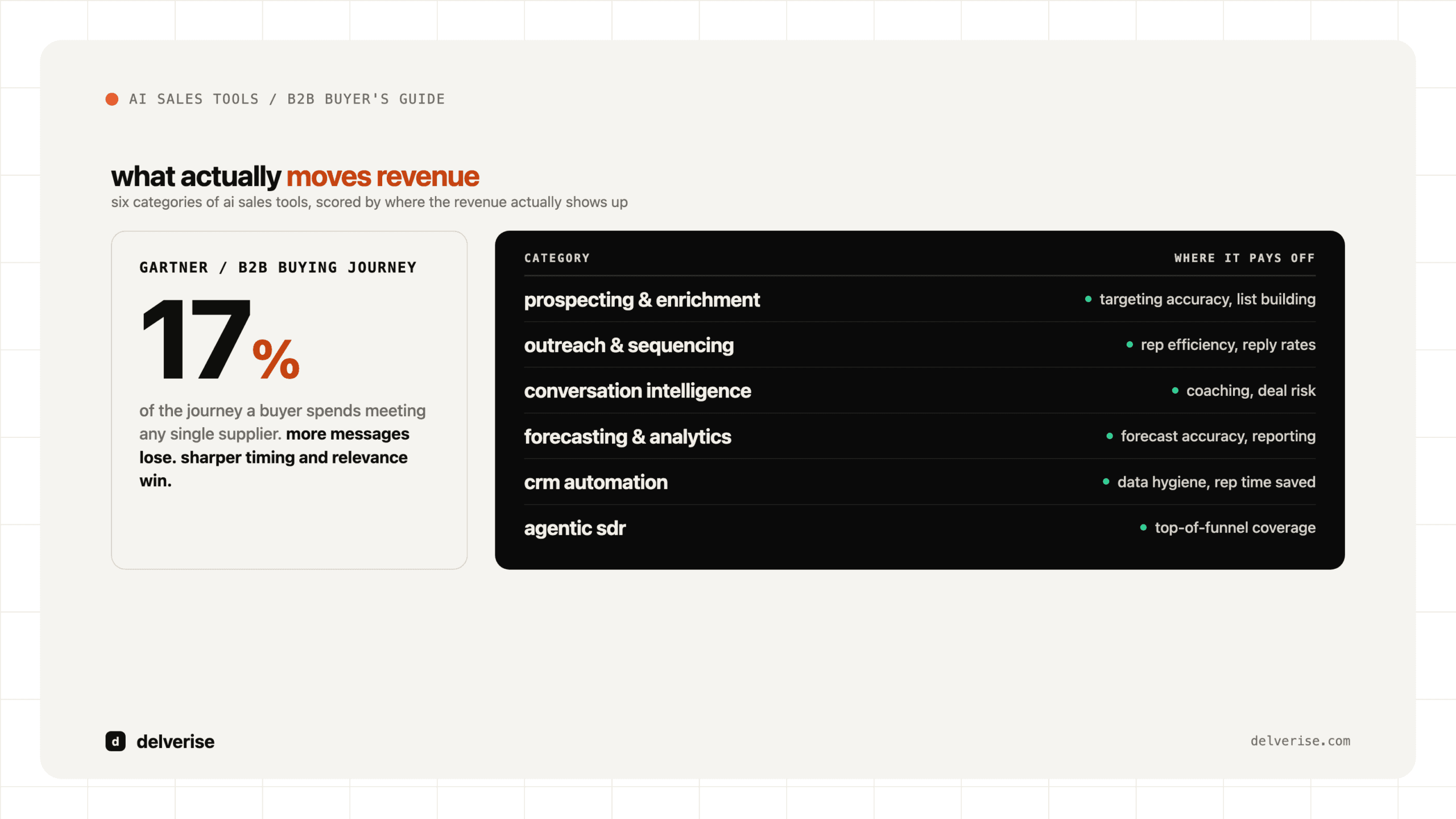
| Category | Core job | Example platforms | Where it pays off |
|---|---|---|---|
| Prospecting & enrichment | Find accounts and contacts, append firmographic and intent data | Clay, Apollo, ZoomInfo | Targeting accuracy, list building |
| Outreach & sequencing | Personalize and schedule multichannel touches | Outreach, Instantly, Smartlead | Rep efficiency, reply rates |
| Conversation intelligence | Record, transcribe, score calls | Gong, Fireflies | Coaching, deal risk, forecasting inputs |
| Forecasting & analytics | Predict pipeline and flag deal risk | Clari, native CRM AI | Forecast accuracy, board reporting |
| CRM automation | Enrich, dedupe, and update records | HubSpot AI, Salesforce Einstein | Data hygiene, rep time saved |
| Agentic SDR | Autonomous research and outreach at scale | Clay-orchestrated agents, 11x-style platforms | Top-of-funnel coverage |
Most teams need two or three of these categories working together, not one tool from each. The choice depends on where your revenue actually leaks.
Do AI sales tools actually increase revenue?
They can, and the mechanism matters. AI moves revenue when it either raises the quality of who you talk to or shortens the time reps spend on low-value work so they can spend it on selling. HBR’s long-running coverage of sales productivity has made a consistent point: reps spend a large share of their week on research, admin, and CRM updates, all of which are automatable.

The catch is targeting. Gartner’s B2B buying research found that buyers spend only about 17 percent of their total journey meeting with potential suppliers, and when they are comparing several vendors, any one supplier gets a sliver of that. So the win is not sending more messages into a market that is already saturated. The win is showing up with relevance at the moment a buyer is actually in a buying motion. McKinsey’s B2B research reinforces this, showing that decision-makers now move across roughly ten channels and expect consistency across all of them.
That reframes the buying question. The tool that helps you identify a buying signal and respond with a relevant, specific message will beat the tool that triples your send volume. Volume without relevance trains buyers to ignore you and can damage sender reputation, which is a real cost in cold email programs. We wrote more about building signal-based motions in our guide to AI outbound.
Why do most AI sales tools underdeliver?
Three reasons, and none of them are the model.

The data is wrong. An AI sales tool is only as good as the records it reads. If your CRM has stale titles, missing account context, and duplicate contacts, the AI personalizes off garbage and produces confident, wrong output. Clean enrichment is the prerequisite, which is why we treat CRM enrichment as foundational work before any AI layer goes on top.
The process is undefined. AI automates a workflow. If your team has no agreed definition of an ideal customer, no lead routing rules, and no shared view of what a qualified opportunity looks like, the AI simply automates the confusion faster. G2’s buyer behavior reporting consistently shows buyers doing more independent research before they ever talk to sales, which means your process has to account for a self-educated buyer who arrives late and expects you to already understand their context.
The tools do not talk to each other. A prospecting tool, a sequencer, and a CRM that each hold a different version of the truth create reconciliation work that eats the time the AI was supposed to save. The value lives in the integration layer, and that is the part teams tend to skip. Our GTM engineering hub covers how these pieces fit into one system.
How should a revenue leader evaluate AI sales tools?
Use a short, honest checklist before you buy anything.
- Name the bottleneck. Is the problem list quality, rep capacity, forecast accuracy, or call coaching? A tool that fixes a bottleneck you do not have is pure cost.
- Check the data dependency. Ask what data the tool needs to work and whether you have it clean today. If the answer is no, budget for enrichment first.
- Test on your own accounts. Run a trial against a real segment of your ICP, not the vendor’s demo data. Measure output quality by hand for a week.
- Count the integration cost. A tool that needs three weeks of engineering to connect to your CRM has a real total cost far above its sticker price.
- Define the owner. Every AI tool needs a human accountable for its output. Unowned automation drifts.
Vendor-neutrality matters here. Platforms like Clay are genuinely powerful for orchestrating enrichment and agentic workflows, but they reward teams that already know what a good prospect looks like. The same tool in the hands of a team without a defined ICP produces expensive noise.
A worked example: fixing a top-of-funnel leak
Consider a Series A SaaS company with two SDRs booking below target. The instinct is to buy an agentic SDR platform and scale sends. A better sequence looks like this.
First, audit the data. You find 40 percent of contacts have missing or wrong titles, so personalization is failing silently. You fix enrichment and dedupe the CRM. Second, you define the buying signals worth chasing: recent funding, a new VP of the relevant function, and product usage patterns for existing free users. Third, you wire a prospecting tool to score accounts against those signals and pass only qualified accounts into the sequencer. Fourth, you layer AI personalization on the now-clean records.
The output is fewer total messages, higher reply rates, and SDRs spending their time on live conversations rather than list cleanup. The AI did not create the lift. The system around it did. That distribution of effort, roughly heavy on data and process and light on the model, is what separates programs that work from programs that stall.
Build versus buy versus orchestrate
Three paths exist, and they suit different stages.
Buy an all-in-one platform when you are early, your motion is simple, and you value speed over control. The tradeoff is limited flexibility as you grow.
Assemble best-of-breed tools when you have specific needs in each category and someone to own the stack. The tradeoff is integration overhead and the risk of data drift between systems.
Orchestrate a custom system when your motion is a competitive advantage and off-the-shelf logic cannot express it. This is where enrichment, signals, routing, and outreach get built as one connected flow. The tradeoff is that it requires engineering discipline, which is precisely the work most revenue teams are not staffed to do internally. SaaStr’s benchmark commentary on efficient growth has made the point repeatedly that the winning teams in this cycle are the ones getting more pipeline per dollar, and orchestration is how mature teams get there.
Frequently Asked Questions
What is the difference between AI sales tools and sales automation?
Sales automation follows fixed rules you configure, such as sending a follow-up three days after no reply. AI sales tools use models to make judgment calls, such as writing a personalized opener from an account’s recent news or scoring a call for deal risk. Most modern platforms blend both, so the useful question is how much of the output requires human review before it is trustworthy.
How much do AI sales tools cost for a B2B SaaS team?
Pricing ranges widely, from roughly a few hundred dollars a month for a single enrichment or sequencing tool to well into five figures monthly for enterprise conversation intelligence and forecasting suites. The larger and often hidden cost is integration and ongoing data quality work, which routinely exceeds the software subscription itself.
Will AI sales tools replace SDRs?
They are changing the role more than eliminating it. Agentic platforms can handle research and first-touch drafting at scale, which shifts SDR time toward qualification, live conversation, and judgment. Teams that redeploy that freed-up time see gains. Teams that simply cut headcount and expect the tool to carry the number tend to be disappointed.
Which AI sales tool should I buy first?
Start with whatever fixes your named bottleneck and depends least on data you do not yet have clean. For most early-stage teams that means enrichment and CRM hygiene before outreach automation, because clean data is the input every other tool relies on. Buying outreach volume before fixing data is the most common expensive mistake.
How do I know if an AI sales tool is working?
Tie it to one metric that reflects revenue quality, not activity. Reply rate on personalized outreach, qualified meetings booked, forecast accuracy, or hours of admin saved per rep are all defensible. Track it against a baseline for at least a full sales cycle before you judge the investment, since pipeline effects lag the change.
Read next