←Back to blog
Revenue OperationsPlaybookMay 20, 202622 min read
GTM Engineering for Seed Stage Startups: Build Your Revenue Foundation Before Product-Market Fit
GTM engineering for seed-stage startups builds a lean revenue foundation before PMF. Framework covers customer discovery, channel testing, early systems, and measurement.
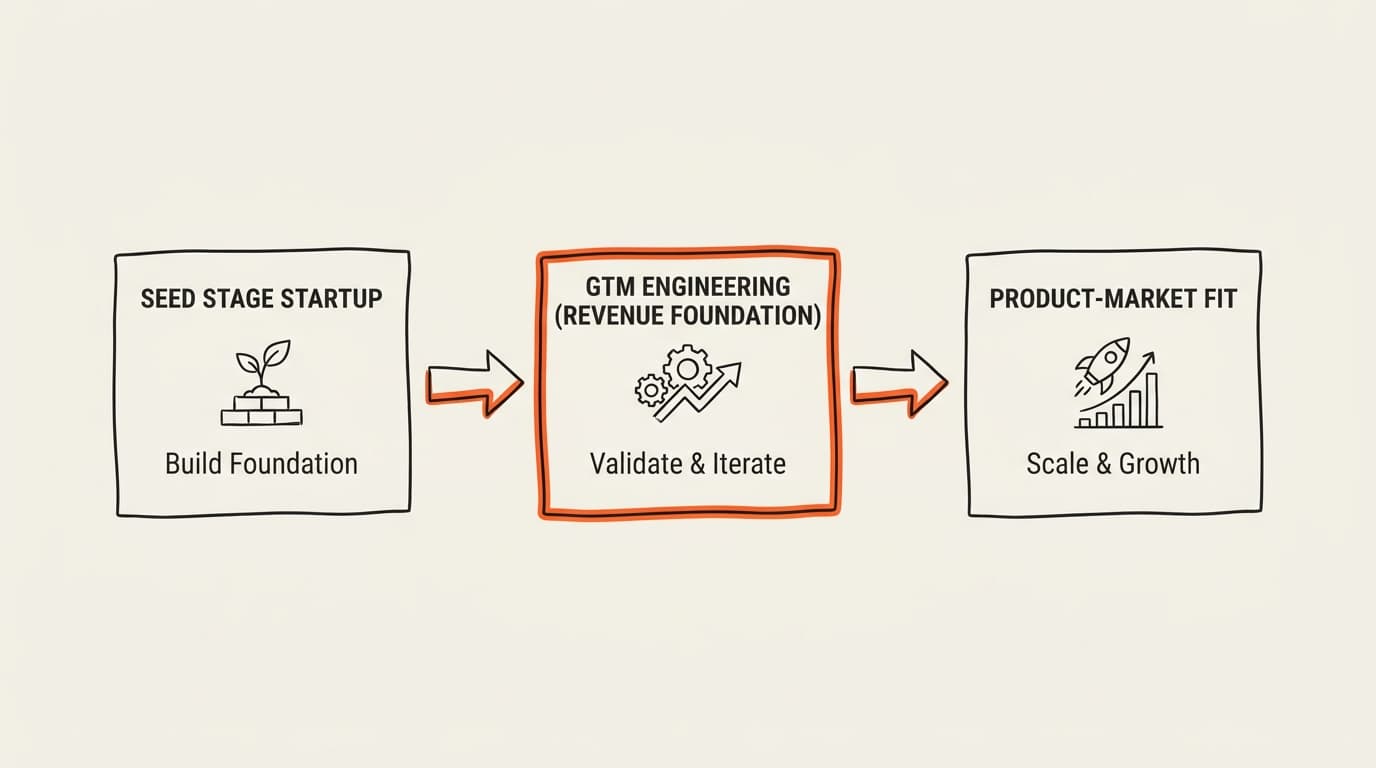
For seed-stage startups, the journey to product-market fit (PMF) is a race against time and resources. While engineering teams furiously build the product, one function quietly separates companies that reach escape velocity from those that stall: GTM (Go-to-Market) Engineering. An effective seed-stage GTM function runs lean. It avoids a heavy sales headcount and expensive enterprise software, and instead stands up an intelligent, scalable revenue foundation before the company has all the answers. GTM engineering for seed-stage startups is the discipline that builds that foundation.
This guide is a reference for revenue leaders evaluating what a strong early-stage revenue engine should contain, whether you are assessing your own pre-revenue or sub-$500K ARR portfolio company or pressure-testing the systems already in place. It lays out a framework for the chaotic, high-stakes early stages of customer acquisition: what doing more with less actually looks like, why learning should outrank premature scaling, and which systems carry growth for years rather than months. Use it as the standard against which to measure a seed stage go-to-market strategy.
Why GTM Engineering at the Seed Stage?
It’s a common and understandable mistake for early-stage founders to believe that GTM is a problem for later. The prevailing wisdom is often: “Build a great product, and the customers will come.” While a great product is non-negotiable, it’s not a GTM strategy. The belief that you can simply “turn on” marketing and sales after finding PMF is a dangerous fallacy. By then, you’ve likely burned through precious capital and time, and the cost of course-correcting is exponentially higher.
GTM Engineering at the seed stage is the practice of applying a systems-thinking, engineering-like mindset to your go-to-market motion. It’s about building a repeatable, data-driven engine for finding, engaging, and converting customers. This emerging function uses modern tools and automation to create leverage, allowing a small team, or even just the founders, to achieve what once required a large organization.
The cost of neglecting this foundation is steep. GTM mistakes made at the seed stage, like targeting the wrong customer, using the wrong channels, or having no process to learn from early interactions, create foundational cracks. These cracks widen into chasms as you attempt to scale, leading to wasted marketing spend, a bloated sales team, and a high cost of customer acquisition (CAC) that can kill your unit economics. Fixing these problems at Series B or C is a painful, expensive, and often public ordeal.
OpenView’s SaaS Benchmarks report consistently finds that top-quartile SaaS companies maintain a CAC payback period under 12 months, while bottom-quartile companies stretch past 24. The gap is rarely about sales talent; it is about whether the GTM system was engineered for efficiency from the start or bolted on after the fact.
According to CB Insights, ‘35% of startups fail because there is no market need for their product,’ making premature GTM scaling without validated demand one of the most expensive mistakes a founder can make. For seed-stage teams, this is exactly why GTM engineering must run in parallel with product development, not after it.

As the chart above illustrates, the investment in building a solid GTM foundation at the seed stage is minimal compared to the cost of retrofitting a broken system later. By embracing GTM engineering early, you are building the very machine that will generate revenue for the life of your company, in addition to finding your first customers.
_””
The Seed Stage GTM Framework
At the seed stage, your GTM strategy shouldn’t be a 100-page document. It should be a simple, agile framework focused on one thing: learning. You are not trying to build a predictable revenue machine yet; you are trying to find the blueprint for one. The goal is to systematically de-risk your business by validating your core assumptions about your customers and how to reach them.
Our seed-stage GTM framework is built on a continuous loop of four key activities: Customer Discovery, Channel Testing, Early Systems, and Measurement. This iterative process ensures that your GTM motion is constantly informed by real-world feedback, keeping you aligned with the market as you evolve.

Here’s a breakdown of each component of the framework:
| Phase | Objective | Key Activities |
|---|---|---|
| Customer Discovery | Deeply understand who your ideal customer is and the pain you solve for them. | • Conduct 20-30 interviews with potential customers. • Formulate a precise Ideal Customer Profile (ICP) hypothesis. • Validate that the problem you solve is urgent and valuable. |
| Channel Testing | Discover the most effective and scalable channels to reach your ICP. | • Select 2-3 high-potential channels (e.g., outbound email, LinkedIn, content). • Run small, targeted campaigns to test messaging and response rates. • Double down on what works and discard what doesn’t. |
| Early Systems | Build the minimum viable infrastructure to create a repeatable process. | • Set up a free CRM to track all customer interactions. • Create basic email templates and a simple sales playbook. • Document everything to ensure consistency and knowledge transfer. |
| Measurement | Use data to track progress, identify bottlenecks, and inform your next iteration. | • Track foundational metrics like CAC, sales cycle length, and conversion rates. • Analyze feedback to refine your product and messaging. • Use insights to loop back into the Customer Discovery phase with new hypotheses. |
This framework is not a linear path but a cycle. The insights from your Measurement phase directly feed back into Customer Discovery, allowing you to refine your ICP, test new messaging in your Channel Testing, and improve your Early Systems. This continuous loop, a hallmark of founder-led GTM strategy, turns founder instinct into a repeatable system backed by real data, which is exactly what investors want to see for a Series A round.
This mirrors what Geoffrey Moore argued in Crossing the Chasm: ‘The single most important difference between early markets and mainstream markets is that the former are dominated by visionaries while the latter are dominated by pragmatists.’ Seed-stage GTM engineering is the discipline of capturing what works with visionaries in a system structured enough to survive the handoff to pragmatists.
Foundation (Pre-Revenue)
Before you even think about acquiring your first paying customer, you need to lay the groundwork. This foundational phase is all about preparation and hypothesis testing. It’s where you translate your vision into a concrete, testable GTM strategy. Rushing this stage is a recipe for wasted effort and confusing market signals. By getting these core elements right, you create the launchpad for a much more efficient and successful customer acquisition journey.

Here’s a closer look at the essential elements you need to put in place during this pre-revenue foundation phase:
1. Solidify Your ICP Hypothesis
Your Ideal Customer Profile (ICP) is a precise definition of the perfect customer for your product. It goes beyond demographics to cover psychographics, pain points, and buying behaviors. At this stage, it’s a hypothesis, but it needs to be specific enough to be testable.
- What to do: Go beyond broad categories like “small businesses.” Define your ICP with precision. For example: “Series A to B B2B SaaS companies with 50-200 employees, a dedicated DevOps team of at least 5, and a publicly stated goal of improving software reliability.”
- What NOT to do: Don’t say “our product is for everyone.” This is a classic early-stage mistake that leads to unfocused marketing and a product that pleases no one. Be willing to exclude potential customers to focus on those who will get the most value.
2. Craft a Clear Value Proposition
Your value proposition is a clear, concise statement that explains the benefit you provide, for whom you provide it, and how you do it uniquely well. It’s the core of your messaging and the answer to the question: “Why should I care?”
- A simple template: “We help [Your ICP] solve [a specific, painful problem] by [your unique approach], unlike [the status quo or competitors].”
- Example: “We help mid-sized e-commerce companies reduce cart abandonment by providing real-time, personalized exit-intent offers, unlike generic pop-up tools that annoy users.”
3. Implement Basic Tracking
You cannot improve what you do not measure. Even before you have customers, you need a system to track your interactions with the market. This doesn’t require complex software; a simple spreadsheet is often enough to get started.
- What to track:
- Prospects: Who have you talked to? (Name, company, role)
- Conversations: What were the key takeaways from each call?
- Pain Points: What specific problems did they mention?
- Feedback: What did they like or dislike about your product idea?
- Win/Loss Reasons: Why did they (or didn’t they) agree to a follow-up, a demo, or a trial?
This simple database of qualitative data will become your most valuable asset in refining your ICP and messaging.
4. Choose Your First Tools (Wisely)
Technology is a powerful enabler, but it can also be a distraction and a cash drain. At the seed stage, the goal is to choose free or low-cost tools that are simple, effective, and can scale with you. Avoid the temptation to buy expensive, all-in-one platforms.
- The Minimum Viable Stack: As detailed in our tech stack section later, your initial toolkit should be lean. A free CRM like HubSpot, a scheduling tool like Calendly, and collaborative docs like Notion are more than enough to get started. The key is to choose tools that reduce administrative overhead and allow you to focus on customer-facing activities.
Completing this foundational work is not about achieving perfection. It’s about creating a structured approach to your initial market interactions. With a clear hypothesis for your ICP and value proposition, and the basic systems to track your learnings, you are now ready to move into the next phase: acquiring your first customers.
“”_
“””
First Customers
With a solid foundation in place, it’s time to enter the arena and win your first customers. This phase is where your hypotheses meet reality. The goal here is to prove that you can systematically guide a prospect from initial contact to a successful, happy customer, rather than merely to get a logo on your website. This is the beginning of your repeatable sales process. Every step of this journey is an opportunity to learn and refine your GTM motion.
The path from a cold prospect to a paying customer is a funnel. At each stage, some prospects will drop off, and that’s okay. Your job is to understand why, and to build systems that guide qualified prospects to the next step. This process, often called the “sales cycle,” needs to be mapped out and supported by your early GTM systems.

Let’s walk through the key stages of this journey and the systems you need to support them:
1. First Contact & Qualification
This is the top of your funnel. Using the channels you identified during your testing phase, you’ll begin reaching out to prospects who fit your ICP. The initial goal is simple: start a conversation and determine if they are a qualified lead.
- System Needed: CRM for Tracking. From the very first interaction, every lead should be logged in your CRM. This is your single source of truth. Who did you contact? When? What was their response? Without this, you’re flying blind.
- What to do: Your initial outreach should be focused on the prospect’s pain, not your product’s features. Use your value proposition to craft a compelling, concise message that piques their interest. The only goal of the first email or message is to get a response.
- What NOT to do: Don’t send generic, mass emails. Even with automation, your outreach should feel personal and relevant to the recipient.
2. Discovery & Demo
Once a lead is qualified, the next step is a discovery call. This is arguably the most critical stage of the sales cycle. Your primary goal is to listen, not to sell. You are digging deep into their problems, their current processes, and what a solution would mean to them. Only after you fully understand their context should you move to a product demo.
- System Needed: Email Sequences & Demo Environment. Use simple email sequences to schedule the discovery call. Your demo environment should be clean, reliable, and tailored to showcase the value proposition that matters most to this specific prospect.
- What to do: Ask open-ended questions. “Tell me about how you’re currently handling X.” “What’s the most frustrating part of that process?” “If you could wave a magic wand, what would an ideal solution look like?” The information gathered here is gold.
3. Trial, Negotiation & Close
After a successful demo, it’s time for the prospect to get their hands on the product. Whether it’s a free trial, a proof-of-concept (POC), or a design partnership, the goal is for them to experience the value firsthand. This is where your product needs to deliver on the promises your sales process made.
- System Needed: Trial Process & Contract Templates. Have a clear process for starting a trial. What are the success criteria? What support will you provide? As you move towards a close, have simple, standardized contract templates ready to go. This avoids legal friction and speeds up the process.
- What to do: Proactively guide the prospect through the trial. Check in regularly to ensure they are on track to see value. When it comes to negotiation, anchor on the value you provide, not the cost of your service.
- What NOT to do: Don’t just give them a trial and disappear. A trial without guidance is a recipe for failure. Also, don’t be afraid to walk away from a deal if the customer is a bad fit for your product. The wrong customers can be more costly than no customers at all.
4. Onboarding & Customer Success
Congratulations, you’ve closed your first customer! But the journey isn’t over. In a recurring revenue business, the sale is just the beginning. A smooth onboarding process that quickly delivers the promised value is essential for long-term retention and turning your first customers into your biggest advocates.
- System Needed: Onboarding Checklist & Customer Success Playbook. Create a step-by-step checklist for every new customer. What needs to be configured? What training is required? Who are the key contacts? This ensures a consistent and professional experience every time. Your early customer success efforts are about being proactive and ensuring your customers are wildly successful.
This entire process is a learning loop. If you’re losing prospects after the demo, is your value proposition not resonating? If trial users aren’t activating, is the product too complex? Use the data and feedback from this process to continuously refine every aspect of your GTM motion.
“””
“””
Minimum Viable Tech Stack
At the seed stage, your technology stack should be a force multiplier, not a financial drain. The goal is to build a Minimum Viable Tech Stack (MVTS) that is lean, cost-effective, and focused on solving the immediate problems of customer acquisition and relationship management. The market is flooded with complex, expensive tools promising a silver bullet for growth. Resist the siren song of enterprise-grade software. Your guiding principle should be: do more with less.
Founders often make the mistake of over-investing in their tech stack too early. This burns precious cash and adds unnecessary complexity and administrative overhead. A clunky, poorly integrated tech stack can slow you down far more than a simple, manual process. The right approach is to start with free or low-cost tools that are easy to implement and use, and then upgrade or add new tools only when a clear, painful need arises.

Here is a battle-tested Minimum Viable Tech Stack for a seed-stage startup, focusing on tools that offer robust free tiers and can scale with you:
Core Systems (The Non-Negotiables)
These are the foundational tools that will form the backbone of your early GTM operations.
- HubSpot Free CRM: This is your single source of truth for all customer interactions. The free version of HubSpot is incredibly powerful, offering contact management, deal tracking, email integration, and basic reporting. Starting with a CRM from day one is one of the most important decisions you can make. It builds the discipline of tracking everything and creates an asset that will become invaluable as you scale.
- Calendly: Eliminate the back-and-forth of scheduling meetings. Calendly’s free tier allows you to connect your calendar and share a link for prospects to book time with you. It’s a simple, professional way to reduce friction in the sales process.
- Typeform / Google Forms: You need a way to capture leads from your website or gather feedback from users. Typeform offers beautiful, engaging forms, while Google Forms is a straightforward, free alternative. Integrate these with your CRM to automatically create new contacts.
Data & Analytics (Your Learning Engine)
Your tech stack should help you answer the most important question: what is working?
- Google Sheets: Before you invest in a complex business intelligence tool, Google Sheets can be your best friend. It’s perfect for building simple dashboards, tracking your key metrics, and performing ad-hoc analysis. You can manually export data from your other tools into a central sheet to get a holistic view of your funnel.
- Google Analytics: If you have a website, Google Analytics is essential. It provides a wealth of data on where your traffic is coming from, how visitors are behaving on your site, and which pages are converting. It’s a free and powerful tool for understanding your top-of-funnel performance.
Communication & Collaboration (The Glue)
These tools ensure your team is aligned and your documentation is centralized.
- Google Workspace: Professional email (you@yourcompany.com), shared file storage (Drive), and collaborative documents. It’s the standard for a reason and is very affordable for small teams.
- Notion: This is your company’s external brain. Use it to document everything: your sales playbook, customer feedback, meeting notes, and competitive analysis. Notion’s free tier is generous and provides a flexible, collaborative space to build your institutional knowledge.
What About Sales Automation?
Tools for outbound automation (like Clay, Instantly, or Apollo) are powerful but should be approached with caution at the seed stage. Before you automate, you must first validate your messaging and targeting manually. Sending 1,000 automated emails with the wrong message is just a fast way to burn your domain reputation and your budget. Start with manual, personalized outreach. Once you have a message that consistently gets a response, then and only then should you consider layering in automation to scale the process.
Your tech stack will evolve as you grow, but this minimum viable stack provides a powerful, low-cost foundation to build your revenue engine without breaking the bank.
“””
“””
Metrics That Matter
In the early stages of a startup, data can be both a compass and a siren. The right metrics will guide you toward product-market fit and a scalable business model. The wrong ones (often called vanity metrics) will lead you onto the rocks of false confidence and wasted resources. The key is to focus on a small, core set of Key Performance Indicators (KPIs) that provide a true signal of your GTM health. Your seed-stage dashboard shouldn’t be a complex beast; it should be a simple, at-a-glance view of what’s really driving your business forward.
At this stage, you’re looking for trends and insights, not statistical perfection. Don’t get paralyzed by a lack of data. Your early metrics will be messy and based on small numbers, and that’s okay. The goal is to establish a baseline and track your progress over time. Are you getting more efficient at acquiring customers? Is your sales cycle getting shorter? Is the product delivering on its promise? These are the questions your metrics should help you answer.

Here are the essential metrics that truly matter for a seed-stage startup:
1. Customer Acquisition Cost (CAC)
CAC is the total cost of your sales and marketing efforts divided by the number of customers you acquire in a given period. It’s the single most important metric for understanding the economic viability of your GTM strategy.
- How to track: At this stage, a simple calculation will suffice. Sum up all your GTM expenses (e.g., salaries for GTM-focused founders/employees, marketing spend, tool costs) for a quarter and divide by the number of new customers in that quarter.
- What it tells you: Is your method of acquiring customers sustainable? Your early CAC will likely be high, but you need to see a clear path to reducing it over time as you optimize your channels and messaging.
2. Sales Cycle Length
This is the average number of days it takes to turn a lead into a paying customer. A shorter sales cycle means you can grow faster and with less capital.
- How to track: In your CRM, log the date a lead is created and the date they convert to a customer. The difference is the sales cycle length for that customer. Average this across all your customers.
- What it tells you: A long or lengthening sales cycle can indicate friction in your process, a lack of urgency in the problem you solve, or a complex purchasing decision. Your goal should be to consistently shorten this cycle as you refine your playbook.
3. Activation Rate
Activation is the point at which a new user or customer experiences the core value of your product for the first time. It’s a critical leading indicator of long-term retention.
- How to track: Define what “activation” means for your product. Is it inviting a team member? Processing the first transaction? Creating the first project? Track the percentage of new users who reach this milestone within their first week.
- What it tells you: A low activation rate is a major red flag. It suggests that your product is too complex, your onboarding is ineffective, or you’re selling to the wrong customers. As Jigsaw Metric highlights, focusing on user engagement and product-market fit is crucial.
4. Early Churn Rate
Churn is the percentage of customers who cancel their subscription in a given period. Early churn (within the first 90 days) is particularly toxic because it means you’re likely burning through your CAC before you have a chance to recoup it.
- How to track: Of the customers you acquired in a given month, what percentage are still with you three months later? The inverse is your early churn rate.
- What it tells you: High early churn signals a fundamental mismatch between the value you promised and the value you delivered. It could be a product issue, a customer success issue, or a sign that you’re selling to the wrong ICP.
The Metrics to Ignore (For Now)
Just as important as what you track is what you don’t track. At the seed stage, avoid getting distracted by vanity metrics like:
- Website Traffic: 10,000 visitors who don’t convert are just a server bill.
- Social Media Followers: Likes and follows don’t pay the bills.
- Number of Leads: A high volume of unqualified leads will just clog your funnel and waste your time.
Focus on the metrics that reflect the true health of your GTM engine. A declining CAC, a shortening sales cycle, a high activation rate, and low churn are the vital signs of a healthy, scalable business.
From Founder-Led Sales to a Sales Team: Build In-House or Partner
For nearly every successful startup, the first salesperson is the founder. Founder-led sales is the right model for the seed stage. No one has more passion, product knowledge, and personal stake in the company’s success. This phase is non-negotiable. Founders must be on the front lines, talking to customers, hearing their objections, and personally closing the first 10, 20, or even 50 deals. This experience is how you build the sales playbook that the next stage will run on.
A founder’s time is also the company’s most valuable and limited resource. As lead volume grows and the sales process becomes more defined, the founder becomes the bottleneck. Moving from a founder-led motion to a dedicated sales function is one of the most critical decisions in a startup’s journey, and it is genuinely a build-vs-buy decision: you can hire and manage the function in-house, or you can bring in a partner who already operates it. Get the choice right, and you unlock scalable growth. Get it wrong, and you can set the company back by months and burn a significant amount of capital.
When the Sales Function Is Ready to Scale
Scaling the function past the founder is a strategic investment in a process you have already proven, whichever path you choose to run it. As detailed by experts at SaaStr and Pitchdrive, acting too early is a classic startup mistake. Here are the signs that you are ready to move:
- You have a repeatable playbook: You can clearly document a step-by-step process for how you win customers. You know what to say, who to say it to, and what to do at each stage of the funnel.
- You have consistent lead flow: You have more qualified leads than you, the founder, can personally handle in a timely manner.
- You have baseline metrics: You know your average sales cycle, your conversion rates, and your CAC. You have a data-driven case that added sales capacity can be a profitable investment.
- You’ve closed 10-20+ deals yourself: You have enough experience to direct the function, judge the work, and know what “good” looks like.
Weighing the Build Path Against a Partner
Once the signals are there, the question becomes how to run the function. The same considerations that make this transition risky to get wrong are the inputs to the build-vs-buy decision. Here is how the major factors compare across the two paths:
| Decision Factor | Building In-House | Bringing In a Partner |
|---|---|---|
| Owning the process | A new hire executes and scales a playbook; they lack the context and authority to create one from scratch, so you must have it documented first. | A partner brings a tested process and adapts it to your motion, which shortens the time from decision to pipeline. |
| Seniority and cost | Big-company VPs of Sales manage teams and budgets rather than grinding deals; the right early hire is a hungry, entrepreneurial AE, and sourcing one takes time and budget. | A partner pairs senior strategy with hands-on execution, so you get both without committing to a full-time VP salary. |
| Single point of failure | One rep is risky; if they miss, you cannot tell whether it was the person or the playbook. Hiring two reps for a cleaner signal roughly doubles the cost. | A partner spreads execution across a team, so output is steadier and performance signal is easier to read. |
| Founder involvement | The founder shifts from primary closer to primary coach and manager, taking on hiring, ramp, and ongoing oversight. | The founder stays the product expert and face of the company while the partner runs execution and reports back, freeing founder time for the business. |
Scaling sales past the founder is a major step toward a repeatable revenue engine. Building the team in-house is a valid path when you have the time and budget to hire, ramp, and manage it. For many Series A to C companies, partnering with a team that already runs the function is the faster and often better route, because it converts a proven playbook into pipeline without the hiring delay. Wait for the right signals, weigh both paths honestly against the factors above, and the transition will accelerate your growth rather than derail it.
Build Your Foundation for Growth
At the seed stage, GTM Engineering is not about building a complex, expensive machine. It is about laying a strong foundation, embracing a mindset of continuous learning, disciplined execution, and relentless focus on the customer. By treating your go-to-market strategy with the same rigor and systems-thinking that you apply to your product, you are chasing your first revenue and building the enduring architecture for a scalable, profitable business.
The journey from pre-revenue to a repeatable GTM motion is a challenging one, but it is not a mystery. By following the framework laid out in this guide, starting with a solid foundation, systematically acquiring your first customers, choosing a lean tech stack, and focusing on the metrics that matter, you can navigate the ambiguity of the seed stage with confidence.
Remember, the work you do now, before you have product-market fit, will determine the trajectory of your company. The small, consistent investments you make in your GTM foundation today will pay exponential dividends in the years to come. You are building more than a product. You are building a revenue engine. Start building it now.
Founder-led GTM engineering works well when you have the bandwidth to wire up the early experiments, instrument your data, and stay close to every customer conversation yourself. Other seed-stage teams would rather keep that energy on the product and have a revenue foundation built alongside them, which is the work delverise does for B2B SaaS companies. If that second path fits where you are right now, our team is happy to talk it through.
Frequently Asked Questions
What is GTM engineering for seed stage startups?
GTM engineering at the seed stage is the practice of applying a systems-thinking, engineering-like mindset to your go-to-market motion. It is a founder-led discipline focused on building a lean, intelligent, and scalable revenue foundation before product-market fit. Using modern tools and automation, it creates leverage so a small team or even just the founders can build a repeatable, data-driven engine for finding, engaging, and converting customers.
Why should founders build GTM systems before product-market fit?
Neglecting GTM until after PMF creates foundational cracks that widen into chasms during scaling, leading to wasted marketing spend, bloated sales teams, and unsustainable CAC. The belief that you can simply turn on marketing and sales after finding PMF is a dangerous fallacy that burns precious capital. Investing in a solid GTM foundation at the seed stage is minimal compared to the cost of retrofitting a broken system at Series B or C.
What are the four phases of the seed stage GTM framework?
The seed-stage GTM framework is a continuous loop of four activities: Customer Discovery, Channel Testing, Early Systems, and Measurement. Customer Discovery validates your ICP through 20-30 interviews. Channel Testing runs small campaigns across 2-3 high-potential channels. Early Systems builds minimum viable infrastructure like a free CRM and sales playbook. Measurement tracks CAC, sales cycle length, and conversion rates. Insights from Measurement feed back into Customer Discovery, creating an iterative cycle.
How many customer interviews should seed stage founders conduct?
Seed stage founders should conduct 20-30 interviews with potential customers during the Customer Discovery phase. These conversations help you formulate a precise Ideal Customer Profile (ICP) hypothesis and validate that the problem you solve is urgent and valuable. This deep understanding of who your ideal customer is and the pain you solve for them is the foundation that informs channel testing, messaging, and every subsequent GTM decision.
How many channels should a seed stage startup test at once?
Seed stage startups should select 2-3 high-potential channels to test, such as outbound email, LinkedIn, or content. Run small, targeted campaigns to test messaging and response rates, then double down on what works and discard what does not. This focused approach prevents spreading resources too thin while still generating enough signal to identify the most effective and scalable channels for reaching your ideal customer profile.
Read next