←Back to blog
Outbound & Pipeline EngineeringPlaybookMay 20, 202641 min read
B2B Sales Enablement: Complete Implementation Framework for Revenue Growth [2026]
B2B sales enablement framework with ROI formulas, implementation timelines, and tech integration tactics that lift win rates 49% and cut onboarding time 40-50%.
The landscape of B2B sales has fundamentally transformed, and the gap between revenue teams running a working enablement system and those without one keeps widening. The data on what an effective system produces is clear: organizations with a sales enablement strategy achieve a 49% higher win rate on forecasted deals, and sales enablement catalyzes ROI by decreasing onboarding time by 40-50%. The harder part is proving it internally, which is why 30.3% of enablement practitioners say their metrics only minimally reflect the value of their enablement efforts.
For a revenue leader, the open question has shifted from whether sales enablement works to what a system worth investing in actually looks like. Traditional sales training, where 87% of training content is forgotten within a month, produces little durable capability against the demands of today’s complex B2B buying environment. Modern buyers complete 50-90% of their buying journey before engaging with a sales representative, so an effective program equips sales teams with sophisticated tools, content, and strategies that hold up from the moment of first contact.
This guide gives revenue operations leaders, sales directors, and marketing executives a clear picture of what a high-performing sales enablement program looks like and how to evaluate one: the implementation timelines that signal a credible build, the ROI calculation formulas that hold up under scrutiny, the organizational design choices that separate strong programs from weak ones, and the technology integration decisions worth getting right. Use it to judge whether your current system, or one you are considering, is built to drive measurable revenue growth.
Answer: B2B sales enablement is the operating system that gives sales teams the content, data, workflows, training, and feedback loops they need to convert qualified pipeline into revenue. A strong enablement program is not a folder of sales assets. It connects buyer-stage content, CRM data, qualification rules, handoff processes, sales training, and performance measurement into one repeatable revenue motion.
- Content enablement gives reps the right proof, messaging, and objection handling for each buyer stage.
- Process enablement defines handoffs, qualification rules, follow-up standards, and operating cadence.
- Data enablement enriches account context so reps can prioritize and personalize.
- Measurement enablement ties asset usage, rep behavior, win rate, sales cycle, and revenue outcomes together.
1. Sales Enablement Strategic Foundation & ROI Framework
The evolution of B2B sales enablement reflects the broader transformation of how businesses acquire and retain customers in an increasingly digital marketplace. What began as simple sales training has evolved into a sophisticated discipline that bridges sales, marketing, and customer success functions to create unified revenue generation engines.

Modern sales enablement represents a strategic, ongoing practice of equipping sales teams with the insights, content, and tools necessary to optimize every interaction with potential buyers. This definition distinguishes enablement from traditional training in several critical ways. While training typically occurs in isolated sessions focused on product knowledge or sales techniques, enablement provides continuous support throughout the entire sales process, delivering contextual resources precisely when and where they’re needed.
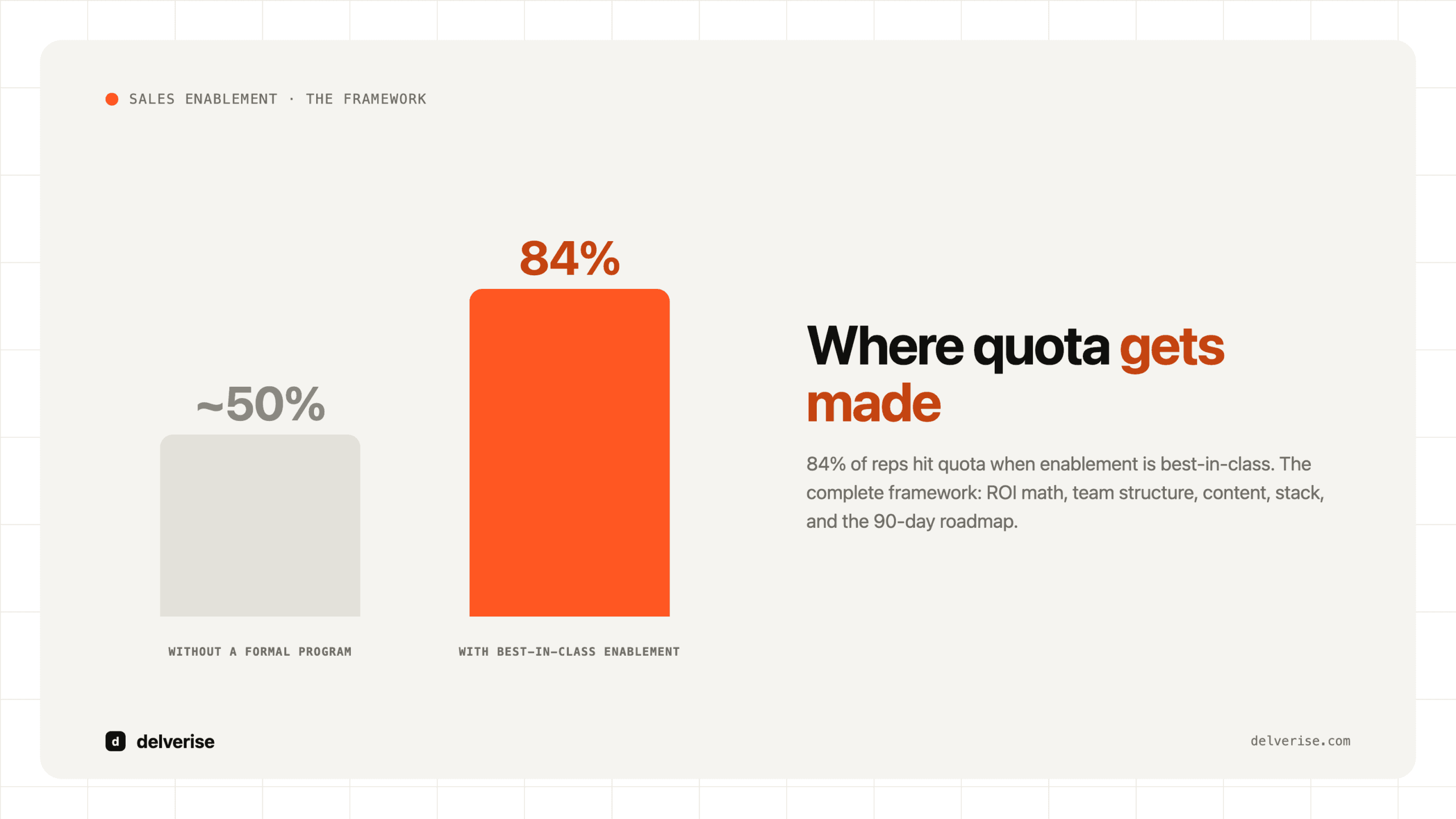
The strategic value proposition of sales enablement extends far beyond individual sales performance improvements. Organizations that implement comprehensive enablement strategies create sustainable competitive advantages through improved sales velocity, enhanced customer experiences, and more predictable revenue outcomes. Research indicates that 84% of sales representatives achieve their quotas when their employers incorporate best-in-class sales enablement strategies, compared to significantly lower attainment rates in organizations without formal enablement programs.
ROI Calculation Methodology
Calculating the return on investment for sales enablement requires a comprehensive framework that captures both direct revenue impact and indirect cost savings. The foundational ROI formula provides a starting point:
Basic ROI Formula:
Sales Enablement ROI = (Revenue Increase - Implementation Cost) / Implementation Cost × 100
However, a more sophisticated approach captures the full spectrum of enablement impact:
Advanced ROI Calculation:
Total ROI = (Revenue Impact + Cost Savings + Productivity Gains - Total Investment) / Total Investment × 100
Revenue impact encompasses multiple dimensions of sales performance improvement. Win rate improvements can be calculated by multiplying the difference between new and baseline win rates by total opportunities and average deal size. For example, if an organization improves its win rate from 15% to 22% across 1,000 annual opportunities with an average deal size of $50,000, the revenue impact equals $3.5 million annually.
Deal size increases represent another significant revenue driver. Organizations implementing effective enablement programs often see average deal sizes grow by 10-25% as sales representatives become more skilled at identifying and articulating value propositions. Sales cycle reduction creates additional revenue impact by enabling teams to close more deals within the same time period, effectively increasing sales velocity.
Cost savings from sales enablement implementation often exceed direct revenue impact in terms of ROI contribution. The best sales onboarding programs help new sales hires become productive 3.4 months sooner on average, representing substantial cost savings when multiplied across multiple new hires. For a sales representative earning $100,000 annually, reducing onboarding time by 3.4 months saves approximately $28,333 per hire in accelerated productivity.
Training efficiency improvements create ongoing cost savings through reduced time investment in learning and development activities. When enablement programs deliver just-in-time learning and microlearning modules, organizations can reduce traditional training time by 40-60% while achieving better knowledge retention and application.
Business Case Development Framework
Developing a compelling business case for sales enablement investment requires connecting enablement outcomes to specific business objectives and financial metrics. The most effective business cases demonstrate clear linkages between enablement activities and revenue growth, cost reduction, and competitive positioning.
Executive stakeholders typically evaluate enablement investments based on three primary criteria: financial return, strategic alignment, and implementation feasibility. Financial return calculations should include both short-term gains from improved sales performance and long-term benefits from enhanced customer relationships and market positioning.
Strategic alignment demonstrates how enablement initiatives support broader organizational objectives such as market expansion, product launches, or customer retention improvements. For example, if an organization plans to enter new geographic markets, the business case should quantify how enablement programs will accelerate market penetration and reduce time-to-revenue in new territories.
Implementation feasibility addresses the organization’s capacity to execute enablement initiatives successfully, including available resources, technology infrastructure, and change management capabilities. The most compelling business cases acknowledge implementation challenges while providing specific mitigation strategies and success metrics.
Common Implementation Failures and Success Patterns
Analysis of sales enablement implementations across thousands of organizations reveals consistent patterns of failure and success that can guide strategic planning and execution. The most common failure modes include lack of executive sponsorship, insufficient sales-marketing alignment, inadequate measurement frameworks, and poor technology adoption.
Lack of executive sponsorship manifests in several ways: insufficient budget allocation, competing priorities that divert attention from enablement initiatives, and absence of clear accountability for enablement outcomes. Successful implementations invariably feature strong executive champions who communicate the strategic importance of enablement and remove organizational barriers to adoption.
Insufficient sales-marketing alignment creates content that doesn’t address real sales challenges, training programs that don’t reflect actual buyer interactions, and measurement systems that don’t capture true business impact. Organizations that achieve enablement success invest heavily in cross-functional collaboration, shared metrics, and integrated planning processes.
Inadequate measurement frameworks prevent organizations from demonstrating enablement value and optimizing program effectiveness. Successful enablement programs implement multi-level measurement approaches that track leading indicators (content usage, training completion), behavioral indicators (skill application, process adherence), and business outcomes (revenue growth, customer satisfaction).
Poor technology adoption undermines even well-designed enablement programs when sales representatives cannot easily access or effectively use enablement tools and content. Success patterns include extensive user experience testing, comprehensive training and support, and ongoing optimization based on usage analytics and feedback.
The most successful enablement implementations follow a systematic approach that begins with clear strategic objectives, includes comprehensive stakeholder alignment, implements robust measurement frameworks, and maintains focus on continuous improvement and optimization. These organizations view enablement as a strategic capability rather than a tactical program, investing in long-term infrastructure and expertise development rather than short-term fixes.
2. Team Structure: Deciding Between Building In-House and Partnering
The architecture of sales enablement fundamentally determines program effectiveness and scalability. Every revenue leader faces a question of what structure the function needs, and who should own it: a team you assemble and manage internally, or a partner who already operates that structure at depth. The considerations below define what the function genuinely requires at each growth stage. Treat them as the inputs to a build-versus-buy decision rather than a hiring checklist.

What the Function Requires by Company Size and Growth Stage
Starter Organization (1-20 Sales Representatives)
Organizations in the starter phase operate with lean teams and limited specialized resources. The function still demands enablement work, and the decision is whether to absorb it across existing roles or hand it to a partner who carries the methodology already.
If built in-house, the sales manager typically dedicates 50% of their time to training delivery, coaching, and performance tracking, including weekly skill-development meetings, call-recording reviews, and performance tracking against benchmarks. A marketing coordinator contributes roughly 25% of their time to content creation, campaign alignment, and lead qualification. An operations specialist dedicates another 25% to technology management, data quality, and reporting. The trade-off is real: that is the equivalent of a full role pulled out of selling and marketing capacity, and the depth depends on whoever happens to hold those seats.
A partner removes that capacity tax. The decision turns on whether your managers have hours to spare and whether enablement maturity matters enough at this stage to justify outside expertise over a distributed internal effort.
The technology stack for starter organizations emphasizes simplicity and integration over advanced functionality: a CRM with a basic content library, plus a simple training platform. A partner usually brings this tooling, which shifts the cost calculation toward buy.
Growth Organization (20-100 Sales Representatives)
Growth-stage organizations require more sophisticated enablement to support increased team size, market complexity, and revenue targets. This is where the build-versus-buy decision carries the most weight, because building means committing to dedicated headcount and formal processes.
The in-house path means a full-time sales enablement coordinator owning program management and content strategy, including onboarding programs, playbooks, battle cards, and effectiveness measurement. It adds a training specialist at 75% time for learning design, delivery, and assessment; a marketing liaison at 50% for content collaboration and campaign alignment; and a revenue operations analyst at 50% for platform management and analytics. Hiring and ramping that mix takes months, and the function is only as strong as your ability to recruit and retain it.
A partner delivers the same coverage as an operating system on day one, with the methodology, content frameworks, and analytics already proven across other accounts. Weigh the cost of three-to-four partial-to-full roles plus recruiting risk against a partner engagement, and factor in time-to-value. For most growth-stage companies under revenue pressure, partnering reaches full effectiveness faster and often costs less than the loaded headcount it replaces.
Growth-stage technology stacks feature integrated enablement platforms combining content management, training delivery, and performance analytics, alongside an advanced CRM and a learning management system. Confirm whether a partner provides this stack or whether you license it yourself.
Enterprise Organization (100+ Sales Representatives)
Enterprise organizations need comprehensive enablement supporting complex sales processes, diverse segments, and sophisticated buyers. At this scale the decision is rarely all-or-nothing. Many enterprises keep a strategic core in-house and bring partners in for execution depth.
A full in-house build includes a sales enablement manager providing strategic leadership and stakeholder management, reporting to the CRO or VP of Sales; a content manager owning content strategy, creation, and lifecycle management; a training manager leading competency frameworks and learning paths; multiple enablement analysts for data analysis and predictive modeling; and a technology specialist for platform administration and integration.
A common and effective model keeps the enablement manager internal to hold strategy and executive sponsorship, then partners for content production, training delivery, analytics, or technology administration. This gives you control where alignment matters most and outside capacity where execution scales. Decide each layer on its own merits: strategy and stakeholder ownership tend to stay in-house, while content, training, and analytics are frequently stronger and faster with a partner.
Cross-Functional Collaboration Frameworks
Effective sales enablement requires seamless collaboration between sales, marketing, customer success, and operations. Whether you build or buy, these collaboration frameworks must define roles, responsibilities, communication protocols, and shared success metrics. A capable partner brings tested frameworks rather than asking you to design them from scratch.
Sales-marketing alignment is the most critical collaboration relationship in enablement success. It requires shared definitions of qualified leads, agreed handoff processes, collaborative content development, and integrated performance measurement. Regular pipeline and content-effectiveness reviews keep that alignment current. When evaluating a partner, ask how they operate inside this relationship and how they keep your sales and marketing leaders aligned.
Customer success integration provides insight into post-sale experiences that informs enablement content and training, including common implementation challenges, expansion opportunities, and retention factors. A partner with cross-account exposure often surfaces these patterns faster than an internal team building the feedback loop alone.
Operations collaboration ensures enablement initiatives align with broader business processes and technology infrastructure, supplying data analysis, process optimization, and integration support so programs scale and deliver measurable impact. Confirm where this responsibility sits in either model so nothing falls through the gap.
Resource Allocation and Budget Planning Strategies
Budget planning is central to the build-versus-buy decision, because the two paths spend differently. Industry benchmarks suggest organizations invest 2-5% of total sales budget in enablement, with higher percentages during rapid growth or in complex markets. Use that envelope to compare a fully loaded internal build against a partner engagement on a like-for-like basis.
In an in-house model, technology investments typically represent 30-40% of the enablement budget, content development 25-35%, and training and development 20-30%, with personnel usually the largest single category. A partner engagement consolidates much of the technology, content, and training spend into one line and removes the recruiting, ramp, and retention costs that personnel carries. Compare total cost of ownership rather than the headline number alone, and account for the months an internal team needs before it produces returns.
Effective budget planning includes provisions for measurement and optimization, so enablement investments generate measurable returns and continuous improvement. The highest-ROI organizations allocate 10-15% of their enablement budget to analytics, measurement, and optimization. Ask any partner how they report on that, and require the same discipline of an internal team, so whichever path you choose stays accountable to results.
3. Content Strategy & Asset Development
Content strategy forms the backbone of effective sales enablement, transforming generic marketing materials into targeted sales tools that address specific buyer challenges and sales scenarios. Organizations that excel in enablement content development implement systematic approaches to content planning, creation, distribution, and optimization that ensure sales teams have the right resources at the right moments in the sales process.

Content Audit and Gap Analysis Methodology
Comprehensive content audits provide the foundation for strategic content development by identifying existing assets, assessing their effectiveness, and revealing gaps that prevent sales success. The most effective audit methodologies combine quantitative analysis of content usage and performance with qualitative assessment of content relevance and quality.
Quantitative analysis examines content engagement metrics, including download rates, sharing frequency, and correlation with sales outcomes. Research indicates that 50% of all prospect engagement is generated with just 10% of sales enablement content, highlighting the importance of identifying and replicating high-performing content characteristics across the entire content library.
Content inventory analysis categorizes existing assets by type, sales stage, buyer persona, and industry vertical to identify coverage gaps and redundancies. This analysis often reveals that organizations have extensive product-focused content but lack industry-specific case studies, competitive positioning materials, or objection handling resources that sales representatives need most frequently.
Qualitative assessment involves sales representative interviews, customer feedback analysis, and competitive content evaluation to understand content effectiveness from user perspectives. Sales teams provide insights into which content assets generate the most positive buyer responses, which materials fail to address common objections, and what additional resources would enhance their selling effectiveness.
Gap analysis synthesizes audit findings to prioritize content development initiatives based on potential impact, creation complexity, and resource requirements. The most effective gap analyses identify quick wins that can be implemented immediately alongside longer-term content initiatives that require significant investment but offer substantial impact potential.
Buyer Journey Mapping and Content Requirements
Sophisticated buyer journey mapping connects content development to specific buyer needs, challenges, and decision-making processes at each stage of the purchase journey. This mapping ensures that sales representatives have appropriate content for every buyer interaction, from initial awareness through post-purchase expansion.
Modern B2B buyer journeys typically include awareness, consideration, evaluation, decision, and implementation stages, each requiring different types of content and sales approaches. During the awareness stage, buyers seek educational content that helps them understand their challenges and potential solutions. Sales representatives need thought leadership articles, industry research, and problem identification tools that position them as trusted advisors.
The consideration stage involves buyers evaluating different solution categories and approaches. Sales content for this stage includes solution overviews, capability comparisons, and ROI frameworks that help buyers understand the value of different approaches. Sales representatives need materials that differentiate their solutions without appearing overly promotional or biased.
Evaluation stage content supports detailed solution assessment and vendor comparison. This includes detailed product demonstrations, technical specifications, implementation timelines, and reference customer stories. Sales representatives need comprehensive product knowledge, competitive battle cards, and proof points that address specific buyer concerns and requirements.
Decision stage content facilitates final vendor selection and contract negotiation. This includes pricing information, contract terms, implementation plans, and risk mitigation strategies. Sales representatives need negotiation tools, approval processes, and escalation procedures that enable them to close deals efficiently while maintaining customer relationships.
Implementation stage content supports successful customer onboarding and expansion. This includes training materials, best practice guides, and expansion opportunity identification tools. Sales representatives need resources that ensure customer success and identify additional revenue opportunities.
Content Creation Workflows and Approval Processes
Efficient content creation workflows balance quality control with speed-to-market requirements, ensuring that sales teams receive timely, accurate, and effective content assets. The most successful workflows incorporate subject matter expert input, sales team feedback, and iterative improvement processes.
Content brief development initiates the creation process by defining content objectives, target audiences, key messages, and success metrics. Effective briefs include specific use cases, competitive positioning requirements, and distribution plans that guide content creators and ensure alignment with sales needs.
Collaborative creation processes involve sales representatives, subject matter experts, and content creators in iterative development cycles. This collaboration ensures that content addresses real sales challenges while maintaining technical accuracy and brand consistency. Regular review cycles allow for feedback incorporation and refinement before final publication.
Quality assurance processes include accuracy verification, brand compliance review, and usability testing with sales representatives. These processes prevent the distribution of outdated, inaccurate, or ineffective content that could damage sales relationships or brand reputation.
Approval workflows balance content quality with publication speed by implementing role-based review processes that focus on relevant expertise areas. Technical content requires subject matter expert approval, while sales-focused materials need sales leadership review. Marketing content requires brand and messaging approval to ensure consistency across all customer touchpoints.
Content Asset Categories and Strategic Applications
Sales Playbooks and Battle Cards
Sales playbooks provide comprehensive guidance for specific sales scenarios, including discovery questions, value propositions, objection responses, and next-step recommendations. Effective playbooks combine strategic guidance with tactical tools, enabling sales representatives to navigate complex sales situations with confidence and consistency.
Battle cards offer quick-reference guides for competitive situations, product positioning, and objection handling. These tools provide essential information in easily digestible formats that sales representatives can reference during live customer interactions. The most effective battle cards include specific talk tracks, proof points, and differentiation messages that address common competitive challenges.
Industry-Specific Case Studies and ROI Calculators
Industry-specific case studies demonstrate solution value in contexts that resonate with target buyers. These assets include detailed implementation stories, quantified business outcomes, and lessons learned that help prospects envision successful implementations in their own organizations. Effective case studies balance specific details with broader applicability to maximize their utility across multiple sales situations.
ROI calculators enable sales representatives to quantify solution value using prospect-specific data and assumptions. These tools transform abstract value propositions into concrete financial projections that support business case development and executive approval processes. The most effective ROI calculators include sensitivity analysis capabilities and scenario modeling that address different implementation approaches.
Competitive Positioning and Objection Handling Materials
Competitive positioning materials help sales representatives differentiate their solutions while maintaining professional respect for competitors. These assets include feature comparisons, positioning frameworks, and response strategies that enable confident competitive discussions without appearing defensive or disparaging.
Objection handling resources provide structured approaches to addressing common buyer concerns and resistance points. These materials include objection identification frameworks, response strategies, and follow-up questions that help sales representatives turn objections into selling opportunities.
Email Sequences and Follow-up Templates
Email sequences provide structured communication frameworks for different sales scenarios, including initial outreach, follow-up after meetings, proposal delivery, and post-decision communication. Effective sequences balance personalization with efficiency, enabling sales representatives to maintain consistent communication while adapting messages to specific buyer situations.
Follow-up templates ensure that sales representatives maintain momentum after important interactions by providing structured approaches to next-step communication. These templates include meeting summaries, action item tracking, and value reinforcement messages that keep deals moving forward.
Content Management Integration and Technology Platforms
HubSpot Content Management and Distribution Workflows
HubSpot integration enables seamless content distribution through CRM workflows that automatically deliver relevant content based on deal stage, buyer persona, and interaction history. This integration ensures that sales representatives have immediate access to appropriate content without requiring manual search or selection processes.
Automated content recommendations use buyer behavior data and sales activity patterns to suggest relevant assets for specific situations. This capability reduces the time sales representatives spend searching for content while increasing the likelihood that they select the most effective materials for each interaction.
Salesforce Asset Organization and Accessibility
Salesforce content management leverages custom objects and fields to organize content by multiple criteria, including sales stage, industry, product line, and competitive situation. This organization enables sophisticated content filtering and search capabilities that help sales representatives quickly locate relevant assets.
Mobile accessibility ensures that sales representatives can access content during customer meetings, travel, and other situations where desktop access is unavailable. Mobile-optimized content delivery includes offline synchronization capabilities that maintain access even in low-connectivity environments.
AirOps Content Creation and Optimization Strategies
AirOps integration enables automated content creation and optimization based on performance data and usage patterns. This capability includes A/B testing frameworks that identify the most effective content variations and automated updates that keep content current and relevant.
Performance analytics provide detailed insights into content effectiveness, including engagement metrics, conversion rates, and revenue attribution. These analytics enable data-driven content optimization and strategic planning that maximizes content ROI and sales impact.
Version Control and Content Lifecycle Management
Version control systems ensure that sales representatives always access current, approved content while maintaining historical versions for reference and compliance purposes. Automated update notifications alert sales teams when new content becomes available or when existing content requires updates.
Content lifecycle management includes automated archival processes that remove outdated content from active libraries while maintaining access for historical reference. This management prevents the distribution of obsolete information that could confuse buyers or damage sales relationships.
4. Technology Stack & Platform Integration
The technology foundation of sales enablement determines program scalability, user adoption, and measurement capabilities. Organizations that achieve sustainable enablement success implement integrated technology stacks that seamlessly connect content management, training delivery, performance analytics, and sales execution while maintaining simplicity and ease of use for end users.

Sales Enablement Technology Evaluation Framework
Technology evaluation for sales enablement requires balancing functionality, usability, integration capabilities, and total cost of ownership to select platforms that support current needs while enabling future growth. The most effective evaluation frameworks assess technology solutions across multiple dimensions including user experience, administrative efficiency, data integration, and vendor stability.
User experience evaluation focuses on the daily workflows of sales representatives, sales managers, and enablement administrators. This includes assessing content discovery and access capabilities, mobile functionality, offline synchronization, and integration with existing sales tools. Research shows that 55% of C-Suite executives identify sales enablement solutions as the top technology investment necessary to boost sales productivity, highlighting the importance of selecting platforms that genuinely enhance rather than complicate sales workflows.
Administrative efficiency assessment examines the resources required to maintain and optimize enablement platforms. This includes content management workflows, user administration, reporting capabilities, and integration maintenance. Platforms that require extensive administrative overhead often fail to deliver sustainable value despite strong initial functionality.
Data integration capabilities determine how effectively enablement platforms connect with existing business systems including CRM, marketing automation, learning management systems, and business intelligence tools. Seamless data integration enables comprehensive performance measurement and automated workflow optimization that maximizes enablement impact.
Vendor stability evaluation includes financial health assessment, product roadmap analysis, customer satisfaction research, and support quality evaluation. Organizations that select vendors with strong stability profiles avoid the disruption and cost associated with platform migrations while ensuring access to ongoing innovation and support.
CRM Integration and Workflow Automation Strategies
HubSpot Sales Enablement Workflows and Automation
HubSpot integration enables sophisticated workflow automation that delivers contextual content and training based on deal characteristics, buyer behavior, and sales representative performance. Automated workflows can trigger content recommendations when deals enter specific stages, send training reminders based on skill assessment results, and escalate opportunities that require additional support.
Deal-based content automation analyzes opportunity characteristics including industry, deal size, competitive situation, and buyer personas to automatically suggest relevant content assets. This automation ensures that sales representatives receive appropriate materials without requiring manual content search or selection processes.
Performance-based training automation monitors individual sales representative performance against key metrics and automatically enrolls underperforming team members in relevant training modules. This automation enables proactive skill development that addresses performance gaps before they impact revenue outcomes.
Lead intelligence integration provides sales representatives with comprehensive prospect information including company background, recent activities, and engagement history. This intelligence enables more effective sales conversations and higher conversion rates by ensuring that sales representatives understand prospect context and priorities.
Salesforce Content Management and Tracking
Salesforce content management leverages custom objects, fields, and workflows to create sophisticated content organization and tracking systems. Content assets can be tagged with multiple attributes including sales stage, industry, product line, and competitive situation, enabling precise content filtering and recommendation capabilities.
Usage tracking analytics provide detailed insights into content performance including download rates, sharing frequency, and correlation with sales outcomes. These analytics enable data-driven content optimization and strategic planning that maximizes content effectiveness and sales impact.
Opportunity-based content suggestions analyze deal characteristics and automatically recommend relevant content assets within the Salesforce interface. This integration ensures that sales representatives have immediate access to appropriate materials without leaving their primary sales workflow.
Activity tracking integration monitors content usage in relation to sales activities and outcomes, providing insights into which content assets contribute most effectively to deal progression and closure. This tracking enables continuous content optimization and strategic planning.
Gong Conversation Intelligence Integration
Gong integration provides conversation analysis capabilities that identify coaching opportunities, content gaps, and competitive intelligence. Conversation intelligence analyzes sales calls to identify successful talk tracks, common objections, and competitive mentions that inform content development and training priorities.
Coaching automation uses conversation analysis to identify specific skill development opportunities for individual sales representatives. This automation can trigger targeted training recommendations, schedule coaching sessions, and track improvement over time.
Content effectiveness analysis examines how different content assets perform in actual sales conversations, providing insights into which materials generate the most positive buyer responses and which assets require optimization or replacement.
Competitive intelligence gathering analyzes competitor mentions across sales conversations to identify market trends, competitive positioning opportunities, and potential threats that require strategic response.
Clay Data Enrichment for Personalized Enablement
Clay integration enables sophisticated prospect research and personalization that enhances sales effectiveness and buyer engagement. Data enrichment provides sales representatives with comprehensive prospect intelligence including company information, recent news, technology stack, and key personnel details.
Personalized content recommendations use enriched prospect data to suggest highly relevant content assets that address specific buyer situations and challenges. This personalization increases content effectiveness and demonstrates sales representative preparation and expertise.
Account intelligence automation continuously monitors prospect accounts for relevant changes including personnel updates, funding announcements, and strategic initiatives that create selling opportunities or require adjusted sales approaches.
Territory planning integration uses enriched data to identify high-potential prospects and optimize sales representative territory assignments based on account characteristics and opportunity potential.
Platform Selection Criteria and Decision Framework
User Adoption and Ease of Use Considerations
User adoption represents the most critical factor in enablement technology success, as even the most sophisticated platforms fail to deliver value if sales representatives don’t use them consistently. Adoption assessment includes interface design evaluation, workflow integration analysis, and change management requirements.
Interface design evaluation focuses on intuitive navigation, visual clarity, and task efficiency. Platforms with complex interfaces or confusing navigation structures typically experience low adoption rates regardless of underlying functionality. The most successful platforms prioritize user experience design that minimizes training requirements and maximizes daily usability.
Workflow integration analysis examines how enablement platforms fit into existing sales processes and tools. Platforms that require significant workflow changes or duplicate existing functionality often face resistance from sales teams who prefer familiar processes and tools.
Change management requirements assessment identifies the training, support, and communication needed to achieve successful platform adoption. Platforms with extensive change management requirements may deliver strong functionality but require substantial investment in user education and ongoing support.
Integration Capabilities with Existing Tech Stack
Integration capabilities determine how effectively enablement platforms connect with existing business systems and data sources. Comprehensive integration enables automated workflows, unified reporting, and seamless user experiences that maximize platform value and minimize administrative overhead.
API availability and quality assessment examines the technical capabilities for connecting enablement platforms with CRM systems, marketing automation tools, learning management systems, and business intelligence platforms. Robust APIs enable sophisticated integrations that automate data synchronization and workflow optimization.
Data synchronization capabilities ensure that enablement platforms maintain current, accurate information from connected systems. Real-time synchronization enables dynamic content recommendations and automated workflow triggers that respond immediately to changing sales situations.
Single sign-on integration reduces user friction by enabling access to enablement platforms through existing authentication systems. This integration eliminates additional login requirements that can reduce platform usage and user satisfaction.
Analytics and Reporting Functionality
Analytics capabilities determine how effectively organizations can measure enablement impact and optimize program performance. Comprehensive analytics include usage metrics, performance correlations, and predictive insights that guide strategic decision-making and tactical adjustments.
Usage analytics provide detailed insights into content engagement, training completion, and platform utilization patterns. These metrics identify high-performing content assets, training effectiveness, and user adoption challenges that require attention.
Performance correlation analysis examines relationships between enablement activities and sales outcomes including revenue growth, deal velocity, and quota attainment. These correlations demonstrate enablement value and identify optimization opportunities.
Predictive analytics use historical data and machine learning algorithms to forecast sales performance, identify at-risk deals, and recommend intervention strategies. These capabilities enable proactive sales management and strategic planning that maximizes revenue outcomes.
5. Training & Sales-Marketing Alignment
Effective sales enablement training transcends traditional product knowledge transfer to develop comprehensive competencies that enable sales representatives to navigate complex buyer journeys, articulate differentiated value propositions, and build trusted advisor relationships. Organizations that achieve training excellence implement systematic approaches to skill development, knowledge transfer, and performance reinforcement while maintaining tight alignment between sales and marketing functions.
Onboarding and Continuous Education Programs
Comprehensive onboarding programs provide new sales representatives with the knowledge, skills, and tools necessary to achieve productivity quickly while establishing foundations for long-term success. Research demonstrates that the best sales onboarding programs help new sales hires become productive 3.4 months sooner on average, representing substantial value creation through accelerated revenue contribution and reduced time-to-productivity.
Structured onboarding curricula typically span 90-120 days and include multiple learning modalities including self-paced modules, instructor-led sessions, peer mentoring, and hands-on practice opportunities. The most effective programs balance comprehensive knowledge transfer with practical application, ensuring that new hires understand both theoretical concepts and real-world implementation.
Product knowledge development forms the foundation of sales onboarding but extends beyond feature-function training to include value proposition articulation, competitive positioning, and use case identification. Sales representatives must understand what products do, as well as how they solve specific customer problems and create measurable business value.
Industry and buyer persona education provides context for product knowledge by helping sales representatives understand target market characteristics, buyer motivations, and decision-making processes. This education includes industry trend analysis, competitive landscape overview, and buyer journey mapping that enables more effective prospect engagement.
Sales methodology training establishes consistent approaches to opportunity qualification, needs discovery, solution presentation, and objection handling. Methodology training provides frameworks and processes that guide sales representative behavior while allowing for individual style and adaptation to specific situations.
Continuous education programs maintain and enhance sales representative capabilities through ongoing learning opportunities that address evolving market conditions, new product releases, and skill development needs. These programs include regular training sessions, certification requirements, and performance-based learning recommendations.
Microlearning approaches deliver training content in small, focused modules that sales representatives can consume during brief periods between customer interactions. This approach maximizes learning retention while minimizing disruption to sales activities and customer engagement.
Service Level Agreements and Handoff Processes
Sales-marketing alignment requires formal agreements that define responsibilities, expectations, and performance standards for lead generation, qualification, and handoff processes. Service Level Agreements (SLAs) provide accountability frameworks that ensure both teams contribute effectively to revenue generation while maintaining focus on their core competencies.
Lead qualification SLAs establish criteria for marketing qualified leads (MQLs) and sales qualified leads (SQLs) that ensure sales representatives receive prospects with genuine purchase intent and appropriate fit characteristics. These criteria typically include demographic qualifiers, behavioral indicators, and engagement thresholds that predict conversion likelihood.
Response time SLAs define expectations for sales follow-up on marketing-generated leads, ensuring that prospects receive timely attention while their interest and engagement remain high. Industry research indicates that response time significantly impacts conversion rates, with immediate follow-up generating substantially higher qualification and conversion rates than delayed response.
Lead routing SLAs specify how leads are distributed among sales representatives based on territory assignments, product specialization, account characteristics, and workload balancing. Effective routing ensures that prospects connect with appropriate sales representatives while maintaining fair opportunity distribution.
Feedback SLAs require sales teams to provide regular input on lead quality, content effectiveness, and market intelligence that enables marketing optimization and strategic planning. This feedback includes lead disposition reporting, content usage analytics, and competitive intelligence that informs marketing strategy and tactical adjustments.
Lead Qualification and Scoring Alignment
Integrated lead scoring systems combine marketing engagement data with sales qualification criteria to create comprehensive prospect prioritization frameworks. These systems enable both teams to focus their efforts on the highest-potential opportunities while ensuring consistent qualification standards and handoff processes.
Demographic scoring evaluates prospect fit based on company size, industry, geographic location, and other characteristics that correlate with successful customer outcomes. This scoring helps prioritize prospects that match ideal customer profiles while identifying potential challenges or opportunities that require special attention.
Behavioral scoring analyzes prospect engagement with marketing content, website interactions, and sales communications to assess purchase intent and readiness. Behavioral indicators include content downloads, webinar attendance, pricing page visits, and email engagement that suggest active evaluation processes.
Engagement scoring tracks the frequency and quality of prospect interactions with sales representatives including meeting attendance, response rates, and stakeholder involvement. This scoring helps identify deals with strong momentum while flagging opportunities that require additional nurturing or different approaches.
Predictive scoring uses machine learning algorithms to analyze historical data and identify patterns that predict conversion likelihood. These algorithms consider multiple variables including demographic characteristics, behavioral patterns, and engagement history to generate probability scores that guide prioritization and resource allocation.
Training Components and Competency Development
Product Knowledge and Positioning Training
Product knowledge training extends beyond feature-function education to include value proposition development, competitive differentiation, and use case identification. Sales representatives must understand how products solve specific customer problems, create measurable business value, and compare to competitive alternatives.
Technical competency development ensures that sales representatives can conduct effective product demonstrations, answer detailed technical questions, and engage productively with technical stakeholders. This competency includes understanding product architecture, integration capabilities, and implementation requirements.
Value proposition articulation training helps sales representatives communicate product benefits in terms that resonate with different buyer personas and decision-making criteria. This training includes ROI calculation methodologies, business case development, and executive presentation skills.
Competitive positioning education provides frameworks for differentiating products while maintaining professional respect for competitors. This education includes competitive analysis, positioning strategies, and response techniques that enable confident competitive discussions.
Sales Methodology and Process Training
Sales methodology training establishes consistent approaches to opportunity management that maximize conversion rates while maintaining predictable sales processes. Methodology training includes qualification frameworks, discovery techniques, presentation strategies, and closing approaches.
Discovery methodology training develops questioning techniques that uncover buyer needs, challenges, decision criteria, and evaluation processes. Effective discovery enables sales representatives to position solutions appropriately while identifying potential obstacles and objections.
Presentation methodology training provides frameworks for delivering compelling solution presentations that address specific buyer requirements while differentiating from competitive alternatives. This training includes storytelling techniques, visual presentation skills, and audience engagement strategies.
Negotiation methodology training develops skills for managing pricing discussions, contract terms, and implementation requirements while maintaining customer relationships and deal profitability. This training includes preparation techniques, concession strategies, and escalation procedures.
Technology and Tool Proficiency Training
CRM proficiency training ensures that sales representatives can effectively use customer relationship management systems for contact management, opportunity tracking, activity logging, and reporting. This proficiency includes data entry standards, workflow optimization, and integration utilization.
Enablement platform training provides comprehensive education on content access, training completion, performance tracking, and collaboration tools. This training ensures that sales representatives can maximize platform value while minimizing time investment in tool navigation and administration.
Communication tool training covers email automation, video conferencing, presentation software, and social selling platforms that enhance sales effectiveness and buyer engagement. This training includes best practice guidelines, efficiency techniques, and integration optimization.
Analytics tool training enables sales representatives to access and interpret performance data, pipeline reports, and market intelligence that inform strategic planning and tactical adjustments. This training includes dashboard navigation, report generation, and data analysis techniques.
Alignment Frameworks and Shared Success Metrics
Lead Routing and Qualification Processes
Automated lead routing systems distribute prospects among sales representatives based on predefined criteria including territory assignments, product specialization, account characteristics, and capacity management. These systems ensure fair opportunity distribution while optimizing prospect-representative matching.
Qualification process standardization establishes consistent criteria and methodologies for evaluating prospect fit, purchase intent, and conversion likelihood. Standardized processes enable accurate forecasting, resource allocation, and performance measurement while ensuring that all prospects receive appropriate evaluation.
Escalation procedures define protocols for managing complex opportunities that require additional resources, specialized expertise, or executive involvement. These procedures ensure that high-value opportunities receive appropriate attention while maintaining efficient resource utilization.
Content Collaboration and Feedback Loops
Content development collaboration involves sales representatives in the creation and optimization of marketing materials, ensuring that content addresses real buyer challenges and sales scenarios. This collaboration includes content brief input, review participation, and effectiveness feedback.
Usage analytics sharing provides marketing teams with detailed insights into content performance including download rates, sharing frequency, and correlation with sales outcomes. These analytics enable data-driven content optimization and strategic planning.
Market intelligence sharing ensures that sales teams communicate competitive information, buyer feedback, and market trends to marketing teams for strategic planning and tactical adjustment. This intelligence includes competitive analysis, pricing feedback, and product development input.
Performance Measurement and Shared KPIs
Revenue attribution models track the contribution of marketing activities to sales outcomes while measuring sales effectiveness in converting marketing-generated opportunities. These models provide comprehensive views of revenue generation that inform resource allocation and strategic planning.
Pipeline quality metrics assess the characteristics and conversion rates of marketing-generated leads compared to sales-generated opportunities. These metrics identify optimization opportunities while ensuring that both teams focus on high-quality prospect development.
Customer acquisition cost analysis examines the total investment required to acquire new customers including marketing spend, sales costs, and enablement expenses. This analysis enables optimization of customer acquisition strategies while maintaining profitability and growth targets.
6. Measurement & Analytics Framework
Comprehensive measurement frameworks transform sales enablement from cost center to revenue driver by demonstrating clear connections between enablement activities and business outcomes. Organizations that excel in enablement measurement implement multi-level analytics approaches that track leading indicators, behavioral changes, and business impact while providing actionable insights for continuous optimization.

Leading Indicator Tracking and Early Warning Systems
Leading indicators provide early signals of enablement program effectiveness and potential performance issues before they impact revenue outcomes. These metrics enable proactive intervention and optimization that prevents problems while amplifying successful initiatives.
Content engagement metrics track how sales representatives interact with enablement materials including download rates, time spent reviewing content, and sharing frequency with prospects. High engagement rates typically correlate with improved sales performance, while declining engagement may indicate content relevance issues or competing priorities that require attention.
Training completion and assessment metrics monitor learning program participation and knowledge retention across the sales organization. These metrics include module completion rates, assessment scores, and time-to-completion that indicate training effectiveness and identify individuals who may need additional support.
Platform utilization analytics examine how sales representatives use enablement technology including login frequency, feature adoption, and workflow completion rates. Low utilization may indicate usability issues, insufficient training, or competing tool preferences that undermine enablement effectiveness.
Skill development progression tracking monitors individual sales representative advancement through competency frameworks and certification programs. This tracking identifies high performers who can serve as mentors and coaches while highlighting skill gaps that require targeted intervention.
Activity correlation analysis examines relationships between enablement activities and sales behaviors including call frequency, meeting rates, and proposal submission timing. Strong correlations indicate that enablement programs successfully influence sales representative behavior, while weak correlations suggest the need for program adjustments.
Lagging Indicator Measurement and Revenue Attribution
Lagging indicators measure the ultimate business impact of enablement programs through revenue performance, customer outcomes, and competitive success metrics. These indicators provide definitive proof of enablement value while identifying areas for strategic improvement and investment.
Revenue growth attribution analyzes the contribution of enablement programs to overall sales performance including quota attainment, deal size increases, and sales cycle acceleration. Organizations that perceive enablement as an ROI engine see 15% lift in win rates and 12% higher quota attainment, demonstrating the substantial impact that effective enablement can achieve.
Win rate improvement tracking compares sales performance before and after enablement program implementation while controlling for market conditions, product changes, and other variables that might influence outcomes. Sustained win rate improvements provide strong evidence of enablement effectiveness and justify continued investment.
Deal velocity analysis examines changes in sales cycle length and pipeline progression rates following enablement program deployment. Faster deal progression indicates that sales representatives are more effective at advancing opportunities while shorter sales cycles increase overall sales capacity and revenue potential.
Customer satisfaction and retention metrics assess the quality of sales interactions and long-term customer relationships. Improved customer satisfaction scores and higher retention rates indicate that enablement programs enhance sales representative effectiveness while creating sustainable competitive advantages.
Competitive win rate analysis tracks success against specific competitors and market segments to identify areas of strength and opportunity. Improving competitive performance demonstrates enablement effectiveness while highlighting areas that may require additional focus or different approaches.
ROI Calculation and Business Impact Analysis
Comprehensive ROI calculation requires systematic tracking of enablement investments and quantification of resulting benefits across multiple dimensions of business performance. The most effective ROI frameworks capture both direct revenue impact and indirect cost savings while accounting for implementation costs and ongoing operational expenses.
Direct revenue impact calculation includes win rate improvements, deal size increases, sales cycle acceleration, and quota attainment enhancement. For example, if an enablement program improves win rates from 20% to 28% across 500 annual opportunities with an average deal size of $75,000, the annual revenue impact equals $3 million.
Cost savings quantification includes reduced onboarding time, improved training efficiency, decreased content creation costs, and enhanced sales representative productivity. Sales enablement catalyzes ROI by decreasing onboarding time by 40-50%, representing substantial cost savings when calculated across multiple new hires.
Implementation cost tracking includes technology platform expenses, content development investments, training program costs, and personnel expenses. Comprehensive cost tracking ensures accurate ROI calculation while identifying optimization opportunities that can improve program efficiency.
Productivity improvement measurement examines changes in sales representative efficiency including activities per day, opportunities per representative, and revenue per representative. Productivity improvements often represent the largest component of enablement ROI through enhanced sales capacity and effectiveness.
Key Performance Indicators and Measurement Frameworks
Content Utilization and Effectiveness Metrics
Content download and sharing analytics track which materials sales representatives access most frequently and share with prospects most often. These metrics identify high-performing content that should be replicated and promoted while highlighting underutilized assets that may require optimization or retirement.
Content correlation with sales outcomes examines relationships between specific content usage and deal progression, win rates, and revenue generation. Strong correlations indicate content effectiveness while weak correlations suggest the need for content improvement or different positioning.
Buyer engagement with shared content provides insights into which materials generate the most positive prospect responses and advance sales conversations most effectively. This engagement includes time spent reviewing content, follow-up questions generated, and meeting requests resulting from content sharing.
Content lifecycle performance tracking monitors how content effectiveness changes over time, identifying materials that require updates, optimization, or replacement. Regular performance review ensures that sales representatives always have access to current, relevant, and effective content assets.
Training Completion and Retention Rates
Training program completion rates indicate sales representative engagement with learning opportunities while identifying potential barriers to participation. Low completion rates may indicate scheduling conflicts, content relevance issues, or competing priorities that require attention.
Knowledge retention assessment measures how effectively sales representatives retain and apply training content over time. Regular assessments identify knowledge gaps that require reinforcement while highlighting successful training approaches that should be expanded.
Skill application observation tracks how sales representatives implement training concepts in real sales situations. This observation includes call reviews, customer feedback, and manager assessments that evaluate training effectiveness and identify coaching opportunities.
Certification achievement and maintenance monitoring ensures that sales representatives meet competency standards while maintaining current knowledge and skills. Certification programs provide objective measures of capability while creating accountability for ongoing learning and development.
Sales Performance Improvement Tracking
Individual performance progression analysis tracks how sales representatives improve over time following enablement program participation. This analysis includes quota attainment trends, activity levels, and skill development that demonstrate enablement impact on individual performance.
Team performance comparison examines differences between teams or regions that participate in enablement programs versus those that do not. Controlled comparisons provide strong evidence of enablement effectiveness while identifying best practices that can be scaled across the organization.
Cohort analysis tracks groups of sales representatives who participate in enablement programs simultaneously, enabling assessment of program effectiveness while controlling for external variables that might influence performance.
Performance correlation with enablement activities examines relationships between specific enablement participation and sales outcomes. Strong correlations indicate effective programs while weak correlations suggest the need for program modification or different approaches.
Analytics Integration and Reporting Infrastructure
GA4 Tracking for Content Engagement and Usage
Google Analytics 4 integration provides comprehensive tracking of content engagement including page views, time on page, download rates, and user journey analysis. This tracking enables detailed understanding of how sales representatives interact with enablement content while identifying optimization opportunities.
Event tracking configuration monitors specific user actions including content downloads, video completions, and form submissions that indicate engagement levels and content effectiveness. Custom event tracking provides insights into user behavior patterns that inform content strategy and platform optimization.
Audience segmentation analysis examines content usage patterns across different user groups including role, experience level, and performance tier. Segmentation insights enable personalized content recommendations and targeted training programs that maximize individual effectiveness.
Conversion tracking measures how content engagement correlates with sales activities and outcomes including meeting scheduling, proposal submission, and deal closure. Conversion analysis demonstrates content value while identifying high-performing assets that should be promoted and replicated.
HubSpot Analytics for Sales Activity and Conversion
HubSpot analytics integration provides comprehensive tracking of sales activities, pipeline progression, and revenue attribution that connects enablement programs to business outcomes. This integration enables automated reporting and real-time performance monitoring.
Deal progression analysis tracks how opportunities advance through sales stages following enablement program participation. This analysis identifies bottlenecks and acceleration points that inform process optimization and training focus areas.
Activity correlation tracking examines relationships between enablement activities and sales behaviors including call frequency, email engagement, and meeting rates. Strong correlations indicate successful behavior change while weak correlations suggest the need for program adjustments.
Revenue attribution modeling connects enablement investments to revenue outcomes through sophisticated tracking and analysis. Attribution models provide clear evidence of enablement value while identifying the most effective program components.
Custom Dashboard Creation for Executive Reporting
Executive dashboard design focuses on high-level metrics that demonstrate enablement impact on business objectives including revenue growth, market share, and competitive positioning. These dashboards provide strategic insights while maintaining focus on actionable information.
Real-time performance monitoring enables immediate identification of trends and issues that require attention. Real-time dashboards support proactive management and rapid response to changing conditions or emerging opportunities.
Predictive analytics integration uses historical data and machine learning algorithms to forecast future performance and identify potential risks or opportunities. Predictive insights enable strategic planning and resource allocation that maximizes enablement impact.
Automated reporting systems generate regular performance summaries and trend analysis that keep stakeholders informed while minimizing administrative overhead. Automated reports ensure consistent communication while freeing enablement teams to focus on strategic activities and optimization initiatives.
7. Implementation Roadmap & Optimization
Successful sales enablement implementation requires systematic planning, phased execution, and continuous optimization that balances speed-to-value with sustainable adoption. Organizations that achieve enablement excellence follow structured roadmaps that establish strong foundations, build momentum through early wins, and create scalable systems for long-term success.

30-60-90 Day Implementation Timeline and Milestones
Days 1-30: Foundation Phase

The foundation phase establishes the strategic, organizational, and technological infrastructure necessary for enablement success. This phase focuses on assessment, planning, stakeholder alignment, and initial system setup that creates the platform for subsequent implementation activities.
Current state assessment provides comprehensive understanding of existing capabilities, challenges, and opportunities that inform implementation strategy and resource allocation. This assessment includes sales performance analysis, content audit, technology evaluation, and stakeholder interviews that identify strengths to leverage and gaps to address.
Executive sponsorship development ensures that enablement initiatives receive appropriate support, resources, and organizational priority. Strong executive sponsorship includes clear communication of enablement importance, resource commitment, and accountability establishment that enables successful implementation and adoption.
Cross-functional team formation brings together representatives from sales, marketing, operations, and other relevant functions to guide implementation planning and execution. Effective teams include decision-making authority, subject matter expertise, and implementation capacity that enables rapid progress and issue resolution.
Technology platform selection and procurement establishes the technological foundation for enablement program delivery. Platform selection considers functionality requirements, integration capabilities, user experience, and total cost of ownership while ensuring alignment with organizational technology standards and strategic direction.
Initial content development focuses on high-priority assets that address immediate sales needs while establishing content creation workflows and quality standards. Priority content typically includes sales playbooks, competitive battle cards, and industry-specific case studies that provide immediate value to sales teams.
Days 31-60: Content and Training Phase
The content and training phase develops comprehensive enablement resources while beginning pilot program implementation that tests approaches and identifies optimization opportunities before full-scale deployment.
Content library development expands initial content creation to include comprehensive asset coverage across sales stages, buyer personas, and use cases. Content development includes creation workflows, review processes, and distribution mechanisms that ensure quality, relevance, and accessibility.
Training program design creates comprehensive learning curricula that address knowledge gaps, skill development needs, and competency requirements identified during the assessment phase. Training design includes multiple learning modalities, assessment mechanisms, and reinforcement strategies that maximize knowledge retention and application.
Pilot program launch implements enablement initiatives with a selected group of sales representatives who provide feedback, identify issues, and validate approaches before broader deployment. Pilot programs typically include 10-20% of the sales team and focus on specific use cases or market segments that enable controlled testing.
Feedback collection and analysis gathers input from pilot participants regarding content effectiveness, training quality, technology usability, and overall program value. Systematic feedback collection enables rapid iteration and optimization that improves program effectiveness before full deployment.
Performance baseline establishment measures current sales performance across key metrics including win rates, deal sizes, sales cycles, and quota attainment. Baseline measurement provides the foundation for subsequent impact assessment and ROI calculation.
Days 61-90: Scale and Optimize Phase
The scale and optimize phase expands enablement programs to the entire sales organization while implementing measurement systems and optimization processes that ensure continuous improvement and sustained value delivery.
Organization-wide deployment extends enablement programs to all sales representatives through systematic rollout that includes training, support, and adoption monitoring. Deployment planning considers change management requirements, resource capacity, and performance monitoring that enables successful adoption.
Comprehensive training delivery provides all sales representatives with access to enablement content, tools, and learning opportunities through multiple channels including instructor-led sessions, self-paced modules, and peer mentoring programs. Training delivery includes assessment, certification, and ongoing reinforcement that ensures competency development.
Performance monitoring implementation establishes systematic tracking of enablement impact through leading indicators, behavioral metrics, and business outcomes. Monitoring systems include automated data collection, regular reporting, and trend analysis that enable proactive management and optimization.
Optimization cycle initiation begins systematic review and improvement of enablement programs based on performance data, user feedback, and changing business requirements. Optimization includes content updates, training refinements, and process improvements that enhance program effectiveness over time.
Change Management and Adoption Strategies
Effective change management ensures that enablement programs achieve widespread adoption and sustained usage rather than initial enthusiasm followed by gradual abandonment. Successful change management addresses both rational and emotional aspects of adoption while providing ongoing support and reinforcement.
Communication strategy development creates comprehensive messaging that explains enablement benefits, addresses concerns, and maintains momentum throughout implementation. Effective communication includes multiple channels, consistent messaging, and regular updates that keep stakeholders informed and engaged.
Champion identification and development leverages influential sales representatives who can advocate for enablement programs and support peer adoption. Champions provide credible endorsement, peer support, and feedback that accelerates adoption while identifying potential issues and solutions.
Training and support systems provide comprehensive resources that enable successful enablement program utilization. Support systems include help desk services, user documentation, video tutorials, and peer mentoring that address questions and issues that arise during adoption.
Incentive alignment ensures that enablement program adoption supports rather than conflicts with existing compensation, recognition, and performance management systems. Aligned incentives encourage adoption while avoiding unintended consequences that might undermine program success.
Resistance management addresses concerns, objections, and barriers that prevent enablement adoption. Effective resistance management includes stakeholder engagement, concern validation, solution development, and ongoing communication that builds confidence and support.
Continuous Improvement and Iteration Processes
Continuous improvement transforms enablement programs from static implementations to dynamic systems that evolve with changing business needs, market conditions, and organizational capabilities. Systematic improvement processes ensure that enablement programs maintain relevance and effectiveness over time.
Performance review cycles establish regular assessment of enablement program effectiveness through data analysis, stakeholder feedback, and business impact evaluation. Review cycles typically occur monthly for tactical adjustments and quarterly for strategic evaluation and planning.
Content optimization processes ensure that enablement materials remain current, relevant, and effective through regular review, update, and replacement activities. Content optimization includes performance analysis, user feedback incorporation, and market condition adaptation that maintains content value.
Training program refinement adapts learning curricula to address evolving skill requirements, knowledge gaps, and performance challenges identified through ongoing assessment and feedback. Training refinement includes content updates, delivery method optimization, and assessment improvement that enhances learning effectiveness.
Technology platform optimization maximizes enablement system value through feature utilization, integration enhancement, and user experience improvement. Platform optimization includes usage analysis, feedback incorporation, and vendor collaboration that ensures technology supports rather than hinders enablement objectives.
Process improvement initiatives address workflow inefficiencies, adoption barriers, and performance gaps identified through systematic analysis and stakeholder feedback. Process improvement includes workflow redesign, automation implementation, and policy adjustment that enhances program effectiveness and user satisfaction.
Need the system behind sales enablement? delverise builds GTM and revenue operations systems that connect CRM enrichment, sales content, workflow automation, scoring, routing, and reporting so enablement becomes measurable pipeline infrastructure. Explore GTM Engineering, Revenue Operations Automation, CRM Enrichment, and Growth Engineering, or apply to work with us.
Frequently Asked Questions
What is the ROI of B2B sales enablement?
Organizations with a sales enablement strategy achieve a 49% higher win rate on forecasted deals and decrease onboarding time by 40-50%. The advanced ROI formula is: (Revenue Impact + Cost Savings + Productivity Gains – Total Investment) / Total Investment × 100. For example, improving win rates from 15% to 22% across 1,000 annual opportunities at a $50,000 average deal size generates $3.5 million in annual revenue impact.
How does sales enablement differ from sales training?
Sales enablement is a strategic, ongoing practice of equipping sales teams with insights, content, and tools to optimize every buyer interaction, while training typically occurs in isolated sessions focused on product knowledge or techniques. Enablement provides continuous support throughout the entire sales process, delivering contextual resources precisely when and where they’re needed. This distinction matters because 87% of traditional training content is forgotten within a month.
How much faster do sales reps ramp with enablement?
The best sales onboarding programs help new hires become productive 3.4 months sooner on average. For a sales representative earning $100,000 annually, that acceleration saves approximately $28,333 per hire in productivity costs. Enablement programs delivering just-in-time learning and microlearning modules can also reduce traditional training time by 40-60% while improving knowledge retention and application.
Why do most B2B sales reps need enablement now?
Modern buyers complete 50-90% of their buying journey before engaging with a sales representative, which forces sales teams to be equipped with sophisticated tools, content, and strategies from the moment of first contact. Research shows 84% of sales representatives achieve their quotas when their employers incorporate best-in-class sales enablement strategies, compared to significantly lower attainment rates in organizations without formal enablement programs.
How do you build a business case for sales enablement?
Executive stakeholders evaluate enablement investments on three primary criteria: financial return, strategic alignment, and implementation feasibility. Financial return calculations should include both short-term gains from improved sales performance and long-term benefits from enhanced customer relationships. Connect enablement outcomes to specific business objectives like revenue growth, cost reduction, and competitive positioning, supported by metrics such as win rate lift, deal size increases of 10-25%, and sales cycle reduction.
Read next