←Back to blog
Growth & Demand GenerationGuideFebruary 9, 202612 min read
Inbound Lead Generation for B2B SaaS: Strategies That Drive Pipeline
Build an inbound lead generation engine for B2B SaaS. Covers MQL/SQL/PQL frameworks, SEO-driven content, product-led growth, and the strategies that generate qualified pipeline.
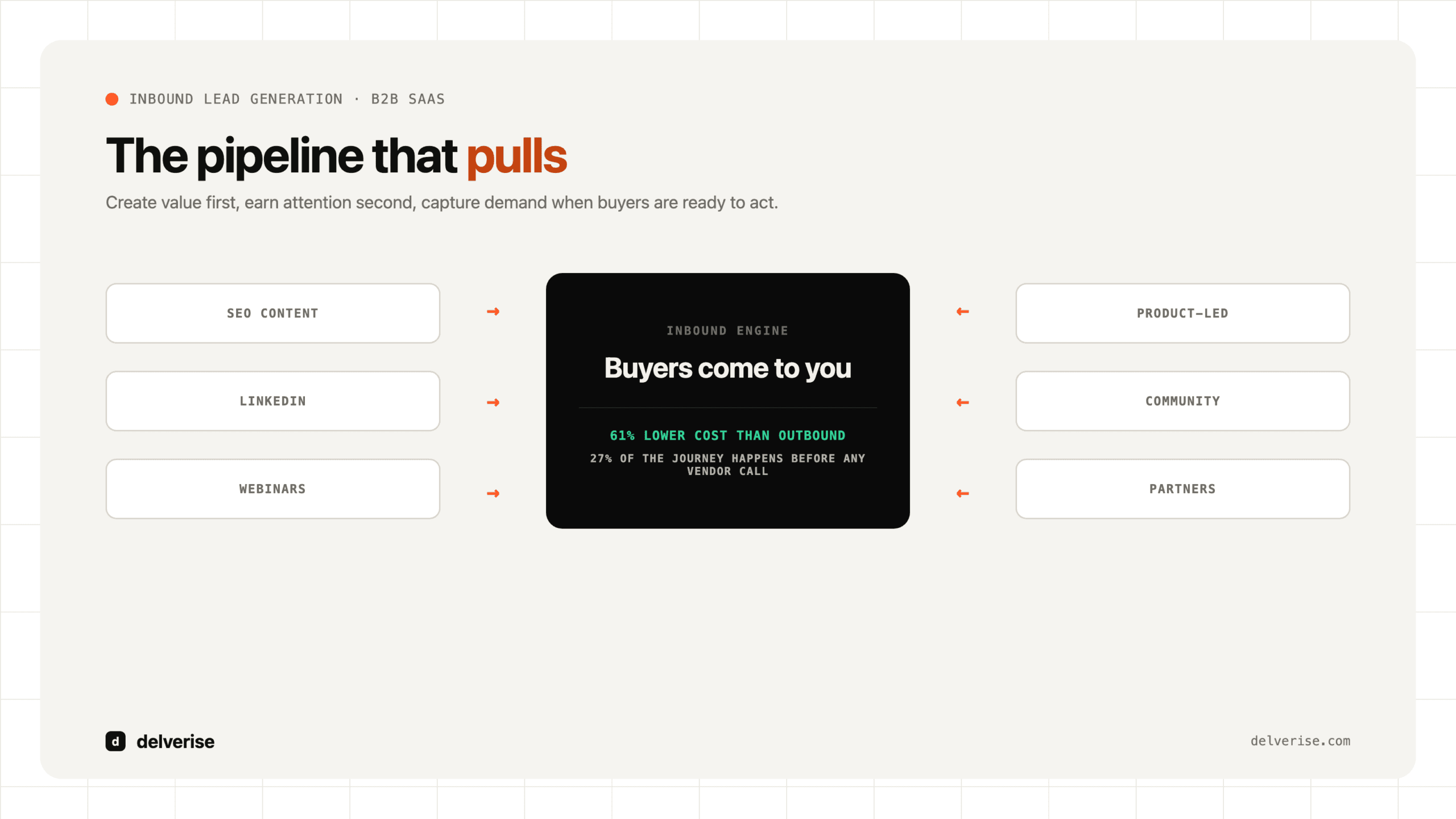
For B2B SaaS companies, inbound lead generation is the difference between chasing prospects and having them come to you. Instead of burning budget on cold outreach that interrupts buyers mid-scroll, inbound flips the dynamic: you create value first, earn attention second, and capture demand when buyers are ready to act.
But inbound for SaaS is not the same as inbound for consumer brands. The buying cycle is longer, multiple stakeholders are involved, and the path from first touch to closed deal can span weeks or months. That means your inbound engine needs to do more than attract traffic. It needs to attract the right traffic, nurture it with relevant content, and convert it into qualified pipeline that your sales team can close.
This guide breaks down the strategies, lead qualification frameworks, and channel-specific tactics that B2B SaaS companies use to build inbound engines that reliably fill pipeline.
Short answer: inbound lead generation for B2B SaaS works when content, product signals, lead scoring, nurture, and routing operate as one system. Traffic alone does not create pipeline; the engine has to identify fit, capture intent, and move qualified leads into the right sales or marketing workflow.
- Attract: create search, content, partner, community, and product-led entry points for the ICP.
- Qualify: use firmographic, behavioral, and intent signals to separate demand from noise.
- Route: send high-fit leads to sales fast and nurture lower-intent accounts until timing improves.

What Are Inbound Leads?
Inbound leads are potential customers who initiate contact with your business after discovering you through content, search, referrals, or product experience. Rather than being interrupted by a cold call or outbound email, these buyers find you organically because you have created something valuable enough to earn their attention.
Consider how HubSpot built one of the most powerful inbound engines in B2B SaaS. Their blog generates millions of organic visitors each month by ranking for keywords that marketers and sales leaders actively search. Visitors who find value in HubSpot’s content naturally explore the free CRM, sign up for tools, and eventually convert to paid plans. The content generates both traffic and pipeline. Similarly, Ahrefs publishes in-depth SEO tutorials that demonstrate their own product’s capabilities, driving demo requests from marketing teams who have already seen the tool in action.
These are not flukes. They are repeatable inbound systems. The common thread is clear: create genuine value for your ideal customer profile, distribute it where they already spend time, and make the path from content to product seamless.
Why Inbound Leads Matter for B2B SaaS
Inbound leads are cheaper. They are also structurally better for SaaS economics. Here is why.
Lower cost per acquisition. According to HubSpot, inbound leads cost 61% less than outbound leads on average. For SaaS companies operating on tight unit economics, that difference compounds across every stage of the funnel.
Higher intent and qualification. Buyers who find you through search, content, or product experience have already self-selected. They have a problem, they are actively researching solutions, and they have engaged with your brand before a sales rep ever reaches out. According to Gartner, B2B buyers spend 27% of their total buying journey researching independently online before engaging with any vendor. Inbound captures that research phase.
Scalability. A well-optimized blog post or webinar recording continues generating leads months or years after publication. Unlike outbound, where results stop the moment you stop sending, inbound compounds over time.
Data-driven optimization. Every inbound touchpoint generates behavioral data, including page visits, content downloads, feature usage, and email engagement, that your marketing operations team can use to continuously improve targeting, messaging, and conversion rates.
Inbound vs. Outbound: A Quick Comparison
Inbound and outbound are not mutually exclusive. Most high-performing B2B SaaS companies run both. But they serve different purposes and carry different tradeoffs.
| Inbound | Outbound | |
|---|---|---|
| How it works | Buyer finds you through content, search, referrals, or product | Sales team reaches out via cold email, calls, or ads |
| Cost | Lower per lead; compounds over time | Higher per lead; stops when spend stops |
| Speed to results | Slower ramp (3-6 months for SEO/content) | Faster initial results |
| Lead quality | Higher intent (self-selected) | Variable (depends on targeting) |
| Trust level | Higher (buyer initiated contact) | Lower (perceived as interruptive) |
| Scalability | High (content compounds) | Linear (more reps = more output) |

The strongest pipeline strategies layer both. Use outbound to accelerate early traction, and invest in inbound to build a compounding engine that reduces reliance on outbound over time.

4 Types of Qualified Leads in SaaS
Not every lead that enters your funnel is ready to buy. The MQL, SQL, PQL, and Service QL framework helps B2B SaaS teams categorize leads by their level of intent and readiness, so marketing and sales can prioritize accordingly. Effective customer segmentation across these lead types ensures your team spends time on the prospects most likely to convert.
1. Marketing Qualified Leads (MQL)
MQLs are leads who have engaged with your marketing content in ways that signal genuine interest but have not yet expressed direct purchase intent. They sit in the middle of the funnel, and they are where your long-term customers begin to form.
SaaS examples of MQL behavior:
- Downloaded a B2B whitepaper or industry report
- Attended a webinar on a topic related to your product
- Visited your pricing page three or more times
- Subscribed to your newsletter and opened multiple emails
Nurturing MQLs requires personalized content that moves them closer to a buying decision. Think targeted email sequences, case studies from companies in their industry, and retargeting ads that address specific pain points.
2. Sales Qualified Leads (SQL)
SQLs have moved beyond passive interest and are actively evaluating solutions. They have signaled purchase intent through direct actions that warrant sales team involvement.
SaaS examples of SQL behavior:
- Requested a product demo
- Asked about enterprise pricing or custom plans
- Responded to a sales rep’s outreach with specific questions
- Matched your ideal customer profile based on firmographic data
The MQL-to-SQL handoff is one of the most critical transitions in B2B SaaS. Marketing teams should pass along behavioral data, content engagement history, and lead scoring context so that sales reps can have personalized, informed conversations rather than starting from zero.
3. Product Qualified Leads (PQL)
PQLs are unique to product-led SaaS companies. These leads have gone beyond reading content or speaking with sales. They have used the product itself, and their in-product behavior signals readiness to upgrade or buy.
SaaS examples of PQL behavior:
- Signed up for a free trial or freemium tier
- Completed the onboarding flow and activated key features
- Hit a usage threshold (e.g., exceeded free-tier limits)
- Invited team members to the workspace
PQLs are often the highest-converting lead type in SaaS because the buyer has already experienced the product’s value firsthand. Nurturing them involves in-app messaging, usage-based email triggers, and timely outreach from a sales rep when expansion signals appear.
4. Service Qualified Leads (Service QL)
Service QLs are existing users or trial customers who have explicitly expressed interest in a paid or premium offering through a service interaction.
SaaS examples of Service QL behavior:
- Requested implementation or onboarding support
- Asked customer support about premium features or higher-tier capabilities
- Inquired about custom integrations or API access
Service QLs represent low-hanging revenue. They have already experienced the product, identified a need for more, and reached out proactively. Route these leads to sales quickly with full context from the support interaction.
B2B SaaS Inbound Lead Generation Strategies
This is where strategy becomes execution. The following channels and tactics are the primary levers B2B SaaS companies use to build inbound pipeline. According to the Demand Gen Report, 47% of B2B buyers consume three to five pieces of content before engaging with a sales rep, which means your inbound system needs to provide value across multiple touchpoints.
SEO-Driven Content Marketing
Content remains the backbone of B2B inbound. But not all content generates pipeline. The key is targeting buyer-intent keywords: search terms that indicate a prospect is actively researching solutions to a problem your product solves.
According to the Content Marketing Institute, 71% of B2B marketers say content marketing became more important to their organization in the past year. The companies winning at inbound are not publishing generic blog posts. They are creating comparison pages, ROI calculators, detailed how-to guides, and thought leadership that positions them as the obvious choice when a buyer is ready to evaluate tools.
High-performing content formats for SaaS inbound:
- Bottom-of-funnel comparisons: “[Your product] vs. [Category]” pages that capture buyers actively evaluating options
- Use case pages: Industry-specific or role-specific pages that map your product to specific workflows
- Original research: Proprietary data, benchmarks, or surveys that earn backlinks and establish authority
- Long-form guides: Comprehensive resources on topics your ICP cares about, optimized for featured snippets
Pair your content strategy with conversion optimization on every page. Every blog post should have a relevant, contextual CTA that moves readers toward a lead capture or product signup.
LinkedIn as a B2B Lead Channel
LinkedIn is the highest-converting social platform for B2B SaaS inbound. It serves dual purposes: organic thought leadership and targeted prospecting.
Organic LinkedIn: Founders and executives who post consistently about industry problems, lessons learned, and product insights build personal brands that generate inbound interest. When a VP of Marketing sees a founder consistently sharing sharp takes on their exact pain points, they remember that founder when budget opens up.
Sales Navigator: LinkedIn Sales Navigator allows sales teams to build hyper-targeted prospect lists based on job title, company size, tech stack, and engagement signals. When combined with inbound content, Navigator becomes a warm outreach tool rather than a cold one, because prospects have already seen your name in their feed.
Webinars and Virtual Events
Webinars remain one of the most effective mid-funnel lead generators for B2B SaaS. They work because they combine education, social proof, and lead capture into a single experience.
The most effective approach is co-hosting with complementary SaaS companies or industry experts. This expands your audience, adds credibility, and generates leads from a pool you would not reach on your own. After the live event, the recording becomes an evergreen lead magnet that continues capturing emails for months.
Product-Led Growth (PLG)
Product-led growth turns your product itself into the primary inbound engine. Instead of gating everything behind a sales call, PLG companies offer a free tier or trial that lets buyers experience value before they pay.
The inbound loop works like this: a prospect discovers your product through content or word-of-mouth, signs up for the free tier, experiences the core value, hits a natural expansion point (more users, more features, more volume), and converts to a paid plan. Companies like Slack, Notion, and Calendly have built billion-dollar businesses on this model.
For PLG to function as an inbound engine, you need strong onboarding, clear value delivery within the free tier, and usage-based triggers that prompt upgrade conversations at the right moment.
Community-Led Growth
Building or participating in communities where your ICP spends time creates a persistent inbound channel. This includes Slack groups, Discord servers, industry forums, and niche online communities.
The approach is not promotional. It is about showing up consistently, answering questions, sharing insights, and becoming a trusted voice. Over time, community members associate your brand with expertise and naturally explore your product when a relevant need arises. Companies like dbt Labs and Figma have built massive communities that function as self-sustaining lead generation ecosystems.
Partner and Integration Ecosystems
Strategic partnerships and integrations create inbound channels that scale without proportional effort. When your product integrates with tools your ICP already uses, you gain distribution through their marketplace, documentation, and customer base.
Integration marketplaces like the Salesforce AppExchange, HubSpot Marketplace, and Shopify App Store drive significant inbound traffic for SaaS companies. Beyond marketplaces, co-marketing partnerships with complementary products, including joint webinars, shared case studies, and cross-promotion, tap into established audiences. This is one of the most underutilized growth strategies available to early and mid-stage SaaS companies.
Lead Magnets and Gated Content
Lead magnets convert anonymous traffic into known leads. For B2B SaaS, the most effective lead magnets solve a specific, immediate problem for your ICP.
High-converting B2B lead magnets:
- Industry benchmark reports with proprietary data
- ROI calculators or assessment tools
- Templates, frameworks, or playbooks relevant to your buyer’s workflow
- Free tools or product features that deliver standalone value
The key is alignment between the lead magnet and your product. A lead magnet that attracts the wrong audience inflates your list but does nothing for pipeline.
Online Credibility and Social Proof
In a crowded SaaS market, trust is a prerequisite for conversion. Prospects research vendors extensively before making contact, and what they find shapes their perception before your sales team ever gets involved.
Build credibility through customer case studies with measurable outcomes, third-party review sites like G2 and Capterra, transparent pricing, active participation in industry discussions, and consistent brand messaging across every channel. Social proof is not a standalone strategy. It amplifies every other inbound channel by increasing conversion rates at every stage of the funnel.
Build an Inbound Engine That Fills Your Pipeline
Inbound lead generation for B2B SaaS is not a single tactic. It is a system. The companies that win at inbound are the ones that commit to building compounding assets: content that ranks, products that sell themselves, communities that advocate, and partnerships that expand reach.
At delverise, we help B2B SaaS companies design and execute inbound systems that generate qualified pipeline consistently. From SEO strategy and content engines to lead qualification frameworks and conversion optimization, we build the infrastructure that turns inbound interest into revenue. Start with our Growth Engineering, AI lead generation, or Revenue Operations automation pages, or apply to work with us.
Frequently Asked Questions
What are inbound leads in B2B SaaS?
Inbound leads are potential customers who initiate contact with your business after discovering you through content, search, referrals, or product experience. Rather than being interrupted by cold outreach, these buyers find you organically because you created something valuable enough to earn their attention. HubSpot’s blog, for example, generates millions of organic visitors monthly by ranking for keywords marketers actively search, turning content discovery into free CRM signups and eventually paid plans.
Why are inbound leads cheaper than outbound leads?
Inbound leads cost 61% less than outbound leads on average, according to HubSpot. The difference comes down to structure: a well-optimized blog post or webinar continues generating leads months or years after publication, while outbound stops the moment you stop sending. Inbound also captures higher-intent buyers who self-select, since Gartner reports B2B buyers spend 27% of their journey researching independently before engaging vendors. That compounding effect makes inbound structurally better for SaaS unit economics.
What is the difference between an MQL and an SQL?
An MQL (Marketing Qualified Lead) has engaged with your marketing content in ways that signal interest but has not expressed direct purchase intent, such as downloading a whitepaper, attending a webinar, or visiting your pricing page multiple times. An SQL (Sales Qualified Lead) has moved beyond passive interest into active evaluation, signaling purchase intent through actions like requesting a demo, asking about enterprise pricing, or matching your ideal customer profile firmographically.
How long does inbound lead generation take to work?
Inbound lead generation typically takes 3 to 6 months to ramp for SEO and content channels, compared to outbound which delivers faster initial results. The tradeoff is that inbound compounds over time while outbound produces linear results tied to spend. Most high-performing B2B SaaS companies layer both: outbound accelerates early traction, while inbound builds a compounding engine that gradually reduces reliance on outbound activity.
Should B2B SaaS companies use inbound or outbound?
B2B SaaS companies should use both, since inbound and outbound serve different purposes and are not mutually exclusive. Outbound delivers faster initial results and works well for early traction, while inbound offers lower cost per lead, higher intent, and scalability as content compounds. The strongest pipeline strategies layer both channels, using outbound to drive immediate pipeline and investing in inbound to build a compounding engine that reduces long-term acquisition costs.
Read next