←Back to blog
Growth & Demand GenerationPlaybookMay 20, 202646 min read
Best B2B SaaS Marketing Campaigns
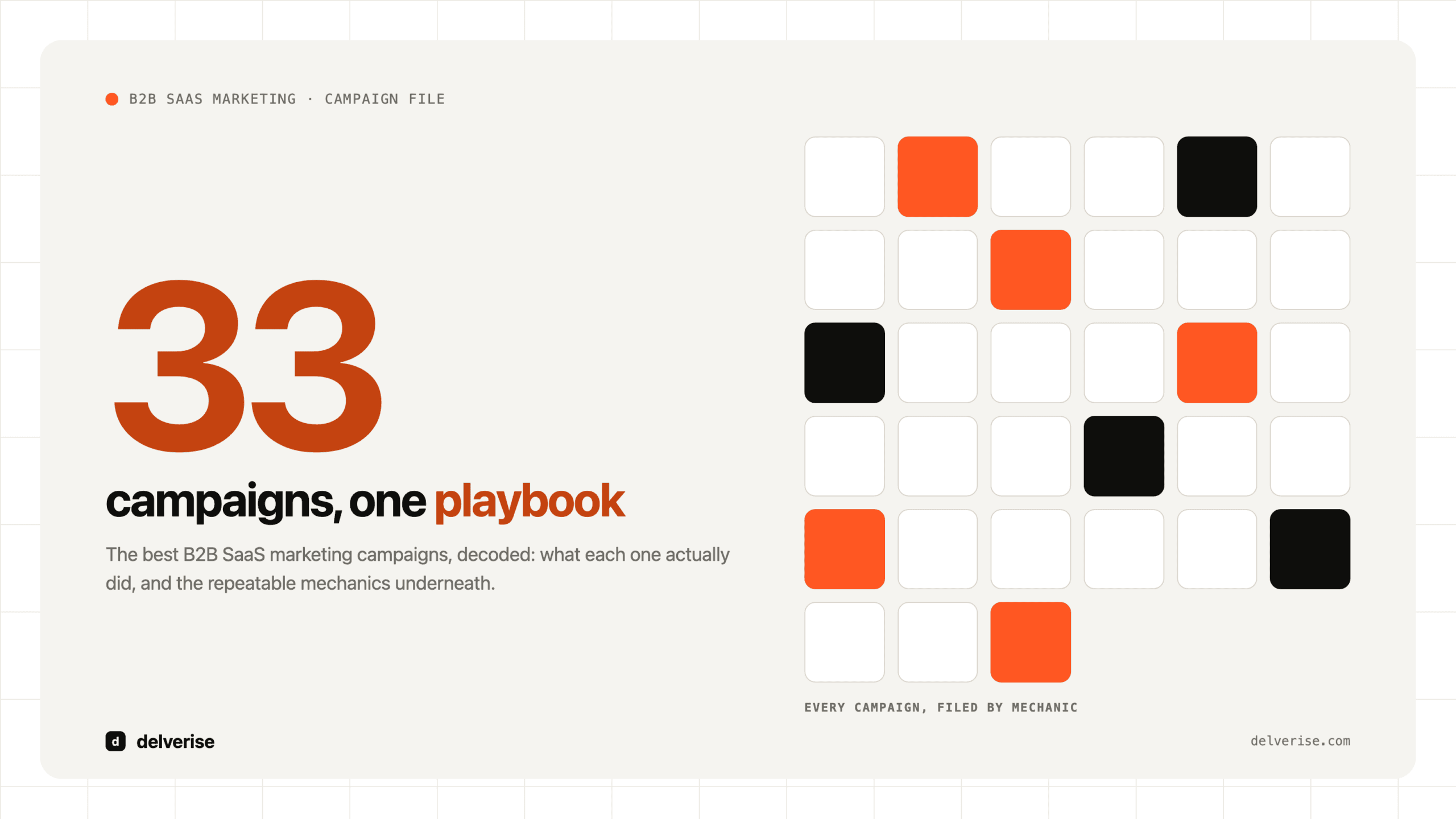
Thirty B2B SaaS marketing campaigns that drove real revenue in 2026 — content, PLG, ABM, and programmatic SEO plays with the data behind each win.
Answer: The best B2B SaaS marketing campaigns work because they connect a clear market insight to a repeatable growth system. Creative concepts matter, but the campaigns that produce pipeline usually combine a sharp audience, a specific conversion path, strong follow-up logic, clean measurement, and a feedback loop that improves the motion over time.
- Content and SEO campaigns create compounding demand when they are tied to the buyer journey and internal linking model.
- Product-led and nurture campaigns work when activation, education, and sales handoff are designed together.
- Personalization and ABM campaigns depend on reliable account data, segmentation, enrichment, and routing.
- Creative campaigns perform best when they still connect to pipeline measurement, not only awareness.
Use the examples below as campaign patterns, then translate the pattern into the system your team can actually operate: audience, message, data, channels, follow-up, attribution, and optimization cadence.
The B2B SaaS Marketing Revolution
The B2B SaaS landscape has become a battleground for attention. With the global SaaS market projected to soar past $300 billion by 2026, the competition is more intense than ever. Cookie-cutter marketing campaigns that once yielded predictable results are now fading into the background noise. To win in this crowded arena, marketers must innovate, connect, and deliver genuine value beyond the feature set. The era of sterile, jargon-filled B2B marketing is over; the revolution is here, and it’s being led by authenticity, creativity, and a relentless focus on revenue.
This shift is a fundamental change in how B2B buyers behave. They expect the same seamless, engaging, and personalized experiences they receive as consumers. The data confirms this evolution. Research shows that 39% of marketing leaders are now embracing storytelling, emotion, and humor to forge deeper connections. The results are undeniable, with strategies like email marketing delivering an astounding 4200% ROI and content-first approaches achieving 6x higher conversion rates. Yet, with a median B2B SaaS sales cycle of 2.5 months, these efforts must be sustained and strategic, guiding prospects through a complex journey.
What truly sets the most successful campaigns of 2026 apart is their ability to blend art with science. They are about generating leads, building audiences, fostering communities, and creating brand evangelists. They drive measurable revenue rather than vanity metrics. This guide moves beyond the theoretical to dissect 30 of the most impactful B2B SaaS marketing campaigns that are doing just that. We will explore ten distinct categories, from the foundational power of content marketing and the viral loops of product-led growth to the precision of account-based marketing and the scale of programmatic SEO. Each example is a masterclass in strategy, execution, and the relentless pursuit of growth.
UNDERSTANDING B2B SAAS MARKETING
1. What Makes B2B SaaS Marketing Unique
B2B SaaS marketing operates in a realm distinct from both traditional B2B and B2C marketing. It is a discipline defined by the unique nature of the products being sold and the relationships built with customers. Unlike physical goods, SaaS products are intangible, complex, and often require a significant investment of trust and education before a purchase is made. The subscription-based revenue model fundamentally shifts the focus from a one-time sale to a long-term partnership, where customer acquisition is just the beginning of the journey.

This dynamic is shaped by several core characteristics. The sales cycles are notoriously long, with a median of 2.5 months and frequently extending from 6 to 12 months for enterprise-level deals. This extended timeline involves navigating multiple decision-makers and buying committees, each with their own set of priorities and pain points. Consequently, the marketing strategy must be designed to engage and nurture these diverse stakeholders over a prolonged period. The emphasis is on demonstrating continuous value rather than simply securing an initial contract. This relationship-centric approach, built on a foundation of trust and thought leadership, is what sets B2B SaaS marketing apart.
These unique characteristics have profound implications for campaign strategy. Multi-touch attribution becomes essential to understand the intricate web of interactions that lead to a sale. Content-heavy educational funnels are no longer optional; they are the primary mechanism for building trust and guiding prospects through their decision-making process. Product-led growth (PLG) emerges as a powerful engine for adoption, allowing the product itself to become a key marketing vehicle. Ultimately, the goal is to acquire customers and then retain and expand them, transforming them into advocates who fuel a virtuous cycle of growth.
Research from McKinsey confirms the compounding value of this approach: ‘Companies that excel at personalization generate 40% more revenue from those activities than average players.’ In B2B SaaS, where expansion revenue often outweighs new logo acquisition, treating customers as a growth channel rather than a closed deal is what separates category leaders from also-rans.
2. Campaigns vs. Strategy: Understanding the Difference
In the fast-paced world of B2B SaaS marketing, the terms “campaign” and “strategy” are often used interchangeably, but this can lead to confusion and a lack of focus. Understanding the distinction is critical for building a marketing function that drives sustainable growth. A strategy is the long-term blueprint, the overarching plan that guides your marketing efforts toward achieving key business objectives. It is informed by market research, competitive analysis, and a deep understanding of your ideal customer profile. A strategy is not set in stone; it is a flexible framework that adapts to market trends and is continuously refined by the data and insights gathered from tactical execution.

Campaigns, on the other hand, are the tactical missions that bring the strategy to life. They are focused, time-bound initiatives with specific, measurable goals. A campaign could be a product launch, a webinar series, or a targeted content promotion. Each campaign has a defined budget, target audience, and set of key performance indicators (KPIs). While a strategy provides the “why,” campaigns are the “what” and the “how.” They are the engines of execution that test strategic hypotheses and generate the data needed to optimize the overall approach.
| Aspect | Strategy | Campaign |
|---|---|---|
| Duration | Long-term (1-3 years) | Short-term (weeks to months) |
| Scope | Broad, overarching | Narrow, focused |
| Flexibility | Adaptive, evolving | Defined, structured |
| Measurement | Business outcomes (revenue, market share) | Tactical KPIs (leads, conversions, engagement) |
| Resource Allocation | High-level budget planning | Specific, allocated budget |
Ultimately, strategy and campaigns are two sides of the same coin. A well-defined strategy provides the necessary direction and coherence for your campaigns, ensuring that every tactical effort contributes to the larger business goals. In turn, the results of your campaigns provide the crucial feedback loop that allows you to validate, refine, and evolve your strategy over time. Without a clear strategy, campaigns become a series of disconnected tactics. Without effective campaigns, a strategy is nothing more than a document that gathers dust.
CAMPAIGN CATEGORIES & EXAMPLES
3. Content Marketing Campaigns
Content marketing remains the bedrock of successful B2B SaaS growth. It is the art of attracting, educating, and engaging a clearly defined audience by creating and distributing relevant and valuable content. In a world where buyers are increasingly self-directed, content is the engine that powers the entire customer journey, from initial awareness to final purchase and beyond. The following campaigns exemplify the power of a strategic, long-term commitment to content.

Campaign 1: HubSpot – Inbound Marketing Methodology
- The Campaign: HubSpot created its own market. The company invented and evangelized the entire “inbound marketing” methodology, building a content empire around the principle of attracting customers with valuable content and experiences tailored to them.
- Tactics Used: Their strategy was a masterclass in comprehensiveness, featuring a blog with thousands of educational articles, free tools like Website Grader, a full-fledged Academy with certification programs, and an extensive library of templates and guides. Every piece of content was meticulously mapped to different stages of the buyer’s journey.
- Why It Worked: By educating the market and providing immense value for free, HubSpot built unparalleled authority and trust. They attracted prospects rather than interrupting them, a revolutionary concept at the time. This content-first approach led to 6x higher conversion rates compared to traditional outbound methods and established their dominance in the marketing software category.
- Key Results: HubSpot grew from a startup to a publicly traded company, with inbound marketing as its primary growth engine. The company now boasts millions of monthly organic visitors and a vast ecosystem of educated, loyal customers.
- Implementation Framework: The Educational Content Funnel (TOFU awareness → MOFU consideration → BOFU decision) is the core framework, guiding prospects from initial problem awareness to final solution evaluation.
- Tools to Replicate: HubSpot CMS, WordPress, Ahrefs, SEMrush.
Campaign 2: Zendesk – Customer Experience Trends Report
- The Campaign: Zendesk solidified its position as an industry thought leader with its annual Customer Experience (CX) Trends Report. It is a comprehensive, data-rich research report that has become an industry benchmark.
- Tactics Used: The campaign involves surveying thousands of customers globally, analyzing support trends, and creating a visually compelling report. This original research is then promoted across multiple channels, including email, social media, PR, and partnerships, and integrated into sales enablement.
- Why It Worked: The report provides genuine, data-backed insights that executives reference in board meetings and practitioners use for daily decision-making. By creating a resource that the entire industry relies on, Zendesk positions itself as a trusted expert. It becomes far more than a software vendor in the eyes of its audience.
- Key Results: The CX Trends Report has become an industry-standard benchmark, generating a massive number of high-quality leads and providing a constant source of earned media coverage.
- Implementation Framework: The research-to-campaign process involves identifying key industry questions, conducting original research, packaging the findings into a high-value asset, and executing a multi-channel promotional plan.
Campaign 3: Wistia – One, Ten, One Hundred Documentary Series
- The Campaign: Wistia, a video hosting platform for business, broke the mold of traditional B2B content with its “One, Ten, One Hundred” documentary series. The company challenged a video production agency to create three ads for the same product at three vastly different budget levels: $1,000, $10,000, and $100,000.
- Tactics Used: The campaign was an entertainment-first approach, using a behind-the-scenes documentary format to showcase the creative process. The series was professionally produced and distributed on Wistia’s own channels as well as on Amazon Prime Video.
- Why This Broke Through: The campaign was a masterclass in authentic storytelling. It entertained while educating, transparently showing the trade-offs and possibilities at different budget levels. This approach showcased the power of video and, by extension, the value of Wistia’s platform, without a hard sell.
- Key Results: The series earned a Webby Award nomination and achieved mainstream distribution on Amazon Prime, an unprecedented feat for B2B content. It generated significant brand lift and high engagement rates.
- Lesson: B2B audiences crave entertainment, especially when it delivers genuine value and insight. Creative risk-taking can lead to outsized returns in brand perception and reach.
- Tools to Replicate: Wistia, professional video production resources.
Campaign 4: Ahrefs – SEO Blog and Educational Content
- The Campaign: Ahrefs, an SEO software suite, has built its growth on a foundation of comprehensive, data-driven educational content. Their blog is a go-to resource for SEO professionals, offering in-depth tutorials, original research, and actionable insights.
- Tactics Used: The strategy revolves around long-form blog posts (often 3,000-5,000 words), detailed YouTube video tutorials, and free tools that provide a taste of the product’s capabilities. Every piece of content is designed to help users become better at their jobs, using Ahrefs’ tools as the vehicle.
- Why It Worked: By demonstrating the product’s value through practical application, Ahrefs builds immense trust with its target audience. This product-led content strategy drives massive organic traffic and generates highly qualified leads who already understand the value of the software.
- Key Results: The Ahrefs blog attracts millions of monthly organic visitors and has established the company as the market-leading authority in the SEO space.
- Implementation Framework: The product-led content strategy focuses on creating educational content that showcases the product’s features in the context of solving real-world problems.
4. Product-Led Growth Campaigns
Product-led growth (PLG) is a strategy where the product itself becomes the primary driver of customer acquisition, conversion, and expansion. In this model, the user experience is the marketing. Companies that master PLG create a frictionless path for users to discover, evaluate, and adopt their products, often leading to explosive, viral growth. The following campaigns are prime examples of PLG in action.

Campaign 5: Slack – Workplace Communication Revolution
- The Campaign: Slack positioned itself not as a mere messaging tool, but as a platform for transforming workplace communication. Its growth was fueled by a relentless focus on user experience and a freemium model that encouraged organic, team-based adoption.
- Tactics Used: The core of Slack’s strategy was its generous free tier, which allowed teams to experience the product’s value without any upfront investment. This, combined with viral mechanics that encouraged users to invite their colleagues, created a powerful growth loop. The focus was always on the outcome, better work, rather than the features.
- Viral Mechanics: Slack’s growth was a masterclass in network effects. As more users joined a workspace, the value of the platform increased for everyone. This organic, team-by-team adoption often led to company-wide adoption, with paid plans spreading naturally as teams grew and required more advanced features.
- Key Results: Slack’s PLG strategy led to staggering growth. The company grew from 500,000 to 1.7 million daily active users in just eight months and has since scaled to over 42 million daily active users globally. This growth was achieved with remarkable capital efficiency, as the product itself did the heavy lifting of acquisition.
- Implementation Framework: The PLG growth loop is the central framework, where new users are acquired, experience the product’s value, and then invite other users, creating a self-sustaining cycle of growth.
Campaign 6: Dropbox – Referral Program
- The Campaign: Dropbox’s referral program is the gold standard in viral marketing. It was a simple yet brilliant campaign that incentivized users to share the product with their friends and colleagues, leading to exponential growth.
- Tactics Used: The program offered a dual incentive: both the referrer and the new user received 500MB of free storage space. This was a genius move because it gave users more of the product’s core value, encouraging them to become evangelists. The referral process was seamlessly integrated into the product, making it incredibly easy to share.
- Strategic Brilliance: By giving away its core asset (storage space), Dropbox allowed users to experience the value of a premium plan before they ever had to pay. This solved the classic problem of demonstrating value for a new product and created a powerful incentive for users to spread the word.
- Key Results: The referral program was a phenomenal success, driving a 3900% increase in signups in just 15 months. At its peak, the program was responsible for 60% of all new signups, proving the power of a well-executed viral loop.
- Tools to Replicate: ReferralCandy, Viral Loops, SaaSquatch.
Campaign 7: Notion – Template Library and Community
- The Campaign: Notion, the all-in-one workspace, tackled the “blank page problem” by building a vibrant community and a rich template library. This strategy transformed users from passive consumers into active co-creators and evangelists.
- Tactics Used: Notion created a public template gallery that showcased the product’s incredible flexibility. Users could find templates for everything from project management to personal journaling. Crucially, Notion also empowered its community to create and share their own templates, turning its most passionate users into a powerful marketing engine.
- Why It Worked: The template library demonstrated the product’s capabilities and provided immediate value to new users, helping them get started quickly. The community-led approach fostered a deep sense of ownership and belonging, creating a powerful network effect that fueled viral growth.
- Key Results: Notion’s community-led strategy has been a key driver of its explosive growth, helping the company reach over 30 million users and a $10 billion valuation. The vast majority of this growth has been organic, driven by the community.
- Implementation Framework: The community-led growth strategy focuses on empowering users to become advocates, creators, and evangelists, turning the user base into a scalable growth engine.
Campaign 8: Calendly – Embedded Booking Links
- The Campaign: Calendly, the scheduling automation tool, achieved massive viral growth through a simple yet powerful mechanic: the embedded booking link. Every time a user sent their Calendly link, they were marketing the product.
- Tactics Used: Calendly’s freemium model made it easy for anyone to get started. The magic happened when users shared their booking links in emails, on websites, and in meeting invitations. Every recipient of a Calendly link was exposed to the product and its value proposition.
- Viral Mechanics: The product’s core functionality was inherently viral. To schedule a meeting with a Calendly user, the recipient had to interact with the Calendly interface. This created a seamless and natural onboarding experience for new users, many of whom would then sign up for their own accounts.
- Key Results: This elegant viral loop has powered Calendly’s growth to over 10 million users and a $3 billion valuation, all with minimal marketing spend. It is a testament to the power of building virality directly into the product experience.
5. Programmatic SEO Campaigns
Programmatic SEO is the practice of creating a large number of landing pages at scale to target a wide range of long-tail keywords. It is a powerful strategy for capturing high-intent organic traffic by systematically addressing a vast array of user search queries. When executed correctly, it can create a durable, compounding advantage that is difficult for competitors to replicate. The following companies have mastered this approach.

Campaign 9: Zapier – Integration Landing Pages
- The Campaign: Zapier, the workflow automation platform, has built an SEO moat with its programmatic approach to integration landing pages. The company has created over 100,000 pages, each targeting a specific integration pair (e.g., “connect Slack to Google Sheets”).
- Tactics Used: The strategy involves programmatically generating a unique landing page for every possible combination of the 5,000+ apps on its platform. These pages are built from a template but populated with dynamic content, including app logos, descriptions, and user-generated testimonials.
- Strategic Approach: This approach allows Zapier to capture an immense volume of long-tail search traffic from users looking to solve very specific automation problems. Each page serves as a high-intent entry point to the product, demonstrating its value proposition at the exact moment of need.
- Key Results: Zapier’s programmatic SEO engine is a primary driver of its growth, generating 7.3 million monthly visitors, with over 53% coming from organic search. This strategy has resulted in massive organic traffic value and a highly efficient customer acquisition model.
- Implementation Framework: The programmatic SEO architecture involves creating a scalable template, a database of content components, and a system for programmatically generating and interlinking pages.
- Tools to Replicate: Webflow, Airtable, Clay, n8n.
Campaign 10: Airtable – Template Gallery
- The Campaign: Airtable, the low-code platform for building collaborative apps, uses a template gallery as a powerful programmatic SEO engine. The gallery features a vast collection of pre-built templates for a wide variety of use cases, industries, and roles.
- Tactics Used: Each template serves as an SEO-optimized landing page, targeting keywords related to specific jobs to be done (e.g., “content calendar template,” “project tracker”). The pages feature live, interactive demos of the templates, providing immediate value to the user.
- Why It Works: This strategy effectively targets users who are actively searching for solutions to their problems. By providing a ready-made template, Airtable captures their attention and dramatically lowers the barrier to adoption. The template gallery serves as a powerful demonstration of the product’s flexibility and power.
- Key Results: Airtable’s template gallery drives a significant volume of high-intent organic traffic and generates strong product-qualified leads. The company ranks for a vast number of use-case-specific keywords, establishing its authority across many different verticals.
Campaign 11: Trello – Use Case Landing Pages
- The Campaign: Trello, the visual project management tool, has created a comprehensive set of landing pages dedicated to specific use cases, industries, and roles. This approach allows Trello to speak directly to the unique needs of different audience segments.
- Tactics Used: The company has developed dedicated pages for everything from “marketing project management” to “engineering sprint planning.” These pages feature industry-specific language, relevant examples, and pre-built board templates that users can copy and start using immediately.
- Why It Works: By tailoring its messaging and content to specific user needs, Trello reduces the friction of adoption. Prospects can immediately see how the tool applies to their world, which makes the value proposition much more tangible and compelling. This strategy has helped Trello achieve SEO dominance for a wide range of vertical-specific searches.
- Key Results: This use-case-driven approach has been a key factor in Trello’s category leadership in the project management space, helping it attract a diverse and loyal user base.
Campaign 12: Canva – Design Type Pages
- The Campaign: Canva, the online design platform, has taken programmatic SEO to another level with its vast array of landing pages targeting virtually every design type a user might search for.
- Tactics Used: Canva has created thousands of programmatic pages for keywords like “Instagram post maker,” “logo designer,” and “presentation templates.” Each page serves as an SEO entry point and features an embedded version of the design tool itself, allowing users to start creating immediately.
- Why It Works: This strategy is brilliant because it captures user intent at the precise moment of need and delivers immediate value. By positioning itself as a free tool for a multitude of design tasks, Canva has created a powerful and scalable acquisition engine.
- Key Results: Canva’s programmatic SEO strategy has been a cornerstone of its incredible growth, helping it achieve dominant search rankings and attract over 100 million monthly active users.
6. Multi-Channel Campaigns
Multi-channel marketing is the practice of interacting with customers using a combination of direct and indirect communication channels. The goal is to create a seamless and consistent brand experience, no matter where the customer is. The most effective multi-channel campaigns go beyond being present on multiple platforms; they orchestrate a cohesive journey that guides the customer from awareness to conversion and beyond. These campaigns demonstrate the power of a truly integrated approach.

Campaign 13: Monday.com – YouTube & Offline Advertising
- The Campaign: Monday.com executed a massive brand awareness play by integrating heavy digital advertising with large-scale offline campaigns. The goal was to achieve ubiquitous brand presence and build strong recall among a broad audience.
- Tactics Used: The company invested heavily in YouTube pre-roll ads, which were complemented by high-visibility advertising in subways, on buses, and on billboards in major metropolitan areas. The creative was consistently colorful, energetic, and centered around the simple, powerful message of a “Work OS.”
- Why It Worked: The campaign created a powerful surround-sound effect. The constant exposure, both online and offline, built a memorable brand identity and drove significant search and direct traffic. By reaching audiences in different contexts throughout their day, Monday.com ensured its message was always top of mind.
- Key Results: This multi-channel blitz resulted in rapid brand awareness growth and was a key factor in the company’s successful IPO. It proved that B2B brands can effectively leverage mass-market channels to build a powerful brand.
Campaign 14: Salesforce – Dreamforce Conference
- The Campaign: Dreamforce is more than a conference; it is the ultimate B2B experience marketing campaign. It is a massive annual event that brings together the entire Salesforce ecosystem for a week of learning, networking, and inspiration.
- Tactics Used: With over 170,000 attendees, 2,700+ breakout sessions, and keynotes from industry titans and celebrities, Dreamforce is an immersive brand experience on an epic scale. The event also features a huge partner expo and is live-streamed to a global audience, extending its reach far beyond the physical attendees.
- Strategic Role: Dreamforce serves multiple strategic purposes. It is a major engine for pipeline generation and acceleration, a platform for major product announcements, a key driver of customer retention and community building, and a critical engagement opportunity for the partner ecosystem.
- Key Results: Dreamforce has become the industry-defining event for B2B technology. It generates a massive amount of pipeline, content, and media buzz that fuels Salesforce’s marketing efforts for the entire year.
Campaign 15: Gong – Super Bowl Commercial
- The Campaign: In a bold move for a B2B SaaS company, Gong, the revenue intelligence platform, invested in a Super Bowl commercial. It was a high-risk, high-reward play designed to achieve mainstream brand awareness and signal market leadership.
- Tactics Used: The campaign featured a high-production-value, humorous commercial that was amplified by an integrated digital campaign. The goal was to generate significant PR and social media buzz beyond the 30-second spot.
- Why It Was a Smart Risk: The campaign allowed Gong to break through the noise and differentiate itself from the sea of sameness in B2B marketing. It reached a massive and influential audience, including C-level executives, and generated a significant amount of earned media and social conversation.
- Key Results: The Super Bowl ad resulted in a huge spike in brand search and awareness, firmly establishing Gong as the confident leader in its category. It was a powerful statement that demonstrated the company’s ambition and momentum.
Campaign 16: Adobe – “Click, Baby, Click!” Campaign
- The Campaign: Adobe launched a brilliantly humorous campaign for its Analytics suite that highlighted the absurdity of relying on vanity metrics like clicks. The viral video featured a baby randomly clicking on banner ads, driving up the click count but providing zero actual value.
- Tactics Used: The campaign centered on the viral video, which was promoted through targeted media buys on marketing and tech publications and amplified through social media. The message was simple and resonated deeply with its target audience of digital marketers.
- Why It Worked: The campaign used humor to address a universal pain point for marketers: the pressure to report on superficial metrics. The creative was memorable, highly shareable, and perfectly targeted. It sparked a conversation about the importance of meaningful analytics and positioned Adobe as the solution.
- Key Results: The “Click, Baby, Click!” video became a viral sensation, generating high engagement and strong brand association for the Adobe Analytics platform.
7. Data-Driven & Personalization Campaigns
Data-driven marketing is no longer a buzzword; it’s a necessity. By leveraging data to understand customer behavior and intent, B2B SaaS companies can deliver highly personalized experiences that resonate on a one-to-one level. These campaigns move beyond broad segmentation to create truly individualized journeys, resulting in higher engagement, conversion, and customer loyalty. The following campaigns showcase the power of data in action.

Campaign 17: Metadata.io – Account-Based Marketing (ABM) Orchestration
- The Campaign: Metadata.io, a platform for B2B marketers, uses its own tool to run sophisticated, data-driven ABM campaigns. The company dogfoods its own product to demonstrate its power and generate a highly qualified pipeline.
- Tactics Used: The strategy involves using data to identify and target best-fit accounts, running personalized ad campaigns across multiple channels, and orchestrating a seamless journey from initial ad click to sales conversation. They leverage intent data to time their outreach perfectly.
- Why It Works: By using data to focus its marketing and sales efforts on a curated list of high-value accounts, Metadata.io eliminates wasted ad spend and ensures its message reaches the right people at the right time. This targeted approach results in a much higher ROI and a more efficient sales process.
- Key Results: Metadata.io’s data-driven ABM campaigns generate a consistent pipeline of meeting-ready leads from their ideal customer profile. Their approach proves that a smaller, more targeted campaign can be far more effective than a broad, spray-and-pray approach.
- Tools to Replicate: Metadata.io, 6sense, Demandbase, Clay.
Campaign 18: Pipedrive – Personalized Onboarding
- The Campaign: Pipedrive, a CRM for sales teams, implemented a highly personalized onboarding experience to improve user activation and retention. The campaign was designed to guide new users to their “aha!” moment as quickly as possible.
- Tactics Used: The onboarding process is tailored based on the user’s role, industry, and stated goals. The platform provides personalized tips, tutorials, and in-app messages that are directly relevant to the user’s specific needs. This is complemented by a segmented email nurture sequence that reinforces key value propositions.
- Why It Works: A generic onboarding experience can be overwhelming. By personalizing the journey, Pipedrive makes the product feel more relevant and accessible. This approach helps users experience the product’s value faster, which is a critical factor in driving long-term adoption and retention.
- Key Results: The personalized onboarding has led to a significant increase in user activation rates and a reduction in early-stage churn for Pipedrive.
Campaign 19: Amazon Web Services (AWS) – Intent-Based Targeting
- The Campaign: AWS, the cloud computing giant, uses sophisticated intent data to identify and engage with accounts that are actively researching cloud solutions. This allows them to focus their marketing efforts on prospects who are already in the market.
- Tactics Used: AWS leverages third-party intent data providers to track which companies are consuming content related to specific cloud services. When an account shows a spike in intent, it triggers a multi-channel campaign that includes targeted ads, personalized content recommendations, and outreach from the sales team.
- Why It Works: Intent-based targeting is incredibly efficient. It allows AWS to engage with prospects at the exact moment they are looking for a solution, resulting in much higher conversion rates. It’s the digital equivalent of being in the right place at the right time.
- Key Results: This data-driven approach helps AWS maintain its dominant market position by identifying and capturing a significant portion of in-market demand for cloud services.
Campaign 20: Netflix – Data-Driven Content Recommendations
- The Campaign: While often seen as a B2C company, Netflix’s content recommendation engine is a masterclass in data-driven personalization that holds valuable lessons for B2B. The platform uses viewing data to create a highly personalized experience for each user.
- Tactics Used: Netflix’s algorithm analyzes billions of data points (what you watch, when you watch it, what you search for, what you re-watch) to create a unique and ever-evolving homepage for each user. Even the artwork for a show can be personalized based on what the algorithm thinks will appeal to you.
- Why It Works: This relentless focus on personalization is the key to Netflix’s incredible retention. By constantly serving up relevant and engaging content, the platform keeps users coming back for more. It’s a powerful example of how data can be used to create a deeply personal and sticky product experience.
- Lesson for B2B: B2B SaaS companies can apply the same principles to their content and product experiences. By using data to understand user behavior, they can deliver more relevant content, personalized onboarding, and proactive support, all of which contribute to higher retention and customer lifetime value.
8. Partnership & Co-Marketing Campaigns
Partnership marketing is a strategic collaboration between two or more businesses to create a mutually beneficial marketing campaign. In the B2B SaaS world, where ecosystems and integrations are paramount, partnership campaigns can be a powerful engine for growth. They provide access to new audiences, enhance credibility, and create a more compelling value proposition for customers. These campaigns illustrate the power of synergy.

Campaign 21: HubSpot + LinkedIn – Educational Content Partnership
- The Campaign: HubSpot and LinkedIn, two powerhouses in the B2B marketing space, have frequently collaborated on educational content to serve their shared audience of marketing and sales professionals.
- Tactics Used: Their partnerships have included co-created research reports, joint webinar series on integrated workflows, and cross-promotion of their respective content to each other’s audiences. They also showcase the integration between their platforms, providing a more seamless experience for their mutual customers.
- Partnership Framework: The success of this partnership lies in their complementary value propositions and shared target audience. Both companies benefit from the expanded reach and enhanced credibility that comes from associating with a trusted industry leader.
- Key Results: These co-marketing efforts have helped both HubSpot and LinkedIn expand their reach, generate high-quality leads from each other’s audiences, and reinforce their positions as thought leaders in the industry.
Campaign 22: Oracle – Financial Services Partnership Campaign
- The Campaign: Oracle has successfully penetrated the highly competitive financial services vertical by forming strategic partnerships with key banking technology providers. This ecosystem approach allows them to offer a more comprehensive solution than any single vendor could provide.
- Tactics Used: The campaign involves creating collaborative content with banking partners, specializing in vertical market messaging, and co-sponsoring industry events. They also heavily feature joint customer success stories to demonstrate the power of their integrated solutions.
- Why It Works: This strategy allows Oracle to demonstrate deep vertical expertise and build credibility within the financial services industry. By positioning itself as the hub of a powerful partner ecosystem, Oracle creates a strong competitive advantage and a more compelling value proposition for enterprise banking clients.
- Key Results: This vertical partnership strategy has been a key driver of Oracle’s success in the enterprise banking sector, helping them win major deals and establish category leadership.
Campaign 23: Microsoft – Integration Ecosystem Campaign
- The Campaign: Microsoft’s core marketing message for its suite of business applications is the power of seamless integration. The campaign promotes the value of the entire ecosystem working together rather than individual products.
- Tactics Used: The campaign heavily features cross-product workflow demonstrations, showing how tools like Teams, Dynamics 365, and the Power Platform can be used together to create powerful, automated solutions. The message is always about the ecosystem versus a collection of point solutions.
- Product-as-Campaign Strategy: In many ways, the integration itself is the campaign. By demonstrating the tangible value of a seamlessly integrated workflow, Microsoft creates a powerful incentive for customers to adopt multiple products from its suite. This creates strong lock-in and increases customer lifetime value.
- Key Results: This ecosystem-focused strategy has been incredibly successful, leading to higher LTV, reduced churn, and widespread adoption of the entire Microsoft product suite.
Campaign 24: Shopify + Facebook Shops Integration
- The Campaign: The strategic partnership between Shopify and Facebook to launch Facebook Shops was a landmark collaboration that enabled millions of merchants to easily sell their products on Facebook and Instagram.
- Tactics Used: The partnership involved a joint product launch, co-branded marketing materials, and a massive mutual customer education effort. The core of the campaign was the deep platform integration, which created a seamless experience for merchants.
- Why It Works: This was a classic win-win partnership. It dramatically reduced friction for Shopify merchants to sell on social media, and it gave Facebook a powerful and scalable way to expand its e-commerce capabilities. The network effects of this partnership benefited both companies immensely.
- Key Results: The integration has been a massive success, onboarding millions of new merchants to social commerce and significantly expanding the total addressable market for both Shopify and Facebook.
9. Email & Nurture Campaigns
Given the long and complex sales cycles in B2B SaaS, email and nurture campaigns are essential for maintaining engagement and guiding prospects through their journey. These campaigns are about delivering the right message to the right person at the right time, building trust and credibility with every interaction. The most effective nurture campaigns go beyond a series of automated emails. They are a systematic approach to relationship building. These campaigns demonstrate the power of strategic, long-term engagement.

Campaign 25: Zoho – Email Referral Campaign
- The Campaign: Zoho, a suite of business software, has successfully integrated a referral program into its email nurture sequences, turning its existing customer base into a powerful acquisition channel.
- Tactics Used: The campaign uses segmented email sequences to engage with customers at different stages of their lifecycle. After a period of successful product use, customers are invited to join a referral program that offers mutual rewards for both the referrer and the new customer. The emails are personalized and feature customer success stories to reinforce the value of the product.
- Why It Works: This approach brilliantly combines retention and acquisition. By tapping into its base of happy customers, Zoho is able to generate high-quality, low-cost leads. Referrals from existing customers are inherently more credible and tend to convert at a higher rate than leads from other channels.
- Key Results: The email referral campaign has created a sustainable and efficient growth engine for Zoho, demonstrating the power of leveraging customer advocacy.
Campaign 26: ActiveCampaign – Marketing Automation Showcase
- The Campaign: ActiveCampaign, a customer experience automation platform, uses its own product to run sophisticated nurture campaigns that serve as a powerful demonstration of its capabilities.
- Tactics Used: The company employs complex nurture sequences with behavioral triggers, dynamic content, and multi-path workflows. Leads are segmented based on their on-site behavior and content consumption, and they receive a highly personalized series of emails that are designed to educate and qualify them over time.
- Why It Works: This is the ultimate “show, don’t tell” campaign. By using its own product to deliver a best-in-class nurture experience, ActiveCampaign provides a compelling and tangible demonstration of its value proposition. This approach generates a steady stream of product-qualified leads and educates them on how to be successful with the platform.
- Key Results: This sophisticated nurture strategy is a key driver of ActiveCampaign’s pipeline, consistently generating meeting-ready leads and showcasing the power of marketing automation.
- Tools to Replicate: ActiveCampaign, HubSpot, Marketo.
Campaign 27: Asana – User Reengagement Campaign
- The Campaign: Asana, the work management platform, runs targeted re-engagement campaigns to reactivate dormant users and prevent churn.
- Tactics Used: The campaign starts with segmenting inactive users based on their past behavior and likely reasons for inactivity. The messaging is then personalized to address these specific reasons. For example, a user who never fully activated might receive an onboarding-focused email, while a user who was once active might receive an email highlighting new features.
- Why It Works: It is almost always cheaper to retain an existing customer than to acquire a new one. Asana’s re-engagement campaigns are a cost-effective way to recover potential lost revenue and identify opportunities for improving the customer experience. By proactively reaching out to at-risk users, Asana can prevent churn and gather valuable feedback.
- Key Results: These re-engagement campaigns have a significant impact on Asana’s retention metrics, helping the company improve user activation and recover monthly recurring revenue (MRR).
Campaign 28: Grammarly – Weekly Writing Insights Email
- The Campaign: Grammarly, the AI-powered writing assistant, maintains incredible user engagement with its personalized weekly writing insights email.
- Tactics Used: Each week, Grammarly sends its users a personalized email that summarizes their writing activity, highlights their most common mistakes, and provides gamified metrics like writing streaks and vocabulary diversity. The email also includes social comparison benchmarks and data-driven prompts to upgrade to the premium version.
- Why It Works: This email is a masterclass in ongoing value delivery. It serves as a regular, positive touchpoint that reinforces the product’s value and keeps it top of mind. The gamification elements and personalized insights create a sticky experience that encourages continued usage.
- Key Results: The weekly insights email boasts incredibly high engagement rates and is a key driver of Grammarly’s high retention and conversion to its paid plans.
10. Creative & Viral Campaigns
In a sea of B2B marketing sameness, creativity is a powerful differentiator. The most memorable campaigns are often those that break conventions, take risks, and create a shareable experience. These campaigns may not always be the most scalable, but they can generate an outsized return in brand awareness, earned media, and social buzz. The following campaigns are a masterclass in creative, viral marketing.

Campaign 29: Mailchimp – “Did You Mean MailChimp?” Campaign
- The Campaign: Mailchimp launched a brilliantly bizarre and creative campaign that embraced common misspellings of its brand name. The campaign, titled “Did You Mean MailChimp?”, featured a series of surreal short films, pop-up experiences, and musical projects based on names like “MailShrimp,” “KaleLimp,” and “VeilHimp.”
- Tactics Used: The campaign was a multi-faceted, experiential effort that intentionally hid the Mailchimp logo and branding. The goal was to create a sense of mystery and discovery, leading people to Google the strange names and be met with the search suggestion, “Did you mean MailChimp?”
- Strategic Brilliance: This campaign turned a common problem (brand name misspelling) into a massive creative opportunity. It generated a huge amount of earned media and social conversation, reinforcing Mailchimp’s quirky and approachable brand personality and differentiating it from more serious competitors.
- Key Results: The campaign was a viral sensation, earning a staggering 988 million media impressions and winning a Grand Prix at the prestigious Cannes Lions International Festival of Creativity. It was a powerful demonstration of how creative risk-taking can drive massive brand awareness.
Campaign 30: Typeform – Interactive Film Experience
- The Campaign: Typeform, a platform for creating beautiful, interactive online forms, created an interactive film experience that served as a brilliant demonstration of its product’s capabilities. The campaign was a choose-your-own-adventure style video that put the viewer in control of the story.
- Tactics Used: The campaign was an entertainment-first approach that embedded Typeform’s product capabilities naturally into the narrative. The viewer’s choices, made through interactive on-screen prompts, affected the direction of the story, creating a unique and engaging experience.
- Why It Works: The interactive film was far more engaging than a standard, passive video. It was a memorable brand experience that showcased the power of interactivity and, by extension, the value of the Typeform platform. It was a perfect example of “show, don’t tell.”
- Key Results: The campaign achieved high engagement and completion rates, and it was widely shared on social media. It successfully positioned Typeform as a creative and innovative technology leader.
Campaign 31: Upwork – Enterprise Expansion Campaign
- The Campaign: Upwork, the freelance marketplace, launched a targeted campaign to penetrate the Fortune 500 and move upmarket into the enterprise segment. The campaign was designed to address the specific concerns of large organizations regarding the use of freelance talent.
- Tactics Used: The campaign featured messaging that directly addressed enterprise objections around security, quality, and compliance. It heavily featured case studies from major brands and positioned Upwork as a white-glove service provider with a dedicated enterprise sales team and custom contract offerings.
- Why It Works: By speaking directly to the needs and concerns of enterprise buyers, Upwork was able to overcome common objections and build credibility. The social proof from recognizable brands was a key element in demonstrating the platform’s ability to scale and meet the demands of large organizations.
- Key Results: The campaign was successful in helping Upwork penetrate the Fortune 500, leading to a significant increase in average deal size and establishing the company as a viable solution for enterprise talent needs.
Campaign 32: Loom – Async Video Messaging Campaign
- The Campaign: Loom, the video messaging platform, capitalized on the massive shift to remote work by positioning itself as an essential tool for asynchronous communication. The campaign was perfectly timed to address the emerging pain points of distributed teams.
- Tactics Used: The campaign’s messaging focused on the benefits of “showing, not telling,” highlighting how video messaging could reduce the need for meetings and improve communication clarity. A key tactic was the use of customer video testimonials (created with Loom, of course), which served as authentic, powerful social proof.
- Why It Works: The campaign’s message was incredibly timely and relevant. The product itself was inherently viral, as every shared Loom video was a demonstration of the product’s value. The generous free tier made it easy for individuals and teams to get started, fueling a powerful bottom-up adoption motion.
- Key Results: Loom’s async video messaging campaign has been a key driver of its explosive growth to over 14 million users and mainstream adoption in the remote work era.
Campaign 33: Figma – Design Community Campaign
- The Campaign: Figma, the collaborative design platform, built a powerful and passionate community that became its most effective marketing engine. The campaign was a masterclass in community-led growth.
- Tactics Used: Figma’s strategy was centered on empowering its users to share, create, and collaborate. The platform’s public file-sharing and remixing capabilities turned every design into a potential template or learning resource. Figma also fostered its community through design challenges, creator spotlights, and its annual Config conference.
- Why It Works: By building a vibrant community, Figma reduced adoption friction and created a powerful network effect. Users became advocates, educators, and evangelists, creating a virtuous cycle of growth. The community-generated templates and resources served as a massive, ever-growing library of use cases and inspiration.
- Key Results: Figma’s community-led approach was a key factor in its explosive adoption by designers worldwide, which ultimately led to Adobe’s (later terminated) $20 billion acquisition offer. It is a powerful testament to the strategic value of building a passionate community.
IMPLEMENTATION FRAMEWORKS
11. Campaign Planning Framework
Transforming inspiration from these successful campaigns into executable plans requires a structured approach. A robust planning framework ensures that every campaign is aligned with business objectives, targeted to the right audience, and set up for measurable success. This four-step process provides a roadmap for turning great ideas into revenue-driving realities.

Step 1: Define Clear Objectives and Metrics
Every successful campaign begins with a clear understanding of what it is meant to achieve. Vague goals lead to vague results. The SMART goals framework is an indispensable tool for bringing clarity and focus to your objectives. For example, instead of “increase leads,” a SMART goal would be: “Generate 500 marketing-qualified leads (MQLs) from the enterprise segment in Q3, tracked in our CRM with multi-touch attribution, to support the sales pipeline goal of $2M.”
Primary metrics should be directly tied to the campaign’s core objective, whether it’s building awareness, generating leads, or driving revenue. Secondary metrics provide additional context and help diagnose performance. Aligning these metrics with the overall marketing plan and business objectives is critical for demonstrating the campaign’s value.
Step 2: Select Campaign Type Based on Goals
With clear objectives in place, the next step is to select the right campaign type. The optimal choice depends on a variety of factors, including your company’s stage, target audience, and available resources. Early-stage companies with limited budgets might focus on high-leverage, organic strategies like content marketing and product-led growth. Growth-stage companies may layer in programmatic SEO and multi-channel campaigns to scale their efforts. Mature companies often turn to sophisticated strategies like ABM and partnerships to optimize for efficiency and expand into new markets.
The key is to create an integrated strategy that combines multiple campaign types to guide prospects through the entire customer journey. A programmatic SEO campaign might be great for top-of-funnel awareness, but it needs to be supported by a robust email nurture campaign to convert that traffic into qualified leads.
Step 3: Build a Testing and Optimization Framework
No campaign is perfect from the start. A systematic approach to testing and optimization is what separates good campaigns from great ones. Start with a clear hypothesis (e.g., “Using video content in our ad campaigns will generate 2x higher engagement than static images”). Define your success metrics, set a test duration, and implement isolated variable testing to ensure you get clean data. Prioritize your tests based on potential impact, starting with audience and messaging, which typically have the largest effect on performance.
Establish a regular cadence for monitoring and analysis. In the early stages of a campaign, daily monitoring is essential. As the campaign matures, you can move to weekly and monthly reviews. The goal is to create a continuous feedback loop: launch, measure, analyze, optimize, and scale. Be ruthless about killing underperforming initiatives and doubling down on what works.
Step 4: Resource Planning and Budget Allocation
Finally, you need to align your resources to support the campaign. This includes both your team and your budget. A typical campaign team might include a campaign manager, content creators, marketing ops specialists, and demand generation experts. Clearly define roles and responsibilities to ensure smooth execution.
Budget allocation should be directly tied to your campaign strategy. A common rule of thumb is to allocate 30-40% to content creation and promotion, 25-35% to paid media, 15-20% to your martech stack, and 10-15% to testing and experimentation. Develop a detailed timeline with clear milestones for each phase of the campaign, from planning and building to launching and analysis.
12. Campaign Execution Playbook
A brilliant strategy is only as good as its execution. This playbook provides a tactical guide for managing the entire campaign lifecycle, from the critical pre-launch phase to ongoing optimization and reporting. Following a structured execution process ensures that nothing falls through the cracks and that the campaign has the best possible chance of success.

Pre-Launch Checklist (Critical for Success)
Before a single dollar is spent, a thorough pre-launch checklist is essential. This is the foundation upon which the entire campaign is built. Key items include confirming that objectives and KPIs are clearly defined and agreed upon by all stakeholders, that the target audience has been validated with data, and that all campaign assets have been created and approved. Landing pages must be built and tested, forms and CTAs optimized, and all tracking and attribution configured correctly. Clear roles and responsibilities, an approved budget, and a detailed timeline are non-negotiable. Finally, define your success criteria and have contingency plans in place for potential underperformance.
Launch Phase Execution (First 2 Weeks)
The first two weeks of a campaign are a critical period for monitoring and rapid iteration. On day one, as the campaign goes live, monitor all systems closely to ensure everything is running as expected. In the first few days, focus on verifying the data flow, ensuring that tracking and attribution are working correctly. By the end of the first week, you should have enough data to conduct an initial performance review and make any quick fixes or minor optimizations. The second week is about analyzing early trends, implementing learnings, and making initial decisions about where to scale and where to pull back.
Run Phase Management (Weeks 3-12)
Once the campaign is stable, it enters the run phase, which is focused on continuous optimization. On a daily basis, monitor spend, pacing, and key metrics dashboards to watch for any anomalies. On a weekly basis, conduct a deeper analysis of performance, test new variations of ads and copy, and adjust budgets and bids accordingly. Monthly strategic reviews are an opportunity to take a step back, analyze the comprehensive performance data, and make any necessary strategic pivots. This is also the time for team retrospectives to capture learnings and plan for the following month.
Campaign Orchestration Across Channels
Effective multi-channel execution requires careful orchestration. Develop a detailed content release schedule, an email campaign cadence, and a social media promotion rhythm. Coordinate the timing of paid media flights with PR and outreach efforts to create a surround-sound effect. Ensure that your core narrative and visual identity are consistent across all channels, while adapting the message to be appropriate for each specific platform. Your martech stack is the key to successful orchestration. Use your CRM for lead management, marketing automation for nurturing, and project management tools for coordinating the efforts of the entire team.
13. Campaign Measurement Framework
“What gets measured gets managed.” This old adage is the cornerstone of successful B2B SaaS marketing. A robust measurement framework is essential for understanding campaign performance, demonstrating ROI, and making data-driven decisions. This framework should go beyond vanity metrics to connect marketing efforts directly to business outcomes.

Choosing the Right Attribution Model
Attribution is one of the most complex and debated topics in marketing. There is no single perfect model; the right choice depends on your business model, sales cycle, and campaign objectives. A first-touch model might be appropriate for understanding what initially drives awareness, while a last-touch model can help you understand what converts leads. However, for most B2B SaaS companies with long sales cycles, a multi-touch attribution model is the most insightful. Models like linear, time-decay, and U-shaped provide a more holistic view of the customer journey, giving credit to the various touchpoints that influence a decision over time. The key is to choose a model, be consistent, and understand its limitations.
Key Metrics for B2B SaaS Campaigns
Your measurement framework should be structured like a funnel, with metrics for each stage of the customer journey:
- Top of Funnel (Awareness): Website traffic, impressions, reach, brand search volume, share of voice.
- Middle of Funnel (Engagement & Lead Gen): Content downloads, webinar registrations, demo requests, cost per lead (CPL), marketing-qualified leads (MQLs).
- Bottom of Funnel (Pipeline & Revenue): Sales-qualified leads (SQLs), pipeline generated, customer acquisition cost (CAC), closed-won deals, revenue.
- Post-Funnel (Retention & Expansion): Customer lifetime value (LTV), churn rate, net revenue retention (NRR).
It is critical to track both the volume of leads and their quality. Lead quality scores, MQL-to-SQL conversion rates, and influenced pipeline are all essential metrics for understanding the true impact of your campaigns.
Building a Reporting and Communication Cadence
Data is only valuable if it is communicated effectively and used to inform decisions. Establish a regular cadence for reporting and stakeholder communication. Weekly updates should focus on tactical performance, highlighting key wins, challenges, and upcoming optimizations. Monthly reviews should provide a more comprehensive analysis, with strategic recommendations and budget utilization. Quarterly business reviews (QBRs) are an opportunity to present the overall impact of marketing on the business, with a focus on pipeline and revenue.
Create a centralized dashboard that serves as the single source of truth for all campaign metrics. This dashboard should be accessible to all stakeholders and should provide a clear, at-a-glance view of performance against goals. Remember that with a median sales cycle of 2.5 months, the full ROI of a campaign may not be visible for several months. Patience and a long-term perspective are key.
PATTERNS & BEST PRACTICES
14. Universal Success Patterns Across Top Campaigns
Across these 33 diverse campaigns, several universal patterns emerge. These are the fundamental principles that separate good campaigns from great ones. Regardless of the specific tactics used, the most successful B2B SaaS marketing initiatives share a common set of success factors that are deeply rooted in a customer-centric, data-driven, and long-term approach.

Common Success Factors (What Winners Share)
- Clear Value Proposition: Every winning campaign is built on a foundation of a clear, compelling, and differentiated value proposition. It speaks directly to a real pain point and offers a specific, measurable outcome.
- Audience-First Approach: The most successful campaigns demonstrate a deep and empathetic understanding of their target audience. The message, format, and channel are all chosen based on the preferences and behaviors of the buyer persona.
- Quality Over Quantity: In a world of content shock, quality is the only sustainable advantage. High-quality creative, deeply researched content, and meaningful engagement will always outperform a high-volume, spray-and-pray approach.
- Data-Driven Decision Making: The campaigns that deliver the best results are those that are relentlessly measured and optimized. They track everything, test systematically, and have the courage to kill what isn’t working and double down on what is.
- Authenticity and Storytelling: B2B buyers are still human. They respond to genuine brand voices, real customer stories, and purpose-driven messaging. The most successful campaigns forge a human connection rather than a corporate one.
- Multi-Channel Orchestration: The customer journey is not linear. The best campaigns create a cohesive and consistent experience across multiple touchpoints, with each channel playing a specific and coordinated role.
- Long-Term Thinking: Sustainable growth is not built on short-term hacks. The most successful companies invest in owned assets like content, community, and SEO, which create a compounding advantage over time. They focus on LTV over CAC.
What Separates Good from Great Campaigns
Beyond these foundational principles, what truly elevates a campaign from good to great is the quality of its execution. Great campaigns are characterized by an obsessive attention to detail, a culture of rapid iteration and learning, and a willingness to take calculated creative risks. They are supported by strong team alignment and a patient, long-term commitment from leadership. Ultimately, a great campaign goes beyond a single event. It is the result of a well-oiled marketing machine that is constantly learning, adapting, and improving.
15. Conclusion: From Inspiration to Action
The world of B2B SaaS marketing is in a constant state of evolution. The campaigns highlighted in this guide demonstrate a clear shift away from interruption and toward invitation. Authenticity, storytelling, and a deep understanding of the customer are no longer optional; they are the essential ingredients of sustainable growth. The most successful companies are those that have mastered the art of blending data with creativity, building multi-touch journeys that deliver value at every stage. They think in terms of ecosystems and communities rather than funnels and leads.
From HubSpot’s content-driven empire to Slack’s product-led viral loops, the key takeaway is that there is no single “best” campaign. The optimal strategy is a unique blend of approaches that is tailored to your specific context, goals, and resources. What is non-negotiable, however, is a relentless commitment to execution quality, measurement, and optimization. The campaigns that win are those that are built on a foundation of data, powered by creativity, and guided by a long-term vision.
Getting started can feel daunting, but the journey begins with a single step. Start with clear objectives and realistic goals. Focus on executing one or two campaign types exceptionally well before trying to do everything at once. Build systems for testing and learning, and be patient, great campaigns take time to deliver ROI. The reality of campaign execution is that it requires dedicated expertise, significant resources, and a level of focus that most in-house teams struggle to maintain. This is where the right partner can make all the difference. An expert partner brings proven frameworks, advanced tools, and the specialized knowledge needed to navigate the complexities of modern campaign execution, allowing you to focus on what you do best: building a great product.
Need the system behind the campaign? delverise builds the growth layer that turns campaign ideas into audience data, enrichment, routing, automation, measurement, and follow-up. Explore Growth Engineering, AI Marketing, AI Lead Generation, and GTM Engineering, or apply to work with us.
16. FAQ Section
How long should a B2B SaaS marketing campaign run?
Campaign duration depends on objectives and complexity. Brand awareness campaigns typically run 3-6 months to build meaningful recognition. Lead generation campaigns are often 6-12 weeks with clear conversion goals. Product launch campaigns span 2-3 months across pre-launch, launch, and post-launch phases. Content marketing and SEO campaigns are ongoing with quarterly optimization cycles. Always run campaigns long enough to gather statistical significance: minimum 4-6 weeks for meaningful data.
What’s the average budget for successful B2B SaaS marketing campaigns?
Budgets vary significantly by company size and goals. Startups might allocate $10,000-50,000 per campaign for focused efforts. Mid-market companies typically invest $50,000-200,000 per major campaign. Enterprise companies often spend $100,000-500,000+ on comprehensive campaigns. The key is ensuring budget aligns with expected CAC and LTV. As a rule of thumb, allocate 30-40% to content creation, 25-35% to paid media, 15-20% to tools/tech, and 10-15% to testing.
How do you measure B2B SaaS marketing campaign success?
Success metrics should align with campaign objectives. Primary metrics include cost per lead (CPL), lead quality scores, MQL and SQL conversion rates, pipeline contribution, and customer acquisition cost (CAC). Track multi-touch attribution to understand full buyer journey impact. Advanced measurement includes influenced pipeline (which captures more than direct attribution), revenue generated, ROI calculation, and customer lifetime value (LTV) of campaign leads. Use tools like HubSpot, Salesforce, or Google Analytics for comprehensive tracking. Remember: a 2.5-month median sales cycle means patience is required for full ROI visibility.
Should B2B SaaS companies focus on one campaign type or multiple approaches?
Most successful companies use integrated approaches combining multiple campaign types. Start with one primary campaign type aligned with your business stage and goals, often content marketing or product-led growth for early-stage, programmatic SEO or multi-channel for growth-stage, ABM or partnerships for mature companies. Then layer complementary tactics as you scale and learn what works. For example, combine programmatic SEO (top-of-funnel traffic) with email nurture (mid-funnel engagement) and personalized demos (bottom-funnel conversion).
How important is personalization in B2B SaaS marketing campaigns?
Personalization significantly improves campaign performance, especially for complex, high-value solutions. Start with basic segmentation by company size, industry, and role. Then advance to behavioral personalization (website activity, content consumption). For enterprise targets, implement account-based personalization with customized messaging, landing pages, and demos. Use tools like Clay for data enrichment, Clearbit for firmographic data, and platforms like HubSpot for personalized email sequences. Don’t over-personalize at scale. Tier your approach based on account value.
What campaign types work best for early-stage SaaS companies with limited budgets?
Early-stage companies should focus on high-leverage, low-cost tactics: Content marketing (blog, SEO) with 6x higher conversion potential. Product-led growth with freemium models (like Slack, Dropbox). Community building around your product (like Notion). Programmatic SEO for scalable organic traffic. Email nurture sequences for relationship building. Avoid expensive paid media until you have proven conversion and CAC. Focus on owned channels that compound over time rather than rented reach.
How do you know when to scale a campaign vs. pivot or kill it?
Scale when: the campaign consistently hits targets for 2-4 weeks, ROI exceeds goals by 20%+, and lead quality meets standards (70%+ ICP fit). Pivot when: performance is 10-30% below target but showing improvement, or specific elements work while others don’t. Kill when: performance is 30%+ below target after optimization, fundamental assumptions are proven wrong, or ROI clearly won’t materialize. Always give campaigns 4-6 weeks minimum before major decisions.
What’s the difference between a campaign and a marketing strategy?
Campaigns are focused, time-bound tactical efforts with specific goals (like a product launch or webinar series), typically running for weeks to months. Strategies are long-term blueprints that guide multiple campaigns, based on market research and business objectives. Think of strategy as your marathon training plan and campaigns as individual sprint races. Your demand generation strategy should inform all campaign decisions.
How do you create viral B2B SaaS campaigns?
Viral B2B campaigns share common traits: authentic, unexpected approaches (like Mailchimp’s misspellings), product virality built into mechanics (like Dropbox referrals), entertainment value beyond pure education (like Wistia’s documentaries), and community-driven sharing (like Notion templates). To replicate this, identify your product’s natural sharing moments, create genuinely shareable content, and make sharing frictionless and rewarding.
What tools do I need to run successful B2B SaaS campaigns?
Essential tools include a CRM (HubSpot or Salesforce), Marketing Automation (HubSpot, Marketo), Analytics (Google Analytics 4, Mixpanel), Data Enrichment (Clay, Clearbit), SEO tools (Ahrefs, Semrush), and Project Management (Asana, Trello). Start with the basics (CRM + analytics + automation) and add specialized tools as you scale.
How do you balance creativity with ROI in B2B SaaS campaigns?
The best campaigns prove creativity and ROI aren’t mutually exclusive. Start with clear business objectives and KPIs. Test creative approaches systematically by allocating 10-15% of your budget to experimental campaigns. Measure the creative impact on key metrics like engagement, conversion, and brand lift. Remember that B2B buyers are humans too. They respond to authentic, entertaining, and memorable experiences.
What’s the role of AI in modern B2B SaaS marketing campaigns?
AI is transforming campaign execution through content creation (using tools like ChatGPT for drafts), personalization at scale (AI-powered recommendations), predictive analytics (identifying high-intent accounts), campaign optimization (automated bid management), and lead scoring. Use AI for efficiency and scale, but maintain human oversight for strategy, creativity, and brand voice.
Reverse-engineering campaigns like these gives you the patterns, but turning patterns into a running marketing engine, one that holds onto authenticity and creative range while staying focused on real value, is a bigger commitment. Plenty of B2B SaaS teams take that build on themselves, hire the roles, and run it in-house, and that is a perfectly good route. If you would rather have the GTM and revenue system built for you instead, that is the work delverise does, and our case studies are there whenever you want a look.
Frequently Asked Questions
What makes B2B SaaS marketing different from traditional marketing?
B2B SaaS marketing differs because products are intangible, subscription-based, and require long-term trust rather than one-time sales. Sales cycles run a median of 2.5 months and stretch to 6-12 months for enterprise deals, involving multiple decision-makers and buying committees. This forces marketers to use multi-touch attribution, content-heavy educational funnels, and product-led growth to nurture stakeholders over time. The goal extends beyond acquisition to retention and expansion, turning customers into advocates who fuel continued growth.
What is the difference between a marketing strategy and a campaign?
A strategy is the long-term blueprint (1-3 years) that guides marketing efforts toward business objectives like revenue and market share, while a campaign is a short-term, focused initiative (weeks to months) with specific KPIs like leads and conversions. Strategy provides the ‘why’ and is adaptive, while campaigns are the tactical ‘what’ and ‘how’ with defined budgets and target audiences. Campaigns test strategic hypotheses and generate data that refines the broader strategy over time.
How big is the B2B SaaS market in 2026?
The global SaaS market is projected to soar past $300 billion by 2026, creating an intensely competitive landscape where cookie-cutter campaigns no longer work. This growth has shifted buyer expectations toward the seamless, personalized experiences they receive as consumers. As a result, 39% of marketing leaders are now embracing storytelling, emotion, and humor to build deeper connections, while strategies like email marketing deliver up to 4200% ROI and content-first approaches achieve 6x higher conversion rates.
Why are storytelling and emotion important in B2B SaaS marketing?
Storytelling and emotion matter because B2B buyers now expect the same engaging, personalized experiences they receive as consumers, and 39% of marketing leaders have already shifted toward storytelling, emotion, and humor to forge deeper connections. The era of sterile, jargon-filled B2B marketing is over. Authentic, creative campaigns outperform feature-focused messaging by building audiences, fostering communities, and creating brand evangelists rather than just generating leads or chasing vanity metrics.
What ROI can B2B SaaS email marketing actually deliver?
B2B SaaS email marketing can deliver an astounding 4200% ROI, making it one of the highest-return channels available to marketers. Content-first approaches similarly achieve 6x higher conversion rates compared to traditional tactics. However, these results require sustained, strategic execution because the median B2B SaaS sales cycle runs 2.5 months, meaning email programs must guide prospects through a complex journey involving multiple decision-makers rather than pushing for immediate conversions.
Read next