←Back to blog
Outbound & Pipeline EngineeringArticleFebruary 8, 20266 min read
Outbound Sales for B2B SaaS: 7 Strategies to Build Predictable Pipeline
7 proven outbound sales strategies B2B SaaS teams use in 2026 to build predictable pipeline — from signal-based prospecting to multi-channel sequences.
Let’s address the elephant in the room: outbound sales is not dead. What’s dead is bad outbound: the mass-blast, generic-template, spray-and-pray approach that fills inboxes with noise nobody reads.
In 2026, the best B2B SaaS teams are generating predictable pipeline through outbound sales that looks nothing like the cold email campaigns of five years ago. They’re using intent data, AI-powered personalization, and multi-channel orchestration to reach the right prospects with the right message at the right time.
Here are seven strategies that actually work.
Short answer: outbound sales for B2B SaaS works when targeting, personalization, channel orchestration, deliverability, enrichment, and measurement operate as one system. The goal is not more cold email; it is predictable pipeline from accounts that are showing fit, intent, or timing signals.
- Signal: prioritize companies with hiring, funding, tech-stack, intent, or website-visit triggers.
- Personalize: use account context to make outreach relevant without turning every touch into manual work.
- Measure: track positive replies, meetings booked, pipeline generated, and sequence-to-close rate.
1. Signal-Based Prospecting

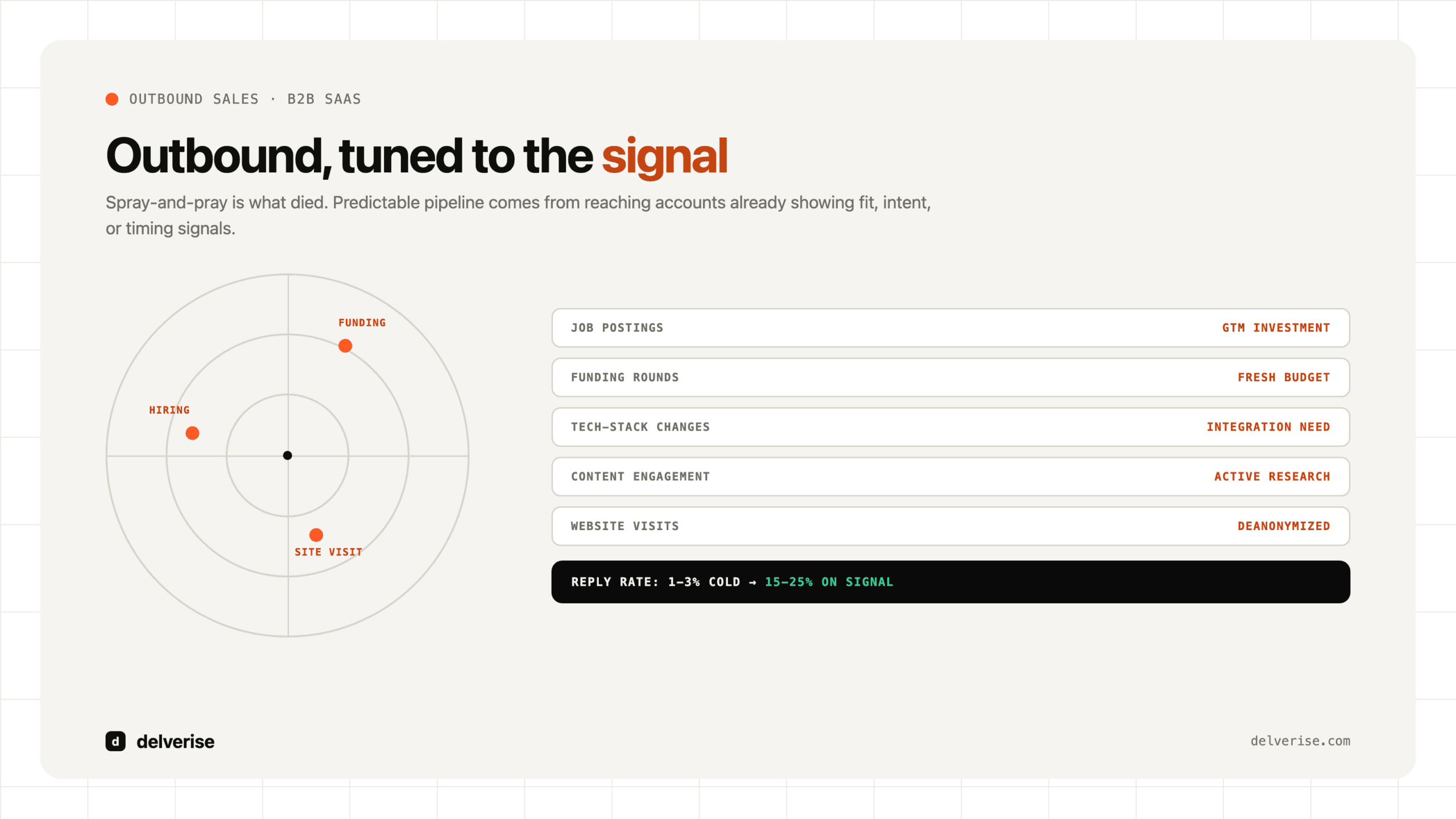
Stop building prospect lists based on static firmographics alone. The highest-converting outbound starts with signals, real-time indicators that a company is likely in-market for your solution.
Signals worth tracking:
- Job postings: A company hiring their first RevOps leader signals GTM infrastructure investment
- Funding rounds: Fresh capital means budget for new tools and services
- Tech stack changes: Switching CRMs or adding new tools creates integration needs
- Content engagement: Prospects consuming competitor content or industry reports
- Website visits: Anonymous traffic from target accounts deanonymized via intent tools
When you reach out to a company already showing buying signals, your reply rates jump from the industry average of 1-3% to 15-25%.
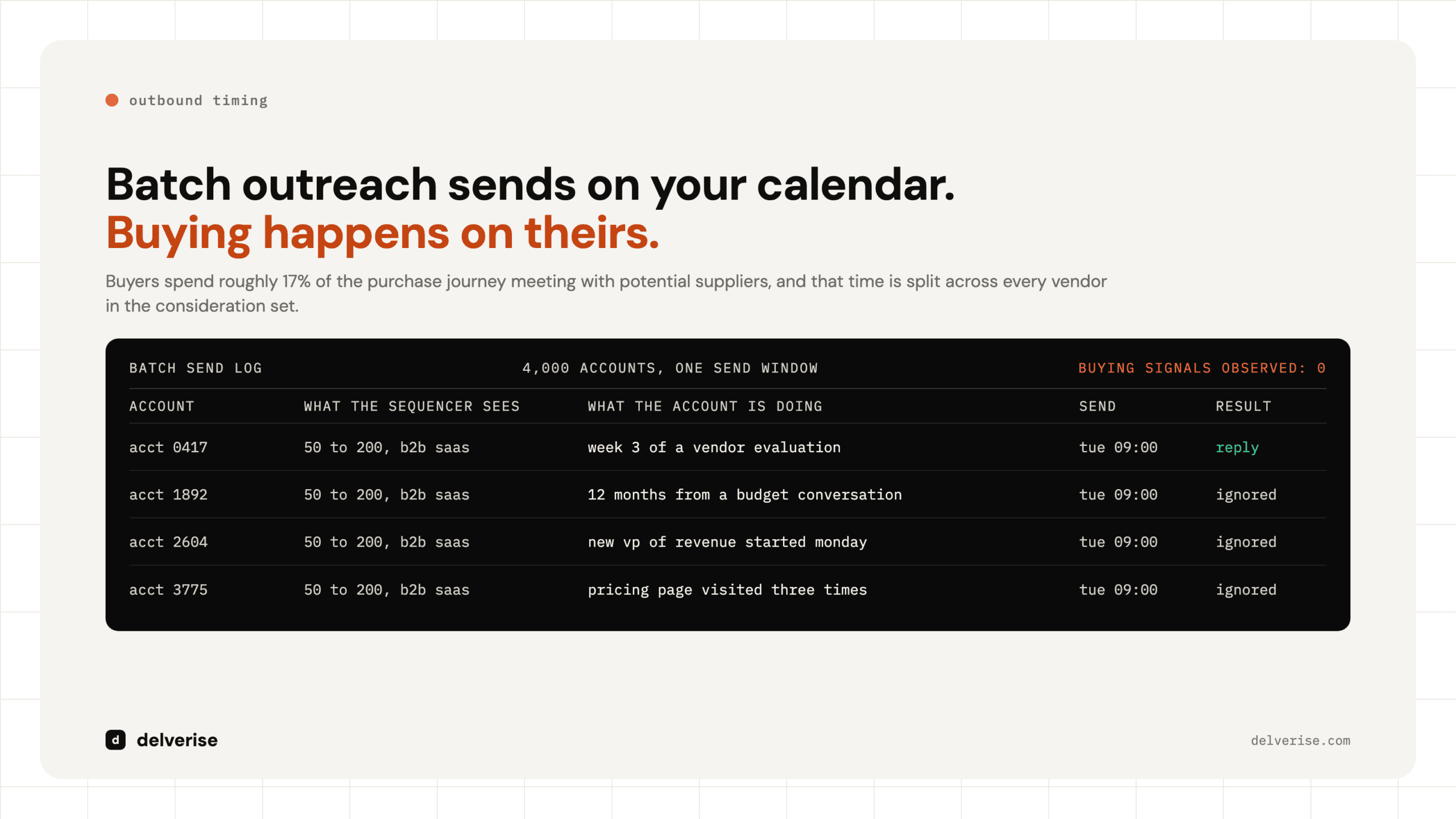
Research from Gartner confirms this shift: ‘B2B buyers spend only 17% of their purchase journey meeting with potential suppliers, making timing and relevance the decisive factors in outbound success.’ For delverise clients, this is why signal-based prospecting consistently outperforms static list-building — you’re reaching prospects during the narrow window when they’re actually evaluating.
2. Hyper-Personalized First Lines

Generic openers like “I noticed your company is growing fast” are instant-delete material. In 2026, effective personalization means referencing something specific and recent:
- A specific LinkedIn post the prospect published
- A recent product launch or feature they shipped
- A challenge mentioned in their earnings call or public interview
- A mutual connection or shared community
AI tools can now generate personalized first lines at scale using enrichment data, but the best-performing teams still have humans review the top-tier accounts. The rule of thumb: automate the 80%, hand-craft the 20% that represents your highest-value targets.
3. Multi-Channel Sequences

Email-only outbound is leaving pipeline on the table. The most effective sequences in 2026 combine:
- Day 1: Personalized email with a specific, relevant insight
- Day 3: LinkedIn connection request with a short, value-first note
- Day 5: Follow-up email with a case study or relevant data point
- Day 8: LinkedIn comment on their recent post (genuine engagement, not a pitch)
- Day 10: Final email, direct, brief, low-friction CTA
The key is channel diversity, not channel volume. Five thoughtful touches across email and LinkedIn outperform twenty generic emails every time.
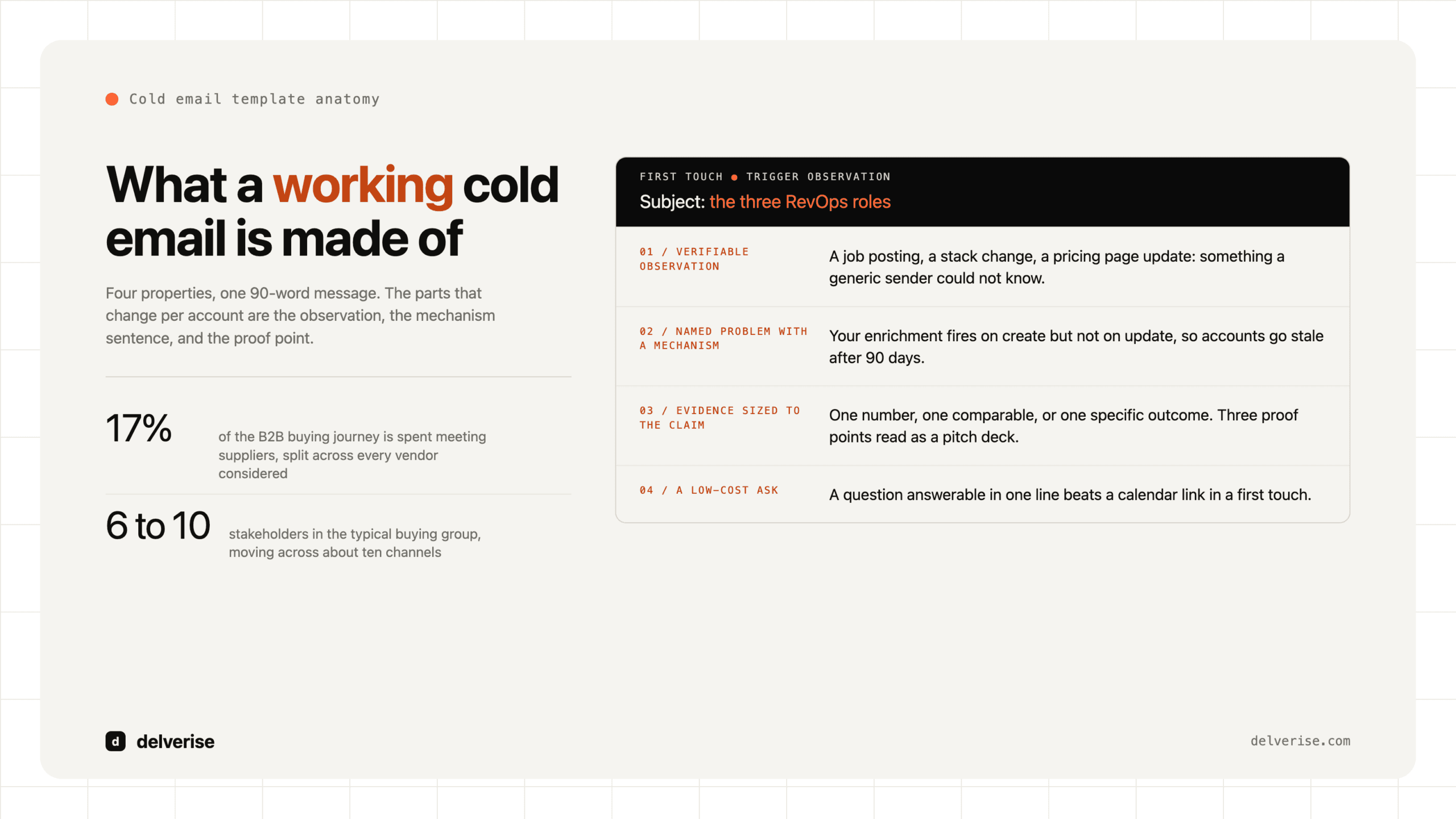
According to McKinsey, ‘B2B customers now regularly use ten or more channels to interact with suppliers, up from five in 2016.’ The implication for outbound is clear: single-channel sequences ignore how modern buyers actually research and evaluate, which is why delverise builds every campaign around coordinated email and LinkedIn motion rather than email volume alone.
4. Problem-First Messaging

Your outbound messaging should never lead with your product. Lead with the prospect’s problem:
| Weak (Product-First) | Strong (Problem-First) |
|---|---|
| “We built an AI-powered platform that…” | “Most Series A teams waste 40% of SDR time on accounts that will never buy…” |
| “Our tool integrates with your CRM to…” | “When your pipeline data lives in spreadsheets instead of your CRM, forecasting becomes guesswork…” |
| “I’d love to show you a demo of…” | “If your CAC payback is over 12 months, there’s usually one workflow that’s the bottleneck…” |
The framework: name the problem → quantify the cost → hint at the solution → offer a conversation.
5. Deliverability Engineering

None of your outbound matters if your emails land in spam. In 2026, deliverability is a technical discipline:
- Domain warm-up: New sending domains need 2-4 weeks of gradual volume increase before full-scale campaigns
- Authentication: SPF, DKIM, and DMARC records must be configured correctly. No exceptions.
- Sending volume: Keep each domain under 50 emails per day. Use multiple domains and rotate them.
- List hygiene: Verify every email address before sending. Bounce rates above 3% damage your domain reputation.
- Content quality: Avoid spam trigger words, excessive links, and HTML-heavy formatting. Plain text outperforms.
The best teams treat deliverability like infrastructure, monitoring inbox placement rates daily and rotating domains before reputation issues surface.
6. Automated Enrichment Pipelines
Manual prospect research doesn’t scale. Build automated pipelines that enrich your target accounts with the data you need for personalization:
- Start with a trigger: New company matches your ICP criteria in your data source
- Enrich automatically: Pull in company size, funding, tech stack, recent news, and decision-maker contacts
- Score and prioritize: Assign a score based on ICP fit and intent signals
- Route to sequences: High-score accounts go to personalized outbound; lower scores go to nurture campaigns
This pipeline approach turns GTM engineering principles into outbound execution. Once built, it runs continuously, surfacing new prospects every day without manual research.
7. Measure What Matters
Vanity metrics like “emails sent” tell you nothing about pipeline health. Track these instead:
| Metric | Target Benchmark | What It Tells You |
|---|---|---|
| Reply Rate | 15-25% | Message relevance and deliverability |
| Positive Reply Rate | 5-10% | ICP fit and offer strength |
| Meeting Booked Rate | 2-5% | Sequence effectiveness end-to-end |
| Pipeline Generated ($) | 3-5x campaign cost | ROI of outbound investment |
| Sequence-to-Close Rate | Track over 90 days | Quality of outbound pipeline vs inbound |
Review these weekly. If reply rates are high but meeting rates are low, your CTA needs work. If reply rates are low, your targeting or messaging is off. The data tells you exactly where to focus.
Putting It All Together
Predictable outbound pipeline in 2026 comes from the intersection of three things:
- Precision targeting, reaching companies that are actually in-market
- Relevant messaging, leading with their problems, not your product
- Systematic execution: automated enrichment, multi-channel sequences, and rigorous measurement
The days of hiring ten SDRs and giving them a dialer are over. The teams building the most pipeline are the ones treating outbound as a revenue operation: engineered, measured, and continuously optimized.
Start with one signal-based campaign. Prove it generates qualified pipeline. Then scale what works.
How delverise Builds Outbound Systems
delverise helps B2B teams build outbound systems that connect signal sourcing, enrichment, AI personalization, sequencing, deliverability, CRM routing, reporting, and QA. Start with our AI outbound, GTM Engineering, or CRM enrichment pages, or apply to work with us.
Frequently Asked Questions
What makes outbound sales work for B2B SaaS now?
Outbound works when teams use buying signals, account context, strong deliverability, and multi-channel sequencing instead of sending generic volume. The modern outbound system needs data quality and workflow discipline as much as copywriting.
How should SaaS teams measure outbound sales?
Measure positive reply rate, meeting booked rate, qualified pipeline, sequence-to-close rate, deliverability health, and pipeline generated per campaign cost. Emails sent and open rate are diagnostic metrics, not proof that outbound is creating revenue.
Read next