←Back to blog
Revenue OperationsPlaybookFebruary 8, 20269 min read
What Is GTM Engineering? Definition, Systems, and Examples
GTM Engineering is the practice of building systems for pipeline generation: enrichment, scoring, routing, outbound, CRM automation, analytics, and revenue workflows.

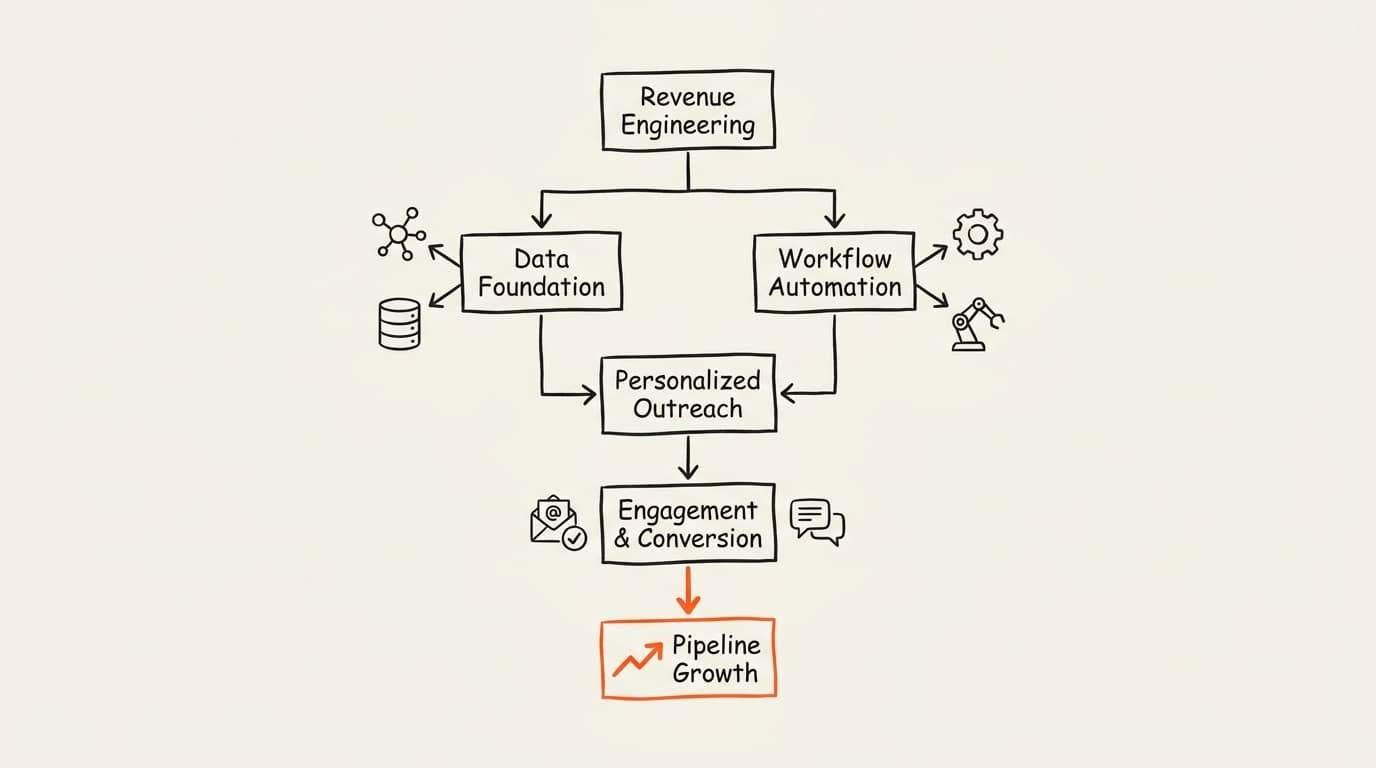
GTM Engineering is the practice of building the systems that turn go-to-market strategy into repeatable pipeline execution. Instead of treating CRM, enrichment, outbound, routing, analytics, and automation as separate tools, GTM Engineering connects them into workflows that identify, enrich, score, route, activate, and measure revenue opportunities.
Short definition: GTM Engineering is the practice of building the systems that help go-to-market teams turn market signals, data, workflows, and sales or marketing execution into repeatable pipeline. It combines GTM strategy, RevOps, automation, enrichment, analytics, and AI-enabled workflows, but its focus is implementation: making the revenue motion work in production.
The category matters because modern revenue teams no longer lose only because their strategy is wrong. They lose because the handoffs are slow, the data is incomplete, the routing logic is brittle, the outbound motion is disconnected from account context, and reporting cannot show which workflow actually created pipeline.
That is the gap GTM Engineering closes. It turns the revenue motion from a collection of tools and manual tasks into a production system that can be tested, maintained, and improved.

What GTM Engineering Builds
A GTM engineer designs and builds workflows across the systems that revenue teams use every day. The work is not limited to one tool or one department. It usually spans CRM, enrichment, sequencing, automation, analytics, and the operating rules that govern how data moves between them.
Common GTM Engineering builds include:
- CRM enrichment workflows that fill missing company, contact, seniority, industry, revenue, employee count, technology, and LinkedIn fields.
- Lead and account scoring models that prioritize the right accounts for sales, marketing, or customer expansion.
- Inbound routing workflows that enrich, score, assign, and alert the right owner after a form submission.
- AI outbound systems that combine account sourcing, enrichment, personalization, sequencing, deliverability, and reply handling.
- TAM sourcing workflows that build and refresh target account universes over time.
- Account research briefs that give reps useful context before calls.
- ABM signal alerts that notify sales when target accounts show hiring, funding, leadership, intent, or website activity.
- QA and governance workflows that prevent broken automations from silently damaging pipeline.
The output is not a dashboard or a workflow in isolation. The output is a revenue system that works in production.
Why GTM Engineering Exists Now
GTM teams have more software than ever, but more software has not automatically produced more clarity. In many companies, each new tool adds another place where data can drift, another workflow that can break, and another handoff that someone has to monitor manually.
AI has made the build side faster. Teams can now create enrichment workflows, automations, research agents, and personalized outbound systems with far less engineering overhead than before. But faster building also exposes weak foundations. If the CRM is messy, the field logic is unclear, or the routing rules are undocumented, AI simply helps the team scale the wrong motion faster.
At the same time, buyers expect relevance and speed. A high-fit inbound lead should not wait hours while someone researches the account manually. A target account should not enter outbound without clean data, fit logic, and a clear reason to reach out. A revenue leader should not need three spreadsheets to understand whether pipeline came from paid demand, outbound, partner activity, or a specific workflow.
GTM Engineering exists because modern go-to-market teams need build capacity, not just strategy. The advantage is connected execution.
The GTM Engineering System Model
A practical GTM Engineering system has six layers. Each layer answers a different operating question: what happened, what do we know, what should we do, how do we act, where does it run, and how do we keep it healthy?

| Layer | What It Covers | Why It Matters |
|---|---|---|
| Signal layer | Intent, hiring, funding, website activity, form submissions, job changes | Finds the moments worth acting on |
| Data layer | Enrichment, dedupe, field standards, CRM hygiene | Makes the system trustworthy enough to automate |
| Decision layer | Scoring, segmentation, routing, prioritization | Turns raw information into operational judgment |
| Activation layer | Outbound, inbound follow-up, ABM plays, sales tasks | Turns decisions into customer-facing motion |
| Orchestration layer | CRM, sequencers, Clay, automation tools, Slack, reporting | Connects the tools that execute the workflow |
| Governance layer | QA, ownership, documentation, refresh cadence, monitoring | Keeps the system from drifting or failing silently |
The governance layer is the one teams most often skip. It is also what separates a production GTM system from a clever automation. A workflow that nobody owns, nobody tests, and nobody monitors becomes a liability as soon as the data changes.
GTM Engineering vs RevOps, Growth Engineering, and Automation
GTM Engineering overlaps with RevOps, GTM strategy, Growth Engineering, automation, and AI outbound, but the center of gravity is different. GTM Engineering is implementation-oriented. It builds the system that makes the motion happen.

| Category | Main Focus | Difference From GTM Engineering |
|---|---|---|
| GTM strategy | Market, ICP, positioning, motion design | GTM Engineering implements the systems that execute the strategy |
| RevOps | CRM, process, reporting, revenue alignment | GTM Engineering is more build-oriented and pipeline-execution focused |
| Growth Engineering | Acquisition, activation, lifecycle, experimentation | GTM Engineering focuses on market-to-pipeline execution |
| Revenue Engineering | The full revenue execution system | GTM Engineering is one layer inside the broader revenue system |
| Automation | Tool connections, triggers, and syncs | GTM Engineering includes operating model, QA, and revenue logic |
| AI outbound | Research, personalization, sequencing, and reply generation | GTM Engineering includes the data, scoring, CRM, visibility, and governance layers around outbound |
Examples Of GTM Engineering In Practice
The easiest way to understand GTM Engineering is to look at the workflows it creates.
Inbound lead routing
A demo request enters the website. The system enriches the company, checks the account against ICP rules, identifies whether it is already in the CRM, scores the lead, routes it to the right owner, creates a CRM task, and posts context in Slack. The lead receives a relevant follow-up quickly because the system already did the research and assignment work.
CRM enrichment
A new account enters the CRM with incomplete information. A CRM enrichment workflow standardizes the company domain, runs enrichment, deduplicates obvious matches, fills missing fields, updates segmentation, and flags low-confidence data for review. The goal is not enrichment for its own sake. The goal is better routing, scoring, reporting, and activation.
AI outbound
A target account list is sourced, filtered, enriched, scored, and pushed into outbound only after the system knows why each account fits. Personalization fields are generated from account context, but the workflow still includes QA, deliverability checks, suppression logic, and feedback from replies. That is the difference between AI-assisted email and a production outbound system.
Account signal monitoring
A target account hires a new revenue leader, raises funding, adds a relevant technology, or shows website intent. The system detects the signal, checks fit, identifies the right contacts, creates a research brief, and routes the action to sales or marketing. The team stops depending on reps to notice every buying trigger manually.
When A Company Needs GTM Engineering
A company usually needs GTM Engineering when the revenue motion is strategically clear but operationally inconsistent.
Common fit signals include:
- Leads enter the CRM without enough context to score or route them properly.
- Sales, marketing, and RevOps use the same tools but do not trust the same data.
- Outbound performance is weak because targeting, enrichment, or personalization is shallow.
- Manual research and spreadsheet work are slowing down pipeline creation.
- Routing rules exist in someone’s head instead of in a maintained system.
- Reporting shows outcomes but not which workflows caused them.
- The team has Clay, HubSpot, Salesforce, sequencers, or automation tools, but they are not connected into one motion.
- RevOps is overloaded with maintenance and reporting, leaving little capacity to build new pipeline systems.
When those symptoms appear, the answer is rarely another point solution. The answer is usually a better operating layer across the tools already in the stack.
How To Start With GTM Engineering
The right starting point is not a massive transformation. It is one production workflow with a clear business outcome.
- Pick one bottleneck. Choose inbound routing, CRM enrichment, outbound account selection, account research, or signal monitoring.
- Define the inputs and outputs. Decide what data enters the workflow, what should change, and where the result should land.
- Set the decision logic. Write down scoring, segmentation, routing, qualification, suppression, and ownership rules before building.
- Build the workflow. Connect the CRM, enrichment sources, automation tools, sequencers, Slack, and reporting layer as needed.
- QA before launch. Test sample records, edge cases, failed enrichment, duplicates, and routing exceptions.
- Measure the workflow. Track speed, coverage, conversion, error rate, and pipeline influence.
- Document ownership. Define who maintains the workflow, how often it is reviewed, and what breaks the system.
This is the same operating logic behind our GTM Engineering work at Delverise. We build the workflow, the data logic, the QA layer, and the operating model around the tools that belong in the motion.
How GTM Engineering Connects To Revenue Engineering
GTM Engineering is the near-term category wedge. It focuses on the market-to-pipeline part of the revenue system: signals, enrichment, scoring, routing, outbound, inbound follow-up, and GTM workflow execution.
Growth Engineering expands the scope into acquisition, activation, lifecycle, experimentation, conversion, and growth loops. Revenue Engineering is the broader umbrella that connects GTM, growth, RevOps, AI workflows, analytics, partner systems, and revenue execution.
That matters because the work should not stop at one campaign or one table. The long-term goal is a revenue system that compounds: better data, faster decisions, cleaner activation, and a feedback loop that improves the next motion.
The Bottom Line
GTM Engineering is not a new name for RevOps, automation, or outbound. It is the build function for modern go-to-market execution. It turns revenue strategy into systems that run, measure, and improve.
If your team knows the market it wants to reach but still depends on manual research, incomplete CRM data, slow routing, disconnected outbound, or unclear reporting, the next constraint is probably not more tools. It is the system between them.
To see how this applies to your current motion, start with the Delverise answers hub or apply to work with us.
Frequently Asked Questions
What is GTM Engineering?
GTM Engineering is the practice of building the systems that help go-to-market teams turn market signals, data, workflows, and sales or marketing execution into repeatable pipeline. It combines GTM strategy, RevOps, automation, enrichment, analytics, and AI-enabled workflows, but its focus is implementation: making the revenue motion work in production.
What does a GTM engineer do?
A GTM engineer designs and builds workflows across CRM, enrichment, scoring, routing, outbound, automation, analytics, and QA. The role turns manual revenue processes into production systems that can be tested, monitored, and improved.
Is GTM Engineering the same as RevOps?
No. RevOps focuses on revenue operations alignment, CRM process, reporting, governance, and the rules of the road. GTM Engineering overlaps with RevOps, but it is more build-oriented and focused on the systems that generate, activate, route, and measure pipeline.
Is GTM Engineering the same as Growth Engineering?
No. Growth Engineering is broader and includes acquisition, activation, lifecycle, experimentation, product-led growth, and conversion systems. GTM Engineering is focused more specifically on market-to-pipeline workflows: signals, data, scoring, routing, outbound, inbound follow-up, and GTM execution.
What tools are used in GTM Engineering?
GTM Engineering systems often use a CRM such as HubSpot or Salesforce, enrichment and orchestration tools such as Clay, sequencing tools, marketing automation, workflow automation, analytics, Slack, and custom internal logic. The tools matter less than the system design that connects them.
When should a company invest in GTM Engineering?
A company should invest in GTM Engineering when manual workflows, disconnected tools, poor data quality, slow routing, weak outbound, or unclear reporting limit pipeline execution. It is especially useful when the team already has the right strategy but needs better systems to execute it consistently.
Read next