←Back to blog
Growth & Demand GenerationGuideMay 20, 202613 min read
AI Customer Journey Mapping: Use Machine Learning to Uncover Hidden Revenue Paths
AI customer journey mapping uses machine learning to reveal hidden revenue paths, replacing static maps with real-time, multi-touchpoint analytics for B2B teams.
In the competitive B2B landscape, understanding the customer journey has become a fundamental necessity rather than a strategic advantage. For decades, marketing and customer experience leaders have relied on traditional journey mapping to visualize the path from awareness to purchase. However, these manual, assumption-based methods are increasingly falling short in a world of complex, multi-channel interactions. Today, the most forward-thinking companies are turning to AI customer journey mapping to move beyond guesswork and uncover the hidden revenue paths that lie dormant in their data.
This guide is designed for CMOs, customer experience leaders, and RevOps teams at data-driven B2B companies who are ready to embrace the next evolution of customer understanding. We will explore how machine learning is revolutionizing journey analytics, providing a clear path to increased revenue, improved customer satisfaction, and a sustainable competitive edge. By the end of this article, you will have a comprehensive framework for implementing AI-powered journey mapping and a clear understanding of the ROI it can deliver.
Traditional vs. AI Journey Mapping: A Tale of Two Approaches
Traditional journey mapping has served businesses well, offering a structured way to outline the key stages and touchpoints of the customer experience. This process typically involves manual data collection through surveys and interviews, followed by a collaborative effort to build a visual map based on collective assumptions and anecdotal evidence. While valuable, this approach is inherently limited by its static nature, subjective interpretation, and inability to scale.
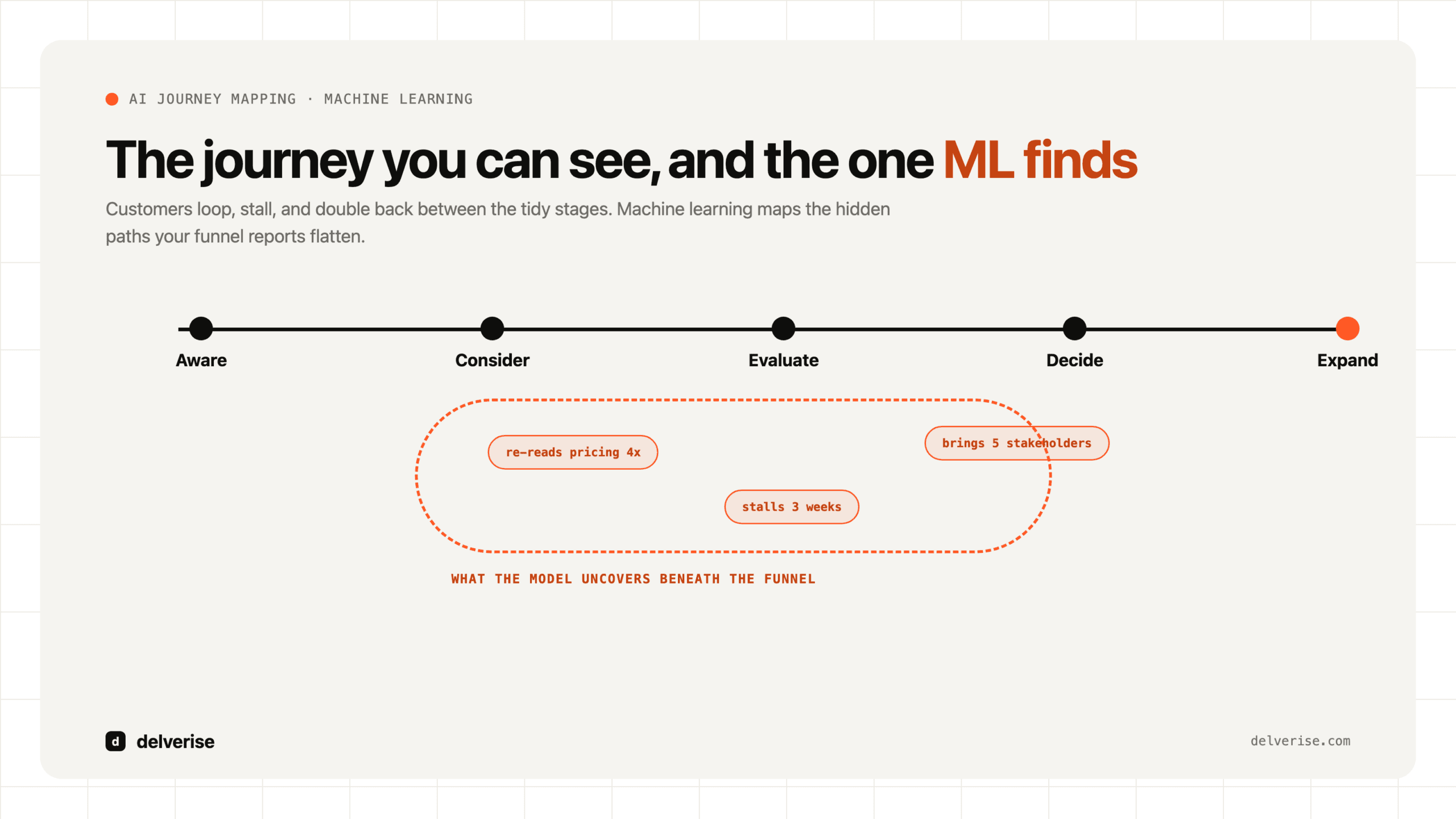
In contrast, AI customer journey mapping represents a paradigm shift from a static, linear view to a dynamic, multi-dimensional understanding of customer behavior. By leveraging machine learning algorithms, AI platforms can automatically ingest and analyze massive datasets from dozens of sources: CRM, web analytics, support tickets, social media, and more. This automated approach eliminates human bias and uncovers the complex, non-linear paths that customers actually take rather than the ones we assume they do.

The differences are stark. Where traditional mapping takes weeks and produces a map that is quickly outdated, AI delivers real-time insights and continuously updates journey maps as customer behavior evolves. The result is a move from a limited, high-effort exercise to a scalable, automated engine for continuous discovery and optimization.
How AI Uncovers Hidden Journeys
One of the most powerful capabilities of AI journey analytics is its ability to see what humans can’t. While a traditional journey map might show a straightforward path from a website visit to a demo request, AI can reveal a far more intricate reality. A customer might start on social media, compare your product on a review site, dive deep into your case studies, self-serve through your help docs, and visit your pricing page five times before ever requesting a demo.
These
“hidden paths” are where the real opportunities for optimization lie. By understanding these nuanced interactions, you can intervene at the right moment with the right message, significantly increasing the likelihood of conversion.

Machine learning models excel at this kind of pattern recognition. They can analyze thousands of touchpoints across millions of customer journeys to identify the sequences of events that are most likely to lead to a purchase, or, conversely, to churn. This is the core of AI customer path analysis: transforming a tangled web of interactions into a clear, actionable map of customer intent.
Research from McKinsey confirms the magnitude of the opportunity: ‘Companies that leverage customer behavioral insights outperform peers by 85% in sales growth and more than 25% in gross margin.’ The hidden paths AI surfaces are not edge cases — they are where the majority of revenue is won or lost, and traditional mapping is structurally blind to them.
AI Journey Mapping Tools: Choosing the Right Platform
The market for AI journey mapping tools is expanding rapidly, with solutions available for businesses of all sizes. Choosing the right platform depends on your specific needs, existing tech stack, and budget. Enterprise-level organizations may gravitate towards comprehensive platforms like Adobe Customer Journey Analytics or Salesforce Customer 360, which offer deep integration with their existing ecosystems. Mid-market companies might find the powerful analytics of FullStory or the journey-centric approach of TheyDo to be a better fit. For SMBs, tools like UXPressia and Smaply provide an accessible entry point into AI-powered mapping.
Here is a comparison of some of the leading AI journey mapping tools, focusing on their journey discovery capabilities:

When evaluating tools, consider the following key features:
- AI Pattern Recognition: The ability to automatically identify significant patterns and trends in customer behavior.
- Predictive Analytics: The use of machine learning to forecast future customer actions, such as churn or purchase likelihood.
- Real-Time Tracking: The capacity to ingest and process data as it happens, enabling immediate journey adaptation.
- Multi-Channel Integration: The power to connect data from a wide range of sources for a holistic view.
- Automated Insights: The platform’s ability to present data and generate actionable recommendations.
Real Journey Examples: From Data to Dollars
The true power of automated journey mapping is best understood through real-world examples. Consider the journey of a B2B software buyer. A traditional map might show a few key touchpoints, but an AI-powered analysis reveals a much richer story, complete with channel details, timing, and conversion points.

In this example, the journey from initial awareness to a $50,000 ARR deal took 10 days and involved multiple channels and touchpoints. The AI analysis reveals several critical insights:
- Multi-Channel Awareness: The journey began on mobile via a LinkedIn ad but quickly moved to desktop for deeper research.
- Intense Consideration: The prospect visited the pricing page five times and spent significant time on case studies and help docs, indicating a high level of interest and a need for detailed information.
- Pivotal Evaluation: The demo request was a key turning point, but the subsequent webinar attendance and ROI calculator usage were crucial in building the business case for purchase.
- The Final Mile: The free trial was the final convincer, but the sales call and contract review were essential steps in closing the deal.
Without AI, many of these critical touchpoints would have been missed, and the opportunity to nurture the prospect effectively would have been lost.
Journey Optimization: AI-Powered Recommendations and ROI
Identifying hidden journeys is only the first step. The real value of AI customer journey mapping lies in optimization. Modern AI platforms don’t just show you what’s happening; they provide concrete, data-driven recommendations on how to improve it. These recommendations can range from optimizing a high-friction pricing page to personalizing an email nurture sequence based on a prospect’s specific behavior.
An AI-powered optimization dashboard can provide a centralized view of journey health, friction points, and the predicted ROI of proposed changes.

The financial impact of this approach is significant. Studies have shown that companies leveraging AI for journey mapping and optimization can achieve:
- A 30-40% increase in customer satisfaction
- A 20-30% increase in customer retention rates
- A 25% increase in sales growth through personalized offerings
These are tangible business results, not vanity metrics, that have a direct impact on the bottom line. By focusing on the highest-impact optimization opportunities, you can systematically de-risk your customer journey and create a more efficient path to revenue.
Implementation Framework: A Step-by-Step Guide
Adopting AI customer journey mapping is a strategic initiative that requires a clear plan and cross-functional collaboration. The following framework outlines a phased approach to implementation, from initial data audit to ongoing optimization.

Phase 1: Foundation (Weeks 1-2)
- Define Goals & KPIs: Start with clear business objectives. Are you trying to reduce churn, increase conversion rates, or improve customer lifetime value? Define the key questions you need to answer.
- Audit Data Sources: Identify and assess all potential data sources, including your CRM, web analytics, marketing automation platform, support desk, and any other relevant systems.
- Select AI Platform: Evaluate and choose an AI journey mapping platform that aligns with your goals, budget, and existing tech stack.
- Assemble Team: Create a cross-functional team with representation from marketing, sales, customer success, and data analytics.
Phase 2: Data Integration (Weeks 3-4)
- Consolidate Data: Work with your IT and data teams to connect your chosen platform to all relevant data sources.
- Clean & Prepare Data: Ensure data quality by cleaning, standardizing, and de-duplicating your datasets.
- Configure AI Tools: Set up tracking and enable autocapture features to begin collecting rich behavioral data.
Phase 3: AI Analysis (Weeks 5-6)
- Train ML Models: Feed your historical data into the platform to train the machine learning models.
- Discover Hidden Paths: Let the AI do its work, identifying the most common and most impactful customer journeys.
- Analyze Friction Points: Pinpoint the stages and touchpoints where customers are struggling or dropping off.
Phase 4: Visualization & Validation (Week 7)
- Create Journey Maps: Use the platform’s visualization tools to create dynamic, multi-channel journey maps.
- Build Dashboards: Develop real-time dashboards to monitor journey health and track key KPIs.
- Validate with Teams: Review the AI-generated maps with your cross-functional team to add qualitative insights and domain expertise.
Phase 5: Optimization (Weeks 8-10)
- Implement Quick Wins: Identify and execute on high-impact, low-effort optimization opportunities.
- Run A/B Tests: Use the AI’s recommendations as hypotheses for A/B tests to validate their impact.
- Personalize Journeys: Begin personalizing content and experiences based on customer segments and journey patterns.
Phase 6: Scale & Iterate (Ongoing)
- Monitor Performance: Continuously track your KPIs and journey health scores.
- Continuous Learning: Allow the machine learning models to refine their understanding as they ingest more data.
- Expand Coverage: Gradually expand your analysis to include more journeys and touchpoints.
The Future is Automated
The era of manual, assumption-based journey mapping is drawing to a close. The future of customer experience belongs to the companies that apply AI to understand and optimize the customer journey at scale. By embracing AI customer journey mapping, you can move beyond guesswork, uncover hidden revenue paths, and build a more efficient, effective, and customer-centric go-to-market strategy.
Deep Dive: Key Concepts in AI Customer Journey Mapping
To fully grasp the transformative power of AI in customer journey mapping, it is essential to understand the core concepts that underpin this technology. These concepts are practical building blocks that enable businesses to move from reactive to predictive customer engagement.
Data Requirements for AI Mapping
The adage “garbage in, garbage out” has never been more relevant than in the context of AI. The success of any AI journey mapping initiative is fundamentally dependent on the quality, breadth, and depth of the data it is fed. To build a truly holistic view of the customer journey, you must break down data silos and integrate information from every corner of your business.
Key Data Sources:
- Behavioral Data: This is the bedrock of AI journey mapping. It includes detailed information on how customers interact with your digital properties, such as website clicks, page views, in-app actions, and feature usage. Platforms with autocapture capabilities, like FullStory, are invaluable here, as they automatically collect every interaction without the need for manual tagging.
- Transactional Data: This includes purchase history, subscription information, and any other data related to the financial relationship with the customer. This data is crucial for connecting journey patterns to revenue outcomes.
- CRM Data: Your Customer Relationship Management system is a goldmine of information, containing demographic data, lead scores, sales interactions, and account history. Integrating this data provides context to the behavioral and transactional data.
- Support & Service Data: Support tickets, chat logs, and call transcripts offer a direct window into customer pain points and friction. Analyzing this unstructured data with Natural Language Processing (NLP) can reveal systemic issues that are impacting the customer journey.
- Marketing & Advertising Data: Data from your marketing automation platform, ad campaigns, and email marketing efforts provides insight into the top of the funnel and the effectiveness of your outreach.
Pattern Recognition in Journeys
Humans are good at spotting simple patterns, but we are easily overwhelmed by complexity. Machine learning algorithms, on the other hand, are designed to sift through massive, complex datasets and identify statistically significant patterns that would be invisible to the naked eye. In the context of journey mapping, this means identifying the subtle sequences of behavior that correlate with specific outcomes.
For example, an AI might discover that customers who view a specific case study, then visit the pricing page twice, and then engage with a chatbot are 3x more likely to convert than those who follow a different path. Such a pattern would be hard to spot intuitively, so this is a data-driven insight that can be used to proactively guide other customers down this high-conversion path. This is the essence of machine learning customer journey analysis: finding the signal in the noise.
Predictive Path Analysis
Pattern recognition looks at past behavior to understand what happened. Predictive path analysis takes this a step further by using those patterns to forecast what is likely to happen next. By training machine learning models on historical journey data, AI platforms can predict the future behavior of individual customers with a surprising degree of accuracy.
This predictive capability is a game-changer for B2B companies with long and complex sales cycles. Imagine being able to identify a high-value prospect who is at risk of churning before they ever show any outward signs of disengagement. Or, conversely, imagine being able to identify a prospect who is on the verge of making a purchase and delivering a timely incentive to close the deal. This is the power of predictive path analysis: it allows you to move from a reactive to a proactive stance, intervening at the most critical moments of the customer journey.
Multi-Touch Attribution
For decades, marketers have struggled with the challenge of attribution: how to assign credit to the various touchpoints that contribute to a conversion. Traditional attribution models, such as first-touch and last-touch, are overly simplistic and fail to capture the complexity of the modern B2B customer journey. They give 100% of the credit to a single touchpoint, ignoring the dozens of other interactions that may have played a crucial role.
AI-powered multi-touch attribution solves this problem by using machine learning to analyze the entire customer journey and assign a fractional credit to each touchpoint based on its influence on the final outcome. This provides a far more accurate and nuanced understanding of which marketing channels, campaigns, and content assets are truly driving revenue. With this information, you can reallocate your marketing spend to the activities that are delivering the highest ROI, rather than relying on gut feelings or incomplete data.
Real-Time Journey Adaptation
The modern customer journey is not a static, linear path. It is a dynamic, real-time conversation that unfolds across multiple channels and devices. To be effective, your engagement strategy must be equally dynamic. Real-time journey adaptation is the ability to monitor a customer’s behavior as it happens and adjust the experience on the fly.
For example, if a customer is struggling with a particular feature in your product, a real-time journey adaptation system could automatically trigger a contextual help guide or a proactive chat message from a support agent. If a high-value prospect suddenly starts revisiting your pricing page after a period of inactivity, the system could alert their account executive to reach out immediately. This level of responsiveness is impossible to achieve with manual processes; it requires the speed and scale of AI.
Personalization at Scale
Personalization has been a marketing buzzword for years, but true one-to-one personalization has remained elusive for most companies. The challenge is scale. It is simply not feasible to manually create a unique experience for every single customer. AI solves this problem by enabling personalization at scale.
By combining deep data integration with predictive analytics, AI platforms can deliver a unique, personalized experience to every customer based on their specific needs, preferences, and journey history. This can manifest in many ways:
- Personalized Website Content: Dynamically changing the content and offers on your website to match the visitor’s industry, role, or stage in the journey.
- Personalized Email Nurturing: Sending a unique sequence of emails to each prospect based on the content they have engaged with and the actions they have taken.
- Personalized Product Experiences: Guiding users through your product in a way that is tailored to their specific goals and use case.
This is the ultimate promise of AI customer journey mapping: the ability to treat every customer as an individual, even when you have millions of them. It is a powerful vision, and with the right tools and strategy, it is now within reach.
Frequently Asked Questions
What is AI customer journey mapping?
AI customer journey mapping uses machine learning to automatically ingest and analyze massive datasets from sources like CRM, web analytics, support tickets, and social media to reveal the actual non-linear paths customers take. Unlike traditional mapping, which is manual, assumption-based, and static, AI mapping eliminates human bias and continuously updates in real time as customer behavior evolves, transforming journey analysis from a high-effort exercise into a scalable engine for discovery and optimization.
How does AI uncover hidden customer journeys?
AI uncovers hidden journeys by applying machine learning pattern recognition to thousands of touchpoints across millions of customer interactions. It identifies the sequences most likely to lead to purchase or churn, revealing complex paths that humans miss. For example, AI can detect when a customer starts on social media, compares your product on review sites, reads case studies, self-serves through help docs, and visits your pricing page five times before requesting a demo.
Which AI journey mapping tools should B2B companies consider?
Platform choice depends on company size and tech stack. Enterprise organizations should consider Adobe Customer Journey Analytics or Salesforce Customer 360 for deep ecosystem integration. Mid-market companies often benefit from FullStory’s analytics or TheyDo’s journey-centric approach. SMBs can start with accessible options like UXPressia and Smaply. When evaluating, prioritize AI pattern recognition, predictive analytics, real-time tracking, multi-channel integration, and automated insights generation.
Traditional vs AI journey mapping: what’s the difference?
Traditional journey mapping relies on manual data collection through surveys and interviews, producing static maps based on collective assumptions that take weeks to build and quickly become outdated. AI journey mapping automatically ingests data from dozens of sources, delivers real-time insights, and continuously updates as behavior evolves. The shift is from a static, linear, subjective view to a dynamic, multi-dimensional, data-driven understanding of actual customer behavior.
What does a real AI-mapped B2B buyer journey look like?
A real AI-mapped journey shows the full multi-channel reality behind a deal. In one example, a $50,000 ARR B2B software deal took 10 days from awareness to close. The buyer started on mobile via a LinkedIn ad, switched to desktop for deeper research, visited the pricing page five times, and spent significant time on case studies and help docs before requesting a demo, revealing intense consideration signals invisible to traditional mapping.
Read next