←Back to blog
Growth & Demand GenerationArticleFebruary 8, 20266 min read
How AI Is Reshaping B2B Growth: 5 Trends Every SaaS Leader Should Watch
5 AI trends reshaping B2B growth in 2026 — from AI agents on buying committees to autonomous GTM workflows and generative engine optimization (GEO).
We’re past the hype cycle. In 2026, AI in B2B isn’t about chatbots on your website or “AI-powered” badge slapped onto existing features. It’s about fundamentally rethinking how companies acquire, convert, and retain customers.
The companies that understand these shifts, and build for them, will dominate their categories. The ones that treat AI as a feature rather than an operating model will get left behind.
Here are five trends reshaping B2B growth right now.
Answer: AI is reshaping B2B growth by turning manual research, enrichment, segmentation, outbound personalization, routing, and reporting into repeatable workflows. The companies that benefit most are not simply adding AI tools; they are redesigning GTM systems so AI improves account selection, buyer context, activation speed, and feedback loops across the revenue motion.
- AI research helps teams understand accounts, roles, triggers, and buying context faster.
- AI activation improves outbound, routing, follow-up, and lifecycle messaging.
- AI operations reduces manual work across CRM hygiene, QA, reporting, and workflow maintenance.
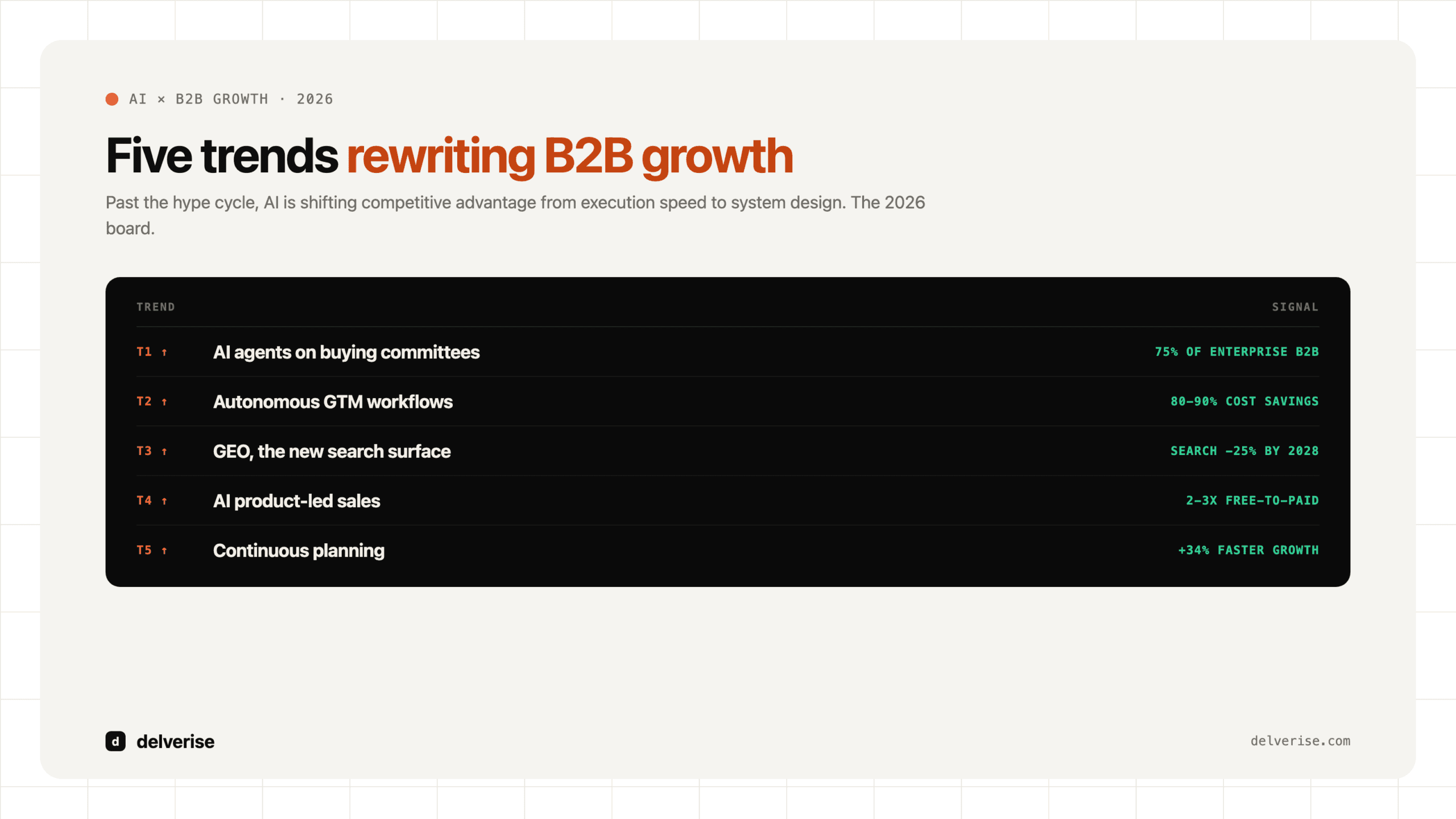
1. AI Agents Are Joining Buying Committees

This is the trend with the most disruptive potential. AI agents (autonomous software that researches, evaluates, and recommends solutions on behalf of human buyers) are becoming part of B2B purchasing decisions.
What this means for your GTM:
- Your content needs to be machine-readable. AI agents parse structured data, not marketing fluff. Schema markup, clear pricing pages, and API documentation become competitive advantages.
- Comparison and evaluation content matters more. AI agents are trained to compare options. “Alternative to X” and feature comparison pages will capture AI-driven traffic.
- Trust signals become critical. AI agents weigh reviews, case studies with verified metrics, and third-party validation more heavily than brand messaging.
Forrester predicts that 75% of enterprise B2B companies will factor AI agent compatibility into their content strategies by the end of 2026. If you’re not optimizing for how AI evaluates your product, you’re invisible to a growing segment of buyers.
2. Autonomous GTM Workflows Replace Manual Ops

The second major trend is the shift from AI-assisted workflows to fully autonomous ones. In 2026, AI helped SDRs write emails. In 2026, AI systems handle entire outbound pipeline generation motions:
- Autonomous prospecting: AI identifies target accounts from intent signals, enriches them with relevant data, and scores them, no human input needed for the initial list
- Dynamic sequence generation: AI writes and A/B tests outbound sequences, adapting messaging based on response patterns
- Meeting scheduling: AI agents handle the back-and-forth of scheduling, qualifying the prospect in the process
- Pipeline management: AI updates deal stages, flags at-risk deals, and generates accurate forecasts
The result: companies with AI-native GTM stacks are reporting 80-90% cost savings on prospecting operations and 3-5x ROI within the first year. This is a step change in GTM economics, not an incremental improvement.
Research from McKinsey confirms the magnitude of this shift: ‘Generative AI could deliver $0.8 trillion to $1.2 trillion in productivity gains across sales and marketing functions, with the largest impact in lead identification and prospect engagement.’ For delverise, this validates what we see on the ground: teams treating autonomous GTM as a line item rather than an operating model are leaving the majority of that value on the table.
3. Generative Engine Optimization (GEO) Is the New SEO

Search behavior is fracturing. In 2026, a significant and growing share of B2B research queries happen through AI interfaces (ChatGPT, Perplexity, Claude, Copilot) rather than traditional Google searches.
This creates a new discipline: Generative Engine Optimization (GEO), optimizing your content to be cited by AI models when they answer questions related to your category.
How to optimize for GEO:
- Be the authoritative source. AI models cite content with original data, unique insights, and clear expertise signals. Generic content gets ignored.
- Structure for extraction. Use clear headings, definition blocks, numbered lists, and FAQ sections. AI models prefer structured content they can quote directly.
- Build entity authority. Establish your brand and key people as recognized entities through consistent mentions across authoritative sources such as publications, podcasts, and industry reports.
- Create citation-worthy data. Original research, benchmarks, and survey data get cited far more than opinion pieces.
GEO doesn’t replace SEO, it extends it. The companies ranking well in both traditional search and AI-generated answers will capture disproportionate market share.
According to Gartner, ‘By 2028, traditional search engine volume will drop 25%, with search marketing losing market share to AI chatbots and other virtual agents.’ That is the window delverise is building toward: brands that publish citation-grade data now will own category answers when buyers stop clicking through to websites entirely.
4. Product-Led Sales Powered by AI

The gap between product-led growth and sales-led growth is closing, thanks to AI. The emerging model, product-led sales, uses AI to identify which free or trial users are most likely to convert and routes them to sales at exactly the right moment.
Here’s how it works:
- Behavioral scoring: AI models analyze product usage patterns to identify accounts showing buying intent. The system looks beyond feature adoption to find patterns correlated with conversion (team invites, integration setup, admin configuration)
- Automated PQL surfacing: Product-qualified leads are identified in real-time and routed to sales with full context: what they’ve used, where they’ve gotten stuck, and what they’re likely to need
- AI-generated outreach: Sales reps receive suggested messages personalized to the user’s product journey, not generic “ready to upgrade?” emails
Companies running AI-powered product-led sales motions are seeing 2-3x higher conversion rates from free-to-paid compared to traditional upgrade prompts. The key is timing, reaching out when behavior signals readiness rather than when a calendar says it’s time.
5. Continuous Planning Replaces Annual Budgets

The final trend is operational rather than technological, but AI is what makes it possible. The traditional annual planning cycle (set targets in Q4, execute all year, measure in December) is being replaced by continuous planning powered by real-time data.
What continuous planning looks like:
- Rolling forecasts: AI-powered models update revenue forecasts weekly based on pipeline changes, win rate trends, and market signals
- Dynamic resource allocation: Budget shifts monthly based on channel performance, double down on what’s working, cut what isn’t
- Scenario modeling: AI runs multiple growth scenarios simultaneously, showing the revenue impact of different investment choices
- Real-time metric tracking: Board-level KPIs like NRR, LTV, and pipeline velocity are monitored continuously, not reviewed quarterly
This shift requires a mature revenue operations function to manage the data and systems. But the payoff is significant: companies that track pipeline velocity weekly grow 34% faster than those reviewing it quarterly.
What This Means for B2B Leaders
These five trends share a common thread: AI is shifting competitive advantage from execution speed to system design.
The companies winning in 2026 aren’t the ones with the most salespeople, the biggest ad budgets, or the most content. They’re the ones with the best systems: engineered GTM motions, clean data, autonomous workflows, and content optimized for both humans and machines.
The strategic question for every B2B SaaS leader: are you building systems that compound, or are you still relying on manual processes that scale linearly?
The answer to that question will determine who leads their category, and who gets disrupted.
Need AI wired into the revenue motion? delverise builds AI outbound, AI lead generation, GTM, and growth systems that connect data, workflows, activation, and reporting around pipeline outcomes. Explore AI Outbound, AI Lead Generation, GTM Engineering, Growth Engineering, or apply to work with us.
Read next