←Back to blog
Revenue OperationsPlaybookMay 20, 202628 min read
AI Revenue Operations: How to Automate Your Entire Revenue Engine with AI
A practical guide to AI revenue operations: automate lead scoring, forecasting, and pipeline intelligence to scale revenue without adding headcount.
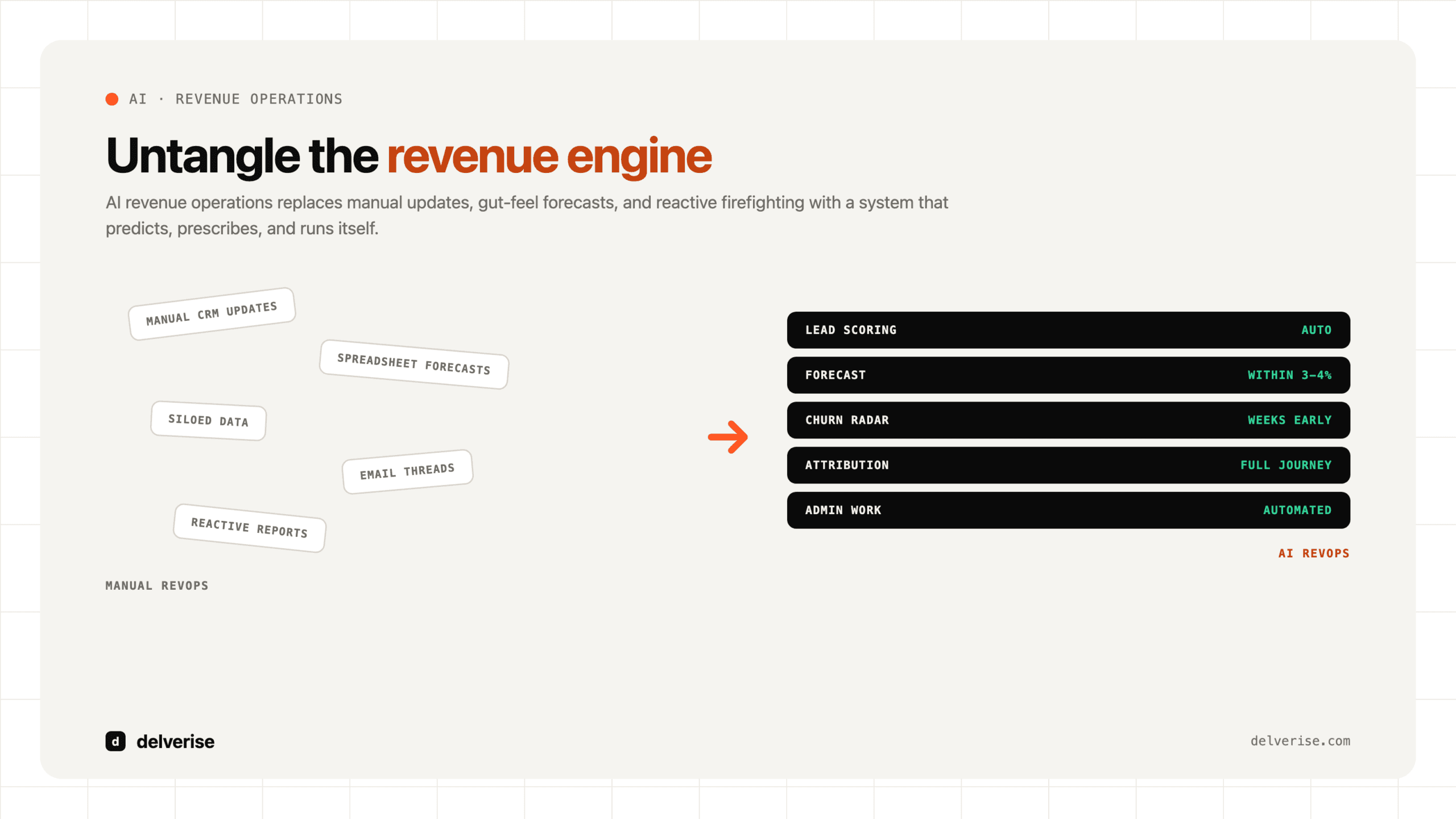
What if your revenue operations could predict, automate, and optimize itself? Imagine a world where your sales forecasts are accurate within 3-4% every quarter, where leads are automatically scored and routed to the right representatives based on propensity to convert, and where potential churn risks are identified weeks before they materialize. Forward-thinking companies are already experiencing this reality through AI-powered revenue operations.
The traditional approach to revenue operations is fundamentally broken. RevOps teams spend countless hours manually updating CRM systems, creating forecasts based on gut feelings rather than data, and struggling to align sales, marketing, and customer success teams around a single source of truth. Meanwhile, valuable insights remain buried in spreadsheets, email threads, and disconnected systems, while revenue opportunities slip through the cracks.
The emergence of artificial intelligence in revenue operations represents a fundamental shift in how businesses can orchestrate their entire revenue engine, going beyond another technological upgrade. Companies implementing AI revenue operations are seeing remarkable results: Dell Technologies achieved double-digit growth in channel revenue within two years of implementing AI-driven sales prioritization, while BirchStreet Systems experienced 70% growth in bookings year-over-year with forecast accuracy consistently landing within 3-4%.
This comprehensive guide will take you through the complete transformation possible when AI meets revenue operations. You’ll discover how leading companies are automating lead scoring, revolutionizing forecasting accuracy, predicting customer churn before it happens, and creating seamless workflows that eliminate manual bottlenecks. More importantly, you’ll learn exactly how to implement these capabilities in your own organization, from assessing your AI readiness to building your technology stack and managing the change process.
Whether AI will transform revenue operations is settled. The real question is whether your organization will lead this transformation or be left behind by competitors who embrace it first. The companies that act now will gain an insurmountable competitive advantage in efficiency, predictability, and growth. Let’s explore how to make your revenue operations truly intelligent, with automation as the foundation.
Short answer: AI revenue operations is the use of AI, automation, and connected revenue data to improve forecasting, lead scoring, routing, customer health, attribution, and operational workflows. It works best when RevOps governance and data quality are already strong enough for automation to trust.
- Automate: repetitive CRM updates, enrichment, routing, reporting, and handoff tasks.
- Predict: pipeline risk, churn risk, account fit, and conversion probability.
- Operationalize: connect AI outputs to the CRM, sales workflows, customer success motions, and executive reporting.
The Revenue Operations Crisis: Manual Processes in a Digital World

Revenue operations teams today find themselves caught in a perfect storm of complexity and inefficiency. Despite the proliferation of sophisticated business tools and platforms, most organizations still rely heavily on manual processes that were designed for a simpler, less connected business environment. This disconnect between the promise of modern technology and the reality of day-to-day operations is creating significant bottlenecks that directly impact revenue growth and competitive positioning.
The most pervasive challenge facing RevOps teams is the existence of data silos across their technology stack. Sales teams work in CRM systems that don’t communicate effectively with marketing automation platforms, while customer success teams operate in separate tools that provide limited visibility into the complete customer journey. This fragmentation means that critical insights about customer behavior, deal progression, and revenue opportunities remain trapped in isolated systems. According to recent research by Clari Labs, 67% of enterprises don’t trust their revenue data, largely due to these integration challenges and the manual effort required to reconcile information across platforms.
The time burden of manual data entry and maintenance represents another significant drain on RevOps productivity. Sales representatives spend an estimated 21% of their time on administrative tasks rather than selling, while RevOps professionals dedicate countless hours to updating records, cleaning data, and creating reports that should be automated. This manual effort reduces the time available for strategic activities, and it introduces human error that compounds over time, further degrading data quality and decision-making capabilities.
Research from McKinsey confirms the productivity drag: ‘Sales representatives spend less than a third of their time on actual selling activities, with administrative work and internal meetings consuming the majority of their week.’ For RevOps leaders, this is the clearest signal that automation is no longer optional, it is the only path to reclaiming selling capacity at scale.
Forecasting accuracy remains one of the most visible symptoms of these underlying process problems. Traditional forecasting methods rely heavily on subjective assessments from sales representatives and managers, combined with historical trends that may not reflect current market conditions or competitive dynamics. The result is forecast accuracy that rarely exceeds 75%, creating significant challenges for resource planning, investor communications, and strategic decision-making. When forecasts are consistently inaccurate, organizations lose confidence in their planning processes and struggle to make informed investments in growth initiatives.
According to Gartner, ‘Less than half of chief sales officers and sales leaders have high confidence in their organization’s forecasting accuracy, despite forecasting being one of the most critical inputs to enterprise planning.’ This confidence gap is exactly what AI-driven forecasting is built to close, by replacing subjective rep inputs with signal-based probability models.
The lack of real-time insights compounds these challenges by creating a reactive rather than proactive approach to revenue management. By the time problems become visible in traditional reporting systems, opportunities have often been lost and deals have already moved to competitors. This delayed visibility makes it nearly impossible to implement course corrections that could salvage at-risk deals or capitalize on emerging opportunities.
Perhaps most concerning is the resistance to change that has developed within many RevOps organizations. Teams that have invested significant time and effort in building manual processes often view new technologies with skepticism, particularly when those technologies promise to automate tasks that have traditionally required human judgment. This resistance is understandable but ultimately counterproductive, as it prevents organizations from realizing the efficiency gains and competitive advantages that modern AI-powered tools can provide.
The cumulative effect of these challenges is a revenue operations function that operates well below its potential, consuming valuable resources while delivering suboptimal results. Organizations that continue to rely on these manual processes will find themselves increasingly disadvantaged as competitors embrace AI-powered alternatives that deliver superior accuracy, efficiency, and insights.
The AI Revolution in Revenue Operations

Artificial intelligence is fundamentally transforming how revenue operations teams approach their core responsibilities, moving from reactive, manual processes to proactive, intelligent automation. This transformation touches every aspect of the revenue engine, from initial lead capture through customer retention and expansion. The key to understanding this revolution lies in recognizing that AI does more than automate existing processes. It reimagines them entirely, creating new possibilities for efficiency, accuracy, and insight that were previously impossible to achieve.
Intelligent Lead Scoring: From Gut Feeling to Data-Driven Precision
Traditional lead scoring has long been one of the weakest links in the revenue operations chain. Most organizations rely on simple demographic and firmographic criteria combined with basic behavioral scoring that fails to capture the nuanced patterns that truly indicate purchase intent. Sales representatives often override these scores based on intuition, while marketing teams struggle to understand why certain leads convert while others with similar profiles do not.
AI-powered lead scoring transforms this process by analyzing hundreds of data points simultaneously, identifying patterns that human analysts would never detect. Machine learning algorithms can process information from website behavior, email engagement, social media activity, content consumption patterns, and external data sources to create comprehensive propensity scores that accurately predict conversion likelihood. These systems continuously learn and improve, adapting to changing market conditions and customer behaviors without requiring manual intervention.
The practical impact of this transformation shows up in real lead-management workflows built on AI-driven automation. One B2B marketing team built a system that uses ChatGPT Vision to extract contact details from business card photos, automatically formats the data into JSON, and integrates it into CRM systems. Each new contact is tagged with event-specific information, triggering pre-configured email and text follow-ups tailored to the context. This approach enabled the sales teams it served to save five hours per week on manual data entry while achieving a 20% increase in closed deals through timely and accurate follow-ups.
The sophistication of modern AI lead scoring extends beyond simple conversion prediction to include routing optimization, timing recommendations, and personalization insights. Advanced systems can determine which leads are most likely to convert. They also identify which sales representative is best positioned to handle each lead based on experience, current workload, and historical performance with similar prospects. This intelligent routing ensures that high-value opportunities receive appropriate attention while maximizing the efficiency of the entire sales organization.
Superhuman Forecasting: AI-Driven Pipeline Prediction
Revenue forecasting has traditionally been more art than science, relying heavily on subjective assessments from sales representatives who may be overly optimistic about their prospects or managers who apply broad-brush adjustments based on historical patterns. This approach consistently produces forecasts that miss targets by significant margins, creating challenges for resource planning and investor communications.
AI-powered forecasting systems approach this challenge by analyzing objective data from every customer interaction, deal progression pattern, and external market signal. These systems can process information from CRM records, email communications, calendar activities, and even conversation analytics to build comprehensive models of deal progression and outcome probability. Unlike human forecasters, AI systems are not influenced by optimism bias or political considerations. They simply analyze patterns and predict outcomes based on data.
Gong’s revenue operations platform exemplifies this transformation by using AI to analyze every customer interaction across sales and customer success teams. The system captures activity data from calls, emails, and web conferencing, then applies machine learning algorithms to identify patterns that correlate with successful deal outcomes. This approach enables what Gong calls “superhuman forecasting,” providing visibility into deal health, risk factors, and progression likelihood that far exceeds traditional forecasting methods.
The accuracy improvements achieved through AI forecasting are remarkable. BirchStreet Systems, using Clari’s AI-powered platform, has achieved forecast accuracy consistently within 3-4% every quarter for two years while growing bookings by over 70% year-over-year. This level of precision enables more confident resource allocation, better investor communications, and more strategic decision-making about market opportunities and competitive positioning.
Advanced AI forecasting systems also provide prescriptive insights that go beyond simple prediction. They can identify specific actions that sales representatives should take to improve deal outcomes, recommend optimal timing for follow-up activities, and flag deals that require management intervention. This guidance transforms forecasting from a reporting exercise into a strategic tool for revenue optimization.
Proactive Customer Success: AI-Powered Health Scoring
Customer retention and expansion represent the most valuable revenue opportunities for most B2B organizations, yet traditional approaches to customer success management are largely reactive, identifying problems only after customers have already decided to churn or reduce their spending. AI-powered customer health scoring changes this dynamic by identifying risk signals and expansion opportunities weeks or months before they become apparent through traditional metrics.
AI customer health scoring systems analyze behavioral patterns across multiple touchpoints, including product usage data, support ticket patterns, communication frequency, and engagement with marketing content. These systems can detect subtle changes in behavior that indicate shifting satisfaction levels or changing business priorities. For example, a gradual decrease in feature adoption combined with increased support ticket volume might indicate implementation challenges that could lead to churn if not addressed proactively.
The sophistication of these systems extends to identifying expansion opportunities that human customer success managers might miss. AI can analyze usage patterns to identify customers who are approaching plan limits, detect workflow patterns that suggest additional product needs, and identify organizational changes that might create new buying opportunities. This intelligence enables customer success teams to approach expansion conversations with confidence and timing that maximizes success probability.
Gong’s platform demonstrates the power of this approach by providing real-time insights into customer health based on conversation analytics and interaction patterns. The system can identify when decision makers become less engaged, when competitive threats emerge, or when implementation challenges arise, enabling proactive intervention that prevents churn and identifies expansion opportunities.
The business impact of AI-powered customer health scoring is significant. Organizations implementing these systems typically see 15-25% improvements in retention rates and 20-30% increases in expansion revenue. More importantly, they shift from reactive firefighting to proactive relationship management, creating more predictable revenue streams and stronger customer relationships.
Revenue Attribution Made Simple: AI-Powered ROI Analysis
Understanding which marketing and sales activities actually drive revenue has long been one of the most challenging aspects of revenue operations. Traditional attribution models rely on simple first-touch or last-touch approaches that fail to capture the complexity of modern B2B buying journeys, which often involve multiple touchpoints across extended timeframes and multiple decision makers.
AI-powered attribution systems solve this challenge by analyzing the complete customer journey across all touchpoints, using machine learning algorithms to identify the combination of activities that most strongly correlate with revenue outcomes. These systems can process data from marketing automation platforms, CRM systems, website analytics, and sales engagement tools to create comprehensive attribution models that accurately reflect the contribution of each activity to revenue generation.
The sophistication of AI attribution extends beyond simple correlation analysis to include predictive modeling that can forecast the revenue impact of different marketing and sales investments. These systems can simulate the effect of budget reallocations, identify underperforming channels, and recommend optimization strategies that maximize return on investment.
Advanced AI attribution systems also provide real-time insights that enable immediate optimization of marketing and sales activities. Rather than waiting for quarterly or monthly reports, revenue operations teams can see which campaigns, content pieces, and sales activities are driving the best results and adjust their strategies accordingly.
Workflow Automation: AI as Your Revenue Operations Assistant
The most transformative aspect of AI in revenue operations may be its ability to automate complex workflows that previously required significant human intervention. Modern AI systems can handle tasks ranging from data entry and CRM updates to complex analysis and decision-making, freeing revenue operations professionals to focus on strategic activities that drive business growth.
One B2B lead generation team shows the power of AI workflow automation through their sales feedback loop system. After every sales call, their system automatically generates meeting transcripts and sends them to a pre-trained GPT agent that analyzes the conversation for insights about what was done well, which opportunities were missed, and which areas need improvement. This feedback is automatically delivered to sales executives via Slack, creating a continuous improvement loop that enhances sales performance and removes the need for manual analysis.
The scope of AI workflow automation continues to expand as natural language processing capabilities improve. Modern systems can draft personalized emails, update CRM records based on conversation content, schedule follow-up activities, and even generate proposals and contracts based on deal parameters. This automation eliminates the administrative burden that traditionally consumes significant portions of sales and marketing professionals’ time.
The key to successful AI workflow automation lies in identifying processes that are repetitive, data-intensive, and rule-based. These processes are ideal candidates for AI automation because they can be clearly defined and measured, allowing AI systems to learn optimal approaches and continuously improve performance. Organizations that systematically identify and automate these workflows can achieve dramatic improvements in efficiency while reducing the risk of human error.
Your AI RevOps Implementation Roadmap

Successfully implementing AI in revenue operations requires a systematic approach that addresses technology, process, and organizational change considerations. The most successful implementations follow a structured roadmap that begins with thorough assessment and preparation, progresses through careful platform selection and integration, and concludes with comprehensive change management and adoption programs.
Is Your Organization Ready for AI Revenue Operations?
Before investing in AI revenue operations technology, organizations must honestly assess their readiness across multiple dimensions. The foundation of successful AI implementation lies in data quality, technology infrastructure, organizational capabilities, and change readiness. Organizations that skip this assessment phase often encounter significant challenges that could have been avoided through proper preparation.
Data quality represents the most critical success factor for AI revenue operations. AI systems are only as good as the data they analyze, and poor data quality will produce unreliable insights and recommendations that undermine confidence in the technology. Organizations should conduct comprehensive audits of their CRM data, marketing automation data, and customer interaction data to identify gaps, inconsistencies, and quality issues. This assessment should examine data completeness, accuracy, consistency, and timeliness across all systems that will integrate with AI platforms.
The data quality assessment should also evaluate data governance processes and capabilities. Organizations need clear policies for data collection, validation, and maintenance, along with the organizational capabilities to enforce these policies consistently. Without strong data governance, even the best AI systems will struggle to deliver reliable results.
Technology infrastructure assessment focuses on the organization’s ability to support AI platforms and integrate them with existing systems. This evaluation should examine CRM capabilities, marketing automation maturity, data integration infrastructure, and security frameworks. Organizations with outdated or fragmented technology stacks may need to invest in foundational improvements before implementing AI solutions.
Team readiness assessment examines the skills, capabilities, and capacity of revenue operations, sales, marketing, and customer success teams. AI implementation requires new skills in data analysis, system configuration, and performance optimization. Organizations should identify skill gaps and develop training plans to ensure teams can effectively leverage AI capabilities.
Change readiness assessment evaluates the organization’s culture, leadership support, and historical experience with technology adoption. Organizations with strong change management capabilities and leadership commitment to innovation are more likely to successfully implement AI revenue operations. Those with cultures that resist change or lack leadership support may need to invest in change management preparation before beginning AI implementation.
Choosing the Right AI RevOps Platform
The AI revenue operations platform landscape includes numerous options, each with different strengths, capabilities, and integration requirements. Successful platform selection requires careful evaluation of organizational needs, technical requirements, and strategic objectives. The most important consideration is alignment between platform capabilities and organizational priorities, rather than simply selecting the most advanced or popular option.
Core platform requirements should be defined based on the organization’s specific use cases and objectives. Organizations focused on sales performance improvement might prioritize conversation analytics and deal intelligence capabilities, while those emphasizing marketing optimization might focus on attribution and lead scoring features. Customer success-focused organizations might prioritize health scoring and retention analytics capabilities.
Integration capabilities represent another critical evaluation criterion. AI platforms must integrate seamlessly with existing CRM, marketing automation, and customer success systems to provide comprehensive insights and automation. Organizations should evaluate API capabilities, pre-built integrations, and data synchronization features to ensure smooth implementation and ongoing operation.
Gong stands out for organizations prioritizing conversation analytics and sales performance optimization. The platform’s strength lies in its ability to analyze sales calls, emails, and meetings to provide insights into deal progression, competitive positioning, and sales effectiveness. Gong’s AI capabilities include automatic call transcription, sentiment analysis, and pattern recognition that identifies successful sales behaviors and deal risk factors.
Clari excels in forecasting accuracy and pipeline management, offering what they call “Revenue Context” that provides comprehensive visibility into deal progression and outcome probability. The platform’s AI capabilities focus on predictive analytics, scenario modeling, and automated forecasting that consistently delivers accuracy within 3-4% of actual results.
People.ai specializes in activity capture and revenue intelligence, automatically logging sales activities and providing insights into customer engagement patterns. The platform’s AI capabilities include automated data entry, activity scoring, and relationship mapping that provides comprehensive visibility into customer interactions.
HubSpot Operations Hub offers integrated AI capabilities across marketing, sales, and customer service functions, making it ideal for organizations seeking comprehensive revenue operations automation within a single platform. The platform’s AI features include lead scoring, content optimization, and workflow automation that spans the entire customer lifecycle.
Platform evaluation should also consider vendor stability, support capabilities, and long-term roadmap alignment. Organizations should assess vendor financial health, customer satisfaction ratings, and strategic direction to ensure long-term partnership viability.
Seamless Integration: Connecting Your AI RevOps Ecosystem
Successful AI revenue operations implementation depends heavily on seamless integration between AI platforms and existing business systems. Poor integration can create data silos, workflow disruptions, and user adoption challenges that undermine the value of AI investments. Organizations should approach integration systematically, with careful planning for data flow, security, and user experience considerations.
CRM integration represents the most critical integration requirement, as CRM systems typically serve as the central repository for customer and deal information. AI platforms must be able to read data from CRM systems, write insights and recommendations back to CRM records, and maintain data synchronization in real-time. Organizations should evaluate API capabilities, field mapping options, and data validation features to ensure smooth CRM integration.
Marketing automation integration enables AI platforms to analyze the complete customer journey from initial awareness through purchase and retention. This integration should include lead scoring synchronization, campaign performance data, and content engagement metrics. The integration should also support automated workflow triggers based on AI insights and recommendations.
Data synchronization strategies must address the challenge of maintaining consistent, up-to-date information across multiple systems. Organizations should implement real-time synchronization where possible, with fallback batch processing for systems that don’t support real-time integration. Data validation and error handling procedures should be established to maintain data quality as information flows between systems.
Security and compliance considerations are particularly important for AI integrations, as these systems often process sensitive customer and business information. Organizations should evaluate encryption capabilities, access controls, and audit logging features to ensure AI platforms meet security and compliance requirements. Data residency and processing location requirements should also be considered for organizations with specific regulatory obligations.
Leading the AI Transformation: Change Management Best Practices
The human element of AI revenue operations implementation often determines success or failure more than technical considerations. Organizations must address concerns about job displacement, provide comprehensive training, and create adoption incentives that encourage teams to embrace AI capabilities rather than resist them.
Communication strategies should emphasize AI as an augmentation tool that enhances human capabilities rather than a replacement technology. Teams need to understand how AI will make their jobs more strategic and valuable by automating routine tasks and providing better insights for decision-making. Success stories from other organizations and early pilot results can help build confidence and enthusiasm for AI adoption.
Training programs should be comprehensive and role-specific, addressing both technical skills and strategic thinking capabilities. Sales representatives need training on interpreting AI insights and recommendations, while revenue operations professionals need deeper technical training on system configuration and optimization. Marketing teams need training on AI-powered campaign optimization and attribution analysis.
Addressing resistance to change requires understanding the underlying concerns that drive opposition to AI adoption. Common concerns include job security fears, skepticism about AI accuracy, and comfort with existing processes. Organizations should address these concerns directly through transparent communication, pilot programs that demonstrate AI value, and clear career development paths that show how AI skills enhance professional growth.
The most successful AI implementations begin with small-scale pilot programs that demonstrate value quickly and build momentum for broader adoption. These pilots should focus on high-impact use cases with clear success metrics, allowing organizations to refine their approach and build internal expertise before scaling to larger implementations.
AI RevOps Success Stories: Real Results from Forward-Thinking Companies

The theoretical benefits of AI revenue operations become tangible when examined through the lens of real-world implementations. Leading organizations across various industries have achieved remarkable results by strategically implementing AI-powered revenue operations, providing valuable insights into what’s possible and how to achieve similar success.
Dell Technologies’ implementation of MBVision, their AI-driven sales prioritization solution, demonstrates the transformative potential of AI in large enterprise environments. Initially met with resistance from sales representatives concerned about job displacement, the system ultimately gained enthusiastic adoption after teams experienced concrete productivity improvements. The AI system automated lead prioritization and reduced administrative tasks, enabling sales representatives to focus more deeply on high-value prospects and customer engagement activities. Within two years of implementation, Dell achieved double-digit growth in channel revenue, directly attributable to improved sales effectiveness and efficiency.
The Dell implementation also illustrates the importance of change management in AI adoption. By clearly presenting AI as a supportive partner designed to handle repetitive tasks rather than replace human judgment, Dell successfully transformed initial skepticism into advocacy. The key was demonstrating tangible value quickly and maintaining transparent communication about the system’s purpose and capabilities.
An automated sales feedback loop is an innovative approach to continuous sales improvement through AI. One B2B team’s system generates meeting transcripts after every sales call and uses a pre-trained GPT agent to analyze conversations for insights about performance, missed opportunities, and improvement areas. This feedback is automatically delivered to sales executives via Slack, creating a systematic approach to sales coaching and development. Over time, the system collects a large dataset of transcripts and sales outcomes, enabling statistical analysis to identify the most effective sales scripts and eliminate common errors.
This AI-driven approach demonstrates how qualitative activities like sales coaching can become data-driven processes. Rather than relying on subjective manager observations or infrequent coaching sessions, the system provides objective, consistent feedback on every customer interaction. This systematic approach to improvement enables B2B teams to optimize their sales processes continuously and achieve more predictable results.
YuLife’s implementation of HubSpot’s AI-driven marketing automation showcases the power of AI in marketing operations and lead conversion. The company achieved a 35% conversion rate from Marketing Qualified Leads to Sales Qualified Opportunities, significantly above industry averages. This success resulted from AI-powered lead scoring, automated nurturing sequences, and intelligent content recommendations that delivered the right message to the right prospects at the optimal time.
Mintel’s use of Gong’s conversation analytics platform resulted in a 34% increase in win rates, demonstrating the impact of AI-powered sales intelligence. The platform analyzed sales conversations to identify patterns associated with successful deals, enabling sales representatives to replicate winning behaviors and avoid common pitfalls. The system also provided real-time coaching recommendations during sales calls, helping representatives navigate challenging conversations more effectively.
BirchStreet Systems’ experience with Clari’s AI-powered forecasting platform illustrates the business impact of accurate revenue prediction. The company achieved 70% growth in bookings year-over-year while maintaining forecast accuracy consistently within 3-4% every quarter for two years. This level of predictability enabled more confident resource allocation, better investor communications, and more strategic decision-making about market opportunities.
These success stories share common themes that provide insights for other organizations considering AI revenue operations implementation. First, successful implementations focus on augmenting human capabilities rather than replacing them, addressing change management concerns proactively. Second, they begin with clear use cases and success metrics, enabling teams to demonstrate value quickly and build momentum for broader adoption. Third, they invest in data quality and integration infrastructure to ensure AI systems have access to accurate, comprehensive information.
AI RevOps Implementation Pitfalls: Learn from Others’ Mistakes

While AI revenue operations offers tremendous potential, organizations can encounter significant challenges that undermine implementation success. Understanding these common pitfalls and their solutions can help organizations avoid costly mistakes and achieve better outcomes from their AI investments.
Over-reliance on technology without corresponding process improvement represents one of the most common implementation mistakes. Organizations sometimes assume that AI platforms will automatically solve process problems without addressing underlying workflow inefficiencies or organizational issues. Successful AI implementation requires examining and optimizing business processes before introducing AI automation, ensuring that technology enhances effective processes rather than automating ineffective ones.
Insufficient data quality preparation undermines many AI implementations before they begin. Organizations often underestimate the time and effort required to clean, standardize, and integrate data across multiple systems. Poor data quality produces unreliable AI insights and recommendations, leading to user skepticism and adoption resistance. Organizations should invest significant effort in data quality improvement before implementing AI platforms, establishing ongoing data governance processes to maintain quality over time.
Unrealistic expectations about implementation timelines and immediate results can create disappointment and resistance to AI adoption. AI systems require time to learn patterns, optimize recommendations, and demonstrate value. Organizations should set realistic expectations about the learning curve and time-to-value, focusing on incremental improvements rather than immediate transformation.
Lack of user adoption strategies represents another common failure point. Organizations sometimes focus heavily on technical implementation while neglecting the human factors that determine adoption success. Comprehensive training programs, change management initiatives, and adoption incentives are essential for ensuring teams embrace AI capabilities rather than resist them.
Vendor lock-in considerations become important as organizations become dependent on specific AI platforms. Organizations should evaluate data portability, integration flexibility, and contract terms to ensure they maintain strategic flexibility as their needs evolve. Avoiding over-dependence on single vendors can prevent future migration challenges and negotiation disadvantages.
Job displacement concerns require honest, transparent communication about how AI will change roles and responsibilities. Organizations should acknowledge that some tasks will be automated while emphasizing how this automation creates opportunities for more strategic, valuable work. Clear career development paths and reskilling programs can help teams see AI adoption as a professional growth opportunity rather than a threat.
Measuring Success: ROI Framework for AI Revenue Operations
Establishing clear metrics and measurement frameworks is essential for demonstrating the value of AI revenue operations investments and guiding ongoing optimization efforts. Successful organizations develop comprehensive ROI frameworks that capture both quantitative benefits and qualitative improvements across multiple dimensions of revenue operations performance.
Revenue impact metrics provide the most direct measure of AI revenue operations value. These metrics should include improvements in conversion rates, deal velocity, average deal size, and customer lifetime value. Organizations should establish baseline measurements before AI implementation and track improvements over time, accounting for external factors that might influence results.
Efficiency metrics capture the productivity improvements that AI automation enables. These metrics include time savings from automated data entry, reduced manual reporting effort, and faster decision-making cycles. Organizations should quantify the hours saved through automation and calculate the cost savings based on fully-loaded employee costs.
Accuracy improvements in forecasting, lead scoring, and customer health assessment provide significant value that can be difficult to quantify but should be measured systematically. Organizations should track forecast accuracy improvements, lead scoring effectiveness, and early warning system performance to demonstrate the value of AI-powered insights.
User adoption and satisfaction metrics indicate whether AI implementations are achieving their intended goals of enhancing human capabilities. These metrics include system usage rates, user satisfaction scores, and feedback on AI recommendations. Low adoption rates or satisfaction scores may indicate training needs or system configuration issues that require attention.
Time-to-value metrics help organizations understand how quickly AI investments begin producing returns. These metrics should track the timeline from implementation to measurable benefits, helping organizations optimize their implementation approaches and set realistic expectations for future projects.
Cost savings calculations should include both direct cost reductions from automation and indirect benefits from improved decision-making and process efficiency. Organizations should consider the fully-loaded costs of manual processes, including employee time, error correction, and opportunity costs from delayed decisions.
The Future is Now: What’s Next for AI Revenue Operations
The AI revenue operations landscape continues to evolve rapidly, with emerging technologies and capabilities promising even greater transformation in the coming years. Organizations that understand these trends and prepare for future developments will be better positioned to maintain competitive advantages and capitalize on new opportunities.
Generative AI technologies like GPT are beginning to transform content creation, communication, and analysis capabilities within revenue operations. These technologies can generate personalized email content, create proposal drafts, and provide natural language explanations of complex data patterns. As these capabilities mature, they will enable even more sophisticated automation and personalization across the entire revenue process.
The evolution from predictive to prescriptive analytics represents another significant trend in AI revenue operations. While current AI systems excel at predicting outcomes and identifying patterns, future systems will provide specific recommendations for actions that optimize results. These prescriptive capabilities will enable more automated decision-making and reduce the expertise required to interpret AI insights effectively.
Autonomous revenue operations represents the ultimate vision for AI transformation, where systems can automatically adjust strategies, optimize processes, and execute decisions with minimal human intervention. While fully autonomous systems remain years away, organizations are already implementing increasingly sophisticated automation that reduces manual oversight requirements.
Integration with other business functions will expand the scope and impact of AI revenue operations. Future systems will integrate more deeply with finance, product development, and customer support functions, providing comprehensive business intelligence that spans the entire organization. This integration will enable more holistic optimization and better alignment across business functions.
The democratization of AI capabilities through no-code and low-code platforms will make advanced AI accessible to smaller organizations and non-technical users. This trend will accelerate AI adoption and enable more organizations to benefit from AI revenue operations capabilities without requiring significant technical expertise or resources.
Your AI Revenue Operations Journey Starts Today
The transformation of revenue operations through artificial intelligence is happening now, and organizations that delay implementation risk falling behind competitors who embrace these capabilities today. The evidence from leading companies demonstrates that AI revenue operations can deliver significant improvements in efficiency, accuracy, and growth, but success requires strategic planning, careful implementation, and sustained commitment to change management.
The key to successful AI revenue operations implementation lies in starting with clear objectives, realistic expectations, and a systematic approach to technology selection and deployment. Organizations should begin by assessing their readiness across data quality, technology infrastructure, and organizational capabilities, addressing any gaps before investing in AI platforms. The platform selection process should focus on alignment between organizational needs and platform capabilities, rather than simply choosing the most advanced or popular option.
Implementation success depends heavily on change management and user adoption strategies that address human concerns while demonstrating tangible value quickly. Organizations should communicate clearly about how AI will augment rather than replace human capabilities, provide comprehensive training programs, and begin with pilot projects that build momentum for broader adoption.
The measurement and optimization of AI revenue operations requires comprehensive frameworks that capture both quantitative benefits and qualitative improvements. Organizations should establish baseline metrics before implementation and track progress systematically, using insights to guide ongoing optimization and expansion efforts.
Most importantly, organizations should view AI revenue operations as a journey rather than a destination. The technology landscape continues to evolve rapidly, and successful organizations will need to adapt their strategies and capabilities continuously to maintain competitive advantages. The organizations that begin this journey today will be best positioned to capitalize on future developments and maintain leadership in their markets.
AI will transform revenue operations. What matters is whether your organization will lead this transformation or follow others who act more decisively. The competitive advantages available to early adopters are significant and may be difficult to replicate once AI revenue operations becomes standard practice across industries.
Your AI revenue operations journey can begin today with a simple assessment of your current capabilities and a commitment to systematic improvement. The tools, technologies, and expertise needed for success are available now. The only requirement is the vision and commitment to embrace the future of revenue operations.
- Download our AI RevOps Readiness Checklist to assess your organization’s preparation for AI implementation
- Get our AI Tool Stack Recommendations for platform selection guidance tailored to your industry and use cases
- Book an AI RevOps Strategy Session with our experts to develop your implementation roadmap
AI RevOps Platform Comparison
| Platform | Primary Strength | Key AI Features | Best For | Starting Price Range |
|---|---|---|---|---|
| Gong | Conversation Analytics | Call transcription, sentiment analysis, deal intelligence, competitive insights | Sales performance optimization, conversation intelligence | $12,000+ annually |
| Clari | Forecasting & Pipeline Management | Revenue Context™, predictive forecasting, scenario modeling | Enterprise forecasting accuracy, pipeline visibility | $15,000+ annually |
| People.ai | Activity Capture & Revenue Intelligence | Automated data entry, relationship mapping, activity scoring | Data quality improvement, activity automation | $10,000+ annually |
| HubSpot Operations Hub | Integrated Marketing & Sales Operations | Lead scoring, workflow automation, attribution modeling | SMB to mid-market, integrated operations | $800+ monthly |
| 6sense | Marketing Revenue Operations | Account intelligence, intent data, predictive analytics | Marketing-focused revenue operations | $20,000+ annually |
| Nektar.ai | CRM Data Enhancement | Data gap identification, hidden revenue discovery | CRM optimization, data quality | $8,000+ annually |
| Momentum.io | Real-time Revenue Optimization | Structured data capture, real-time insights | Real-time revenue intelligence | $15,000+ annually |
| Outreach | Sales Engagement & Workflow | AI-powered sequences, engagement optimization | Sales engagement automation | $12,000+ annually |
Note: Pricing varies significantly based on company size, features selected, and contract terms. Contact vendors for accurate pricing.
How delverise Builds AI Revenue Operations
delverise helps B2B teams turn AI RevOps strategy into production workflows: enrichment, lead scoring, routing, forecasting, reporting, CRM automation, and QA. Start with our Revenue Operations automation, GTM Engineering, or AI sales automation pages, or apply to work with us.
Frequently Asked Questions
What is AI revenue operations and how does it work?
AI revenue operations uses artificial intelligence to predict, automate, and optimize the entire revenue engine across sales, marketing, and customer success. It automates lead scoring based on propensity to convert, generates forecasts with 3-4% accuracy, identifies churn risks weeks in advance, and routes leads to the right representatives. Unlike traditional RevOps that relies on manual CRM updates and gut-feel forecasting, AI RevOps unifies data across previously siloed systems to create a single source of truth that drives intelligent, real-time decisions.
How accurate is AI-powered sales forecasting compared to traditional methods?
AI-powered sales forecasting consistently delivers accuracy within 3-4% per quarter, compared to traditional forecasting methods that rarely exceed 75% accuracy. BirchStreet Systems achieved this level of forecast accuracy while growing bookings 70% year-over-year. Traditional methods rely on subjective assessments from sales reps and historical trends that may not reflect current market dynamics, leading to unreliable resource planning. AI models analyze real-time deal signals, customer behavior, and pipeline patterns to remove the guesswork that erodes confidence in planning processes.
Why don’t enterprises trust their revenue data?
According to research by Clari Labs, 67% of enterprises don’t trust their revenue data, primarily because of data silos and integration challenges across their technology stack. Sales CRMs don’t communicate effectively with marketing automation platforms, and customer success tools operate in isolation. Sales representatives spend 21% of their time on administrative tasks, introducing human error during manual reconciliation that compounds over time. This fragmentation traps critical insights about customer behavior and deal progression in isolated systems, degrading data quality.
What results have companies seen from AI revenue operations?
Companies implementing AI revenue operations are seeing measurable competitive advantages. Dell Technologies achieved double-digit growth in channel revenue within two years of implementing AI-driven sales prioritization. BirchStreet Systems experienced 70% growth in bookings year-over-year while maintaining forecast accuracy within 3-4% every quarter. These outcomes come from automating lead scoring, revolutionizing forecasting, predicting customer churn before it happens, and eliminating manual bottlenecks that previously kept revenue opportunities trapped in spreadsheets and disconnected systems.
How much time do sales reps lose to manual administrative tasks?
Sales representatives spend an estimated 21% of their time on administrative tasks rather than selling, while RevOps professionals dedicate countless hours to updating records, cleaning data, and building reports that should be automated. This manual burden reduces time available for strategic selling and pipeline work, and it also introduces human error that compounds over time. The cumulative effect is degraded data quality, weaker forecasts, and a reactive approach to revenue management where problems only surface after opportunities are already lost.
Read next