←Back to blog
Revenue OperationsGuideMay 20, 202611 min read
GTM Engineering vs Revenue Operations: Understanding the Key Differences and When You Need Each
GTM Engineering builds automated revenue systems with code and AI; RevOps aligns sales, marketing, and CS on shared data. Learn when to invest in each.
Predictable, scalable revenue depends on a revenue engine that is built correctly, and the operating model behind that engine is evolving fast. Two terms now surface constantly in board meetings and leadership planning: Revenue Operations (RevOps) and Go-to-Market (GTM) Engineering. Both disciplines exist to optimize the revenue engine, and they rest on distinct philosophies, skill sets, and strategic approaches.
For founders, CROs, VPs of Sales and Marketing, and GTM leaders at Series A to C companies, the practical question is which capability your revenue engine actually needs and how to judge whether it is performing. Get the mix wrong and you end up with misaligned investment, friction between teams, and growth that stalls. This article gives you a clear comparison of what each function looks like when it is working, where the two complement each other, and what to evaluate when deciding which one your organization should invest in next.
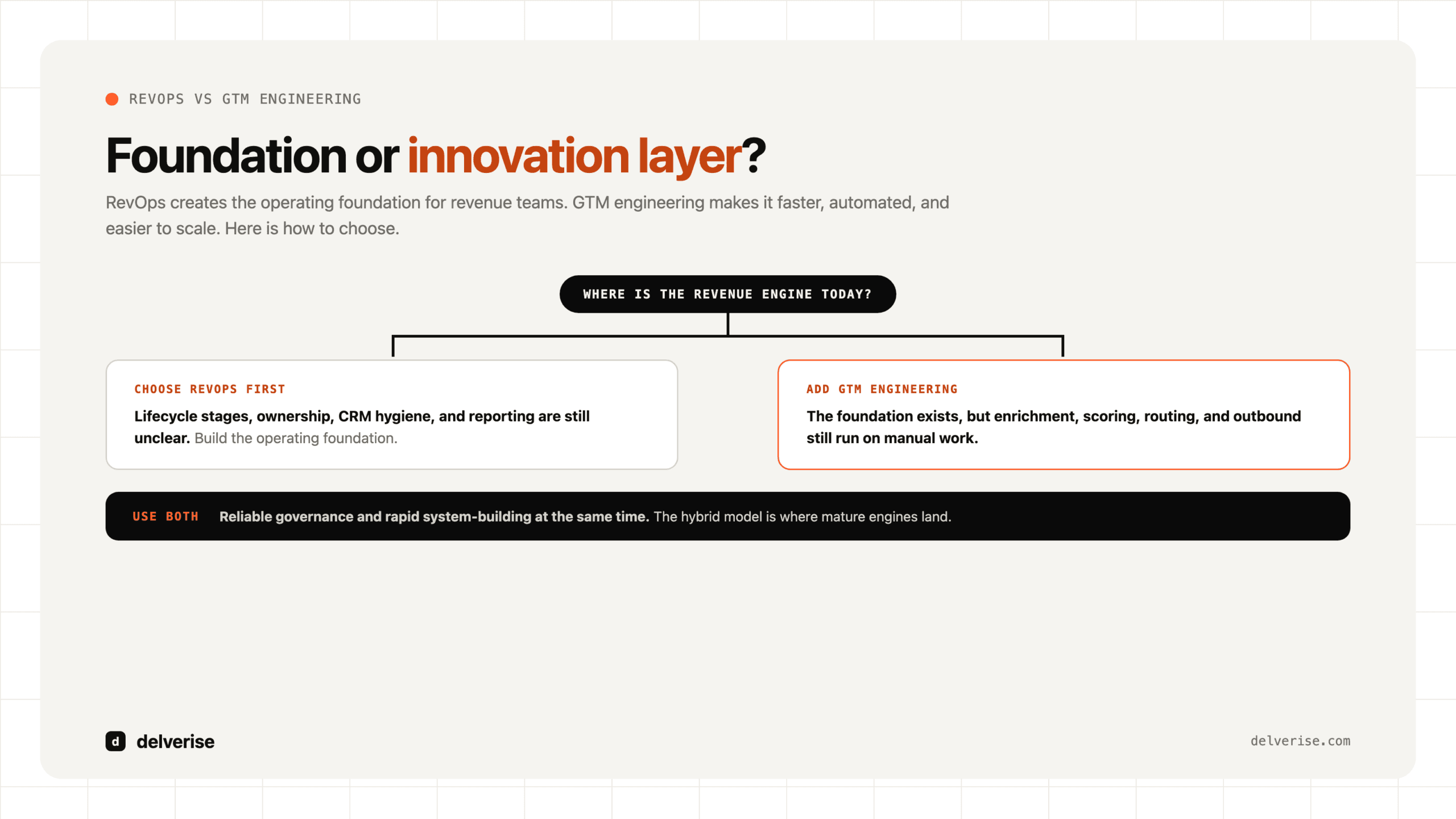
Short answer: RevOps creates the operating foundation for revenue teams; GTM Engineering builds the technical systems that make that foundation faster, more automated, and easier to scale.
- Choose RevOps first when lifecycle stages, ownership, CRM hygiene, reporting, and team handoffs are unclear.
- Add GTM Engineering when the foundation exists but enrichment, scoring, routing, outbound activation, and CRM workflows still depend on manual work.
- Use both when the business needs reliable governance and rapid system-building at the same time.
Defining the Concepts: Foundation vs. Innovation
At their core, Revenue Operations provides the stable foundation for all revenue-generating activities, while GTM Engineering builds an innovation layer on top of it to accelerate growth through technology.
What is Revenue Operations (RevOps)?
Revenue Operations is a strategic business function that integrates and aligns a company’s sales, marketing, and customer service departments to provide a unified, end-to-end view of the revenue process. Think of RevOps as the central nervous system of the go-to-market strategy. Its primary goal is to break down departmental silos and create a single source of truth for all revenue-related data and processes.
RevOps focuses on optimizing the entire revenue-generating process. It achieves this by focusing on four key pillars: operations management, enablement, insights, and tools. The ultimate objective is to drive predictable revenue by ensuring that all teams are working in concert, guided by shared data and a cohesive strategy. If the GTM strategy is an orchestra, RevOps is the conductor, ensuring every section plays in harmony to create a masterpiece of revenue growth.
What is GTM Engineering?
GTM Engineering is a more recent and technical evolution, applying an engineering mindset to design, build, and automate scalable revenue systems. It sits at the intersection of RevOps, growth, and sales, blending data-driven automation and AI-powered personalization to help revenue teams scale output without scaling effort.

Where RevOps ensures the existing systems run smoothly, GTM Engineering architects and builds new, more efficient ones. GTM Engineers are the builders of the revenue factory, using code, APIs, and AI to construct automated outbound systems, dynamic data pipelines, and personalized messaging at scale. Their focus is less on managing existing processes and more on inventing new ways to generate revenue with technology.
Scope Comparison: Shared Territory and Unique Domains
While GTM Engineering and RevOps are deeply interconnected, their areas of focus have both distinct and overlapping domains. RevOps is broader in its strategic and cross-functional scope, while GTM Engineering is deeper in its technical implementation.

As the diagram illustrates:
- Revenue Operations’ Unique Domain primarily involves cross-functional alignment, strategic revenue planning, and process standardization. This includes managing vendor relationships, facilitating team training and adoption of new processes, and owning the high-level forecasting and reporting that the C-suite relies on.
- GTM Engineering’s Unique Domain is centered on building and automating. This includes creating AI-powered personalization engines, constructing automated outbound prospecting systems, and designing the underlying revenue system architecture. They are the ones building custom integrations and data activation frameworks that turn raw data into revenue-generating actions.
- Shared Territory includes the foundational elements of the tech stack. Both functions are heavily involved in CRM management, ensuring data quality and enrichment, overseeing the technology stack, and tracking revenue metrics. However, their approach differs: RevOps manages these systems for stability and consistency, while GTM Engineering builds upon them to drive innovation and automation.
Approach Differences: Build vs. Optimize, Proactive vs. Reactive
The fundamental difference between the two functions can be seen in their core approach to problem-solving. RevOps is primarily focused on optimizing the present, while GTM Engineering is focused on building the future.

One distinction we keep returning to is personality fit. A natural RevOps professional loves solving people problems with process solutions and is energized by strategic conversations. A natural GTM Engineer sees manual processes and immediately thinks of ways to automate them, gaining satisfaction from building new systems from scratch. (For more on the RevOps vs GTM Engineering distinction.)
This is not a matter of one being “better” than the other. The two functions depend on each other. Without RevOps, GTM Engineering would be chaotic. Without GTM Engineering, RevOps would be stagnant.
According to Gartner, ‘By 2026, 65% of B2B sales organizations will transition from intuition-based to data-driven decision making, using technology that unites workflow, data, and analytics.’ That shift is exactly what GTM Engineering operationalizes on top of the RevOps foundation, which is why mature revenue engines invest in both rather than choosing one.
Team Structure & Roles: Build In-House or Bring In a Partner
Once you understand what each function involves, the next question is who runs it. The way each function is typically staffed gives you the inputs for that build-versus-buy decision.

The RevOps function is usually more hierarchical and structured around clearly defined functional roles. Its work centers on process ownership, project management, and cross-functional coordination across sales, marketing, and customer success. Building it in-house means hiring for those defined roles and giving them time to embed across teams, which suits companies with stable, ongoing process needs and the budget to carry headcount.
The GTM Engineering function, being a newer discipline, tends to be flatter and more technically focused. The roles demand deep skills in coding, API integration, and AI implementation, and that talent is scarce and expensive to recruit. Because the discipline is still taking shape, the way these teams are built and run keeps evolving quickly, so an in-house hire risks being out of date soon after onboarding.
That volatility is why partnering is often the better path, especially for Series A to C companies. A partner brings the technical depth, the AI tooling, and a current view of an evolving field without the recruiting timeline, the salary load, or the bet on a single hire keeping pace. Building in-house makes sense once the function is stable, the workload is predictable, and you can justify permanent headcount. Until then, a partner lets you access the capability at the stage when it moves fastest, and you can always transition to an internal team later as your needs settle.
The Maturity Journey: From Silos to Scalable Systems
Companies don’t typically hire for RevOps and GTM Engineering on day one. Their operational functions evolve as the company grows and matures. This journey can be visualized as a timeline, often correlated with Annual Recurring Revenue (ARR) milestones.

- Stage 1: Sales Ops (Early Stage, ~$1M-$5M ARR): The focus is on a single function, typically supporting the sales team with basic CRM administration and reporting. Processes are manual and reactive.
- Stage 2: Expanding Ops (Growth Phase, ~$5M-$20M ARR): As the company grows, a Marketing Ops function emerges. There are initial efforts to integrate systems, but alignment is still a challenge.
- Stage 3: Revenue Ops (Maturity Phase, ~$20M-$100M ARR): The pain of misalignment becomes too great, leading to the creation of a unified RevOps team. The focus shifts to cross-functional alignment, process standardization, and creating an integrated tech stack.
- Stage 4: GTM Engineering (Innovation Phase, ~$100M+ ARR): With a solid RevOps foundation in place, the company is ready to invest in scale and innovation. GTM Engineering is introduced to build automated, AI-powered systems on top of the stable operational base provided by RevOps.
When You Need What: A Decision Framework
So, which approach does your organization need? The answer depends on your current stage of maturity and your most pressing challenges. This decision tree can help guide your thinking:

- If you lack basic infrastructure, start with RevOps. If your teams are working in silos, your data is a mess, and you have no consistent processes, your immediate priority is to build a solid foundation. A strong RevOps function will integrate your core systems, align your teams, and establish the processes necessary for predictable growth.
- If your foundation is shaky, strengthen RevOps. If you have a RevOps team but still struggle with alignment, inefficient processes, or unreliable reporting, you need to optimize your existing operations before thinking about the next layer of innovation. A RevOps maturity model maps this stage clearly: it means moving from a basic foundation to a state of measurement and optimization.
- If your foundation is solid and you need to scale, add GTM Engineering. If your RevOps function is running smoothly, your data is clean, and your teams are aligned, but your growth is starting to plateau or you want to scale more efficiently, it’s time to invest in GTM Engineering. This team will build the automated systems and AI-powered workflows to take your growth to the next level.
Metrics and Success Criteria: How Each Function Measures Impact
One of the clearest ways to distinguish between GTM Engineering and Revenue Operations is to examine how each function defines and measures success. While there is some overlap in the metrics both teams care about, their primary focus areas reveal their distinct strategic priorities.
Revenue Operations Success Metrics center on operational efficiency and alignment. RevOps teams track process adoption rates to ensure that new workflows and tools are being used consistently across departments. They monitor data quality scores, measuring the completeness and accuracy of CRM records, because clean data is the foundation of reliable forecasting. Cross-functional alignment is often measured through team satisfaction surveys and the speed of handoffs between marketing, sales, and customer success. Finally, RevOps owns the accuracy of revenue forecasting, with success measured by how closely actual results match predictions.
GTM Engineering Success Metrics are more directly tied to revenue impact and system performance. These teams measure conversion rate improvements across the funnel, demonstrating how their automated systems increase the percentage of leads that become customers. They track revenue per sales rep, showing how automation allows each team member to generate more pipeline. Pipeline velocity, the speed at which deals move through the sales cycle, is another key metric, as GTM Engineering’s automated workflows can dramatically reduce friction. Finally, they measure automation coverage, tracking what percentage of previously manual tasks have been successfully automated.
The difference in metrics reflects the difference in mission. RevOps asks, “Are we running efficiently and predictably?” GTM Engineering asks, “Are we scaling revenue faster with the same resources?”
Addressing the Market Confusion: Why the Lines Are Blurry
If you’re confused about the difference between GTM Engineering and Revenue Operations, you’re not alone. The market itself is still grappling with these definitions. GTM Engineering is a relatively new discipline; the term emerged in 2023, and many professionals who now call themselves GTM Engineers were previously RevOps practitioners who upleveled their technical skills.
There’s also significant overlap in the tools both functions use, from CRMs to marketing automation platforms. What separates them is their approach to those tools. We’ve also found that nearly sixty percent of companies have established their RevOps functions in just the last two years, meaning many organizations are still figuring out what RevOps means for them, let alone how GTM Engineering fits into the picture.
The key takeaway: don’t get too hung up on titles. Focus instead on the capabilities your organization needs: alignment and process optimization, or automated system building.
Real-World Examples: What These Roles Actually Do Day-to-Day
Case Studies in Action
- GTM Engineering Pioneer: Clay is a prime example of a company built around the concept of GTM Engineering. The platform lets GTM Engineers build sophisticated, automated outbound campaigns by integrating dozens of data sources. Companies like Cursor, Lovable, and Webflow are leveraging GTM engineers to build powerful, AI-driven revenue engines, a shift documented across Clay’s blog.
The Future is a Hybrid Model
The debate over GTM Engineering vs. Revenue Operations presents a false choice. The two are not competitors but partners in the pursuit of revenue excellence. RevOps provides the stability, alignment, and process integrity that form the bedrock of any successful go-to-market strategy. GTM Engineering provides the technical innovation, automation, and scalability required to win in an increasingly complex and competitive market.
The most successful companies of the future will not choose one over the other; they will embrace a hybrid model where a robust RevOps function creates a stable foundation upon which a lean, agile GTM Engineering team can build, experiment, and innovate. By understanding the distinct value of each, you can build a revenue organization that is efficient, predictable, adaptable, and built for the future.
How delverise Builds the Hybrid Model
delverise helps B2B teams turn RevOps strategy into working GTM systems: enrichment, scoring, routing, outbound activation, CRM automation, reporting, and QA. If your operating foundation exists but execution still depends on manual work, start with our GTM Engineering page or apply to work with us.
Frequently Asked Questions
What is the difference between GTM Engineering and RevOps?
Revenue Operations provides the stable foundation for revenue-generating activities by aligning sales, marketing, and customer service around a single source of truth. GTM Engineering builds an innovation layer on top, applying an engineering mindset with code, APIs, and AI to architect new automated systems. RevOps focuses on optimizing the present through process and cross-functional alignment, while GTM Engineering focuses on building the future through technical automation and scalable revenue systems.
When does a company need GTM Engineering vs RevOps?
Invest in RevOps first to establish the foundational tech stack, data quality, and cross-functional alignment across sales, marketing, and customer service. Add GTM Engineering once that foundation is stable and you need to scale through automation, AI-powered personalization, or custom integrations. Without RevOps, GTM Engineering becomes chaotic. Without GTM Engineering, RevOps eventually stagnates. The two functions depend on each other rather than competing for the same scope.
What does a GTM Engineer actually do day-to-day?
GTM Engineers build and automate revenue systems using code, APIs, and AI. Their work includes constructing automated outbound prospecting systems, creating AI-powered personalization engines, designing revenue system architecture, and building custom integrations and data activation frameworks. They sit at the intersection of RevOps, growth, and sales, blending data-driven automation with AI to help revenue teams work smarter. A natural GTM Engineer sees a manual process and immediately thinks of ways to automate it.
How are RevOps and GTM Engineering team structures different?
RevOps teams are typically more hierarchical and structured around clearly defined functional roles, with work centered on process ownership, project management, and cross-functional coordination across sales, marketing, and customer success. GTM Engineering teams are newer, with a flatter and more technically focused structure. These roles require deep skills in coding, API integration, and AI implementation.
Where do RevOps and GTM Engineering overlap?
Both functions share territory in the foundational tech stack, including CRM management, data quality and enrichment, technology stack oversight, and revenue metrics tracking. The approach differs even where scope overlaps. RevOps manages these systems for stability and consistency, ensuring processes run smoothly across teams. GTM Engineering builds on top of those same systems to drive innovation and automation, turning raw data into revenue-generating actions through custom-built tools and pipelines.
Read next