←Back to blog
Growth & Demand GenerationGuideFebruary 9, 202611 min read
How to Create a Successful CRO Strategy for B2B SaaS
Learn how to build a CRO strategy for B2B SaaS that turns traffic into pipeline. Covers where to apply CRO, 9 steps to build your strategy, key metrics, and the tools that make it work.
What Is a CRO Strategy?

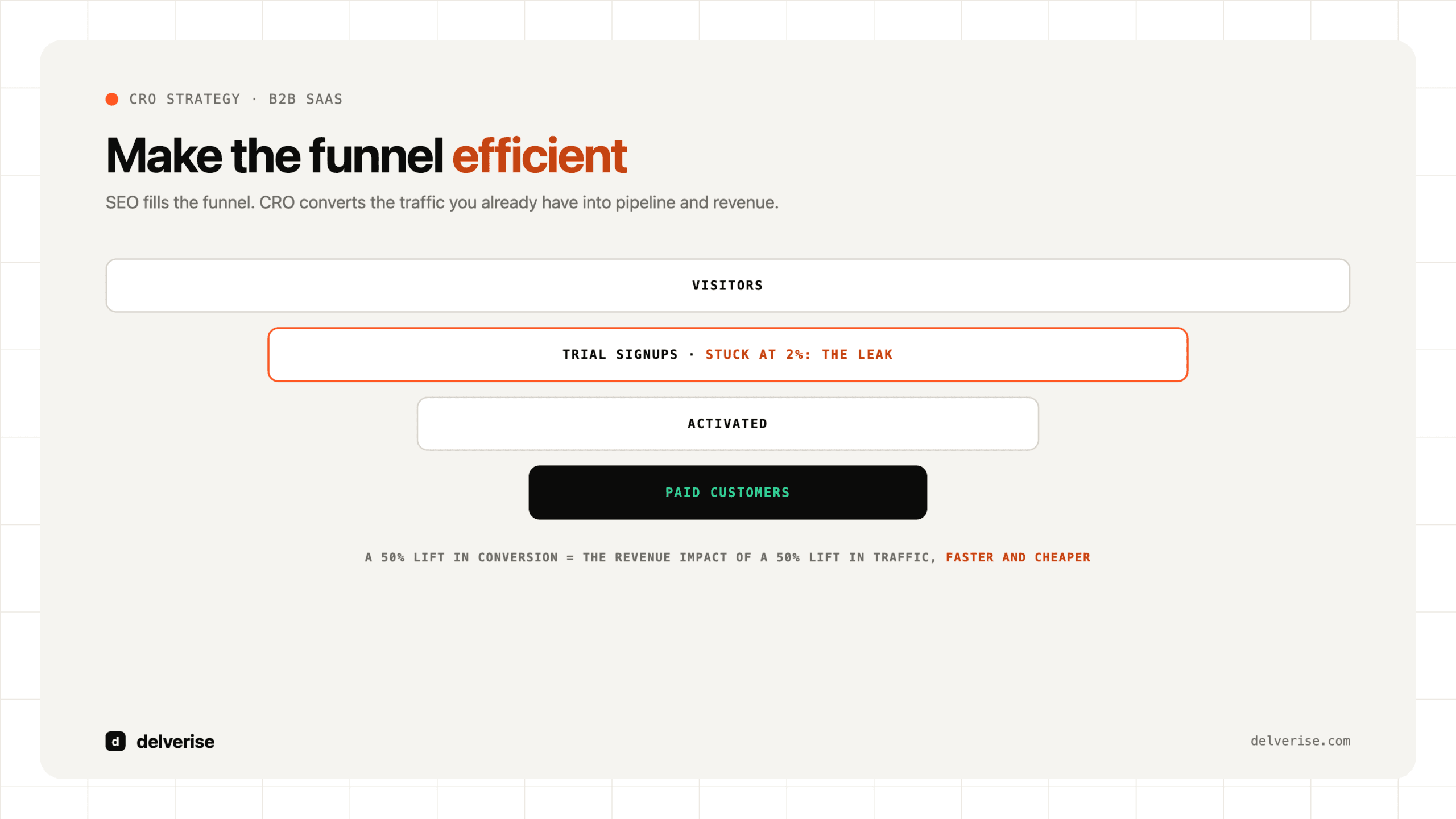
Your B2B SaaS website is generating traffic. Paid campaigns are running, organic rankings are climbing, and visitors are landing on your site every day. But your free trial signup rate sits at 2%. Demo requests trickle in. Leads visit your pricing page and vanish without taking action.
This gap between traffic and revenue is where Conversion Rate Optimization (CRO) delivers its highest ROI. A CRO strategy is the systematic process of increasing the percentage of website visitors who take a desired action, whether that is starting a free trial, requesting a demo, upgrading from freemium, or completing an onboarding flow.
For B2B SaaS companies, CRO is not about cosmetic tweaks. It is about understanding the decision-making process of buyers who evaluate software over days or weeks, often with multiple stakeholders involved. A strong CRO program examines every stage of the funnel: from the first landing page visit through to activation, expansion, and ultimately revenue.
According to HubSpot, companies with 40 or more landing pages generate 12x more leads than those with only 1 to 5. That statistic alone illustrates why optimizing what you already have often outperforms simply driving more top-of-funnel traffic. Yet most SaaS teams continue to pour budget into acquisition while their conversion paths leak revenue at every step.
A well-executed CRO strategy helps B2B SaaS companies:
- Increase trial-to-paid conversion rates
- Lower customer acquisition cost (CAC)
- Improve demo request volume without increasing ad spend
- Shorten sales cycles through better-qualified leads
- Maximize return on existing traffic and marketing investment
- Deepen understanding of your ideal customer profile (ICP)
Answer: A B2B SaaS CRO strategy is a structured system for turning existing traffic and demand into more qualified pipeline. It combines buyer research, funnel analytics, landing-page experiments, offer testing, form and routing improvements, sales follow-up, and measurement so conversion work improves revenue quality instead of only increasing form fills.
- Diagnose where high-intent visitors, accounts, or leads are dropping off.
- Prioritize tests by revenue impact, confidence, and implementation effort.
- Instrument pages, forms, CRM handoffs, and pipeline outcomes before scaling changes.
- Operationalize winning tests through workflows the team can keep running.
CRO vs. SEO: What Is the Difference?

SEO and CRO work on different sides of the same growth equation. SEO drives qualified traffic to your website by improving visibility in search results. CRO converts that traffic into pipeline and revenue. Both are essential, but they solve fundamentally different problems.
SEO focuses on:
- Increasing organic traffic volume through keyword targeting and content
- Improving keyword rankings and domain authority over time
- Expanding content reach across search engines and AI answer engines
CRO focuses on:
- Increasing the percentage of visitors who take a desired action
- Optimizing page layouts, messaging, and user flows for conversion
- Reducing friction in the path from anonymous visitor to paying customer
The most effective B2B SaaS go-to-market strategy combines both disciplines. SEO fills the funnel; CRO makes the funnel efficient. A 50% improvement in conversion rate has the same revenue impact as a 50% increase in traffic, but it is often faster and cheaper to achieve. Neglecting either one leaves growth on the table.
Where to Apply CRO in B2B SaaS

Not every page on your website deserves equal optimization effort. Focus your CRO resources on the pages and flows where conversion decisions actually happen. These high-impact areas will give you the fastest return on your testing investment.
Homepage
Your homepage is often the highest-traffic page and the first impression for prospects evaluating your product. Optimize it by testing headline copy, hero section CTAs, social proof placement, and navigation structure. The goal is to route visitors toward their next logical step, whether that is a product tour, pricing page, or demo request. A disorganized homepage that tries to speak to every audience at once will convert none of them well.
Pricing Page
The pricing page is where buying intent is highest and drop-off is most costly. Test pricing tier presentation, feature comparison layouts, FAQ placement, and CTA button copy. Small changes here, like moving the most popular plan to the center position, adding a “Talk to Sales” option alongside self-serve signup, or including a short testimonial from a recognizable customer, can shift conversion rates meaningfully. Since visitors on your pricing page are already deep in the evaluation process, even marginal improvements translate directly to revenue.
Free Trial and Demo Request Flows
The average SaaS website converts at 3 to 5 percent for free trial signups, according to industry benchmarks. If you are below that range, your signup flow likely has friction: too many form fields, unclear value propositions, missing trust signals, or a confusing post-signup experience. Audit each step of the flow and remove anything that does not directly serve the conversion. Consider testing single-step versus multi-step forms, and experiment with reducing required fields to only what is essential for qualification.
Onboarding Sequences
CRO does not stop at signup. The onboarding experience determines whether trial users reach their “aha moment” and convert to paid customers. Map the critical activation steps for your product, identify where users drop off in the journey, and optimize the in-app guides and email sequences that move them through each milestone. A trial user who never experiences your product’s core value will never convert, no matter how optimized your signup page is.
Chatbots and Live Chat
According to Gartner, chatbots will become the primary customer service channel for 25% of businesses by 2027. For B2B SaaS, strategically deployed chat, whether live or automated, can answer buyer objections in real time on high-intent pages like pricing and feature comparison pages, accelerating the path to conversion. The key is strategic placement: deploy chat where prospects are most likely to have questions that block a purchase decision, not on every page indiscriminately.
How to Build a B2B SaaS CRO Strategy: 9 Steps

1. Define Clear Conversion Goals
Start by identifying the specific actions that matter most to your business at this stage. For a product-led SaaS company, the primary conversion goal might be increasing free trial signups by 20% in the next quarter. For a sales-led motion, it could be doubling qualified demo requests from the pricing page. For a usage-based model, the goal might center on activating more free-tier users into paid plans. Every optimization decision should trace back to a defined, measurable goal with a clear timeline.
2. Conduct Thorough Market Research
Understand your ICP’s buying behavior, objections, and decision criteria before you start testing. Use tools like customer segmentation analysis, win/loss interviews, and message testing platforms like Wynter to identify what resonates with your target buyers and what falls flat. Survey recent customers about what nearly stopped them from signing up. Talk to prospects who evaluated your product but chose a competitor. This research should inform every element of your CRO program, from headline copy to form design to social proof selection.
3. Use Data-Driven Analysis Tools
Deploy a CRO analytics stack that gives you both quantitative and qualitative data. Google Analytics 4 provides traffic patterns and conversion funnel analysis. Hotjar and Fullstory offer session recordings and heatmaps that reveal exactly where users hesitate, rage-click, or abandon the page. Together, these tools show you what is happening on your site and why visitors behave the way they do. Start with the quantitative data to identify problem areas, then use qualitative tools to diagnose the root cause before designing a test.
4. Implement A/B Testing
Test one variable at a time on critical pages. Run experiments on CTA copy, button placement, headline messaging, form length, and social proof positioning. Use platforms like VWO or Optimizely to manage tests with statistical rigor and avoid calling winners too early. HubSpot found that personalized CTAs convert 202% better than default versions, which makes CTA testing one of the highest-leverage activities in any CRO testing program. Start with your highest-traffic, highest-intent pages to reach statistical significance faster.
5. Segment Your Audience
Not all visitors have the same intent, needs, or readiness to buy. Segment by company size, industry vertical, traffic source, or funnel stage, and tailor the experience accordingly. A first-time visitor from an organic search needs different messaging than a returning visitor who already attended a webinar or downloaded a whitepaper. Mutiny and similar personalization platforms make it possible to serve dynamic page content to different segments without engineering effort, turning a single landing page into multiple targeted experiences.
6. Optimize for Mobile
Even in B2B, a significant and growing share of initial research happens on mobile devices. Decision-makers browse on their phones during commutes, between meetings, and outside office hours. Ensure your key conversion pages, especially pricing and signup flows, work flawlessly on smaller screens. Test form usability, page load speed, CTA tap targets, and responsive layout behavior on actual mobile devices rather than just browser emulators.
7. Personalize User Journeys
Move beyond one-size-fits-all pages. Use behavioral data to serve relevant content, case studies, and CTAs based on a visitor’s industry, role, company size, or previous interactions with your site. For example, a visitor who spent time on your integrations page should see integration-focused social proof and case studies on subsequent visits. A visitor from the financial services industry should see testimonials from fintech customers. Personalization at scale is one of the fastest-growing areas in B2B CRO because it compounds: each personalized experience increases both conversion rates and the quality of data you collect for future optimization.
8. Remove Friction at Every Step
Audit your conversion paths for unnecessary obstacles. Common friction points in B2B SaaS include: requiring a credit card for free trials, asking for too much information on demo request forms, slow page load times on landing pages, confusing navigation between pricing tiers, and unclear next steps after form submission. Every field you remove and every second you shave off load time compounds into measurable conversion gains. For early-stage startups with limited traffic, prioritize fixing obvious friction points before investing in statistically rigorous A/B tests. Often, the biggest wins come from removing barriers rather than testing variations.
9. Continuously Monitor and Iterate
CRO is not a one-time project. Build a regular cadence of reviewing performance metrics, identifying new test hypotheses, and running experiments. Your marketing operations infrastructure should support this cycle with dashboards that track conversion rates by page, segment, and traffic source on a weekly basis. The companies that win at CRO are the ones that treat it as an ongoing discipline, not a quarterly initiative. Document every test, including failures, so your team builds institutional knowledge about what your specific audience responds to.
Key CRO Metrics for B2B SaaS

A CRO strategy is only as strong as the metrics you track. Without clear measurement, you cannot distinguish real improvements from noise. These are the KPIs that matter most for B2B SaaS conversion optimization:
- Visitor-to-trial conversion rate: the percentage of website visitors who start a free trial
- Trial-to-paid conversion rate: the percentage of trial users who become paying customers
- Demo request rate, the percentage of pricing or product page visitors who request a demo
- Bounce rate, particularly on landing pages and the pricing page, where high bounce signals messaging mismatch
- Average session duration: indicates engagement depth and content relevance
- Page load time directly impacts conversion rates, especially on mobile where patience is lower
- Scroll depth: reveals whether visitors consume enough content to make an informed conversion decision
- Activation rate: the percentage of trial users who complete key onboarding steps
- Click-through rate (CTR), on CTAs, email sequences, and in-app prompts
- Return on Investment (ROI): the revenue impact of CRO efforts relative to cost and resources invested
Track these metrics using a combination of Google Analytics 4, your product analytics platform, and CRO tools like Hotjar, Fullstory, or VWO. Build a shared dashboard that your growth team reviews weekly so optimization stays continuous rather than reactive. Over time, these metrics reveal patterns in your funnel that point directly to your next highest-impact test.
Stop Guessing, Start Converting
Most B2B SaaS companies leave significant revenue on the table by focusing exclusively on traffic acquisition while neglecting conversion optimization. The highest-performing growth teams treat CRO as a core competency, not an afterthought. They invest in the tools, processes, and expertise needed to systematically turn more visitors into customers.
At delverise, we help B2B SaaS companies build data-driven CRO programs that turn traffic into pipeline. From landing page optimization and A/B testing to full-funnel conversion strategy, we work as your growth team to maximize the revenue potential of every visitor who reaches your site.
Let’s optimize your funnel.
Need CRO connected to the revenue system? delverise builds growth systems that connect conversion paths, enrichment, routing, follow-up, automation, and reporting so experiments turn into measurable pipeline. Explore Growth Engineering, AI Lead Generation, GTM Engineering, or apply to work with us.
Frequently Asked Questions
What is a CRO strategy in B2B SaaS?
A CRO strategy is the systematic process of increasing the percentage of website visitors who take a desired action, such as starting a free trial, requesting a demo, upgrading from freemium, or completing onboarding. For B2B SaaS, it goes beyond cosmetic tweaks and examines every funnel stage, from landing page visit through activation, expansion, and revenue. A strong program increases trial-to-paid rates, lowers CAC, improves demo volume without higher ad spend, and shortens sales cycles.
What is the difference between CRO and SEO?
SEO drives qualified traffic to your website by improving visibility in search results, while CRO converts that traffic into pipeline and revenue. SEO focuses on keyword rankings, content reach, and organic traffic volume. CRO focuses on page layouts, messaging, and user flows that reduce friction from visitor to paying customer. A 50% improvement in conversion rate has the same revenue impact as a 50% traffic increase, but is often faster and cheaper to achieve.
Where should B2B SaaS companies apply CRO first?
Focus CRO resources on high-impact pages and flows where conversion decisions actually happen: the homepage, pricing page, free trial and demo request flows, onboarding sequences, and strategic chatbot placement. The pricing page is especially critical because buying intent is highest there and drop-off is most costly. Free trial flows typically convert at 3 to 5 percent, so auditing form fields, value propositions, and trust signals delivers fast returns on testing investment.
What is a good free trial conversion rate for SaaS?
The average SaaS website converts at 3 to 5 percent for free trial signups, according to industry benchmarks. If your rate falls below that range, your signup flow likely has friction such as too many form fields, unclear value propositions, missing trust signals, or a confusing post-signup experience. Audit each step, remove anything that does not directly serve the conversion, and test single-step versus multi-step forms while reducing required fields to qualification essentials.
Why do landing pages matter for SaaS lead generation?
According to HubSpot, companies with 40 or more landing pages generate 12x more leads than those with only 1 to 5. This shows why optimizing what you already have often outperforms simply driving more top-of-funnel traffic. Most SaaS teams pour budget into acquisition while their conversion paths leak revenue at every step. Building out and optimizing landing pages maximizes return on existing traffic and deepens understanding of your ideal customer profile.
Read next