←Back to blog
Revenue OperationsGuideJuly 1, 20268 min read
Lead Scoring: How B2B SaaS Teams Rank Pipeline by Real Buying Intent
Lead scoring is the practice of assigning each lead a numeric value based on how well they match your ideal customer and how much buying intent they show, so sales works the accounts most likely to close. A good model blends firmographic fit (company size, industry, role) with behavioral signals (product usage, content engagement, buying-committee activity) into one prioritized queue.
Lead scoring is the practice of assigning each lead a numeric value based on how well they match your ideal customer and how much buying intent they show, so sales works the accounts most likely to close. A good model blends firmographic fit (company size, industry, role) with behavioral signals (product usage, content engagement, buying-committee activity) into one prioritized queue.
Key takeaways
- Lead scoring exists to answer one question for your reps: who do I call first, and why?
- The strongest models separate fit (should we sell to them) from intent (are they ready to buy now), then combine both.
- Most scoring fails because of stale data, points assigned to vanity actions, and no feedback loop from closed-won deals.
- You do not need machine learning to start. A transparent points model calibrated against your last 12 months of deals beats a black box nobody trusts.
- Scoring is a system, not a one-time setup. It needs owners, a scoring rubric, and quarterly recalibration tied to real outcomes.
What is lead scoring and why does it matter?
Lead scoring ranks incoming and existing leads so your revenue team spends its limited hours on the accounts most likely to convert. Every rep has a finite number of dials, emails, and demos per week. Without a scoring system, that capacity gets spread evenly across good and poor prospects, which quietly caps your win rate.
The economics are stark. Research on B2B buying from Gartner has repeatedly shown that buyers spend only a small share of their journey talking to any single vendor, with much of their time spent researching independently and meeting internally. If a buyer gives you a narrow window of attention, you want your best reps in that window with your best-fit accounts. Scoring is how you make that match at scale instead of by gut feel.
Scoring also protects your funnel math. When you rank leads honestly, you can measure conversion by tier and forecast with far more confidence. This connects directly to the metrics that matter downstream, which we break down in our guide to B2B sales funnel metrics.
What signals should a lead scoring model use?
A durable model draws from two distinct sources. Keeping them separate is what makes the score readable later.

Fit signals (firmographic and demographic)
Fit answers whether a company belongs in your market at all. Common inputs:
- Company size by headcount or revenue band, mapped to where your product actually wins.
- Industry or vertical, weighted toward the segments with your highest historical close rates.
- Job title and seniority, so a VP of Sales scores higher than an individual contributor for a sales tool.
- Tech stack, since running a complementary platform (a CRM like Salesforce or HubSpot, an enrichment tool like Clay) often signals readiness.
- Geography, if you have regional coverage or compliance constraints.
Fit scoring depends on clean firmographic data, which is where enrichment earns its keep. If you are still standardizing this layer, our overview of CRM enrichment covers how to keep those attributes accurate.
Intent signals (behavioral)
Intent answers whether a good-fit company is showing buying motion right now. Strong behavioral inputs:
- Requesting a demo, starting a trial, or opening a pricing page more than once.
- Repeat visits to product or comparison pages within a short window.
- Email and content engagement that clusters in time, not one accidental open.
- Multiple people from the same account engaging, which signals a forming buying committee.
- Product usage milestones for product-led motions, such as inviting a teammate or hitting an activation event.
Weight these by proximity to purchase. A pricing-page visit and a demo request deserve far more points than a single blog read. Marketing teams often connect these behaviors to lifecycle stages, a topic we cover in our piece on the modern marketing funnel.
Fit vs. intent: how do the two work together?
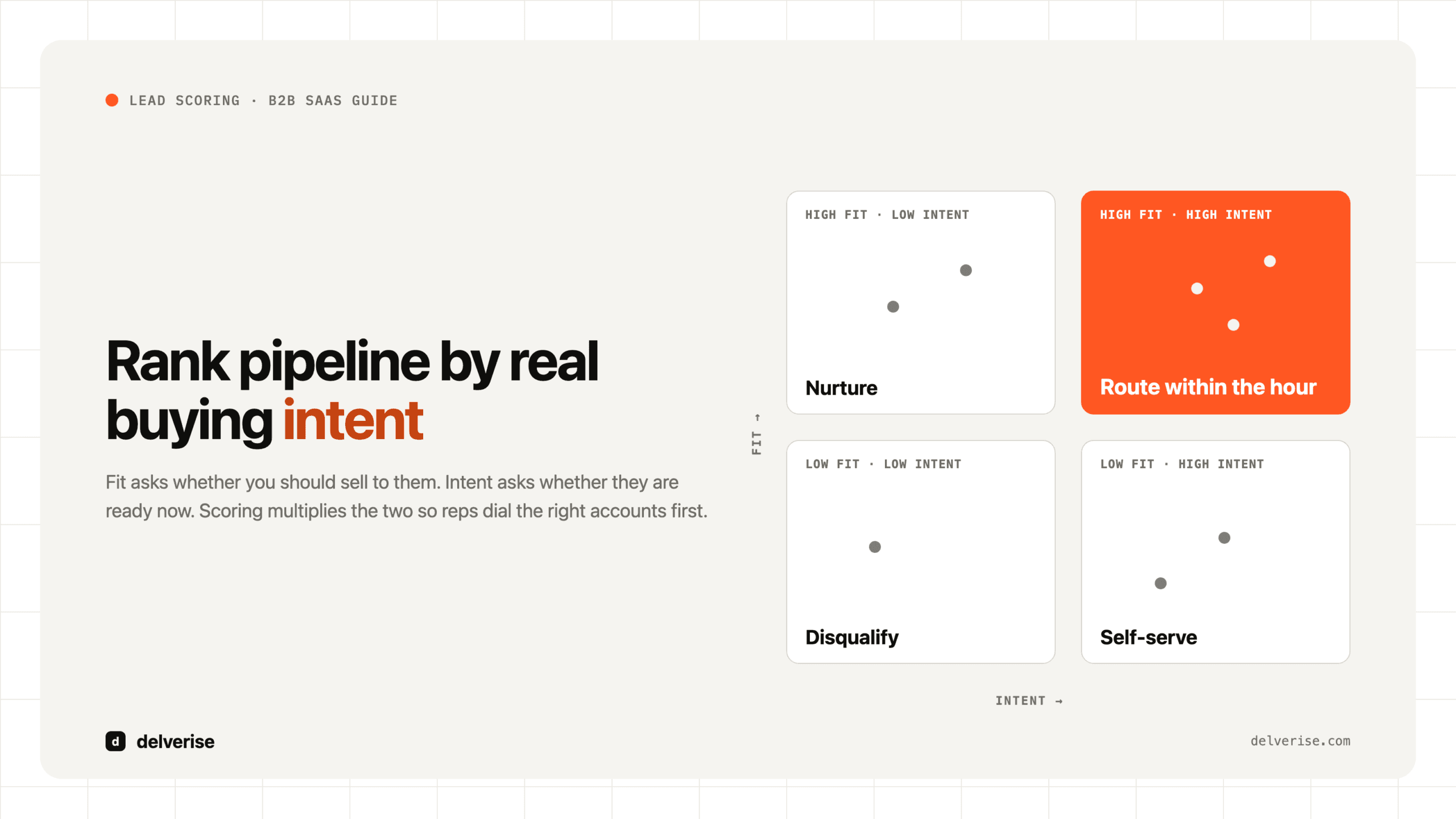
The clearest way to operationalize a model is a simple two-axis grid. Score fit on one axis and intent on the other, then let the quadrant dictate the action.

This grid prevents a common mistake: chasing loud, active leads who will never be a fit, while ignoring quiet accounts that match your best customers perfectly. The high-fit, high-intent quadrant is where speed matters most. HBR’s well-known study on lead response time found that companies contacting a prospect within the first hour were dramatically more likely to qualify that lead than those who waited even a few hours. Your scoring model is what tells a rep which leads deserve that hour.
How do you build a lead scoring model that works?
You can stand up a working model in five steps without any predictive tooling.

1. Mine your closed-won and closed-lost data
Pull your last 12 to 18 months of deals. Look for the attributes and behaviors that best-fit closed-won accounts shared, and the patterns that predicted a stall. This historical grounding is what keeps your point values honest instead of aspirational. Understanding these patterns also sharpens your customer segmentation, which feeds directly back into fit scoring.
2. Assign transparent point values
Give each fit attribute and intent action a point value tied to how strongly it correlated with a win. Keep the rubric visible to your reps. A model people can read and challenge is a model they will trust and use.
3. Set threshold tiers and routing rules
Define clear tiers, for example A, B, and C, with a marketing-qualified threshold and a sales-qualified threshold. Then wire each tier to an action: A-tier routes to a rep within minutes, B-tier enters nurture with alerts, C-tier stays out of the priority queue. Getting this routing right is a core piece of marketing operations.
4. Add decay and negative scoring
Intent is perishable. A demo request from six months ago is not the signal it was last week, so scores should decay over time. Apply negative points for disqualifying attributes too: a personal email domain, a student title, or a competitor visiting your pricing page. Without decay and negatives, scores inflate and lose meaning.
5. Close the loop
Feed deal outcomes back into the model every quarter. If your A-tier leads are not converting better than your B-tier, the model is miscalibrated and needs new weights. This feedback discipline separates a scoring system that compounds from a static rule set that decays.
What are the most common lead scoring mistakes?
Across B2B SaaS teams, the same failure modes recur.
- Scoring on vanity actions. Awarding heavy points for email opens or generic page views inflates scores without predicting revenue. Weight actions by their real correlation to closed deals.
- Stale firmographic data. A fit score built on outdated titles and headcounts misroutes leads daily. Enrichment and regular verification keep the fit layer trustworthy.
- No decay. Scores that only ever climb turn every old lead into a false A-tier, burning rep time.
- Set-and-forget. A model built once and never recalibrated drifts away from your evolving ICP within a year.
- Ignoring the buying committee. B2B purchases involve multiple stakeholders. McKinsey’s research on B2B sales has highlighted how decisions increasingly move through committees and multiple channels, so scoring one contact in isolation misses the account-level signal. Roll individual scores up to an account view.
Getting the tooling layer right prevents several of these at once. Teams choosing infrastructure for the first time can start with our guide to the best MarTech stack for Series A startups.
Do you need AI or predictive lead scoring?
Predictive lead scoring uses machine learning to find patterns in your historical data and assign scores automatically, rather than relying on manually set point values. It can surface non-obvious correlations and adapt as data grows. That power comes with real requirements though.
Predictive models need a meaningful volume of clean, labeled deal data to train on. A seed-stage company with 40 closed deals does not have enough signal for a model to learn from reliably, and a black-box score your reps cannot interrogate erodes trust fast. The honest tradeoff: start with a transparent rules-based model, prove it changes rep behavior and conversion, then graduate to predictive scoring once your data volume and pipeline maturity justify it. For teams ready to layer automation onto a working foundation, our overview of AI lead generation automation covers where machine learning genuinely helps.
Whichever path you choose, scoring is one component of a larger revenue system. It only pays off when fit data, routing, sequencing, and reporting all connect, which is the systems work at the center of GTM engineering.
Frequently Asked Questions
What is a good lead scoring model for B2B SaaS?
A good model separates fit (firmographic and role data showing whether a company belongs in your market) from intent (behavioral signals showing they are ready to buy), scores each, and combines them into clear tiers with defined routing rules. It stays transparent enough for reps to trust and gets recalibrated against closed-deal data every quarter.
What is the difference between lead scoring and lead grading?
Grading typically refers only to fit, giving a letter or rating based on how well a company matches your ideal customer profile. Scoring usually refers to the combined number that includes behavioral intent. Many teams use both together: a grade for fit and a numeric score for intent, then route on the pairing.
How many points should a lead need to be sales-ready?
There is no universal number, because point values are specific to your rubric. Set the sales-qualified threshold by looking at the score your historical closed-won leads had when a rep first engaged them. Calibrate so that leads above the threshold convert meaningfully better than leads below it, then adjust quarterly.
How often should you update your lead scoring model?
Review the model quarterly at minimum, and any time your ICP, pricing, or product shifts materially. The trigger to recalibrate is data: if your top-tier leads stop converting better than lower tiers, the weights no longer reflect reality and need revision.
Can you do lead scoring without a full CRM or automation platform?
Yes. A spreadsheet with clear point values and a weekly manual pass can work at very low volume. It stops scaling once lead flow grows or you need real-time routing, at which point moving the logic into your CRM or a marketing automation tool becomes worth it. Compare options in our look at HubSpot vs Salesforce for startups.
Read next