←Back to blog
Revenue OperationsGuideJuly 28, 20267 min read
Demand Forecasting Software: What Do B2B SaaS Teams Actually Need?
Demand forecasting software predicts future demand for your product by modeling historical pipeline, marketing performance, and market signals. In B2B SaaS it forecasts qualified pipeline, bookings, and revenue by segment. It earns its price when your CRM data is trustworthy, your stage definitions are enforced, and one person owns the model.
Demand forecasting software predicts future demand for your product by modeling historical pipeline, marketing performance, and market signals. In B2B SaaS it forecasts qualified pipeline, bookings, and revenue by segment. It earns its price when your CRM data is trustworthy, your stage definitions are enforced, and one person owns the model.
Key takeaways
- In B2B SaaS, “demand forecasting” usually means forecasting qualified pipeline and bookings. The supply chain version, forecasting units and inventory, solves a different problem.
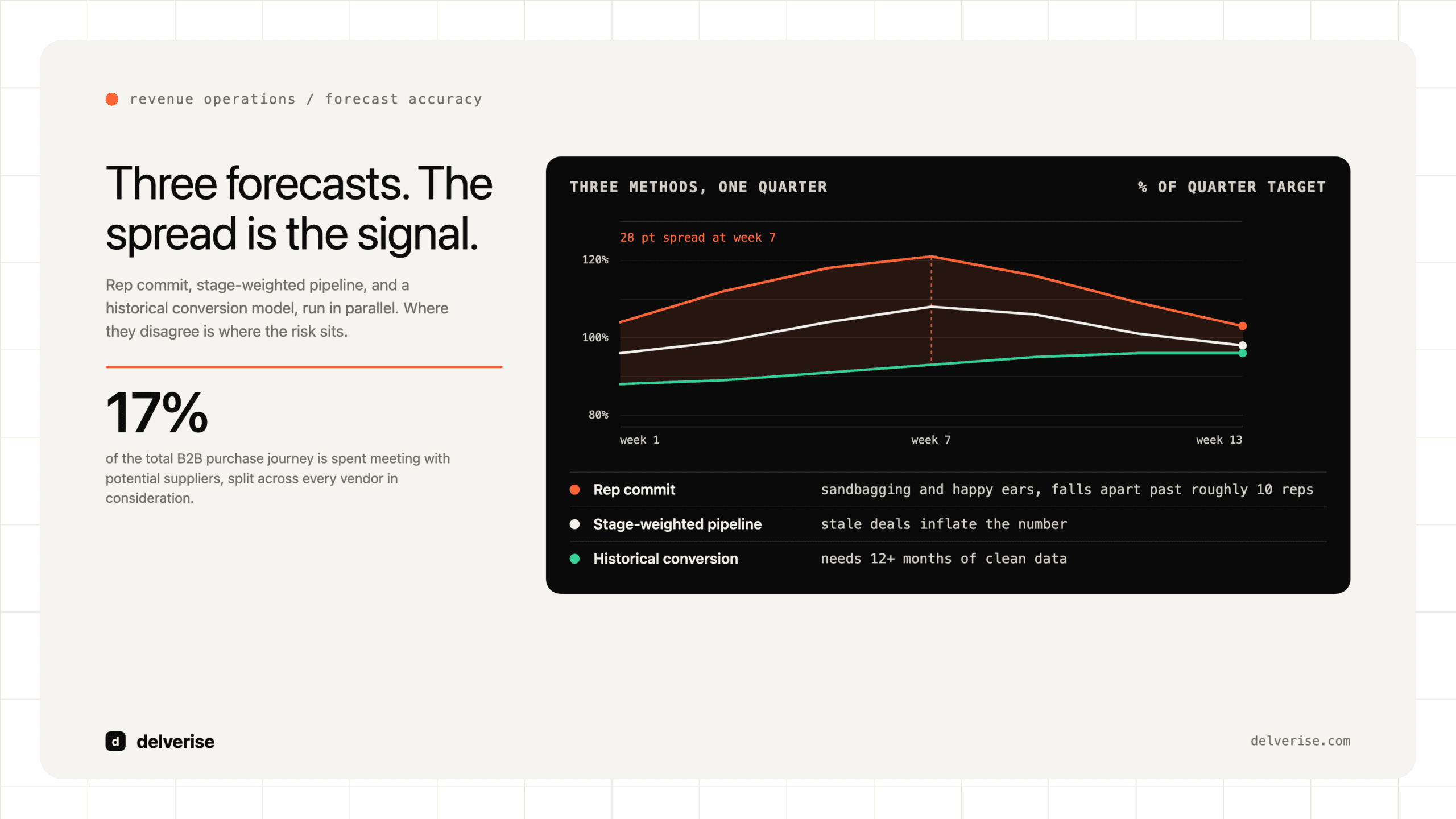
- Gartner’s research on sales forecasting found that fewer than half of sales leaders have high confidence in their own organization’s forecast accuracy. Software rarely closes that gap on its own.
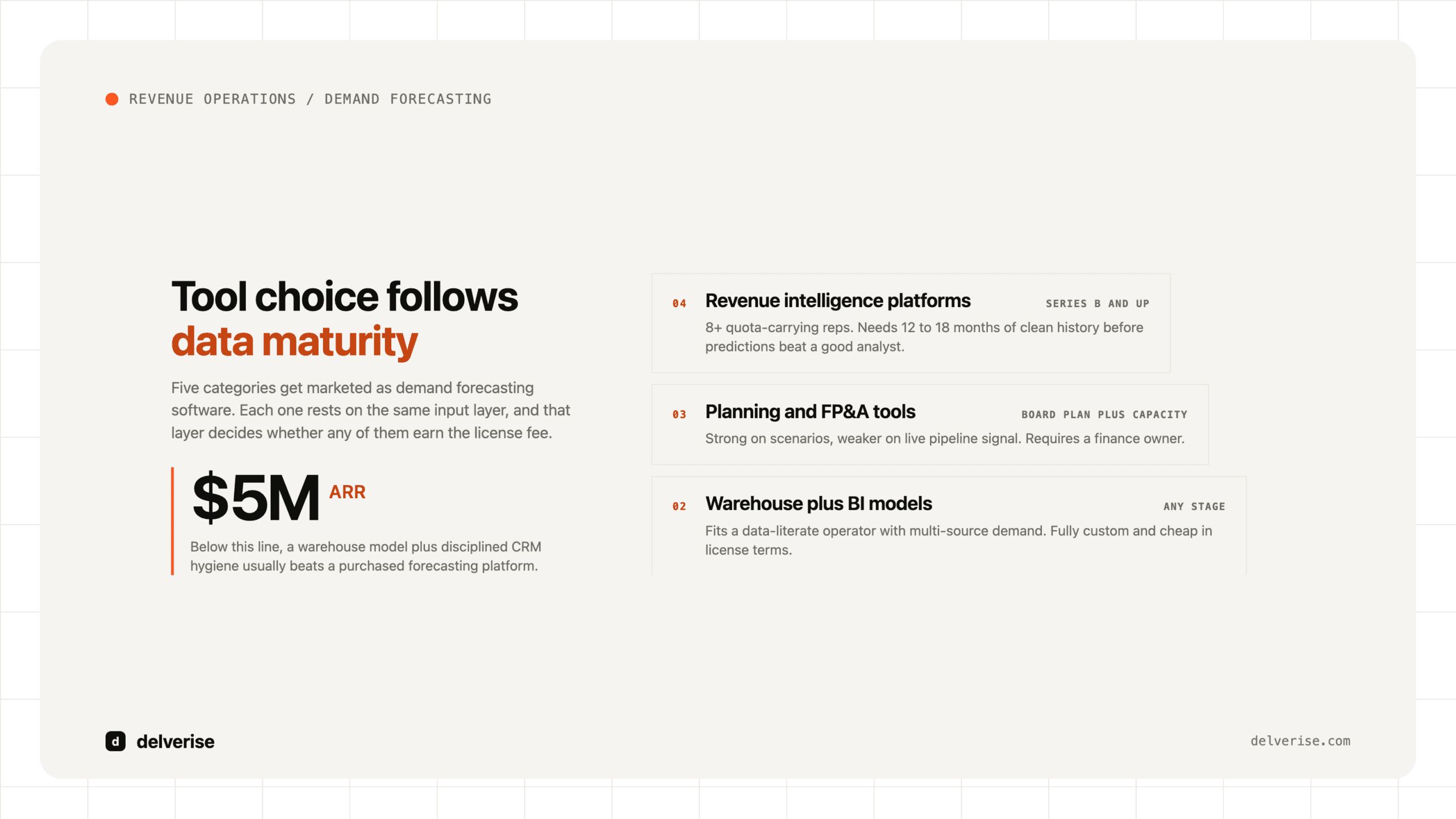
- Tool choice follows data maturity. Under $5M ARR, a warehouse model plus disciplined CRM hygiene usually beats a purchased forecasting platform.
- The forecast is only as good as its weakest input: stage definitions, win rate math, capacity assumptions, and lead source attribution.
- Budget for instrumentation, not just license fees. Most failed implementations fail at data mapping.
What is demand forecasting software, and does B2B SaaS need it?
Demand forecasting software is any system that takes historical and current signals and produces a quantified prediction of future demand. In manufacturing that output is units. In B2B SaaS the output is pipeline created, opportunities by stage, bookings, and net new ARR, usually cut by segment, region, and channel.

The reason the category confuses SaaS buyers is that most search results describe inventory planning. If you sell software, you are forecasting two things: how much qualified demand your go-to-market motion will generate, and how much of that demand will convert into revenue inside a given period. Those are separate models with separate error rates, and most teams collapse them into one spreadsheet.
You need software when three conditions hold at once: your revenue plan depends on more than one acquisition channel, your sales cycle is long enough that this quarter’s bookings were created last quarter, and enough people now touch the number that a single spreadsheet owner becomes a bottleneck. Before that, you need better inputs.
Which category of forecasting tool fits your stage?
Five distinct product categories get marketed as demand forecasting software. They are not interchangeable, and G2 reviews across these categories repeatedly flag the same friction: implementation, field mapping, and data quality rather than features.

| Category | Examples | Best fit | Honest tradeoff |
|---|---|---|---|
| CRM-native forecasting | Salesforce Forecasting, HubSpot Forecasting | Seed to Series A, single motion, one CRM of record | Inherits every flaw in your CRM hygiene. Weak at multi-channel demand modeling. |
| Revenue intelligence platforms | Clari, Gong Forecast, BoostUp | Series B and up with 8+ quota-carrying reps and enough closed deals to train on | Priced for scale. Needs 12 to 18 months of clean history before predictions beat a good analyst. |
| Planning and FP&A tools | Pigment, Cube, Anaplan, Causal | Teams reconciling a board plan, headcount capacity, and pipeline in one model | Strong on scenarios, weaker on live pipeline signal. Requires a finance owner. |
| Warehouse plus BI models | BigQuery or Snowflake with dbt, Looker, Hex | Any stage with a data-literate operator and multi-source demand | Fully custom and cheap in license terms. Costs engineering time and needs documentation. |
| Demand planning suites | Netstock, Kinaxis, o9 | Physical goods, inventory, supply constraints | Almost never the right buy for a pure software business. |
What does a working forecast look like in practice?
Here is a worked example using round numbers. A Series A company sits at $6M ARR with a $24K average contract value and a board plan calling for $3M in net new ARR next year.

Work the model backwards from bookings:
- $3M target divided by 22% historical opportunity win rate means roughly $13.6M of qualified pipeline must be created.
- At $24K ACV, that is about 568 qualified opportunities, or 47 per month.
- If 60% of sales-qualified leads become opportunities, the top of the funnel needs roughly 947 SQLs.
- $3M divided by $24K means 125 new customers. If a productive AE closes five deals a quarter, that is 25 per AE per year, so six ramped reps and a hiring plan that accounts for a 90 day ramp.
Now the important part. Every number above is an assumption with an error bar. If the true win rate is 17% rather than 22%, required pipeline jumps to $17.6M, a 29% increase in demand generation load that no software will discover for you after the fact. This is why forecast reviews should argue about conversion rates and capacity, not about whether the dashboard refreshed.
Sales cycle length is the other silent variable. With a 75 day average cycle, pipeline created in month 11 has almost no chance of contributing to the year. Forecasting software earns its keep when it enforces that arithmetic automatically instead of letting optimism carry a deal into the current quarter’s commit.
What data has to be in place before software helps?
Forecast accuracy is a data engineering outcome. Four inputs carry most of the weight.
Stage definitions with exit criteria. Every stage needs an observable event that moves a deal forward, such as a named economic buyer, a documented pain, or a written next step. Without exit criteria, stage-weighted forecasting is just rep sentiment with decimal places.
Account and contact data that resolves cleanly. Duplicate accounts, missing firmographics, and blank industry fields break segment-level forecasting immediately. This is where CRM enrichment stops being a hygiene project and becomes a forecasting prerequisite, because you cannot model demand by segment if the segment field is empty on a third of your accounts.
Source and channel attribution you trust. Forrester’s work on buying groups shows that most B2B purchases involve a group of stakeholders, and McKinsey’s B2B Pulse research found buyers now move across roughly ten interaction channels during a purchase. Single-touch attribution will systematically misprice your channels and push budget toward whatever gets credited last.
Capacity data. Rep count, ramp status, quota, and territory. Demand forecasts that ignore capacity produce plans nobody can execute.
If two or more of these are broken, buying a platform converts a data problem into a data problem with a subscription. Fixing the instrumentation first is the higher-return sequence, and it is the core of GTM engineering work.
How should you evaluate demand forecasting software?
Run the evaluation against your own data, not a vendor demo dataset. A useful test: give each vendor your last four closed quarters and ask what their model would have predicted at the start of each one. Any tool that cannot backtest is selling dashboards.
- Backtest each finalist against four historical quarters of your own closed-won data
- Confirm which CRM objects and fields are required, and who will maintain them
- Ask for the implementation timeline in weeks, with named milestones
- Define the accuracy metric before signing, usually mean absolute percentage error on quarterly bookings
- Verify segment-level forecasting, not just a single company-wide number
- Check whether marketing-sourced demand and outbound-sourced demand can be modeled separately
- Price the full first year: license, implementation, integration work, and internal analyst time
- Name the single owner of the forecast before the contract starts
Where does demand forecasting software usually fail?
Three failure patterns account for most of the disappointment.
The first is a model trained on too little history. Predictive forecasting needs volume. A company closing 30 deals a year does not have a statistical problem, it has a judgment problem, and judgment is cheaper to improve through disciplined pipeline reviews.
The second is forecasting demand you have no system to create. A model can tell you that you need 947 SQLs. Producing them requires working pipeline generation infrastructure, whether that is AI-assisted outbound, paid acquisition, partnerships, or content. Teams frequently buy the measurement layer and skip the creation layer, then blame the forecast for being pessimistic.
The third is ownership drift. When sales, marketing, and finance each keep a private version, the forecast becomes a negotiation. One owner, one model, one weekly cadence, and documented assumptions that anyone can inspect.
Forecasting is a RevOps discipline with a software component. Treat the software as the last 20% of the work and the odds improve considerably.
Frequently Asked Questions
Is demand forecasting software the same as sales forecasting software?
They overlap but answer different questions. Sales forecasting predicts how much of your existing pipeline will close in a period. Demand forecasting predicts how much new qualified pipeline your go-to-market motion will generate. Most B2B SaaS teams need both, and many revenue intelligence platforms bundle them, which is why the terms get used interchangeably in vendor marketing.
What forecast accuracy should a B2B SaaS company expect?
A mature process typically lands within 5 to 10% of quarterly bookings, measured as mean absolute percentage error. Companies under $10M ARR with lumpy deal sizes often see 20% or worse, and that is normal because a single large deal slipping moves the whole number. Set the accuracy target relative to your deal concentration rather than an industry average.
Do we need forecasting software before Series A?
Usually no. At that stage the constraint is data quality and process discipline, and both are fixable with your CRM’s native forecasting plus a documented model in the warehouse or a spreadsheet with version control. The trigger for buying is normally 8 or more quota-carrying reps, multiple segments, or a board that needs scenario planning.
Can AI forecast our pipeline if our CRM data is messy?
AI models will produce a confident number from messy data, and that is the risk. Machine learning amplifies whatever signal exists in your history, including systematic bias in how reps set close dates. Clean stage definitions and complete account data first. Enrichment tooling like Clay helps close firmographic gaps quickly, which makes segment-level modeling viable.
Who should own the demand forecast?
RevOps owns the model and the data. Sales leadership owns the commit. Finance owns the reconciliation to the plan. When RevOps does not exist yet, the owner should be whoever controls the CRM configuration, because the forecast is downstream of field-level decisions that person makes every week.
Read next