←Back to blog
August 23, 20266 min read
Go-To-Market Consultant vs Building In-House: How to Decide
Most companies do not start by asking whether they need a go-to-market consultant. They start by trying to hire one person who can fix pipeline, and then discovering that the job description they wrote describes four different people. That is the real decision underneath the search. Not consultant or nothing. It is a choice between a first GTM hire, an agency, a consultant, and doing nothing for another quarter.
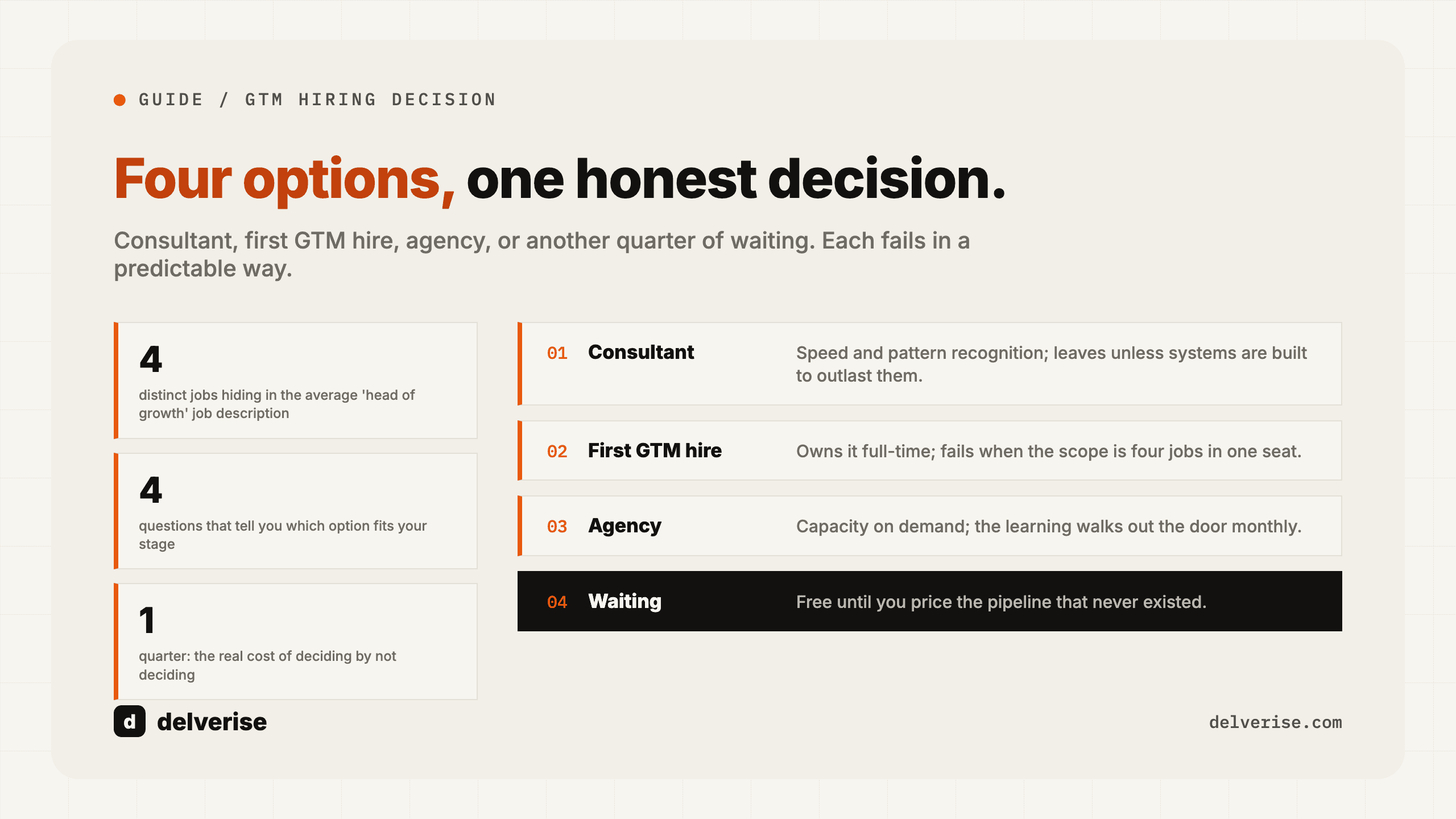
Most companies do not start by asking whether they need a go-to-market consultant. They start by trying to hire one person who can fix pipeline, and then discovering that the job description they wrote describes four different people.
That is the real decision underneath the search. Not consultant or nothing. It is a choice between a first GTM hire, an agency, a consultant, and doing nothing for another quarter. Each one fails in a specific way, and the failure modes are predictable enough that you can pick correctly before you spend anything.
The job description problem
Write out what you actually want the person to do. Most lists look something like this: find the right accounts, get accurate contact data, run outbound that does not sound like everyone else’s outbound, wire the CRM so the data lands somewhere useful, report on what worked, and adjust.
That is not one job. Finding the right accounts is a data and research function. Running outbound is a copy and sequencing function. Wiring the CRM is an operations and engineering function. Reporting is an analytics function. The market has separate roles and separate salary bands for each of them.
When you hire one person to cover all four, you get one person’s actual strength plus three areas of quiet underperformance. Usually it takes two quarters to notice, because the strong area produces enough activity to look like progress.
What each option is actually good at
A first GTM hire
Correct when you already know what works and need volume. If your outbound motion is proven, your data sources are stable, and someone internally can say precisely who to target and what to say, then hiring is the cheapest way to do more of it. The new person inherits a working system.
Wrong when the motion is unproven. A first hire with no system to inherit spends their first two quarters building one, usually alone, usually while being measured on meetings booked. That is how good people fail in a role and leave, and it costs you the salary plus the recruiting cycle plus the six months.
An agency
Correct when you want activity at volume and are indifferent to how it is produced. Agencies are built to run many accounts on shared infrastructure, and that is a real efficiency when your need is standard.
Wrong when the differentiator is in the details. Shared infrastructure means shared data sources, shared sequence structures, and often shared inbox reputation. If your ICP is unusual, or your value only becomes clear with context, standard machinery will produce standard results.
A go-to-market consultant
Correct when you have a decision problem rather than a labor problem. If nobody can say confidently which accounts are worth pursuing, why the last campaign underperformed, or which part of the funnel is actually broken, then more activity will not help. Diagnosis will.
Wrong when you need execution and the engagement ends at the recommendation. A strategy document that nobody has capacity to implement is an expensive way to confirm what the team already suspected.
Doing nothing for another quarter
Worth naming, because it is the option most companies actually choose. It is correct when something upstream is unresolved, usually positioning or product fit. Running a GTM motion against an unclear value proposition burns your domain reputation and your list at the same time. Sometimes the right move is to fix the message first.
The four questions that decide it
Can someone on your team name the twenty-five accounts most worth pursuing this quarter, and say why for each one? If yes, you have a labor problem: hire or use an agency. If no, you have a selection problem, and adding activity multiplies the error.
When a campaign underperforms, can you tell whether it was the list, the message, or the timing? If you cannot separate those three, you cannot improve any of them, and every subsequent campaign is a guess with a bigger budget.
Does your data move between systems without someone copying it? Enrichment landing in one tool, sending happening in another, and results living in a third is the normal state of things. It is also where most of the loss is: the handoffs are manual, so they happen late or not at all.
Would the work still run if the person who built it left? This is the question that separates a system from a heroic individual. Systems survive turnover. Heroes take the institutional knowledge with them.
What GTM engineering changes about the calculus
The reason the traditional options feel unsatisfying is that they were designed for a market where the constraint was headcount. Reaching more people required more people. That constraint moved.
The work of building a target list, keeping its data accurate, personalizing at the account level, and routing results back into a CRM is now largely engineering work. It gets built once and runs continuously, which means the question is no longer only who does the work but whether the work needs to be redone every time.
This is the practical difference between buying activity and buying a system. Activity stops when you stop paying for it. A system keeps producing after the engagement ends, and the person you eventually hire inherits something instead of starting from a blank page.
It also changes what a first hire is for. If selection, enrichment, and routing already run, the person you hire can spend their time on the part that genuinely requires a human: the conversations.
How to evaluate whoever you are considering
Ask for the reasoning, not the results. Anyone can show you a list of companies. Ask why each one is on it. If the answer is a filter (industry, headcount, funding stage), you are buying a database query. If the answer explains what changed at that company and why it makes them worth a conversation now, you are buying judgment.
Ask what happens when it does not work. A motion that produces no replies in the first three weeks is normal. What matters is whether the engagement has a diagnostic step or just a bigger send next month.
Ask who owns the infrastructure. Domains, sending accounts, data sources, and CRM configuration should end up under your control. If they live inside someone else’s account, you are renting your pipeline and the switching cost compounds quietly.
Ask what you keep. At the end of the engagement, is the deliverable a report, a set of running systems, or a team that now knows how to operate them? All three are legitimate. Only one of them is usually what people assumed they were buying.
A reasonable sequence
Most companies get better results by inverting the usual order. Diagnose before you staff. Build the selection and routing layer before you scale the sending. Hire once there is a working system for the new person to run, because that is when a hire compounds instead of struggling.
The cost of getting this order wrong is not only money. It is the quarter you spend discovering that the problem was never capacity.
If you are working through this decision, we can look at your situation directly. Grab 30 minutes and we will go through what you have, what is actually broken, and which of the four options fits. No deck.
Read next