←Back to blog
Revenue Intelligence & Data ToolingPlaybookOctober 8, 20269 min read
ABM Playbooks: How B2B SaaS Teams Build Ones That Actually Produce Pipeline
An ABM playbook is a documented, repeatable sequence: how you pick target accounts, detect buying signals, map the buying group, run coordinated plays across channels, and hand off to sales. The playbook lives in your data and CRM, so the same trigger produces the same coordinated response every time.
An ABM playbook is a documented, repeatable sequence: how you pick target accounts, detect buying signals, map the buying group, run coordinated plays across channels, and hand off to sales. The playbook lives in your data and CRM, so the same trigger produces the same coordinated response every time.
Key takeaways
- A playbook is an operating system, and the document is only the surface. If the selection logic, signals, and plays do not live in your data layer and CRM, it stops running the week people get busy.
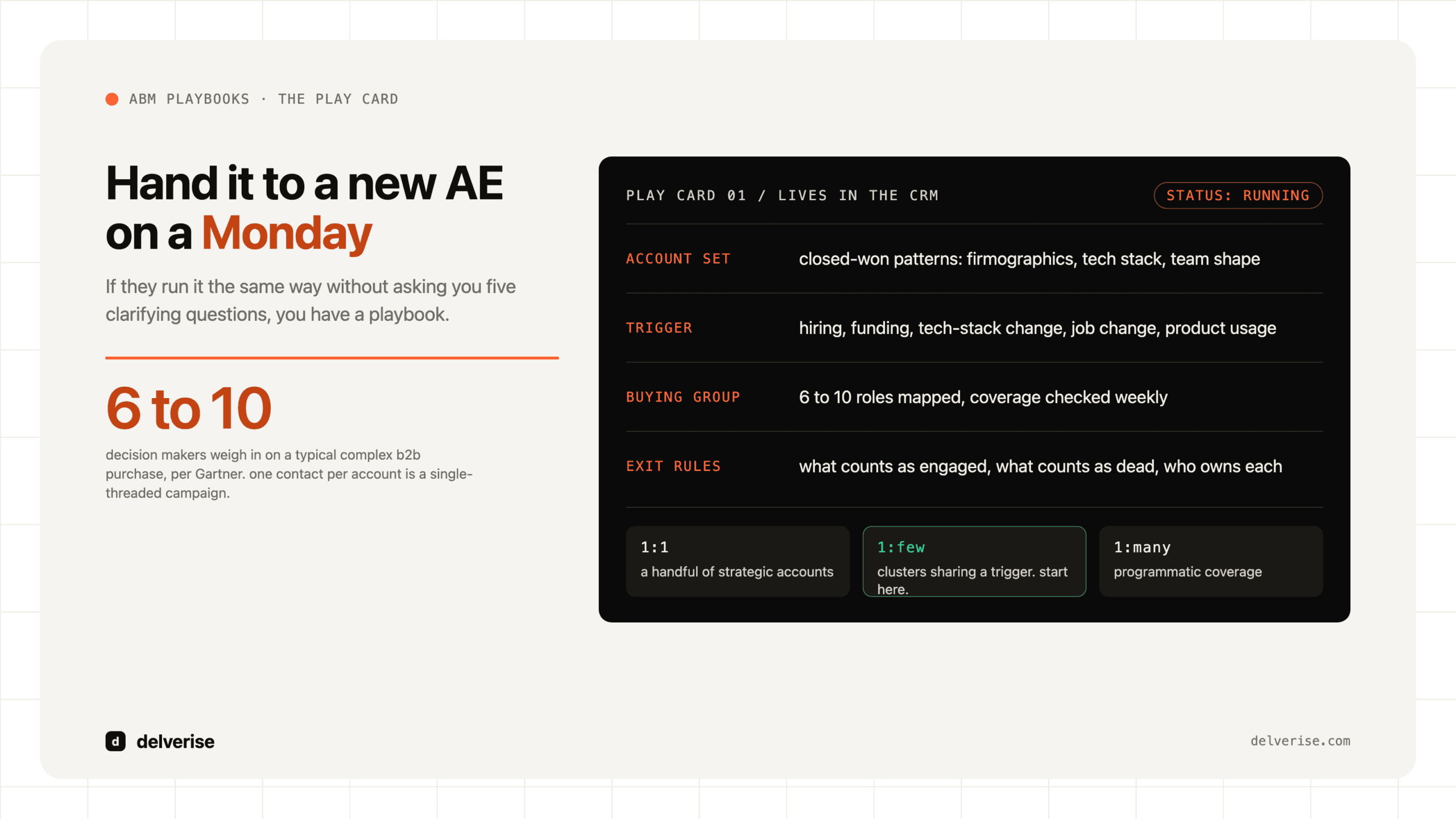
- Gartner’s research on B2B buying puts a typical complex purchase in the hands of six to ten decision makers. A playbook that targets one contact per account is a single-threaded campaign wearing an ABM label.
- Three playbook tiers exist for a reason: 1:1 for a handful of strategic accounts, 1:few for clusters that share a trigger, 1:many for programmatic coverage. Most Seed to Series B teams should start at 1:few.
- Measure account engagement depth and buying-group coverage weekly. Waiting on closed-won to judge an ABM program means you learn nothing for three quarters.
- Tooling follows the playbook. Clay, HubSpot, Salesforce, Outreach, and enrichment vendors execute the logic, and none of them supply it.
What is an ABM playbook, exactly?
Account-based marketing (ABM) is a GTM approach where marketing and sales treat a named set of accounts as the unit of targeting, instead of chasing individual leads. An ABM playbook is the operational spec for one motion inside that approach: a specific account segment, a specific trigger, a specific sequence of touches, and explicit rules for who does what when the account responds.
The useful test: hand the playbook to a new AE and a marketer on a Monday. If they can execute it the same way without asking you five clarifying questions, you have a playbook. If they cannot, you have a strategy deck.
A complete playbook names five things. The account set and why those accounts qualify. The trigger that puts an account into the play. The buying group roles you need to reach. The sequence of touches across email, LinkedIn, phone, ads, and events. The exit conditions, meaning what counts as engaged, what counts as dead, and what happens in each case.
Why do most ABM playbooks stall after two quarters?
Four failure modes account for nearly all of it.

The account list is a wish list. Teams build target lists from revenue ambition instead of fit evidence. A real list starts from your closed-won patterns: firmographics, tech stack, team shape, trigger events that preceded past deals. If you cannot articulate why an account is on the list in one sentence, it is padding.
Single-threading dressed up as ABM. Gartner’s buying group research is the relevant constraint here. Six to ten people weigh in, each arriving with their own information, and Gartner has also found that buyers spend only a small share of their total purchase time with any one supplier’s reps. A play that reaches one champion and nobody else leaves the rest of the committee to form an opinion without you.
No signal layer. Running the same sequence against 300 accounts on a fixed calendar is outbound with account-shaped list building. The gain in ABM comes from timing: hiring signals, funding, tech-stack changes, job changes among past users, product usage, content consumption. Without signals, you pay premium effort for commodity timing.
Ownership sits nowhere. Marketing builds the campaign, sales ignores the alerts, and nobody owns the account between the two. This is a structural problem in how the GTM function is organized, and no amount of playbook documentation fixes it.
Forrester’s analysts have spent the last few years pushing the field toward buying groups as the measured unit rather than accounts alone, which is a direct response to how often account-level reporting hides the fact that only one person ever engaged.
Which ABM playbook tier should you run?
The tiers differ in economics, not ambition. Pick based on ACV and the size of your addressable set.

| Dimension | 1:1 Strategic | 1:Few Cluster | 1:Many Programmatic |
|---|---|---|---|
| Accounts per play | 5 to 25 | 25 to 150 | 150 to 2,000 |
| Best fit ACV | $100k+ | $25k to $100k | Under $25k |
| Research depth | Custom account plan per logo | Shared thesis per cluster, variable details | Template with enriched variables |
| Primary channels | Exec outreach, custom assets, events, referrals | Email, LinkedIn, phone, targeted ads, small dinners | Email, ads, retargeting, automated nurture |
| Who builds it | AE plus marketing plus exec sponsor | RevOps builds, AEs and SDRs execute | RevOps and MarOps, largely automated |
| Realistic time to signal | 60 to 120 days | 30 to 60 days | 14 to 30 days |
| Main failure mode | Effort concentrated on accounts that were never going to buy | Cluster thesis is too generic to earn a reply | Personalization tokens without real relevance |
For most Seed to Series B SaaS companies, 1:few is where the math works. You get enough accounts for statistical signal within a quarter and enough specificity for the message to land.
What does a working playbook look like end to end?
Here is an illustrative build for a Series A company selling a $35k ACV compliance platform to fintech operations teams.

Trigger: the account posts a job for a compliance or risk operations hire, or announces a new market entry. Both events correlate with the problem the product solves.
Account qualification: fintech, 80 to 600 employees, US or UK, already running a modern data stack, no incumbent enterprise GRC vendor detected. That yields roughly 120 accounts, refreshed weekly as new triggers fire.
Buying group map: four roles per account. Head of Compliance as economic buyer, Ops Manager as the person feeling the pain daily, CTO or Head of Engineering as technical validator, CFO as budget sponsor on deals above a threshold. Enrichment fills each slot, and any account where you cannot find three of four gets deprioritized rather than force-fed into the sequence.
Sequence: a 21-day multi-role play. Ops Manager gets a specific message about the manual work the new hire is being brought in to absorb. Head of Compliance gets a peer benchmark. Engineering gets the integration and data-residency angle. Ads run against the whole account for the full window. Every touch references the same thesis, phrased in that role’s language.
Exit rules: two or more roles engaged moves the account to an AE-owned account plan. One role engaged holds in nurture for 60 days. Zero engagement returns the account to the pool with a 90-day cooldown and a different thesis on re-entry.
Notice how much of this is data work. The trigger detection, the buying-group completion, the routing logic, and the exit rules are all pipeline engineering before they are creative work. That is why ABM programs tend to succeed or fail on the quality of the underlying outbound funnel plumbing rather than on messaging alone.
What tooling do ABM playbooks actually require?
Less than vendors suggest, and different from what most teams buy first. You need four capabilities: a source of account and contact data, a signal layer, an orchestration layer, and a system of record that can hold account-level state.
Clay has become the practical default for the first two, because it lets you compose multiple enrichment providers, run waterfall lookups, and build the trigger logic in one place instead of stitching five vendors together. The honest tradeoff: Clay is a build environment, so it rewards teams who will actually maintain tables and punishes teams who expect a finished product out of the box. Credit costs also climb quickly when enrichment runs on a badly filtered list. If you want the workflow built and maintained properly, delverise works with teams on exactly this as a Clay partner.
For orchestration and record-keeping, your existing CRM plus a sequencer usually suffices. Dedicated ABM platforms make sense once you are running several tiers simultaneously across a large list. Before that point, they mostly add a dashboard.
The prerequisite nobody wants to hear: account-level data hygiene. Duplicate accounts, missing domains, and contacts unattached to accounts will break every one of these plays. Most teams need to fix the foundation pieces before the playbook produces anything.
How do you measure ABM playbooks without waiting four quarters?
Closed-won is the outcome, and it is a poor learning signal on a six-month sales cycle. Track leading indicators weekly instead.
- Buying-group coverage: percentage of target accounts where you have verified contacts in three or more required roles
- Account engagement depth: number of distinct people per account who took a meaningful action in the last 30 days
- Trigger-to-first-touch latency: hours between a signal firing and the first human or automated touch
- Meeting rate by cluster thesis, not by campaign average, so a weak thesis cannot hide behind a strong one
- Progression rate from engaged account to qualified opportunity, tracked against your baseline
McKinsey’s B2B Pulse research consistently finds buyers moving across roughly ten channels during a purchase, which is why single-channel attribution on ABM will always look worse than the program’s actual contribution. Measure at the account level and accept that the model is directional. When these numbers start feeding your pipeline math, connect them to your revenue forecast so ABM output shows up in the same plan as everything else.
One more discipline worth building: consistent scoring on what “engaged” means. Teams that let reps judge it by feel end up with inflated account plans and forecast noise. An explicit, documented model, whether rules-based or using AI lead qualification, keeps the definition stable across the team.
Should you build this in-house or bring in help?
Build in-house when you have a RevOps person with time, a clear ICP backed by at least 20 closed-won deals, and a CRM whose account data you trust. Those three conditions together are rarer than most teams assume.
Bring in outside help when the constraint is systems depth rather than headcount: the signal layer needs to be engineered, enrichment waterfalls need designing, routing and exit rules need to live in the CRM, and someone needs to own the whole thing end to end. That is the work delverise does as GTM engineering, building the system and handing over something your team can run.
Either way, start with one playbook against one cluster. A single well-instrumented 1:few play teaches you more in six weeks than a full ABM platform rollout teaches you in two quarters.
Frequently Asked Questions
How many accounts should be in an ABM playbook?
For a 1:few play, 25 to 150 accounts that share a single trigger and thesis. Fewer than 25 gives you no signal on whether the message works. More than 150 usually means the cluster thesis has been stretched too thin to be specific, which shows up immediately as a flat reply rate.
How long before an ABM playbook produces pipeline?
Expect 30 to 60 days for first meetings on a 1:few play, and one full sales cycle plus 60 days before you can judge revenue contribution. Strategic 1:1 plays run longer. If you need pipeline inside 30 days, ABM is the wrong instrument for that quarter.
Do we need a dedicated ABM platform?
Usually no, at least at first. A CRM with reliable account-level data, an enrichment and signal layer, and a sequencer cover most of what a Seed to Series B team needs. Dedicated platforms earn their cost once you are running multiple tiers across thousands of accounts and need centralized orchestration and reporting.
Who should own ABM playbooks, marketing or sales?
RevOps should own the system, marketing should own the thesis and content, and sales should own the accounts once engagement crosses the threshold. Splitting ownership at the engagement threshold, with an explicit written rule, prevents the handoff gap that kills most programs.
Can ABM and broad outbound run at the same time?
Yes, and they should share infrastructure. The same enrichment, deliverability setup, and CRM routing serve both. What has to stay separate is the reporting: mixing programmatic outbound volume into ABM account metrics will mask whether either motion is working.
Read next