←Back to blog
Growth & Demand GenerationGuideOctober 8, 20268 min read
People Data Labs: What It Actually Does and When It Fits Your Revenue Stack
People Data Labs is a B2B data provider that sells person and company records through APIs, bulk files, and data warehouse shares instead of through a prospecting interface. Revenue teams use it to enrich CRM records, resolve identities, score accounts, and route leads at scale. It fits companies with engineering capacity behind the go-to-market motion.
People Data Labs is a B2B data provider that sells person and company records through APIs, bulk files, and data warehouse shares instead of through a prospecting interface. Revenue teams use it to enrich CRM records, resolve identities, score accounts, and route leads at scale. It fits companies with engineering capacity behind the go-to-market motion.
Key takeaways
- People Data Labs (PDL) sells raw data infrastructure. Apollo, ZoomInfo, and similar platforms sell a finished prospecting workflow on top of data they own.
- Match rates vary sharply by input. Work email as the identifier performs far better than name plus company, and small private companies resolve worse than mid-market and enterprise.
- Pricing is credit-based on self-serve and volume-based on annual contracts, so cost per usable record depends almost entirely on your match rate, not the sticker price.
- It is a strong fit for enrichment, scoring, territory design, and TAM sizing. It is a weak fit for a team that needs a list-building UI and verified phone numbers tomorrow morning.
- You need someone who can build against an API, plus a defined data model in your CRM, before the spend returns anything.
What does People Data Labs actually sell?
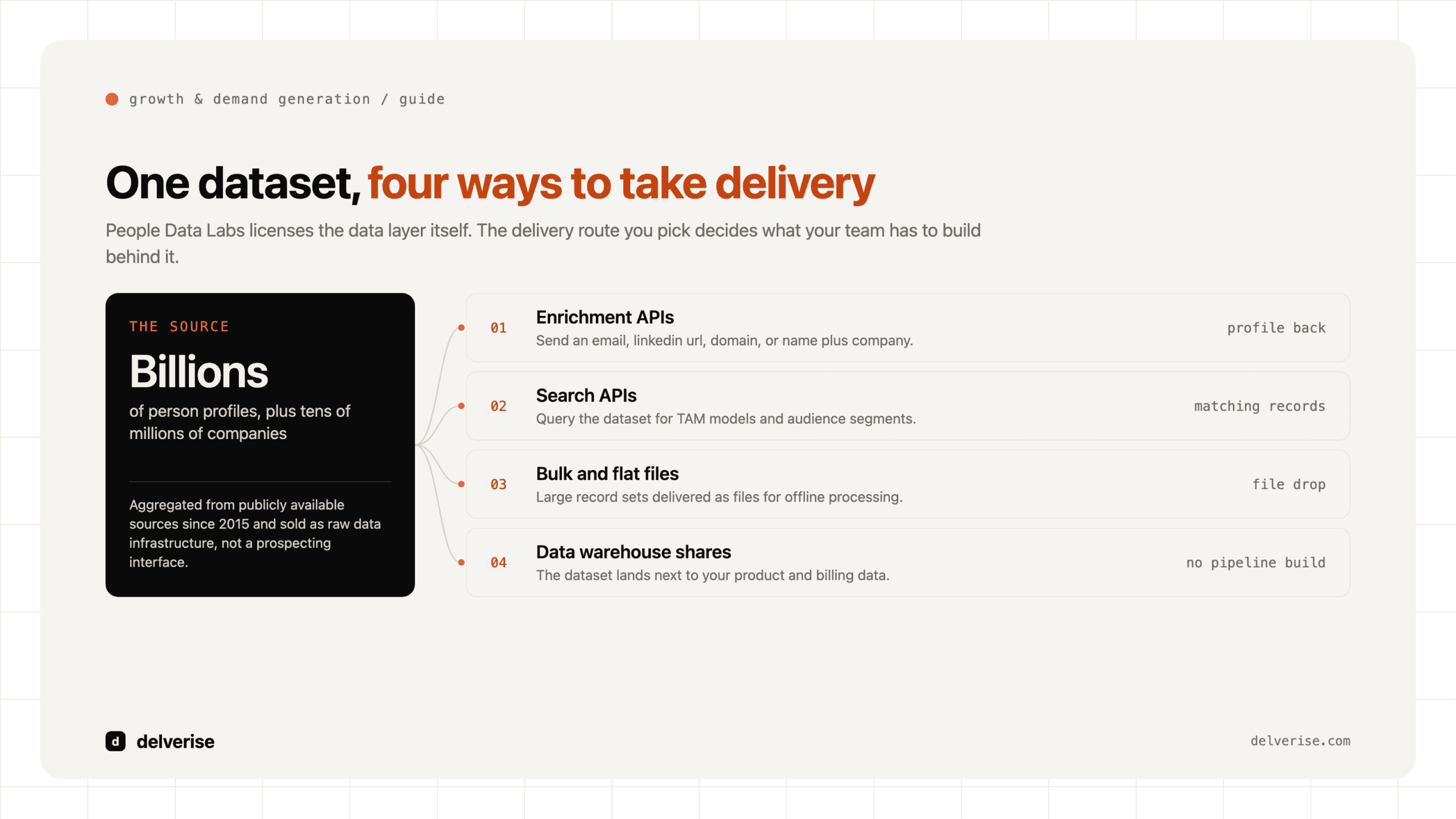
PDL is a data-as-a-service company founded in 2015. It aggregates publicly available information from a wide set of sources into resolved person and company profiles, then licenses access to that dataset. Coverage is marketed in the billions of person profiles and tens of millions of companies.

Delivery happens four ways, and the choice matters more than most buyers expect:
- Enrichment APIs. You send an identifier (email, LinkedIn URL, name plus company, domain) and receive a structured profile back.
- Search APIs. You send an Elasticsearch-style or SQL-style query and receive matching records. This is how teams build TAM models and audience segments programmatically.
- Bulk and flat file delivery. Large record sets delivered as files for offline processing.
- Data warehouse shares. PDL distributes through marketplaces including Snowflake and AWS Data Exchange, so the dataset can land next to your product and billing data without a pipeline build.
Supporting endpoints include company enrichment, IP-to-company enrichment for website visitor resolution, autocomplete for building clean filter inputs, and cleaner APIs that normalize messy job titles, school names, and locations into canonical values. Those cleaner endpoints are quietly the most useful part for anyone who has tried to segment a CRM where the title field contains 4,000 unique strings.
What data does a record actually contain?
A person record typically carries name, current and historical job titles, employer and employer domain, seniority and job function classifications, location, education, skills, and social profile links. A company record carries domain, size band, industry, location, founding year, and identifiers you can join on.

Two honest caveats. First, direct dial phone numbers and verified personal emails are not PDL’s strength, and any contact data you pull should go through a separate verification step before it touches a send. Second, recency varies by segment. A VP at a 2,000-person software company refreshes often. A founder at an eight-person startup may sit on a profile that is eighteen months stale.
How does it compare to Apollo, ZoomInfo, and Clearbit?
These products get compared constantly and they solve different problems. The table below is the version worth putting in front of a leadership team.
| Dimension | People Data Labs | Apollo | ZoomInfo | Clearbit (now HubSpot Breeze Intelligence) |
|---|---|---|---|---|
| Primary form factor | API, bulk file, warehouse share | Prospecting UI plus sequencing | Prospecting UI plus intent and workflow suite | Enrichment inside the HubSpot ecosystem |
| Who operates it | Engineer or technical RevOps | SDR or marketer | SDR, marketer, RevOps | Marketer or RevOps admin |
| Best at | Scaled enrichment, identity resolution, TAM modeling | Fast list building and outbound execution | Enterprise coverage, intent signals, contract-grade SLAs | Inbound form shortening and record completion |
| Weakest at | Verified phones, out-of-the-box workflow | Data depth outside its core coverage | Price flexibility for early-stage teams | Use outside HubSpot |
| Typical buyer stage | Series A and up with data engineering capacity | Seed to Series B | Series C and up | Any stage already standardized on HubSpot |
The practical read: PDL is the layer underneath. Several tools you already use license third-party data to fill their own gaps, and a company with real engineering capacity can buy that layer directly and stop paying a workflow premium on top of it. If your team needs a UI and needs pipeline this quarter, a platform with a front end will get you there faster. We cover that tradeoff in more depth in our guide to choosing an AI prospecting tool.
What does People Data Labs cost?
PDL offers a limited free tier for evaluation, self-serve credit plans, and annual enterprise agreements priced by record volume and data scope. Per-record cost drops as committed volume rises, which is standard for this category.

The number that matters is cost per usable record, and it is almost never the number on the pricing page. Here is a worked example using illustrative figures to show the math.
You have 40,000 CRM contacts to enrich. 24,000 have a work email on file. 16,000 have only first name, last name, and company. Assume a 75 percent match rate on the email cohort and a 40 percent match rate on the name-plus-company cohort, which is a reasonable planning range for mid-market B2B. That yields 18,000 plus 6,400, or 24,400 matched records. If you paid for 40,000 lookups, your effective cost per matched record is roughly 1.6 times the list price. Then apply a usability filter: how many matched records carry a current title and a valid employer domain? If that is 85 percent, you are at 20,740 records you can actually segment on, and your true cost per usable record is close to double the headline rate.
Run that calculation before you sign. It changes vendor rankings more often than feature comparisons do, and it belongs in the same planning conversation as your revenue forecast, because enrichment coverage sets the ceiling on how many accounts you can work at all.
Why does data quality matter this much?
Gartner has estimated that poor data quality costs the average organization around $12.9 million per year across rework, bad decisions, and missed opportunities. Harvard Business Review published research by Tadhg Nagle and Thomas Redman finding that only a tiny fraction of companies had data records meeting basic quality standards, with most firms falling far below any reasonable bar.
The go-to-market consequence is specific. McKinsey’s B2B Pulse research has consistently found that buyers now move across many channels before they talk to a seller, and they expect the seller to already know who they are. Every routing rule, scoring model, and personalization token in your stack reads from the same underlying record. When that record is wrong, the failure surfaces as a low reply rate or a bad demo, and the team blames the copy. We wrote about that diagnostic trap in the six foundation pieces under every revenue stack.
Where does People Data Labs break?
Four failure modes come up repeatedly in G2 review patterns and in real implementations:
- Long tail coverage. Companies under 50 employees, non-US markets outside Western Europe, and non-technology verticals resolve less reliably. If your ICP is 15-person accounting firms in Ohio, test hard before committing.
- No workflow. The API returns JSON. Turning JSON into a routed, deduplicated, scored CRM record is work somebody on your side has to do, or orchestrate through a platform like Clay that sits between the data and the destination.
- Silent staleness. A record can be complete and still be twelve months out of date. Build a refresh cadence rather than enriching once and treating the result as permanent.
- Compliance scope. PDL sources publicly available data and publishes opt-out mechanisms, but if you sell into the EU or handle regulated data, have counsel review the DPA and your own legitimate interest basis before launch.
How should a revenue leader evaluate it?
Run a paid pilot against your own data, never against the vendor’s sample. The sequence that produces a defensible decision:
- Pull 1,000 real records from your ICP, split evenly between accounts you know well and accounts you have never touched.
- Send them through enrichment and measure match rate separately for each identifier type.
- Manually verify 50 matched records against LinkedIn and company sites, then record the error rate.
- Calculate cost per usable record using your measured rates, not the vendor’s.
- Run the same 1,000 records through one competing provider and compare on the same three metrics.
- Confirm who on your team owns the integration, the refresh schedule, and the field mapping before you sign.
That last item kills more data investments than any coverage gap. A dataset with no owner degrades into a CRM full of half-populated fields that nobody trusts, which undermines the qualification model sitting on top of it and every automated outbound sequence downstream.
Frequently Asked Questions
Is People Data Labs a replacement for ZoomInfo or Apollo?
For enrichment and data infrastructure, yes, and often at lower cost per record at volume. For a sales team that needs to search, build lists, and send sequences in one interface, no. Many companies run PDL underneath a CRM while keeping a separate execution tool for reps. Our guide to building a B2B lead system covers how those layers fit together.
Does People Data Labs provide phone numbers and verified emails?
It returns contact fields, but phone coverage and email deliverability are not its strongest attributes. Teams running outbound typically pair it with a dedicated waterfall of contact providers and an email verification step. Treat every address as unverified until a verification service says otherwise.
Do I need engineers to use it?
You need someone comfortable with REST APIs, authentication, and JSON. That can be a technical RevOps person rather than a software engineer, particularly if you route the data through an orchestration platform. Buying PDL with no technical owner assigned reliably wastes the contract.
How often does the data refresh?
PDL refreshes its dataset on an ongoing cycle, and higher-profile profiles update more frequently than long-tail ones. Plan your own re-enrichment cadence, quarterly for core accounts and semiannually for the broader database, and log the enrichment date on every record so you can audit staleness later.
Is it compliant with GDPR and CCPA?
PDL operates a privacy program with published opt-out mechanisms and offers data processing agreements. Compliance is a shared responsibility, so your own lawful basis for processing, your retention policy, and your outbound practices still need review. Get counsel involved before you enrich EU contact data at scale.
If you are deciding whether to buy the data layer directly or keep paying a workflow premium for it, the answer usually comes down to how much engineering capacity sits behind your revenue team. Our CRM enrichment and GTM engineering work exists for exactly that decision.
Read next