←Back to blog
Revenue Intelligence & Data ToolingGuideOctober 9, 20268 min read
AI Academy Lead Scrape: What the Course Playbook Builds and Where It Breaks
An AI academy lead scrape is the list-building workflow taught in AI automation courses: pull companies and contacts from a public source such as Google Maps, LinkedIn, or a B2B database, enrich each record with an LLM, and push the result into an email sequencer. It builds lists fast. B2B SaaS pipeline also needs verification, targeting logic, and a CRM connection.
An AI academy lead scrape is the list-building workflow taught in AI automation courses: pull companies and contacts from a public source such as Google Maps, LinkedIn, or a B2B database, enrich each record with an LLM, and push the result into an email sequencer. It builds lists fast. B2B SaaS pipeline also needs verification, targeting logic, and a CRM connection.
Key takeaways
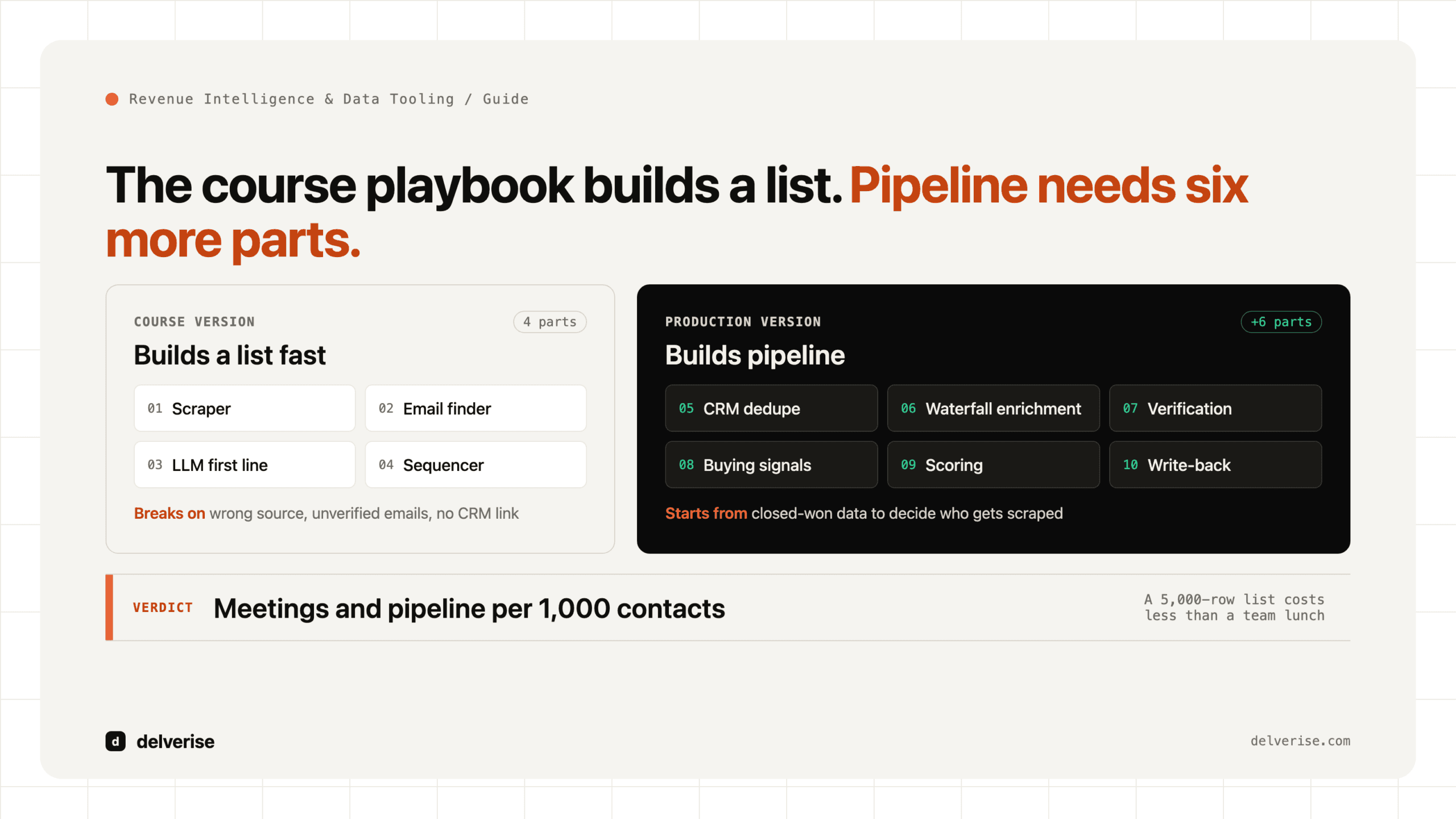
- The course version has four parts: a scraper, an email finder, an LLM that writes a first line, and a sequencer. Each part is cheap and easy to demo.
- It fails in B2B SaaS for predictable reasons: the wrong data source for your ICP, unverified emails that damage sender reputation, and no link to the CRM.
- Your closed-won data should define who gets scraped. Most course templates start from a search query instead.
- A production version adds deduplication against the CRM, waterfall enrichment, verification, buying signals, scoring, and write-back.
- Judge any scraping build on meetings and pipeline per thousand contacts, never on list size.
What is an AI academy lead scrape, exactly?
Over the last two years, a wave of online AI automation academies (paid communities and courses that teach people to build workflows in n8n, Make, Apify, and the OpenAI API) has popularized a standard lead generation template. Graduates often sell it to businesses as a done-for-you build. The template usually looks like this:

- Source: a scraper pulls records from Google Maps, LinkedIn search results, a directory, or an export from a database like Apollo. Scraping means extracting data from web pages or tools programmatically instead of by hand.
- Enrichment: an email finder guesses or looks up a work address for each contact. Enrichment is the process of adding missing fields (email, phone, company size, tech used) to a record.
- Personalization: an LLM reads the person’s profile or company website and writes an opening line.
- Delivery: the rows land in a Google Sheet, then get pushed into a cold email tool.
As an education project, this is useful. The question for a revenue leader is whether that template, as built, belongs anywhere near your sending domain.
Why are B2B SaaS leaders hearing about this workflow now?
Scraping and LLM costs have dropped so far that a 5,000-row list costs less than a team lunch, the courses produce plenty of freelancers who need clients, and outbound teams are asked to do more with fewer SDRs.
The buyer side makes the stakes higher. Gartner’s research on how B2B buyers purchase found that buyers spend only about 17% of their total buying time meeting with suppliers, and that time is split across every vendor they consider. McKinsey’s B2B Pulse research has repeatedly shown buyers moving between ten or more channels during a purchase. Attention is scarce, so a badly targeted email burns one of very few chances to be considered. We cover how those contacts should be judged in AI generated leads and how to make them convert.
Where does the course version break for B2B SaaS?
The source rarely matches your ICP
Google Maps is excellent data for local businesses such as dentists, roofers, and restaurants. It holds almost nothing useful about a 200-person fintech company’s VP of Finance. LinkedIn scraping gives you titles, but titles are noisy, and automated collection runs against LinkedIn’s user agreement, which puts the accounts doing the scraping at risk. If your ideal customer profile (ICP) is defined by headcount, funding stage, tech used, and hiring patterns, the source needs to carry those fields.

Unverified emails put your domain at risk
Pattern-guessed addresses and catch-all domains produce bounces. Since early 2024, Google and Yahoo have enforced bulk sender requirements that include authentication and a spam complaint rate kept under 0.3%. A single campaign built on a raw scrape can push a sending domain past those limits, and recovery takes weeks. Every contact needs verification before it touches a sequencer.
LLM first lines read as generated
“I saw your company is growing fast” written 5,000 ways is still the same line. Personalization works when it references something that explains why you are reaching out now, like a new hire, a funding round, or a tool migration. For message structure that holds up, see our breakdown of cold email templates for B2B SaaS that book meetings.
There is no CRM in the loop
The spreadsheet has no idea that one prospect is an open opportunity, another is a current customer, and a third told your AE to stop emailing last quarter. Without a dedupe and suppression check against HubSpot or Salesforce, the scrape creates embarrassing touches and corrupts attribution. Replies never reach the record, so nobody can tell what the list produced.
Compliance is an afterthought
Contacting EU or UK individuals means GDPR applies, which requires a documented lawful basis such as legitimate interest, an opt-out path, and a way to honor deletion requests. US sends fall under CAN-SPAM. Course templates rarely include a suppression list, a data retention rule, or a record of where each contact came from.
How does a course scrape compare with a production lead system?
| Dimension | AI academy lead scrape | Production lead system |
|---|---|---|
| Targeting input | A search query or keyword | ICP derived from closed-won deals and win rates |
| Data source | One scraper or one database export | Firmographic database plus signal sources (hiring, funding, tech changes) |
| Email accuracy | Single finder, often unverified | Waterfall lookup across several providers, then verification |
| CRM check | None | Dedupe against accounts, open opportunities, customers, and opt-outs |
| Personalization | Generic LLM opener | Signal-based reason for outreach, reviewed by a person at launch |
| Routing | Everyone into one campaign | Scored and routed to a sequence or a rep by fit and intent |
| Measurement | Rows scraped, emails sent | Meetings, pipeline, and revenue per 1,000 contacts, written back to CRM |
| Upfront cost | Low | Higher, with lower cost per qualified meeting once running |
What does a production version look like in practice?
Take an illustrative Series A company that sells a forecasting tool to RevOps leaders at software companies with 100 to 1,000 employees. Here is how the same goal, “find RevOps leaders to email,” runs through each approach.

The course build: scrape a LinkedIn search for “Head of RevOps,” find emails for the 2,000 profiles returned, generate a first line from each headline, and load everything into one campaign. The list includes consultants, people at 15-person startups, and two current customers.
The production build:
- Pull the last 18 months of closed-won deals from the CRM and confirm which company traits actually correlate with winning, for example running Salesforce with a sales engagement tool and an active RevOps hire.
- Source accounts that match those traits from a firmographic database, then add signals such as a recently posted RevOps role or a new CRO.
- Suppress anything already in the CRM as a customer, open opportunity, or opt-out.
- Find contacts through a waterfall of email providers and verify every address.
- Score each account on fit and signal strength, and route high scorers to a rep for manual outreach while the rest enter a sequence.
- Write every send, reply, and meeting back to the contact record so the team can compare segments.
Many teams run steps two through five in Clay, since it handles multi-provider enrichment and AI research columns in one table. It has a learning curve and a credit model to budget for, and n8n or custom code can cover parts of the same job. The tool matters less than the logic. Our CRM enrichment work covers how the write-back side should be designed, and AI lead qualification explains how to build the scoring step.
Should you build it in-house, hire a course graduate, or bring in a systems partner?
- In-house: works if you already have a RevOps or GTM engineer with time to own it. The risk is a side project nobody maintains once providers change their APIs.
- Freelance course graduate: fast and inexpensive for a proof of concept. Expect a working scraper and limited attention to deliverability, CRM hygiene, and compliance. Keep them on a separate test domain.
- Systems partner: costs more upfront and makes sense when outbound is a real pipeline channel you plan to scale. The value comes from connecting sourcing to the CRM, the forecast, and the sales process.
Before choosing, confirm the basics exist. Our guide to the six foundation pieces under every revenue system is a good gut check, and outbound sales automation covers which steps should stay human. If you want the full system designed and built, that is what our GTM engineering practice does, and our Clay implementation team handles Clay-specific builds.
What should you check before a scraped list touches your domain?
- The targeting criteria trace back to closed-won data, and someone can explain them in one sentence.
- Every record has been deduped against CRM accounts, open opportunities, customers, and opt-outs.
- Every email address has passed verification, and catch-all addresses are handled separately.
- Sending runs on secondary domains with SPF, DKIM, and DMARC configured and warmed.
- Each contact has a recorded source and a lawful basis if they are in the EU or UK.
- Replies, meetings, and opportunities write back to the CRM record automatically.
- A person has read a sample of at least 50 generated messages before launch.
Frequently Asked Questions
Is lead scraping legal for B2B outreach?
Collecting publicly available business data is generally allowed in the US, but platform terms of service still apply, and LinkedIn prohibits automated scraping. Contacting people in the EU or UK brings GDPR obligations, including a lawful basis and an opt-out. Get legal review for your specific regions before scaling.
Can an AI academy lead scrape work for B2B SaaS at all?
Yes, as a starting point. The scraping and LLM components are sound building blocks. They produce pipeline once you add ICP-based targeting, CRM suppression, email verification, and measurement. Used raw, the template tends to generate volume and bounces more than meetings.
What is waterfall enrichment?
Waterfall enrichment queries several data providers in sequence for a missing field, such as a work email, and stops when one returns a verified result. It raises coverage above what any single provider finds.
How many contacts should a scraping workflow produce each month?
Size it to what your sending infrastructure and reps can handle with quality. A smaller list of well-matched accounts with a clear reason for outreach will usually beat a large generic list on meetings per thousand sends. Start with a few hundred contacts per segment, measure, then expand.
What metrics show a lead scrape is working?
Track bounce rate, spam complaint rate, positive reply rate, meetings booked, and pipeline created per 1,000 contacts, broken out by segment. Rows scraped and emails sent only describe activity.
Read next