←Back to blog
Revenue Intelligence & Data ToolingPlaybookMay 20, 202620 min read
ActiveCampaign vs HubSpot: Which Marketing Automation Platform is Best for Growing B2B Companies?
Compare ActiveCampaign vs HubSpot for growing B2B companies. Detailed analysis of pricing, features, automation capabilities, and ROI for 10-200 employee teams.
Choosing the right marketing automation platform can make or break your company’s growth trajectory. For marketing managers and operations teams at growing B2B companies with 10-200 employees, this decision becomes even more critical as you balance the need for sophisticated automation capabilities with budget constraints and team resources.
According to Gartner, ‘By 2025, 60% of B2B sales organizations will transition from experience- and intuition-based selling to data-driven selling.’ For growing B2B companies, that shift makes the marketing automation platform decision less about features and more about which system can serve as a durable data backbone as the team scales.
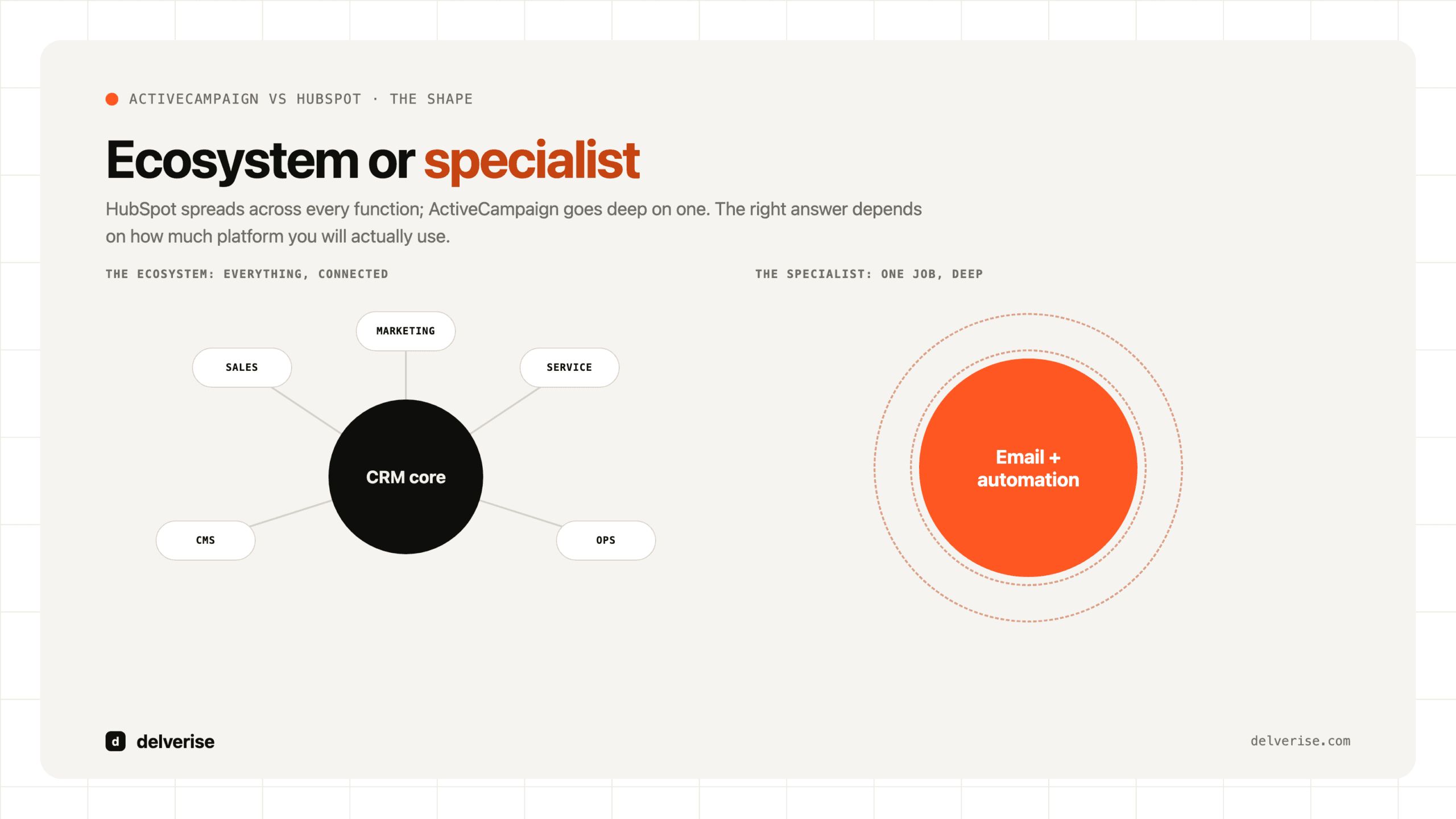
The activecampaign vs hubspot debate has dominated marketing technology discussions for years, and for good reason. Both platforms have carved out significant market share by addressing different aspects of the marketing automation challenge. ActiveCampaign has built its reputation as a powerful, email-focused automation platform that delivers enterprise-grade capabilities at small business prices. HubSpot, meanwhile, has positioned itself as the comprehensive inbound marketing ecosystem that promises to be your single source of truth for all customer interactions.
But which platform truly serves growing B2B companies best? The answer isn’t straightforward because it depends heavily on your current tech stack, growth stage, team expertise, and long-term strategic vision. A company with 15 employees and a lean marketing team has vastly different needs than a 150-person organization with dedicated marketing, sales, and customer success departments.
This comprehensive comparison will dissect every aspect of both platforms, from their fundamental philosophical approaches to the nitty-gritty details of pricing, features, and implementation complexity. We’ll examine real-world scenarios, analyze total cost of ownership over multiple years, and provide actionable frameworks for making the right choice for your specific situation.
Whether you’re evaluating activecampaign alternatives, researching hubspot for small business applications, or conducting a broader marketing automation comparison, this analysis will equip you with the insights needed to make an informed decision that aligns with your company’s growth objectives and operational realities.
Answer: HubSpot is usually the stronger choice for B2B teams that want CRM, marketing automation, sales workflows, reporting, and lifecycle operations in one platform. ActiveCampaign is usually stronger for smaller teams that need sophisticated email automation at a lower platform cost. The right choice depends on whether the system must support the full revenue motion or primarily marketing automation.
- Choose HubSpot when CRM, sales, marketing, reporting, and RevOps workflows need to live together.
- Choose ActiveCampaign when email automation depth and cost control matter more than full-platform breadth.
- Evaluate total operating fit, including data model, routing, attribution, handoff, and reporting needs.
Platform Philosophy: All-in-One vs Best-of-Breed
The most fundamental difference between ActiveCampaign and HubSpot lies in their core philosophical approaches to marketing technology. Understanding this distinction is crucial because it influences everything from pricing structure to feature development, integration capabilities, and long-term scalability.

HubSpot: The All-in-One Ecosystem
HubSpot has built its entire business model around the concept of being a comprehensive customer platform. The company offers separate “hubs” for Marketing, Sales, Service, Content, Operations, and Commerce, all designed to work seamlessly together within a unified data model. This all-in-one approach means that when you choose HubSpot, you’re selecting more than a marketing automation tool. You’re potentially replacing your entire customer relationship management infrastructure.
The benefits of this approach are significant for growing companies. Data flows seamlessly between marketing campaigns and sales activities. Customer service interactions automatically update contact records that marketing can leverage for segmentation. Content creation tools integrate directly with marketing campaigns and sales outreach. This level of integration eliminates the data silos that plague many growing companies as they add new tools to their tech stack.
Research from McKinsey reinforces the cost of this fragmentation: ‘Companies that fully integrate their marketing and sales technology stacks see 15 to 20 percent higher revenue growth than peers operating in silos.’ For a 10-200 person B2B company, that integration premium often outweighs the per-feature advantages of a more specialized point solution.
However, the all-in-one approach also comes with trade-offs. HubSpot’s features in any given area may not be as specialized or advanced as dedicated best-of-breed solutions. For example, while HubSpot’s email marketing capabilities are robust, they may not match the sophisticated automation logic and deliverability optimization that ActiveCampaign has perfected through years of email-focused development.
ActiveCampaign: The Best-of-Breed Specialist
ActiveCampaign takes a fundamentally different approach, positioning itself as the best-in-class solution for email marketing and marketing automation. Rather than trying to be everything to everyone, ActiveCampaign has focused intensively on perfecting the art and science of automated email marketing, customer journey mapping, and behavioral trigger-based communications.
This specialization has allowed ActiveCampaign to develop incredibly sophisticated automation capabilities that often surpass what’s available in all-in-one platforms. Their visual automation builder, predictive sending algorithms, and advanced segmentation capabilities reflect years of focused development in the email marketing domain. The platform integrates with over 900 third-party applications, allowing companies to build custom tech stacks that combine ActiveCampaign’s automation strengths with specialized tools for CRM, analytics, e-commerce, and other functions.
The best-of-breed approach offers flexibility and often superior functionality in specific areas. Companies can choose the absolute best tool for each function rather than accepting the compromises inherent in all-in-one solutions. This approach also typically offers better pricing scalability, as you only pay for the specific capabilities you need rather than a comprehensive suite where you may only use a fraction of the available features.
Strategic Implications for Growing Companies
The choice between these philosophies has profound implications for growing B2B companies. Organizations in the 10-50 employee range often benefit from the simplicity and integration of an all-in-one approach, especially if they lack dedicated IT resources to manage multiple integrations. The unified data model and single vendor relationship can significantly reduce operational complexity during rapid growth phases.
Conversely, companies in the 50-200 employee range, particularly those with specialized needs or existing tech investments, may find the best-of-breed approach more advantageous. These organizations often have the resources to manage more complex integrations and benefit from the superior functionality that specialized tools provide.
Harvard Business Review frames the same tension bluntly: ‘The right technology architecture depends less on which tools are best in isolation and more on which combination matches the organization’s operating model.’ That is why the 50-200 employee inflection point matters so much in this comparison — operating models genuinely diverge at that scale, and the platform that fit at 20 people can quietly become the bottleneck at 120.
Feature Comparison: Depth vs Breadth
When evaluating marketing automation platforms, the feature comparison often becomes the deciding factor for many organizations. However, it’s crucial to look beyond simple feature checklists and understand the depth, usability, and strategic value of each capability.

Email Marketing Capabilities
Email marketing remains the foundation of most B2B marketing automation strategies, and this is where the differences between these platforms become most apparent. ActiveCampaign has built its reputation on delivering sophisticated email marketing capabilities that rival dedicated email service providers.
ActiveCampaign’s email editor offers advanced personalization options, including dynamic content blocks that change based on contact properties, behavioral data, and custom fields. The platform’s deliverability rates consistently rank among the industry’s best, with sophisticated IP warming, domain authentication, and reputation management features built into every plan. The email testing capabilities include comprehensive spam score analysis, rendering previews across dozens of email clients, and A/B testing options that extend beyond simple subject line variations to include send time optimization, content variations, and sender name testing.
HubSpot’s email marketing capabilities are robust but reflect the platform’s broader focus. The email editor is user-friendly and includes smart content features for personalization, but lacks some of the advanced automation triggers and conditional logic that ActiveCampaign offers. HubSpot’s deliverability is generally good, though not quite at the level of specialized email platforms. Where HubSpot excels is in the integration between email marketing and other platform features: emails automatically sync with contact timelines, sales activities, and customer service interactions.
Marketing Automation and Workflow Management
The automation capabilities represent perhaps the most significant differentiator between these platforms. ActiveCampaign’s visual automation builder is widely regarded as one of the most intuitive and powerful in the industry. The platform supports complex, multi-branch automations with sophisticated conditional logic, behavioral triggers, and goal-based optimization. Users can create automations that respond to website behavior, email engagement, CRM activities, and custom events from integrated applications.
ActiveCampaign’s automation recipes provide pre-built templates for common scenarios like lead nurturing, customer onboarding, and re-engagement campaigns. However, the real power lies in the platform’s flexibility to create custom automations that can handle complex business logic. The automation reporting provides detailed analytics on performance, conversion rates, and optimization opportunities.
HubSpot’s workflow capabilities are comprehensive and benefit from deep integration with the platform’s CRM and sales tools. Workflows can trigger based on contact properties, list membership, form submissions, page views, and sales activities. The platform’s strength lies in its ability to create seamless handoffs between marketing and sales teams, with workflows that can create tasks, send internal notifications, and update deal stages based on prospect behavior.
CRM Integration and Contact Management
The CRM question represents one of the most critical decision points in the activecampaign vs hubspot comparison. HubSpot includes a full-featured CRM as part of its core offering, even in the free tier. This CRM provides contact management, deal tracking, sales pipeline management, and task automation. The integration between marketing activities and CRM data is seamless, with every email interaction, form submission, and website visit automatically logged in the contact record.
ActiveCampaign takes a different approach, offering a built-in CRM that focuses specifically on sales automation and pipeline management for marketing-qualified leads. The ActiveCampaign CRM is designed to complement the platform’s marketing automation capabilities rather than serve as a comprehensive sales management system. For organizations that already have a dedicated CRM like Salesforce, Pipedrive, or Microsoft Dynamics, ActiveCampaign’s approach allows for specialized integration without forcing a complete CRM migration.
This difference has significant implications for growing companies. Organizations without an existing CRM investment may find HubSpot’s integrated approach more appealing, as it eliminates the need for separate CRM licensing and integration management. However, companies with established CRM processes or specialized sales requirements may prefer ActiveCampaign’s flexibility to integrate with best-of-breed CRM solutions.
Automation Capabilities: Sophistication vs Simplicity
The automation capabilities of marketing platforms often determine their long-term value for growing B2B companies. While both ActiveCampaign and HubSpot offer powerful automation features, they approach workflow design and execution from different perspectives that reflect their core philosophies.

ActiveCampaign’s Automation Strengths
ActiveCampaign’s automation builder represents the platform’s crown jewel, offering a visual interface that makes complex automation logic accessible to non-technical users while providing the depth that sophisticated marketers demand. The platform’s automation capabilities are built around the concept of behavioral triggers and conditional logic that can respond to virtually any customer action or data point.
A typical ActiveCampaign automation might begin with a contact subscribing to a specific lead magnet. The automation can then branch based on the contact’s industry (determined by their email domain or form submission data), sending different welcome sequences to SaaS prospects versus manufacturing leads. As contacts engage with emails, the automation can adjust sending frequency, content topics, and call-to-action messaging based on engagement patterns.
One of ActiveCampaign’s most powerful features is its ability to create goal-based automations that optimize for specific outcomes. For example, a lead nurturing automation might have the goal of scheduling a demo call. Once a contact achieves this goal through any channel, whether by clicking an email link, visiting a pricing page, or filling out a contact form, they automatically exit the nurturing sequence and enter a demo preparation workflow.
The platform’s automation recipes provide templates for common B2B scenarios including lead scoring and qualification, abandoned cart recovery for SaaS trials, customer onboarding sequences, and re-engagement campaigns for dormant contacts. These templates serve as starting points that can be customized extensively to match specific business requirements.
HubSpot’s Workflow Philosophy
HubSpot’s approach to automation reflects its all-in-one platform philosophy, emphasizing workflows that span marketing, sales, and service functions. The platform’s workflow builder is designed to handle complex business processes that involve multiple departments and touchpoints.
A typical HubSpot workflow might begin with a marketing qualified lead (MQL) designation based on lead scoring. The workflow can then automatically create a deal in the sales pipeline, assign it to the appropriate sales representative based on territory or lead source, send personalized outreach emails from the assigned rep, and create follow-up tasks with specific timelines. If the prospect doesn’t respond within a defined timeframe, the workflow can trigger additional marketing touches or reassign the lead to a different sales approach.
HubSpot’s strength lies in its ability to create seamless handoffs between departments. Marketing workflows can trigger sales sequences, which can then activate customer success onboarding processes. This cross-functional capability is particularly valuable for growing companies that need to scale their operations without losing leads in the handoff process.
Automation Templates and Use Cases
Both platforms provide extensive libraries of automation templates, but they reflect different use case priorities. ActiveCampaign’s templates focus heavily on email marketing scenarios, lead nurturing, and customer lifecycle management. Popular templates include welcome series for new subscribers, educational drip campaigns for different buyer personas, event-triggered follow-ups, and win-back campaigns for inactive contacts.
HubSpot’s workflow templates span a broader range of business functions, including lead routing and assignment, sales process automation, customer onboarding, and service ticket management. The templates are designed to work seamlessly with HubSpot’s CRM and sales tools, making them particularly valuable for organizations using the full HubSpot ecosystem.
True Cost Analysis: Beyond the Sticker Price
The hubspot vs activecampaign pricing comparison extends far beyond the monthly subscription fees displayed on each platform’s pricing page. For growing B2B companies, understanding the total cost of ownership (TCO) over multiple years is crucial for making an informed decision that aligns with budget constraints and growth projections.

Pricing Model Fundamentals
The most fundamental difference between these platforms lies in their pricing structures. ActiveCampaign uses a contact-based pricing model where costs scale with your database size, while HubSpot employs a user-based model that scales with team size and feature requirements.
ActiveCampaign’s contact-based pricing starts at $15 per month for 1,000 contacts on the Starter plan, scaling to $49 for Plus, $79 for Pro, and $145 for Enterprise at the same contact level. As your contact database grows, these prices increase proportionally. For a company with 2,500 contacts, the monthly costs become $39 for Starter, $95 for Plus, $149 for Pro, and $255 for Enterprise.
HubSpot’s pricing structure is more complex, with separate pricing for different hubs and user-based scaling. The Marketing Hub Starter plan begins at $9 per user per month (currently discounted from $15), while the Professional plan starts at $800 per month for three core seats with additional seats at $45 each. The Enterprise plan begins at $3,600 per month for five core seats with additional seats at $75 each.
Hidden Costs and Implementation Fees
The true cost comparison becomes more complex when considering implementation and onboarding fees. ActiveCampaign includes free data migration services and basic onboarding support across all paid plans. The platform’s relatively straightforward setup process means most companies can begin using core features within days of signing up.
HubSpot requires mandatory onboarding fees for Professional and Enterprise plans: $3,000 for Professional and $7,000 for Enterprise. These fees cover platform setup, data migration, and initial training, but represent significant upfront investments that must be factored into the total cost analysis.
Training and certification costs also differ significantly between platforms. ActiveCampaign provides extensive free training resources, including video tutorials, webinars, and email marketing courses. The platform’s focus on email marketing means the learning curve is typically shorter for marketing teams.
Three-Year TCO Analysis
A realistic three-year TCO analysis for a growing B2B company reveals significant cost differences. Consider a company starting with 2,500 contacts and a three-person marketing team, growing to 10,000 contacts and five team members over three years.
For ActiveCampaign Pro, the costs would include the base subscription scaling from $149 to $189 per month, plus minimal training and setup costs. The three-year total would approximate $9,500, including some additional automation add-ons and integration costs.
For HubSpot Marketing Hub Professional, the costs include the base $800 monthly subscription, the $3,000 onboarding fee, additional seat costs as the team grows, and potential integration expenses. The three-year total could exceed $33,000, representing a significant investment difference.
ROI Considerations and Value Justification
While the cost difference is substantial, the ROI calculation must consider the value delivered by each platform. HubSpot’s all-in-one approach can eliminate the need for separate CRM, landing page, and analytics tools, potentially offsetting some of the higher costs. The platform’s comprehensive reporting and attribution capabilities may also enable better optimization and higher conversion rates.
ActiveCampaign’s lower costs allow companies to invest savings in other marketing tools or activities. The platform’s superior email deliverability and automation capabilities may drive higher engagement rates and better email marketing ROI, particularly for companies where email remains a primary marketing channel.
Learning Curve: Time to Value Analysis
The speed at which your team can become proficient with a marketing automation platform directly impacts your return on investment and competitive advantage. For growing B2B companies with limited resources and urgent growth objectives, understanding the learning curve and time-to-value for each platform is crucial for planning successful implementations.

Initial Setup and Onboarding Experience
ActiveCampaign’s onboarding process reflects its focus on email marketing simplicity and user accessibility. New users typically complete basic setup within their first week, including contact import, email template creation, and simple automation setup. The platform’s intuitive interface allows marketing team members to begin creating and sending campaigns almost immediately after account creation.
The guided setup process walks users through essential configurations like domain authentication, contact list organization, and basic automation creation. ActiveCampaign’s extensive template library means teams can launch sophisticated email campaigns without starting from scratch. Most marketing managers report feeling comfortable with core platform features within two to three weeks of initial setup.
HubSpot’s onboarding experience is more comprehensive but consequently more time-intensive. The mandatory onboarding process for Professional and Enterprise plans includes detailed platform configuration, CRM setup, integration planning, and team training. While this thorough approach ensures proper implementation, it typically extends the initial setup period to four to six weeks before teams achieve basic proficiency.
Time to First Value
The time required to achieve meaningful results varies significantly between platforms and depends heavily on team experience and implementation goals. ActiveCampaign users typically see their first automation results within two to three weeks of setup, particularly for straightforward email nurturing campaigns and welcome sequences.
The platform’s pre-built automation recipes and email templates enable quick wins that demonstrate value and build team confidence. Companies often report measurable improvements in email engagement rates and lead nurturing effectiveness within the first month of implementation.
HubSpot’s time to first value is typically longer due to the platform’s comprehensive setup requirements and learning curve. However, organizations that complete thorough implementations often see more dramatic improvements in overall marketing and sales efficiency. The integrated approach means that value accumulates across multiple business functions rather than just email marketing.
Migration Paths: Planning for Platform Transitions
Understanding migration complexity and planning for potential platform transitions is crucial for growing B2B companies. As organizations evolve, their marketing automation needs may outgrow their current platform capabilities, or strategic changes may necessitate technology stack adjustments.

Data Migration Considerations
The complexity of migrating from one marketing automation platform to another varies significantly depending on the depth of implementation and data complexity. Contact data migration is typically the most straightforward aspect, as both ActiveCampaign and HubSpot support standard data export and import formats. However, the nuances of custom fields, contact properties, and segmentation criteria often require careful mapping and validation.
ActiveCampaign’s data structure is primarily focused on contact management and email marketing history. Migrating contact records, email engagement data, and basic automation triggers is relatively straightforward. The platform’s API provides comprehensive data access, making it easier for organizations to extract their data for migration to other platforms.
HubSpot’s comprehensive data model includes contacts, companies, deals, tickets, and complex relationship mappings between these objects. While this rich data structure provides significant value within the HubSpot ecosystem, it can complicate migration efforts. Organizations with extensive HubSpot implementations may find that recreating the same level of data richness in other platforms requires significant effort and potentially some data loss.
Migration Timeline and Resource Requirements
Migrating from ActiveCampaign to other platforms typically requires two to four weeks for basic implementations and up to eight weeks for complex automation setups. The focused nature of ActiveCampaign implementations means that migration projects can often be managed by existing marketing team members with minimal external assistance.
Migrating from HubSpot to other platforms generally requires six to twelve weeks due to the comprehensive nature of typical implementations. Organizations often benefit from external consulting assistance to ensure proper data mapping, workflow recreation, and integration setup. The complexity of HubSpot migrations may also require coordination between marketing, sales, and IT teams.
Recommendations by Company Size and Use Case
The choice between ActiveCampaign and HubSpot should align with your company’s current stage, growth trajectory, and strategic priorities. This section provides specific recommendations based on company size, industry focus, and operational characteristics.
Companies with 10-50 Employees
Organizations in this size range typically benefit from ActiveCampaign’s focused approach and cost-effective pricing structure. These companies often have limited marketing budgets and small teams that need to achieve maximum impact with minimal complexity.
ActiveCampaign excels for companies in this segment because it provides enterprise-grade email marketing and automation capabilities without the overhead of comprehensive platform management. The lower learning curve means small teams can become productive quickly, and the contact-based pricing scales naturally with business growth.
Consider ActiveCampaign if your organization fits these characteristics: email marketing represents a primary growth channel, you have limited budget for marketing technology, your team lacks extensive technical resources, you need sophisticated automation without complexity, or you prefer best-of-breed tools that integrate with existing systems.
HubSpot may be appropriate for companies in this size range if they lack existing CRM infrastructure and need comprehensive lead management capabilities. The free CRM tier can provide significant value for organizations without existing sales management systems. However, the higher costs and complexity of paid HubSpot plans often exceed the needs and budgets of smaller organizations.
Companies with 50-100 Employees
This size range represents a critical decision point where organizations often transition from simple marketing tools to comprehensive automation platforms. Companies in this segment typically have dedicated marketing teams and more sophisticated lead generation requirements.
ActiveCampaign remains an excellent choice for organizations with strong email marketing focus and existing technology investments. The platform’s advanced automation capabilities can support sophisticated lead nurturing and customer lifecycle management without requiring comprehensive platform migration.
HubSpot becomes more attractive for organizations in this size range, particularly those experiencing rapid growth and needing to scale their sales and marketing operations quickly. The integrated CRM and sales automation features can provide significant operational efficiency gains for companies managing increasing lead volumes and sales complexity.
Choose HubSpot if your organization needs comprehensive lead-to-customer lifecycle management, lacks existing CRM infrastructure, has budget for higher-tier marketing automation, requires extensive reporting and attribution capabilities, or plans to scale marketing and sales teams significantly.
Companies with 100-200 Employees
Organizations in this size range typically have established marketing and sales teams with sophisticated operational requirements. The choice between platforms often depends on existing technology investments and strategic growth plans.
HubSpot’s comprehensive feature set becomes more valuable at this scale, particularly for organizations managing complex sales processes and multiple customer touchpoints. The platform’s ability to provide unified reporting across marketing, sales, and service functions can deliver significant operational insights and efficiency gains.
The higher costs of HubSpot are more easily justified at this scale, particularly when considering the potential savings from consolidating multiple tools into a single platform. Organizations with dedicated marketing operations roles can fully leverage HubSpot’s advanced features and customization capabilities.
ActiveCampaign remains viable for organizations with specialized needs or significant existing technology investments. Companies with established CRM systems, advanced analytics platforms, or industry-specific tools may prefer ActiveCampaign’s focused capabilities and integration flexibility.
Making the Right Choice for Your Growing B2B Company
The activecampaign vs hubspot decision ultimately comes down to aligning platform capabilities with your organization’s specific needs, growth stage, and strategic objectives. Both platforms offer powerful marketing automation capabilities, but they serve different organizational profiles and use cases.
ActiveCampaign excels as a specialized email marketing and automation platform that delivers enterprise-grade capabilities at accessible price points. Its focused approach makes it ideal for organizations where email marketing drives primary growth, budget constraints favor cost-effective solutions, and teams prefer best-of-breed tools that integrate with existing systems. The platform’s sophisticated automation capabilities, superior email deliverability, and intuitive interface provide excellent value for companies prioritizing email marketing excellence.
HubSpot succeeds as a comprehensive customer platform that unifies marketing, sales, and service functions within a single ecosystem. Its all-in-one approach benefits organizations that need comprehensive lead-to-customer lifecycle management, lack existing CRM infrastructure, and have the budget for higher-tier marketing automation investments. The platform’s extensive feature set and cross-functional capabilities provide significant operational advantages for companies managing complex sales processes and multiple customer touchpoints.
For growing B2B companies in the 10-200 employee range, the choice often depends on current operational maturity and growth trajectory. Smaller organizations typically benefit from ActiveCampaign’s focused capabilities and lower costs, while larger organizations may find HubSpot’s comprehensive features more valuable despite higher investment requirements.
The decision should also consider long-term strategic implications. ActiveCampaign’s best-of-breed approach provides flexibility to evolve your technology stack as needs change, while HubSpot’s all-in-one platform can simplify operations but may create higher switching costs over time.
Regardless of which platform you choose, success depends on proper implementation planning, adequate training investments, and realistic timeline expectations. Both platforms offer extensive educational resources and support services that can significantly impact your implementation success and long-term results.
Resources for Your Platform Selection
Making the right marketing automation platform choice requires careful planning and evaluation. We’ve created resources to help guide your decision-making process and ensure successful implementation.
This analysis is based on platform capabilities and pricing as of July 2026. Features and pricing may change over time. Always verify current platform capabilities and costs before making final decisions.
Need the automation layer designed around revenue? delverise builds growth and RevOps systems that connect CRM architecture, marketing automation, enrichment, lifecycle routing, reporting, and GTM workflows. Explore Growth Engineering, Revenue Operations Automation, CRM Enrichment, or apply to work with us.
Frequently Asked Questions
What is the main difference between ActiveCampaign and HubSpot?
The fundamental difference is philosophical: HubSpot is an all-in-one customer platform with separate hubs for Marketing, Sales, Service, Content, Operations, and Commerce sharing a unified data model, while ActiveCampaign is a best-of-breed specialist focused on email marketing and automation. HubSpot replaces your entire CRM infrastructure with seamless integration, whereas ActiveCampaign perfects automation depth and connects to 900+ third-party tools so you can build a custom stack.
Which platform is better for small B2B companies?
Companies in the 10-50 employee range often benefit from HubSpot’s all-in-one approach, especially without dedicated IT resources to manage multiple integrations. The unified data model and single vendor relationship reduce operational complexity during rapid growth. Organizations with 50-200 employees, specialized needs, or existing tech investments typically find ActiveCampaign’s best-of-breed approach more advantageous, since they can manage complex integrations and benefit from superior specialized functionality.
Does ActiveCampaign have better automation than HubSpot?
Yes, ActiveCampaign’s automation capabilities often surpass what’s available in all-in-one platforms because of years of focused development in email marketing. Its visual automation builder, predictive sending algorithms, and advanced segmentation reflect this specialization. HubSpot’s email marketing is robust but may not match ActiveCampaign’s sophisticated automation logic and deliverability optimization. The trade-off is that ActiveCampaign requires integrations to cover functions HubSpot handles natively across its connected hubs.
How many integrations does ActiveCampaign support?
ActiveCampaign integrates with over 900 third-party applications, allowing companies to combine its automation strengths with specialized tools for CRM, analytics, e-commerce, and other functions. This flexibility supports the best-of-breed approach, letting teams pick the absolute best tool for each function rather than accepting compromises inherent in all-in-one suites. It also typically offers better pricing scalability since you only pay for capabilities you actually need.
Why does platform philosophy matter for growing B2B companies?
Platform philosophy influences pricing structure, feature development, integration capabilities, and long-term scalability. The all-in-one model eliminates data silos that plague growing companies as they add tools, with seamless flow between marketing, sales, and service. The best-of-breed model offers superior functionality in specific areas and better pricing scalability. Your choice should align with current tech stack, growth stage, team expertise, and long-term strategic vision rather than feature checklists alone.
Read next