←Back to blog
Revenue Intelligence & Data ToolingGuideAugust 5, 20267 min read
What Is a GTM Team? Roles, Structure, and How to Build One
A GTM team is the group that owns how a company acquires, converts, and expands customers: sales, marketing, RevOps, customer success, and product marketing working against one revenue number. In B2B SaaS, it performs when roles, data, and handoffs are designed as a single system instead of five departments reporting separately.
A GTM team is the group that owns how a company acquires, converts, and expands customers: sales, marketing, RevOps, customer success, and product marketing working against one revenue number. In B2B SaaS, it performs when roles, data, and handoffs are designed as a single system instead of five departments reporting separately.
Key takeaways
- A GTM team is defined by shared ownership of pipeline and revenue, not by which org chart box each person sits in.
- Most early-stage GTM problems trace back to data and handoffs, so the first operations hire usually returns more than the fifth seller.
- Gartner research found B2B buyers spend roughly 17% of their purchase process meeting with potential suppliers, which puts pressure on every touch your team does get.
- Structure should change at Seed, Series A, and Series B. Copying a Series C org chart at Seed creates overhead with no coverage.
- Measure the team on conversion rate between defined stages, speed to first meaningful touch, and pipeline coverage, and hold each metric to a named owner.
What is a GTM team, and who actually belongs on it?
Go-to-market (GTM) is the full path from a stranger in your market to a paying, expanding customer. A GTM team is everyone who influences that path plus the systems they operate.

In practice that means five functions:
- Demand and marketing: owns awareness, inbound volume, and message quality.
- Sales: owns qualification, discovery, and closing. At Seed this is often the founder.
- Outbound and pipeline generation: owns targeted account selection and first contact, whether staffed by SDRs, sellers, or automated sequences.
- Revenue operations (RevOps): owns the CRM, data quality, routing, forecasting, and reporting that the other functions depend on.
- Customer success and expansion: owns onboarding, retention, and net revenue retention.
Product marketing sits across all five, defining positioning and the competitive story. If you want a role-by-role breakdown with hiring triggers, our guide to what each GTM job actually owns covers the sequencing in detail.
The distinguishing feature of a real GTM team is a shared definition of terms. When marketing, sales, and RevOps each define “qualified lead” differently, every downstream number becomes an argument instead of a decision.
How should a GTM team be structured at each funding stage?
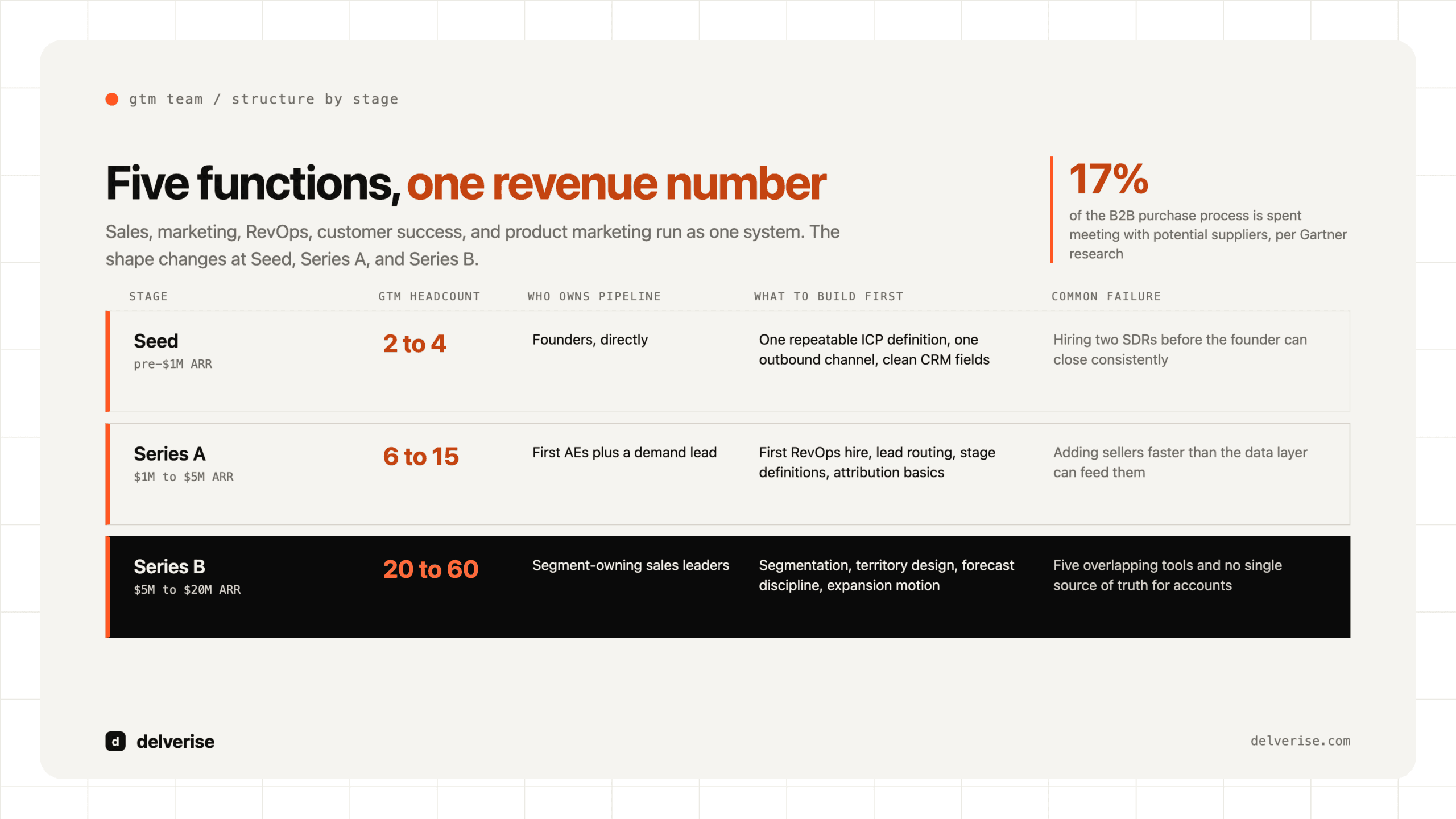
Structure is a function of stage, deal size, and motion. A $6k ACV product-led company and a $60k ACV sales-led company should not share an org chart. The table below shows a common shape for B2B SaaS teams selling into mid-market with a sales-assisted motion.

| Stage | Typical GTM headcount | Who owns pipeline | What to build first | Common failure |
|---|---|---|---|---|
| Seed (pre-$1M ARR) | 2 to 4 | Founders, directly | One repeatable ICP definition, one outbound channel, clean CRM fields | Hiring two SDRs before the founder can close consistently |
| Series A ($1M to $5M ARR) | 6 to 15 | First AEs plus a demand lead | First RevOps hire, lead routing, stage definitions, attribution basics | Adding sellers faster than the data layer can feed them |
| Series B ($5M to $20M ARR) | 20 to 60 | Segment-owning sales leaders | Segmentation, territory design, forecast discipline, expansion motion | Five overlapping tools and no single source of truth for accounts |
Two patterns hold across all three stages. First, one person should own the number for each stage transition. Second, operations capacity should lead headcount, not follow it. Teams that hire the RevOps function at Series B typically spend the first two quarters cleaning up decisions made eighteen months earlier.
Why do GTM teams stall even with good people?
Buying behavior has moved faster than most GTM orgs. Gartner’s research on B2B buying groups found that a typical complex purchase now involves six to ten decision makers, each arriving with independently gathered information. McKinsey’s work on B2B decision journeys found buyers now move across roughly ten channels before committing, up from about five a decade ago.

That creates three concrete failure points inside teams that look well staffed:
Data fragmentation. Account records live in the CRM, enrichment data lives in a spreadsheet, intent signals live in a tool nobody has logged into for a month. Sellers work from stale context and buyers notice. Building an accurate map of your addressable market is usually the prerequisite for everything else.
Undefined handoffs. Marketing passes a lead. Sales rejects it. Nobody writes down why. Six weeks later the same disagreement repeats with different names. A written service-level agreement between functions, including response time and rejection reasons, resolves most of this in a single quarter.
Slow follow-up. Response time remains one of the highest-return variables in B2B. Inbound requests that sit overnight convert materially worse than those touched inside an hour, and the fix is operational rather than motivational. Our breakdown of speed and context in lead follow up covers the routing patterns that make this reliable.
What systems does a modern GTM team run on?
A functioning GTM team needs four layers working together.
- System of record: the CRM. One object model, agreed field definitions, mandatory fields kept to a minimum so reps actually fill them.
- Data and enrichment layer: the pipes that keep account and contact records current. Most teams chain multiple providers because no single vendor has full coverage. Clay is the common choice here because it lets you run providers in sequence and only pay for the next one when the previous returns nothing. Our post on chaining data providers for higher match rates explains the economics, and if you want the workflows built rather than assembled in-house, see our Clay implementation work.
- Activation layer: sequencing, calling, and campaign tools that act on the data.
- Measurement layer: reporting that ties spend and activity to closed revenue with definitions everyone accepts.
Be honest about the tradeoffs. Enrichment waterfalls raise coverage and raise cost per record. More automation raises volume and lowers the ceiling on personalization quality. Every tool added without an owner becomes a source of conflicting numbers within two quarters. The operations function exists to make those tradeoffs deliberately.
A worked example: fixing conversion without hiring
Consider an illustrative Series A company at $3.2M ARR with four AEs, two SDRs, a demand generation manager, and no dedicated operations hire. Monthly numbers look like this: 340 inbound leads, 61 qualified, 24 first meetings, 5 closed deals at $28k average contract value.
The reflex is to hire two more SDRs to raise the top of the funnel. Run the arithmetic on the middle instead. Qualified-to-meeting sits at 39%, which is low for inbound. Two causes surface in the data: median response time is 9 hours because routing depends on a rep manually claiming records, and 31% of leads carry no company size or industry data, so reps deprioritize them.
Fixing routing and enrichment costs one operations hire plus roughly $2k per month in tooling. If qualified-to-meeting moves from 39% to 55%, that is 34 meetings instead of 24, and at the same close rate roughly 7 deals instead of 5. Two extra deals per month at $28k is $672k in incremental annual bookings from a fix that costs well under a quarter of that. Two SDRs would have cost more and added load to the same broken middle.
This is the arithmetic that should precede most GTM headcount decisions. Related reading: ranking pipeline by real buying intent.
How do you know the GTM team is working?
Track a small set of numbers with a named owner on each:
- Stage-to-stage conversion rates, reviewed monthly with agreed stage definitions
- Median time from inbound request to first human touch
- Pipeline coverage against next-quarter target, by segment
- CRM data completeness on the fields that drive routing and scoring
- Net revenue retention, owned by customer success and reviewed with sales
- Cost per opportunity by channel, calculated with the same attribution rules every month
If any of those six lacks an owner, that gap is where the next quarter’s surprise will come from. For teams building the underlying architecture, our GTM engineering work focuses on exactly these connections.
Frequently Asked Questions
What is the difference between a GTM team and a sales team?
A sales team owns conversion of opportunities into revenue. A GTM team includes sales plus marketing, RevOps, product marketing, and customer success, and owns the entire path from market definition through expansion. Sales is one function inside a GTM team.
When should we make our first RevOps hire?
Most B2B SaaS companies benefit once they pass roughly $1M to $2M ARR or three sellers, whichever comes first. The signal is when leadership starts disagreeing about what the numbers mean. That disagreement costs more than the salary.
Should GTM report to one leader?
At Series A and beyond, a single accountable leader such as a CRO or founder-CEO acting as head of revenue reduces handoff friction. What matters more than the title is that one person owns the full funnel number and has authority over the systems that produce it.
How many people should a Series A GTM team have?
Typically 6 to 15, weighted toward sellers and one operations person. The right count depends on deal size and sales cycle. A useful check: if your average rep is at less than 60% of quota attainment, adding headcount will compound the problem instead of solving it.
Can a small GTM team compete with a larger one?
Yes, when the smaller team has better data and faster response. Buyers spend a small fraction of their process talking to any vendor, so precision in targeting and speed in follow-up matter more than raw headcount for companies below roughly $20M ARR.
Read next