←Back to blog
Revenue Intelligence & Data ToolingPlaybookMay 20, 202642 min read
Intercom vs Drift: Which Conversational Marketing Platform Drives More Pipeline? (2026 Analysis)
Intercom vs Drift compared for 2026: pricing, features, conversion rates, and pipeline ROI. See which conversational platform wins for B2B SaaS teams.
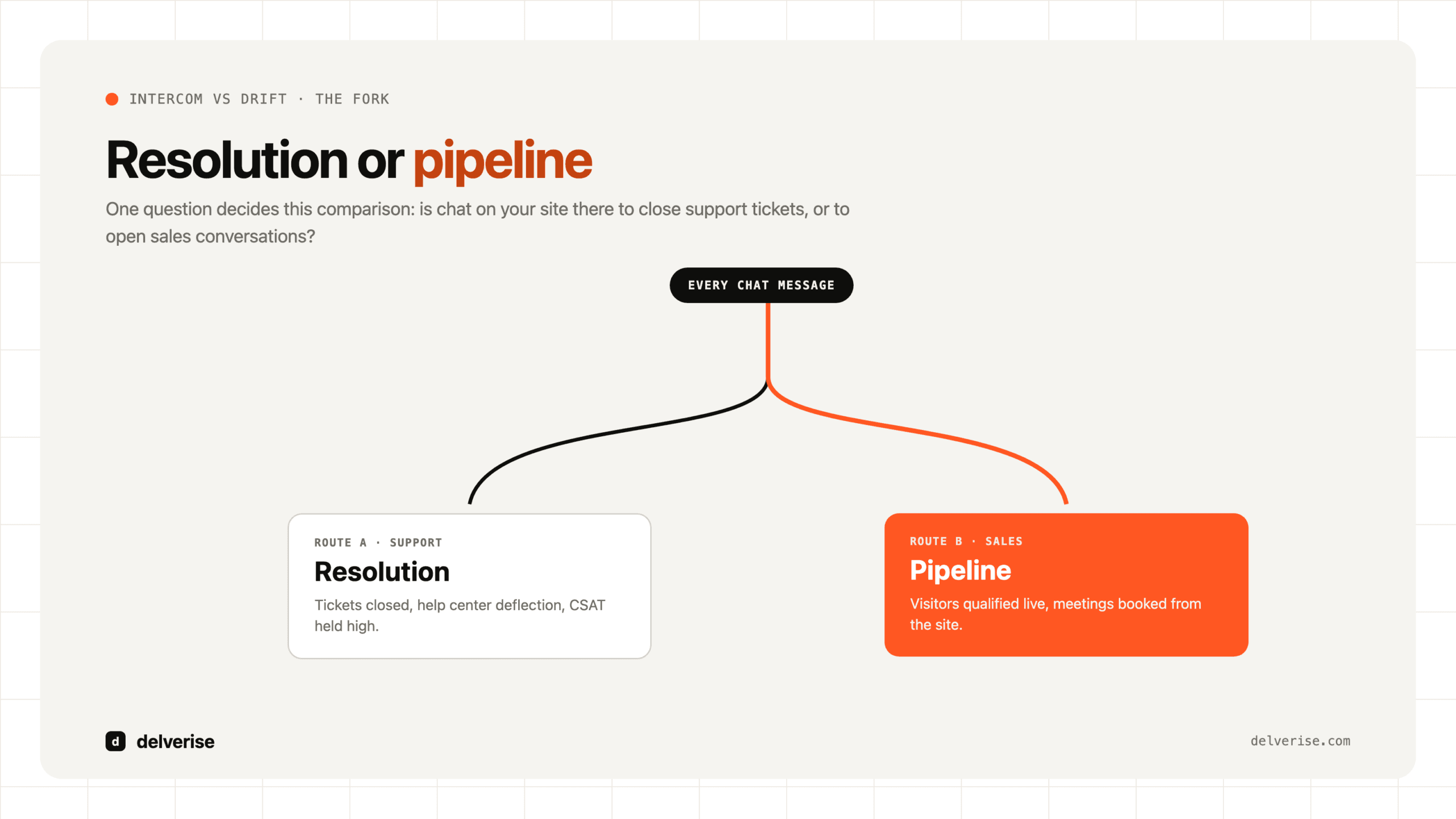
The conversational marketing landscape has evolved dramatically in 2026, with businesses increasingly recognizing that real-time, personalized customer interactions are no longer optional. They’re essential for pipeline growth. As marketing leaders and demand generation managers at B2B SaaS companies face mounting pressure to deliver qualified leads and accelerate sales cycles, the choice between conversational marketing platforms has become more critical than ever.
Two platforms have emerged as dominant forces in this space: Intercom, with its AI-first customer service approach powered by the Fin AI Agent, and Drift, now part of the Salesloft ecosystem, focusing on conversational sales and lead generation. Both promise to transform website visitors into pipeline opportunities, but they take fundamentally different approaches to achieving this goal.
Recent industry data reveals the stakes of this decision. Companies implementing conversational marketing techniques see an average 42% increase in conversion rates, while 99% of B2B marketers report that chatbots have increased their lead-to-customer conversion rate. With 83% of consumers now expecting to kickstart conversations instantly with brands, the platform you choose will directly impact your ability to meet these evolving expectations and drive revenue growth.
Research from Forrester reinforces this shift: ‘Buyers expect immediate, contextual responses, and B2B firms that fail to deliver real-time engagement see measurable drops in pipeline velocity.’ For delverise clients, this means the platform decision is no longer a support-tooling choice. It’s a direct lever on revenue cycle time.
This comprehensive analysis examines both platforms through the lens of pipeline generation, comparing their features, pricing, implementation complexity, and real-world performance metrics. Whether you’re a startup looking to implement your first conversational marketing solution or an enterprise seeking to optimize your existing approach, this guide will help you make an informed decision that aligns with your revenue goals and organizational needs.
Answer: Intercom is usually stronger when customer support, lifecycle messaging, and product-led engagement are central to the motion. Drift is usually stronger when the primary goal is conversational marketing, sales qualification, and meeting creation from high-intent website visitors. The better platform depends on whether the business needs a customer engagement layer, a pipeline capture layer, or a workflow that connects both into CRM and sales follow-up.
- Intercom fits support, onboarding, retention, and lifecycle engagement workflows.
- Drift fits website conversion, qualification, routing, and sales conversation workflows.
- The real ROI depends on routing, enrichment, follow-up speed, and pipeline attribution.
Platform Overview: Two Distinct Philosophies
Understanding the fundamental differences between Intercom and Drift begins with recognizing their core philosophies and target use cases. These platforms have evolved along different trajectories, resulting in solutions that serve overlapping but distinct needs in the conversational marketing ecosystem.
Intercom: The AI-First Customer Service Evolution
Intercom has positioned itself as the leader in AI-powered customer service, with conversational marketing serving as an extension of its comprehensive support suite. The platform’s flagship feature, Fin AI Agent, represents a significant leap forward in automated customer interactions, capable of resolving complex queries without human intervention while maintaining brand voice and accuracy.
The company’s approach centers on resolution-based pricing, where businesses pay $0.99 per conversation resolved by AI, fundamentally changing the economics of customer support and lead qualification. This model reflects Intercom’s confidence in its AI capabilities and aligns costs directly with value delivered. For B2B SaaS companies, this means predictable scaling costs that grow with success rather than team size.
Intercom’s strength lies in its multichannel approach, supporting live chat, email automation, in-app messaging, and knowledge base management within a unified platform. The system excels at creating seamless customer journeys from initial website visit through post-purchase support, making it particularly valuable for companies prioritizing customer lifetime value and retention alongside new lead generation.
The platform’s recent innovations include advanced workflow automation, multilingual support, and sophisticated reporting capabilities that provide deep insights into customer behavior patterns. These features make Intercom especially attractive to growing SaaS companies that need to scale their customer interactions without proportionally increasing their support team size.
Drift: Conversational Sales and Pipeline Acceleration
Drift has carved out its niche as the conversational sales specialist, focusing intensively on converting website visitors into qualified sales opportunities. Now integrated into the Salesloft Revenue Orchestration Platform, Drift benefits from deep sales engagement capabilities and enterprise-grade revenue intelligence tools.
The platform’s core strength lies in its sophisticated meeting booking automation and lead qualification processes. Drift’s chatbots are specifically designed to identify high-intent visitors, engage them in qualification conversations, and seamlessly route qualified prospects to sales representatives. This focus on sales enablement makes Drift particularly appealing to organizations where marketing’s primary mandate is lead generation and sales support.
Drift’s integration with Salesloft provides unique advantages for companies already invested in the Salesloft ecosystem. The platform can automatically sync conversation data with sales workflows, ensuring that valuable insights from chat interactions inform broader sales strategies. This integration enables sales teams to act on buyer signals instantly, potentially shortening sales cycles and improving conversion rates.
However, this specialization comes with trade-offs. Drift’s pricing model reflects its enterprise focus, with plans starting at $2,500 monthly and scaling significantly for larger organizations. The platform’s advanced features, including sophisticated ABM capabilities and complex automation workflows, are typically reserved for higher-tier plans, making it less accessible for smaller organizations or those with limited conversational marketing budgets.
Gartner notes that ‘enterprise conversational platforms increasingly bundle their highest-value automation behind premium tiers, creating a meaningful affordability gap for mid-market buyers.’ This is why delverise pushes growth-stage SaaS teams to map required features against tier thresholds before signing, rather than after a quarter of underwhelming pipeline.
Market Positioning and Target Audiences
The fundamental difference between these platforms becomes clear when examining their target audiences and use cases. Intercom serves as a comprehensive customer communication platform that happens to excel at conversational marketing, while Drift operates as a specialized conversational sales tool that integrates into broader revenue operations.
For marketing leaders at early-stage SaaS companies, Intercom’s approach offers the flexibility to grow into multiple use cases while maintaining cost predictability. The platform’s ability to serve support, marketing, and sales needs simultaneously can be particularly valuable for lean teams wearing multiple hats.
Conversely, Drift appeals to organizations with dedicated sales and marketing teams, substantial lead generation budgets, and specific needs around meeting booking and sales qualification. The platform’s enterprise focus and Salesloft integration make it especially suitable for companies with complex sales processes and high-value deals where sophisticated lead qualification justifies the higher investment.
Understanding these philosophical differences is crucial for making the right platform choice, as they influence everything from pricing and implementation complexity to long-term scalability and feature development priorities.
Feature Deep Dive: Capabilities That Drive Pipeline
The effectiveness of any conversational marketing platform ultimately depends on its feature set and how well those capabilities align with your pipeline generation goals. Both Intercom and Drift offer robust functionality, but their approaches to core features reflect their different philosophies and target markets.

Live Chat and Real-Time Engagement
Both platforms excel at live chat functionality, but their implementations reveal important distinctions. Intercom’s live chat integrates seamlessly with its broader customer service suite, allowing conversations to flow naturally between automated responses, AI assistance, and human agents. The platform’s shared inbox approach ensures that all team members have visibility into customer interactions, creating opportunities for cross-functional collaboration between marketing, sales, and support teams.
Intercom’s chat widget is highly customizable, supporting branded experiences that align with company design systems. The platform’s targeting capabilities allow for sophisticated visitor segmentation, enabling different chat experiences based on factors like company size, industry, or previous interaction history. This level of personalization can significantly impact conversion rates, particularly for B2B companies with diverse customer segments.
Drift’s live chat functionality is optimized specifically for sales conversations, with features designed to qualify leads and book meetings efficiently. The platform’s real-time visitor intelligence provides sales teams with contextual information about website visitors, including company data, previous interactions, and behavioral signals. This information enables more informed and personalized conversations that can accelerate the qualification process.
The key differentiator lies in conversation routing and handoff processes. Intercom’s approach prioritizes comprehensive customer context and smooth transitions between channels, while Drift focuses on rapid qualification and sales team enablement. For organizations where chat serves multiple functions beyond lead generation, Intercom’s approach may provide greater long-term value.
AI and Automation Capabilities
The AI capabilities of these platforms represent perhaps their most significant differentiator and greatest potential for pipeline impact. Intercom’s Fin AI Agent has garnered attention for its ability to resolve complex customer queries autonomously, with some customers reporting resolution rates as high as 87%. This capability extends beyond simple FAQ responses to include actions like account management, troubleshooting, and even basic sales qualification.
Fin’s strength lies in its natural language processing and contextual understanding. The AI can maintain conversation context across multiple interactions, access customer data to provide personalized responses, and escalate to human agents when appropriate. For B2B SaaS companies, this means that initial visitor inquiries can be handled intelligently, with qualified leads seamlessly passed to sales teams along with comprehensive conversation context.
Drift’s AI capabilities focus more narrowly on sales qualification and meeting booking. The platform’s chatbots excel at asking qualifying questions, identifying decision-makers, and scheduling meetings based on sales team availability. While less sophisticated in terms of general customer service, Drift’s AI is highly optimized for the specific task of converting website visitors into sales opportunities.
The automation capabilities extend beyond chat interactions. Intercom’s workflow builder allows for complex, multi-step automation sequences that can span email, in-app messaging, and chat interactions. These workflows can nurture leads over time, provide educational content, and trigger sales outreach based on specific behavioral triggers.
Drift’s automation focuses on sales enablement, with features like automatic lead scoring, CRM synchronization, and sales alert systems. The platform’s integration with Salesloft enables sophisticated revenue orchestration workflows that can coordinate chat interactions with broader sales engagement strategies.
Email Marketing and Campaign Management
Email marketing capabilities reveal another area of significant differentiation between the platforms. Intercom offers comprehensive email marketing functionality, including campaign builders, audience segmentation, and automated drip sequences. The platform’s strength lies in its ability to coordinate email campaigns with other communication channels, creating cohesive customer experiences that span multiple touchpoints.
Intercom’s email capabilities include advanced personalization options, A/B testing functionality, and detailed analytics that track engagement across the entire customer journey. For B2B SaaS companies, this means the ability to nurture leads through educational content, product updates, and targeted offers while maintaining consistent messaging across all channels.
Drift’s email functionality is more limited, focusing primarily on targeted emails that support sales conversations. The platform excels at sending personalized follow-up emails after chat interactions, scheduling reminders for upcoming meetings, and coordinating email outreach with sales team activities. While less comprehensive than Intercom’s offering, Drift’s email features are tightly integrated with its sales-focused workflow.
Knowledge Base and Self-Service Options
Knowledge base functionality represents a critical component of conversational marketing strategy, as effective self-service options can reduce chat volume while improving customer satisfaction. Intercom’s knowledge base capabilities are comprehensive, supporting both public-facing help centers and private internal documentation.
The platform’s knowledge base integrates directly with chat interactions, allowing AI agents to reference articles when responding to customer queries. This integration ensures consistent information delivery and can significantly improve resolution rates. Intercom also supports multilingual knowledge bases, making it suitable for companies with global customer bases.
Drift’s knowledge base capabilities are more limited, reflecting the platform’s focus on direct sales interactions rather than comprehensive customer education. While the platform can reference basic FAQ content during chat conversations, it lacks the sophisticated content management and organization features that characterize Intercom’s approach.
Integration Ecosystem and Extensibility
The integration capabilities of conversational marketing platforms can significantly impact their effectiveness within existing marketing and sales technology stacks. Intercom offers over 300 integrations with popular business tools, including CRM systems, marketing automation platforms, analytics tools, and customer success software.
These integrations enable sophisticated data synchronization and workflow automation. For example, Intercom can automatically create leads in Salesforce based on chat interactions, trigger marketing automation sequences in HubSpot, or update customer success platforms with support interaction data. This level of integration ensures that conversational marketing efforts contribute to broader business objectives and provide comprehensive customer insights.
Drift’s integration ecosystem is more focused but potentially deeper for organizations using Salesloft. The platform’s native integration with Salesloft’s revenue orchestration capabilities provides unique advantages for sales-focused organizations. Drift can automatically sync conversation data with sales workflows, trigger cadence sequences based on chat interactions, and provide sales teams with comprehensive prospect intelligence.
For companies not using Salesloft, Drift offers integrations with major CRM systems and marketing platforms, but the ecosystem is less comprehensive than Intercom’s offering. This difference may be significant for organizations with complex technology stacks or specific integration requirements.
Bot Builder Comparison: Ease vs. Sophistication
The bot building experience significantly impacts both implementation speed and long-term success with conversational marketing platforms. The complexity and capabilities of bot builders often determine how quickly teams can deploy effective automation and how sophisticated their conversational workflows can become.


Intercom’s Approach: Simplicity with Power
Intercom’s bot builder strikes a balance between ease of use and functionality, making it accessible to marketing teams without extensive technical backgrounds while still providing the flexibility needed for complex use cases. The visual workflow builder uses a drag-and-drop interface that allows users to create conversation flows by connecting different message types, conditions, and actions.
The platform’s strength lies in its pre-built templates and guided setup process. New users can quickly deploy functional bots using templates for common use cases like lead qualification, customer support, and product demos. These templates serve as starting points that can be customized to match specific business needs and brand voice requirements.
Intercom’s bot builder includes sophisticated condition logic that allows for branching conversations based on user responses, visitor attributes, or behavioral data. For example, a bot can provide different conversation paths for visitors from different company sizes, industries, or geographic regions. This level of personalization can significantly improve engagement rates and lead quality.
The platform’s integration with Fin AI Agent adds another layer of sophistication. Bots can seamlessly hand off conversations to AI agents when queries become too complex for rule-based responses, then escalate to human agents when necessary. This multi-tiered approach ensures that visitors receive appropriate assistance regardless of their inquiry complexity.
One notable advantage of Intercom’s approach is the ability to test and iterate on bot performance easily. The platform provides detailed analytics on bot interactions, including completion rates, drop-off points, and conversion metrics. This data enables continuous optimization of conversation flows to improve performance over time.
Drift’s Enterprise-Focused Builder
Drift’s bot builder reflects the platform’s enterprise focus, offering advanced capabilities that can handle complex sales qualification and meeting booking scenarios. The interface is more sophisticated than Intercom’s, with extensive customization options and integration capabilities that appeal to organizations with specific workflow requirements.
The platform excels at creating complex decision trees that can handle nuanced qualification scenarios. For B2B companies with multiple product lines, diverse customer segments, or complex sales processes, Drift’s bot builder provides the flexibility needed to create highly targeted conversation experiences.
Drift’s integration with Salesloft enables unique bot capabilities, including real-time access to prospect data, automatic lead scoring updates, and seamless handoffs to sales cadence sequences. These integrations allow bots to make intelligent routing decisions based on comprehensive prospect intelligence rather than just conversation responses.
The platform’s meeting booking capabilities are particularly sophisticated, with bots able to check real-time calendar availability, handle scheduling conflicts, and send automated confirmations and reminders. For sales-focused organizations, this level of automation can significantly reduce the friction in converting interested prospects into scheduled meetings.
However, Drift’s sophistication comes with increased complexity. The learning curve for creating effective bots is steeper than Intercom’s, potentially requiring more technical expertise or dedicated training for marketing teams. The platform’s advanced features may be overwhelming for organizations with simpler conversational marketing needs.
Implementation Complexity and Time-to-Value
The complexity of bot implementation varies significantly between platforms, impacting both initial deployment speed and ongoing maintenance requirements. Intercom’s approach prioritizes quick wins, with most organizations able to deploy basic but effective bots within days of platform implementation.
The platform’s template library covers common B2B SaaS use cases, including trial signup assistance, feature explanation, and basic lead qualification. These templates can be customized with company-specific information and deployed quickly, providing immediate value while teams learn the platform’s more advanced capabilities.
Intercom’s guided setup process includes best practice recommendations and optimization suggestions based on industry benchmarks. This guidance helps new users avoid common pitfalls and implement bots that align with proven conversion optimization strategies.
Drift’s implementation typically requires more planning and setup time, particularly for organizations wanting to leverage the platform’s advanced features. The integration with Salesloft, while powerful, adds complexity to the initial configuration process. Organizations may need dedicated implementation resources or professional services to fully realize the platform’s potential.
However, for companies with the resources to invest in proper implementation, Drift’s sophisticated capabilities can deliver significant returns. The platform’s ability to handle complex qualification scenarios and seamlessly integrate with sales workflows can justify the additional implementation effort for sales-focused organizations.
Customization and Brand Alignment
Both platforms offer extensive customization options, but their approaches reflect their different target audiences and use cases. Intercom provides comprehensive branding capabilities, allowing organizations to create chat experiences that seamlessly integrate with their website design and brand identity.
The platform supports custom CSS, branded chat widgets, and personalized messaging that maintains brand voice across all interactions. For B2B SaaS companies where brand consistency is crucial for building trust and credibility, these customization options can significantly impact conversion rates.
Drift’s customization capabilities focus more on functional flexibility than visual branding. The platform excels at creating conversation flows that align with specific sales processes and qualification criteria. While visual customization options are available, the emphasis is on optimizing conversations for lead generation and sales enablement rather than brand experience.
Analytics and Optimization Capabilities
The ability to measure and optimize bot performance is crucial for long-term success with conversational marketing. Both platforms provide analytics capabilities, but their focus areas reflect their different priorities and target outcomes.
Intercom’s analytics emphasize comprehensive conversation insights, including resolution rates, customer satisfaction scores, and cross-channel engagement metrics. The platform provides detailed funnel analysis that shows how bot interactions contribute to broader customer journey outcomes, including trial signups, feature adoption, and customer retention.
Drift’s analytics focus on sales-relevant metrics, including lead qualification rates, meeting booking conversion, and pipeline contribution. The platform’s integration with Salesloft provides additional insights into how chat interactions influence broader sales outcomes, including deal progression and revenue attribution.
Both platforms support A/B testing of bot conversations, allowing teams to optimize messaging, question sequences, and call-to-action placement based on performance data. This capability is essential for continuous improvement and maximizing the pipeline impact of conversational marketing efforts.
Pricing Breakdown: Total Cost of Ownership Analysis
Understanding the true cost of conversational marketing platforms requires looking beyond headline pricing to consider implementation costs, scaling factors, and hidden expenses that can significantly impact total cost of ownership. The pricing models of Intercom and Drift reflect their different approaches and target markets, with implications that extend far beyond monthly subscription fees.

Intercom’s Resolution-Based Pricing Model
Intercom’s pricing structure represents a fundamental shift in how conversational marketing platforms charge for their services. The company’s resolution-based model charges $0.99 per conversation resolved by AI, combined with seat-based pricing for platform access. This approach aligns costs directly with value delivered, making it particularly attractive for organizations focused on measurable outcomes.
For small to medium-sized B2B SaaS companies, Intercom’s Essential plan starts at $29 per seat monthly when billed annually. This plan includes access to the Fin AI Agent, basic chat functionality, shared inbox capabilities, and pre-built reporting. The resolution-based pricing means that companies only pay for successful AI interactions, creating predictable scaling costs that grow with platform effectiveness rather than team size.
The Advanced plan, priced at $85 per seat monthly, adds sophisticated automation capabilities, multiple team inboxes, and workflow builders that can significantly enhance lead qualification and nurturing processes. This tier includes 20 free lite seats, making it cost-effective for growing teams that need broader platform access without full feature requirements.
Intercom’s Expert plan, at $132 per seat monthly, provides enterprise-grade features including SSO, HIPAA compliance, and multi-brand support. This tier includes 50 free lite seats and advanced security features that make it suitable for larger organizations with complex compliance requirements.
The resolution-based pricing model creates interesting dynamics for cost planning. Organizations with effective AI implementations can achieve significant cost savings compared to traditional per-seat models, while those with less optimized setups may find costs higher than expected. Industry data suggests that well-implemented Intercom deployments achieve 70-87% AI resolution rates, making the $0.99 per resolution fee highly cost-effective.
Drift’s Enterprise-Focused Pricing
Drift’s pricing reflects its position as an enterprise sales enablement platform, with costs that can range from $10,000 to $150,000 annually depending on organization size and feature requirements. The platform’s Premium plan starts at $2,500 monthly, representing a significant investment that reflects the sophisticated sales automation and integration capabilities included.
This pricing model makes Drift most suitable for organizations with substantial lead generation budgets and dedicated sales teams that can fully utilize the platform’s advanced features. The high entry cost is justified by sophisticated meeting booking automation, advanced lead qualification capabilities, and deep integration with Salesloft’s revenue orchestration platform.
For growing companies, Drift’s pricing can represent a significant portion of marketing technology budgets. However, organizations that can effectively leverage the platform’s sales enablement features often see returns that justify the investment. The platform’s focus on meeting booking and sales qualification can be particularly valuable for companies with high-value deals where improved conversion rates offset higher platform costs.
Drift’s enterprise tiers include additional features like advanced ABM capabilities, custom integrations, and dedicated customer success support. These features can be crucial for large organizations with complex sales processes, but they come with proportionally higher costs that may not be justified for smaller companies.
Hidden Costs and Implementation Considerations
Both platforms involve costs beyond their headline pricing that can significantly impact total cost of ownership. Implementation costs vary based on organizational complexity, integration requirements, and the level of customization needed to achieve desired outcomes.
Intercom’s implementation is generally straightforward, with most organizations able to achieve basic functionality within days of signup. However, maximizing the platform’s AI capabilities may require investment in content creation, workflow design, and team training. The platform’s extensive integration ecosystem can also lead to additional costs for premium connectors or custom development work.
Organizations implementing Intercom should budget for content creation costs, particularly for knowledge base articles and bot conversation flows. The platform’s effectiveness depends heavily on the quality of content and conversation design, which may require dedicated resources or external consulting support.
Drift’s implementation typically requires more substantial upfront investment, particularly for organizations wanting to leverage advanced features like Salesloft integration or complex automation workflows. The platform’s enterprise focus means that implementation often involves professional services, custom configuration, and extensive team training.
The integration with Salesloft, while powerful, may require additional licensing costs for organizations not already using the platform. This can significantly increase total cost of ownership for companies that need Drift’s advanced features but don’t require Salesloft’s broader sales engagement capabilities.
Scaling Considerations and Long-Term Costs
The scaling characteristics of these platforms can significantly impact long-term costs and should be carefully considered when making platform decisions. Intercom’s resolution-based pricing creates favorable scaling dynamics for organizations that can achieve high AI resolution rates, as costs grow with successful outcomes rather than team size.
However, organizations with complex customer queries or those in industries where AI resolution rates are typically lower may find Intercom’s costs less predictable. The platform’s seat-based component also means that costs will increase as teams grow, though the inclusion of lite seats in higher tiers can help manage these expenses.
Drift’s flat enterprise pricing can be advantageous for large organizations with extensive sales teams, as the platform cost doesn’t increase directly with user count. However, the high entry cost can be prohibitive for smaller organizations, and the lack of lower-tier options limits flexibility for companies with varying needs.
ROI Considerations and Value Justification
Evaluating the return on investment for conversational marketing platforms requires considering both direct revenue impact and operational efficiency gains. Industry data suggests that companies implementing conversational marketing see average conversion rate increases of 42%, with some organizations reporting even higher improvements.
For Intercom users, the combination of improved customer satisfaction, reduced support costs, and increased lead conversion can often justify platform costs within months of implementation. The platform’s comprehensive analytics make it relatively easy to track ROI across multiple use cases and customer touchpoints.
Drift’s higher costs require more substantial returns to achieve positive ROI, but the platform’s focus on high-value sales activities can generate significant returns for appropriate use cases. Organizations with high average deal values and complex sales processes are most likely to achieve ROI that justifies Drift’s premium pricing.
The key to maximizing ROI with either platform lies in proper implementation, ongoing optimization, and alignment with broader business objectives. Organizations that treat conversational marketing as a strategic initiative rather than a tactical tool are most likely to achieve returns that justify platform investments.
Performance Metrics: Real-World Results and Benchmarks
The ultimate measure of any conversational marketing platform’s value lies in its ability to drive measurable business outcomes. Both Intercom and Drift have accumulated substantial performance data from their customer bases, providing insights into the real-world impact these platforms can have on pipeline generation and revenue growth.

Conversion Rate Performance and Industry Benchmarks
Conversion rate improvements represent the most direct measure of conversational marketing success, and both platforms have demonstrated significant impact in this area. Industry-wide data shows that implementing conversational marketing techniques results in an average 42% increase in conversion rates, with live chat specifically driving 40% conversion rates for engaged visitors.
Intercom’s customer success stories provide compelling evidence of the platform’s conversion impact. Synthesia, a leading AI video platform, achieved remarkable results within six months of implementation, with Fin AI resolving over 6,000 conversations and pushing self-serve support rates as high as 87%. This level of automation improved customer satisfaction and freed human agents to focus on complex queries and sales opportunities.
The financial services sector has seen particularly strong results with Intercom’s approach. Sharesies, a New Zealand-based investment platform, reported a 70% resolution rate with Fin AI, significantly reducing response times while maintaining high customer satisfaction scores. These improvements translated directly into improved customer onboarding experiences and higher conversion rates for new account signups.
Drift’s performance metrics focus more heavily on sales-specific outcomes, reflecting the platform’s specialization in lead generation and meeting booking. Organizations using Drift typically report significant improvements in meeting booking rates, with some customers achieving 60% or higher booking rates for qualified conversations.
The platform’s integration with Salesloft enables sophisticated attribution analysis, allowing organizations to track how chat interactions influence broader sales outcomes. Companies using this integrated approach often report 2.8x faster pipeline acceleration and 20% or higher improvements in enterprise conversion rates.
Customer Satisfaction and Experience Metrics
Customer satisfaction scores provide crucial insights into the quality of conversational experiences and their impact on brand perception. High CSAT scores often correlate with improved customer lifetime value and increased referral rates, making them important leading indicators of long-term business success.
Intercom’s focus on AI-powered customer service has yielded impressive satisfaction results across diverse industries. Dental Intelligence, a dental practice management software company, achieved a 97% CSAT score with Fin AI interactions, demonstrating that automated conversations can maintain high quality standards while scaling efficiently.
Culture Amp, a people analytics platform, reported a 95% global CSAT score across all Intercom interactions, including both AI and human-assisted conversations. This consistency across interaction types suggests that Intercom’s unified approach to customer communication can maintain quality standards regardless of the specific channel or agent type handling inquiries.
The speed of response has emerged as a critical factor in customer satisfaction, with 69% of customers citing fast communication as crucial in chatbot interactions. Intercom’s AI-first approach enables response times of less than one minute for most queries, significantly exceeding customer expectations and contributing to high satisfaction scores.
Drift’s customer satisfaction metrics focus on the sales experience, with particular emphasis on the quality of lead qualification and meeting booking processes. Organizations using Drift report high satisfaction rates among prospects who engage with the platform’s sales-focused chatbots, particularly when conversations result in successful meeting bookings.
Lead Quality and Sales Impact Metrics
The quality of leads generated through conversational marketing platforms significantly impacts their overall value to organizations. High-quality leads that convert to customers at higher rates justify platform investments more effectively than high volumes of unqualified prospects.
B2B-specific data reveals that 99% of B2B marketers report chatbots have increased their lead-to-customer conversion rate, with 56% seeing improvements of at least 10% and 17% achieving improvements of 20% or more. These improvements suggest that conversational marketing platforms can significantly impact both lead volume and lead quality.
Intercom’s approach to lead qualification combines AI-powered initial screening with seamless handoffs to human agents when appropriate. This multi-tiered approach helps ensure that sales teams receive well-qualified prospects with comprehensive context about their needs and interests. The platform’s integration capabilities enable automatic lead scoring updates and CRM synchronization, ensuring that conversational insights inform broader sales strategies.
Drift’s specialization in sales qualification has yielded strong results for organizations focused on meeting booking and direct sales engagement. The platform’s ability to identify high-intent visitors and route them directly to sales conversations can significantly improve lead quality metrics. Companies using Drift often report higher meeting show rates and improved sales conversion rates for chat-generated leads.
Cost Efficiency and Resource Optimization
The operational efficiency gains from conversational marketing platforms can be substantial, particularly for organizations with high support volumes or complex lead qualification requirements. These efficiency improvements often provide significant cost savings that can offset platform investments.
Industry data suggests that chatbot automation can reduce customer service costs by up to 30% while handling 80% of repetitive customer queries. For B2B SaaS companies with substantial support volumes, these savings can be significant and provide ongoing justification for platform investments.
Intercom’s resolution-based pricing model aligns costs directly with efficiency gains, creating favorable economics for organizations that can achieve high AI resolution rates. Synthesia’s experience of saving over 1,300 hours within six months of implementation demonstrates the potential for substantial resource optimization.
The time savings extend beyond direct cost reductions to enable strategic reallocation of human resources. Support teams can focus on complex problem-solving and relationship building, while sales teams can concentrate on high-value prospects and deal progression rather than initial qualification activities.
Implementation Speed and Time-to-Value
The speed at which organizations can achieve meaningful results from conversational marketing platforms significantly impacts their overall return on investment. Platforms that enable quick wins while building toward more sophisticated implementations often provide better overall value.
Intercom’s template-based approach and guided setup process enable most organizations to achieve basic functionality within days of implementation. Linktree, a link-in-bio platform, reported that Fin was successfully resolving 42% of conversations within just six days of implementation, demonstrating the platform’s ability to deliver immediate value.
The platform’s pre-built integrations and extensive documentation support rapid deployment, while the AI capabilities provide immediate automation benefits without requiring extensive training data or complex configuration.
Drift’s implementation typically requires more time and resources, but organizations that invest in proper setup often see substantial returns. The platform’s sophisticated features require more planning and configuration, but they can deliver significant competitive advantages for sales-focused organizations.
Long-Term Performance Trends
Sustained performance improvements over time indicate platform maturity and ongoing value delivery. Both platforms have demonstrated the ability to maintain and improve performance as organizations scale their conversational marketing efforts.
Intercom’s AI capabilities continue to improve through machine learning and regular updates, with many customers reporting increasing resolution rates over time. The platform’s ability to learn from interactions and improve responses contributes to ongoing performance gains without requiring additional manual optimization.
Drift’s integration with Salesloft enables continuous optimization of sales workflows and conversation strategies. Organizations using the integrated platform often report improving conversion rates over time as they refine their qualification processes and optimize their sales handoff procedures.
The key to sustained performance improvement with either platform lies in ongoing optimization, regular analysis of conversation data, and continuous refinement of automation rules and conversation flows. Organizations that treat conversational marketing as an evolving capability rather than a set-and-forget tool are most likely to achieve long-term success.
ABM Capabilities: Account-Based Marketing Excellence
Account-based marketing has become increasingly critical for B2B SaaS companies targeting enterprise customers, and conversational marketing platforms play a crucial role in ABM strategy execution. The ability to identify, engage, and nurture high-value accounts through personalized conversations can significantly impact pipeline quality and deal velocity.

Account Identification and Visitor Intelligence
The foundation of effective ABM lies in accurately identifying website visitors and understanding their account context. Both Intercom and Drift offer visitor identification capabilities, but their approaches and sophistication levels differ significantly.
Intercom’s account identification capabilities integrate with its broader customer data platform, enabling sophisticated visitor recognition based on multiple data sources. The platform can identify visitors through email addresses, company domains, IP addresses, and previous interaction history. This multi-faceted approach provides comprehensive account context that enables personalized conversation experiences from the first interaction.
The platform’s integration with popular ABM tools and data providers enhances its identification capabilities. Organizations can enrich visitor data with firmographic information, technographic details, and intent signals to create highly targeted conversation experiences. This enrichment enables chat experiences that reference specific company challenges, industry trends, or competitive situations.
Drift’s visitor intelligence capabilities are particularly sophisticated, leveraging real-time data to provide sales teams with comprehensive account context during live conversations. The platform can identify visitors from target accounts and provide immediate alerts to sales representatives, enabling rapid response to high-value prospects.
The integration with Salesloft enhances Drift’s account intelligence by providing access to comprehensive prospect data, including previous sales interactions, email engagement history, and account progression status. This integration enables conversations that build on existing sales relationships rather than starting from scratch.
Personalized Engagement Strategies
Effective ABM requires personalized engagement that acknowledges account-specific context and demonstrates understanding of unique business challenges. Both platforms enable sophisticated personalization, but their approaches reflect their different strengths and target use cases.
Intercom’s personalization capabilities span multiple channels, enabling coordinated ABM campaigns that include chat, email, in-app messaging, and targeted content delivery. The platform’s workflow automation can trigger different conversation paths based on account characteristics, previous interactions, or behavioral signals.
For enterprise ABM programs, Intercom’s ability to create account-specific conversation experiences can be particularly valuable. The platform can reference specific company information, industry challenges, or competitive situations to create highly relevant conversation experiences that demonstrate deep understanding of prospect needs.
The platform’s AI capabilities enhance personalization by enabling dynamic conversation adaptation based on visitor responses and behavior. Fin AI can adjust conversation tone, content depth, and call-to-action timing based on engagement signals and account characteristics.
Drift’s personalization focuses specifically on sales conversation optimization, with features designed to maximize meeting booking rates and sales qualification efficiency. The platform can automatically adjust qualification questions based on account size, industry, or previous interaction history.
The integration with Salesloft enables sophisticated personalization based on comprehensive sales context. Conversations can reference previous sales interactions, acknowledge specific pain points identified in earlier conversations, or build on existing relationships with other stakeholders within the target account.
Lead Scoring and Qualification
ABM success depends heavily on effective lead scoring and qualification processes that identify the most promising opportunities within target accounts. Both platforms offer sophisticated scoring capabilities, but their approaches reflect their different priorities and integration ecosystems.
Intercom’s lead scoring combines conversation data with broader customer interaction history to create comprehensive prospect profiles. The platform can track engagement across multiple channels and touchpoints, providing a holistic view of account interest and engagement levels.
The platform’s AI capabilities enable dynamic scoring adjustments based on conversation quality, question sophistication, and engagement depth. This real-time scoring helps ensure that the most promising prospects receive appropriate attention and follow-up.
Intercom’s integration with marketing automation platforms enables sophisticated lead nurturing sequences that can span multiple channels and extend over extended time periods. This capability is particularly valuable for complex B2B sales cycles where multiple touchpoints are required to build trust and demonstrate value.
Drift’s lead scoring focuses specifically on sales readiness and meeting booking potential. The platform’s algorithms analyze conversation patterns, question types, and engagement signals to identify prospects most likely to convert to meetings and ultimately to customers.
The Salesloft integration enables sophisticated scoring that considers broader sales context, including previous outreach attempts, email engagement history, and account progression status. This comprehensive scoring helps sales teams prioritize their efforts and focus on the most promising opportunities.
Sales Handoff and Coordination
The transition from marketing-qualified leads to sales-accepted leads represents a critical moment in ABM programs, and conversational marketing platforms can significantly impact the quality and effectiveness of this handoff process.
Intercom’s handoff capabilities emphasize comprehensive context transfer, ensuring that sales teams receive detailed information about prospect needs, interests, and conversation history. The platform’s shared inbox approach enables seamless collaboration between marketing and sales teams throughout the qualification process.
The platform’s integration capabilities enable automatic CRM updates, task creation, and sales alert generation based on conversation outcomes. This automation ensures that promising prospects receive timely follow-up while maintaining comprehensive records of all interactions.
Intercom’s workflow automation can coordinate handoff processes with broader marketing and sales activities, including email sequences, content delivery, and sales cadence enrollment. This coordination helps ensure that prospects receive consistent messaging and appropriate follow-up regardless of the specific team member handling their inquiry.
Drift’s handoff capabilities are optimized specifically for sales team efficiency, with features designed to minimize response time and maximize conversion rates. The platform can automatically route qualified prospects to available sales representatives based on territory, expertise, or account ownership.
The Salesloft integration enables sophisticated handoff workflows that can automatically enroll prospects in appropriate sales cadences, schedule follow-up activities, and update opportunity records based on conversation outcomes. This automation helps ensure that no promising prospects fall through the cracks while maintaining efficient sales team workflows.
Account-Based Reporting and Analytics
Measuring ABM success requires sophisticated analytics that can track account progression, engagement quality, and revenue attribution across multiple touchpoints and time periods. Both platforms offer ABM-focused reporting capabilities, but their approaches reflect their different strengths and integration ecosystems.
Intercom’s ABM analytics provide comprehensive account-level insights that span multiple channels and interaction types. The platform can track account engagement over time, identify key stakeholders and influencers, and measure the impact of conversational interactions on broader account progression.
The platform’s reporting capabilities include account-level dashboards that show engagement trends, conversation quality metrics, and progression through defined ABM stages. These insights enable marketing teams to optimize their ABM strategies and demonstrate the impact of conversational marketing on account development.
Intercom’s integration with popular ABM platforms enables sophisticated attribution analysis that can track the influence of conversational interactions on account progression and revenue outcomes. This attribution helps justify conversational marketing investments and optimize resource allocation across ABM programs.
Drift’s ABM analytics focus specifically on sales outcomes and pipeline impact, with reporting that emphasizes meeting booking rates, sales qualification efficiency, and revenue attribution. The platform’s dashboards provide real-time insights into ABM performance and enable rapid optimization of conversation strategies.
The Salesloft integration enhances Drift’s analytics by providing comprehensive sales context and enabling sophisticated attribution analysis. Organizations can track how conversational interactions influence broader sales outcomes, including deal progression, sales cycle length, and win rates.
Integration with ABM Technology Stack
The effectiveness of conversational marketing in ABM programs often depends on integration with broader ABM technology stacks, including account intelligence platforms, marketing automation systems, and sales engagement tools.
Intercom’s extensive integration ecosystem includes connections with popular ABM platforms like Demandbase, 6sense, and Terminus. These integrations enable sophisticated account targeting, intent signal incorporation, and coordinated campaign execution across multiple channels.
The platform’s API capabilities enable custom integrations with proprietary ABM tools and data sources, providing flexibility for organizations with unique technology requirements or sophisticated data strategies.
Drift’s integration with Salesloft provides unique advantages for organizations already invested in that ecosystem, but the platform also offers connections with other popular ABM and sales tools. The focus on sales enablement means that integrations emphasize data synchronization and workflow automation rather than broad marketing capabilities.
For organizations evaluating ABM capabilities, the choice between platforms often depends on existing technology investments and specific ABM strategy requirements. Intercom’s broader integration ecosystem may be advantageous for comprehensive ABM programs, while Drift’s Salesloft integration provides unique benefits for sales-focused ABM approaches.
Use Case Analysis: Support, Sales, and Marketing Applications
The versatility of conversational marketing platforms enables their application across multiple business functions, but the effectiveness of each platform varies significantly depending on the specific use case and organizational priorities. Understanding how Intercom and Drift perform across different applications is crucial for making informed platform decisions.
Customer Support Excellence
Customer support represents one of the most mature applications for conversational marketing platforms, with established best practices and clear success metrics. The ability to provide immediate assistance, resolve common queries automatically, and escalate complex issues appropriately can significantly impact customer satisfaction and operational efficiency.
Intercom’s approach to customer support leverages its AI-first philosophy to create sophisticated support experiences that can handle complex queries while maintaining high satisfaction rates. The platform’s Fin AI Agent can access customer data, reference knowledge base articles, and even perform account-related actions to resolve issues without human intervention.
The platform’s strength in support applications lies in its comprehensive approach to customer communication. Support conversations can seamlessly transition between chat, email, and in-app messaging based on customer preferences and issue complexity. This flexibility ensures that customers receive assistance through their preferred channels while maintaining conversation context across all touchpoints.
Intercom’s shared inbox approach enables effective collaboration between support team members, with features like internal notes, conversation assignment, and escalation workflows that ensure complex issues receive appropriate attention. The platform’s reporting capabilities provide detailed insights into support performance, including resolution times, satisfaction scores, and agent productivity metrics.
For B2B SaaS companies, Intercom’s support capabilities can significantly impact customer retention and expansion opportunities. The platform’s ability to identify upsell opportunities during support conversations and coordinate with sales teams can turn support interactions into revenue-generating activities.
Drift’s support capabilities are more limited, reflecting the platform’s focus on sales and lead generation. While the platform can handle basic support queries and route complex issues to appropriate team members, it lacks the sophisticated support-specific features that characterize Intercom’s offering.
However, for organizations where support is not the primary use case, Drift’s basic support capabilities may be sufficient, particularly when combined with dedicated support tools. The platform’s strength lies in its ability to identify sales opportunities during support interactions and route them appropriately to sales teams.
Sales Enablement and Lead Generation
Sales enablement represents Drift’s core strength, with features specifically designed to identify, qualify, and convert website visitors into sales opportunities. The platform’s sophisticated lead qualification capabilities and meeting booking automation can significantly impact sales team productivity and conversion rates.
Drift’s approach to sales enablement emphasizes speed and efficiency, with features designed to minimize the time between initial visitor interest and sales team engagement. The platform’s real-time visitor intelligence enables sales representatives to engage with high-value prospects while they’re actively browsing the website, potentially capturing interest that might otherwise be lost.
The platform’s meeting booking capabilities are particularly sophisticated, with automation that can handle complex scheduling scenarios, send confirmations and reminders, and integrate with popular calendar systems. For sales teams focused on meeting-based sales processes, these capabilities can significantly improve conversion rates and reduce administrative overhead.
Drift’s integration with Salesloft enables sophisticated sales workflow automation that can coordinate chat interactions with broader sales engagement strategies. Qualified prospects can be automatically enrolled in appropriate sales cadences, with conversation context informing subsequent outreach efforts.
Intercom’s sales enablement capabilities are less specialized but more integrated with broader customer communication strategies. The platform can identify sales opportunities during support or marketing interactions and route them appropriately to sales teams with comprehensive context about customer needs and interests.
The platform’s strength in sales enablement lies in its ability to nurture prospects over extended periods through multiple channels and touchpoints. This approach can be particularly valuable for complex B2B sales cycles where multiple interactions are required to build trust and demonstrate value.
Intercom’s AI capabilities can enhance sales enablement by providing intelligent lead scoring, conversation analysis, and opportunity identification. The platform can identify prospects showing buying signals and alert sales teams to engage at optimal moments.
Marketing Automation and Campaign Management
Marketing automation represents an area where the platforms’ different approaches become particularly apparent. The ability to coordinate conversational interactions with broader marketing campaigns can significantly impact overall campaign effectiveness and lead nurturing success.
Intercom’s marketing automation capabilities are comprehensive, enabling sophisticated campaign orchestration across multiple channels and touchpoints. The platform can coordinate chat interactions with email campaigns, in-app messaging, and targeted content delivery to create cohesive customer experiences.
The platform’s workflow automation enables complex, multi-step campaigns that can adapt based on customer behavior, engagement signals, and conversation outcomes. This flexibility allows marketing teams to create sophisticated nurturing sequences that guide prospects through extended buying journeys.
Intercom’s segmentation capabilities enable highly targeted campaigns based on customer characteristics, behavior patterns, and interaction history. This targeting can significantly improve campaign effectiveness and ensure that prospects receive relevant messaging throughout their journey.
The platform’s analytics provide comprehensive insights into campaign performance, including cross-channel attribution, engagement metrics, and conversion tracking. These insights enable continuous optimization of marketing strategies and demonstrate the impact of conversational marketing on broader business objectives.
Drift’s marketing automation capabilities are more focused, emphasizing lead generation and sales enablement rather than comprehensive campaign management. The platform excels at identifying marketing qualified leads and routing them efficiently to sales teams.
The platform’s strength lies in its ability to coordinate conversational interactions with sales activities, ensuring that marketing efforts translate directly into sales opportunities. This coordination can be particularly valuable for organizations with short sales cycles and direct sales processes.
Implementation Complexity and Best Practices
The success of conversational marketing initiatives depends heavily on proper implementation, ongoing optimization, and alignment with broader business objectives. Understanding the implementation requirements and best practices for each platform is crucial for achieving desired outcomes.
Technical Implementation Requirements
Both platforms offer relatively straightforward technical implementation, but the complexity varies based on desired functionality and integration requirements. Understanding these requirements upfront can help organizations plan appropriate resources and timelines.
Intercom’s implementation typically begins with basic chat widget deployment, which can be accomplished through simple JavaScript integration or popular CMS plugins. The platform’s guided setup process helps organizations configure basic functionality quickly while providing recommendations for optimization.
More sophisticated implementations involving AI automation, workflow creation, and extensive integrations may require additional technical resources. The platform’s API documentation and developer resources support custom implementations for organizations with specific requirements.
Intercom’s extensive integration ecosystem means that most common business tools can be connected without custom development. However, organizations with unique technology stacks or specific data requirements may need to invest in custom integration work.
Drift’s implementation often requires more upfront planning, particularly for organizations wanting to leverage advanced features like Salesloft integration or complex automation workflows. The platform’s enterprise focus means that implementation often involves professional services or dedicated technical resources.
The integration with Salesloft, while powerful, adds complexity to the implementation process. Organizations need to coordinate configuration across both platforms and ensure that data synchronization works correctly for their specific use cases.
Organizational Change Management
Successful conversational marketing implementation requires more than technical deployment; it demands organizational change management that addresses team workflows, responsibilities, and success metrics. Both platforms require different approaches to change management based on their capabilities and target use cases.
Intercom’s comprehensive approach to customer communication often requires coordination across multiple teams, including marketing, sales, and customer success. Organizations need to establish clear workflows for conversation routing, escalation procedures, and cross-team collaboration.
The platform’s AI capabilities require investment in content creation and conversation design. Teams need to develop knowledge base articles, conversation flows, and escalation procedures that enable effective automation while maintaining quality standards.
Training requirements for Intercom are generally moderate, with most team members able to achieve basic proficiency quickly. However, maximizing the platform’s advanced features may require dedicated training and ongoing optimization efforts.
Drift’s sales focus means that implementation often centers on sales team workflows and lead qualification processes. Organizations need to establish clear criteria for lead qualification, meeting booking procedures, and sales handoff protocols.
The platform’s sophisticated features may require more extensive training, particularly for teams new to conversational sales techniques. Organizations often benefit from professional services or dedicated training programs to maximize platform effectiveness.
Success Metrics and Optimization
Establishing appropriate success metrics and optimization processes is crucial for long-term conversational marketing success. Both platforms provide analytics capabilities, but organizations need to define metrics that align with their specific objectives and business models.
Common success metrics include conversation volume, conversion rates, lead quality scores, customer satisfaction ratings, and revenue attribution. The specific metrics that matter most depend on the primary use case and organizational objectives.
Intercom’s comprehensive analytics enable tracking across multiple use cases and customer touchpoints. Organizations can measure support efficiency, marketing campaign effectiveness, and sales conversion rates within a unified platform.
Drift’s analytics focus on sales-specific metrics, including meeting booking rates, lead qualification efficiency, and pipeline contribution. These metrics align well with sales-focused objectives but may not capture broader customer experience impacts.
Ongoing optimization requires regular analysis of conversation data, A/B testing of different approaches, and continuous refinement of automation rules and conversation flows. Organizations that treat conversational marketing as an evolving capability rather than a static implementation are most likely to achieve sustained success.
The key to successful optimization lies in establishing regular review processes, maintaining current knowledge of platform capabilities, and staying informed about industry best practices and emerging trends in conversational marketing.
Customer Success Stories: Real-World Impact
The true measure of any conversational marketing platform lies in the tangible results achieved by real customers. Both Intercom and Drift have accumulated impressive case studies that demonstrate their potential impact on pipeline generation and business growth.
Intercom Success Stories
Synthesia: Scaling AI Video Platform Support
Synthesia, a leading AI video generation platform, faced the challenge of scaling customer support while maintaining high quality standards during rapid growth. The company implemented Intercom’s Fin AI Agent to handle the increasing volume of customer inquiries without proportionally expanding their support team.
Within six months of implementation, Fin had resolved over 6,000 conversations, saving the team more than 1,300 hours of manual work. The AI agent achieved self-serve support rates as high as 87%, allowing human agents to focus on complex technical issues and relationship building. This efficiency gain enabled Synthesia to maintain excellent customer satisfaction while scaling their business rapidly.
The implementation also improved response times significantly, with most customer queries receiving immediate responses rather than waiting for human agent availability. This improvement in customer experience contributed to higher retention rates and positive word-of-mouth referrals that supported the company’s growth objectives.
Culture Amp: Global Customer Success at Scale
Culture Amp, a people analytics platform serving organizations worldwide, needed to provide consistent, high-quality support across multiple time zones and languages. The company implemented Intercom’s comprehensive customer communication suite to create seamless support experiences regardless of customer location or inquiry complexity.
The implementation achieved a 95% global CSAT score across all interaction types, demonstrating that automated and human-assisted conversations could maintain consistently high quality standards. The platform’s multilingual capabilities enabled Culture Amp to serve their diverse customer base effectively while maintaining centralized support operations.
The success extended beyond support metrics to impact customer expansion and retention. The platform’s ability to identify upsell opportunities during support conversations and coordinate with sales teams contributed to increased customer lifetime value and expansion revenue.
Dental Intelligence: Healthcare Industry Excellence
Dental Intelligence, a dental practice management software company, required a support solution that could handle complex technical queries while maintaining the high standards expected in healthcare technology. The company implemented Intercom’s AI-powered support capabilities to provide immediate assistance while ensuring accurate information delivery.
The implementation achieved a remarkable 97% CSAT score for AI-handled interactions, demonstrating that automated support could meet the quality standards required in healthcare applications. The platform’s ability to access customer data and provide personalized responses contributed to high satisfaction rates and improved customer relationships.
The success enabled Dental Intelligence to scale their support operations efficiently while maintaining the personal touch that healthcare customers expect. The platform’s comprehensive analytics provided insights into common customer challenges, informing product development and customer success strategies.
Drift Success Stories
Enterprise SaaS Lead Generation
B2B Technology Company Pipeline Acceleration
Professional Services Firm Client Acquisition
Making the Right Choice for Your Organization
The decision between Intercom and Drift ultimately depends on your organization’s specific needs, priorities, and long-term objectives. Both platforms offer powerful conversational marketing capabilities, but their different approaches and strengths make them suitable for different types of organizations and use cases.
When to Choose Intercom
Intercom represents the ideal choice for organizations seeking a comprehensive customer communication platform that can serve multiple functions while providing sophisticated AI capabilities. The platform’s strength lies in its ability to unify customer interactions across support, marketing, and sales functions within a single, cohesive system.
Organizations should consider Intercom when they prioritize customer experience consistency, need comprehensive support capabilities, or want to implement conversational marketing as part of a broader customer communication strategy. The platform’s resolution-based pricing model makes it particularly attractive for companies focused on measurable outcomes and cost predictability.
Intercom is especially well-suited for B2B SaaS companies in growth phases, where the ability to scale customer interactions efficiently while maintaining quality is crucial. The platform’s extensive integration ecosystem and flexible pricing make it accessible to organizations of various sizes and technical sophistication levels.
The platform’s AI-first approach provides significant advantages for organizations willing to invest in proper implementation and content creation. Companies that can achieve high AI resolution rates will find Intercom’s economics particularly favorable, with costs that scale with success rather than team size.
When to Choose Drift
Drift represents the optimal choice for organizations with dedicated sales teams, substantial lead generation budgets, and specific needs around meeting booking and sales qualification. The platform’s specialization in conversational sales makes it particularly valuable for companies with high-value deals and complex sales processes.
Organizations should consider Drift when they have sophisticated sales operations, existing investments in Salesloft, or specific requirements for advanced ABM capabilities. The platform’s enterprise focus and premium pricing reflect its positioning as a specialized sales enablement tool rather than a general-purpose communication platform.
Drift is especially suitable for established B2B companies with dedicated sales and marketing teams, substantial technology budgets, and specific needs around sales acceleration. The platform’s integration with Salesloft provides unique advantages for organizations already invested in that ecosystem.
The platform’s sophisticated features and higher costs require organizations to have clear ROI expectations and the resources to implement and optimize advanced conversational sales workflows. Companies that can effectively leverage Drift’s specialized capabilities often see returns that justify the premium investment.
Implementation Recommendations
Regardless of platform choice, successful conversational marketing implementation requires careful planning, appropriate resource allocation, and ongoing optimization. Organizations should begin with clear objectives, defined success metrics, and realistic timelines for achieving desired outcomes.
Start with basic functionality and gradually expand capabilities as teams become comfortable with the platform and processes. This approach enables quick wins while building toward more sophisticated implementations that can deliver greater long-term value.
Invest in proper training and change management to ensure that teams can effectively utilize platform capabilities. The most sophisticated platform will fail to deliver results if teams lack the knowledge and processes needed to use it effectively.
Establish regular review and optimization processes to ensure that conversational marketing efforts continue to improve over time. The most successful organizations treat conversational marketing as an evolving capability rather than a static implementation.
Future Considerations
The conversational marketing landscape continues to evolve rapidly, with advances in AI, integration capabilities, and customer expectations driving ongoing innovation. Organizations should consider current capabilities, platform roadmaps, and strategic directions when making platform decisions.
Both Intercom and Drift continue to invest heavily in AI capabilities, with improvements in natural language processing, conversation intelligence, and automation sophistication. These advances will likely expand the potential applications and effectiveness of conversational marketing over time.
The integration ecosystem will continue to be crucial for platform success, as conversational marketing becomes more tightly integrated with broader marketing and sales technology stacks. Platforms with strong integration capabilities and developer ecosystems will likely provide greater long-term value.
Customer expectations for conversational experiences will continue to rise, driven by improvements in AI capabilities and increased exposure to sophisticated conversational interfaces. Organizations that invest in conversational marketing capabilities now will be better positioned to meet these evolving expectations.
Need website conversations to become qualified pipeline? delverise builds AI lead generation and growth systems that connect chat, enrichment, routing, CRM workflows, and follow-up into one revenue motion. Explore AI Lead Generation, Growth Engineering, GTM Engineering, or apply to work with us.
Frequently Asked Questions
What is the main difference between Intercom and Drift?
Intercom is an AI-first customer service platform with conversational marketing as an extension of its support suite, while Drift specializes in conversational sales and pipeline acceleration. Intercom centers on resolution-based pricing at $0.99 per AI-resolved conversation and supports live chat, email, in-app messaging, and knowledge base management. Drift, now part of the Salesloft Revenue Orchestration Platform, focuses on meeting booking automation and qualifying high-intent website visitors for sales teams.
How much does Drift cost compared to Intercom?
Drift’s pricing reflects its enterprise focus, with plans starting at $2,500 monthly and scaling significantly for larger organizations. Intercom uses a resolution-based pricing model at $0.99 per conversation resolved by its Fin AI Agent, aligning costs directly with value delivered. This makes Intercom more predictable as it scales with success rather than team size, while Drift’s advanced ABM and automation features are typically reserved for higher-tier plans.
Which platform is better for B2B SaaS lead generation?
Drift is purpose-built for B2B SaaS lead generation, with chatbots designed to identify high-intent visitors, run qualification conversations, and route qualified prospects to sales reps. Its Salesloft integration syncs conversation data with sales workflows so teams can act on buyer signals instantly. Intercom works well for SaaS companies prioritizing customer lifetime value and retention alongside new leads, thanks to its multichannel support and unified customer journey from first visit through post-purchase.
How effective is conversational marketing for pipeline growth?
Companies implementing conversational marketing techniques see an average 42% increase in conversion rates, and 99% of B2B marketers report that chatbots have increased their lead-to-customer conversion rate. With 83% of consumers now expecting to kickstart conversations instantly with brands, conversational platforms have shifted from optional to essential. The platform choice directly impacts a company’s ability to meet evolving buyer expectations and accelerate revenue growth in 2026.
What is Intercom’s Fin AI Agent and how does it work?
Fin AI Agent is Intercom’s flagship feature representing a significant leap forward in automated customer interactions. It resolves complex queries without human intervention while maintaining brand voice and accuracy. Businesses pay $0.99 per conversation resolved by the AI, which fundamentally changes the economics of customer support and lead qualification. The model lets growing SaaS companies scale customer interactions without proportionally increasing support team size, with predictable costs that grow alongside success.
Read next