←Back to blog
Revenue Intelligence & Data ToolingGuideAugust 5, 202610 min read
Intentsify: What It Does, Where It Fits, and What Buying Intent Data Actually Changes
Intentsify is a B2B intent data and activation platform that identifies accounts researching topics related to your category, scores that research activity, and pushes the resulting audiences into advertising, sales, and content syndication programs. It combines third-party intent signals with demand generation delivery, so buyers get both the signal and a channel to act on it.
Intentsify is a B2B intent data and activation platform that identifies accounts researching topics related to your category, scores that research activity, and pushes the resulting audiences into advertising, sales, and content syndication programs. It combines third-party intent signals with demand generation delivery, so buyers get both the signal and a channel to act on it.
Key takeaways
- Intent data tells you which accounts are researching your category right now. It does not tell you who inside the account is doing the research, or why.
- Intentsify’s differentiator is bundling intent detection with activation: display, syndication, and audience delivery in one contract, rather than signal alone.
- The value of any intent vendor is capped by what happens downstream. Signal into a broken routing and follow-up system produces noise, not pipeline.
- Most Seed to Series B teams should prove their motion works on known signals (product usage, website behavior, hand raises) before paying for third-party intent.
- Budget for the operational build, not just the license. Ingestion, scoring, routing, and measurement typically cost more effort than the subscription itself.
What is Intentsify and what problem does it solve?
Intentsify sits in the category of lead intelligence platforms: tools that observe buying behavior across the web and translate it into account-level signals your revenue team can act on. Intent data, defined simply, is evidence that a company is actively researching a problem, a category, or a competitor, gathered from publisher networks, bidstream data, content consumption, and review site activity.
The problem it addresses is timing. Most of your total addressable market is not in-market at any given moment. Traditional outbound sprays the whole list and accepts a low reply rate. Intent data attempts to narrow the field to accounts showing research behavior in the last few weeks, so your reps and your ad spend concentrate where attention already exists.
Intentsify’s specific positioning is that it closes the loop between signal and action. Many intent vendors sell you a feed and leave activation to you. Intentsify packages intent scoring alongside programmatic display, content syndication, and audience delivery into your CRM or ad platforms. For a team without a strong operations bench, that bundling is genuinely useful. For a team that already has activation infrastructure, it can mean paying for delivery capability you do not need.
How does intent data actually work under the hood?
Understanding the mechanics matters, because it determines how much confidence to place in the output.

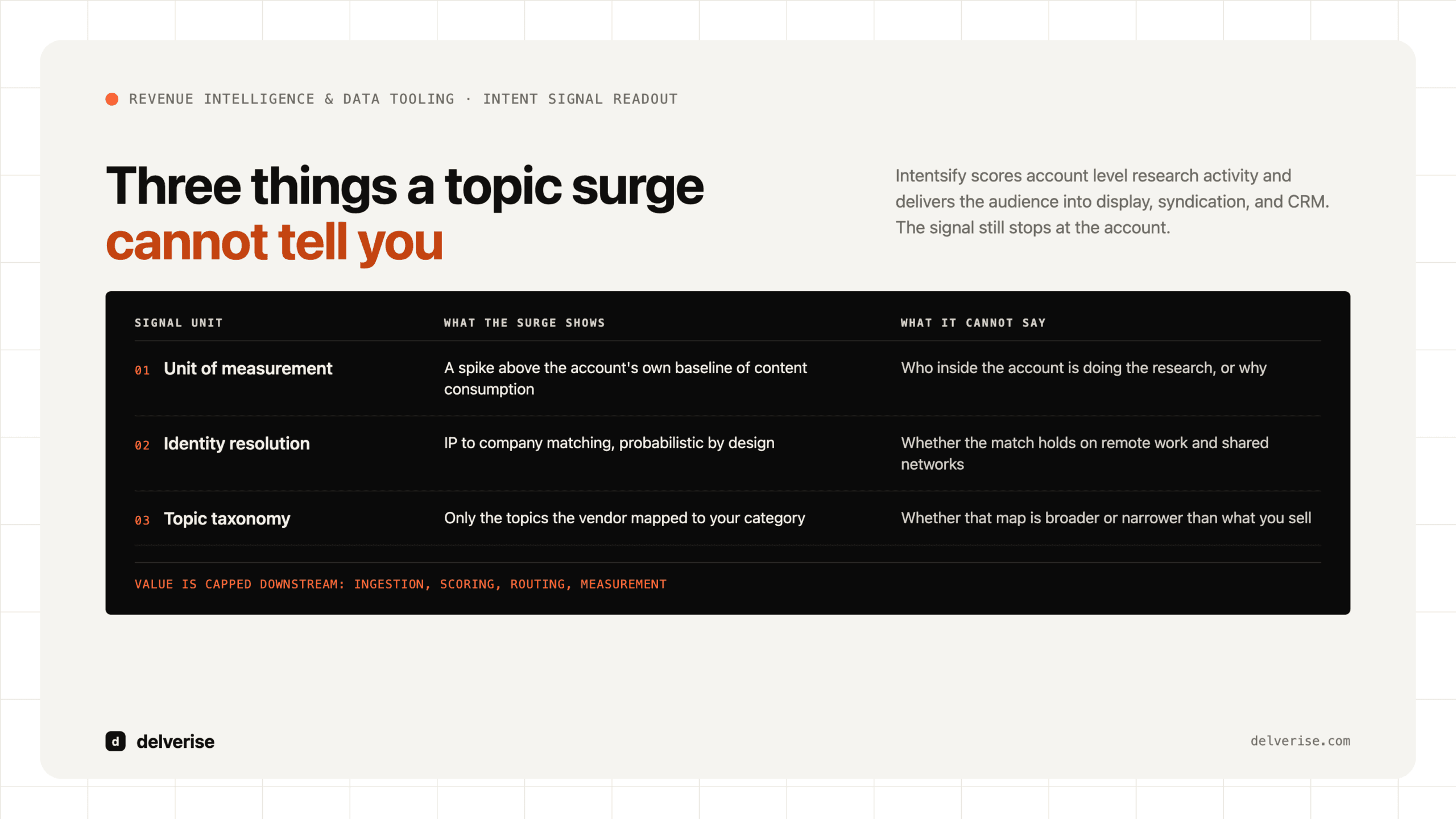
Third-party intent providers observe content consumption across networks of B2B publishers and data partners. When devices associated with a company’s IP range or resolved firmographic identity consume content about, say, “customer data platform,” the provider records a topic hit. Compare that volume against the account’s own baseline, and a spike becomes a “surge.” That surge is what you buy.
Three things follow from this. First, the unit of measurement is the account, not the person. Second, resolution is probabilistic; IP-to-company matching degrades with remote work and shared networks. Third, topic taxonomies are vendor-defined, so “intent for your category” means intent for the topics the vendor mapped to your category, which may be broader or narrower than what you sell.
None of that makes intent data useless. It makes it a prior, not a fact. Gartner has repeatedly noted that B2B buyers spend the majority of their buying journey doing independent research rather than talking to sellers, which is exactly the window intent data tries to observe. Treat a surge as a reason to prioritize an account this week rather than next quarter, and it earns its keep. Treat it as proof of a live deal, and your team will burn credibility on badly timed outreach.
Where does Intentsify fit against other options?
The market splits along a useful axis: signal-only vendors versus signal-plus-activation vendors. Here is how the tradeoffs compare.

| Approach | What you get | Best fit | Main tradeoff |
|---|---|---|---|
| Signal-plus-activation (Intentsify, similar bundled vendors) | Intent scoring, display, syndication, audience delivery | Teams with budget but thin ops capacity | Less control over targeting logic; harder to attribute which layer worked |
| Signal-only feeds (Bombora, G2 Buyer Intent, TrustRadius) | Topic surges or category-page activity delivered as data | Teams with a working RevOps function | You own all activation, scoring, and routing work |
| First-party signals (product usage, site visits, pricing page views) | High-confidence behavior from people you can identify | Every team, always the first build | Only covers accounts already aware of you |
| Composite systems (warehouse plus Clay plus CRM scoring) | Blended first-party and third-party signals under your own logic | Teams past product-market fit scaling outbound | Requires engineering ownership and ongoing maintenance |
The honest read: G2 Buyer Intent tends to be higher-confidence but narrower, since someone comparing products on a review page is closer to purchase than someone reading a blog post about a topic. Bombora offers broad co-op coverage. Intentsify’s argument is convenience and delivery. All three are viable. What separates a good outcome from a bad one is rarely the vendor, and almost always the system you plug it into.
What does a worked example look like?
Take a Series A SaaS company selling compliance automation, 800 accounts in ICP, two AEs and one SDR. They license intent data and receive 90 surging accounts in a month.

Without a system, those 90 accounts land in a spreadsheet, the SDR works the top 20, sends generic sequences referencing nothing specific, and books two meetings. Cost per meeting is high and the team concludes intent data does not work.
With a system, the same 90 accounts get filtered against ICP fit (down to 55), deduplicated against open opportunities and recent outreach (down to 41), enriched to identify the three most likely buying-committee roles per account, and routed with a topic-specific first line: the surge topic becomes the message hook. Display retargeting warms the account for ten days before the SDR touches it. Meetings booked from the same raw signal typically land several times higher, because the signal was routed into context rather than into a list.
The difference is not the data. It is the four steps between the data and the human. That is the work most teams skip, and it is why our GTM operations builds start with routing and enrichment logic before any new signal source gets bought.
What has to be true before Intentsify is worth buying?
Intent data amplifies whatever system it enters. If your follow-up is slow and generic, more signal produces more mediocre outreach. Run through this before you sign:
- Your ICP is defined at the account level with firmographic and technographic criteria your CRM can actually filter on
- First-party signals are already captured and scored: pricing page visits, demo requests, product trials, content downloads
- Lead routing assigns owners in minutes, not days, with clear rules for account ownership conflicts
- You have a documented follow-up motion with sequenced touches, not ad hoc rep discretion
- Enrichment fills contact-level data at the buying committee level, not just one champion per account
- You can measure meetings and pipeline sourced by signal type, so you can tell whether intent contributed anything
- Someone owns the intent-to-action workflow as a named responsibility, not a shared side project
If four or more of those are missing, buying intent data is premature. Fix the pipes first. Our guide to lead scoring covers how to build the scoring layer that makes any third-party signal usable, and lead follow-up covers the speed-and-context problem that determines whether prioritized accounts convert.
How should you measure whether intent data is working?
Most intent programs fail measurement before they fail performance. The vendor reports surges and impressions. Your board asks about pipeline. Those are different questions.
Build the measurement layer before the first campaign runs:
- Holdout groups. Withhold a random sample of surging accounts from outreach. Compare conversion against the worked group. This is the only clean way to know whether intent added lift over your baseline motion.
- Signal-tagged pipeline. Stamp every opportunity with the signal that triggered first contact. Without this field, attribution becomes an argument rather than a number.
- Time-to-first-touch. Measure hours between surge detection and human outreach. If the median exceeds a week, the timing advantage you paid for has evaporated.
- Topic-level conversion. Some topics predict purchase; most do not. After a quarter, you will find two or three topics carrying most of the conversion. Cut the rest.
Forrester’s research on B2B buying behavior has consistently pointed to buying groups rather than individuals driving purchase decisions, with multiple stakeholders involved in most enterprise deals. That has a direct measurement implication: single-contact conversion rates understate the effect of account-level programs. Measure at the account level or you will misjudge the program.
What are the common failure modes?
Four patterns account for most disappointing intent programs.
Buying signal without buying capacity. A surge tells you research is happening. It says nothing about budget, timing, or authority. Teams that treat intent accounts as hot leads and pitch immediately get worse response rates than teams that treat them as warm and lead with relevant content.
Topic taxonomy drift. The topics you select at onboarding rarely match how your market actually describes the problem. Review and revise quarterly, using your own closed-won language rather than the vendor’s suggested list.
No contact-level bridge. Account-level intent is worthless until you know which humans to reach. That is an enrichment and waterfall problem, covered in our post on chaining data providers for higher match rates.
Personalization theater. “I saw your team is researching data governance” is creepy when it is wrong and generic when it is right. The better use of a surge topic is choosing which case study, benchmark, or point of view to lead with, not announcing that you are surveilling the account. Our take on AI prospecting tools goes deeper on where automated personalization holds up and where it breaks.
What should a Seed to Series B team do instead, or first?
Sequence matters more than tool selection. A practical order:
First, instrument first-party signals completely. Website behavior, product usage, email engagement, and hand raises are free, high-confidence, and under your control. Most companies below Series B have not fully exploited these, which makes third-party intent an expensive substitute for work they have not done.
Second, build the activation spine: enrichment, scoring, routing, sequencing, and reporting as one connected system. This is the part that determines return on every signal source you will ever buy. See our GTM engineering work for how this gets assembled.
Third, add third-party intent as an accelerant once the spine works. At that point you can evaluate Intentsify against signal-only feeds on the real question: does the bundled activation save you more than it costs in control and attribution clarity?
McKinsey’s work on B2B sales has highlighted how buyers now move fluidly across digital and human channels and expect consistency between them. Intent data is one input into meeting that expectation. It is not a strategy on its own, and no vendor, Intentsify included, can supply the operating system it plugs into.
Frequently Asked Questions
Is Intentsify worth it for a company under $5M ARR?
Usually not as a first purchase. Below that revenue level, most teams have not fully instrumented first-party signals, and third-party intent adds volume they cannot process well. The exception is a company selling into a narrow, well-defined enterprise segment where account timing genuinely gates every deal and the total addressable market is small enough that prioritization is the whole game.
How accurate is B2B intent data?
Accuracy varies by provider, topic, and account size. Larger companies with stable IP ranges resolve more reliably than distributed startups. Review-site intent tends to be higher confidence than bidstream-derived topic data because the behavior is closer to purchase. Treat all of it as directional prioritization rather than confirmed buying activity, and validate with holdout testing on your own accounts.
What is the difference between Intentsify and Bombora?
Bombora is primarily a signal provider, operating a data co-op and delivering topic surge data into your systems for you to act on. Intentsify bundles intent detection with activation channels including display advertising and content syndication. If you already have a strong operations function and ad infrastructure, a signal-only feed gives you more control. If you need delivery too, bundled vendors reduce the number of moving parts.
Can we build intent detection ourselves instead of buying it?
You can build first-party intent detection yourself and you should: website behavior, content consumption, product usage, and engagement scoring are all achievable with your existing stack plus a warehouse. What you cannot build is off-site third-party observation, which requires publisher network access. The practical answer for most teams is to build the first-party layer, then decide whether third-party coverage is worth the incremental spend.
How long before an intent program shows results?
Expect one full sales cycle plus a ramp period, typically 90 to 180 days for mid-market B2B SaaS. The first 30 days go to topic calibration and workflow setup. Meaningful conversion data requires enough surging accounts to compare against a holdout, which for most Seed to Series B teams means at least a quarter of consistent execution. Anyone promising results in weeks is measuring activity, not pipeline.
Read next