←Back to blog
Growth & Demand GenerationPlaybookMay 20, 202620 min read
Best MarTech Stack for Series A Startups: Build a Scalable Foundation for Growth
Series A startups need a MarTech stack that scales. Architect your foundation across CRM, automation, analytics, and attribution with budget guidance for $2-5M ARR teams.
Successfully navigating the transition from Seed to Series A is a formidable challenge for any startup. With a fresh injection of capital, the pressure is on to demonstrate scalable, repeatable growth. For marketing leaders, this means moving beyond the scrappy, founder-led tactics that secured initial traction and building a robust, data-driven marketing engine. The foundation of this engine is a well-architected marketing technology (MarTech) stack.
According to Carta’s Q2 2026 data, the median Series A valuation reached $47.9 million, with average round sizes of $16.6 million. This guide provides a strategic framework for Series A startups with $2-5 million in Annual Recurring Revenue (ARR) to build a MarTech stack that supports immediate growth objectives while also laying a scalable foundation for the future. We will explore the core architectural principles, provide detailed tool recommendations across key categories, offer budget allocation guidance, and present a roadmap for scaling your stack as your company grows.
The Series A Marketing Challenge
The leap to Series A marks a pivotal moment in a startup’s journey. The primary challenge shifts from simply acquiring customers to acquiring them efficiently and predictably. This requires a fundamental change in the marketing operating model, moving from ad-hoc experimentation to a structured, scalable system. At this stage, marketing is no longer just about generating leads; it’s about building a revenue-generating machine.
According to McKinsey, ‘companies that build operational rigor into their go-to-market motion early grow 1.5 to 2 times faster than peers that defer systems investment.’ For Series A founders, this reframes MarTech spend from overhead to a direct lever on growth velocity, not a cost center to minimize.
This transition involves several key shifts. The marketing function, previously driven by the founders’ vision and hustle, must now be operationalized and scaled through a dedicated team. Gut feelings and qualitative feedback, while still valuable, must be augmented with quantitative data and rigorous analysis to inform decisions. Processes for lead nurturing, customer communication, and reporting, once handled manually, must be automated to support a higher volume of activity. Finally, disparate tools and data sources must be integrated to provide a unified view of the customer journey and enable seamless cross-functional collaboration.
Gartner notes that ‘the average enterprise marketing organization uses only 42% of its MarTech stack’s capabilities,’ a gap rooted in poor integration and unclear ownership. Series A teams that architect for integration from day one avoid the rip-and-replace cycles that consume later-stage marketing budgets.

Successfully navigating this transition requires a thoughtful and strategic approach to building your MarTech stack. Companies like Notion, which raised its Series A in 2018, built a lean but powerful stack focused on product-led growth analytics and community engagement tools. Similarly, Airtable prioritized integration-heavy tools that could scale with their rapidly growing user base. The choices you make at this stage will have a lasting impact on your ability to scale efficiently, prove marketing’s contribution to revenue, and ultimately, achieve your growth targets.
Core MarTech Stack Architecture
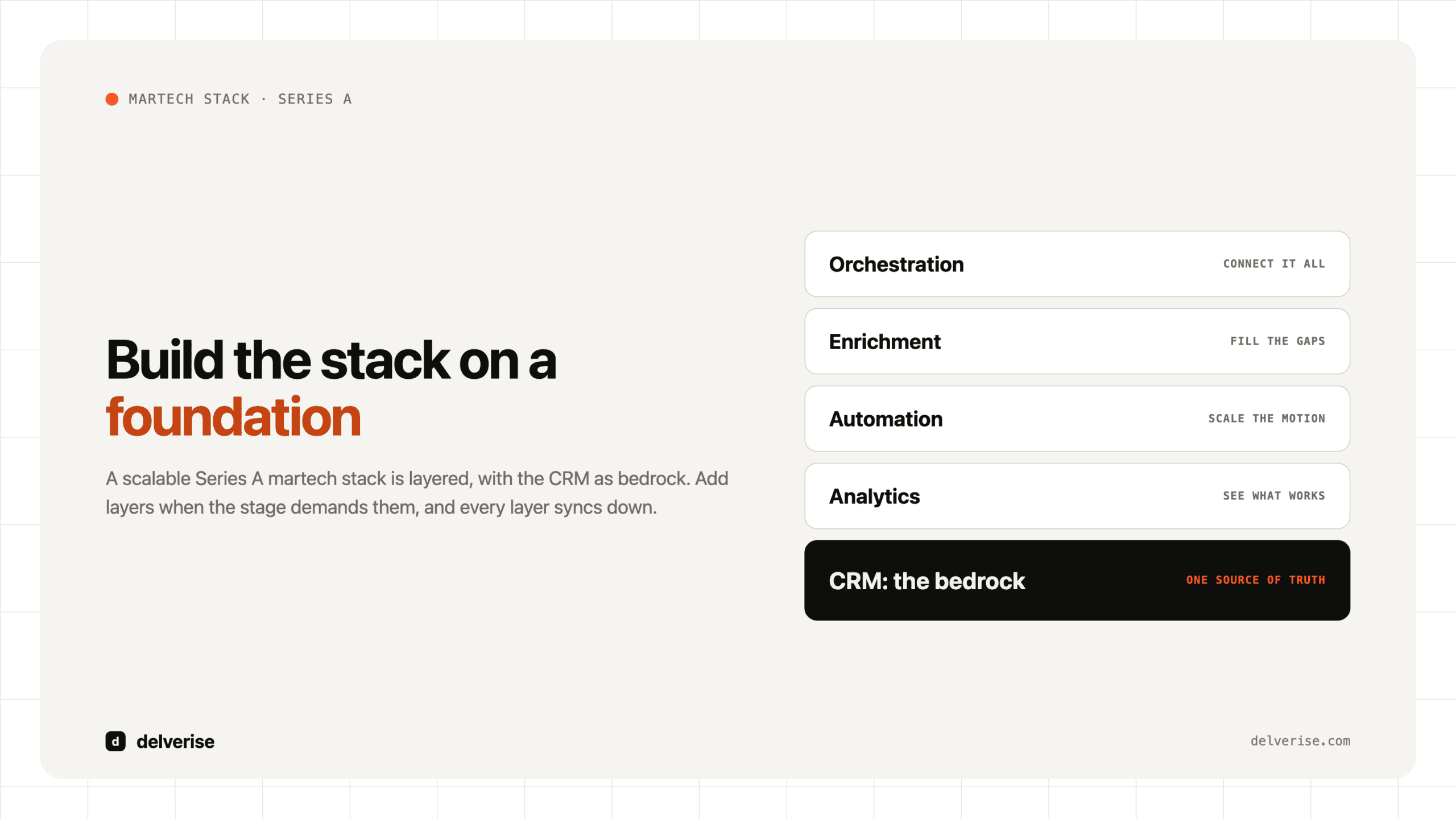
A scalable MarTech stack is a structured ecosystem where each component has a specific role and works in harmony with the others. For a Series A startup, it’s crucial to build this architecture with a long-term vision, even if you start with a lean implementation. We recommend a layered approach that provides a clear framework for prioritizing investments and adding new capabilities over time.

The Four Layers of a Series A MarTech Stack
The foundation layer forms the bedrock of your marketing operations. These are the non-negotiable systems that provide a single source of truth for customer data and enable basic marketing and sales activities. This includes your Customer Relationship Management (CRM) system, which serves as the central repository for all customer and prospect data, a robust Analytics platform for tracking website traffic and user behavior, and a Content Management System (CMS) for creating and publishing your website content.
Once the foundation is in place, the core platforms layer consists of systems that automate key marketing functions and enable you to engage with your audience at scale. This includes Marketing Automation platforms for nurturing leads and scoring engagement, as well as dedicated Email Marketing tools for newsletters and broadcast communications.
The specialty tools layer consists of specialized applications that enhance specific marketing functions and provide a competitive edge. These tools are typically added as the team grows and marketing programs become more sophisticated. This layer includes SEO Tools for keyword research and backlink analysis, Social Media Management platforms for scheduling and monitoring, and Design Tools for creating visual assets.
Finally, the nice-to-haves layer includes advanced tools that can accelerate growth and provide deeper insights. These are typically considered once the core stack is mature and the team has the capacity to leverage them effectively. This includes Attribution platforms to understand which channels are driving revenue, and Customer Data Platforms (CDP) to unify customer data from multiple sources.
This layered approach provides a clear roadmap for building your MarTech stack in a phased and strategic manner, ensuring that you prioritize the most critical investments first and add new capabilities as your needs evolve.
Budget Allocation Guide
For a Series A startup with an ARR between $2 million and $5 million, the annual marketing budget typically falls between $500,000 and $2 million, representing 25-40% of the company’s funding. According to CB Insights’ 2026 benchmark study, Series A companies that allocate at least 30% of funding to growth marketing see 40% faster revenue scaling compared to those spending under 20%.

| Category | Percentage of Budget | Example Annual Spend ($1M Budget) |
|---|---|---|
| MarTech Tools & Platforms | 20-30% | $200,000 – $300,000 |
| Core Infrastructure (CRM, Analytics, CMS) | 5-10% | $50,000 – $100,000 |
| Automation & Engagement (Marketing Automation, Email) | 10-15% | $100,000 – $150,000 |
| Specialty Tools (SEO, Social, Design, Attribution) | 5-10% | $50,000 – $100,000 |
| Paid Media & Advertising | 30-40% | $300,000 – $400,000 |
| Search Engine Marketing (SEM) | 15-20% | $150,000 – $200,000 |
| Social Media Advertising | 10-15% | $100,000 – $150,000 |
| Content Syndication & Other | 5% | $50,000 |
| Content & Creative | 15-20% | $150,000 – $200,000 |
| Freelance Writers & Designers | 10-15% | $100,000 – $150,000 |
| Video & Multimedia Production | 5% | $50,000 |
| Team & Headcount | 15-20% | $150,000 – $200,000 |
| Marketing Team Salaries | 15-20% | $150,000 – $200,000 |
Key Budgeting Considerations
At the Series A stage, it is almost always more cost-effective to buy off-the-shelf MarTech solutions rather than building them in-house. The opportunity cost of diverting engineering resources from your core product is simply too high. Opt for annual subscriptions whenever possible, as they often come with significant discounts of 10-20%. Don’t be afraid to negotiate pricing with MarTech vendors, especially if you are making a long-term commitment or bundling multiple products.
When evaluating the total cost of a new tool, be sure to factor in any one-time implementation fees and the cost of training your team. According to Gartner research, marketers utilize just 42% of their MarTech stack capabilities, so proper training is essential to maximize your investment. Finally, allocate a portion of your budget (5-10%) for experimenting with new channels and tools to stay ahead of the curve and identify new growth opportunities.
Tool Recommendations by Category
Choosing the right tools is one of the most critical decisions you’ll make when building your MarTech stack. The 2024 MarTech landscape contains 14,106 products, making the selection process overwhelming. To help you navigate this complex landscape, we’ve compiled a list of recommendations across key categories, using a “Good/Better/Best” framework to cater to different needs and budgets.

Marketing Automation
Marketing automation is the engine of your demand generation efforts. It allows you to nurture leads at scale, personalize communication, and align sales and marketing efforts. The right platform will serve as a central hub for your campaigns and provide the analytics you need to optimize performance.
| Tier | Tool | Indicative Pricing | When to Use It |
|---|---|---|---|
| Good | Close.io | ~$99/user/month | You are a sales-heavy organization and need a CRM with strong, integrated marketing automation features from the get-go. Your primary focus is on outbound sales and you need a tool that can support that motion effectively. |
| Better | HubSpot Marketing Hub | Starts at $800/month (Professional) | You are looking for a powerful, all-in-one platform that can scale with you. You value ease of use and a seamless integration between your marketing automation and CRM. You are willing to pay a premium for a comprehensive solution. |
| Best | Salesforce Marketing Cloud Account Engagement (Pardot) | Starts at $1,250/month | You are already using Salesforce as your CRM and want a tightly integrated marketing automation solution. You have a dedicated marketing operations team that can leverage the platform’s advanced features and customization options. You are focused on B2B marketing and need a tool that can support complex sales cycles. |
Migration Considerations: If you are migrating from a simpler tool like Mailchimp or a basic CRM, be sure to plan for data migration and team training. The transition to a more sophisticated marketing automation platform can be complex, so it’s important to allocate sufficient resources to ensure a smooth rollout.
Real-World Example: Pylon, a B2B SaaS company, successfully transitioned from basic email tools to HubSpot Marketing Hub during their Series A phase, which enabled them to implement sophisticated lead scoring and nurture campaigns that increased their qualified pipeline by 60%.
Analytics
Analytics is the compass that guides your marketing strategy. It allows you to understand user behavior, measure campaign performance, and make data-driven decisions. A modern analytics stack for a Series A startup should be able to track the entire customer journey, from the first touchpoint to revenue.
| Tier | Tool | Indicative Pricing | When to Use It |
|---|---|---|---|
| Good | Google Analytics 4 (GA4) | Free | You are just getting started with analytics and need a powerful, free tool to track website and app engagement. You are willing to invest the time to learn the new data model and interface. |
| Better | GA4 + Segment | Segment starts at $120/month | You want to go beyond basic web analytics and unify customer data from multiple sources. You need a customer data platform (CDP) to collect, clean, and control your customer data, and then send it to various destinations, including GA4. |
| Best | Amplitude | Starts with a generous free plan, custom pricing for paid plans | You are a product-led growth (PLG) company and need deep insights into user behavior within your product. You want to understand user retention, engagement, and conversion drivers. You are willing to invest in a more specialized and powerful product analytics solution. |
Key Consideration: The choice between Segment and Amplitude often comes down to your primary focus. If your main goal is to unify customer data and create a single source of truth for your entire organization, Segment is the better choice. If your primary focus is on understanding user behavior within your product, Amplitude is the more powerful solution.
Content Management System (CMS)
Your CMS is the foundation of your digital presence. It’s where you’ll build your website, publish content, and engage with your audience. The right CMS should be flexible, scalable, and easy for your team to use.
| Tier | Tool | Indicative Pricing | When to Use It |
|---|---|---|---|
| Good | WordPress | Free (open-source), but requires hosting and plugins | You need a flexible, powerful, and cost-effective CMS. You have a content-heavy strategy and need a platform that can support a large volume of blog posts and other content. You are willing to invest in some technical resources to manage hosting, security, and updates. |
| Better | Webflow | Starts at $23/month (Basic) | You prioritize design and want a visually stunning, responsive website without writing code. You are a VC-backed startup that values speed, control, and lower overhead. You are willing to pay a premium for a more modern, all-in-one platform. |
Key Consideration: The choice between WordPress and Webflow often comes down to the trade-off between flexibility and ease of use. WordPress offers unparalleled flexibility and a massive ecosystem of plugins, but it requires more technical maintenance. Webflow provides a more streamlined, all-in-one solution with a focus on design, but it is less flexible and can be more expensive.
Email Marketing
Email remains one of the most effective channels for nurturing leads, engaging customers, and driving revenue. While your marketing automation platform will handle complex, behavior-driven campaigns, you also need a dedicated tool for sending newsletters, product updates, and other broadcast communications.
| Tier | Tool | Indicative Pricing | When to Use It |
|---|---|---|---|
| Good | Loops.so | Starts at $49/month | You are a modern SaaS company and need a lightweight, easy-to-use email tool for both marketing and transactional emails. You value a clean interface, a powerful API, and simple pricing. |
| Better | Customer.io | Starts at $100/month | You are focused on behavioral marketing and need a tool that can trigger emails based on user actions within your product. You want to create sophisticated, event-driven campaigns and have a unified view of the customer lifecycle. |
| Best | HubSpot Marketing Hub | Starts at $800/month (Professional) | You are already using HubSpot CRM and want a fully integrated email marketing solution. You are willing to pay a premium for an all-in-one platform that combines email, marketing automation, and CRM. |
Key Consideration: The choice between these tools often comes down to your primary use case. If you need a simple, elegant tool for both marketing and transactional emails, Loops.so is a great choice. If you are focused on behavioral marketing and event-driven campaigns, Customer.io is the more powerful solution. If you want an all-in-one platform, HubSpot is the way to go.
Social Media Management
Social media is a critical channel for building brand awareness, engaging with your community, and driving traffic to your website. A social media management tool will help you streamline your workflow, schedule posts, monitor conversations, and analyze your performance.
| Tier | Tool | Indicative Pricing | When to Use It |
|---|---|---|---|
| Good | Shield App | ~$6/month per account | You are heavily focused on LinkedIn and need a tool to analyze and grow your personal and company presence on the platform. You want detailed analytics on your content performance and audience engagement. |
| Better | Hootsuite | Starts at $99/month | You need a versatile, affordable tool to manage multiple social media accounts. You are a budget-conscious team that needs a solid all-in-one solution for scheduling, monitoring, and analytics. |
| Best | Sprout Social | Starts at $249/user/month | You are a data-driven team and need advanced analytics, social listening, and reporting capabilities. You want a premium platform with robust features for team collaboration and customer engagement. You are willing to invest in a more expensive solution for superior functionality. |
Key Consideration: The choice between Hootsuite and Sprout Social often comes down to the trade-off between price and features. Hootsuite is a more affordable option that covers the basics well, while Sprout Social offers a more comprehensive and powerful feature set at a higher price point. Shield App is a niche tool that is a great addition if LinkedIn is a primary channel for your business.
SEO Tools
Search Engine Optimization (SEO) is a long-term investment that can drive sustainable, high-intent organic traffic to your website. A good SEO tool is essential for keyword research, rank tracking, backlink analysis, and competitive intelligence.
| Tier | Tool | Indicative Pricing | When to Use It |
|---|---|---|---|
| Good | SEMrush | Starts at $129.95/month | You need a versatile, all-in-one SEO platform that covers a wide range of features, including keyword research, competitor analysis, rank tracking, and site audits. You are looking for a tool with a strong focus on PPC and advertising research. |
| Best | Ahrefs | Starts at $99/month | You are heavily focused on link building and content marketing. You need a tool with the best backlink database in the industry and powerful features for keyword research and content exploration. You value a clean, intuitive interface and are willing to pay a premium for superior data. |
Key Consideration: The choice between Ahrefs and SEMrush is a long-standing debate in the SEO community. Both are excellent tools, but they have different strengths. Ahrefs is generally considered to have a better backlink index and a more user-friendly interface, making it the preferred choice for many content-focused SEOs. SEMrush, on the other hand, offers a broader suite of tools, including more features for PPC and advertising research.
Real-World Example: Webflow, during its growth phase, invested heavily in Ahrefs to build a content-first SEO strategy that helped them rank for thousands of high-intent keywords, driving significant organic growth that complemented their product-led approach.
Design Tools
High-quality visual assets are essential for creating a strong brand identity and engaging your audience. A good design tool will empower your marketing team to create professional-looking graphics for your website, social media, and marketing campaigns, without having to rely on a dedicated designer for every small task.
| Tier | Tool | Indicative Pricing | When to Use It |
|---|---|---|---|
| Good | Canva | Free, Pro starts at $12.99/month | You need a simple, intuitive tool for creating a wide range of marketing assets, from social media graphics to presentations. You want a tool with a large library of templates and a drag-and-drop interface that is easy for non-designers to use. |
| Best | Figma | Free, Professional starts at $12/editor/month | You need a more powerful, collaborative design tool for creating high-fidelity mockups, prototypes, and design systems. You have a dedicated designer or a design-savvy marketing team that can leverage Figma’s advanced features. You are building a product and need a tool that can support a seamless handoff between design and development. |
Key Consideration: The choice between Canva and Figma depends on your team’s design skills and needs. Canva is the perfect tool for marketers who need to create beautiful graphics quickly and easily, without a steep learning curve. Figma is a more powerful and versatile tool that is better suited for professional designers and product teams.
Attribution
Marketing attribution is the science of assigning credit to the various marketing touchpoints that a customer interacts with on their path to purchase. A good attribution tool will help you understand which channels and campaigns are driving the most revenue, so you can optimize your spend and maximize your ROI.
| Tier | Tool | Indicative Pricing | When to Use It |
|---|---|---|---|
| Good | Dreamdata | Free plan available, paid plans start at $1,000/month | You are a B2B company and need a tool that can track the entire customer journey, from the first anonymous touchpoint to revenue. You want to understand how your marketing activities are impacting pipeline and revenue. |
| Better | Northbeam | Starts at ~$1,000/month | You are an e-commerce or DTC company and need a tool that can provide a single source of truth for your marketing data. You want to understand the true ROI of your ad spend and make data-driven decisions about your marketing mix. |
| Best | HockeyStack | Custom pricing | You are a B2B company and need a comprehensive GTM intelligence platform that goes beyond attribution. You want to unify your sales, marketing, and product data to get a complete picture of the customer journey. You want to use AI to get answers to your most complex attribution questions. |
Key Consideration: The choice between these tools often comes down to your business model. Dreamdata and HockeyStack are better suited for B2B companies with long sales cycles, while Northbeam is a better choice for e-commerce and DTC companies with a shorter path to purchase. According to customer case studies, companies like Pylon and Firstup have replaced tools costing $140K+ per year with HockeyStack for better visibility and alignment.
Integration Map
A well-integrated MarTech stack is more than the sum of its parts. When your tools are connected, data flows seamlessly between them, creating a unified view of the customer and enabling more powerful, automated workflows. For a Series A startup, a few key integrations are critical for building a scalable foundation. According to industry research, the majority of marketing tool pain stems from data accessibility issues, making proper integration essential.

Critical Integrations for a Series A Stack
The most important integration in your stack is between your CRM and Marketing Automation platform. This bi-directional sync allows you to share leads and contacts between your marketing and sales teams, pass lead intelligence to sales, and trigger sales cadences from marketing campaigns. Both teams working with the most up-to-date information ensures alignment and efficiency.
Integrating your CRM with Analytics allows you to connect marketing activities to revenue. By passing CRM data (like deal stage and value) into your analytics tool, you can track the entire customer journey, from the first touchpoint to a closed-won deal. This integration is essential for proving marketing’s contribution to revenue.
The Analytics to Marketing Automation integration allows you to track user behavior on your website and in your product, and then use that data to trigger personalized marketing campaigns. For example, you can send a targeted email to a user who has viewed your pricing page but has not yet signed up for a trial.
Integrating your CMS with Marketing Automation platform allows you to capture leads from your website and add them to your marketing campaigns. This is typically done by embedding marketing automation forms on your website or by using a CMS plugin.
Finally, the Attribution to CRM integration is essential for proving the ROI of your marketing efforts. It allows you to pass attribution data (like first-touch and last-touch channel) into your CRM, so you can see which marketing campaigns are driving the most revenue.
The Role of Integration Platforms (iPaaS)
As your stack grows, you may find it difficult to manage all of your point-to-point integrations. An Integration Platform as a Service (iPaaS) like Zapier or Workato can help you connect your tools and automate workflows without writing any code. While an iPaaS may not be necessary on day one, it can be a valuable addition to your stack as you scale.
Real-World Example: Intercom, during its Series A growth phase, built a tightly integrated stack where customer data flowed seamlessly between their product analytics, CRM, and marketing automation tools. This integration enabled them to create highly personalized customer experiences that drove significant improvements in activation and retention rates.
Scaling Roadmap
Your MarTech stack should not be a static entity. It should evolve and grow with your company. The following roadmap provides a general framework for when to add new tools and capabilities to your stack, based on your team size and ARR milestones.

Foundation (Pre-Series A / <$2M ARR)
At this stage, you have a small team of 1-2 marketers focused on building a foundation for growth and proving out initial channels. Your core tools should include a CRM (HubSpot CRM Free or Close.io), Analytics (Google Analytics 4), CMS (WordPress or Webflow), Email Marketing (Loops.so), and Design tools (Canva). The focus is on establishing basic infrastructure and testing which channels resonate with your audience.
Acceleration (Series A / $2-5M ARR)
As you scale to 3-5 marketers, including specialists in content and demand generation, your focus shifts to scaling proven channels, optimizing conversion rates, and building a predictable pipeline. At this stage, you should add Marketing Automation (HubSpot Marketing Hub Professional or Customer.io), SEO tools (Ahrefs or SEMrush), and Social Media Management (Hootsuite or Shield App). These additions enable you to automate workflows, expand your organic reach, and manage your social presence more effectively.
Expansion (Late Series A / $5-10M ARR)
With a team of 5-10+ marketers, including roles for marketing operations and product marketing, your focus expands to new channels, personalizing the customer experience, and optimizing for lifetime value. At this stage, you should consider adding Attribution (Dreamdata or HockeyStack), a Customer Data Platform (Segment), Advanced Design tools (Figma), and Advanced Social Media management (Sprout Social). These tools provide deeper insights, enable more sophisticated personalization, and support a more complex marketing operation.
This roadmap is not a rigid prescription. The right time to add a new tool will depend on your specific needs and priorities. However, it provides a useful framework for thinking about how your MarTech stack should evolve as you scale.
Compliance, Security, and Data Privacy
In today’s data-driven world, compliance, security, and data privacy are legal obligations and critical components of building trust with your customers. For a Series A startup, a data breach or a compliance violation can be catastrophic, leading to hefty fines, reputational damage, and a loss of customer trust. Therefore, it is essential to build your MarTech stack with a strong foundation of security and privacy by design.
Key Regulations to Consider
If you are doing business in the European Union, you must comply with the General Data Protection Regulation (GDPR). This regulation gives individuals greater control over their personal data and imposes strict obligations on companies that collect, process, or store that data. Similarly, if you are doing business in California, you must comply with the California Consumer Privacy Act (CCPA). This regulation gives California consumers the right to know what personal information is being collected about them, the right to have that information deleted, and the right to opt-out of the sale of their personal information.
Best Practices for MarTech Security and Compliance
When selecting MarTech vendors, be sure to choose companies that are compliant with the relevant data privacy regulations. Look for vendors that have clear privacy policies, robust security measures, and a commitment to data protection. Implement a Consent Management Platform (CMP) to help you obtain and manage user consent for data collection and processing, which is a critical requirement for GDPR compliance.
Only collect the data that you absolutely need to run your business. The more data you collect, the greater your risk of a data breach. Whenever possible, anonymize or encrypt personal data to protect it from unauthorized access. Restrict access to personal data to only those employees who need it to do their jobs.
Conduct regular security audits of your MarTech stack to identify and address any vulnerabilities. Train your team on data privacy and security best practices, as every employee has a role to play in protecting customer data. According to marketing compliance experts, proper data protection practices are essential for maintaining customer trust and avoiding regulatory penalties.
By taking a proactive approach to compliance, security, and data privacy, you can build a MarTech stack that drives growth and builds trust with your customers.
Frequently Asked Questions
What is the typical MarTech budget for a Series A startup?
A Series A startup with $2-5 million ARR typically allocates between $500,000 and $2 million annually for marketing, representing 25-40% of company funding. Of that, MarTech tools and platforms should consume 20-30% of the marketing budget, or roughly $200,000 to $300,000 on a $1 million budget. CB Insights’ 2026 benchmark study found that Series A companies allocating at least 30% of funding to growth marketing scale revenue 40% faster than those spending under 20%.
What are the four layers of a Series A MarTech stack?
A scalable Series A MarTech stack is built in four layers. The foundation layer covers CRM, analytics, and CMS as the single source of truth. The core platforms layer adds marketing automation and email tools to engage audiences at scale. The specialty tools layer brings in SEO, social media management, and design applications. The nice-to-haves layer includes advanced attribution platforms and Customer Data Platforms, typically added once the core stack matures.
How does marketing change at the Series A stage?
At Series A, marketing shifts from acquiring customers to acquiring them efficiently and predictably. The function moves from founder-led hustle to an operationalized, scaled team. Gut feelings get augmented with quantitative data and rigorous analysis. Manual processes for lead nurturing, communication, and reporting become automated to handle higher volume. Disparate tools and data sources must be integrated to provide a unified view of the customer journey and enable cross-functional collaboration.
How much should Series A startups spend on paid media?
Paid media and advertising should consume 30-40% of a Series A marketing budget, translating to roughly $300,000 to $400,000 on a $1 million annual budget. Within that allocation, Search Engine Marketing typically takes around 15% of total spend. This makes paid media the largest single category in a Series A marketing budget, exceeding the 20-30% allocated to MarTech tools and platforms combined.
Which startups built effective lean Series A MarTech stacks?
Notion, which raised its Series A in 2018, built a lean but powerful stack focused on product-led growth analytics and community engagement tools. Airtable took a different approach, prioritizing integration-heavy tools that could scale with their rapidly growing user base. Both examples show that Series A stacks do not need to be expansive to be effective, but they must align with the company’s core growth motion and be architected for long-term scalability.
Read next