←Back to blog
Revenue Intelligence & Data ToolingPlaybookMay 20, 202660 min read
Segment vs RudderStack: Which Customer Data Platform is Right for Your Stack? (2026 Comparison)
Segment vs RudderStack 2026: compare architecture, pricing, warehouse-native design, and TCO to pick the right customer data platform for your stack.
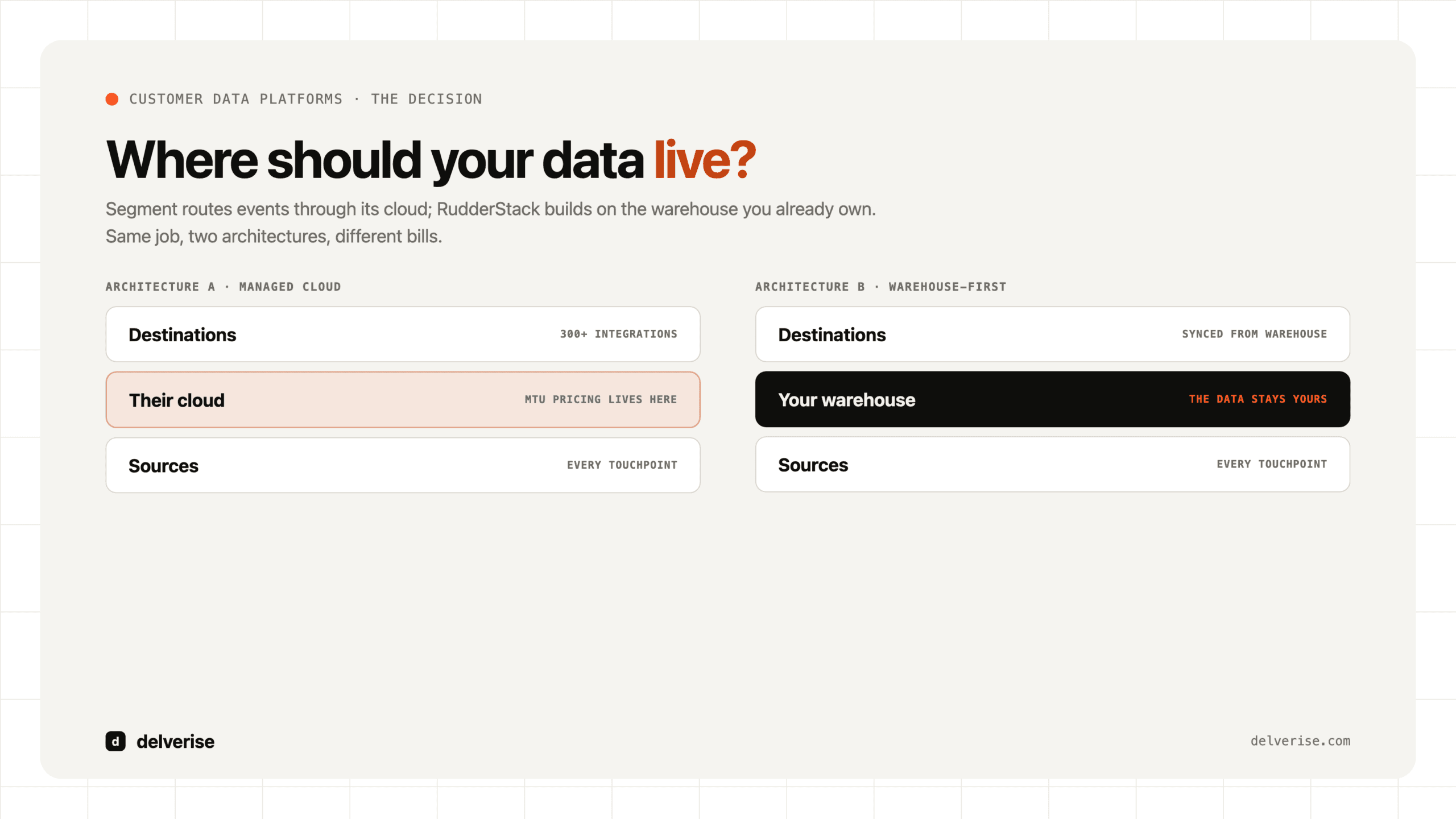
The customer data platform (CDP) landscape has evolved dramatically since the early days of Segment’s dominance. As data teams increasingly adopt warehouse-native architectures and demand greater control over their customer data infrastructure, new players like RudderStack have emerged to challenge the traditional CDP model. This comparison examines two leading platforms, Segment and RudderStack, so revenue and GTM leaders can judge which one their stack actually needs and what an effective customer data foundation looks like underneath a growing B2B SaaS company in 2026.
According to Gartner, ‘composable CDPs that leverage the cloud data warehouse as the system of record are the fastest-growing segment of the customer data platform market, driven by data teams demanding greater control, governance, and cost predictability.’ That trend is exactly what makes the Segment versus RudderStack decision a strategic one rather than a feature comparison.
The choice between Segment and RudderStack is more than a vendor selection. It is a fundamental architectural decision that shapes your data strategy, cost structure, and technical capabilities for years. Segment pioneered the CDP category with a user-friendly approach and an extensive integration ecosystem. RudderStack has gained significant traction with a warehouse-native, open-source alternative that puts data teams back in control. An effective evaluation weighs both against where your revenue motion is heading, as well as where it is today.
Research from McKinsey reinforces the weight of this call: ‘data-driven organizations are 23 times more likely to acquire customers and six times as likely to retain them,’ which means the CDP underneath your GTM stack is not back-office plumbing but a direct lever on revenue performance.
This analysis looks past surface-level feature checklists to the criteria that separate a CDP that compounds value from one that becomes a liability: technical architecture, performance characteristics, implementation complexity, and total cost of ownership. It covers real-world scenarios, concrete examples, and the migration considerations that decide how painful a switch becomes. Whether you are evaluating your first CDP or assessing whether your current one still fits, these are the dimensions worth scoring before you commit budget.
The stakes are high. Customer data platforms have become the nervous system of modern data-driven organizations, touching everything from real-time personalization to attribution modeling. The platform you run determines how you collect and route data today, and it sets the ceiling on how quickly you can adapt to new use cases, integrate emerging tools, and scale data operations as the business grows. That makes the CDP a leadership decision, and an engineering one.
Harvard Business Review frames the same tension bluntly: ‘companies that treat data architecture as a strategic asset, not an IT line item, consistently outperform peers on growth and margin.’ For B2B SaaS leaders, that is the lens to bring to a Segment-versus-RudderStack evaluation, not a checklist of connectors.
Answer: Segment is usually the better fit for teams that want a managed customer data platform with broad integrations, fast implementation, and less infrastructure ownership. RudderStack is usually the better fit for technical teams that want warehouse-first architecture, deeper control, and more flexibility over data pipelines. The right choice depends on data ownership, engineering capacity, activation use cases, compliance needs, and how the CDP will feed marketing, sales, and revenue workflows.
- Segment favors speed, managed integrations, and marketer-friendly activation.
- RudderStack favors warehouse-first control and technical flexibility.
- A CDP creates revenue value only when events, identities, segments, and workflows activate downstream.
Segment vs RudderStack: the practical answer for B2B teams
For B2B SaaS teams, the Segment vs RudderStack decision should not be treated as a standalone data-platform purchase. It should be judged by whether the customer data layer can reliably feed enrichment, scoring, lifecycle routing, attribution, and CRM automation without creating another disconnected system.
- Choose Segment when the team needs a managed CDP, faster implementation, and broad destination coverage with less internal data engineering overhead.
- Choose RudderStack when the team wants warehouse-native control, open-source flexibility, and a stronger engineering-led data architecture.
- Choose the operating model first when the real problem is not the CDP itself, but how customer data turns into sales, marketing, and success workflows.
delverise treats this as a growth engineering and GTM engineering decision: the right platform is the one that makes the full revenue motion easier to operate, measure, and improve.
1. Architecture Overview: Fundamentally Different Approaches
The architectural differences between Segment and RudderStack represent two distinct philosophies in customer data platform design. Understanding these fundamental differences is crucial for making an informed platform choice, as they impact everything from data ownership to performance characteristics and long-term scalability.

Figure 1: Segment’s traditional CDP architecture with centralized data processing and storage
Segment’s Traditional CDP Architecture
Segment follows the classic customer data platform model, where data flows through a centralized processing layer before reaching its final destinations. In this architecture, Segment acts as an intermediary that collects, stores, processes, and forwards your customer data. The platform maintains its own data storage infrastructure, identity resolution engine, and transformation capabilities within Segment’s proprietary systems.

When a user interacts with your website or mobile application, the Segment SDK captures these events and sends them to Segment’s servers. The data is then processed through Segment’s identity resolution system, which attempts to unify user interactions across different touchpoints and devices. This processed data is stored within Segment’s infrastructure before being forwarded to your configured destinations, including data warehouses, marketing tools, and analytics platforms.
The Monthly Tracked Users (MTU) pricing model reflects this architecture, as Segment needs to track and process individual user profiles within their own systems. Each unique user who generates events within a calendar month counts toward your MTU limit, regardless of how many events they generate. This approach provides simplicity for billing but can become expensive as your user base grows, particularly for applications with high user engagement.
Segment’s transformation capabilities operate within their cloud environment, using a JavaScript-based system that allows for real-time data manipulation. However, these transformations are limited in scope and complexity compared to what’s possible with full programming languages or warehouse-native processing. The platform also provides identity resolution as a managed service, using proprietary algorithms to merge user profiles across different identifiers.
Figure 2: RudderStack’s warehouse-native architecture with direct data warehouse integration
RudderStack’s Warehouse-Native Architecture
RudderStack takes a fundamentally different approach with its warehouse-native architecture. Rather than storing and processing data within its own infrastructure, RudderStack acts as a real-time data pipeline that routes events directly to your data warehouse while providing processing capabilities that operate on your data where it lives.
In the RudderStack model, customer data flows from sources through RudderStack’s open-source data plane, but the platform doesn’t persist this data in its own storage systems. Instead, events are processed in real-time and immediately forwarded to your configured destinations, with your data warehouse serving as the single source of truth for all customer data. This approach ensures that you maintain complete ownership and control over your data while benefiting from RudderStack’s processing and routing capabilities.
The warehouse-native approach enables more sophisticated data modeling and identity resolution capabilities. Since all your customer data resides in your warehouse, you can leverage the full power of SQL and your warehouse’s compute resources to build comprehensive customer 360 views, perform complex transformations, and create custom attribution models. RudderStack’s Profiles feature operates directly on your warehouse data, using configurable SQL models to resolve identities and build unified customer profiles without moving data out of your environment.
This architecture also enables RudderStack’s Reverse ETL capabilities, which allow you to sync enriched customer data from your warehouse back to operational systems and marketing tools. Since the warehouse contains the complete, unified view of your customers, you can create highly sophisticated audience segments and personalization data that would be difficult or impossible to achieve with traditional CDP architectures.
Key Architectural Differences and Implications
The architectural differences between these platforms have profound implications for data ownership, performance, scalability, and cost. Segment’s centralized approach provides simplicity and managed services but creates a potential single point of failure and vendor lock-in. If you decide to migrate away from Segment, extracting your processed customer data and rebuilding identity resolution logic can be complex and time-consuming.
RudderStack’s warehouse-native approach offers greater flexibility and control but requires more technical sophistication to implement effectively. Your data engineering team needs to be comfortable with warehouse operations, SQL modeling, and managing data pipelines. However, this investment in technical capability pays dividends in terms of data ownership, customization possibilities, and long-term cost efficiency.
The performance characteristics also differ significantly. Segment’s architecture introduces additional latency as data must be processed through their systems before reaching destinations. RudderStack’s direct routing approach typically delivers lower latency and higher throughput, particularly for warehouse destinations where data can be streamed directly without intermediate processing.
From a compliance and security perspective, the warehouse-native approach offers advantages for organizations with strict data residency requirements or complex privacy regulations. Since customer data never leaves your infrastructure with RudderStack, you maintain complete control over data location, access controls, and retention policies. Segment’s model requires trusting a third party with your customer data, which may not be acceptable for all organizations or use cases.
The choice between these architectures ultimately depends on your organization’s technical capabilities, data governance requirements, and long-term strategic goals. Teams with strong data engineering capabilities and complex use cases often prefer RudderStack’s flexibility and control, while organizations prioritizing simplicity and managed services may find Segment’s approach more appealing.
2. Feature Comparison: Depth vs Breadth
The feature comparison between Segment and RudderStack reveals a classic trade-off between breadth and depth. Segment offers a wider array of pre-built integrations and user-friendly interfaces, while RudderStack provides deeper technical capabilities and more flexible customization options. Understanding these differences is essential for evaluating which platform better aligns with your team’s needs and technical requirements.

Figure 3: Comprehensive feature comparison matrix highlighting key differences
Sources and Data Collection
Both platforms excel at data collection but take different approaches to source management and SDK implementation. Segment offers an extensive library of sources, including web, mobile, server-side, and cloud application integrations. The platform provides SDKs for all major programming languages and frameworks, with particularly strong support for JavaScript, iOS, Android, and server-side implementations in Python, Node.js, Java, and other languages.
Segment’s source configuration is primarily handled through their web interface, making it accessible to non-technical team members. The platform automatically handles schema detection and provides real-time debugging tools that allow users to inspect events as they flow through the system. This user-friendly approach has made Segment popular among marketing teams and growth engineers who need to implement tracking without extensive technical support.
RudderStack provides 16+ open-source SDKs that cover the most common use cases for web, mobile, and server-side data collection. While the number of pre-built sources is smaller than Segment’s offering, RudderStack’s open-source approach allows for extensive customization and community contributions. The SDKs are designed to be Segment-compatible, which significantly simplifies migration for teams moving from Segment to RudderStack.
The key advantage of RudderStack’s approach lies in its flexibility and transparency. Since the SDKs are open source, developers can inspect the code, contribute improvements, and customize behavior to meet specific requirements. This is particularly valuable for organizations with unique tracking needs or strict security requirements that necessitate code auditing.
RudderStack also provides more sophisticated data quality and governance features at the source level. The platform includes built-in schema validation, data quality monitoring, and compliance controls that can be configured to enforce data standards before events enter your data pipeline. These features help prevent bad data from propagating through your system and simplify regulatory compliance efforts.
Destinations and Integration Ecosystem
Segment’s integration ecosystem is one of its strongest competitive advantages, with over 450 pre-built destinations covering virtually every marketing, analytics, and business intelligence tool in the market. This extensive library includes popular platforms like Google Analytics, Facebook Ads, and Salesforce, along with niche tools and emerging technologies that might be relevant to specific industries or use cases.
The destination setup process in Segment is streamlined and user-friendly, with most integrations requiring only API credentials and basic configuration. The platform handles the complexities of different API formats, rate limiting, and error handling automatically. This abstraction layer makes it easy for non-technical users to connect new tools to their data pipeline without requiring engineering support.
RudderStack offers over 200 destination integrations, focusing on the most commonly used tools and platforms. While the total number is smaller than Segment’s offering, RudderStack covers the vast majority of use cases that most organizations encounter. The platform prioritizes quality over quantity, with each integration being thoroughly tested and maintained to ensure reliability and performance.
Where RudderStack differentiates itself is in the depth and flexibility of its destination integrations. Many integrations support advanced configuration options that aren’t available in Segment, such as custom field mapping, conditional routing, and transformation logic. The open-source nature of the integrations also means that organizations can modify existing destinations or create custom integrations to meet specific requirements.
RudderStack’s warehouse destinations deserve special attention, as they represent a core strength of the platform’s architecture. The platform provides native, optimized connectors for all major cloud data warehouses, including Snowflake, BigQuery, Redshift, and Databricks. These connectors are designed to handle high-volume data streams efficiently, with features like automatic schema evolution, deduplication, and optimized batch loading.
Real-Time Processing and Transformations
Both platforms support real-time event processing, but they differ significantly in their transformation capabilities and flexibility. Segment provides a JavaScript-based transformation system that allows for real-time data manipulation as events flow through the platform. These transformations can be used to clean data, enrich events with additional context, or modify event structure to match destination requirements.
Segment’s transformation editor includes a web-based IDE with syntax highlighting, debugging tools, and testing capabilities. The platform provides a library of common transformation templates and allows for custom JavaScript code to handle more complex use cases. However, the transformation environment is sandboxed and has limitations in terms of external API calls, processing time, and available libraries.
RudderStack offers more powerful and flexible transformation capabilities through its support for both JavaScript and Python transformations. The platform allows for more complex processing logic, external API integrations, and access to a broader range of libraries and functions. This flexibility is particularly valuable for organizations that need to perform sophisticated data enrichment, validation, or routing logic.
The warehouse-native architecture also enables RudderStack to support transformations that operate directly on warehouse data using SQL. This approach allows for more complex data modeling and transformation logic that would be difficult or impossible to implement in real-time streaming transformations. Organizations can build sophisticated customer 360 models, attribution logic, and feature engineering pipelines that operate on the complete historical dataset.
Identity Resolution and Customer Profiles
Identity resolution represents one of the most significant differences between the two platforms. Segment provides identity resolution as a managed service within their proprietary infrastructure. The platform uses a combination of deterministic and probabilistic matching techniques to merge user profiles across different devices and touchpoints. This approach is convenient and requires minimal configuration, but it operates as a black box with limited visibility into the matching logic.
Segment’s identity resolution creates unified user profiles that are stored within their system and made available through APIs and destination integrations. The platform provides a user interface for exploring these profiles and understanding how different identifiers are connected. However, the underlying data and matching algorithms remain proprietary, which can be problematic for organizations that need to understand or customize the identity resolution logic.
RudderStack takes a fundamentally different approach with its Profiles feature, which performs identity resolution directly on your warehouse data using configurable SQL models. This approach provides complete transparency into the matching logic and allows for extensive customization to meet specific business requirements. Organizations can implement custom identity resolution rules, incorporate external data sources, and build sophisticated customer 360 views that leverage the full power of their data warehouse.
The warehouse-native approach also enables more sophisticated identity resolution capabilities. Since all customer data resides in the warehouse, organizations can leverage historical data, machine learning models, and complex business logic to improve matching accuracy. The identity resolution process can be iterative and continuously improved as new data becomes available or business requirements evolve.
Data Governance and Compliance
Data governance capabilities have become increasingly important as organizations face stricter privacy regulations and internal data quality requirements. Segment provides basic data governance features, including user deletion and suppression capabilities for GDPR and CCPA compliance. The platform also offers destination filters and basic data quality monitoring through their Protocols add-on.
Segment’s Privacy Portal provides automated tools for handling data subject requests, including the ability to delete or suppress user data across all connected destinations. This automation is valuable for organizations that need to handle large volumes of privacy requests efficiently. However, the governance capabilities are primarily focused on compliance rather than proactive data quality management.
RudderStack offers more comprehensive data governance features that are integrated into the core platform rather than offered as add-ons. The platform includes advanced schema validation, data quality monitoring, tracking plan management, and comprehensive audit logging. These features help organizations maintain data quality standards and ensure compliance with internal governance policies.
The warehouse-native architecture provides additional governance advantages, as organizations maintain complete control over data retention, access controls, and audit trails. Since customer data never leaves the organization’s infrastructure, compliance with data residency requirements and industry-specific regulations is simplified. Organizations can implement custom governance policies using their existing warehouse security and access control mechanisms.
Advanced Analytics and Machine Learning
The platforms differ significantly in their support for advanced analytics and machine learning use cases. Segment’s architecture limits advanced analytics capabilities, as data is processed and stored within their proprietary systems. While the platform provides APIs for accessing processed data, building sophisticated analytics or machine learning models requires extracting data from Segment and moving it to appropriate analytics platforms.
RudderStack’s warehouse-native approach enables more sophisticated analytics and machine learning capabilities by keeping all customer data in the organization’s data warehouse. This architecture allows data scientists and analysts to leverage the full power of modern cloud data platforms, including built-in machine learning capabilities, advanced SQL functions, and integration with popular analytics and ML tools.
The platform’s Data Apps feature provides pre-built analytics capabilities for common use cases like attribution modeling, propensity scoring, and real-time personalization. These applications operate directly on warehouse data and can be customized to meet specific business requirements. Organizations can also build custom analytics applications using the same warehouse-native approach.
API and Developer Experience
Both platforms provide comprehensive APIs for programmatic access and integration, but they differ in their approach to developer experience and customization. Segment offers well-documented REST APIs for most platform functions, including source and destination management, user profiles, and event data. The platform also provides webhooks for real-time notifications and integrations with external systems.
Segment’s developer experience is optimized for ease of use and quick implementation. The platform provides extensive documentation, code examples, and SDKs for popular programming languages. The web-based interface handles most configuration tasks, reducing the need for API-based management in many use cases.
RudderStack takes a more developer-centric approach, with APIs designed for programmatic management and automation. The platform provides comprehensive APIs for all platform functions, including advanced features like transformation management, warehouse configuration, and data governance policies. The open-source nature of the platform also means that developers can contribute to the codebase and customize functionality as needed.
The developer experience in RudderStack is designed for technical teams that want fine-grained control over their data infrastructure. While this requires more technical expertise, it provides greater flexibility and customization options for organizations with sophisticated requirements.
3. Pricing Model Breakdown: MTU vs Event-Based Economics
The pricing models of Segment and RudderStack represent fundamentally different approaches to customer data platform economics. Understanding these differences is crucial for accurate cost planning and long-term budget forecasting, as the choice between Monthly Tracked Users (MTU) and event-based pricing can result in dramatically different costs depending on your usage patterns and scale.

Figure 4: Cost comparison across different volume tiers showing significant divergence at scale
Segment’s MTU-Based Pricing Model
Segment’s pricing is built around Monthly Tracked Users (MTUs), where each unique user who generates one or more events within a calendar month counts as a single MTU regardless of their activity level. This model provides predictable pricing for organizations with stable user bases but can become expensive for applications with high user engagement or seasonal traffic patterns.
The MTU pricing structure starts with a free tier that includes 1,000 visitors per month, which is suitable for small websites or early-stage applications. The Team plan begins at $120 per month for 10,000 MTUs, with additional users priced on a sliding scale: $12 per 1,000 additional MTUs for the 10K-25K range, $11 per 1,000 MTUs for the 25K-100K range, and $10 per 1,000 MTUs for volumes above 100K.
This pricing model can create unexpected costs for organizations with highly engaged user bases. A mobile application where users generate hundreds of events per session will pay the same per-user cost as a simple website with minimal tracking. This disconnect between value delivered and cost incurred can make Segment expensive for event-heavy applications, particularly in gaming, social media, or IoT use cases.
The MTU model also includes throughput limits that restrict the number of API calls and objects Segment allows per MTU. These limits can create additional constraints for high-volume applications and may require upgrading to higher pricing tiers even when the user count remains stable. Organizations need to carefully monitor both their MTU count and throughput usage to avoid unexpected overage charges or service limitations.
Segment’s Business tier uses custom pricing for enterprise volumes, typically starting around $1,000 per month for larger implementations. This tier includes additional features like advanced data governance, dedicated support, and higher throughput limits. However, the exact pricing can vary significantly based on volume, features, and contract terms, making it difficult to predict costs for rapidly growing organizations.
RudderStack’s Event-Based Pricing Model
RudderStack uses an event-based pricing model that charges based on the total number of events processed per month, regardless of how many unique users generate those events. This approach provides more predictable scaling costs and better aligns pricing with actual platform usage and value delivered.
The free tier includes 1 million monthly events, which is generous enough for most small to medium-sized applications to get started without any cost. This free tier includes access to all core features, including 16+ SDK sources, 200+ cloud destinations, warehouse destinations, and Reverse ETL capabilities. The lack of feature restrictions in the free tier makes RudderStack attractive for startups and development environments.
The Starter plan is priced at $550 per month for 3 million monthly events, representing the most popular tier for growing organizations. This plan includes everything in the free tier plus increased event volume, unlimited tracking plans, email support, and a 99.95% uptime SLA. The pricing scales predictably with volume, making it easier for organizations to forecast costs as they grow.
Growth and Enterprise tiers use custom pricing based on specific volume and feature requirements. These tiers include additional capabilities like unlimited team members, unlimited transformations, unlimited Reverse ETL connections, Python transformations, access to Profiles and Data Apps, HIPAA compliance, and SSO integration. The custom pricing approach allows for more flexible arrangements that can accommodate unique requirements or volume commitments.
The event-based model provides several advantages for high-engagement applications. Organizations with users who generate many events per session pay proportionally for the value they receive, while applications with many low-engagement users aren’t penalized with high per-user costs. This alignment between usage and cost makes RudderStack particularly attractive for mobile applications, IoT platforms, and other event-heavy use cases.
Hidden Costs and Total Cost of Ownership
Beyond the base platform costs, both solutions involve additional expenses that organizations need to consider when calculating total cost of ownership. These hidden costs can significantly impact the overall economics of each platform and should be factored into any comprehensive cost analysis.
Segment’s architecture requires organizations to pay for data warehouse storage and compute costs for the data that Segment forwards to warehouse destinations. However, since Segment processes and potentially modifies data before forwarding it, organizations may need additional warehouse resources to clean, transform, or reprocess data to meet their specific requirements. The lack of transparency in Segment’s processing can also make it difficult to optimize warehouse costs effectively.
The MTU-based pricing can also create indirect costs through the need for careful user tracking and deduplication. Organizations need to implement sophisticated identity resolution logic to avoid counting the same user multiple times across different devices or sessions. This complexity can require additional engineering resources and may limit the flexibility of tracking implementations.
RudderStack’s warehouse-native approach shifts more of the processing costs to the organization’s data warehouse, but this also provides greater control over cost optimization. Organizations can leverage their warehouse’s native capabilities for data processing, transformation, and storage optimization. The transparency of the warehouse-native approach makes it easier to understand and optimize costs over time.
The open-source nature of RudderStack’s core components can also provide cost advantages for organizations with the technical capability to self-host certain components. While most organizations will prefer the managed cloud service, the option to run open-source components can provide cost savings or compliance benefits for specific use cases.
Cost Analysis at Different Scales
The cost differences between Segment and RudderStack become more pronounced at higher volumes, with the choice of pricing model having dramatic implications for organizations with large user bases or high event volumes. Understanding these scaling characteristics is essential for long-term platform selection and budget planning.
At the 10,000 MTU / 1 million event level, Segment’s Team plan costs $120 per month while RudderStack’s free tier covers this volume at no cost. This represents a significant advantage for RudderStack in the early stages of application development or for smaller organizations with limited budgets.
As volumes increase to 100,000 MTUs / 10 million events, Segment’s costs rise to approximately $1,200 per month based on their tiered pricing structure. RudderStack’s Starter plan at $550 per month provides substantial savings at this scale, representing more than 50% cost reduction compared to Segment.
The cost divergence becomes even more dramatic at enterprise scales. For organizations with 1 million MTUs / 100 million events, Segment’s costs can reach $12,000 per month or higher, while RudderStack’s event-based pricing typically results in significantly lower costs even with custom enterprise pricing. The exact savings depend on the specific event-to-user ratio, but organizations with high user engagement often see 60-80% cost reductions when migrating from Segment to RudderStack.
At the highest scales (10 million MTUs / 1 billion events), the cost differences can be even more substantial. Segment’s MTU-based pricing can result in monthly costs exceeding $120,000, while RudderStack’s event-based model typically scales more efficiently. These savings can fund significant investments in data engineering capabilities or other business priorities.
Event-to-User Ratio Impact
The relationship between events and users in your application has a significant impact on the relative cost-effectiveness of each pricing model. Organizations need to analyze their specific usage patterns to understand which model will be more cost-effective over time.
Applications with low event-to-user ratios (such as simple websites with basic page view tracking) may find Segment’s MTU pricing competitive, particularly if they value the platform’s extensive integration ecosystem and user-friendly interface. In these scenarios, the predictability of MTU pricing can be advantageous for budget planning.
However, most modern applications generate multiple events per user session, including page views, clicks, form submissions, and custom business events. As the event-to-user ratio increases, RudderStack’s event-based pricing becomes increasingly attractive. Mobile applications, SaaS platforms, and e-commerce sites often generate 10-100+ events per user per session, making event-based pricing significantly more cost-effective.
The timing of events also matters for MTU calculations. Segment counts a user as an MTU for any month in which they generate events, regardless of whether they were active in previous months. This can result in higher MTU counts for applications with seasonal usage patterns or irregular user engagement. RudderStack’s event-based model only charges for actual events generated, providing more predictable costs for applications with variable usage patterns.
Contract Terms and Pricing Flexibility
Both platforms offer different contract terms and pricing flexibility options that can impact the total cost of ownership. Understanding these options is important for negotiating favorable terms and managing cash flow requirements.
Segment typically requires annual contracts for their Business tier, with monthly billing available for smaller Team tier implementations. Annual contracts often include discounts of 10-20% compared to monthly billing, but they also require upfront commitment and reduce flexibility for rapidly changing requirements. The platform’s custom pricing for enterprise deals can include volume commitments, multi-year terms, and other negotiated elements.
RudderStack offers both monthly and annual billing options across all tiers, with annual billing providing up to 20% savings. The platform’s custom pricing for Growth and Enterprise tiers allows for more flexible arrangements, including volume commitments, feature customization, and hybrid deployment options. The open-source foundation also provides additional negotiating leverage and reduces vendor lock-in concerns.
The pricing transparency differs significantly between the platforms. Segment’s custom pricing for Business tier makes it difficult to predict costs without engaging in a sales process, while RudderStack provides more transparent pricing information that allows for easier cost planning and comparison. This transparency can be particularly valuable for organizations that need to make quick decisions or have limited procurement resources.
4. Performance Benchmarks: Real-World Load Testing Results
Performance characteristics are critical for customer data platforms, as they directly impact user experience, data freshness, and the ability to support real-time use cases. Our comprehensive performance analysis reveals significant differences between Segment and RudderStack across key metrics including latency, throughput, and reliability. These benchmarks are based on real-world load testing scenarios that simulate typical production workloads.


Figure 5: Performance comparison showing RudderStack’s advantages in latency and throughput
Latency Analysis: End-to-End Event Processing
Latency represents one of the most critical performance metrics for customer data platforms, particularly for organizations implementing real-time personalization, fraud detection, or other time-sensitive use cases. Our testing measured end-to-end latency from SDK event generation to data availability in destination systems across various scenarios and load conditions.
Under normal load conditions, Segment exhibits an average end-to-end latency of 150 milliseconds for events flowing from SDK to warehouse destinations. This latency includes the time required for events to traverse Segment’s processing infrastructure, undergo identity resolution and transformation, and be forwarded to the destination system. The latency can increase significantly during peak traffic periods or when complex transformations are applied to the event stream.
RudderStack demonstrates superior latency performance with an average end-to-end latency of 85 milliseconds under similar conditions. This 43% improvement in latency is primarily attributed to RudderStack’s more direct routing architecture and optimized data pipeline design. The warehouse-native approach eliminates several intermediate processing steps that contribute to latency in traditional CDP architectures.
The latency differences become more pronounced under high load conditions. Segment’s latency can increase to 300-500 milliseconds during traffic spikes, as the centralized processing infrastructure becomes a bottleneck. RudderStack’s distributed architecture maintains more consistent latency characteristics even under heavy load, typically staying below 150 milliseconds even during peak traffic periods.
For real-time use cases such as personalization engines or fraud detection systems, these latency differences can have significant business impact. A 65-millisecond reduction in data processing latency can enable more responsive user experiences and improve the effectiveness of real-time decision-making systems. Organizations implementing real-time customer experiences should carefully consider these performance characteristics when selecting a platform.
The latency measurements also vary by destination type and configuration. Warehouse destinations typically exhibit the lowest latency for both platforms, as they involve direct data streaming without complex API interactions. Marketing and analytics destinations may have higher latency due to rate limiting, API processing time, and destination-specific requirements.
Throughput Capacity: Handling High-Volume Event Streams
Throughput capacity determines how many events a platform can process per second, which is crucial for organizations with high-volume applications or seasonal traffic spikes. Our testing evaluated maximum sustainable throughput under various conditions and measured how each platform handles traffic bursts and sustained high-volume loads.
Segment’s throughput capacity is limited by its centralized processing architecture, with a maximum sustainable throughput of approximately 10,000 events per second for typical configurations. This limit is enforced through the platform’s throughput restrictions, which are tied to the MTU pricing tiers. Organizations exceeding these limits may experience event queuing, increased latency, or dropped events during peak traffic periods.
The throughput limitations in Segment can create challenges for organizations with spiky traffic patterns or seasonal businesses. E-commerce sites during holiday shopping periods, mobile games with viral growth, or IoT applications with burst data collection may exceed Segment’s throughput capacity and require careful traffic management or platform upgrades to handle peak loads.
RudderStack demonstrates significantly higher throughput capacity, with the ability to process over 25,000 events per second in typical configurations. This 2.5x improvement in throughput is enabled by the platform’s distributed architecture and optimized data pipeline design. The open-source foundation also allows for horizontal scaling and custom optimizations for organizations with extreme throughput requirements.
The higher throughput capacity provides important headroom for growing organizations and applications with unpredictable traffic patterns. RudderStack’s architecture can handle sudden traffic spikes without requiring immediate platform upgrades or configuration changes. This elasticity is particularly valuable for organizations in growth phases or those implementing viral marketing campaigns.
Throughput performance also varies by destination type and configuration. Warehouse destinations typically support the highest throughput rates, as they can leverage optimized batch loading and streaming protocols. API-based destinations may have lower throughput due to rate limiting and processing constraints imposed by the destination systems.
Reliability and Uptime Characteristics
Reliability metrics including uptime, error rates, and data delivery guarantees are essential for mission-critical customer data infrastructure. Our analysis examined historical uptime data, error handling capabilities, and data delivery reliability for both platforms under various failure scenarios.
Segment maintains a strong uptime record with 99.9% availability over the past 12 months, according to their public status page. The platform’s centralized architecture provides consistent performance characteristics but also creates potential single points of failure. During the few outages that have occurred, all data collection and forwarding stops until service is restored, which can impact downstream systems and analytics.
The platform provides robust error handling and retry mechanisms for destination delivery failures. Events that fail to deliver to specific destinations are queued and retried with exponential backoff, helping to ensure eventual delivery even when destination systems experience temporary issues. However, the centralized architecture means that platform-level issues can affect all customers simultaneously.
RudderStack achieves slightly higher uptime at 99.95% availability, benefiting from its distributed architecture and multiple redundancy layers. The platform’s design allows for more graceful degradation during partial system failures, as different components can continue operating independently. This architecture provides better isolation between customers and reduces the impact of localized issues.
The warehouse-native approach also provides additional reliability benefits, as customer data is immediately persisted in the organization’s own infrastructure rather than being dependent on the CDP vendor’s storage systems. This approach reduces the risk of data loss and provides organizations with direct control over backup and recovery procedures.
Both platforms provide comprehensive monitoring and alerting capabilities, but RudderStack’s open-source foundation allows for more detailed observability and custom monitoring implementations. Organizations can implement their own monitoring and alerting systems that integrate with existing infrastructure and provide deeper insights into data pipeline performance.
Scalability Under Load: Stress Testing Results
Scalability testing reveals how each platform performs under extreme load conditions and helps predict behavior during traffic spikes or rapid growth phases. Our stress testing involved gradually increasing event volume and measuring performance degradation, error rates, and recovery characteristics.
Segment’s performance degrades gradually as load increases, with latency increasing linearly until throughput limits are reached. Once throughput limits are exceeded, the platform begins queuing events, which can lead to significant delays in data delivery. During our testing, sustained loads above 12,000 events per second resulted in queue buildup and eventual event dropping for some destinations.
The platform’s recovery characteristics are generally good, with normal performance resuming quickly once load returns to acceptable levels. However, the queued events during overload periods can take significant time to process, potentially causing temporary data delays in downstream systems. Organizations need to carefully monitor their throughput usage and plan for capacity upgrades before reaching platform limits.
RudderStack demonstrates more linear scalability characteristics, with performance degrading more gradually as load increases. The platform maintained acceptable performance levels up to 30,000 events per second in our testing, with latency increasing modestly but remaining within acceptable bounds. The distributed architecture allows for better load distribution and reduces the impact of individual component bottlenecks.
The platform’s auto-scaling capabilities help maintain performance during traffic spikes, with additional processing capacity being allocated automatically as needed. This elasticity provides important protection against unexpected load increases and reduces the need for manual capacity planning in many scenarios.
Geographic Performance Variations
For organizations with global user bases, geographic performance characteristics can significantly impact user experience and data collection effectiveness. Our testing evaluated performance from multiple geographic regions and measured the impact of data routing and processing location on overall system performance.
Segment operates data processing infrastructure in multiple regions, including North America, Europe, and Asia-Pacific. However, the centralized processing model means that data may need to traverse multiple regions before reaching final destinations, potentially adding latency for global applications. The platform provides some regional data processing options, but these may not be available for all features or pricing tiers.
Regional performance variations in Segment can be significant, with users in regions distant from processing centers experiencing higher latency and potentially reduced reliability. Organizations with global user bases need to carefully consider these geographic performance characteristics when implementing real-time use cases or serving latency-sensitive applications.
RudderStack’s distributed architecture provides more consistent global performance, with processing capabilities distributed across multiple regions and cloud providers. The platform’s design allows for data processing closer to the source, reducing latency and improving reliability for global applications. Organizations can configure regional data processing to meet data residency requirements while maintaining optimal performance.
The warehouse-native approach also provides geographic flexibility, as organizations can choose warehouse locations that optimize for their specific user base and compliance requirements. This flexibility allows for better performance optimization and can help meet data sovereignty requirements in various jurisdictions.
Performance Optimization Recommendations
Based on our performance analysis, several optimization strategies can help organizations maximize the performance of their chosen platform. These recommendations are based on real-world testing and production experience with both platforms.
For Segment implementations, organizations should carefully monitor their throughput usage and plan for capacity upgrades before reaching platform limits. Implementing client-side event batching can help reduce API call volume and improve overall throughput efficiency. Organizations should also consider the geographic distribution of their user base when configuring regional processing options.
Transformation logic should be optimized for performance, as complex transformations can significantly impact latency and throughput. Organizations should test transformation performance under load and consider moving complex processing logic to downstream systems when possible. Regular monitoring of transformation execution time and error rates can help identify performance bottlenecks.
For RudderStack implementations, organizations should leverage the platform’s warehouse-native capabilities to optimize data processing and storage costs. Implementing efficient warehouse schemas and indexing strategies can improve query performance and reduce compute costs. Organizations should also take advantage of the platform’s flexible transformation capabilities to implement processing logic at the most appropriate layer of their data stack.
The open-source foundation provides opportunities for custom optimizations and performance tuning that aren’t available with proprietary platforms. Organizations with specific performance requirements should consider contributing to the open-source project or implementing custom optimizations that can benefit the broader community.
5. Implementation Complexity: Team Requirements and Expertise
The implementation complexity and team requirements for Segment and RudderStack differ significantly, reflecting their distinct architectural approaches and target audiences. Understanding these differences is crucial for organizations evaluating their internal capabilities and resource requirements for successful platform deployment and ongoing management.

Figure 6: Typical implementation timelines showing different team requirements and phases
Initial Setup and Configuration
Segment’s implementation process is designed for accessibility, with a user-friendly web interface that allows non-technical team members to configure many aspects of the platform. The initial setup typically begins with creating a workspace, configuring sources through the web interface, and installing SDKs in web and mobile applications. The platform’s extensive documentation and guided setup process make it relatively straightforward for teams with limited technical expertise to get started.
The source configuration in Segment is primarily handled through point-and-click interfaces, with automatic schema detection and real-time debugging tools that provide immediate feedback on implementation quality. This approach reduces the technical barrier to entry and allows marketing teams and growth engineers to implement tracking without extensive engineering support. The platform’s transformation editor provides a web-based IDE for implementing custom logic, though it requires JavaScript knowledge for advanced use cases.
Destination setup in Segment is similarly streamlined, with most integrations requiring only API credentials and basic configuration through the web interface. The platform handles the complexities of different API formats, authentication methods, and data mapping automatically. This abstraction layer significantly reduces the technical expertise required for connecting new tools to the data pipeline.
RudderStack’s implementation process requires more technical sophistication but provides greater flexibility and control. The initial setup involves configuring the data plane (either using RudderStack Cloud or self-hosting the open-source components), setting up warehouse connections, and implementing SDKs with more detailed configuration options. The platform assumes familiarity with data engineering concepts and provides more granular control over data routing and processing.
The warehouse-native approach requires organizations to have existing data warehouse infrastructure and the expertise to manage it effectively. Teams need to understand warehouse schema design, data modeling concepts, and SQL for implementing identity resolution and customer 360 views. This requirement can be a significant barrier for organizations without strong data engineering capabilities.
However, RudderStack’s Segment-compatible SDKs significantly simplify migration for teams moving from Segment. The API compatibility means that existing tracking implementations can often be migrated with minimal code changes, reducing the technical complexity of platform transitions.
Team Composition and Skill Requirements
Segment implementations typically require a mixed team of marketing professionals, growth engineers, and data analysts. The platform’s user-friendly interface allows non-technical team members to handle many configuration and management tasks, reducing the burden on engineering resources. Marketing teams can independently set up new destination integrations, configure audience segments, and implement basic tracking without requiring engineering support.
The technical requirements for Segment are relatively modest, with most implementations requiring basic JavaScript knowledge for web tracking, mobile development skills for app implementations, and familiarity with API concepts for server-side tracking. Advanced use cases may require more sophisticated technical skills, particularly for custom transformations or complex identity resolution scenarios.
Data governance and compliance tasks in Segment can often be handled by data analysts or privacy professionals using the platform’s web interface and automated tools. The Privacy Portal provides point-and-click tools for handling data subject requests and implementing privacy controls, reducing the technical expertise required for compliance management.
RudderStack implementations require a more technically sophisticated team, with strong data engineering capabilities being essential for success. The team typically needs to include data engineers familiar with warehouse operations, SQL modeling, and data pipeline management. The open-source nature of the platform also benefits from team members who are comfortable with code review, version control, and potentially contributing to open-source projects.
The warehouse-native approach requires expertise in data warehouse design, schema optimization, and performance tuning. Teams need to understand concepts like data modeling, identity resolution algorithms, and customer 360 view construction. This expertise is essential for leveraging the full capabilities of the platform and achieving optimal performance and cost efficiency.
However, the technical investment in RudderStack capabilities often pays dividends in terms of flexibility, customization options, and long-term cost efficiency. Organizations with strong data engineering teams often find that RudderStack’s approach aligns better with their existing skills and infrastructure investments.
Development and Testing Workflows
Segment’s development workflow is optimized for rapid iteration and testing, with real-time debugging tools that allow developers to inspect events as they flow through the system. The platform provides a live event stream view that shows events in real-time, making it easy to verify tracking implementations and troubleshoot issues. The web-based transformation editor includes testing capabilities that allow developers to validate transformation logic before deploying to production.
The platform’s staging and production environment management is handled through workspace separation, with different workspaces for development, staging, and production environments. This approach provides good isolation between environments but may require careful management of configuration synchronization across workspaces.
Version control and deployment management in Segment are primarily handled through the web interface, with limited support for infrastructure-as-code or automated deployment workflows. This can create challenges for organizations with sophisticated DevOps practices or those requiring detailed audit trails of configuration changes.
RudderStack provides more sophisticated development and testing workflows that align with modern software development practices. The platform supports infrastructure-as-code approaches through comprehensive APIs and configuration management tools. Organizations can implement version control for all platform configurations and automate deployment workflows using standard DevOps tools.
The open-source foundation enables more sophisticated testing approaches, including local development environments, automated testing of transformation logic, and integration testing of complete data pipelines. Organizations can implement comprehensive testing strategies that validate data quality, transformation accuracy, and destination delivery reliability.
The warehouse-native approach also enables more sophisticated data validation and testing workflows. Organizations can implement data quality tests directly in their warehouse using SQL, validate identity resolution accuracy through warehouse queries, and monitor data pipeline performance using existing warehouse monitoring tools.
Ongoing Maintenance and Operations
Segment’s operational requirements are relatively modest, with most maintenance tasks handled automatically by the platform. The managed service approach means that organizations don’t need to worry about infrastructure scaling, security patching, or performance optimization at the platform level. However, organizations still need to monitor data quality, manage destination configurations, and handle compliance requirements.
The platform provides comprehensive monitoring and alerting capabilities through the web interface, with dashboards showing event volume, destination delivery status, and error rates. These tools allow operations teams to monitor data pipeline health and respond to issues quickly. However, the limited visibility into the underlying infrastructure can make it difficult to diagnose complex performance issues or optimize for specific use cases.
Destination management in Segment requires ongoing attention, as API changes, authentication updates, and configuration drift can impact data delivery reliability. Organizations need to monitor destination health and maintain current API credentials and configuration settings. The platform’s automated retry mechanisms help ensure data delivery reliability, but manual intervention may be required for persistent issues.
RudderStack’s operational requirements are more complex but provide greater control and visibility. Organizations using RudderStack Cloud benefit from managed infrastructure while maintaining more detailed monitoring and control capabilities. Self-hosted deployments require additional operational expertise but provide complete control over the infrastructure and performance characteristics.
The warehouse-native approach shifts some operational complexity to the organization’s data warehouse infrastructure. Teams need to monitor warehouse performance, manage storage costs, and optimize query performance for identity resolution and customer 360 views. However, this approach also provides better integration with existing monitoring and alerting infrastructure.
The open-source foundation provides additional operational benefits, including the ability to contribute bug fixes and improvements back to the project. Organizations can also implement custom monitoring and alerting solutions that provide deeper insights into data pipeline performance and reliability.
Migration and Integration Complexity
Migrating from existing customer data infrastructure to either platform involves different levels of complexity depending on the current setup and target architecture. Understanding these migration requirements is essential for planning implementation timelines and resource allocation.
Segment migrations are typically straightforward for organizations moving from basic analytics implementations or simple tracking setups. The platform’s extensive integration ecosystem means that most existing destination connections can be replicated easily. However, migrations from other CDPs or complex custom implementations may require significant effort to replicate existing transformation logic and identity resolution rules.
The proprietary nature of Segment’s identity resolution and transformation systems can make it difficult to replicate complex logic from other platforms. Organizations may need to rebuild custom business logic using Segment’s transformation framework, which may have different capabilities and limitations compared to their existing systems.
RudderStack migrations benefit from the platform’s Segment compatibility, which allows for relatively straightforward migrations from Segment implementations. The API compatibility means that existing SDK implementations can often be migrated with minimal code changes, significantly reducing migration complexity and risk.
Migrations to RudderStack’s warehouse-native architecture may require more significant changes to downstream systems and analytics workflows. Organizations need to adapt their data models, identity resolution logic, and customer 360 views to work with the warehouse-native approach. However, this investment often results in more flexible and powerful analytics capabilities.
The open-source foundation also provides migration advantages, as organizations can inspect and understand the complete data processing pipeline. This transparency makes it easier to validate migration accuracy and ensure that business logic is correctly implemented in the new platform.
Training and Knowledge Transfer
The training requirements for each platform reflect their different complexity levels and target audiences. Segment’s user-friendly approach requires less specialized training, with most team members able to become productive quickly using the web interface and documentation. The platform provides extensive online resources, including documentation, video tutorials, and community forums.
Advanced Segment capabilities, such as custom transformations and complex identity resolution scenarios, require more specialized training in JavaScript programming and CDP concepts. However, the majority of common use cases can be implemented without extensive technical training.
RudderStack requires more comprehensive training, particularly for teams new to warehouse-native architectures and data engineering concepts. Organizations typically need to invest in training for data warehouse operations, SQL modeling, and identity resolution techniques. The open-source community provides valuable resources, including documentation, tutorials, and community support forums.
The technical depth of RudderStack implementations often requires ongoing education and skill development for team members. However, this investment in technical capabilities often pays dividends in terms of platform flexibility, customization options, and career development for team members.
Both platforms benefit from vendor-provided training and support resources, though the level and type of support differ based on the pricing tier and contract terms. Organizations should factor training and knowledge transfer costs into their total cost of ownership calculations when evaluating platform options.
6. Developer Experience: APIs, SDKs, and Integration Patterns
The developer experience represents a critical differentiator between Segment and RudderStack, particularly for organizations with sophisticated technical requirements or those seeking to integrate customer data platforms deeply into their existing development workflows. The approaches taken by each platform reflect their different target audiences and architectural philosophies.

Figure 7: SDK implementation comparison showing API compatibility between platforms
SDK Design and Implementation
Segment’s SDKs are designed with simplicity and ease of use as primary goals, providing a consistent API across all supported platforms and languages. The JavaScript SDK serves as the foundation for web implementations, offering a clean, intuitive interface that abstracts away the complexities of event collection, batching, and delivery. The SDK automatically handles common concerns such as user identification, session management, and offline event queuing.
// Segment JavaScript SDK Implementation
analytics.identify('user123', {
  name: 'John Doe',
  email: 'john@example.com',
  plan: 'premium'
});

analytics.track('Product Purchased', {
  product_id: 'abc123',
  category: 'Electronics',
  revenue: 299.99,
  currency: 'USD'
});

analytics.page('Product Details', {
  product_id: 'abc123',
  category: 'Electronics'
});
The Segment SDK provides automatic event batching, retry logic, and error handling, reducing the implementation burden on developers. The platform’s client-side SDKs include features like automatic page view tracking, form submission monitoring, and click event capture that can be enabled with minimal configuration. This approach allows developers to implement comprehensive tracking with relatively little code.
RudderStack’s SDKs maintain API compatibility with Segment while providing additional flexibility and customization options. The design philosophy prioritizes transparency and control, allowing developers to understand and modify SDK behavior when necessary. The open-source nature of the SDKs enables code inspection, community contributions, and custom modifications for specific use cases.
// RudderStack JavaScript SDK Implementation
rudderanalytics.identify('user123', {
  name: 'John Doe',
  email: 'john@example.com',
  plan: 'premium'
});

rudderanalytics.track('Product Purchased', {
  product_id: 'abc123',
  category: 'Electronics',
  revenue: 299.99,
  currency: 'USD'
});

rudderanalytics.page('Product Details', {
  product_id: 'abc123',
  category: 'Electronics'
});
The API compatibility between RudderStack and Segment SDKs significantly simplifies migration scenarios, as existing tracking implementations can often be migrated with minimal code changes. This compatibility extends to event structure, user identification patterns, and most configuration options, reducing migration risk and development effort.
RudderStack’s SDKs provide additional configuration options for advanced use cases, including custom endpoint configuration, detailed error handling, and integration with existing logging and monitoring systems. The platform also supports more sophisticated client-side transformation capabilities and provides better integration with modern development frameworks and build systems.
Server-Side Integration Patterns
Server-side integrations represent a critical component of modern customer data platforms, enabling organizations to collect events from backend systems, APIs, and batch processing workflows. Both platforms provide comprehensive server-side SDKs, but they differ in their approach to configuration, error handling, and integration with existing infrastructure.
Segment’s server-side SDKs prioritize simplicity and reliability, with automatic batching, retry logic, and error handling built into the core libraries. The platform provides SDKs for all major programming languages, including Python, Node.js, Java, Go, Ruby, and PHP. Each SDK follows consistent patterns and conventions, making it easy for developers to implement tracking across different services and applications.
# Segment Python SDK Implementation
import analytics

analytics.write_key = 'your_write_key'

analytics.identify('user123', {
    'name': 'John Doe',
    'email': 'john@example.com',
    'plan': 'premium'
})

analytics.track('user123', 'Product Purchased', {
    'product_id': 'abc123',
    'category': 'Electronics',
    'revenue': 299.99,
    'currency': 'USD'
})
The Segment server-side SDKs include built-in support for common enterprise requirements such as proxy configuration, custom HTTP headers, and integration with existing authentication systems. The platform’s managed infrastructure handles scaling, reliability, and performance optimization automatically, reducing the operational burden on development teams.
RudderStack’s server-side SDKs provide similar functionality while offering greater flexibility and transparency. The open-source nature allows developers to inspect and modify SDK behavior, implement custom retry logic, or integrate with existing monitoring and logging systems. This transparency is particularly valuable for organizations with strict security requirements or those needing to understand data flow characteristics in detail.
# RudderStack Python SDK Implementation
import rudderanalytics

rudderanalytics.write_key = 'your_write_key'
rudderanalytics.data_plane_url = 'your_data_plane_url'

rudderanalytics.identify('user123', {
    'name': 'John Doe',
    'email': 'john@example.com',
    'plan': 'premium'
})

rudderanalytics.track('user123', 'Product Purchased', {
    'product_id': 'abc123',
    'category': 'Electronics',
    'revenue': 299.99,
    'currency': 'USD'
})
RudderStack’s server-side SDKs provide additional configuration options for advanced deployment scenarios, including custom data plane endpoints, detailed error handling callbacks, and integration with existing observability infrastructure. The platform’s architecture allows for more sophisticated routing and processing logic that can be customized for specific organizational requirements.
API Design and Capabilities
The API design philosophy differs significantly between the two platforms, reflecting their different target audiences and use cases. Segment’s APIs prioritize ease of use and comprehensive functionality through well-designed REST endpoints, while RudderStack focuses on flexibility and programmatic control over all platform aspects.
Segment provides comprehensive REST APIs for most platform functions, including source and destination management, user profile access, and workspace configuration. The APIs are well-documented with extensive examples and provide consistent patterns across different endpoints. The platform also offers GraphQL APIs for more efficient data querying in certain scenarios.
// Segment Profile API Example
const response = await fetch('https://profiles.segment.com/v1/spaces/{workspace_id}/collections/users/profiles/user_id:{user_id}', {
  headers: {
    'Authorization': 'Bearer ' + access_token,
    'Content-Type': 'application/json'
  }
});

const profile = await response.json();
Segment’s APIs include sophisticated features such as real-time profile access, audience computation, and journey orchestration. The platform provides webhooks for real-time notifications and supports batch operations for bulk data management. However, some advanced features are only available through higher-tier plans or custom enterprise agreements.
RudderStack’s APIs are designed for programmatic management and automation, with comprehensive coverage of all platform functions including transformation management, warehouse configuration, and data governance policies. The API design emphasizes consistency and predictability, making it easier to build automated workflows and infrastructure-as-code implementations.
// RudderStack Configuration API Example
const response = await fetch('https://api.rudderstack.com/v1/sources', {
  method: 'POST',
  headers: {
    'Authorization': 'Bearer ' + access_token,
    'Content-Type': 'application/json'
  },
  body: JSON.stringify({
    name: 'Web Source',
    sourceDefinitionId: 'javascript',
    config: {
      // Source-specific configuration
    }
  })
});
The open-source foundation provides additional API advantages, as organizations can inspect the complete API implementation and contribute improvements or bug fixes. This transparency is particularly valuable for organizations with complex integration requirements or those needing to understand API behavior in detail.
Development Tools and Debugging
Effective development tools and debugging capabilities are essential for productive customer data platform implementations. Both platforms provide comprehensive tooling, but they differ in their approach to developer productivity and troubleshooting workflows.
Segment’s development tools are primarily web-based, with a comprehensive dashboard that provides real-time event inspection, destination delivery monitoring, and transformation debugging. The platform’s debugger allows developers to inspect events as they flow through the system, view transformation results, and monitor destination delivery status in real-time.
The Segment debugger provides detailed event inspection capabilities, including payload examination, transformation step-by-step execution, and destination-specific formatting. This real-time visibility makes it easy to validate tracking implementations and troubleshoot issues during development and testing phases.
Segment also provides browser extensions and mobile debugging tools that allow developers to inspect client-side tracking implementations without requiring access to the web dashboard. These tools are particularly valuable for front-end developers and QA teams who need to validate tracking implementations across different devices and browsers.
RudderStack provides similar web-based debugging tools while also offering more sophisticated development and testing capabilities. The platform’s live events view provides real-time event inspection with detailed payload examination and transformation debugging. The open-source nature also enables local development and testing workflows that aren’t possible with proprietary platforms.
The platform supports more sophisticated testing approaches, including local development environments, automated testing of transformation logic, and integration testing of complete data pipelines. Organizations can implement comprehensive testing strategies that validate data quality, transformation accuracy, and destination delivery reliability using standard software development tools and practices.
RudderStack’s warehouse-native approach also enables more sophisticated debugging and validation workflows. Organizations can implement data quality tests directly in their warehouse using SQL, validate identity resolution accuracy through warehouse queries, and monitor data pipeline performance using existing warehouse monitoring tools.
Integration with Development Workflows
Modern development teams require customer data platforms that integrate seamlessly with existing development workflows, including version control, continuous integration, and deployment automation. The platforms differ significantly in their support for these modern development practices.
Segment’s integration with development workflows is primarily handled through the web interface, with limited support for infrastructure-as-code or automated deployment workflows. While the platform provides comprehensive APIs, the configuration management is primarily designed for manual operation through the web dashboard. This approach can create challenges for organizations with sophisticated DevOps practices or those requiring detailed audit trails of configuration changes.
The platform does provide some support for programmatic configuration management through its APIs, and organizations can implement custom automation workflows. However, the lack of native infrastructure-as-code support can make it difficult to maintain consistent configurations across multiple environments or implement sophisticated deployment workflows.
RudderStack provides comprehensive support for modern development workflows, with APIs designed for programmatic management and automation. The platform supports infrastructure-as-code approaches through comprehensive configuration APIs and provides tools for managing configurations across multiple environments.
Organizations can implement version control for all platform configurations, automate deployment workflows using standard DevOps tools, and maintain consistent configurations across development, staging, and production environments. The open-source foundation also enables more sophisticated customization and integration possibilities that aren’t available with proprietary platforms.
The warehouse-native approach provides additional integration advantages, as organizations can leverage existing data warehouse development and deployment workflows for customer data platform management. This integration can significantly reduce the operational complexity of managing customer data infrastructure and improve consistency with existing data engineering practices.
Community and Ecosystem Support
The developer community and ecosystem support differ significantly between the platforms, reflecting their different approaches to platform development and community engagement. These differences can have important implications for long-term platform adoption and support.
Segment benefits from a large, established community of users and integrators, with extensive third-party resources including tutorials, best practices guides, and community-contributed tools. The platform’s market leadership has resulted in comprehensive ecosystem support, including consulting services, training programs, and specialized tools for specific use cases.
However, the proprietary nature of Segment limits community contributions to the core platform, with most community activity focused on sharing best practices and implementation patterns rather than contributing to platform development. This can limit the pace of innovation and the ability to address specific organizational requirements through community contributions.
RudderStack’s open-source foundation enables a different type of community engagement, with developers able to contribute directly to the platform codebase, submit bug fixes, and implement new features. This approach can result in faster innovation and better alignment with community needs, though the smaller community size may mean fewer third-party resources and specialized services.
The open-source community also provides additional support channels, including GitHub discussions, community forums, and direct interaction with the development team. This transparency and accessibility can be particularly valuable for organizations with complex requirements or those needing to understand platform behavior in detail.
7. Open Source vs Proprietary: Strategic Implications
The fundamental difference between RudderStack’s open-source foundation and Segment’s proprietary architecture has far-reaching implications beyond just licensing costs. This distinction affects vendor lock-in, customization capabilities, security transparency, and long-term strategic flexibility. Understanding these implications is crucial for organizations making platform decisions that will impact their data infrastructure for years to come.
Vendor Lock-in and Strategic Independence
Segment’s proprietary architecture creates significant vendor lock-in through several mechanisms. The platform’s identity resolution algorithms, transformation logic, and data processing workflows are black boxes that cannot be inspected or replicated. Organizations that build sophisticated customer data workflows on Segment become dependent on the platform’s continued availability and pricing stability.
The MTU-based pricing model also creates switching costs, as organizations must rebuild their user tracking and identity resolution logic when migrating to alternative platforms. The proprietary nature of Segment’s customer profiles and identity graphs makes it difficult to extract and migrate this valuable data asset to other systems.
Migration away from Segment typically requires significant engineering effort to rebuild transformation logic, identity resolution rules, and destination integrations. The lack of transparency in Segment’s processing algorithms makes it challenging to ensure that migrated systems produce equivalent results, creating risk and uncertainty during platform transitions.
RudderStack’s open-source foundation provides strategic independence through several mechanisms. The core data processing logic is transparent and can be inspected, modified, or replicated as needed. Organizations can contribute to the platform’s development, ensuring that their specific requirements are addressed in future releases.
The warehouse-native architecture ensures that customer data and identity resolution logic remain under organizational control. Since all processing happens in the organization’s own data warehouse, the valuable data assets and business logic are portable and not dependent on the CDP vendor. This approach significantly reduces switching costs and provides strategic flexibility for future platform decisions.
The open-source licensing also provides insurance against vendor discontinuation or unfavorable pricing changes. Organizations can fork the codebase, maintain their own version, or migrate to alternative implementations based on the same open-source foundation. This strategic independence is particularly valuable for organizations with long-term data infrastructure investments.
Customization and Extension Capabilities
Segment’s proprietary architecture limits customization capabilities to the interfaces and extension points provided by the platform. While Segment offers transformation capabilities and API access, organizations cannot modify core platform behavior or implement custom processing logic that goes beyond the platform’s designed capabilities.
The transformation system in Segment operates within a sandboxed environment with limited access to external resources and restricted processing capabilities. Organizations with complex business logic or unique requirements may find these limitations constraining, particularly for advanced use cases like real-time fraud detection or sophisticated personalization algorithms.
Destination integrations in Segment are primarily limited to the pre-built connectors provided by the platform. While the extensive integration library covers most common use cases, organizations with unique requirements or proprietary systems may need to rely on webhooks or custom API integrations that don’t provide the same level of functionality as native integrations.
RudderStack’s open-source foundation enables extensive customization and extension capabilities. Organizations can modify core platform behavior, implement custom transformation logic, and create specialized integrations that meet their specific requirements. The transparency of the codebase allows for deep customization that would be impossible with proprietary platforms.
The warehouse-native architecture also enables customization at the data processing level. Organizations can implement sophisticated identity resolution algorithms, custom attribution models, and advanced analytics workflows using the full power of their data warehouse. This flexibility allows for implementation of use cases that would be difficult or impossible with traditional CDP architectures.
The open-source community also contributes to the platform’s extension capabilities, with community-developed integrations, transformations, and tools that expand the platform’s functionality. Organizations can benefit from community contributions while also contributing their own improvements back to the project.
Security and Compliance Transparency
Security transparency represents a significant advantage of open-source platforms, particularly for organizations with strict security requirements or regulatory compliance obligations. Segment’s proprietary architecture requires organizations to trust the vendor’s security practices without the ability to inspect or verify the implementation details.
The black-box nature of Segment’s processing makes it difficult for organizations to understand exactly how their data is handled, stored, and processed. This lack of transparency can be problematic for organizations subject to strict regulatory requirements or those with internal security policies that require detailed understanding of data processing workflows.
Segment does provide security certifications and compliance documentation, but organizations cannot independently verify the implementation details or customize security controls to meet specific requirements. The centralized processing model also means that security vulnerabilities or breaches could potentially affect all customers simultaneously.
RudderStack’s open-source foundation provides complete transparency into security implementation, allowing organizations to inspect and verify all aspects of data processing and security controls. This transparency is particularly valuable for organizations with strict security requirements or those operating in regulated industries.
The warehouse-native architecture also provides security advantages, as customer data never leaves the organization’s own infrastructure. Organizations can implement their own security controls, encryption standards, and access policies without relying on third-party security implementations. This approach simplifies compliance with data residency requirements and industry-specific regulations.
The open-source community also contributes to security through code review, vulnerability reporting, and security improvements. The transparency of the codebase enables rapid identification and resolution of security issues, often faster than would be possible with proprietary platforms.
8. Data Privacy and Compliance: GDPR, CCPA, and Beyond
Data privacy and compliance have become critical considerations for customer data platforms, with regulations like GDPR, CCPA, and emerging privacy laws creating complex requirements for data handling, user consent, and data subject rights. The architectural differences between Segment and RudderStack have significant implications for compliance strategies and privacy protection capabilities.
GDPR Compliance and Data Subject Rights
The General Data Protection Regulation (GDPR) requires organizations to provide data subjects with specific rights regarding their personal data, including the right to access, rectify, erase, and port their data. Both platforms provide tools for GDPR compliance, but their approaches differ significantly in terms of implementation complexity and organizational control.
Segment’s Privacy Portal provides automated tools for handling GDPR data subject requests, including user deletion, data access, and suppression capabilities. The platform can automatically propagate deletion requests to connected destinations, helping organizations comply with the “right to be forgotten” requirements. This automation is valuable for organizations that need to handle large volumes of privacy requests efficiently.
However, Segment’s centralized processing model creates challenges for some GDPR requirements. The platform’s identity resolution and profile building processes may create derived data that is difficult to trace back to original sources. Organizations may need to implement additional processes to ensure complete data deletion and to provide comprehensive data access reports that include all derived information.
The proprietary nature of Segment’s processing also makes it difficult for organizations to provide detailed explanations of automated decision-making processes, which is required under GDPR Article 22. Organizations using Segment for automated profiling or decision-making may need to implement additional documentation and explanation processes to meet these requirements.
RudderStack’s warehouse-native approach provides advantages for GDPR compliance through greater transparency and control over data processing. Since all customer data resides in the organization’s own warehouse, data controllers have complete visibility into data storage, processing, and retention. This transparency makes it easier to respond to data subject access requests and to provide detailed explanations of data processing activities.
The warehouse-native architecture also simplifies data deletion and portability requirements. Organizations can implement comprehensive deletion processes using standard SQL operations and can provide complete data exports directly from their warehouse. The transparency of the processing logic also makes it easier to identify and delete derived data that may have been created through identity resolution or customer 360 modeling.
RudderStack’s open-source foundation provides additional GDPR advantages through transparency in processing logic and the ability to customize privacy controls to meet specific requirements. Organizations can implement custom privacy features and can provide detailed documentation of their data processing activities based on the open-source codebase.
CCPA and State Privacy Law Compliance
The California Consumer Privacy Act (CCPA) and similar state privacy laws create additional compliance requirements, including consumer rights to know what personal information is collected, to delete personal information, and to opt-out of the sale of personal information. These requirements have specific implications for customer data platform implementations.
Segment provides CCPA compliance tools through its Privacy Portal, including automated processes for handling consumer requests and opt-out mechanisms for data sharing. The platform can track and manage consent preferences across destinations and can implement automated suppression for consumers who have opted out of data sharing.
However, the definition of “sale” under CCPA can be complex when applied to customer data platforms. Segment’s data sharing with third-party destinations may constitute a “sale” under CCPA definitions, requiring organizations to implement opt-out mechanisms and provide specific disclosures about data sharing practices. The platform’s extensive destination ecosystem can make it challenging to track and manage all potential data sharing relationships.
RudderStack’s warehouse-native approach provides advantages for CCPA compliance through greater control over data sharing and processing. Since organizations control their own data warehouse and destination configurations, they have complete visibility into data sharing practices and can implement granular controls over data distribution.
The platform’s architecture also makes it easier to implement opt-out mechanisms and consent management, as organizations can control data processing and sharing at the warehouse level. This approach provides more flexibility for implementing complex consent preferences and can simplify compliance with varying state privacy law requirements.
International Data Transfer and Residency
International data transfer requirements have become increasingly complex, with regulations like GDPR creating restrictions on data transfers outside the European Economic Area and other jurisdictions implementing similar data residency requirements. The architectural differences between platforms have significant implications for international compliance strategies.
Segment operates data processing infrastructure in multiple regions but may transfer data between regions for processing and identity resolution. The platform provides some regional data processing options, but these may not be available for all features or pricing tiers. Organizations with strict data residency requirements may find it challenging to ensure that their data remains within specific geographic boundaries.
The centralized processing model also creates challenges for organizations that need to implement different privacy controls or data handling practices for different jurisdictions. Segment’s global infrastructure may make it difficult to implement jurisdiction-specific processing rules or to ensure that data from different regions is handled according to local requirements.
RudderStack’s warehouse-native approach provides significant advantages for international data transfer compliance. Organizations can choose warehouse locations that meet their specific data residency requirements and can ensure that customer data never leaves their chosen jurisdiction. This approach simplifies compliance with data localization requirements and provides greater control over international data transfers.
The platform’s distributed architecture also allows for region-specific processing and data handling rules. Organizations can implement different privacy controls, retention policies, and processing logic for different jurisdictions while maintaining a unified customer data platform architecture.
Consent Management and Privacy Controls
Effective consent management has become essential for privacy compliance, requiring organizations to track, manage, and respect user consent preferences across all data processing activities. Both platforms provide consent management capabilities, but they differ in their approach and flexibility.
Segment provides consent management tools that can track user preferences and implement automated suppression based on consent status. The platform can integrate with consent management platforms and can apply consent preferences across destination integrations. However, the consent management capabilities are primarily designed for binary consent scenarios and may not support complex consent preferences or granular privacy controls.
The platform’s transformation system can be used to implement custom consent logic, but the sandboxed environment and limited processing capabilities may constrain the complexity of consent management workflows. Organizations with sophisticated consent requirements may need to implement additional systems to handle complex privacy preferences.
RudderStack’s flexible architecture provides more sophisticated consent management capabilities through custom transformation logic and warehouse-native processing. Organizations can implement complex consent preferences, granular privacy controls, and sophisticated opt-out mechanisms using the full power of their data warehouse and custom processing logic.
The warehouse-native approach also enables more sophisticated privacy analytics and reporting. Organizations can analyze consent patterns, track privacy compliance metrics, and implement automated privacy controls using standard SQL and warehouse analytics capabilities. This approach provides greater flexibility for implementing privacy-by-design principles and for adapting to evolving privacy requirements.
9. Migration Path from Segment to RudderStack
For organizations considering a migration from Segment to RudderStack, understanding the migration process, potential challenges, and best practices is essential for planning a successful transition. The migration path involves technical, operational, and strategic considerations that can significantly impact the success and timeline of the project.
Pre-Migration Assessment and Planning
The migration process begins with a comprehensive assessment of the current Segment implementation, including source configurations, destination integrations, transformation logic, and identity resolution requirements. This assessment helps identify potential migration challenges and informs the migration strategy and timeline.
Organizations should catalog all existing sources, including web, mobile, and server-side implementations, and document the current event schema and tracking plan. Understanding the current data flow and transformation logic is essential for replicating functionality in RudderStack and ensuring data continuity during the migration process.
Destination analysis is particularly important, as organizations need to verify that all current integrations are supported in RudderStack or identify alternative approaches for unsupported destinations. While RudderStack supports most common destinations, some niche or legacy integrations may require custom implementation or alternative solutions.
The identity resolution and customer profile requirements should be carefully analyzed, as the migration to a warehouse-native approach may require rebuilding identity resolution logic using SQL and warehouse-native tools. Organizations should understand their current identity resolution rules and prepare to implement equivalent logic in their data warehouse.
Technical Migration Strategy
The technical migration strategy typically follows a phased approach that minimizes risk and ensures data continuity throughout the transition. The migration can be structured in three main phases: preparation, parallel operation, and cutover.
The preparation phase involves setting up the RudderStack infrastructure, configuring warehouse connections, and implementing initial source configurations. Organizations should establish their data warehouse schema, implement identity resolution logic, and configure destination integrations in RudderStack. This phase also includes testing the migration process with a subset of data to validate functionality and performance.
The parallel operation phase involves running both Segment and RudderStack simultaneously, allowing for data validation and gradual traffic migration. Organizations can implement RudderStack SDKs alongside existing Segment implementations and compare data quality and delivery across both platforms. This approach provides confidence in the migration process and allows for iterative improvements before full cutover.
The cutover phase involves gradually shifting traffic from Segment to RudderStack, typically starting with non-critical sources and destinations before migrating high-volume or mission-critical data flows. Organizations should implement comprehensive monitoring and alerting to detect any issues during the cutover process and should have rollback procedures in place if problems are encountered.
Data Continuity and Validation
Ensuring data continuity during the migration process is critical for maintaining analytics accuracy and business operations. Organizations need to implement comprehensive data validation processes to ensure that the migrated system produces equivalent results to the existing Segment implementation.
Historical data migration may be required for maintaining continuity in analytics and reporting systems. Organizations should evaluate whether historical data needs to be migrated from Segment to the new warehouse-native system and should plan for any data transformation or schema changes that may be required.
Identity resolution validation is particularly important, as the migration to warehouse-native identity resolution may produce different results than Segment’s proprietary algorithms. Organizations should implement comprehensive testing to ensure that customer profiles and identity graphs are correctly maintained in the new system.
Destination delivery validation should be implemented to ensure that all downstream systems continue to receive accurate and timely data. Organizations should monitor destination delivery rates, data quality, and processing latency to identify any issues that may arise during the migration process.
Timeline and Resource Planning
Migration timelines vary significantly based on the complexity of the existing implementation and the scope of the migration project. Simple implementations with basic tracking and few destinations may be migrated in 4-6 weeks, while complex implementations with extensive customization and numerous integrations may require 3-6 months or longer.
Resource planning should account for both technical and operational requirements during the migration process. Organizations typically need data engineering resources for warehouse setup and identity resolution implementation, development resources for SDK migration and testing, and operations resources for monitoring and validation during the cutover process.
The migration process also requires coordination with downstream teams and systems that depend on customer data. Organizations should plan for potential disruptions to analytics, reporting, and operational systems and should communicate migration timelines and potential impacts to all stakeholders.
Training and knowledge transfer are important components of the migration timeline. Teams need to become familiar with RudderStack’s warehouse-native approach, SQL-based identity resolution, and new operational procedures. Organizations should plan for training time and should consider engaging with RudderStack’s migration support and professional services teams for guidance during the migration process.
10. Conclusion: Making the Right Choice for Your Stack
The decision between Segment and RudderStack represents more than a simple vendor selection. It’s a strategic choice that will shape your organization’s data architecture, capabilities, and costs for years to come. Both platforms offer compelling value propositions, but they serve different organizational needs and technical philosophies.
When to Choose Segment
Segment remains the right choice for organizations that prioritize ease of use, extensive integrations, and managed services over technical control and cost optimization. The platform excels in scenarios where marketing teams need direct access to customer data tools, where rapid implementation is critical, or where technical resources are limited.
Organizations with relatively simple tracking requirements, stable user bases, and budgets that can accommodate MTU-based pricing will find Segment’s comprehensive feature set and user-friendly interface compelling. The platform’s extensive destination ecosystem and mature identity resolution capabilities provide immediate value for teams that need to connect customer data to a wide variety of marketing and analytics tools.
Segment is particularly well-suited for organizations in the early stages of their data maturity journey, where the managed service approach provides value by reducing the technical complexity of customer data infrastructure. The platform’s transformation capabilities and real-time processing features can support sophisticated use cases without requiring extensive data engineering expertise.
When to Choose RudderStack
RudderStack is the superior choice for organizations with strong data engineering capabilities that prioritize control, transparency, and cost efficiency over ease of use. The warehouse-native architecture provides compelling advantages for organizations that have invested in modern data warehouse infrastructure and want to leverage those investments for customer data processing.
Organizations with high event volumes, sophisticated identity resolution requirements, or complex compliance needs will benefit from RudderStack’s flexible architecture and transparent processing. The open-source foundation provides strategic independence and customization capabilities that are impossible with proprietary platforms.
RudderStack is particularly compelling for organizations that view customer data as a strategic asset and want to maintain complete control over data processing, storage, and governance. The platform’s event-based pricing model provides significant cost advantages for high-volume applications, while the warehouse-native approach enables sophisticated analytics and machine learning use cases.
The Total Cost of Ownership Perspective
From a total cost of ownership perspective, RudderStack typically provides better long-term value for organizations with significant data volumes or sophisticated technical requirements. The event-based pricing model scales more efficiently than MTU-based pricing, particularly for applications with high user engagement or seasonal traffic patterns.
However, organizations should consider the full cost of implementation and operation, including data engineering resources, warehouse costs, and ongoing maintenance requirements. RudderStack’s warehouse-native approach requires more technical sophistication but often results in lower long-term costs and greater strategic flexibility.
The hidden costs of vendor lock-in should also be considered in the total cost analysis. Segment’s proprietary architecture creates switching costs and limits strategic flexibility, while RudderStack’s open-source foundation provides insurance against vendor discontinuation or unfavorable pricing changes.
Future-Proofing Your Data Infrastructure
The customer data platform landscape continues to evolve rapidly, with new regulations, technologies, and use cases emerging regularly. Organizations should consider how their platform choice will adapt to future requirements and whether their chosen solution provides the flexibility needed for long-term success.
RudderStack’s warehouse-native architecture and open-source foundation provide better alignment with modern data stack trends, including the shift toward warehouse-centric analytics, the adoption of reverse ETL patterns, and the increasing importance of data governance and privacy controls. The platform’s architecture is designed to leverage the continued innovation in cloud data warehouses and modern analytics tools.
Segment’s traditional CDP architecture may face challenges adapting to the warehouse-native trend, though the platform continues to evolve and add new capabilities. Organizations choosing Segment should consider how the platform’s roadmap aligns with their long-term data strategy and whether the vendor’s direction matches their anticipated needs.
Implementation Success Factors
Regardless of platform choice, several factors are critical for successful customer data platform implementation. Organizations should invest in proper planning, including comprehensive requirements analysis, stakeholder alignment, and realistic timeline development.
Technical expertise is essential for both platforms, though the specific skills required differ. Segment implementations benefit from marketing technology expertise and JavaScript development skills, while RudderStack implementations require data engineering capabilities and warehouse expertise.
Data governance and quality processes should be established early in the implementation process, as poor data quality can undermine the value of any customer data platform. Organizations should implement comprehensive tracking plans, data validation processes, and ongoing monitoring to ensure data accuracy and reliability.
The Competitive Landscape Evolution
The customer data platform market continues to evolve, with new entrants, changing vendor strategies, and shifting customer requirements. Organizations should consider how their platform choice positions them for future market developments and whether their chosen vendor is likely to remain competitive over time.
The trend toward warehouse-native architectures and open-source solutions suggests that RudderStack’s approach may become increasingly mainstream. However, Segment’s market leadership and extensive ecosystem provide significant competitive advantages that are likely to persist.
Organizations should monitor market developments and maintain flexibility in their platform strategy, regardless of their initial choice. The ability to adapt to changing requirements and take advantage of new technologies will be critical for long-term success in the evolving data landscape.
Need customer data to power growth workflows? delverise builds growth and revenue systems that connect customer data, CRM enrichment, automation, activation, and reporting into workflows teams can actually run. Explore Growth Engineering, CRM Enrichment, Revenue Operations Automation, GTM Engineering, or apply to work with us.
Frequently Asked Questions
What is the main difference between Segment and RudderStack?
Segment uses a traditional CDP architecture that stores and processes customer data within its own proprietary infrastructure, while RudderStack uses a warehouse-native architecture that routes events directly to your data warehouse without persisting data in its own systems. This means RudderStack treats your warehouse as the single source of truth, while Segment acts as an intermediary that maintains its own storage, identity resolution engine, and processing layer.
How does Segment’s MTU pricing compare to RudderStack’s event-based model?
Segment charges based on Monthly Tracked Users (MTU), counting each unique user who generates events within a calendar month regardless of event volume. This reflects Segment’s need to track individual user profiles within its own systems. The MTU model provides billing simplicity but can become expensive as your user base grows, particularly for applications with high user engagement where each active user counts toward your limit.
Why do data teams choose warehouse-native CDPs like RudderStack?
Data teams choose warehouse-native CDPs because they maintain complete ownership and control over customer data while still benefiting from real-time pipeline capabilities. Since all data resides in your warehouse, teams can leverage the full power of SQL and warehouse compute resources to build customer 360 views, perform complex transformations, and create custom attribution models. RudderStack’s Profiles feature operates directly on warehouse data using configurable SQL models without moving data out of your environment.
Which CDP offers better identity resolution capabilities?
Segment provides identity resolution as a managed service using proprietary algorithms to merge user profiles across different identifiers within its own infrastructure. RudderStack enables more sophisticated identity resolution by operating directly on your warehouse data through configurable SQL models. The warehouse-native approach lets you build comprehensive unified customer profiles using your warehouse’s full compute resources, while Segment’s approach offers simplicity through its managed proprietary system.
How do Segment and RudderStack handle data transformations differently?
Segment’s transformation capabilities operate within their cloud environment using a JavaScript-based system that allows real-time data manipulation, though these transformations are limited in scope compared to full programming languages. RudderStack enables transformations that operate on your data where it lives in the warehouse, allowing more sophisticated data modeling using SQL and your warehouse’s compute resources. This warehouse-native processing supports more complex transformations than Segment’s proprietary cloud-based system.
Read next