←Back to blog
Revenue OperationsArticleFebruary 8, 20268 min read
How to Build a Go-to-Market Strategy for Your Series A Startup
A step-by-step guide to building a go-to-market strategy after Series A — from ICP definition and channel selection to metrics, hiring, and 90-day milestones.
You just closed your Series A. The board wants growth. Your investors expect you to scale from founder-led sales to a repeatable go-to-market motion. The scrappy tactics that got you here, personal networks, warm intros, and founder charisma, no longer carry the number on their own.
A go-to-market strategy at the Series A stage is one of the highest-leverage systems a B2B startup can have in place. When the system is built well, it compounds into a predictable revenue engine. When it is built poorly, it burns runway chasing the wrong customers through the wrong channels, and the cost shows up quarters later.
Here is what an effective Series A GTM system looks like, and what to evaluate before you trust it with your growth targets.
Answer: A Series A go-to-market strategy should turn founder-led traction into a repeatable growth system. The core work is to narrow the ICP, choose the primary sales or product-led motion, identify the channels that can create qualified pipeline, define the operating metrics, and build the CRM, routing, enrichment, reporting, and workflow foundation before scaling headcount.
- Start with ICP precision so the team knows which accounts are worth pursuing.
- Choose the GTM motion before hiring around it: product-led, sales-led, or hybrid.
- Build the operating layer for data, routing, outbound, nurture, attribution, and QA.
- Run 90-day execution cycles so the company learns quickly without locking into the wrong motion.
The goal is not a bigger GTM team immediately after funding. The goal is a focused system that proves where growth can scale efficiently.
Why Series A Is the Inflection Point

Pre-seed and seed-stage companies can get away with improvising their go-to-market. You’re mostly in discovery mode: talking to customers, iterating on product, figuring out what resonates.
Series A is different. You’ve proven product-market fit (or at least strong signals of it). Now you need to prove you can acquire customers repeatably and efficiently. That requires a structured approach:
- A clearly defined ICP, not “any company that will pay us,” but a specific, narrow profile you can target systematically
- A primary GTM motion, product-led, sales-led, or a hybrid of both
- Unit economics that work: CAC payback under 18 months, LTV:CAC ratio above 3:1
- Channels that scale: at least two acquisition channels showing early traction
Step 1: Sharpen Your ICP

Your ideal customer profile at Series A should be ruthlessly specific. Analyze your existing customers (the ones who onboard fastest, retain longest, and expand most) and find the patterns:
Research from OpenView’s SaaS Benchmarks reinforces this discipline: ‘The best-performing SaaS companies at Series A concentrate effort in two to three channels rather than spreading thin across many.’ At delverise, we see the same pattern, founders who pick fewer channels and go deeper compound results faster than those chasing every surface.
- Company size: How many employees? What ARR range?
- Industry vertical: Which industries get the most value?
- Tech stack: What tools do they already use that complement yours?
- Buying trigger: What event causes them to search for a solution like yours?
- Decision maker: Who signs the contract? Who champions it internally?
The tighter your ICP, the more efficient every downstream activity becomes, from content to outbound to product development.
Step 2: Choose Your GTM Motion

In 2026, the most successful B2B SaaS companies blend multiple motions based on customer segment:
Product-Led Growth (PLG)
Best for: SMB and mid-market, self-serve price points under $500/month. Users try the product, experience value, and convert without talking to sales. Your GTM investment goes into onboarding, activation flows, and in-product conversion.
Sales-Led Growth (SLG)
Best for: Mid-market and enterprise, deal sizes above $20K ARR. Requires dedicated AEs, structured sales process, and usually a demo-first experience. Your GTM investment goes into outbound and pipeline generation.
Hybrid (PLG + Sales-Assisted)
Best for: Companies with a wide market. Let users self-serve at lower tiers while sales teams focus on expansion and enterprise deals. This is where most successful Series A companies land in 2026.
‘Product-led companies that layer in a sales motion grow 50% faster than pure PLG or pure sales-led peers,’ notes OpenView in its annual Product Benchmarks report. That is why most Series A companies delverise works with land on a hybrid model rather than committing to a single motion.
Step 3: Build Your Channel Strategy

Don’t try to be everywhere. At Series A, pick 2-3 channels and go deep:
Fastest Pipeline Channels
- Founder-led content + LinkedIn: Your founder’s authentic POV is your unfair advantage. Invest in building their brand as a thought leader in your category.
- Outbound sequences: Targeted, personalized outreach to ICP accounts showing buying signals. This is engineered outbound with data enrichment, not spray-and-pray.
- Paid search (Google Ads): Capture existing demand from prospects actively searching for solutions in your category. High intent, measurable ROI.
Compounding Channels (Invest Now, Harvest Later)
- SEO content: Build a library of high-value content targeting the keywords your ICP searches. Takes 6-12 months to compound but becomes your lowest-CAC channel.
- Community and partnerships: Integrate with complementary tools, participate in industry communities, and build referral relationships.
- Product-led virality: Build sharing, collaboration, and referral loops into the product itself.
Step 4: Define Your Metrics

Your board will want to see these numbers. Track them from day one:
| Metric | What It Tells You | Series A Benchmark |
|---|---|---|
| CAC Payback | Efficiency of customer acquisition | Under 18 months |
| LTV:CAC Ratio | Return on acquisition investment | Above 3:1 |
| Pipeline Velocity | Speed of revenue through funnel | Track weekly for 34% faster growth |
| Win Rate | Sales effectiveness | 20-30% for new business |
| Net Revenue Retention | Product stickiness + expansion | Above 110% |
| Months to Close | Sales cycle length | 30-90 days depending on ACV |
Step 5: Decide How to Build Your Revenue Function
At Series A, you’re transitioning from founder-led sales to a repeatable GTM motion. The work is the same whether you run it in-house or with a partner. What changes is who carries it. Use the requirements below to make a deliberate build-vs-buy call rather than defaulting to headcount.
A functioning revenue team needs three capabilities, roughly in this order of priority:
- Revenue operations. Someone has to build the systems and data infrastructure that make your motion repeatable before you add more sellers. In-house, this is a senior RevOps hire who can take six-plus months to ramp. With a partner, the systems layer is live from week one and you skip the search.
- Account executive capacity. Two to three AEs matched to your motion: PLG AEs who run product demos look nothing like enterprise AEs who manage complex deals. Building in-house means recruiting, onboarding, and quota-ramp risk on each seat. A partner gives you flexible capacity that scales with pipeline instead of fixed payroll.
- Demand generation. Ownership of pipeline creation across content, paid, and outbound. This is the hardest single hire to get right, and a partner already operates the playbooks across all three channels.
The honest trade-off: building in-house gives you full control and compounding institutional knowledge, at the cost of payroll, ramp time, and the risk of a mis-hire before you fully understand your own motion. A partner gives you a working motion faster, with the systems and channel expertise already in place, and lets you learn what scales before you commit to permanent headcount. For most Series A to C companies, partnering on the systems and demand layers while you keep founder-led selling close is the lower-risk path. Whichever you choose, understand your sales motion deeply before you hand scaling of it to anyone, in-house or external.
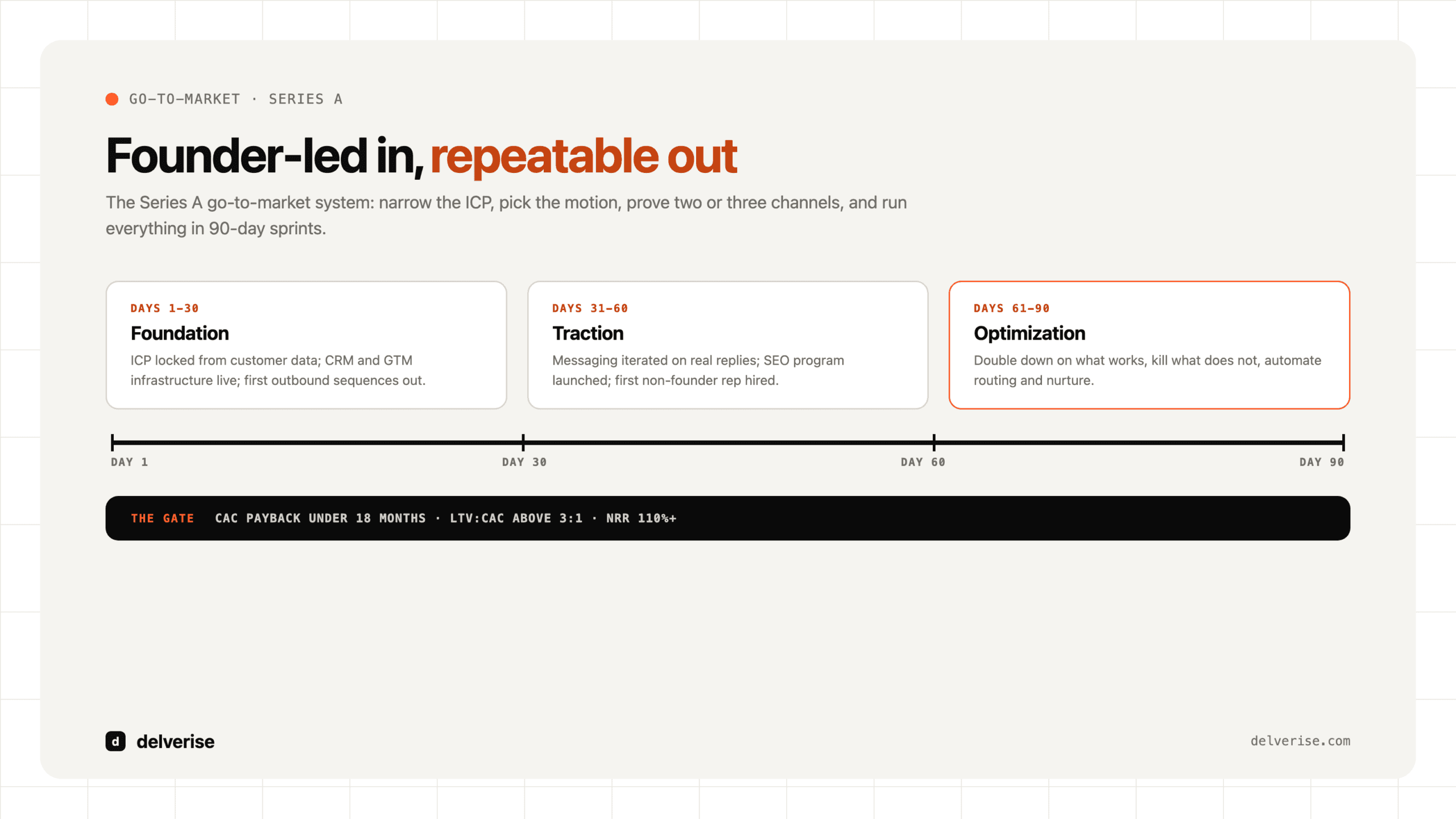
Step 6: Set 90-Day Milestones
Don’t plan the entire post-Series A journey. Plan in 90-day sprints:
Days 1-30: Foundation
- Finalize ICP definition with data from existing customers
- Set up CRM, analytics, and GTM engineering infrastructure
- Launch first outbound sequences to validate messaging
Days 31-60: Traction
- Analyze first outbound results and iterate on messaging
- Launch SEO content program targeting ICP search terms
- Hire first non-founder sales rep
Days 61-90: Optimization
- Double down on channels showing early traction
- Kill channels that aren’t working
- Build first automated workflows for lead routing and nurture
Common Series A GTM Mistakes
After working with dozens of Series A companies, these are the patterns that consistently lead to wasted runway:
- Targeting too broad. “All B2B companies” is not an ICP. Narrow ruthlessly.
- Hiring before systematizing. Adding headcount to a broken process just burns cash faster.
- Ignoring unit economics. Growth at any cost worked in 2021. In 2026, efficient growth wins.
- Over-investing in brand before demand gen. Brand matters, but pipeline pays the bills. Get demand gen working first.
- Building in isolation. Sales, marketing, and product need a shared GTM strategy, not three separate plans.
The Path Forward
Your Series A go-to-market strategy doesn’t need to be perfect. It needs to be focused, measurable, and iterative. Start narrow, prove what works, then scale what’s proven.
The companies that win post-Series A are the ones that treat GTM as an engineering problem, building systems that compound, rather than a hiring problem that throws bodies at the pipeline.
Need the operating layer behind post-Series A growth? delverise builds the systems that help B2B teams move from founder-led traction to repeatable pipeline: GTM architecture, outbound activation, CRM automation, reporting, and workflow QA. Explore GTM Engineering, Growth Engineering, AI Outbound, and Revenue Operations Automation, or apply to work with us.
Frequently Asked Questions
What should a Series A go-to-market strategy include?
A Series A GTM strategy should include a specific ICP, a primary GTM motion, channel priorities, qualification rules, core metrics, CRM and routing infrastructure, and a 90-day execution plan. The strategy needs to show how the company will move from founder-led traction to a repeatable pipeline system.
Should a Series A startup hire first or build the GTM system first?
Most Series A startups should define the system before scaling headcount. Hiring into an unclear ICP, weak routing model, or unproven channel usually increases burn without creating predictable revenue. The better path is to prove the motion, document the workflow, then hire around the parts that are ready to scale.
Which metrics matter most after raising a Series A?
The most important metrics are qualified pipeline creation, CAC payback, sales cycle length, win rate by segment, lead-to-opportunity conversion, outbound reply and meeting rates, activation or product usage signals, and forecast reliability. The exact mix depends on whether the company is product-led, sales-led, or hybrid.
How long should a post-Series A GTM plan run?
A Series A company should usually plan in 90-day execution cycles. The long-term direction can span a year, but the operating plan should be short enough to test ICP assumptions, channel performance, messaging, and conversion quality before the team commits more budget or headcount.
Read next