←Back to blog
Revenue Intelligence & Data ToolingGuideMay 20, 202615 min read
Best Sales Engagement Platforms for Startups in 2026: Scale Your Outbound Without Breaking the Bank
Compare HubSpot, Apollo, and 6 other sales engagement platforms for startups in 2026. Affordable picks ranked by pricing, ease of use, and scalability.
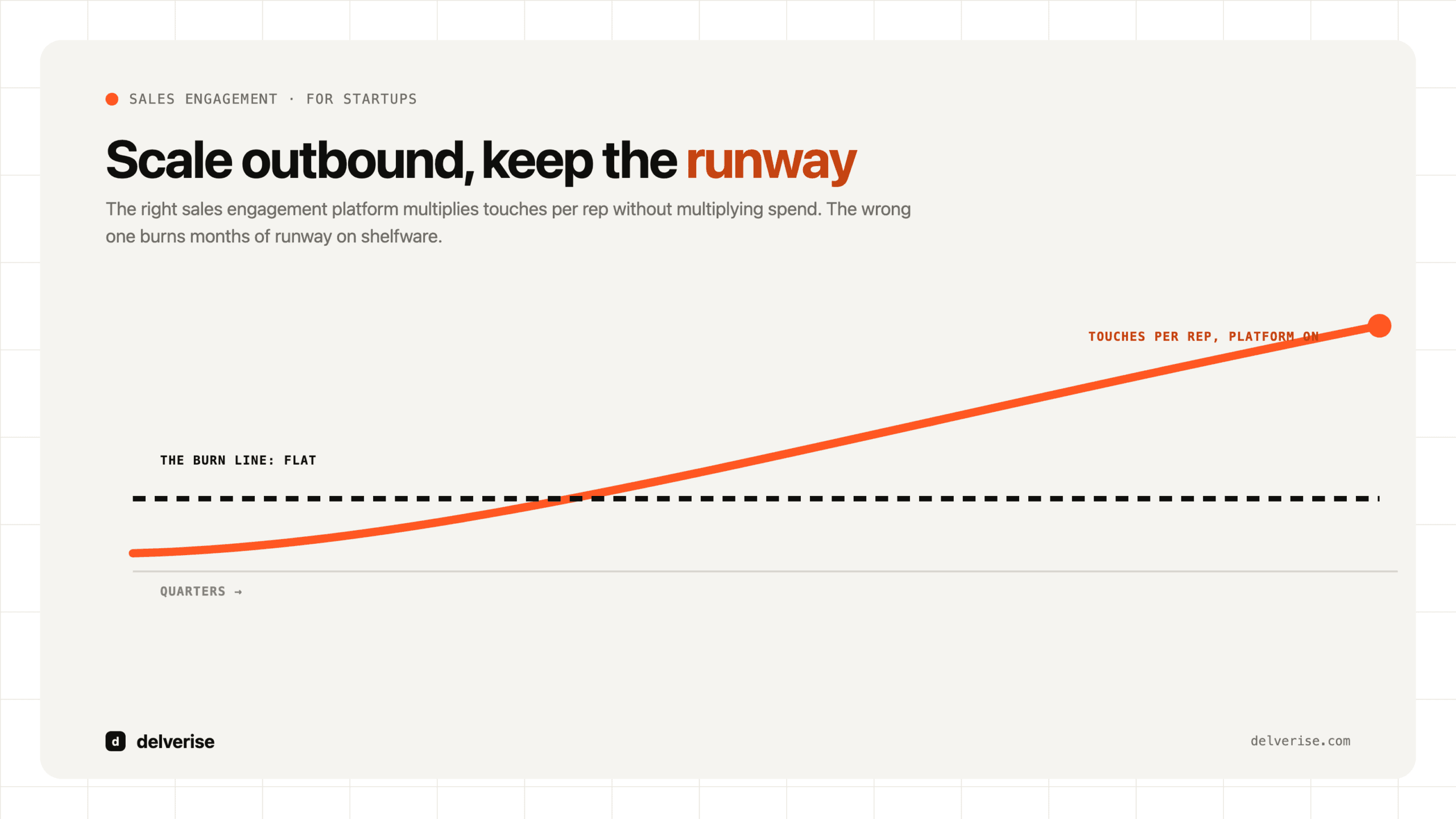
For founders and early-stage sales leaders, the pressure to generate pipeline on a shoestring budget is immense. You know you need to move beyond a messy spreadsheet and a basic email client, but the enterprise-grade sales tools you hear about seem impossibly complex and expensive. This guide is for you. We’ll explore the best sales engagement platforms for startups in 2026, focusing on tools that help you scale your outbound efforts without breaking the bank.
Sales engagement goes beyond sending emails. It means orchestrating a series of touchpoints across multiple channels (email, phone, and social media) to build relationships and book meetings. The right platform can be a game-changer, automating manual tasks, ensuring consistent follow-up, and providing the data you need to improve your process. We’ll analyze the top contenders through the lens of a bootstrapped or lean startup: affordability, ease of use, time to value, and scalability.
Answer: The best sales engagement platform for a startup is the one that matches the team’s sales motion, data needs, outbound volume, and implementation capacity. Email-first teams usually prioritize deliverability, inbox rotation, and simple sequencing. Teams that need data plus outreach often need a combined prospecting and engagement platform. Teams building highly personalized outbound need stronger enrichment, workflow logic, and CRM integration.
- Choose by motion first: cold email, calling, LinkedIn, multichannel, or data-driven outbound.
- Choose by operating capacity: a simple platform the team uses well beats a powerful platform no one maintains.
- Choose by data model: contact database, enrichment, CRM sync, and attribution matter as much as sequence features.
- Choose by scale path: the platform should support clean handoff, reporting, and deliverability as volume grows.
Why Startups Need Sales Engagement Beyond Email Tools
In the early days, manual outreach feels manageable. But as you scale, the process quickly breaks down. Simple email automation tools offer a slight improvement, but they lack the multichannel capabilities and deep analytics of a true sales engagement platform. The global sales engagement market is projected to grow from $7.87 billion to $29.62 billion by 2033, a testament to the value these platforms provide.
Research from Gartner reinforces the urgency: ‘Sales technology adoption has shifted from a competitive advantage to table stakes, with high-performing sales organizations using 3.7x more tools than underperformers.’ For startups, this means the question is no longer whether to adopt a sales engagement platform, but which one fits your stage and budget.
For startups, the efficiency gains are a necessity. With a small team, every minute counts. Research shows that automation can free up about 20 percent of a sales team’s capacity, allowing them to focus on high-value activities like talking to prospects and closing deals. Furthermore, 87% of sales development organizations have already adopted a sales engagement platform, making it a competitive imperative.
Harvard Business Review puts a finer point on where that capacity goes: ‘Sales reps spend less than 36% of their time actually selling, with the rest consumed by administrative work, data entry, and internal meetings.’ Reclaiming even a fraction of that lost time is the single biggest lever a lean startup sales team has.
McKinsey frames the stakes plainly: ‘Companies that digitize their sales processes can see revenue gains of 5 to 10 percent and cost reductions of 10 to 20 percent within two years.’ At startup scale, those margins often decide whether you hit the next funding milestone.

Top 8 Platforms Ranked by Startup-Friendliness
We’ve evaluated the top sales engagement platforms on the market, scoring them based on the criteria that matter most to startups: Pricing, Ease of Setup, Time to Value, Scalability, and Support Quality. Here’s how they stack up.

Detailed Platform Reviews
Here’s a deeper look at each platform, with a “report card” style summary to help you quickly assess if it’s the right fit for your startup.
1. HubSpot Sales Hub
Report Card
- Starting Price: $0 (Free Tools)
- Free Trial: Forever Free Plan
- Key Features: Free CRM, Email Tracking, Meeting Scheduler, Limited Sequences
- Best for: Solo founders and small teams needing an all-in-one, free solution to start.
- Limitations: The free and starter tiers have significant limitations on sequences and automation.
HubSpot is a powerhouse in the sales and marketing world, and its free CRM and Sales Hub tools are an incredible entry point for startups. You get a robust CRM, email tracking, meeting scheduling, and a centralized contact database at no cost. It’s the perfect platform to establish good sales habits from day one. The main limitation is that true sales engagement features, like automated multi-step sequences, are limited in the free and low-cost starter plans.
When to upgrade: You’ll know it’s time to upgrade to the Professional tier when your team grows beyond 2-3 reps and you find yourself manually sending follow-up sequences that could be automated.
2. Apollo.io
Report Card
- Starting Price: $0 (Free Plan)
- Free Trial: 14-day trial of paid plans
- Key Features: B2B Database (275M+ contacts), Email Sequences, Analytics, CRM Sync
- Best for: Startups that need both lead data and sales engagement in one platform.
- Limitations: Email deliverability can be a concern, and credit costs can add up.
Apollo.io offers a compelling all-in-one proposition: a massive B2B contact database combined with a full-featured sales engagement platform. This integration can save startups a significant amount of time and money. The free plan is generous, and the startup program, offering 50% off the first year, makes it highly accessible. The platform is easy to use and you can get a campaign running in a matter of hours.
When to upgrade: Upgrade from the free plan when you need more than the 1,200 annual credits or want to run more than two sequences at a time. The Basic plan offers a significant jump in capabilities for a reasonable price.
3. Instantly.ai
Report Card
- Starting Price: $37/month
- Free Trial: No
- Key Features: Unlimited Email Accounts, Unlimited Warmup, Advanced Sequencing, A/Z Testing
- Best for: Email-first outbound teams focused on deliverability and volume.
- Limitations: No built-in CRM or calling features.
Instantly has quickly become a favorite in the cold email community, and for good reason. Its standout feature is the ability to connect unlimited email accounts for a flat fee, which is a game-changer for deliverability. By spreading your sending volume across multiple inboxes, you can warm them up effectively and avoid spam filters. It’s a specialized tool that does one thing (email outreach) exceptionally well.
When to upgrade: You’ll upgrade from the Growth to the Hypergrowth plan when you need to contact more than 1,000 new leads per month or send more than 5,000 emails.
4. Close.io
Report Card
- Starting Price: $35/user/month (Essentials)
- Free Trial: 14 days
- Key Features: Integrated CRM, Power Dialer, SMS, Email Automation
- Best for: Teams that want a seamless CRM and sales engagement experience with strong calling features.
- Limitations: Less focused on data enrichment and LinkedIn automation.
Close is a CRM built by salespeople, for salespeople. Its tight integration of communication channels (email, calling, SMS) is its biggest strength. The Power Dialer is a huge productivity booster for teams that do a lot of calling. While it doesn’t have a built-in lead database like Apollo, it excels at managing the entire sales workflow from prospecting to close in one place. The new Solo plan at $9/month is a fantastic option for individual founders.
When to upgrade: Move from Essentials to Growth when you’re ready to implement automated workflows and use the Power Dialer to increase call volume.
5. Lemlist
Report Card
- Starting Price: $55/user/month (Email Pro)
- Free Trial: 14 days
- Key Features: Multichannel Sequences (Email, LinkedIn, Calling), AI Personalization, Email Warmup
- Best for: Startups focused on highly personalized, multichannel outreach.
- Limitations: Can get pricey as you scale, and the lead database is not as strong as Apollo’s.
Lemlist pioneered personalized images in cold emails and has since evolved into a powerful multichannel sales engagement platform. It allows you to combine email, LinkedIn actions (views, invites, messages), and cold calls into a single, automated sequence. This is crucial for breaking through the noise. Their focus on deliverability and personalization makes it a strong choice for startups that want to build relationships rather than send bulk email.
When to upgrade: Choose the Multichannel Expert plan from the start if your strategy involves LinkedIn. The Email Pro plan is too limiting for a true multichannel approach.
6. Smartlead
Report Card
- Starting Price: $39/month
- Free Trial: No
- Key Features: Unlimited Email Accounts, Email Warmup, Advanced Sequencing, Strong Deliverability
- Best for: Deliverability-focused teams who want a more feature-rich alternative to Instantly.
- Limitations: Steeper learning curve than some competitors.
Smartlead is another strong contender in the email-first category. Like Instantly, it offers unlimited email accounts and a focus on deliverability. It differentiates itself with more advanced features around inbox rotation, A/Z testing, and AI-powered sequence management. It’s a great option for startups that are serious about scaling their cold email outreach safely and effectively.
When to upgrade: Smartlead’s pricing is designed to scale with your needs, so you’ll naturally move up the tiers as your contact and sending volume increases.
7. Clay.com Sequencer
Report Card
- Starting Price: $314/month (Explorer)
- Free Trial: Limited Free Plan
- Key Features: Deep Data Enrichment (100+ sources), Web Scraping, AI Message Drafting, Conditional Logic
- Best for: Data-driven teams with a budget that want to build highly sophisticated, personalized campaigns.
- Limitations: Very expensive and has a steep learning curve.
Clay is best suited for teams that want a powerful data enrichment and automation platform with sequencing attached. You can pull data from hundreds of sources, use AI to find insights, and build complex, logic-based outreach campaigns. For a technically inclined founder or operator who wants to build a differentiated GTM motion, Clay can become the workflow layer behind more personalized outbound. However, the price and complexity make it a niche choice for most startups.
When to upgrade: Clay is an upgrade in itself. You’d typically move to Clay from a simpler platform when you’ve exhausted its data and personalization capabilities and have the budget to invest in a more powerful tool.
8. HeyReach
Report Card
- Starting Price: $799/month (flat)
- Free Trial: No
- Key Features: Unlimited LinkedIn Accounts, Automated Connection Requests & Messages, Whitelabel for Agencies
- Best for: Agencies or startups with a LinkedIn-heavy outreach strategy.
- Limitations: Specialized for LinkedIn; not a full sales engagement platform.
HeyReach is a specialized tool designed for scaling LinkedIn outreach. Its flat-fee pricing for unlimited LinkedIn accounts is perfect for agencies or teams that want to run high-volume campaigns without getting banned. It automates profile visits, connection requests, and follow-up messages. It is not a comprehensive sales engagement platform. For teams that live on LinkedIn, it’s a best-in-class solution.
When to upgrade: HeyReach is a premium, specialized tool. You wouldn’t typically upgrade from it, but rather add it to your stack alongside an email-focused platform.
9. Email Bison
Report Card
- Starting Price: $499/month (flat)
- Free Trial: No
- Key Features: Private Sequencer, Dedicated IPs, Premium Warmup Pool, Master Inbox
- Best for: Agencies and high-volume senders who need premium deliverability.
- Limitations: Expensive for small teams, requires technical expertise.
Email Bison is built for agencies and high-volume cold emailers who need the absolute best deliverability. Unlike shared platforms, Email Bison provides dedicated infrastructure (private IPs and servers), which means your sending reputation isn’t affected by other users. This is crucial for maintaining inbox placement at scale. The platform includes a master inbox for managing replies and a premium warmup pool that helps new domains establish credibility quickly.
When to upgrade: Email Bison is a specialized tool you’d add to your stack when you’re sending tens of thousands of emails per month and deliverability becomes a critical bottleneck.
10. Clarify.ai
Report Card
- Starting Price: $0 (Free)
- Free Trial: Free tier available
- Key Features: AI-Powered CRM, Meeting Capture & Summaries, Autonomous Follow-ups, Automatic Enrichment
- Best for: AI-first teams looking for a modern, autonomous CRM approach.
- Limitations: Still emerging platform, limited sales engagement features compared to dedicated platforms.
Clarify represents a new generation of AI-powered CRM. Instead of charging per seat, Clarify charges based on the AI work it does for you, measured in credits. The platform automatically captures meeting notes, drafts follow-up emails, and enriches contact data without manual input. It’s perfect for founders who want to spend less time on CRM hygiene and more time selling. However, it’s not a full sales engagement platform. You’ll still need a separate tool for sequences and outreach.
When to upgrade: Clarify’s credit-based model means you naturally scale your usage as your needs grow. Consider pairing it with a dedicated outreach tool like Instantly or Apollo for a complete stack.
Pricing Reality Check
The starting price of a platform is often misleading. As your team grows, per-seat pricing can quickly balloon your costs. This chart shows the real monthly cost of some of the most popular platforms as you scale from 2 to 20 users. Notice how flat-fee platforms like Instantly remain affordable, while per-seat platforms like Apollo and Close scale linearly.

Feature Comparison for Startup Needs
What features do you actually need as a startup? This matrix focuses on the capabilities that are most critical for getting an outbound sales motion off the ground. For most startups, a strong combination of Email Sequences, Email Warmup, and a good Template Library is the foundation for success.

Implementation Timeline
Getting a new tool set up and running can be a major time sink. This Gantt chart provides a realistic estimate of the time it takes to go from account creation to having a fully operational platform. Platforms like HubSpot and Apollo are designed for quick setup, while more complex tools like Clay require a significant time investment to learn and configure properly.

When to Upgrade
How do you know you’ve outgrown your current tool? Here are a few signals:
- You’re hitting volume limits: You consistently need more contacts, emails, or sequences than your plan allows.
- Your team is growing: You’re scaling your sales team beyond 5-10 reps and need better team management, reporting, and permissions.
- You need more channels: Your email-only approach is no longer effective, and you need to add calling and social selling to your mix.
- You’re manually doing what could be automated: You’re spending hours on tasks like CRM data entry, follow-up scheduling, or lead routing.
- Deliverability is suffering: Your open and reply rates are declining, and you need more advanced tools to manage your sending reputation.
Cost-Saving Strategies for Startups
While investing in the right tools is important, there are several strategies to keep costs under control:
Start with free tiers and trials. Almost every platform offers a free trial or a free tier. Use these to validate your outreach strategy before committing to a paid plan. HubSpot and Apollo both offer genuinely useful free plans that can take you surprisingly far.
Negotiate annual contracts. Most platforms offer 10-20% discounts for annual commitments. If you’re confident in your choice, paying upfront can save thousands over the course of a year. Additionally, don’t be afraid to ask for startup discounts. Many vendors have special programs for early-stage companies.
Optimize your tech stack. Avoid paying for overlapping features across multiple tools. For example, if you’re using Apollo for both data and engagement, you don’t need a separate lead database subscription. Similarly, if your CRM has basic email tracking, you might not need a separate tool for that.
Watch for hidden fees. Credit-based pricing can be a trap. Platforms like Apollo and Clay charge credits for data enrichment, which can add up quickly if you’re not careful. Set up alerts to monitor your credit usage and adjust your workflows to be more efficient.
Use flat-fee pricing when possible. For teams that are scaling quickly, flat-fee platforms like Instantly, Smartlead, and HeyReach can offer significant savings compared to per-seat pricing. If you know you’ll be adding reps, these platforms can grow with you without a corresponding increase in cost.
Common Mistakes to Avoid
Startups often make predictable mistakes when choosing and implementing sales engagement platforms. Here’s what to watch out for:
Choosing based on features, not fit. The platform with the longest feature list isn’t necessarily the best choice. Focus on the features you’ll actually use in the next 6-12 months, not the ones you might need someday. A simpler tool that you can implement quickly will deliver more value than a complex platform that sits unused.
Ignoring deliverability. All the automation in the world won’t help if your emails land in spam. Prioritize platforms with strong deliverability features like email warmup, inbox rotation, and spam testing. For cold email, deliverability should be your top concern.
Skipping the setup. Too many teams sign up for a platform, send a few emails, and then abandon it because they didn’t see immediate results. Take the time to properly configure your sequences, templates, and integrations. The platforms that seem “hard to use” are often just poorly set up.
Not tracking the right metrics. Vanity metrics like email open rates can be misleading. Focus on metrics that matter: reply rate, meeting booked rate, and ultimately, deals closed. Set up proper attribution so you can see which campaigns are actually driving revenue.
Templates and Sequences That Work
The best platform in the world won’t help if your messaging is off. Here are some proven templates and sequence structures that work for startups:
The 3×3 Email Sequence: This is a simple, effective structure for cold outreach. Send three emails over three weeks. Email 1 introduces the problem and hints at a solution. Email 2 provides social proof or a case study. Email 3 is a direct ask with a clear call to action. Keep each email under 100 words and personalize the first line.
The Value-First Approach: Instead of immediately asking for a meeting, lead with value. Share a relevant insight, a piece of content, or a quick win the prospect can implement immediately. This builds trust and positions you as a helpful resource. They see you as more than another salesperson.
The Breakup Email: Don’t underestimate the power of a well-timed “breakup” email. After several attempts with no response, send a final email saying you’ll stop reaching out unless they’re interested. This often gets a response from prospects who were on the fence.
Need the outbound system behind the platform? delverise builds AI outbound systems that connect sales engagement platforms, data enrichment, CRM workflows, deliverability, sequencing, and reporting. Explore AI Outbound, CRM Enrichment, Clay Systems, and GTM Engineering, or apply to work with us.
Frequently Asked Questions
What is the cheapest sales engagement platform for startups?
HubSpot Sales Hub offers a forever-free plan, making it the most affordable starting point for solo founders and small teams. You get a robust CRM, email tracking, meeting scheduling, and a centralized contact database at no cost. Apollo.io also offers a free plan with 1,200 annual credits and 50% off the first year through its startup program. For email-first teams, Instantly.ai starts at $37/month with unlimited email accounts.
Why do startups need sales engagement platforms instead of email tools?
Sales engagement platforms orchestrate multichannel touchpoints across email, phone, and social media, while basic email tools only handle one channel. Research shows automation frees up about 20 percent of a sales team’s capacity for high-value activities like talking to prospects. The global sales engagement market is projected to grow from $7.87 billion to $29.62 billion by 2033, and 87% of sales development organizations have already adopted a platform, making it a competitive imperative.
When should a startup upgrade from a free sales engagement plan?
Upgrade from HubSpot’s free tier when your team grows beyond 2-3 reps and you’re manually sending follow-up sequences that should be automated. For Apollo.io, upgrade when you exceed 1,200 annual credits or need to run more than two sequences at a time. For Instantly.ai, move from Growth to Hypergrowth when you need to contact more than 1,000 new leads per month or send more than 5,000 emails.
Which sales engagement platform is best for cold email deliverability?
Instantly.ai is the strongest choice for email-first outbound teams focused on deliverability and volume. Its standout feature is the ability to connect unlimited email accounts for a flat fee starting at $37/month, which spreads sending volume across multiple inboxes to warm them up effectively and avoid spam filters. It’s a specialized tool that does cold email outreach exceptionally well, though it lacks a built-in CRM or calling features.
How does Apollo.io compare to Close.io for startups?
Apollo.io combines a massive B2B contact database of 275M+ contacts with sales engagement, making it ideal for startups that need both lead data and outreach in one platform, starting free. Close.io starts at $35/user/month and focuses on integrated CRM with strong calling features including a Power Dialer, email, and SMS. Choose Apollo for data and prospecting needs, or Close for managing the full sales workflow from prospecting to close.
Read next