←Back to blog
Revenue Intelligence & Data ToolingGuideMay 20, 202650 min read
Clay vs the Top Alternatives: B2B Enrichment Compared (2026)
Clay.com aggregates 100+ data sources for B2B enrichment, but is it right for you? Compare top alternatives across data quality, AI, pricing, and workflows for 2026.
The B2B data enrichment landscape has evolved dramatically in 2026, with sales teams drowning in data while simultaneously starving for actionable insights. Clay.com has emerged as a compelling solution, offering access to over 100 data sources through a single platform. However, the question remains: is aggregating everything always the answer, or might a focused alternative be a smarter fit for your specific go-to-market strategy?
According to Gartner, ‘through 2025, 80% of organizations seeking to scale digital business will fail because they do not take a modern approach to data and analytics governance.’ For B2B revenue teams, this gap is exactly why tool selection in the enrichment category has become a make-or-break GTM decision rather than a back-office procurement choice.
This comprehensive guide explores the landscape of Clay alternatives, comparing key platforms across factors like data quality, feature sets, automation capabilities, AI integration, ease of use, and pricing models. Whether you’re questioning Clay’s complexity, seeking more predictable costs, or looking for specialized functionality, this analysis provides the tactical guidance you need to choose the platform that truly drives results.
Short answer: Clay is usually the strongest fit when a team needs flexible enrichment workflows, multiple data sources, AI research, and custom GTM automation. A Clay alternative may be better when the team needs a simpler contact database, a bundled sales engagement suite, stricter cost predictability, or a region-specific compliance/data provider.
- Choose Clay for waterfall enrichment, research-heavy outbound, RevOps-controlled workflows, and system-level GTM builds.
- Choose a sales intelligence suite when the team wants prospecting, sequencing, calling, and analytics in one rep-facing platform.
- Choose a specialized contact provider when the problem is narrow: email finding, phone coverage, EU compliance, or a specific market.
Clay.com Analysis & Market Position
Clay has carved out a distinctive position in the go-to-market technology stack, focusing primarily on data aggregation and workflow automation for sales, marketing, and operations teams. The platform aims to solve inefficiencies related to manual research efforts and incomplete customer relationship management data by providing a comprehensive data enrichment and automation solution.
Clay’s Unique Value Proposition and Core Capabilities
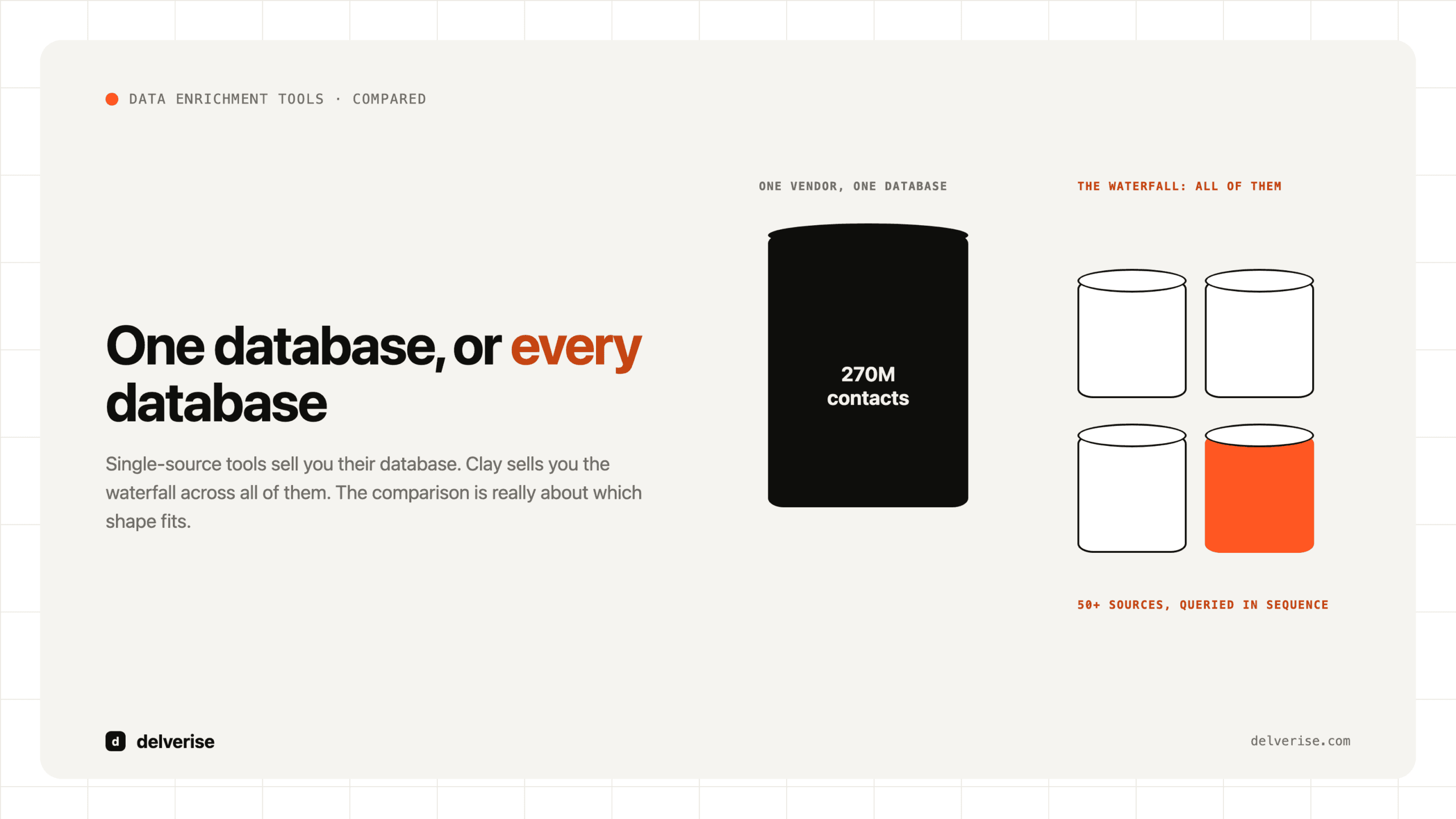
At its core, Clay functions as a sophisticated data marketplace that provides access to over 100 data providers through a single, spreadsheet-like interface using a credit-based system. This approach fundamentally differs from traditional sales intelligence platforms that rely on proprietary databases. Instead of building their own data collection infrastructure, Clay has positioned itself as an aggregator that allows users to access multiple data sources simultaneously, creating what they term “waterfall enrichment” strategies.
The platform’s architecture centers around two primary innovations that distinguish it from competitors. First, its flexible workflow automation engine enables intricate conditional logic, fallbacks, and custom integrations via API and webhooks, allowing for highly tailored automated workflows. This system goes beyond simple data enrichment to enable complex, multi-step processes that can adapt based on data availability and quality from different sources.
Second, Clay’s AI research agent, known as Claygent, performs custom research tasks that extend beyond standard data enrichment. Unlike basic AI tools that simply reformat existing data, Claygent can summarize documents, find niche data points, and enable deeper personalization for outreach campaigns. This capability allows sales teams to automate research that would traditionally require manual effort, such as identifying specific business challenges or recent company developments that could inform personalized messaging.
Waterfall Enrichment Strategy and Data Provider Aggregation
Clay’s waterfall enrichment methodology represents a fundamental shift in how B2B teams approach data collection and verification. Rather than relying on a single data source that may have incomplete or outdated information, the waterfall approach systematically queries multiple providers in a predetermined sequence until the desired data point is found. This strategy can significantly improve data coverage rates, with some users reporting up to 3x better contact information discovery compared to single-source approaches.
Research from McKinsey reinforces the underlying economics: ‘B2B companies that use analytics extensively are more likely to report above-market growth, with high performers being 1.5 times more likely to leverage advanced data capabilities than their peers.’ The waterfall model isn’t just a technical pattern; it’s the operational expression of treating data coverage as a compounding revenue input.
The waterfall system operates by establishing a hierarchy of data providers based on factors such as data quality, cost per credit, and specific strengths for different types of information. For example, a typical email enrichment waterfall might start with a high-accuracy, premium provider for initial attempts, then fall back to more cost-effective options for broader coverage, and finally utilize web scraping or AI research for hard-to-find contacts. This approach optimizes both data quality and cost efficiency while maximizing coverage rates.
However, this aggregation strategy also introduces complexity that may not be suitable for all organizations. Teams must understand the strengths and limitations of different data providers, configure appropriate fallback sequences, and manage credit allocation across multiple sources. The learning curve can be substantial, particularly for organizations accustomed to simpler, single-source solutions.
Target Market and Ideal Use Cases for Clay
Clay’s sophisticated approach makes it particularly well-suited for specific organizational profiles and use cases. The platform excels in environments where data requirements are complex, diverse, or highly customized. Revenue operations teams at mid-market and enterprise companies often find Clay’s flexibility invaluable for creating sophisticated lead scoring models, account research workflows, and multi-touch attribution systems that require data from numerous sources.
The platform is especially powerful for organizations that need to enrich data beyond basic contact information. Companies selling complex B2B solutions often require detailed firmographic data, technographic insights, intent signals, and competitive intelligence that no single provider can comprehensively deliver. Clay’s ability to aggregate and correlate data from multiple sources enables these organizations to build comprehensive prospect profiles that inform more effective sales strategies.
Additionally, Clay serves organizations with significant technical resources and workflow automation requirements. Companies with dedicated revenue operations teams or technical marketing professionals can leverage Clay’s API capabilities and custom workflow features to create sophisticated automation that integrates with existing technology stacks. This makes Clay particularly attractive to fast-growing companies that need scalable, automated processes but require more flexibility than traditional sales intelligence platforms provide.
Harvard Business Review frames this trade-off directly: ‘the most successful sales organizations are those that balance automation with judgment, using technology to amplify rather than replace human decision-making.’ That’s the lens to apply when evaluating Clay against more opinionated alternatives — flexibility is only an asset when your team has the operational maturity to wield it.
Common Reasons Teams Seek Clay Alternatives
Despite Clay’s powerful capabilities, several factors drive organizations to explore alternatives. The most frequently cited concern relates to cost predictability and budget management. Clay’s credit-based pricing model, while flexible, can lead to unpredictable monthly expenses that make budgeting challenging compared to fixed per-seat subscription models. Organizations with strict budget constraints or those requiring precise cost forecasting often find this pricing structure problematic.
Complexity and learning curve represent another significant barrier to Clay adoption. The platform’s extensive customization options and multiple data source integrations require substantial time investment to master effectively. Organizations without dedicated technical resources or those needing immediate productivity may find Clay’s sophistication overwhelming compared to more straightforward alternatives.
The need for integrated sales engagement capabilities also drives teams toward alternatives. Clay excels at data enrichment and research but requires integration with separate sales engagement platforms for outreach execution. Teams seeking all-in-one solutions that combine prospecting, enrichment, and outreach in a single platform often prefer alternatives that offer native engagement features, even if they sacrifice some of Clay’s advanced enrichment capabilities.
Finally, some organizations discover that their data requirements are simpler than Clay’s capabilities suggest. Teams focused primarily on basic contact finding or standard firmographic enrichment may find that specialized, simpler tools provide better value and easier implementation than Clay’s comprehensive but complex approach.
Clay vs Comprehensive Sales Intelligence Platforms
The comprehensive sales intelligence category represents Clay’s most direct competition, featuring platforms that combine large proprietary databases with prospecting, enrichment, and often native outreach capabilities. These platforms typically serve as central hubs for sales teams, offering integrated workflows that span from initial prospect identification through engagement and pipeline management.
Clay vs Apollo.io: Complete Head-to-Head Analysis
Apollo.io positions itself as an all-in-one sales intelligence and engagement platform, combining a database of over 275 million verified contacts with native prospecting, data enrichment, and sales engagement capabilities. This integrated approach represents a fundamentally different philosophy from Clay’s aggregation strategy, offering both advantages and limitations depending on organizational needs and preferences.
Data Quality and Coverage Comparison
The data quality comparison between Clay and Apollo reveals distinct approaches to information accuracy and coverage. Apollo maintains a proprietary database built through a combination of web scraping, user contributions, and partnerships with data providers. This approach enables Apollo to offer consistent data formatting, unified verification processes, and predictable coverage across their entire database. Users report that Apollo’s data quality is generally reliable for standard business contact information, with email deliverability rates typically ranging from 85-92% for verified contacts.
Clay’s waterfall enrichment approach, by contrast, can achieve superior data coverage and accuracy by leveraging multiple specialized providers for different types of information. When properly configured, Clay’s multi-source strategy can identify contact information that Apollo’s single database might miss, particularly for hard-to-reach prospects or niche industries. However, this advantage requires sophisticated configuration and understanding of different data providers’ strengths and limitations.
The practical impact of these different approaches becomes evident in real-world usage scenarios. Apollo’s unified database provides consistent results and simplified workflows, making it easier for sales teams to achieve immediate productivity. Clay’s approach can deliver superior results but requires more technical expertise and ongoing optimization to realize its full potential.
Native Outreach Capabilities vs Clay’s Integration Approach
Apollo’s native sales engagement features represent one of its most significant advantages over Clay’s enrichment-focused approach. The platform includes built-in email sequencing, call logging, LinkedIn messaging, task management, and comprehensive analytics that enable sales teams to execute complete prospecting workflows within a single interface. This integration eliminates the need for additional tools and reduces the complexity of managing multiple platform integrations.
Clay’s approach requires integration with separate sales engagement platforms such as Smartlead, Instantly, or HubSpot Sequences to execute outreach campaigns. While this separation allows for more specialized tool selection and potentially superior engagement capabilities, it also introduces additional complexity, cost, and potential integration challenges. Teams must manage data synchronization between platforms, maintain consistent contact records across systems, and coordinate workflows that span multiple tools.
The choice between these approaches often depends on organizational preferences for simplicity versus specialization. Teams prioritizing ease of use and integrated workflows typically favor Apollo’s all-in-one approach, while organizations with specific engagement requirements or existing tool preferences may prefer Clay’s flexibility to integrate with best-of-breed engagement platforms.
Pricing Models and Cost Predictability Analysis
The pricing structure comparison reveals fundamental differences in how these platforms approach customer value and cost management. Apollo operates on a traditional subscription model with tiered pricing based on features and usage limits, providing predictable monthly costs that facilitate budget planning and financial forecasting. Their pricing typically ranges from $49-$149 per user per month, with enterprise plans offering custom pricing for larger organizations.
Clay’s credit-based pricing model offers more flexibility but introduces cost unpredictability that can complicate budget management. Credits are consumed based on data enrichment activities, with costs varying depending on the data providers used and the complexity of enrichment workflows. While this approach can be more cost-effective for organizations with variable or seasonal data needs, it requires careful monitoring and optimization to prevent unexpected expenses.
The total cost of ownership analysis must also consider the additional tools required for complete sales workflows. Apollo’s integrated approach may result in lower overall costs for teams that can utilize its native features effectively, while Clay’s approach may require additional investments in sales engagement platforms, potentially increasing the total technology stack cost.
Workflow Automation and Customization Capabilities
Clay’s workflow automation capabilities significantly exceed Apollo’s in terms of flexibility and sophistication. Clay’s workflow engine supports complex conditional logic, multi-step processes, custom API integrations, and advanced data manipulation that enables highly customized automation scenarios. This flexibility allows organizations to create sophisticated lead scoring models, account research workflows, and data enrichment processes that adapt based on multiple variables and data sources.
Apollo’s automation features, while more limited in scope, are designed for ease of use and immediate productivity. The platform offers pre-built automation templates for common sales workflows, simple sequence builders, and basic conditional logic that covers most standard use cases without requiring technical expertise. This approach enables faster implementation and broader team adoption but may not satisfy organizations with complex or unique workflow requirements.
The practical implications of these differences become apparent in implementation timelines and ongoing maintenance requirements. Apollo’s simpler automation can be deployed quickly and managed by non-technical users, while Clay’s advanced capabilities may require dedicated technical resources for optimal configuration and ongoing optimization.
Integration Ecosystem and CRM Connectivity
Both platforms offer extensive integration capabilities, but with different focuses and implementation approaches. Apollo provides native integrations with major CRM platforms including Salesforce, HubSpot, and Pipedrive, along with connections to popular sales engagement and marketing automation tools. These integrations are typically straightforward to configure and maintain, with standardized data mapping and synchronization processes.
Clay’s integration ecosystem is more extensive but requires greater technical sophistication to implement effectively. The platform offers over 100 integrations with data providers, CRM systems, marketing automation platforms, and custom API connections. This breadth enables more sophisticated data workflows but may require technical expertise or dedicated implementation support to realize full value.
Clay vs ZoomInfo: Enterprise Data Intelligence Comparison
ZoomInfo represents the enterprise tier of sales intelligence platforms, offering comprehensive data coverage, advanced intent data capabilities, and enterprise-grade features designed for large sales organizations. The comparison with Clay reveals different approaches to serving enterprise data requirements and organizational complexity.
Proprietary Database vs Aggregated Data Sources
ZoomInfo’s proprietary database approach contrasts sharply with Clay’s aggregation strategy, each offering distinct advantages for enterprise users. ZoomInfo maintains one of the industry’s largest B2B databases, with comprehensive company and contact information that undergoes rigorous verification and updating processes. This approach ensures data consistency, standardized formatting, and reliable coverage across their entire database, which is particularly valuable for large organizations requiring predictable data quality and compliance with data governance requirements.
Clay’s aggregated approach can potentially provide superior data coverage by accessing specialized providers that may have information not available in ZoomInfo’s database. However, this advantage requires sophisticated configuration and ongoing management that may not be practical for large enterprise deployments where consistency and standardization are prioritized over maximum coverage.
Intent Data Quality and Buying Signal Accuracy
ZoomInfo’s intent data capabilities represent one of its strongest differentiators from Clay’s enrichment-focused approach. The platform provides comprehensive buyer intent tracking, competitive intelligence, and buying signal identification that enables sales teams to prioritize prospects based on demonstrated purchase interest. This capability is particularly valuable for enterprise sales organizations with long sales cycles and complex decision-making processes.
Clay’s approach to intent data relies on integrations with specialized intent data providers rather than native capabilities. While this can provide access to multiple intent data sources, it requires additional configuration and may not offer the same level of integration and workflow automation that ZoomInfo’s native intent capabilities provide.
Enterprise Features and Compliance Capabilities
ZoomInfo’s enterprise features include advanced data governance, compliance management, and administrative controls designed for large organizations with complex regulatory requirements. These capabilities include data retention policies, user access controls, audit trails, and compliance reporting that may be essential for enterprises in regulated industries or with strict data governance requirements.
Clay’s enterprise capabilities are more focused on workflow flexibility and data source diversity rather than administrative controls and compliance management. While the platform can support enterprise use cases, organizations with extensive compliance requirements may find ZoomInfo’s purpose-built enterprise features more suitable for their needs.
Custom Pricing vs Credit-Based Models
The pricing comparison between ZoomInfo and Clay reflects their different target markets and value propositions. ZoomInfo typically employs custom enterprise pricing that includes comprehensive platform access, dedicated support, and often includes professional services for implementation and optimization. This approach provides predictable costs and comprehensive support but may result in higher overall expenses and longer implementation timelines.
Clay’s credit-based model can offer more cost flexibility for enterprise users with variable data needs, but may require more sophisticated usage monitoring and optimization to manage costs effectively at enterprise scale. The choice between these approaches often depends on organizational preferences for cost predictability versus usage flexibility.
Use Case Analysis: When to Choose Each Platform
The decision between Clay, Apollo, and ZoomInfo should be based on specific organizational requirements, technical capabilities, and strategic priorities rather than feature comparisons alone.

When to Choose Apollo for Integrated Prospecting and Outreach
Apollo is typically the optimal choice for organizations prioritizing simplicity, integrated workflows, and rapid implementation. Sales teams that need to combine prospecting, data enrichment, and outreach in a single platform will find Apollo’s integrated approach more efficient than managing multiple specialized tools. This is particularly true for mid-market companies with limited technical resources or those seeking to minimize technology stack complexity.
Organizations with straightforward data requirements that can be satisfied by Apollo’s proprietary database will benefit from the platform’s consistent data quality and simplified workflows. Teams focused on standard B2B prospecting activities such as email outreach, LinkedIn messaging, and basic account research will find Apollo’s feature set comprehensive and easy to use.
When Clay’s Flexibility Justifies the Complexity
Clay becomes the preferred choice when data requirements exceed what single-source platforms can provide or when workflow customization is essential for competitive advantage. Organizations with complex data needs, such as those requiring technographic data, competitive intelligence, or specialized industry information, will benefit from Clay’s ability to aggregate multiple data sources.
Companies with dedicated revenue operations teams or technical marketing professionals can leverage Clay’s advanced workflow capabilities to create sophisticated automation that provides competitive advantages. This is particularly valuable for organizations with unique go-to-market strategies or those operating in niche markets where standard approaches may not be effective.
Enterprise vs Startup Decision Frameworks
The organizational maturity and resource availability significantly influence the optimal platform choice. Startups and small companies typically benefit from Apollo’s simplicity and integrated approach, which enables rapid productivity without requiring dedicated technical resources. The predictable pricing and straightforward implementation make Apollo particularly attractive for organizations with limited budgets and immediate revenue generation requirements.
Enterprise organizations with complex data requirements, compliance needs, and dedicated technical resources may find Clay or ZoomInfo more suitable depending on their specific priorities. ZoomInfo’s enterprise features and intent data capabilities serve large organizations with sophisticated sales processes, while Clay’s flexibility benefits enterprises with unique requirements or existing technology investments that require specialized integration approaches.
Clay vs Specialized Contact Finding Tools
The specialized contact finding category represents a different approach to B2B data enrichment, focusing on simplicity, ease of use, and specific geographic or functional strengths rather than comprehensive platform capabilities. These tools typically excel in particular use cases or markets while offering more straightforward implementation and pricing compared to complex platforms like Clay.
Clay vs Kaspr: European Market and LinkedIn Prospecting
Kaspr has established itself as a prominent player in the European B2B data market, with particular strength in LinkedIn-based prospecting and GDPR-compliant data collection. The platform’s approach contrasts significantly with Clay’s comprehensive aggregation strategy, focusing instead on specialized functionality and regional expertise.
GDPR Compliance and Data Accuracy Comparison
The regulatory landscape in Europe has created unique requirements for B2B data collection and usage that significantly impact platform selection for European organizations. Kaspr has built its platform with GDPR compliance as a foundational requirement, implementing data collection and processing practices specifically designed to meet European regulatory standards. The platform emphasizes transparency in data sourcing, provides clear consent mechanisms, and offers data subject rights management that European organizations require for compliance.
However, Kaspr’s recent regulatory challenges highlight the complexity of GDPR compliance in the B2B data space. In December 2024, the French data protection authority (CNIL) imposed a €240,000 fine on Kaspr for data scraping violations, specifically related to their Chrome extension’s collection of LinkedIn profile data without proper consent. This regulatory action underscores the ongoing challenges that specialized data providers face in balancing data collection capabilities with compliance requirements.
Clay’s approach to GDPR compliance relies on the compliance practices of its integrated data providers rather than implementing comprehensive compliance features natively. While this approach can provide access to GDPR-compliant data sources, it requires users to understand and manage compliance across multiple providers, which can be complex for organizations with strict regulatory requirements.
The data accuracy comparison reveals different strengths based on geographic focus and data types. Kaspr’s specialization in European markets enables deeper coverage and more accurate contact information for European prospects compared to global platforms that may have limited regional data collection capabilities. The platform claims access to over 200 million European B2B contacts with verification processes specifically designed for European business structures and contact patterns.
Clay’s waterfall approach can potentially achieve superior accuracy by combining multiple European data providers, but this requires sophisticated configuration and understanding of which providers offer the best coverage for specific European markets. The aggregation approach may be particularly valuable for organizations operating across multiple European countries with different business cultures and data availability patterns.
Chrome Extension Simplicity vs Clay’s Workflow Power
The user experience comparison between Kaspr and Clay reflects fundamentally different philosophies about tool complexity and user empowerment. Kaspr’s Chrome extension provides immediate access to contact information while browsing LinkedIn profiles, offering a streamlined workflow that requires minimal training or technical expertise. This approach enables sales professionals to gather contact information efficiently during their normal prospecting activities without switching between multiple platforms or learning complex workflow configurations.
The simplicity of Kaspr’s approach comes with limitations in terms of automation and scalability. While the Chrome extension excels for individual prospect research and small-scale contact gathering, it may not provide sufficient automation capabilities for organizations with high-volume prospecting requirements or complex data enrichment needs.
Clay’s workflow power enables sophisticated automation that can scale to handle large prospect lists and complex enrichment requirements, but this capability requires significant time investment to master effectively. Organizations must weigh the immediate productivity benefits of Kaspr’s simplicity against the long-term scalability advantages of Clay’s more complex but powerful approach.
Real-time Verification and Contact Quality Analysis
The approach to data verification reveals different priorities and capabilities between these platforms. Kaspr emphasizes real-time verification during the contact discovery process, providing immediate feedback about data quality and deliverability while users are actively prospecting. This real-time approach can prevent the collection of outdated or incorrect contact information, improving overall campaign effectiveness and reducing bounce rates.
Clay’s verification approach depends on the specific data providers included in waterfall configurations, with some providers offering real-time verification while others may provide batch verification or historical accuracy data. This variability requires users to understand the verification capabilities of different providers and configure workflows appropriately to ensure data quality meets their requirements.
Clay vs Lusha: Simplicity and Ease of Use Comparison
Lusha represents the simplicity-focused segment of the contact finding market, emphasizing ease of use, quick implementation, and affordable pricing for small to medium-sized businesses. The platform’s approach prioritizes immediate productivity over advanced features, creating a clear contrast with Clay’s comprehensive but complex capabilities.
Learning Curve and Team Adoption Considerations
The implementation and adoption comparison reveals significant differences in organizational requirements and time-to-value. Lusha’s interface is designed for immediate usability, with most users able to begin productive prospecting within minutes of account creation. The platform’s straightforward approach to contact finding eliminates the need for extensive training or technical configuration, making it particularly attractive for organizations with limited technical resources or those requiring immediate results.
Clay’s learning curve is substantially steeper, with most organizations requiring several weeks to months to fully optimize their workflows and realize the platform’s full potential. This investment in learning and configuration can provide significant long-term benefits in terms of automation and data quality, but may not be practical for organizations with immediate prospecting needs or limited technical expertise.
The team adoption implications extend beyond individual user experience to organizational change management. Lusha’s simplicity facilitates broad team adoption without requiring significant process changes or additional training investments. Clay’s complexity may require dedicated champions or technical resources to drive adoption and ongoing optimization, which can be challenging for smaller organizations or those with limited change management capabilities.
Contact Finding Accuracy and Coverage Analysis
The data quality comparison between Lusha and Clay reveals different approaches to balancing accuracy, coverage, and cost. Lusha maintains a curated database with emphasis on data quality over comprehensive coverage, resulting in generally reliable contact information for the prospects they do cover. However, this approach may result in lower overall coverage rates compared to Clay’s multi-source aggregation strategy.
According to G2 user reviews, Clay achieves superior data accuracy with a score of 8.9 compared to Lusha’s 7.5, indicating that users trust Clay more for accurate contact information. This difference likely reflects Clay’s ability to cross-reference multiple data sources and implement sophisticated verification workflows, while Lusha’s single-source approach may be more limited in terms of verification capabilities.
The coverage analysis must consider both geographic and industry factors. Lusha’s database may provide excellent coverage for certain markets or industries while having limitations in others, whereas Clay’s aggregation approach can potentially provide more consistent coverage across different markets by leveraging specialized providers for specific regions or industries.
Integration Capabilities and CRM Synchronization
The integration ecosystem comparison reveals different approaches to connecting with existing sales and marketing technology stacks. Lusha offers standard integrations with major CRM platforms and sales engagement tools, with straightforward data synchronization that maintains contact records across systems. These integrations are typically easy to configure and maintain, requiring minimal technical expertise.
Clay’s integration capabilities are more extensive but require greater technical sophistication to implement effectively. The platform’s API-first approach enables custom integrations and sophisticated data workflows that can provide competitive advantages for organizations with specific integration requirements. However, these capabilities may be unnecessary for organizations with standard integration needs that can be satisfied by simpler approaches.
Clay vs Cognism: Global Compliance and Premium Data
Cognism positions itself as a premium B2B data provider with emphasis on global compliance, phone-verified mobile numbers, and high-quality contact information. The platform’s approach focuses on data quality and compliance rather than comprehensive feature sets, creating an interesting comparison with Clay’s aggregation strategy.
Diamond Data Mobile Verification vs Clay’s Mobile Sources
Cognism’s Diamond Data represents a unique approach to mobile phone number verification that distinguishes the platform from both Clay and other competitors. The Diamond Data process involves manual phone verification of mobile numbers to ensure accuracy and deliverability, resulting in connect rates of approximately 87% for verified contacts. This manual verification process is labor-intensive but provides superior data quality for phone-based outreach campaigns.
Clay’s approach to mobile phone data relies on the capabilities of integrated data providers, with quality varying depending on the specific sources included in waterfall configurations. While some of Clay’s integrated providers may offer phone verification services, the platform does not provide the same level of manual verification that Cognism’s Diamond Data process delivers.
The practical implications of these different approaches become evident in outreach campaign performance. Organizations prioritizing phone-based prospecting may find Cognism’s verified mobile data provides superior results despite potentially higher costs per contact. Teams using multi-channel approaches may prefer Clay’s flexibility to optimize for different data types and cost considerations across various outreach methods.
Compliance Features and Data Governance
Cognism’s compliance approach reflects the platform’s focus on serving enterprise customers with strict regulatory requirements. The platform provides comprehensive data governance features, including data retention policies, consent management, and audit trails that enable organizations to maintain compliance with various international data protection regulations.
The platform’s compliance capabilities extend beyond GDPR to include other international regulations such as CCPA, PIPEDA, and industry-specific requirements that may be relevant for global organizations. This comprehensive approach to compliance can be particularly valuable for enterprises operating in multiple jurisdictions or regulated industries.
Clay’s compliance approach relies on the individual compliance practices of integrated data providers rather than implementing comprehensive compliance features at the platform level. While this approach can provide access to compliant data sources, it requires organizations to understand and manage compliance across multiple providers, which can be complex for enterprises with strict regulatory requirements.
Market Coverage and Geographic Limitations
The geographic coverage comparison reveals different strengths and limitations based on regional focus and data collection strategies. Cognism has invested significantly in European and North American data coverage, with particular strength in markets where phone-based prospecting is common and effective. The platform’s manual verification process is particularly well-suited to markets with complex business structures or where data quality is prioritized over coverage breadth.
Clay’s aggregation approach can potentially provide superior global coverage by combining regional specialists and global providers, but this requires sophisticated configuration and understanding of which providers offer the best coverage for specific markets. Organizations operating in multiple international markets may find Clay’s flexibility valuable for optimizing data sources based on regional requirements and preferences.
Implementation Scenarios: Simple Contact Finding vs Complex Enrichment Workflows
The choice between specialized contact finding tools and comprehensive platforms like Clay should be based on specific organizational requirements, technical capabilities, and strategic priorities rather than feature comparisons alone.
Team Size and Technical Capability Considerations
Organizational size and technical sophistication significantly influence the optimal platform choice. Small teams with limited technical resources typically benefit from specialized tools like Lusha or Kaspr that provide immediate productivity without requiring extensive configuration or ongoing optimization. These platforms enable sales professionals to focus on selling activities rather than learning complex tools or managing sophisticated workflows.
Larger organizations with dedicated revenue operations teams or technical marketing professionals can leverage Clay’s advanced capabilities to create competitive advantages through sophisticated automation and data aggregation. However, these benefits require ongoing investment in technical expertise and workflow optimization that may not be practical for smaller organizations.
Budget Optimization Strategies by Company Size
The cost analysis must consider both direct platform costs and indirect expenses related to implementation, training, and ongoing optimization. Specialized tools typically offer more predictable pricing and lower total cost of ownership for organizations with straightforward requirements. The subscription-based pricing models common among specialized providers facilitate budget planning and financial forecasting.
Clay’s credit-based pricing can be more cost-effective for organizations with variable or seasonal data needs, but requires sophisticated usage monitoring and optimization to prevent unexpected expenses. Organizations must also consider the additional costs of sales engagement platforms and technical resources required to fully leverage Clay’s capabilities.
The budget optimization strategy should also consider the opportunity cost of different approaches. While specialized tools may have lower direct costs, they may also limit organizational capabilities and scalability compared to more comprehensive platforms. Organizations should evaluate both immediate cost considerations and long-term strategic requirements when making platform decisions.
Clay vs AI-Powered Research and Automation Tools
The emergence of AI-powered sales automation represents a significant evolution in the B2B prospecting landscape, with platforms leveraging artificial intelligence to automate research, personalization, and outreach activities that traditionally required manual effort. These tools offer a different value proposition compared to Clay’s data aggregation approach, focusing on autonomous operation and intelligent automation rather than comprehensive data source access.
Clay vs Persana: AI-Driven Prospecting Comparison
Persana AI has positioned itself as an AI-first prospecting platform that emphasizes autonomous operation and intelligent automation over manual workflow configuration. The platform’s approach represents a fundamental shift from Clay’s user-controlled aggregation strategy toward AI-driven automation that requires minimal human intervention once properly configured.
Autopilot Automation vs Clay’s Custom Workflow Building
The automation philosophy comparison reveals fundamentally different approaches to sales process optimization. Persana’s autopilot automation is designed to operate with minimal human intervention, using AI algorithms to identify prospects, score leads, and execute outreach sequences based on predefined parameters and learning from campaign performance. This approach prioritizes ease of use and autonomous operation over granular control and customization.
Persana’s AI SDR, known as “Nia,” represents the platform’s most distinctive feature, functioning as an autonomous sales development representative that can handle prospect research, lead qualification, and initial outreach activities. The AI agent learns from successful interactions and continuously optimizes its approach based on response rates, engagement patterns, and conversion metrics. This autonomous capability can significantly reduce the manual effort required for prospecting activities while maintaining personalization and relevance.
Clay’s custom workflow building approach provides greater control and flexibility but requires substantial human expertise to configure and optimize effectively. Users must understand data sources, configure enrichment sequences, and design automation logic that accounts for various scenarios and data availability patterns. While this approach can provide superior results when properly implemented, it requires ongoing optimization and technical expertise that may not be practical for all organizations.
The practical implications of these different approaches become evident in implementation timelines and ongoing maintenance requirements. Persana’s autopilot approach can begin generating results within days of initial configuration, while Clay’s custom workflows may require weeks or months to fully optimize. However, Clay’s approach may provide greater long-term flexibility and customization capabilities for organizations with unique requirements or sophisticated automation needs.
Trigger-Based Outreach vs Manual Workflow Design
The outreach automation comparison highlights different philosophies about when and how to engage prospects. Persana’s trigger-based approach uses AI algorithms to identify optimal engagement moments based on prospect behavior, company events, and buying signals. The platform can automatically initiate outreach sequences when prospects demonstrate specific behaviors or when external events suggest increased purchase likelihood.
This trigger-based approach can improve outreach timing and relevance by engaging prospects when they are most likely to be receptive to sales messages. The AI algorithms continuously learn from engagement patterns and optimize trigger conditions to improve response rates and conversion metrics over time.
Clay’s manual workflow design provides greater control over outreach timing and conditions but requires users to anticipate and configure appropriate triggers manually. While this approach can provide superior customization for organizations with specific outreach strategies or unique market conditions, it requires greater expertise and ongoing optimization to achieve optimal results.
Data Source Diversity and Enrichment Capabilities
The data access comparison reveals different approaches to information gathering and prospect research. Persana focuses on AI-powered research capabilities that can gather information from publicly available sources and synthesize insights for personalization purposes. The platform’s AI agents can analyze prospect websites, social media profiles, and public company information to generate personalized messaging and identify relevant talking points.
Clay’s approach provides access to over 100 specialized data providers, enabling comprehensive data aggregation that may include proprietary databases, intent data, technographic information, and other specialized data types not available through public sources. This comprehensive approach can provide deeper insights and more accurate contact information but requires sophisticated configuration and understanding of different data providers’ capabilities.
The choice between these approaches often depends on the depth and type of information required for effective prospecting. Organizations requiring comprehensive firmographic data, technographic insights, or specialized industry information may benefit from Clay’s extensive data provider network. Teams focused on personalization and relationship building may find Persana’s AI-powered research capabilities sufficient for their needs while offering greater automation and ease of use.
Clay vs Amplemarket: End-to-End Sales Automation
Amplemarket represents the comprehensive end-to-end sales automation category, offering integrated capabilities that span from initial prospect identification through deal closing. The platform’s holistic approach contrasts with Clay’s specialized focus on data enrichment and workflow automation, providing a different value proposition for organizations seeking complete sales process automation.
Holistic Sales Process Automation vs Specialized Enrichment
The scope comparison reveals fundamentally different approaches to sales technology architecture. Amplemarket’s end-to-end platform includes prospect identification, data enrichment, outreach automation, engagement tracking, pipeline management, and deal closing support within a single integrated system. This comprehensive approach eliminates the need for multiple specialized tools and reduces integration complexity while providing consistent data and workflow management across the entire sales process.
Amplemarket Duo, the platform’s AI copilot, represents a significant advancement in sales automation technology, providing intelligent assistance throughout the sales process rather than focusing on specific activities like data enrichment or outreach. The AI copilot can autonomously discover leads, craft personalized outreach sequences, manage multi-channel campaigns, and provide insights for deal progression and closing strategies.
Clay’s specialized approach focuses specifically on data enrichment and workflow automation, requiring integration with separate tools for outreach execution, pipeline management, and deal closing activities. While this specialization enables superior data aggregation and enrichment capabilities, it requires organizations to manage multiple tool integrations and maintain data consistency across different platforms.
Multi-Channel Outreach Integration and Management
The outreach capability comparison highlights different approaches to managing prospect engagement across multiple channels. Amplemarket provides native multi-channel outreach capabilities that include email sequences, LinkedIn messaging, phone calling, and social media engagement within a single platform. This integration enables coordinated campaigns that can adapt messaging and timing across channels based on prospect responses and engagement patterns.
The platform’s AI algorithms can optimize channel selection and messaging timing based on prospect preferences and historical engagement patterns. This intelligent channel management can improve response rates and reduce the risk of over-communication or channel conflicts that may occur when managing outreach across multiple separate platforms.
Clay’s approach requires integration with specialized outreach platforms for multi-channel campaign execution, which can provide access to best-of-breed engagement tools but introduces complexity in campaign coordination and data synchronization. Organizations must manage prospect data consistency across multiple platforms and coordinate messaging strategies to prevent conflicts or redundant communications.
AI Personalization Capabilities and Content Generation
The personalization comparison reveals different approaches to creating relevant and engaging prospect communications. Amplemarket’s AI capabilities include automated content generation that can create personalized email sequences, LinkedIn messages, and call scripts based on prospect research and company information. The AI algorithms can adapt messaging tone, content focus, and call-to-action based on prospect characteristics and engagement history.
The platform’s content generation capabilities extend beyond simple template customization to include intelligent content creation that considers prospect industry, role, company size, and recent company events. This sophisticated personalization can improve engagement rates and response quality while reducing the manual effort required for campaign creation and optimization.
Clay’s personalization capabilities rely on the data enrichment and research automation provided by Claygent and integrated data sources. While this approach can provide comprehensive prospect information for personalization purposes, it requires users to create and optimize messaging templates manually or integrate with separate content generation tools.
AI Capability Analysis: Claygent vs Competitor AI Research Features
The AI research capability comparison reveals different approaches to automating prospect research and information gathering activities that traditionally require significant manual effort.

Custom Research Automation and Scalability
Claygent’s research automation capabilities focus on custom information gathering that extends beyond standard data enrichment to include specific research tasks tailored to individual prospect or account requirements. The AI agent can analyze websites, documents, and public information to answer specific questions, identify business challenges, or gather competitive intelligence that informs personalized outreach strategies.
The scalability of Claygent’s approach enables organizations to conduct sophisticated research at scale without proportional increases in manual effort. This capability is particularly valuable for organizations with complex sales processes that require detailed account research or those selling solutions that must be tailored to specific prospect challenges or opportunities.
Competitor AI research features typically focus on standardized information gathering and template-based personalization rather than custom research capabilities. While these approaches may be sufficient for many use cases, they may not provide the depth of insight or customization that complex B2B sales processes require.
Personalization Depth and Accuracy Comparison
The personalization quality comparison must consider both the depth of information gathered and the accuracy of insights generated. Claygent’s approach enables deep, custom research that can uncover specific business challenges, recent company developments, or competitive positioning that informs highly relevant personalization.
The accuracy of AI-generated insights depends on the quality of source information and the sophistication of analysis algorithms. Claygent’s access to diverse data sources and custom research capabilities can provide more accurate and relevant insights compared to AI systems that rely primarily on standardized databases or limited public information.
However, the effectiveness of AI personalization ultimately depends on how well the insights are translated into compelling messaging and outreach strategies. Organizations must evaluate both the quality of AI-generated insights and their ability to leverage those insights effectively in their sales processes.
Clay vs General Automation and Workflow Platforms
The general automation category represents platforms that extend beyond sales-specific functionality to provide comprehensive workflow automation capabilities across various business functions. These platforms offer different value propositions compared to Clay’s sales-focused approach, emphasizing versatility and broad applicability over specialized sales intelligence features.
Clay vs Bardeen: Browser Automation and Web Scraping
Bardeen has established itself as a versatile browser automation platform that enables users to automate repetitive tasks across web applications, including data extraction, form filling, and workflow automation. The platform’s approach differs significantly from Clay’s data aggregation strategy, focusing on browser-based automation and custom workflow creation rather than pre-built data provider integrations.
GTM-Specific Features vs General Web Automation
The feature comparison reveals different approaches to addressing sales and marketing automation requirements. Bardeen’s general web automation capabilities enable users to create custom workflows that can extract data from virtually any web application, automate form submissions, and integrate with various online tools. This flexibility allows organizations to create highly customized automation that addresses specific workflow requirements that may not be covered by specialized sales tools.
However, Bardeen’s general approach may require more technical expertise and configuration effort to achieve sales-specific functionality compared to Clay’s purpose-built sales intelligence features. Organizations must design and implement custom workflows for common sales activities like lead enrichment, contact discovery, and CRM integration that Clay provides as pre-built capabilities.
Clay’s GTM-specific features include pre-configured integrations with popular sales and marketing tools, standardized data enrichment workflows, and sales-focused automation templates that enable faster implementation for common use cases. This specialization can provide immediate value for sales teams without requiring extensive custom configuration or technical expertise.
Data Provider Integrations vs Manual Scraping
The data access comparison highlights fundamental differences in approach to information gathering and data quality management. Clay’s data provider integrations offer access to verified, structured data from specialized B2B databases with established quality controls and compliance practices. This approach provides reliable data quality and reduces the risk of collecting inaccurate or outdated information.
Bardeen’s web scraping capabilities enable data extraction from virtually any web source but require users to implement their own quality controls and verification processes. While this approach offers greater flexibility in terms of data sources, it may result in inconsistent data quality and requires ongoing maintenance to adapt to website changes or anti-scraping measures.
The compliance implications of these different approaches are significant, particularly for organizations operating in regulated industries or jurisdictions with strict data protection requirements. Clay’s data provider integrations typically include compliance features and consent management, while manual scraping approaches may require additional compliance considerations and risk management.
Learning Curve and Implementation Complexity
The implementation comparison reveals different requirements for technical expertise and ongoing maintenance. Bardeen’s flexibility comes with increased complexity in terms of workflow design, testing, and optimization. Users must understand web technologies, data extraction techniques, and automation logic to create effective workflows that provide reliable results.
Clay’s purpose-built approach enables faster implementation for common sales use cases but may be less flexible for organizations with unique requirements that extend beyond standard sales intelligence functionality. The choice between these approaches often depends on organizational technical capabilities and the specific automation requirements that need to be addressed.
Clay vs Zapier/N8n: Workflow Automation Comparison
The workflow automation platform comparison extends beyond sales-specific functionality to consider broader business process automation capabilities and integration ecosystems.
Pre-built Enrichment Workflows vs Custom Automation
The workflow approach comparison reveals different philosophies about automation design and implementation. Clay provides pre-built enrichment workflows and templates specifically designed for common sales and marketing use cases. These pre-configured workflows enable rapid implementation and provide best-practice approaches to data enrichment and prospect research.
General automation platforms like Zapier and N8n offer greater flexibility in workflow design but require users to create custom automation from basic building blocks. This approach can provide superior customization for organizations with unique requirements but requires greater technical expertise and implementation effort.
Data Source Connectivity and Integration Capabilities
The integration ecosystem comparison must consider both the breadth of available connections and the depth of integration capabilities. Clay’s integrations focus specifically on sales and marketing tools, providing deep functionality and purpose-built features for common GTM use cases.
General automation platforms typically offer broader integration ecosystems that include business applications beyond sales and marketing, enabling comprehensive business process automation. However, these integrations may be more generic and require additional configuration to achieve the same level of functionality that specialized platforms provide natively.
Cost Efficiency for Data-Heavy Workflows
The cost analysis for data-intensive workflows reveals important considerations for organizations with high-volume data processing requirements. Clay’s credit-based pricing is specifically designed for data enrichment activities and may provide better cost efficiency for organizations with substantial data processing needs.
General automation platforms typically use execution-based pricing that may become expensive for data-heavy workflows, particularly those involving multiple API calls or complex data processing steps. Organizations must carefully analyze their specific usage patterns and cost requirements when evaluating different automation approaches.
Integration and Tech Stack Optimization Strategies
The modern B2B sales and marketing technology landscape requires sophisticated integration strategies that enable seamless data flow, workflow automation, and performance optimization across multiple platforms. The choice between Clay and its alternatives significantly impacts integration complexity, data consistency, and overall technology stack effectiveness.
CRM Integration Comparison Across All Platforms
Customer Relationship Management integration represents the foundation of most B2B sales technology stacks, requiring reliable data synchronization, workflow automation, and performance tracking capabilities that support sales team productivity and management visibility.
HubSpot Integration Strategies and Data Flow
HubSpot’s comprehensive CRM and marketing automation platform creates unique integration requirements and opportunities for data enrichment tools. Clay’s HubSpot integration enables sophisticated workflow automation that can trigger enrichment activities based on contact lifecycle stages, lead scoring changes, or specific prospect behaviors. The platform can automatically enrich new contacts, update existing records with fresh data, and trigger follow-up activities based on enrichment results.
The integration architecture supports bi-directional data synchronization that maintains contact record consistency while enabling Clay’s advanced workflow capabilities to enhance HubSpot’s native functionality. This approach allows organizations to leverage Clay’s superior data aggregation capabilities while maintaining HubSpot as the central system of record for customer relationship management.
Alternative platforms offer different integration approaches with varying levels of sophistication and automation capabilities. Apollo’s native CRM features can reduce integration complexity but may limit flexibility for organizations with existing HubSpot investments or specific workflow requirements. Specialized tools like Lusha and Kaspr typically offer simpler integration approaches that focus on contact data synchronization without advanced workflow automation capabilities.
Salesforce Integration Architecture and Custom Objects
Salesforce’s enterprise-grade CRM platform requires sophisticated integration approaches that can leverage custom objects, complex workflow automation, and advanced data governance features. Clay’s Salesforce integration supports custom field mapping, automated data enrichment workflows, and integration with Salesforce’s native automation tools like Process Builder and Flow.
The platform’s API-first approach enables deep integration with Salesforce’s custom objects and fields, allowing organizations to enrich proprietary data structures and maintain complex data relationships that may be essential for enterprise sales processes. This capability is particularly valuable for organizations with sophisticated lead scoring models, account hierarchies, or custom sales methodologies that require specialized data enrichment approaches.
Enterprise alternatives like ZoomInfo offer purpose-built Salesforce integrations that include pre-configured custom objects, standardized field mapping, and enterprise-grade data governance features. These integrations may provide faster implementation and better compliance features for large organizations but may offer less flexibility for customization compared to Clay’s API-first approach.
Email Automation Tool Connectivity and Data Flow
Email automation platform integration enables sophisticated outreach campaigns that leverage enriched prospect data for personalization, segmentation, and performance optimization.
Smartlead and Instantly Integration Workflows
Modern email automation platforms like Smartlead and Instantly require sophisticated data integration that supports dynamic personalization, automated list building, and performance tracking across multiple campaigns and sequences. Clay’s integration capabilities enable automated prospect list creation, real-time data enrichment, and dynamic personalization that can significantly improve email campaign performance.
The workflow automation possibilities include trigger-based list building that automatically identifies and enriches prospects based on specific criteria, dynamic personalization that incorporates real-time company information and recent developments, and automated follow-up sequences that adapt based on prospect engagement and enrichment data.
Integrated platforms like Apollo provide native email automation capabilities that eliminate integration complexity but may offer less flexibility in terms of email deliverability optimization, advanced personalization, or integration with specialized email service providers. Organizations must evaluate whether integrated capabilities meet their specific email marketing requirements or whether specialized tool integration provides superior results.
Campaign Personalization and Dynamic Content
The personalization capabilities enabled by different integration approaches significantly impact email campaign effectiveness and prospect engagement rates. Clay’s comprehensive data aggregation enables sophisticated personalization that can incorporate firmographic data, technographic insights, recent company developments, and competitive intelligence into email campaigns.
The platform’s AI research capabilities through Claygent can generate custom talking points, identify specific business challenges, and create highly relevant messaging that goes beyond standard template personalization. This level of personalization can significantly improve response rates and engagement quality but requires sophisticated integration and workflow configuration.
Alternative approaches may offer simpler personalization capabilities that focus on standard data fields and template-based customization. While these approaches may be easier to implement and manage, they may not provide the same level of engagement and differentiation that sophisticated personalization can achieve in competitive markets.
Marketing Automation Platform Synchronization
Marketing automation integration enables comprehensive lead nurturing, scoring, and attribution that supports both marketing and sales team objectives.
Marketo and Pardot Integration Capabilities
Enterprise marketing automation platforms require sophisticated integration approaches that support complex lead scoring models, multi-touch attribution, and advanced segmentation capabilities. Clay’s integration with platforms like Marketo and Pardot enables automated data enrichment that enhances lead scoring accuracy, improves segmentation precision, and provides additional data points for attribution analysis.
The integration capabilities include automated enrichment of marketing qualified leads, dynamic list building based on enrichment results, and integration with marketing automation workflows that can trigger specific nurturing sequences based on prospect characteristics or company attributes. This level of integration can significantly improve marketing campaign effectiveness and lead quality.
Lead Scoring Enhancement and Attribution
The impact of data enrichment on lead scoring accuracy and attribution analysis represents a significant value driver for marketing automation integration. Clay’s comprehensive data aggregation can provide additional firmographic, technographic, and intent data that improves lead scoring model accuracy and enables more sophisticated attribution analysis.
The platform’s ability to identify decision-maker roles, company growth indicators, and technology usage patterns can enhance lead scoring models beyond basic demographic and behavioral data. This enhanced scoring capability can improve sales team efficiency by prioritizing prospects with higher conversion likelihood and better qualification characteristics.
Custom Workflow Creation and API Utilization
Advanced integration scenarios require custom workflow development and API utilization that extends beyond standard platform integrations to create competitive advantages and operational efficiencies.

API Rate Limits and Optimization Strategies
The technical implementation of sophisticated integration workflows must consider API rate limits, data processing efficiency, and error handling that ensures reliable operation at scale. Clay’s API architecture is designed to handle high-volume data processing with appropriate rate limiting and optimization features that prevent service disruptions.
Organizations implementing custom workflows must design appropriate error handling, retry logic, and monitoring systems that ensure reliable operation and provide visibility into integration performance. These technical considerations become particularly important for high-volume operations or time-sensitive workflows that support critical business processes.
Webhook Implementation and Real-time Data Sync
Real-time data synchronization through webhook implementation enables immediate response to prospect behavior, company events, or data changes that can trigger automated workflows and improve response timing. Clay’s webhook capabilities support real-time integration with various platforms and enable sophisticated automation that responds immediately to relevant events or data changes.
The implementation of webhook-based workflows requires careful consideration of data security, error handling, and performance optimization that ensures reliable operation without compromising system security or performance. Organizations must also consider the operational implications of real-time automation and ensure appropriate monitoring and control mechanisms are in place.
Cost Analysis and ROI Optimization Framework
Understanding the total cost of ownership and return on investment for different data enrichment and sales intelligence platforms requires comprehensive analysis that extends beyond subscription fees to include implementation costs, ongoing optimization requirements, and productivity impacts.
Credit-Based Pricing vs Subscription Models Analysis
The pricing model comparison reveals fundamental differences in cost structure, budget predictability, and usage optimization that significantly impact total cost of ownership and financial planning requirements.
Total Cost of Ownership Calculations
Clay’s credit-based pricing model requires sophisticated cost analysis that considers usage patterns, data source costs, and workflow efficiency to accurately predict monthly expenses. The platform’s pricing typically ranges from $0.01 to $0.05 per credit, with different data sources consuming varying numbers of credits based on data complexity and provider costs.
A typical mid-market organization enriching 5,000 contacts monthly might consume 15,000-25,000 credits depending on the data sources used and enrichment depth required. This usage pattern could result in monthly costs ranging from $150-$1,250, with significant variation based on specific workflow configuration and data source selection.
Subscription-based alternatives offer more predictable cost structures but may result in higher total costs for organizations with variable usage patterns or seasonal data needs. Apollo’s subscription pricing ranges from $49-$149 per user monthly, while enterprise platforms like ZoomInfo typically require custom pricing that can range from $1,000-$10,000+ monthly depending on features and user count.
ROI Measurement Frameworks for Each Platform
Return on investment analysis must consider both direct cost savings and productivity improvements that result from improved data quality, automation efficiency, and sales team effectiveness. Clay’s comprehensive data aggregation can improve lead quality and conversion rates, potentially justifying higher per-contact costs through improved sales outcomes.
The ROI calculation should include factors such as time savings from automation, improved lead conversion rates from better data quality, reduced manual research requirements, and enhanced personalization capabilities that improve outreach effectiveness. Organizations typically report 20-40% improvements in sales team productivity and 15-25% increases in lead conversion rates when implementing sophisticated data enrichment workflows.
Budget Optimization Strategies by Company Size
Budget optimization strategies must consider organizational size, technical capabilities, and growth trajectory to select platforms and pricing models that provide optimal value at different scales.
Startup Budget Optimization (Under $500/month)
Early-stage organizations with limited budgets should prioritize tools that provide immediate productivity improvements without requiring extensive technical implementation or ongoing optimization. Specialized tools like Lusha ($49-$99/month) or Kaspr ($65-$149/month) may provide better value than comprehensive platforms for organizations with straightforward contact finding requirements.
Clay can be cost-effective for startups with sophisticated data requirements or technical expertise to optimize credit usage, but requires careful usage monitoring to prevent budget overruns. The platform’s flexibility enables startups to scale usage based on growth and changing requirements without being locked into fixed subscription costs.
Mid-Market Efficiency Focus ($500-$2,000/month)
Mid-market organizations typically benefit from platforms that balance functionality, ease of use, and cost predictability. Apollo’s integrated approach ($245-$745/month for 5 users) may provide optimal value for teams seeking comprehensive sales intelligence without complex integration requirements.
Clay’s credit-based model can provide superior value for mid-market organizations with variable data needs or sophisticated enrichment requirements, but requires dedicated resources for optimization and monitoring. The platform’s advanced capabilities can provide competitive advantages that justify higher costs for organizations with appropriate technical resources.
Enterprise Compliance and Scale Requirements ($2,000+/month)
Enterprise organizations must consider compliance requirements, data governance needs, and integration complexity in addition to direct platform costs. ZoomInfo’s enterprise features and intent data capabilities may justify premium pricing for large organizations with sophisticated sales processes and compliance requirements.
Clay’s flexibility and comprehensive data access can provide significant value for enterprises with unique requirements or existing technology investments that require specialized integration approaches. However, enterprise implementation may require dedicated technical resources and ongoing optimization that increases total cost of ownership.
Performance Measurement and Optimization Protocols
Effective platform utilization requires comprehensive performance monitoring and optimization protocols that ensure maximum value realization and continuous improvement.
Key Performance Indicators and Success Metrics
Performance measurement should include both operational metrics and business outcomes that demonstrate platform value and identify optimization opportunities. Key operational metrics include data accuracy rates, enrichment coverage percentages, workflow completion rates, and integration reliability.
Business outcome metrics should include lead conversion rate improvements, sales cycle acceleration, pipeline value increases, and sales team productivity gains. These metrics provide insight into platform effectiveness and return on investment while identifying areas for optimization and improvement.
Continuous Optimization and Performance Tuning
Platform optimization requires ongoing analysis of usage patterns, performance metrics, and business outcomes to identify improvement opportunities and ensure maximum value realization. Clay’s sophisticated workflow capabilities require regular optimization of data source selection, enrichment sequences, and automation logic to maintain optimal performance.
The optimization process should include regular analysis of credit usage patterns, data source performance comparison, workflow efficiency assessment, and integration reliability monitoring. This ongoing optimization can significantly improve platform ROI and ensure continued value as business requirements evolve.
Decision Framework and Implementation Guide
Selecting the optimal data enrichment and sales intelligence platform requires a systematic evaluation framework that considers organizational requirements, technical capabilities, and strategic objectives rather than focusing solely on feature comparisons or pricing considerations.
Tool Selection Matrix by Use Case and Company Characteristics
The decision framework should evaluate platforms based on specific organizational characteristics and use case requirements that determine optimal platform fit and implementation success likelihood.
Simple Contact Finding Decision Criteria
Organizations with straightforward contact finding requirements should prioritize ease of use, implementation speed, and cost predictability over advanced features or comprehensive data access. The evaluation criteria should include user interface simplicity, onboarding time requirements, data accuracy for target markets, and pricing transparency.
Recommended Approach: Lusha or Kaspr
Lusha provides optimal value for organizations requiring simple contact finding with minimal technical complexity. The platform’s subscription-based pricing ($49-$99/month) provides cost predictability, while the straightforward interface enables immediate productivity without extensive training requirements.
Kaspr offers superior value for organizations focused on LinkedIn prospecting or European market coverage. The platform’s Chrome extension provides immediate access to contact information during normal prospecting activities, while GDPR compliance features address European regulatory requirements.
Complex Enrichment Workflow Requirements
Organizations requiring sophisticated data enrichment, custom research capabilities, or advanced workflow automation should evaluate platforms based on data source diversity, automation flexibility, and integration capabilities rather than simplicity or cost considerations.
Clay vs ZoomInfo Analysis for Complex Requirements
Clay provides superior flexibility and data source diversity for organizations with unique requirements or existing technology investments that require specialized integration approaches. The platform’s waterfall enrichment and AI research capabilities can provide competitive advantages for organizations with appropriate technical resources.
ZoomInfo offers comprehensive enterprise features, intent data capabilities, and compliance management that may be essential for large organizations with sophisticated sales processes and regulatory requirements. The platform’s proprietary database and native features provide consistency and reliability that may be preferable to Clay’s aggregation approach for certain enterprise use cases.
Integrated Sales Process Optimization
Organizations seeking to optimize entire sales processes rather than specific activities should evaluate platforms based on workflow integration, automation capabilities, and total cost of ownership across multiple tools.
Apollo vs Clay + SEP Combinations
Apollo’s integrated approach provides comprehensive sales intelligence and engagement capabilities within a single platform, reducing integration complexity and total technology stack costs. The platform’s native features may provide sufficient functionality for organizations with standard sales processes and straightforward requirements.
Clay combined with specialized sales engagement platforms can provide superior capabilities for organizations with specific requirements or existing tool preferences. This approach requires greater integration complexity but may provide better optimization opportunities for sophisticated sales processes.
Implementation Timeline and Change Management Strategies
Successful platform implementation requires careful planning, change management, and optimization protocols that ensure user adoption and value realization.
Platform Evaluation and Selection (2-4 weeks)
The evaluation phase should include comprehensive requirements analysis, platform demonstrations, pilot testing, and stakeholder alignment to ensure optimal platform selection and implementation success.
The evaluation process should include technical requirements assessment, integration complexity analysis, user experience evaluation, and total cost of ownership calculation that considers both direct platform costs and implementation requirements.
Implementation and Integration (4-8 weeks)
The implementation phase should include platform configuration, integration development, user training, and workflow optimization that enables productive platform utilization.
Implementation success requires dedicated project management, technical resources for integration development, comprehensive user training, and change management support that ensures smooth transition and user adoption.
Optimization and Scale (Ongoing)
Platform optimization requires ongoing performance monitoring, workflow refinement, and user feedback incorporation that ensures continued value realization and adaptation to changing business requirements.
The optimization process should include regular performance analysis, user feedback collection, workflow efficiency assessment, and strategic alignment review that identifies improvement opportunities and ensures continued platform value.
Migration Strategies and Data Transfer Considerations
Organizations transitioning between platforms must carefully plan data migration, workflow recreation, and user transition to minimize disruption and ensure continuity of sales operations.
Data Export and Import Procedures
Data migration requires comprehensive planning that includes data mapping, quality validation, and integration testing to ensure accurate transfer and continued workflow functionality.
The migration process should include complete data backup, field mapping documentation, integration testing, and rollback procedures that minimize risk and ensure business continuity during transition.
Workflow Recreation and Optimization
Workflow migration provides opportunities for optimization and improvement that can enhance platform value beyond simple feature replacement.
The workflow recreation process should include requirements analysis, best practice implementation, automation optimization, and performance measurement that ensures improved outcomes from platform transition.
Key Takeaways for Platform Selection
The analysis reveals that optimal platform selection depends more on organizational characteristics, technical capabilities, and specific use case requirements than on feature comparisons or pricing considerations alone. Organizations must evaluate their current technology stack, team capabilities, and strategic objectives to identify platforms that provide optimal value and implementation success likelihood.
For Simple Contact Finding Requirements: Specialized tools like Lusha and Kaspr provide superior value through ease of use, predictable pricing, and immediate productivity without requiring extensive technical implementation or ongoing optimization. These platforms excel for organizations with straightforward prospecting needs and limited technical resources.
For Complex Data Enrichment Workflows: Clay’s waterfall enrichment and AI research capabilities provide unmatched flexibility and data source diversity for organizations with sophisticated requirements or unique market conditions. However, these capabilities require dedicated technical resources and ongoing optimization to realize full value.
For Integrated Sales Processes: Comprehensive platforms like Apollo and ZoomInfo offer different approaches to sales process optimization, with Apollo emphasizing simplicity and integration while ZoomInfo focuses on enterprise features and intent data capabilities. The choice between these approaches should be based on organizational size, compliance requirements, and existing technology investments.
For AI-Powered Automation: Emerging platforms like Persana and Amplemarket represent the future of sales automation, offering autonomous operation and intelligent optimization that can reduce manual effort while maintaining personalization and effectiveness. These platforms may provide optimal value for organizations seeking to minimize human intervention in prospecting activities.
Future Trends and Platform Evolution
The B2B data enrichment landscape continues to evolve rapidly, with several key trends shaping platform development and organizational requirements. Artificial intelligence integration is becoming increasingly sophisticated, with platforms offering autonomous research, intelligent personalization, and predictive analytics that extend beyond traditional data enrichment capabilities.
Data privacy regulations continue to impact platform capabilities and compliance requirements, with organizations requiring increasingly sophisticated data governance and consent management features. Platforms that proactively address these requirements while maintaining data quality and coverage will provide competitive advantages for organizations operating in regulated industries or multiple jurisdictions.
Integration complexity is driving demand for platforms that can seamlessly connect with existing technology stacks while providing advanced automation capabilities. Organizations are increasingly prioritizing platforms that can enhance existing investments rather than requiring complete technology stack replacement.
The emergence of AI-powered sales automation represents a fundamental shift toward autonomous operation and intelligent optimization that may eventually reduce the need for manual workflow configuration and ongoing optimization. Organizations should consider both current capabilities and future development trajectories when making platform selection decisions.
Implementation Success Factors
Successful platform implementation requires more than optimal tool selection, demanding comprehensive change management, technical expertise, and ongoing optimization that ensures value realization and user adoption. Organizations must invest in appropriate training, technical resources, and performance monitoring to achieve optimal results from any platform selection.
The most successful implementations typically include dedicated project management, comprehensive user training, technical integration support, and ongoing optimization protocols that ensure continued value as business requirements evolve. Organizations should budget for these implementation requirements in addition to direct platform costs when evaluating total cost of ownership.
Platform optimization is an ongoing process that requires regular performance analysis, workflow refinement, and strategic alignment review to ensure continued value and adaptation to changing market conditions. Organizations that invest in continuous improvement typically achieve superior results and return on investment compared to those that implement platforms without ongoing optimization.
Frequently Asked Questions
What is the main difference between Clay and traditional sales intelligence platforms?
Clay operates as a data aggregator that provides access to over 100 data sources through a single interface using waterfall enrichment strategies, while traditional platforms like Apollo and ZoomInfo rely primarily on proprietary databases. This fundamental difference means Clay can potentially provide superior data coverage and accuracy by leveraging multiple specialized providers, but requires more sophisticated configuration and understanding of different data sources.
Traditional platforms offer more consistent user experiences and simpler implementation but may have limitations in data coverage or accuracy for specific markets or use cases. The choice between these approaches depends on organizational technical capabilities, data requirements complexity, and preferences for simplicity versus flexibility.
How does Clay’s credit-based pricing compare to subscription models?
Clay’s credit-based pricing offers flexibility for organizations with variable data needs but introduces cost unpredictability that can complicate budget planning. Credits are consumed based on data enrichment activities, with costs varying depending on data sources used and enrichment complexity. Typical usage ranges from $0.01-$0.05 per credit, with monthly costs varying significantly based on workflow configuration.
Subscription-based alternatives provide predictable monthly costs that facilitate budget planning but may result in higher total costs for organizations with seasonal or variable data needs. The optimal pricing model depends on usage patterns, budget requirements, and organizational preferences for cost predictability versus usage flexibility.
Which platform is best for GDPR compliance and European markets?
Kaspr has built its platform specifically for European markets with GDPR compliance as a foundational requirement, implementing data collection and processing practices designed to meet European regulatory standards. However, recent regulatory challenges highlight the ongoing complexity of GDPR compliance in B2B data collection.
Cognism offers comprehensive compliance features that extend beyond GDPR to include other international regulations, making it suitable for global organizations with complex regulatory requirements. Clay’s compliance approach relies on individual data providers’ practices, requiring users to understand and manage compliance across multiple sources.
Can Clay replace multiple tools in my current tech stack?
Clay excels at data enrichment and workflow automation but requires integration with separate sales engagement platforms for outreach execution. The platform can potentially replace multiple data providers and research tools but typically requires additional tools for complete sales workflows.
Integrated platforms like Apollo provide comprehensive sales intelligence and engagement capabilities within a single platform, potentially reducing total technology stack complexity and costs. The choice between specialized tools and integrated platforms depends on specific requirements, existing technology investments, and preferences for best-of-breed versus all-in-one approaches.
What level of technical expertise is required for Clay implementation?
Clay’s advanced capabilities require significant technical expertise for optimal configuration and ongoing optimization. Organizations typically need dedicated revenue operations resources or technical marketing professionals to fully leverage the platform’s workflow automation and data aggregation capabilities.
Simpler alternatives like Lusha and Kaspr are designed for immediate usability without requiring technical expertise, while comprehensive platforms like Apollo offer middle-ground approaches that balance functionality with ease of use. Organizations should honestly assess their technical capabilities when evaluating platform options.
How do I measure ROI from data enrichment platforms?
ROI measurement should include both operational improvements and business outcomes. Key metrics include time savings from automation, improved lead conversion rates from better data quality, reduced manual research requirements, and enhanced personalization capabilities that improve outreach effectiveness.
Organizations typically report 20-40% improvements in sales team productivity and 15-25% increases in lead conversion rates when implementing sophisticated data enrichment workflows. However, ROI realization requires appropriate implementation, optimization, and change management to ensure user adoption and value realization.
What are the main risks of switching platforms?
Platform migration risks include data loss, workflow disruption, user adoption challenges, and integration complexity that can impact sales team productivity during transition periods. Organizations should carefully plan data migration, workflow recreation, and user training to minimize disruption.
The migration process should include comprehensive data backup, integration testing, rollback procedures, and change management support that ensures business continuity during transition. Organizations should also consider the opportunity cost of migration effort versus optimization of existing platforms.
Which platform scales best for growing companies?
Clay’s credit-based pricing and flexible architecture enable scaling based on actual usage and changing requirements without being locked into fixed subscription costs. However, scaling Clay effectively requires ongoing technical optimization and workflow refinement.
Subscription-based platforms offer more predictable scaling costs but may require plan upgrades or feature limitations as organizations grow. The optimal scaling approach depends on growth trajectory, technical capabilities, and budget predictability requirements.
How important is AI capability in data enrichment platforms?
AI capabilities are becoming increasingly important for automation, personalization, and research tasks that traditionally required manual effort. Clay’s Claygent provides sophisticated custom research capabilities, while platforms like Persana offer autonomous operation and intelligent optimization.
However, AI effectiveness depends on implementation quality and integration with existing workflows. Organizations should evaluate AI capabilities based on specific use case requirements rather than general AI features, focusing on practical value and implementation feasibility.
What should I consider when evaluating data quality across platforms?
Data quality evaluation should include accuracy rates, coverage percentages, verification processes, and update frequency for target markets and prospect types. Clay’s waterfall approach can achieve superior quality by leveraging multiple sources, but requires sophisticated configuration.
Organizations should conduct pilot testing with actual prospect data to evaluate quality for their specific requirements rather than relying on general quality claims. Data quality requirements may vary significantly based on industry, geography, and prospect characteristics.
How delverise Builds Clay and Enrichment Systems
delverise helps B2B teams choose the right enrichment architecture and then build the workflows around it: provider waterfalls, fit scoring, routing, outbound activation, CRM sync, reporting, and QA. If Clay is the right orchestration layer, we build it into the system where it creates leverage. Start with our Clay systems, CRM enrichment, or GTM Engineering pages, or apply to work with us.
Read next