←Back to blog
Revenue Intelligence & Data ToolingGuideFebruary 10, 202618 min read
Clay vs Apollo for Sales Teams: The Complete 2026 Comparison
Clay vs Apollo for 2026: the verdict by use case, plus pricing, data coverage, and enrichment depth. See which platform fits your outbound motion.
You’re here because you need to pick a tool that helps your team hit quota faster, and you don’t have time to waste. Maybe you’re a sales leader juggling SDR performance reviews, or a RevOps manager trying to simplify a bloated tech stack. However you arrived, you’re likely comparing Clay vs Apollo because you’ve heard they’re the frontrunners for data enrichment and outbound automation.
This guide is not another generic “pros and cons” list. It is built for growing B2B teams, backed by real-world usage data and feedback from SDR managers, RevOps leaders, and growth hackers. You’ll see exactly where each platform shines, what trade-offs you should expect, and how they fit into different sales motions, from scrappy outbound teams to enterprise playbooks.
By the end, you’ll know which platform can give your team an edge in 2026, and you’ll have a framework to evaluate any future sales intelligence tool with confidence.
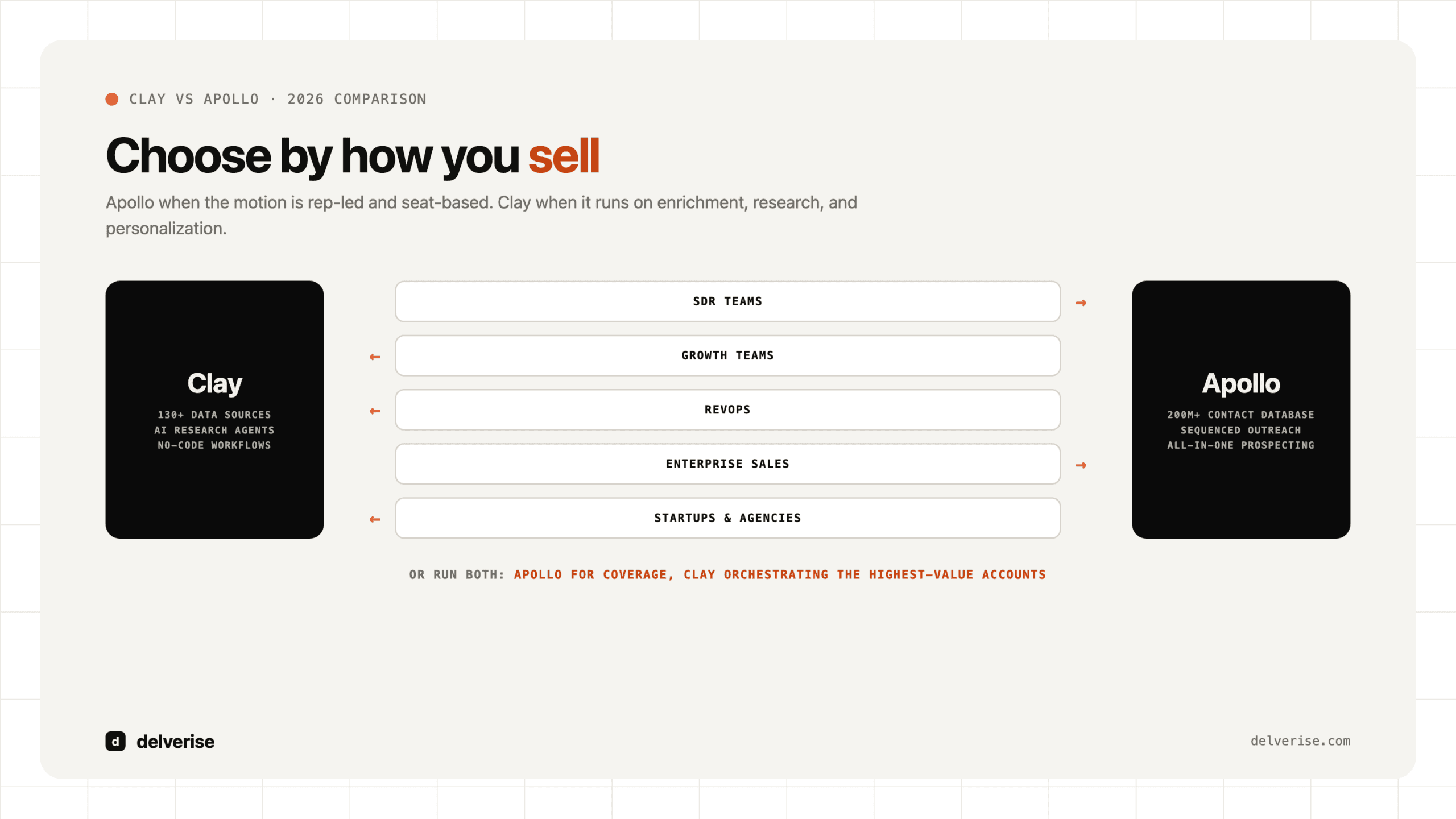
Short answer: Apollo is usually better for high-volume SDR teams that want a bundled prospecting and engagement platform. Clay is usually better for growth, RevOps, agency, and revenue operations teams that need enrichment flexibility, waterfall data coverage, AI research, and workflow control.
- Choose Apollo when the motion is rep-led, seat-based, and centered on list building plus sequenced outreach.
- Choose Clay when the motion depends on multi-source enrichment, custom scoring, AI research, CRM workflows, or highly personalized outbound.
- Use both when Apollo supplies broad prospecting coverage and Clay orchestrates enrichment, research, and routing logic around the highest-value accounts.
Quick Verdict: Which Tool Wins for Different Use Cases
The modern sales landscape moves fast, and so must your tools. When comparing Clay vs Apollo for sales, the decision shapes your team’s workflows, levels up your data quality, and accelerates revenue growth.
This guide dives into Clay.com vs Apollo.io with real-world use cases, feature comparisons, and pricing analysis. Whether you’re an SDR leader, RevOps strategist, or a growth-hacking trailblazer, you’ll find actionable insights to choose confidently.
For SDR Teams: Apollo Takes the Lead
If your SDR team thrives on high-volume prospecting and repeatable outreach, Apollo is tough to beat.
The Salesforce State of Sales report backs this up, noting that ‘sales reps spend only 28% of their week actually selling,’ with the rest lost to manual research and admin work. Apollo’s all-in-one engagement stack is built to claw back those hours through automation and built-in cadences.
Why it wins:
- Proprietary database of 200M+ contacts
- Built-in sequences and integrated dialer
- Comprehensive performance analytics
- Browser extension for smooth LinkedIn prospecting
Apollo is a full-funnel machine built for teams who live by activity metrics and need an all-in-one sales engagement workflow.
For Growth Teams: Clay Dominates
Growth teams crave flexibility and unique insights, exactly where Clay data enrichment shines.
Why it wins:
- AI research agents (Claygent) uncover data others miss
- No-code workflow builder for rapid experimentation
- 130+ data sources with waterfall enrichment
- Credit-based pricing that supports experimentation
Clay is the playground for growth marketers who want to explore, personalize, and push campaigns beyond cookie-cutter outreach.
For RevOps: Clay Puts You in the Driver’s Seat
RevOps leaders thrive on clarity, and that’s exactly where Clay delivers. Instead of locking you into a single data source, Clay acts as a central command center that pulls from 130+ providers. You get a complete, side-by-side view of every enrichment source, so you can see which ones perform best, eliminate duplicates, and control spend.
This transparency means no more guessing where your data came from or why certain leads are flagged. You can build workflows that reflect your revenue strategy, enforce data hygiene at scale, and ensure every lead that enters your CRM is sales-ready. For RevOps teams tasked with optimizing pipeline efficiency, Clay offers both control and confidence.
For Enterprise Sales: Apollo Scales with You
Enterprise sales teams have unique challenges: complex buying committees, multi-touch deal cycles, and strict compliance requirements. Apollo’s platform is built for this environment. With SSO, role-based permissions, and enterprise-grade security, Apollo keeps your data protected while giving your team the tools they need to execute at scale.
According to Gartner, ‘by 2026, 65% of B2B sales organizations will transition from intuition-based to data-driven decision making, using technology that unites workflow, data, and analytics.’ That shift is exactly why infrastructure-grade platforms become non-negotiable once your team crosses the enterprise threshold.
Its built-in engagement workflows, analytics, and support resources help large teams stay aligned and consistent across hundreds of reps. And when you need help, Apollo’s enterprise support and onboarding programs make adoption smoother, a critical factor when you’re rolling out to dozens or hundreds of users. For enterprise sales leaders, Apollo is an infrastructure play.
For Startups and Agencies: Clay Maximizes Every Dollar
When you’re running lean, every tool in your stack has to earn its keep, and Clay is built with that reality in mind. Its free plan and flexible credit-based pricing let you start small, experiment boldly, and scale usage only when you see results. No hefty seat licenses, no overpaying for features you don’t use.
Clay’s spreadsheet-like interface makes onboarding almost effortless. Your team can be enriching leads, building workflows, and launching campaigns within days, not weeks. For founders, scrappy growth teams, and agencies managing multiple clients, Clay removes the friction so you can focus on landing meetings, closing deals, and proving ROI faster.
Platform Overviews: Understanding the Fundamental Differences
Choosing between Clay and Apollo starts with understanding the philosophies that drive them. Both are powerful, but they take very different paths to solving the same problem: how to help sales teams find, enrich, and engage the right prospects faster.
Clay represents a new generation of sales intelligence tools, built for teams that value flexibility, creativity, and control over their data. Backed by Sequoia Capital and valued at $500M after a $46M Series B in July 2024, Clay has become the go-to choice for growth teams that want to stay nimble while scaling.
Instead of relying on a single proprietary database, Clay aggregates over 130 premium data sources, pulling in the best data from across the web. This architecture means no vendor lock-in, no blind spots, just the freedom to design a data workflow that fits your strategy.
Research from McKinsey reinforces this approach: ‘high-growth companies are 2.3x more likely to use advanced analytics and multiple data sources to drive commercial decisions than their slower-growing peers.’ For RevOps leaders, aggregating data beats betting on a single provider, every time.
Clay’s AI research agents, led by its flagship tool Claygent, automate the kind of deep research that usually eats up hours of SDR time. Need to analyze a prospect’s website, summarize recent job postings, or identify niche attributes like “companies hiring for AI engineers in Europe”? Claygent can do it, and do it at scale.
Real-world wins with Clay:
- OpenAI doubled enrichment coverage from 40% to 80%, enabling better segmentation and outreach personalization.
- Anthropic consolidated multiple enrichment vendors into Clay, saving four hours of manual work per week across their RevOps team.
- Verkada automated entire research processes, reducing manual data gathering by over 60% and letting SDRs focus on high-value conversations.
- Series B SaaS Startups report cutting prospect research time in half, freeing bandwidth for outbound experiments that increased reply rates by 20 to 30%.
Clay is more than a data tool. It’s a research assistant, data strategist, and growth engine rolled into one, perfect for teams who want to move fast and personalize at scale.
Apollo takes the opposite approach: instead of stitching together multiple tools, it delivers everything in one place. Since its launch in 2015, Apollo has grown into a $1.5B powerhouse, serving more than 500,000 businesses worldwide.
At its core, Apollo is a comprehensive sales engagement platform anchored by its proprietary database of over 200M contacts and 73M companies. This database fuels an integrated workflow that includes prospect search, email sequencing, dialer functionality, analytics, and CRM integrations, replacing the need for multiple tools like ZoomInfo, Outreach, or Salesloft.
Apollo’s core strengths are its breadth and scalability:
- Proven Data Scale: A massive, constantly updated database that SDR teams rely on for high-volume prospecting.
- Integrated Engagement: Built-in sequences and analytics make it a one-stop shop for outbound teams.
- Enterprise-Grade Readiness: SSO, role-based permissions, and advanced security make it a safe choice for IT and compliance teams.
Battle-Tested at Scale: With hundreds of thousands of users, Apollo’s workflows are optimized for teams managing massive outbound volumes.
For teams that want a single system to run their entire go-to-market motion, from list-building to deal management, Apollo offers a predictable, all-in-one solution that scales with headcount and outbound volume.
Now that you understand the core philosophies behind Clay and Apollo, it’s time to dig deeper. In the next section, we’ll break down how each platform performs in the areas that matter most: data quality, automation capabilities, pricing, and time-to-value, so you can see exactly which solution will give your team the edge.
Comprehensive Feature Comparison: Clay vs Apollo

Clay vs Apollo feature comparison table
The visual above summarizes the core product difference: Clay behaves like an enrichment and workflow layer, while Apollo behaves like a sales engagement platform with a built-in contact database.
| Feature category | Clay | Apollo |
|---|---|---|
| Data sources | 130+ integrated providers and custom waterfalls | Proprietary 200M+ contact database |
| AI capabilities | Advanced AI research agents and enrichment logic | Limited AI features focused around prospecting workflows |
| Automation | No-code workflow builder for research, scoring, enrichment, and routing | Built-in email sequences and sales engagement workflows |
| Integration model | API-first, designed to connect many tools and data providers | Native CRM integrations with a more self-contained sales workflow |
| Learning curve | Moderate: spreadsheet-like builder with flexible logic | Steeper: broader all-in-one sales platform |
| Best fit | Growth, RevOps, agencies, enrichment, and custom GTM systems | SDR teams that need prospecting, sequencing, and dialing in one place |
Pricing Model

The pricing models are fundamentally different. Clay is usually evaluated by usage and workflow throughput, while Apollo is usually evaluated by seat count and bundled sales platform access.
| Pricing dimension | Clay | Apollo |
|---|---|---|
| Primary model | Credit-based usage with unlimited users on many plans | Per-user subscription tiers |
| Cost driver | Enrichment volume, provider mix, and AI research usage | Seats, contact credits, and sales engagement features |
| Budget implication | Better when multiple operators need to share the same GTM workflows | Better when a defined SDR team needs an all-in-one prospecting suite |
Key Architectural Differences
The real distinction between Clay.com vs Apollo.io comes down to their DNA: how they’re built and what that means for your team.
Clay is a data orchestration platform at its core. Instead of relying on a single database, it connects to more than 130 premium providers and combines their outputs into one unified view. This multi-source advantage means you’re not stuck with the blind spots of any one vendor. Clay uses a waterfall enrichment approach, pulling the best data from each source for every contact, resulting in higher coverage, fresher insights, and access to niche data points that competitors often miss.
Apollo, on the other hand, is an all-in-one sales engagement ecosystem. It’s designed to keep everything under one roof: prospecting, enrichment, outreach, analytics, and reporting. This integration advantage reduces tool sprawl, simplifies user training, and enables sophisticated workflow automation without the need for complex external connections. For teams that want one platform to rule them all, Apollo provides a single, tightly integrated system.
Deep Dive Analysis: Where Each Platform Excels
When comparing Clay vs Apollo data quality, it really comes down to a classic trade-off: coverage vs accuracy. Getting this balance right matters, because your campaigns are only as good as the data fueling them.
Apollo takes a database-first approach, boasting a proprietary network of more than 200 million contacts and 73 million companies. Its strength lies in sheer volume, built through web scraping, user contributions, and data partnerships. For teams running high-volume outbound, this coverage means you’ll rarely run out of prospects. The limitation? When Apollo doesn’t have a particular data point, there’s no backup source, and you may need to supplement with other tools.
Clay flips this model with a multi-source strategy. Its waterfall enrichment pings multiple providers in sequence, selecting the highest-confidence result from the most reliable source for every field. This layered approach improves accuracy and dramatically boosts coverage. Real-world users have reported increasing enrichment rates from 40% to over 80% after switching from single-source platforms.
Where Clay really shines is in its contextual intelligence. With AI research agents like Claygent, it can go beyond static records and gather dynamic insights, such as identifying a company’s tech stack from its careers page, flagging recent funding announcements, or spotting key business initiatives hidden in blog posts. This kind of intelligence allows for hyper-personalized outreach that generic databases simply can’t match.
Pricing Analysis: Understanding True Costs
Detailed pricing comparison showing Clay’s credit-based vs Apollo’s per-user model
Pricing involves more than the sticker price. It’s about how costs scale as your team and outbound motion grow. Here’s what to expect from each platform:
Clay Pricing Structure:
- Free: $0 (includes 100 credits/month)
- Starter: $134/month (2,000 credits)
- Explorer: $314/month (10,000 credits)
- Pro: $720/month (50,000 credits)
- Enterprise: Custom pricing tailored for high-volume enrichment
Clay’s credit-based, unlimited-user model means you pay for usage rather than headcount. Whether you have three SDRs or thirty, the cost stays the same, making Clay extremely cost-effective for growing teams. It also allows you to experiment freely with enrichment workflows without worrying about adding another paid seat every time you hire.
Apollo Pricing Structure:
- Free: $0 (1,200 credits/year)
- Basic: $49/user/month
- Professional: $79/user/month
- Organization: $119/user/month
Apollo uses a per-user subscription model, which can scale predictably for small teams but becomes more expensive as headcount grows. A 10-person SDR team on Apollo Professional would cost roughly $9,480/year, before factoring in any add-ons.
That said, Apollo’s all-in-one functionality can offset these costs by consolidating multiple tools (like Outreach, ZoomInfo, and a separate dialer) into a single platform. For some teams, this can actually reduce overall spend while simplifying vendor management.
Bottom Line:
- Clay is best for teams that expect rapid headcount growth, run enrichment-heavy workflows, or want predictable costs regardless of team size.
- Apollo is best for teams that want an all-in-one solution and are comfortable paying per seat in exchange for deep integration and full-funnel visibility.
Decision Tree

Decision framework for choosing between Clay and Apollo based on your specific needs
Your choice of Clay vs Apollo depends on what your team needs most: volume, personalization, control, or scalability. Here’s how each platform shines in common go-to-market scenarios:
For SDR Teams: Mastering Volume Prospecting
If your SDR team thrives on high-volume outreach, Apollo is purpose-built for you. Its 200M+ contact database ensures you never run out of prospects, while its built-in tools keep reps focused on execution rather than managing multiple platforms.
Why Apollo Wins:
- Advanced search filters to build precise, targeted lists
- Browser extension for smooth LinkedIn prospecting
- Built-in email sequencing (no extra tools required)
- Call management with recording and AI-powered insights
- Comprehensive performance analytics for manager visibility
Bottom line: Apollo is ideal for SDR teams that need speed, scale, and a single environment to run all prospecting workflows.
For Growth Teams: Experimentation and Personalization at Scale
Growth teams need flexibility to test bold new campaigns, and this is where Clay truly excels. Its AI research agents and multi-source enrichment help teams craft unique, hyper-personalized messages that stand out.
Why Clay Excels:
- AI agents for custom data discovery and enrichment
- No-code workflow builder for rapid iteration
- Credit-based pricing designed for experimentation budgets
- Access to specialized data sources for niche targeting
- API-first approach for advanced integrations and custom automations
Bottom line: Clay is perfect for growth teams who rely on creativity, personalization, and rapid testing to gain an edge.
For RevOps: Consolidation and Control
Revenue Operations teams need to unify data, maintain governance, and track ROI. Clay’s data orchestration model gives RevOps teams full visibility and control over their stack.
Clay’s RevOps Advantages:
- Consolidates multiple data providers into one workflow
- Transparent cost tracking and data source attribution
- Conditional logic for sophisticated routing and segmentation
- API-first architecture to fit smoothly into existing systems
- Flexibility to maintain existing vendor relationships
Bottom line: Clay empowers RevOps leaders to streamline operations, reduce silos, and enforce data quality across the entire GTM motion.
- Implementation Timeline Comparison
Implementation Timeline

Comparison of implementation timelines showing Clay’s faster deployment
Choosing the right platform is about how quickly you can get value after signing the contract. Features matter too. Here’s how Clay vs Apollo compare when it comes to onboarding and going live:
Clay: Fast, Flexible, and Lightweight (1 to 4 Weeks)
Clay is designed for rapid deployment, so most teams are fully operational in under a month. Its spreadsheet-like interface and intuitive workflows make onboarding easy, even for non-technical users.
Typical Clay Rollout:
- Week 1: Account setup, domain authentication, and basic team training
- Week 2: Workflow creation and first enrichment tests
- Week 3: Integration with CRM and marketing automation tools
- Week 4: Optimization and full deployment across the team
Takeaway: Clay’s quick setup means your team can see real results, like enriched leads and personalized outreach, within weeks rather than quarters.
Apollo: Comprehensive but Time-Intensive (8 to 12 Weeks)
Apollo offers a more reliable implementation, which is great for large teams but takes longer to complete. The process often involves multiple stakeholders across sales, RevOps, and IT, ensuring proper configuration and alignment.
Typical Apollo Rollout:
- Weeks 1 to 2: Platform setup, user provisioning, and initial data import
- Weeks 3 to 4: CRM integration and data mapping
- Weeks 5 to 6: Team training and onboarding sessions
- Weeks 7 to 8: Sequence configuration and workflow customization
- Weeks 9 to 10: Testing, deliverability optimization, and QA
- Weeks 11 to 12: Full rollout to SDRs and managers
Takeaway: Apollo’s longer timeline reflects its complexity. Once live, you have a tightly integrated outbound engine that scales across your entire GTM team.
Alternatives to Consider: Beyond Clay and Apollo
While Clay vs Apollo dominate many sales stack conversations, they’re not the only players worth exploring. Depending on your team’s size, budget, and technical requirements, a few other platforms may fit the bill.
ZoomInfo: The Enterprise Standard
Trusted by Fortune 500 companies, ZoomInfo remains the heavyweight in the sales intelligence space.
- Strengths: Unmatched database scale, intent signals, advanced enterprise-grade features, and reliable security.
- Considerations: High cost and complexity make it best suited for large enterprises with the budget and resources to fully use it.
Clearbit: The Developer-Friendly Option
For teams that want maximum flexibility, Clearbit offers enrichment that’s designed to be embedded directly into products and workflows.
- Strengths: API-first approach, real-time enrichment, highly customizable for technical teams.
- Considerations: Requires engineering resources to implement effectively, which may not suit lean sales teams.
Lusha: The Simple Prospecting Tool
Lusha is a straightforward option for teams that need fast, lightweight prospecting support.
- Strengths: Easy-to-use browser extension, simple interface, quick access to basic contact info.
Considerations: Limited advanced features make it less effective for sophisticated, large-scale sales motions.
UpLead: The Balanced Alternative
UpLead positions itself as a middle-ground solution, offering solid coverage without the overhead of enterprise platforms.
- Strengths: Real-time email verification, reliable data coverage, and a user-friendly interface.
- Considerations: Great as a practical, no-frills option, but lacks the AI-driven flexibility of Clay or the all-in-one depth of Apollo.
Expert Recommendations: Making the Right Choice
After analyzing real-world implementations and speaking with dozens of revenue teams, here’s how we’d guide you to the right platform:
Choose Clay if:
- You want maximum flexibility and control, designing workflows that fit your strategy rather than adapting to a rigid system.
- Your team relies on multiple data sources and needs AI research capabilities to uncover unique, contextual insights.
- You have (or can dedicate) technical resources to build and optimize custom workflows and integrations.
- You prefer transparent, credit-based pricing that scales with usage, not headcount.
- Your campaigns require deep personalization and unique data points for account-based marketing (ABM).
- You value the ability to experiment rapidly, test new approaches, and iterate without long implementation cycles.
Choose Apollo if:
- You prioritize all-in-one functionality and want to replace multiple tools with a single platform.
- Your team needs built-in email sequencing, dialer functionality, and call analytics to run high-volume outbound.
- You prefer a mature, battle-tested platform with extensive documentation, onboarding, and support resources.
- You want predictable per-user pricing and a clear cost structure as you scale your team.
- Your sales motion aligns with traditional, systematic outbound processes (high activity, high consistency).
- You’re running a large SDR organization where centralized workflows and standardization are mission-critical.
Aligning Platform Choice with Strategic Objectives
The Clay vs Apollo decision is bigger than just picking software. It’s about choosing the operating system for your go-to-market motion. This choice signals how your team wants to compete: with flexibility and personalization, or with scale and standardization.
Clay’s superpower lies in its flexibility, AI-driven enrichment, and multi-source data orchestration. It’s the platform for teams that want to experiment fearlessly, personalize deeply, and build custom workflows that unlock hidden opportunities.
Apollo, on the other hand, is a comprehensive, battle-tested sales engagement platform that thrives in environments where process, predictability, and high-volume execution matter most. For SDR-heavy teams or enterprise organizations looking to consolidate their stack, Apollo provides a single, reliable engine to drive outbound at scale.
Ultimately, success with either platform comes down to more than the features on a pricing page. It’s about thoughtful implementation, empowering your team with proper training, and continually optimizing your workflows to stay ahead of the market. When chosen with strategy in mind, the right platform actively accelerates your revenue goals, transforming your GTM motion into a true competitive advantage.
Plan Your Next Move with Confidence
Choosing between Clay and Apollo is a decision that can transform how your team operates. We’ve built a Sales Tool Stack Playbook that includes a detailed Clay vs Apollo evaluation matrix, implementation timelines, and ROI calculation worksheets, so you can see exactly how each platform aligns with your growth strategy.
If you’d rather skip the guesswork, our GTM specialists can guide you through the decision. We’ve helped hundreds of revenue teams implement Clay or Apollo successfully, and we’ll help you identify the platform (and rollout plan) that gets you results faster.
How delverise Can Help
Choosing the right tools and strategy is only the first step. Executing effectively is what separates high-growth teams from the rest. At delverise, we help B2B SaaS companies build and optimize their revenue engines, from tool selection and implementation to full GTM execution.
Whether you’re evaluating clay vs apollo, building your sales tech stack, or scaling your go-to-market operations, our team combines RevOps strategy with hands-on engineering to deliver measurable results.
Related Resources
- Best B2B Data Enrichment Tools
- Clearbit vs ZoomInfo
- Outbound Sales for B2B SaaS
- Best Sales Intelligence Tools
- AI Lead Generation
How delverise Helps Teams Choose and Build
delverise helps B2B teams choose the right GTM workflow and then build the operating system around it: enrichment, scoring, outbound activation, CRM routing, reporting, and QA. If Clay is part of the system, we build it where it creates leverage; if Apollo is the right sales engagement layer, we make sure it connects cleanly to the rest of the motion. Start with our Clay systems, CRM enrichment, or AI outbound pages, or apply to work with us.
Frequently Asked Questions
Which is better for SDR teams, Clay or Apollo?
Apollo wins for SDR teams focused on high-volume prospecting and repeatable outreach. It offers a proprietary database of 200M+ contacts, built-in sequences, an integrated dialer, comprehensive performance analytics, and a browser extension for LinkedIn prospecting. Apollo functions as a full-funnel machine built for teams who live by activity metrics and need an all-in-one sales engagement workflow, making it tough to beat for traditional SDR motions.
Why do growth teams prefer Clay over Apollo?
Growth teams prefer Clay because it delivers flexibility and unique insights that Apollo can’t match. Clay offers AI research agents called Claygent that uncover data others miss, a no-code workflow builder for rapid experimentation, 130+ data sources with waterfall enrichment, and credit-based pricing that supports testing. This makes Clay the playground for growth marketers who want to personalize and push campaigns beyond cookie-cutter outreach.
How does Clay help RevOps teams improve data quality?
Clay acts as a central command center that pulls from 130+ data providers, giving RevOps leaders complete side-by-side visibility into every enrichment source. This transparency lets teams identify which providers perform best, eliminate duplicates, and control spend without guessing where data came from. RevOps can build workflows reflecting their revenue strategy, enforce data hygiene at scale, and ensure every lead entering the CRM is sales-ready.
Which platform is better for enterprise sales teams?
Apollo is better suited for enterprise sales teams handling complex buying committees, multi-touch deal cycles, and strict compliance requirements. It provides SSO, role-based permissions, and enterprise-grade security to protect data while supporting execution at scale. Built-in engagement workflows, analytics, and enterprise support resources help large teams stay aligned across hundreds of reps, making Apollo an infrastructure play rather than just a tool.
Is Clay or Apollo better for startups and agencies?
Clay is the stronger choice for startups and agencies operating lean. Its free plan and flexible credit-based pricing let teams start small, experiment boldly, and scale usage only when results justify the spend, avoiding hefty seat licenses for unused features. Clay’s spreadsheet-like interface makes onboarding nearly effortless, so teams can enrich leads, build workflows, and launch campaigns within days rather than weeks.
Read next