←Back to blog
Outbound & Pipeline EngineeringPlaybookSeptember 12, 20268 min read
Cold Email Templates for B2B SaaS: What Actually Books Meetings
Cold email templates are reusable message structures that hold a proven sequence of relevance, evidence, and ask, while leaving room for variable inputs drawn from data. The template rarely wins the meeting on its own. Targeting, timing, and the specific proof you insert decide reply rate. Treat templates as one component inside an outbound system.
Cold email templates are reusable message structures that hold a proven sequence of relevance, evidence, and ask, while leaving room for variable inputs drawn from data. The template rarely wins the meeting on its own. Targeting, timing, and the specific proof you insert decide reply rate. Treat templates as one component inside an outbound system.
Key takeaways
- A template is a structure, and the variable inputs it pulls from your data are what make it land.
- Copy is the smallest lever in cold email. List quality and trigger timing move reply rate several times more.
- Four structures cover most B2B SaaS outbound: trigger observation, peer benchmark, mechanism, and routing request.
- Personalization has tiers with real costs. Match the tier to account value instead of applying one setting to every contact.
- Open rate is no longer trustworthy. Measure reply rate, positive reply rate, and meetings held per thousand sends.
- Deliverability infrastructure decides whether any of your copy is ever read.
Why do most cold email templates stop working?
Templates decay because they get copied. A structure that felt fresh in a founder’s sent folder becomes a category-wide pattern within two quarters, and buyers learn to pattern-match it in under a second. The “I noticed you’re hiring SDRs” opener now reads as automation to anyone who has been on the receiving end.

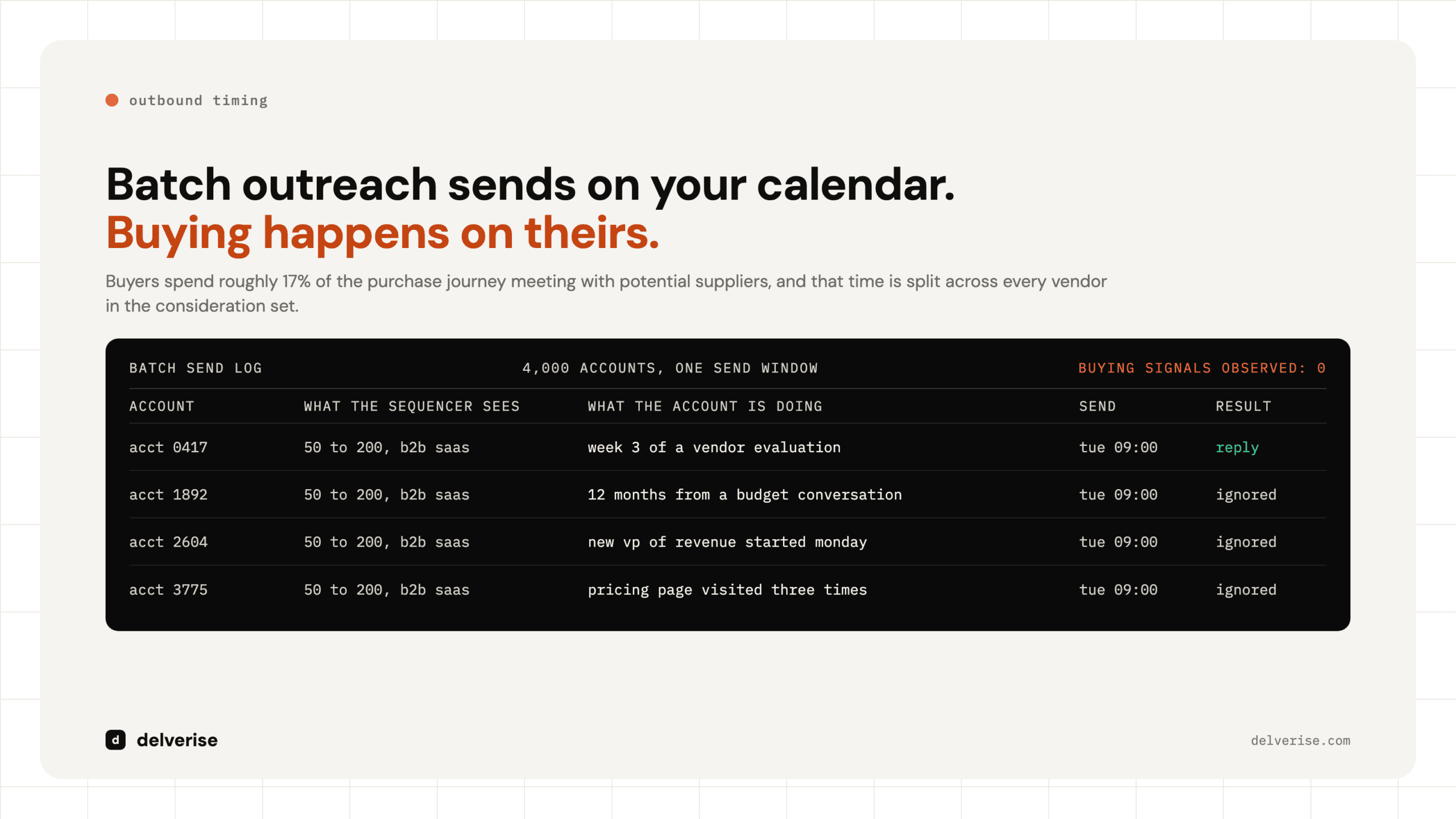
The deeper reason is that most templates are written for an audience that has already left. Gartner’s research on B2B buying found that buyers spend roughly 17% of their purchase journey meeting with potential suppliers, and that time is split across every vendor they consider. Gartner also puts the typical buying group at six to ten stakeholders. McKinsey’s B2B Pulse work found buyers now move across about ten channels during a decision journey. A cold email is one touch inside a process that is mostly happening without you.
That reframes the job of the template. It is a relevance filter that earns you a place in a decision already underway. Copy that describes your product performs worse than copy that describes the prospect’s operating reality accurately enough that they assume you have context.
What makes a cold email template work?
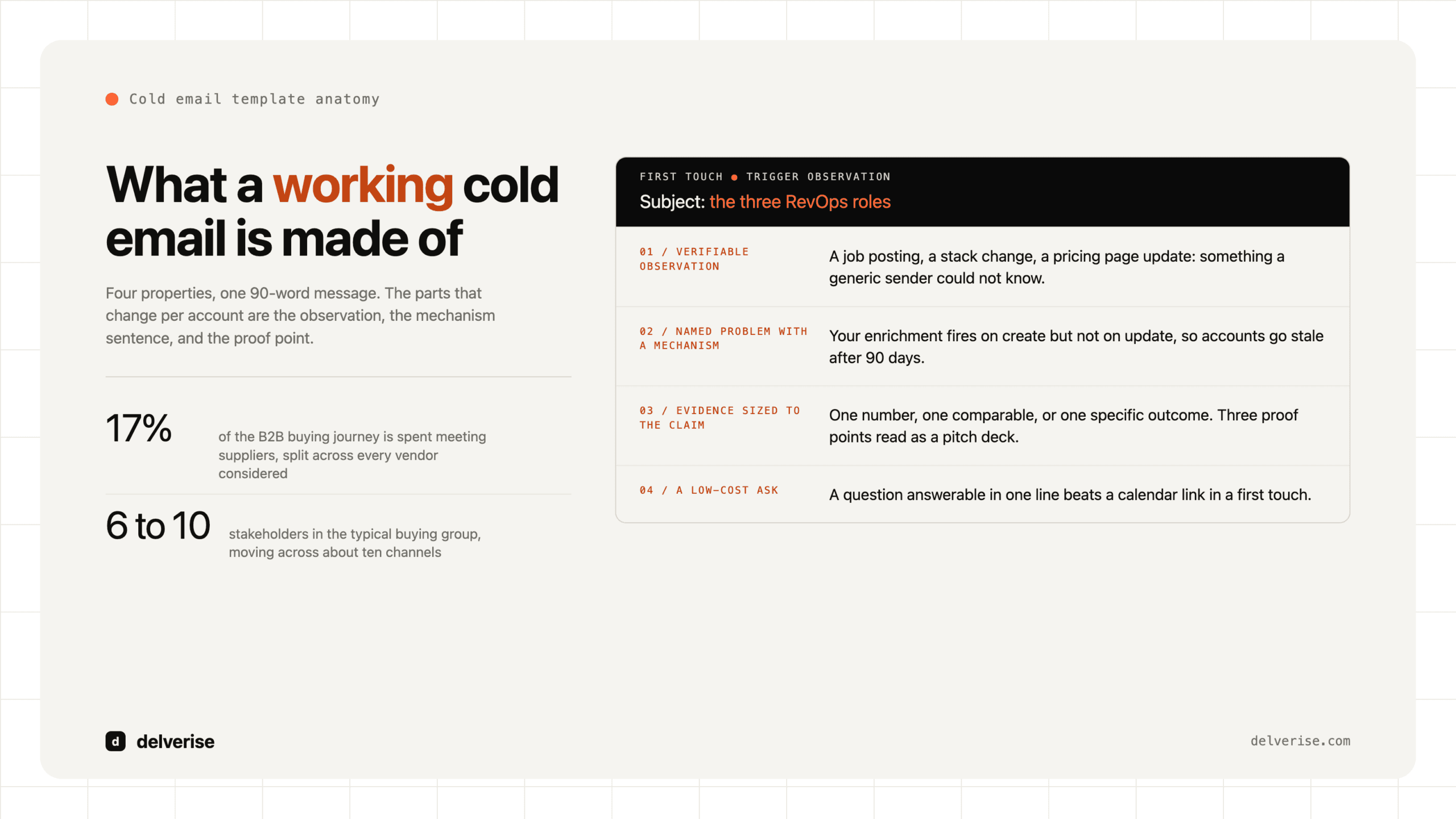
Working templates share four properties.
 cold email template, closing on the 90-word versus 40-word densit” class=”wp-image-3094″/>
- A verifiable observation. Something true about that account that a generic sender could not know: a job posting, a stack change, a pricing page update, a funding event, a hiring pattern across a team.
- A named problem with a mechanism. Say how the problem happens, not just that it exists. “Your enrichment fires on create but not on update, so accounts go stale after 90 days” outperforms “we help with data quality.”
- Evidence sized to the claim. One number, one comparable, or one specific outcome. Three proof points read as a pitch deck.
- A low-cost ask. A question that can be answered in one line beats a calendar link in a first touch.
Length matters less than density. A 90-word email with one real observation outperforms a 40-word email with none.
Which cold email templates should B2B SaaS teams use?
These four structures cover most of what a Seed to Series B outbound motion needs. The examples below are written out fully so you can see the shape. The elements that change per account are the opening observation, the mechanism sentence, and the proof point.

1. The trigger observation
Subject: the three RevOps roles
Saw you opened two RevOps roles and a Salesforce admin req in the last six weeks. Usually that means routing and attribution are being rebuilt by hand while the number keeps moving.
The teams that get through this fastest fix lead routing and lifecycle stages before they add headcount, because the new hires inherit a working spine instead of a queue of exceptions.
Worth a look at how your routing is structured today?
This works when the trigger is genuinely recent. A hiring signal from nine months ago reads as scraped data.
2. The peer benchmark
Subject: outbound reply rates at your stage
Most Series A SaaS teams running outbound in-house sit between 1% and 3% reply rate. The teams above 5% are almost always doing one thing differently: they trigger sequences off product and hiring signals rather than sending to a static list every Monday.
Do you know your current reply rate by segment, or is it reported as one blended number?
The closing question does the work. It surfaces a measurement gap the reader can feel, and answering costs them nothing.
3. The mechanism email
Subject: stale accounts in HubSpot
Quick technical guess: your enrichment runs on record creation. If that’s true, every account you sourced more than two quarters ago is carrying headcount, funding, and tech stack data that is now wrong, and your ICP scoring is running on it.
The fix is a refresh trigger on a rolling window rather than a one-time waterfall. Takes about a week to wire up.
Is enrichment set to re-run on your side?
This structure suits technical buyers and works well for CRM enrichment and data-quality offers, where being specifically right is more persuasive than being polished.
4. The routing request
Subject: right person for pipeline reporting
You are probably not the owner here, so this should be short. We build the reporting layer that connects outbound activity to closed revenue by segment, which usually sits with whoever owns RevOps.
Who should I be speaking with?
Sent to a VP or C-level contact who is adjacent to the buyer, this produces internal forwards that carry more weight than a cold touch to the same person.
How much personalization is worth paying for?
Personalization has a unit cost. The question is which tier each account deserves, which is an economics decision rather than a copywriting one.
| Tier | What varies | Data source | Realistic cost per contact | Fits |
|---|---|---|---|---|
| Segment | Problem statement and proof point by ICP segment | Firmographics, static enrichment | Under $0.05 | High-volume, low ACV, broad TAM |
| Signal | Opening line generated from a live trigger | Job posts, tech stack, funding, product changes | $0.10 to $0.40 | Most Seed to Series B outbound |
| Account | Whole first paragraph plus a tailored mechanism | Scraped site, docs, earnings calls, LinkedIn activity | $1 to $5 | Named accounts, ACV above $50k |
| Human | Entire message written by a person with research | Manual | $15 to $40 | Top 50 target accounts, executive contacts |
Signal tier is where most teams should live. Tools like Clay, Apollo, and n8n make it possible to assemble the research layer that produces those opening lines without adding headcount, which is the core of any AI outbound build. The failure mode is spending account-tier money on segment-tier accounts, then concluding that outbound does not work.
What should you actually measure?
Apple Mail Privacy Protection and similar filters inflate open rates to the point of uselessness. Report on replies and meetings instead.
Here is the arithmetic for a realistic Series A motion. Take 300 target accounts with three contacts each, so 900 contacts. After verification and suppression you send to 830. At a 4% reply rate that is 33 replies. If 35% are positive, you get 12 conversations. At a 60% show rate that is seven meetings held. With a 20% close rate and a $35,000 ACV, one cycle produces roughly $49,000 in closed-won, against maybe $4,000 in data and tooling cost.
Run that same model at a 1.5% reply rate and the whole thing produces two meetings and does not pay for itself. The gap between those two outcomes sits in list quality and trigger timing, which is why template hunting is usually the wrong place to spend a week.
What has to be true before templates matter?
Deliverability is the gate. If your domain reputation is poor, the best copy in your category lands in spam and reports as a copy problem.
- SPF, DKIM, and DMARC are configured and passing on every sending domain
- Sending happens from secondary domains, never your primary corporate domain
- Each mailbox sends fewer than 40 emails per day
- Every address is verified within 30 days of send
- Sequences stop on reply, on meeting booked, and on any open opportunity
- Reply rate is reported by segment and by template, not blended
- Meetings held, not meetings booked, is the number on the dashboard
- Unsubscribes and spam complaints are tracked per domain weekly
Once that spine holds, templates become a testable variable. This is the sequencing we use when building an outbound engine as part of broader GTM engineering work: infrastructure, then data, then targeting, then copy. Reversing that order is the most common reason a well-funded outbound program underperforms for two quarters.
Frequently Asked Questions
How many cold email templates should a sequence contain?
Four to six touches over 18 to 24 days, using two or three distinct structures. Repeating one structure across every step trains the reader to ignore the thread. Mixing a trigger observation, a mechanism email, and a routing request gives three different reasons to reply.
Do AI-written cold emails perform better than templates?
Generated copy performs about the same as a good template when it draws on the same data, and worse when it does not. The gain from AI in outbound comes from the research layer, meaning what it finds and structures per account, rather than from the sentence generation itself. Assembling that layer is what a Clay build is generally for.
What is a good reply rate for B2B SaaS cold email in 2026?
Between 1% and 3% is common for list-based sending. Signal-triggered sequences to a tight ICP regularly reach 4% to 8%. Anything reported above 15% usually reflects a very small named-account list or a counting method that includes out-of-office replies.
Should cold emails include a calendar link?
Not in the first touch. A link asks for a 30-minute commitment from someone who has not agreed the problem is real. Ask a question that costs one line to answer, then send the link once they engage.
How long before a new template should be judged?
Around 400 sends per variant to a consistent segment, which is usually two to three weeks. Below that, the difference between a 3% and a 5% reply rate is noise. Change one element at a time: subject line, opening observation, or ask.
Read next