←Back to blog
Revenue Intelligence & Data ToolingGuideAugust 22, 20268 min read
Email Prospecting: How B2B SaaS Teams Turn It Into a System That Books Meetings
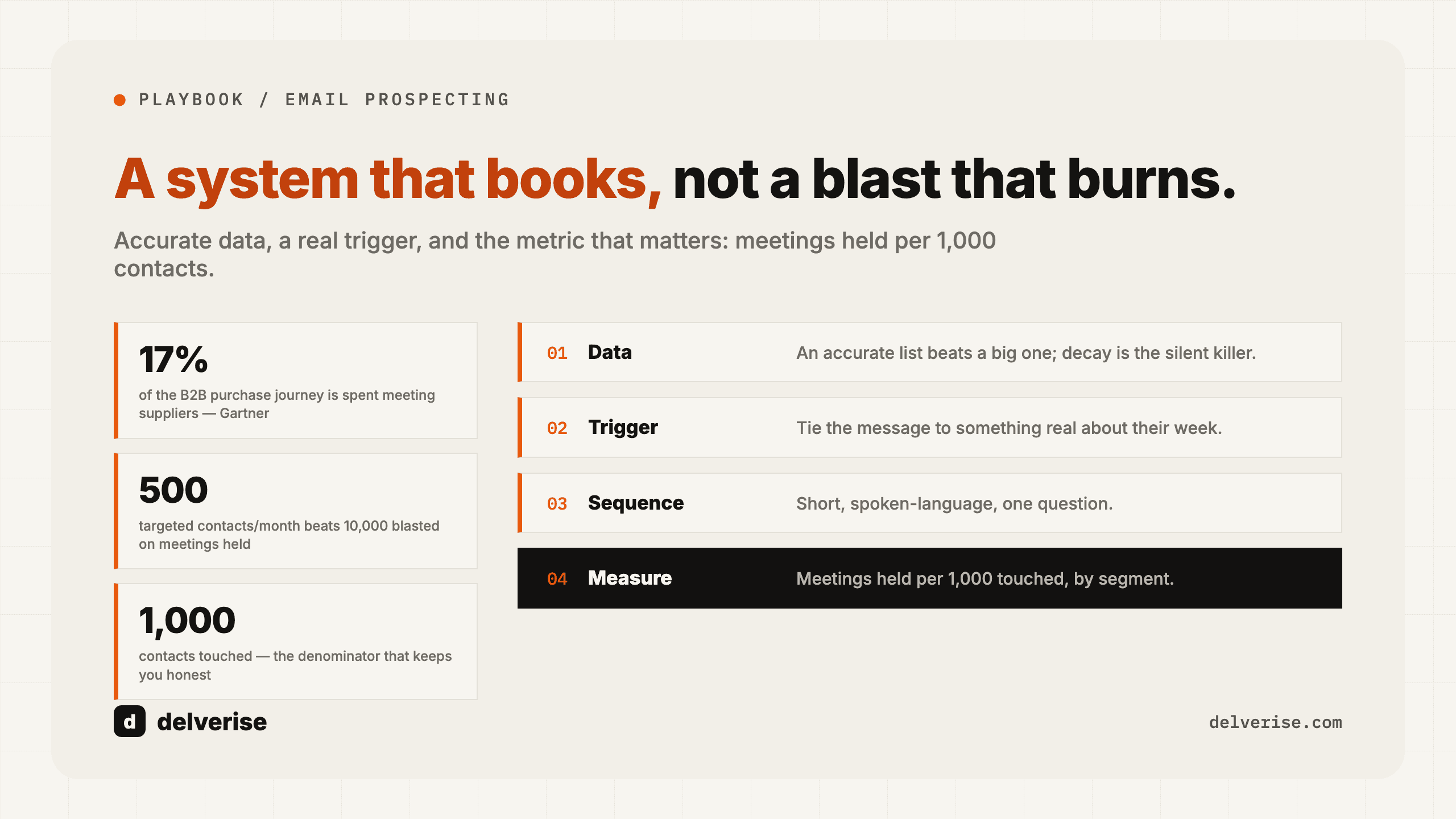
Email prospecting is the practice of identifying specific accounts and buyers, then reaching them by email with a message tied to something real about their situation. In B2B SaaS it works as a system: an accurate data layer, a trigger that sets timing, sending infrastructure that reaches the inbox, and measurement that goes past reply rate.
Email prospecting is the practice of identifying specific accounts and buyers, then reaching them by email with a message tied to something real about their situation. In B2B SaaS it works as a system: an accurate data layer, a trigger that sets timing, sending infrastructure that reaches the inbox, and measurement that goes past reply rate.
Key takeaways
- Email prospecting performance is mostly determined before a word is written: who you selected, and when you reached them.
- Volume compensates for bad targeting only until deliverability collapses, which usually happens in month three or four.
- Gartner’s research on B2B buying found buyers spend roughly 17% of the purchase journey meeting with potential suppliers, so your email competes with self-directed research, peers, and review sites.
- A buying group of six to ten people means single-threaded email prospecting quietly caps your win rate.
- The measurable unit is meetings held per 1,000 contacts touched, tracked by segment, not reply rate in aggregate.
What is email prospecting, and how does it differ from a cold email blast?
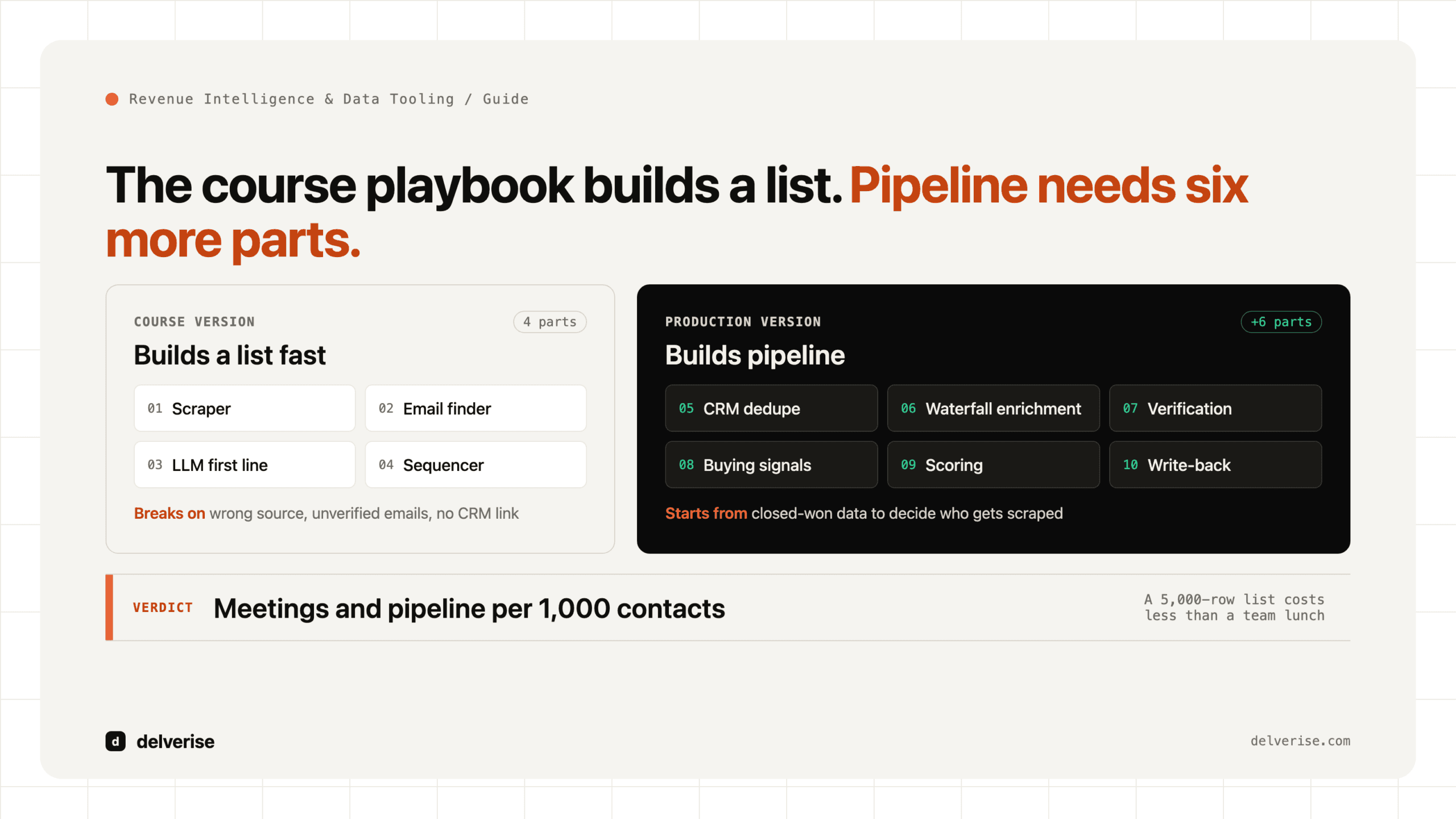
Cold email blasting selects a broad list, writes one message, and sends it on a schedule. Email prospecting selects accounts against a defined fit model, waits for a reason to reach out, and sends a message that could only have been written to that account. Both use the same channel. The difference sits upstream in the data and timing layers.


That upstream difference decides the economics. A blast at 10,000 contacts per month burns your domain reputation, trains buyers to ignore you, and produces replies dominated by people who were never going to buy. A targeted program at 500 contacts per month with a real trigger produces fewer replies and more meetings held. We wrote about the underlying failure mode in why cold email has a blind spot: batch outreach cannot see buying timing, so it treats every account as equally ready on the day you happened to press send.
Why do most email prospecting programs stall?
Four causes account for most of it, and only one of them is copy.
The list was never a list. Most teams export from a data provider, filter by headcount and industry, and call it targeting. A real prospecting list encodes your fit model: the technographic signals, the org structure, the maturity stage where your product creates value. Filters that any competitor could reproduce in ten minutes produce the same accounts everyone else is emailing.
Timing is random. Buyers move when something changes: a funding round, a leadership hire, a platform migration, a compliance deadline, a competitor churn event. Email prospecting that ignores those changes is a lottery with your domain reputation as the ticket price.
Infrastructure is treated as an afterthought. Sending domain, authentication records, mailbox warmup, per-mailbox volume caps, and list hygiene determine whether your message is seen at all. Teams debug subject lines for six weeks when the actual problem is that 40% of sends land in spam.
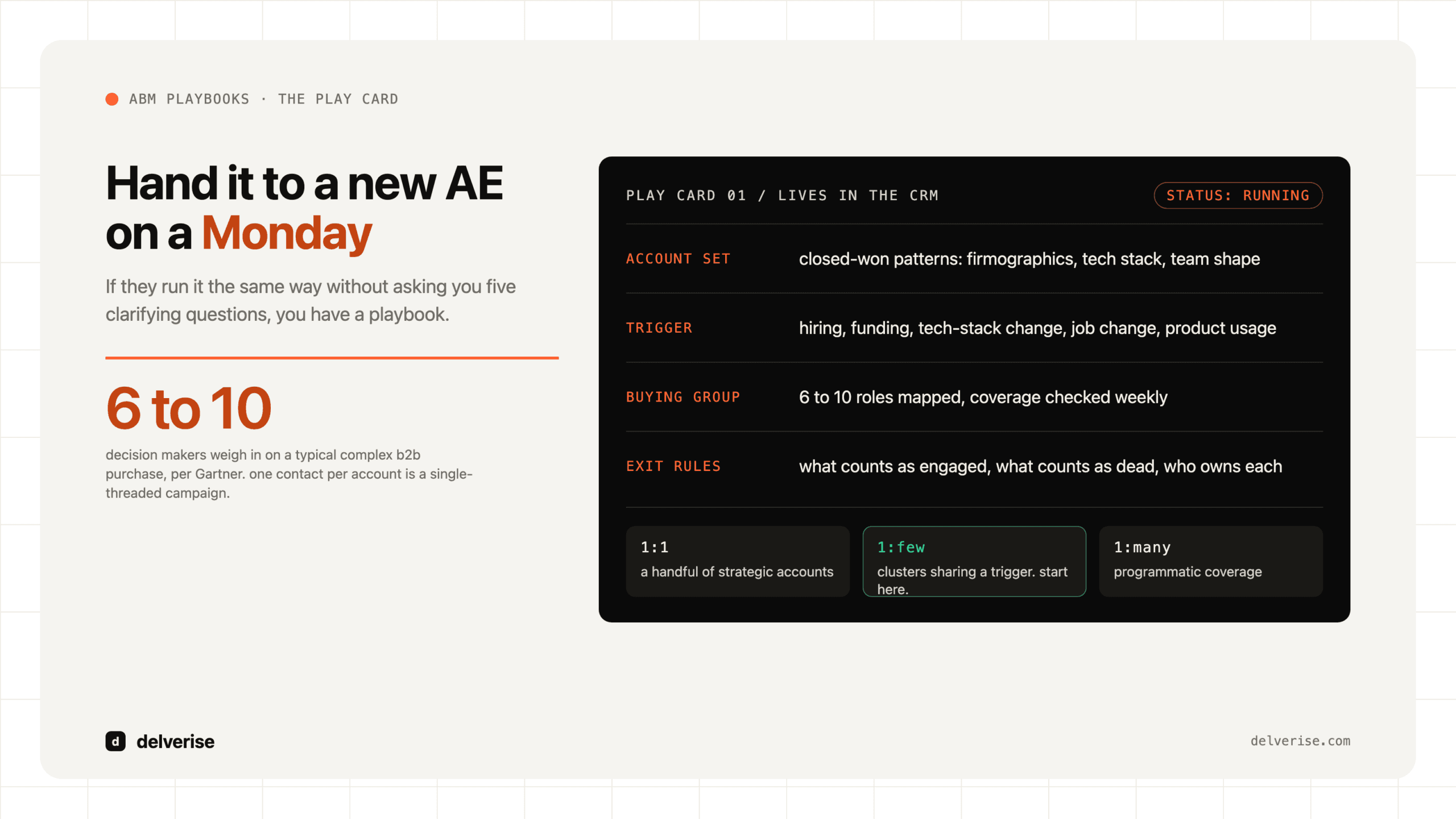
The system is single-threaded. Gartner has consistently found that complex B2B purchases involve a buying group of roughly six to ten decision makers. Emailing one VP and waiting means your deal depends on that person selling internally on your behalf, with no material from you to do it with.
What does a working email prospecting system look like?
Think in layers, each with a clear owner and a clear failure mode. This is the same layer logic that governs the rest of your GTM tech stack.

| Layer | What it owns | Failure mode when it is weak |
|---|---|---|
| Fit model | Which accounts qualify, and why | High reply volume, low meeting conversion, junk pipeline |
| Data and enrichment | Accurate contacts, verified emails, firmographics, technographics | Bounce rates above 3%, domain reputation damage |
| Signal layer | The trigger that determines when to reach out | Right account, wrong month; message reads as generic |
| Message | Relevance, specificity, a low-friction ask | Opens without replies |
| Sending infrastructure | Domains, authentication, warmup, volume caps, suppression | Invisible failure: inbox placement drops with no visible symptom |
| Routing and follow-up | Who responds, how fast, with what context | Replies decay in a shared inbox for two days |
| Measurement | Meetings held and pipeline per segment | Optimization theater around open rates |
Most teams have three of these seven and wonder why output is inconsistent. The layers compound: strong data with weak routing still loses deals, and strong copy on a burned domain reaches nobody.
How do you build the data and signal layer without hiring a team?
This is where the work has changed most in the last two years. Waterfall enrichment, where a contact runs through multiple data providers in sequence until one returns a verified result, used to require engineering. Now it is configuration. Tools like Clay, Apollo, and Ocean let a revenue team assemble sourcing, enrichment, verification, and signal detection in one place, then push clean records into HubSpot or Salesforce.
The honest tradeoff: these platforms move the bottleneck rather than removing it. You stop paying for headcount to research accounts and start paying in credits, plus the internal skill to design the tables and score the signals. Teams that treat Clay as a list exporter get a more expensive list. Teams that treat it as the enrichment and scoring engine behind their CRM get compounding returns. If you want that built rather than learned, delverise works on it directly through our Clay partner practice.
On the signal side, be selective. A dozen weak signals scored together beat one loud signal used badly. Job postings, funding events, hiring patterns in adjacent functions, tooling changes, and executive moves are all observable. Third-party intent data is a legitimate input with real noise, and worth understanding on its own terms before you buy. The same care applies to AI prospecting tools: they accelerate whatever process you already have, including a bad one.
What does a good prospecting email actually look like?
Here is a worked example. The seller offers a revenue analytics product. The trigger is a Series A company that posted a req for its first RevOps hire and runs HubSpot with a Salesforce migration mentioned in the job description.
Subject: your first RevOps hire
Saw the RevOps req, and that the JD mentions moving off HubSpot onto Salesforce. The usual pattern there: whoever you hire spends their first two quarters rebuilding reporting instead of working on pipeline quality, because attribution history does not survive the migration cleanly.
We keep the historical model intact through a CRM migration so the reporting works on day one in the new system. Two similar-stage teams did this last quarter.
Worth fifteen minutes before the migration starts, or should I follow up after your hire lands?
Four things make it work. It cites a specific, verifiable fact. It names a consequence the buyer has not fully priced in. It states the mechanism in one sentence. It gives an easy exit, which raises reply rates because it costs nothing to answer. Notice what is absent: no paragraph about the company, no feature list, no calendar link in the first touch.
McKinsey’s B2B Pulse research found buyers now move across ten or more channels during a purchase. Your email is one input among many, so its job is to earn a reply, not to complete the sale.
What should you measure?
Open rate has been unreliable since Apple Mail Privacy Protection began prefetching images. Treat it as directional at best. Track these instead:
- Meetings held per 1,000 contacts touched, segmented by ICP tier and by trigger type
- Bounce rate per sending domain, checked weekly, with a hard stop above 3%
- Reply-to-meeting conversion, which exposes whether your targeting or your qualification is the problem
- Time from reply to first human response, measured in minutes
- Pipeline created and closed-won by trigger type, so you can retire signals that do not pay
- Sequence completion rate, since half-finished sequences distort every other number
Segmenting by trigger type is the highest-value habit here. It tells you which signals deserve more budget and which are noise, which is the only way the program improves rather than oscillating. Speed on the response side matters as much as the send: see how speed and context turn replies into pipeline.
When should you build this in-house?
Below roughly $2M ARR, a founder or first AE running 200 to 400 highly targeted emails per month with manual research usually outperforms any automated system, because judgment beats scale at that volume. Between $2M and $10M, the constraint shifts to repeatability, and that is when the data, signal, and routing layers need real engineering. Past that, the question becomes governance: who owns suppression lists, domain health, and CRM write rules across multiple sending teams.
The pattern that fails at every stage is buying tools before defining the fit model. delverise builds these systems as integrated infrastructure across outbound, RevOps, and analytics, because the layers only pay off together.
Frequently Asked Questions
How many emails per day can one mailbox safely send?
A conservative ceiling is 30 to 50 per day per mailbox on a warmed domain, with warmup running continuously in the background. Scale by adding mailboxes and domains rather than raising per-mailbox volume. Sudden volume increases are the single most common cause of deliverability collapse.
Does personalization at scale still work?
Token-level personalization, meaning a first name and company name inserted into a template, stopped working years ago and now reads as automation. What works is relevance derived from a real event at the account. AI drafting helps you produce that relevance faster once the signal exists, and it produces convincing-sounding noise when the signal does not.
How long before an email prospecting program shows results?
Expect four to six weeks for domain warmup and infrastructure, then two full sequence cycles, roughly eight to twelve weeks total, before the meeting numbers mean anything. Judging a program at week three produces decisions based on noise.
Should email prospecting sit with sales or marketing?
The sending sits with sales development. The data, signal, and infrastructure layers belong with RevOps or GTM engineering, because they serve paid, lifecycle, and sales motions at once. Splitting it any other way creates two teams each owning half a system with no shared metric.
What is the most common mistake revenue leaders make here?
Adding volume to fix a conversion problem. When meetings per 1,000 contacts is low, tripling sends triples the noise, damages the domain, and hides the real defect, which is almost always in the fit model or the timing signal. Fix the numerator before touching the denominator.
Read next