←Back to blog
Outbound & Pipeline EngineeringGuideAugust 17, 20268 min read
Why Cold Email Has a Blind Spot: Batch Outreach Cannot See Buying Timing
Cold email’s blind spot is timing. A batch send reaches every account on the same day regardless of whether that account is evaluating, renewing, or asleep, so response depends on luck. Signal-led outbound systems watch for buying behavior and trigger contact within days of it, which is where reply rates actually come from.
Cold email’s blind spot is timing. A batch send reaches every account on the same day regardless of whether that account is evaluating, renewing, or asleep, so response depends on luck. Signal-led outbound systems watch for buying behavior and trigger contact within days of it, which is where reply rates actually come from.
Key takeaways
- Batch outreach optimizes for coverage. Buying decisions are governed by timing, so coverage and conversion drift apart as list size grows.
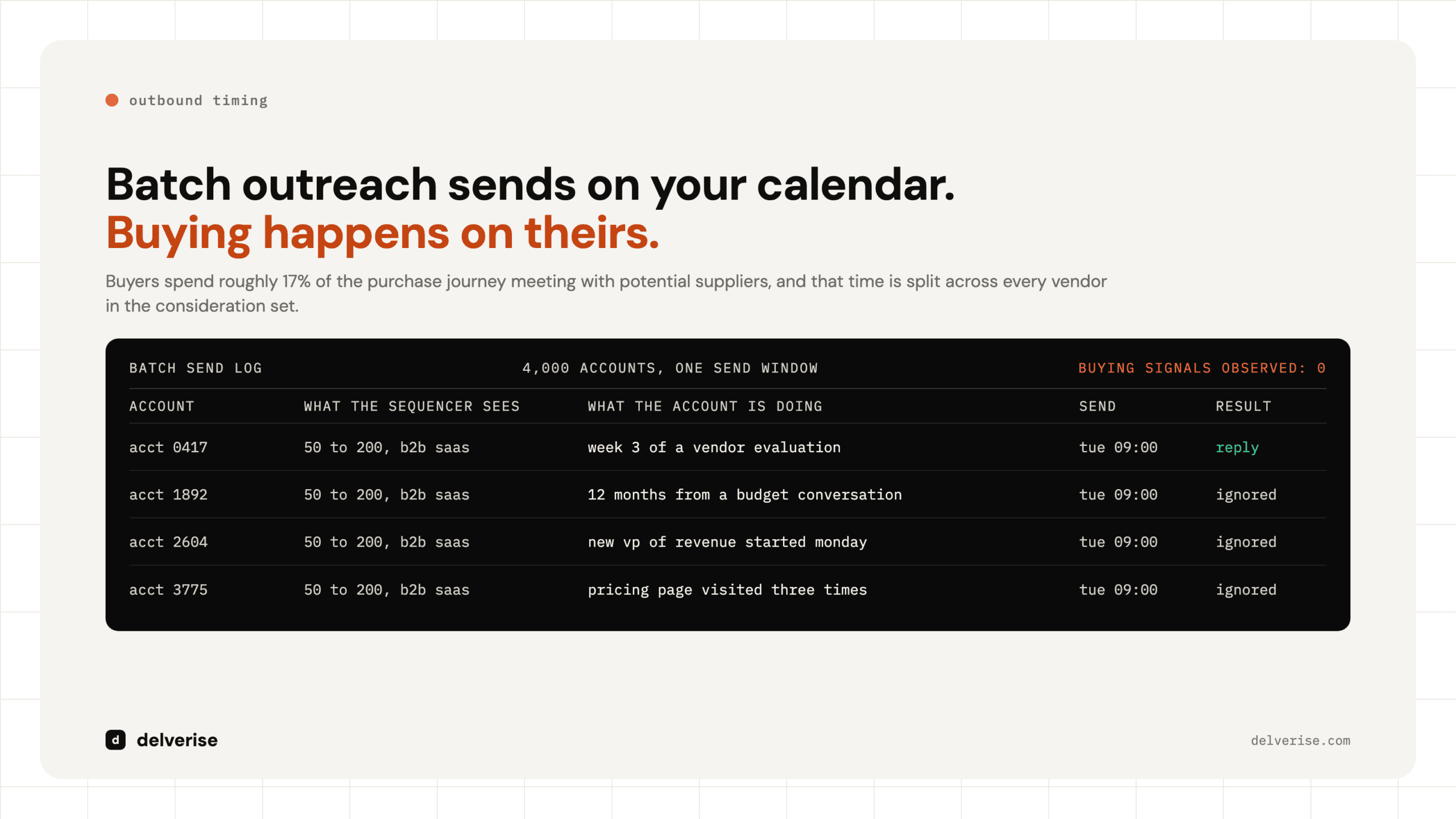
- Gartner’s research on B2B buying found that buyers spend roughly 17% of the purchase journey meeting with potential suppliers, and that time is split across every vendor in the consideration set. Your window is small and it opens on the buyer’s schedule.
- A signal is any observable event that correlates with a buying window opening: a role change, a funding round, a tech stack change, a hiring pattern, a repeat visit to a pricing page.
- Signal-led systems usually send fewer emails and book more meetings, because relevance replaces volume as the primary lever.
- The build is an operations problem: signal capture, entity resolution, routing rules, and an SLA on response time. Buying a tool without the routing layer changes nothing.
What is the cold email blind spot?
Batch outreach treats an account list as a static object. You build 4,000 accounts, load them into a sequencer, and the system sends on a calendar defined by your sending capacity. Nothing in that process observes what the account is doing this week.
That is the blind spot: a batch sequence has no input for buying timing. It can personalize by industry, headcount, job title, and tech stack, all of which describe who the account is. None of them describe what the account is doing right now. Two identical companies, one three weeks into a vendor evaluation and one twelve months from any budget conversation, receive the same email on the same Tuesday.
The math still works at low volumes, which is why the problem hides for so long. When you are sending 500 emails a month with a decent list, luck delivers enough hits to look like a working channel. Scale to 10,000 sends and the same hit rate produces more noise, more spam complaints, and worse deliverability, which lowers the hit rate further. Teams then diagnose it as a copy problem or a data problem and rewrite the sequence, which does not address timing.
Why does batch outreach miss buying timing?
Three structural reasons, and none of them are fixed by better writing.

The buying window is short and mostly invisible. Forrester and Gartner have both documented that buyers complete a large share of their evaluation before contacting vendors directly. By the time an account raises its hand, a shortlist often exists. Cold email that arrives outside that window is competing against zero attention.
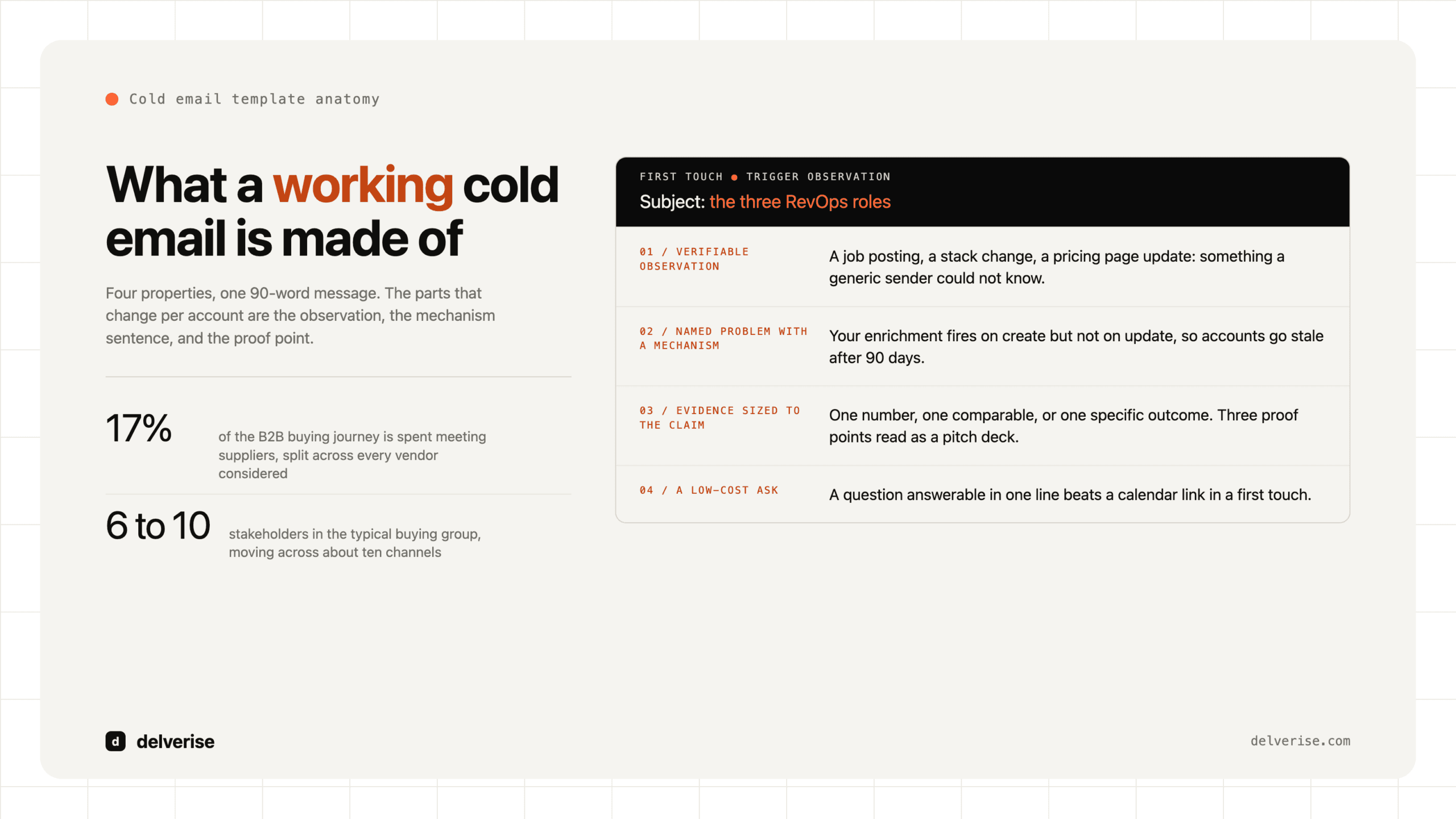
The buying group is larger than your list. Gartner has consistently found that a typical complex B2B purchase involves a buying group of six to ten decision makers. A batch sequence usually targets one or two titles per account, so even a perfectly timed send may reach someone with no active role in the evaluation.
Buyers move across many channels at once. McKinsey’s B2B Pulse research has tracked a steady rise in the number of channels buyers use across a single purchase decision, now averaging around ten. A cold email sent in isolation from what that account is doing on your site, in your community, or in a review platform is one uncoordinated touch among many.
Put together, batch outreach is asking a low-probability question to a large audience at an arbitrary moment. It works exactly as well as random sampling predicts.
What does a signal-led outbound system do differently?
A signal-led system inverts the trigger. Instead of a calendar deciding when an account gets contacted, an event does. The account list becomes a watchlist, and the sequencer becomes the last step in a pipeline rather than the first.

In practice that means four components working together: a signal layer that captures events, an identity layer that resolves those events to accounts and contacts, a routing layer that decides which play fires, and an execution layer that sends. Most teams already own the fourth. The gap is usually in the middle two, which is where enrichment waterfalls and identity resolution earn their cost.
| Dimension | Batch outreach | Signal-led system |
|---|---|---|
| Trigger | Sending calendar and list capacity | An observed account event |
| Unit of work | The sequence | The play, mapped to a signal type |
| Volume | High and constant | Variable, driven by signal frequency |
| Personalization basis | Firmographics and title | The event itself, plus context |
| Primary failure mode | Irrelevance at scale, deliverability decay | Signal noise, slow routing, missed SLA |
| What you measure | Sends, open rate, reply rate | Signal-to-meeting rate, time from signal to first touch |
| Cost driver | Domains, inboxes, contact credits | Data sources, engineering, routing logic |
The tradeoff is real and worth stating plainly. Signal-led systems have a lower ceiling on raw volume, they require ongoing maintenance as data sources change their schemas, and they concentrate risk in the quality of your signal definitions. A poorly defined signal fires constantly and produces the same irrelevance as batch, with higher operating cost.
What does the difference look like in numbers?
Here is a model, not a case study. Assume a total addressable list of 4,000 accounts and a planning assumption that roughly 5% are in an active evaluation window in a given quarter, which is a reasonable starting estimate for a category with a three-to-five-year replacement cycle. That is 200 accounts.

Batch approach. Send to all 4,000 accounts across the quarter, one contact each. At a 1.2% reply rate you get 48 replies. If 20% of those replies are qualified, you book roughly 10 meetings. You also burn 4,000 sends worth of domain reputation to reach the 200 accounts that mattered, and you reached most of them at the wrong week.
Signal-led approach. Watch the same 4,000 accounts. Fire only on the 200 that produce a qualifying signal, contacting three members of the buying group each, for 600 sends. Relevance lifts reply rate to 6% and qualification to 45%. That is 36 replies and roughly 16 meetings, from 15% of the send volume.
Change the assumptions and the totals move, but the shape holds: the second system spends less capacity and converts a higher share of the accounts that were actually available to buy. The compounding benefit sits in deliverability, since 600 relevant sends per quarter keeps domain health in a place that 4,000 cold sends does not.
Which signals actually predict timing?
Signal quality varies enormously, and vendors are not always candid about it. A workable hierarchy:
First-party behavioral signals are the strongest and the most underused. Repeat pricing page visits, documentation reads, a demo request that stalled, a closed-lost deal passing its renewal anniversary, a free trial that went quiet at day nine. These are yours, they are free, and most teams do not route them anywhere. Getting the follow-up motion right on existing first-party signal usually produces more pipeline than any new data purchase.
Relationship and personnel signals come next. A champion changing companies is one of the highest-converting triggers in B2B, because the person already knows your product works. Tracking job changes across your closed-won and closed-lost contact base is a contained, high-yield project.
Company event signals include funding, leadership hires, office expansion, and tech stack additions or removals. Useful, though they are visible to every competitor with the same data subscription, so speed of response matters more than the signal itself.
Third-party intent data sits last, and honestly so. It works when it is treated as a prioritization input rather than a trigger, and it disappoints when it is treated as an in-market list. Our breakdown of what buying intent data actually changes covers where the category earns its keep and where the accuracy claims outrun the evidence. A related trap is assuming an AI BDR solves timing on its own. Automating the writing step while keeping the calendar-based trigger produces the same blind spot at higher speed.
How do you build this without adding headcount?
The order matters. Most teams start by buying a signal source and end up with a data feed nobody acts on. Start instead with the routing layer, then add signals to it.
- Instrument first-party behavior first: pricing page, docs, trial milestones, and closed-lost anniversaries, all written back to the CRM as timestamped events.
- Define an account object your systems agree on, so a signal about a subsidiary resolves to the right parent. A clean map of your market makes this tractable.
- Write three plays, each mapped to one signal type, with the exact contacts, message angle, and channel sequence specified.
- Set an SLA on time from signal to first touch. Under 24 hours for behavioral signals, under 72 hours for company events.
- Instrument signal-to-meeting rate by signal type, then retire the signals that underperform after 90 days.
- Keep a small batch program running as a control group so you can measure the delta honestly.
Ownership is the part that stalls most often. Signal routing sits between marketing operations, sales operations, and data engineering, so it belongs to whoever owns the GTM operations function. When no one owns it, the pipeline degrades quietly as data sources change and nobody notices for a quarter. This is the class of system delverise builds and hands over as part of outbound engineering work, with the routing logic documented well enough that an internal team can maintain it.
Frequently Asked Questions
Does this mean we should stop sending cold email?
No. Cold email remains an efficient way to reach a market that does not know you exist. The change is what decides when a given account gets contacted. Keep the channel and replace the calendar-based trigger with an event-based one, and keep a small batch program running so you can measure the difference.
How much signal volume do we need for this to work?
Enough to keep your reps busy, which for most Seed to Series B teams means 30 to 80 triggered accounts per rep per month. Below that, add signal sources or widen the definition. Above roughly 150, you are probably firing on weak signals and should tighten the thresholds.
Is third-party intent data required?
It is optional and it should be the last thing you buy. Most teams have unrouted first-party signal sitting in their product analytics and CRM that outperforms any purchased feed. Exhaust that before adding a subscription, then evaluate intent data as a prioritization input with a defined test period.
How long does it take to see results?
Instrumenting first-party signals and building two or three plays typically takes four to eight weeks. Meaningful reply-rate data arrives about a month after that, once enough signals have fired. Full attribution on signal-to-closed-won takes a sales cycle, so plan on one to two quarters before the model is trustworthy.
What is the most common way these systems fail?
Slow response. A signal that fires on Monday and gets worked on Friday has decayed to roughly the value of a cold send. The second most common failure is signal definitions that never get pruned, so a play that stopped converting nine months ago keeps consuming rep time. Both are operating discipline problems with straightforward fixes.
Read next