←Back to blog
Revenue Intelligence & Data ToolingGuideJuly 12, 20267 min read
Waterfall Map: How Revenue Teams Chain Data Providers for Higher Match Rates
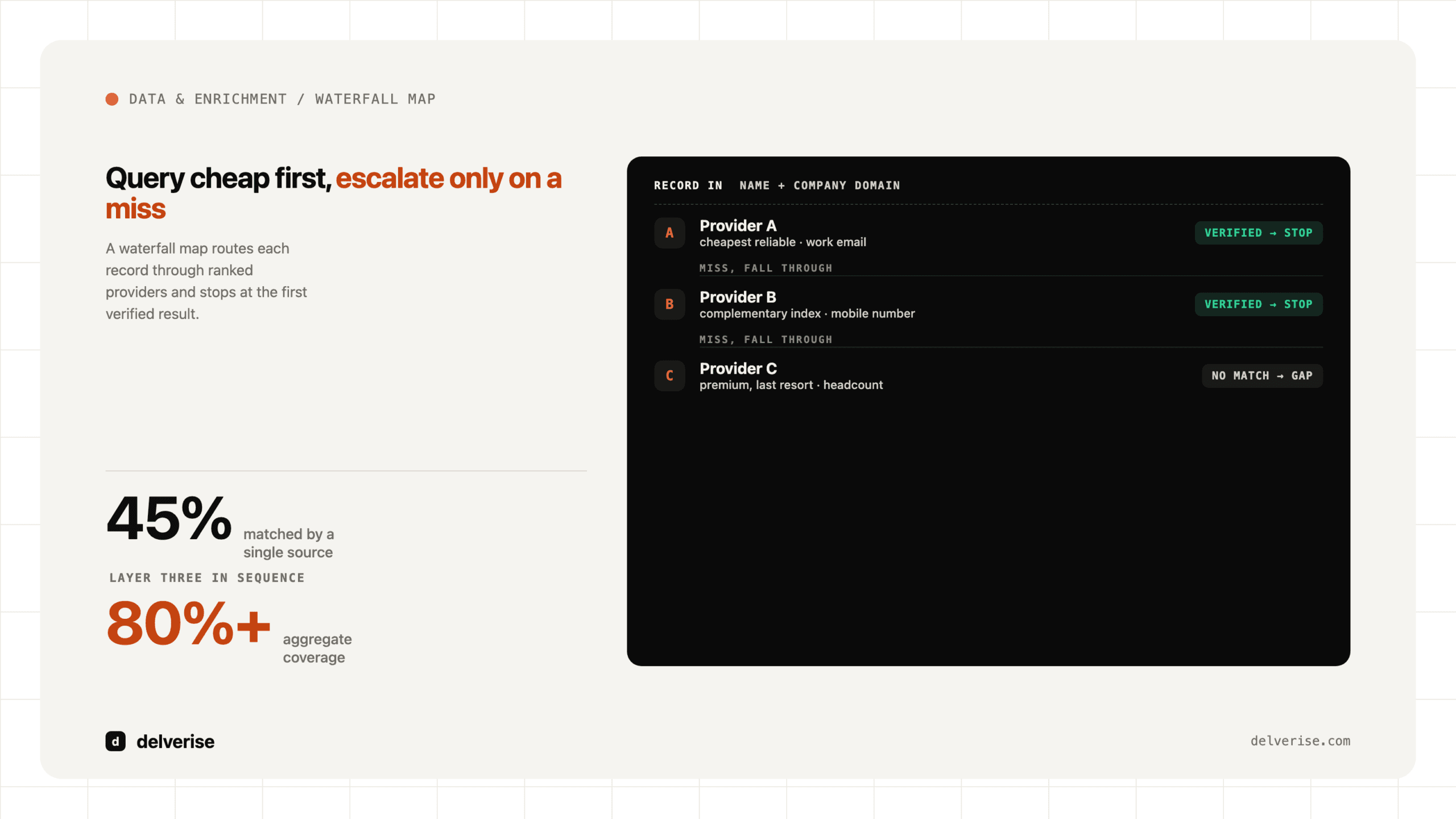
A waterfall map is the routing logic that sends each record through multiple data providers in a ranked sequence, stopping at the first source that returns a verified result. Instead of relying on one vendor to enrich an email, phone, or firmographic field, you query the cheapest reliable source first, then fall back to others only when a match fails.
A waterfall map is the routing logic that sends each record through multiple data providers in a ranked sequence, stopping at the first source that returns a verified result. Instead of relying on one vendor to enrich an email, phone, or firmographic field, you query the cheapest reliable source first, then fall back to others only when a match fails.
Key takeaways
- A waterfall map is a decision tree for data enrichment: it decides which provider to ask, in what order, and when to stop.
- The payoff is higher aggregate match rates and lower cost per verified record, because you stop paying premium vendors for data a cheaper one already has.
- It only works when you rank providers by real hit rate and accuracy for your specific segment, not by brand reputation.
- Waterfalls belong inside a governed data model. Without deduplication and verification, they multiply bad data faster.
- Tools like Clay make waterfalls accessible, but the strategy behind provider order and stop conditions is where the value lives.
What is a waterfall map in data enrichment?
Picture a single lead: a name and a company domain. You need a work email, a mobile number, and a headcount figure before your team can act on it. A waterfall map is the sequence that fills those fields. It asks Provider A for the email. If Provider A returns a verified address, the record moves on. If not, it asks Provider B, then Provider C, and so on until a field is filled or the list of sources runs out.
The term borrows from finance, where a waterfall describes cash flowing to claimants in strict priority order. Here, the “claimants” are your data vendors, and priority is set by how well each one performs on the specific field and segment you care about. This is the same mechanic behind Clay email enrichment waterfall strategies, applied across every attribute you enrich, not just email.
Why not just use one enrichment vendor?
Every data provider has blind spots. One vendor indexes European mobile numbers well and North American ones poorly. Another has strong job-title data but stale company headcounts. A single source might match 45 percent of your list. Layer three complementary sources in sequence and aggregate coverage can climb past 80 percent, because each provider catches records the previous one missed.

There is a cost dimension too. Premium phone data is expensive per lookup, and cheaper providers often hold the same number. If you always call the expensive vendor first, you overpay for records a low-cost source already had. A waterfall inverts that: ask cheap-and-good first, escalate to premium only for the records that still have gaps.
Data quality also decays. Industry research on B2B contact data consistently finds that a meaningful share, often cited near 30 percent per year, goes stale as people change roles. Gartner has long flagged poor data quality as a direct drag on revenue operations, with the cost measured in millions annually for larger organizations. A waterfall that includes verification at each step is one practical defense against that decay.
How does a waterfall map actually work, step by step?
A working waterfall has four moving parts. Get these right and the rest is configuration.

- Ranked providers. For each field (email, mobile, company size), you order sources by hit rate and accuracy for your target segment, then by cost. Order is per field: your best email source is rarely your best phone source.
- Stop conditions. The waterfall halts the moment it gets a result that clears your bar. If you require a verified, non-catch-all email, a “guessed” address does not count as a stop and the record continues down the list.
- Verification gates. Between steps, you validate. An email runs through a syntax and deliverability check. A phone number gets format-validated. Skipping this turns a waterfall into a machine for accumulating plausible-looking garbage.
- Fallback logging. You record which provider filled each field. Over a few thousand records, that log tells you which vendors earn their contracts and which you can cut.
A concrete worked example
Say you upload 1,000 accounts, each needing a verified work email. Here is how a three-step waterfall might resolve.

| Step | Provider (illustrative) | Cost per hit | New matches | Running coverage |
|---|---|---|---|---|
| 1 | Low-cost bulk source | $0.02 | 520 | 52% |
| 2 | Mid-tier accuracy source | $0.08 | 210 | 73% |
| 3 | Premium verified source | $0.30 | 140 | 87% |
You reach 87 percent coverage, but you only paid the $0.30 premium rate on the 280 records the first two steps could not resolve, not on all 1,000. Run the same volume through the premium vendor alone and you would spend roughly ten times more for a similar or worse result, since no single source tends to beat a well-ordered stack.
Where does Clay fit into building a waterfall map?
Clay is the tool most revenue teams reach for when they build waterfalls, because it connects dozens of data providers behind one interface and lets you chain them with conditional logic and no engineering time. You set the provider order, define the stop condition per column, and Clay runs each record down the stack. It is a genuinely strong fit for this job.
The honest tradeoff: the tool is the easy part. Clay will happily run a waterfall in the wrong provider order, verify nothing, and quietly burn credits on premium lookups that a cheaper source could have covered. The value sits in the strategy, which providers, in which order, with which gates, tuned to your segment. That is where teams either save money or waste it. If you want that logic designed and maintained rather than assembled by trial and error, our Clay partner page covers how we build and run these systems.
For a broader look at the tool itself and how it compares to other options, the Clay vs top alternatives comparison is a useful vendor-neutral starting point. The same waterfall thinking applies whether you are enriching emails with Apollo or pulling firmographics from a specialized source.
How do you rank providers for a waterfall?
Ranking is an empirical exercise, and it is the part most teams skip. The right order for one company is wrong for another because the answer depends entirely on your ideal customer. A waterfall tuned for enterprise North American accounts looks different from one built for European mid-market.
Run a calibration test. Take a sample of a few hundred records where you already know the correct answer, or where you can manually verify it. Send that sample to every provider you are considering, in parallel, and measure two things per vendor: hit rate (did it return anything) and accuracy (was the answer correct and current). Then order by accuracy-weighted hit rate first, cost second. This is closely related to how mature teams approach lead scoring: you rank by evidence, not by which brand name feels safest.
Re-run that calibration quarterly. Provider coverage shifts as vendors gain and lose data partnerships, and a source that led your waterfall in January can slip by summer.
What can go wrong with a waterfall map?
Three failure modes account for most of the damage. First, no verification: the waterfall stops at the first source that returns anything, verified or not, and you end up emailing catch-all addresses that tank your sender reputation. Second, no deduplication upstream: you run the same account through the stack three times under slightly different names and pay three times for one answer. Third, no logging: you cannot see which providers earn their keep, so you renew every contract by default.
These failures share a root cause. A waterfall is a component inside a larger data system, and it inherits the health of that system. If your CRM data model is messy, a waterfall accelerates the mess. This is why enrichment sits downstream of clean segmentation and a governed pipeline, a point the customer segmentation examples guide makes concrete, and why it belongs in a considered marketing operations foundation rather than bolted on as an afterthought. For teams designing the wider stack, our GTM engineering approach treats enrichment as one layer of an integrated revenue system.
Frequently Asked Questions
Is a waterfall map the same as data enrichment?
No. Data enrichment is the outcome, filling in missing contact and company attributes. A waterfall map is one method for doing it well, specifically the logic that routes each record through multiple providers in ranked order. You can enrich with a single vendor and no waterfall, but you will usually get lower coverage at higher cost.
How many providers should a waterfall include?
For most B2B teams, three to five per field hits the point of diminishing returns. The first two or three sources typically capture the large majority of matches, and each additional provider adds a smaller slice of new coverage. Add sources only until the marginal hit rate no longer justifies the added cost and complexity.
Do I need engineering resources to build one?
Not for the mechanics. Platforms built for enrichment let you configure provider order and stop conditions without code. What you do need is the analytical work of calibrating providers against your segment and maintaining the logic over time, which is where most teams benefit from experienced help.
How much can a waterfall map actually save?
Savings come from two places: not paying premium rates for records cheaper sources already cover, and cutting underperforming vendor contracts once your logs expose them. The exact figure depends on your volume and current setup, but reclaiming a large share of premium lookups is common when teams move from a single-vendor approach to a ranked stack.
How does a waterfall map connect to the rest of my funnel?
It feeds the top of it. Clean, verified enrichment is what lets scoring, routing, and outreach work on accurate data. If you are mapping the full path from first touch to closed revenue, the B2B sales funnel metrics guide shows where enrichment quality shows up downstream in conversion and pipeline health.
Read next