←Back to blog
Revenue OperationsGuideAugust 24, 20268 min read
Affinity CRM: What It Does, Who It Fits, and Where It Breaks
Affinity is a relationship intelligence CRM built for deal-driven teams: venture capital, private equity, investment banking, and corporate development. It automatically captures email and calendar activity across the firm, builds contact and company records without manual entry, and scores how strong each relationship is. For most B2B SaaS sales motions, a conventional CRM fits better.
Affinity is a relationship intelligence CRM built for deal-driven teams: venture capital, private equity, investment banking, and corporate development. It automatically captures email and calendar activity across the firm, builds contact and company records without manual entry, and scores how strong each relationship is. For most B2B SaaS sales motions, a conventional CRM fits better.
Key takeaways
- Affinity’s core mechanic is passive data capture: it reads team email and calendar metadata to build person and organization records automatically, so pipeline hygiene stops depending on rep discipline.
- Its pipeline model is built on flexible lists rather than a fixed opportunity object, which suits deal flow tracking and fits quota-carrying sales forecasting less cleanly.
- The buyer profile is a firm where warm introductions drive most origination. If your pipeline comes from outbound, paid, and product-led signups, Affinity solves a problem you do not have.
- Affinity does not publish list pricing. Expect quote-based annual contracts priced per seat, materially above HubSpot Sales Hub and in the range of enterprise Salesforce.
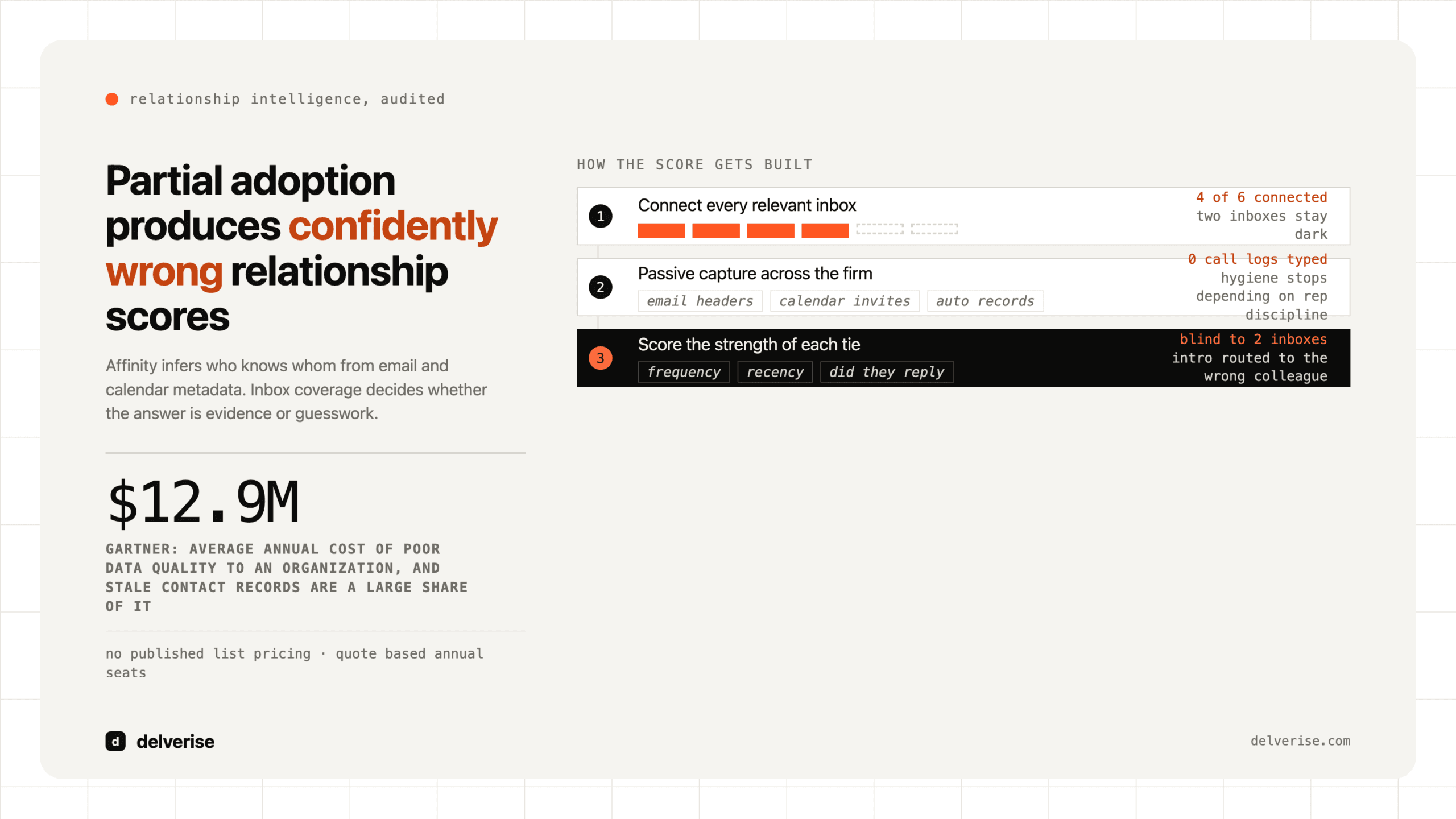
- Relationship intelligence works only when every relevant inbox is connected. Partial adoption produces confidently wrong relationship scores.
What is Affinity CRM?
A CRM (customer relationship management system) is the system of record for accounts, contacts, and deals. Affinity belongs to a narrower category: relationship intelligence, meaning software that infers the strength and ownership of a business relationship from communication history instead of asking a human to log it.

When a firm connects its Google Workspace or Microsoft 365 accounts, Affinity ingests email headers and calendar invites across the team. From that stream it creates and maintains person and organization profiles, attaches every interaction to the right record, and computes a relationship score based on frequency, recency, and whether the other side actually replies. Ask “who here knows the CFO at this target company,” and Affinity answers from evidence rather than from a rep’s memory.
The pipeline layer is deliberately loose. Instead of a rigid opportunity object with stages and amounts, Affinity uses lists: configurable tables of companies or people with custom fields, board views, and status columns. A venture firm runs a “Deal Flow” list. A corp dev team runs an “Acquisition Targets” list. That flexibility is the product’s real design choice.
How does relationship intelligence actually work?
Three mechanisms do most of the work.

Passive capture. Every email and meeting across connected inboxes becomes a timestamped interaction. Nobody types a call log. This directly attacks the failure mode that makes CRM data untrustworthy: Gartner has put the average annual cost of poor data quality to an organization at roughly $12.9 million, and stale contact records are a large share of that in revenue systems.
Relationship scoring. Affinity ranks the strength of each person-to-person tie. Someone who exchanged one cold email two years ago scores far below someone in a monthly thread. This lets you route an introduction request to the colleague with a live relationship rather than the one who once shared a conference badge scan.
Enrichment. Affinity layers firmographic and funding data onto company records so a new name arriving by email gets context automatically. The coverage is decent for venture-backed companies and thinner elsewhere, which is why serious teams still chain multiple providers. We wrote up how that chaining works in the data enrichment waterfall.
Worth being precise about the limit: relationship intelligence measures communication, and communication is a proxy for influence. A weekly thread with a procurement analyst scores high while a single decisive conversation with the economic buyer scores low. Gartner’s research on B2B buying groups puts six to ten decision makers in a typical complex purchase, so a high score against one contact tells you little about deal coverage.
Who is Affinity CRM actually for?
Affinity fits when three conditions hold at once: your deal flow arrives through people rather than campaigns, the same target company may be worked by several colleagues over years, and the “deal” does not fit a clean stage-and-amount model. Venture and growth equity firms, investment banks, family offices, and corp dev teams all match.

It also fits a narrower B2B SaaS case: a company whose revenue depends on a partner, investor, or advisor network. If a third or more of your closed-won pipeline traces back to a warm introduction, the map of who-knows-whom is a real asset that currently lives in nobody’s system.
The mismatch is a standard SaaS sales org running outbound sequences, inbound demo requests, and product-led trials, with SDRs, AEs, and a forecast the board reviews weekly. That motion needs quota rollups, territory rules, sequence integration, and lifecycle automation. Salesforce and HubSpot were engineered for it. Before committing either way, get clear on who owns which surface of the revenue system, which is the subject of GTM operations.
How does Affinity compare to Salesforce and HubSpot?
| Dimension | Affinity | Salesforce | HubSpot |
|---|---|---|---|
| Core model | Flexible lists of people and organizations | Accounts, contacts, opportunities, custom objects | Contacts, companies, deals, tickets |
| Data entry | Automatic from email and calendar | Manual, plus capture add-ons | Manual, plus native email tracking |
| Relationship graph | Native, firm-wide, scored | Requires an add-on layer | Limited |
| Sales forecasting | Basic, list-driven | Deep, configurable | Solid mid-market forecasting |
| Marketing automation | Minimal | Via Marketing Cloud or Pardot | Native and strong |
| Ecosystem breadth | Narrow, finance-oriented | Widest in the category | Broad mid-market |
| Pricing transparency | Quote only | Published tiers, negotiated in practice | Published tiers |
| Best fit | Relationship-led origination | Complex enterprise sales | Mid-market SaaS with marketing depth |
Affinity also sells a relationship intelligence layer that pushes its graph into Salesforce. For a company already standardized on Salesforce, that path preserves your forecast architecture while adding the relationship data. It costs more than either product alone and adds a sync dependency to your stack.
What does Affinity CRM cost?
Affinity keeps pricing behind a sales conversation, with annual, per-seat contracts and tiering by feature depth, API access, and data credits. Practically, budget it as an enterprise line item well above a mid-market CRM subscription, and expect the quote to move on seat count and contract length.
The subscription is rarely the largest number. Three costs show up later: connecting and governing every inbox, migrating historical records into list structures that survive contact with real work, and the integration effort to reconcile Affinity with the tools that actually send and measure outreach. Vendors quote the first number. Finance eventually sees all three.
What does Affinity look like in a real revenue system?
Model a Series B company: 55 employees, 400 named target accounts, an ACV of $60,000, and a sales cycle near five months. Historically, 30 percent of closed-won deals began with a warm introduction, and win rates on introduced deals run roughly double cold-sourced ones.
Connect all 55 inboxes and the relationship graph surfaces first-degree ties into maybe 90 of the 400 accounts, most of them held by founders, investors on the board, and two long-tenured AEs. That is the entire value proposition: 90 accounts move from cold outbound to introduction requests, at a win rate twice as high.
The operating discipline is what converts that into revenue. You need a rule for who requests the introduction, an SLA for how fast it happens, and a way to fall back to a sequence when the introduction stalls after ten days. Without those, the graph is a very expensive contact viewer. The same principle applies to any signal-driven system, which is why lead intelligence platforms so often underperform their demo.
Now run the counterfactual. If only 40 accounts have first-degree ties and your ACV is $18,000, the arithmetic collapses and the money belongs in your account map and outbound engine instead. Building that view of the market is covered in how revenue teams turn scattered data into a buyable market.
Where does Affinity fall short?
Four honest limitations.
Coverage sensitivity. Relationship scores are only as complete as inbox participation. One executive who declines to connect creates a blind spot the system reports as “no relationship,” which is worse than an obvious gap.
Forecasting depth. List-based pipelines do not produce the weighted, territory-aware, multi-currency forecast a board expects from a scaling sales org. Teams routinely export to a spreadsheet, which reintroduces the manual work the product was bought to remove.
Ecosystem gravity. Sequencers, enrichment vendors, and reporting tools ship Salesforce and HubSpot connectors first. G2 reviewers consistently praise Affinity’s automatic capture and point to reporting and integration depth as the softer edges.
Privacy governance. Firm-wide email metadata capture is a real policy decision. Get legal and your data protection lead involved before rollout, not after.
One more structural point. McKinsey’s B2B Pulse research found buyers now move across roughly ten channels in a single purchase journey, up from about five a decade ago. Email and calendar cover two of them. Community activity, product usage, review sites, and paid touchpoints stay invisible to a relationship graph, so treat it as one input among several.
What should you decide before you buy?
- Measure what share of closed-won revenue over the last four quarters started as a warm introduction. Below 20 percent, stop here.
- Confirm every executive and senior seller will connect their inbox, and get written sign-off from legal on metadata capture.
- Decide where the forecast lives. Running Affinity and Salesforce in parallel means owning a sync and a reconciliation process.
- Write the introduction request workflow before the contract: who asks, how fast, and what happens when it stalls.
- Name the person accountable for the graph’s accuracy and enrichment coverage, with time allocated for it.
- Price the full first year including migration, integration, and admin time, then compare against the incremental pipeline the 90-account math predicts.
Most teams that regret this purchase skipped items three and four. The software arrived, the graph populated, and no operating rule ever attached to it. If that risk sounds familiar, the fix sits in system design rather than tool selection: see how we approach GTM engineering and CRM enrichment.
Frequently Asked Questions
Is Affinity CRM good for B2B SaaS sales teams?
Only in specific cases. A SaaS company with a heavy partner, investor, or advisor-led motion gets real value from the relationship graph. A standard outbound and inbound sales org will find the forecasting, sequencing, and marketing automation thinner than Salesforce or HubSpot, and will spend the difference stitching tools together.
Can Affinity replace Salesforce?
For an investment firm, yes, and it usually does. For a scaling SaaS sales organization, replacement is risky because of forecasting depth and connector availability. The common middle path is Salesforce as system of record with Affinity’s relationship data pushed into it, accepting the added cost and sync overhead.
How accurate are Affinity’s relationship scores?
Accurate as a measure of communication volume and reciprocity, which is a useful but imperfect signal for influence. Scores degrade when inbox coverage is incomplete, when key conversations happen on Slack, phone, or in person, and when the strongest relationship belongs to someone who left the company.
What data does Affinity capture from our email?
Primarily metadata: sender, recipients, timestamps, and calendar invitees, with configurable controls over message body access and private domains. Because the capture is firm-wide and continuous, treat the configuration as a governance decision with legal input rather than an IT setup task.
Does Affinity handle enrichment well enough on its own?
For venture-backed technology companies, the native enrichment is reasonable. For broader B2B coverage, especially direct-dial phone numbers and verified work emails outside tech, most teams add dedicated providers and route requests across them by cost and hit rate rather than relying on a single source.
Read next