←Back to blog
Revenue Intelligence & Data ToolingGuideJuly 12, 20267 min read
What Is a Lead Intelligence Platform? A Revenue Leader’s Buying Guide
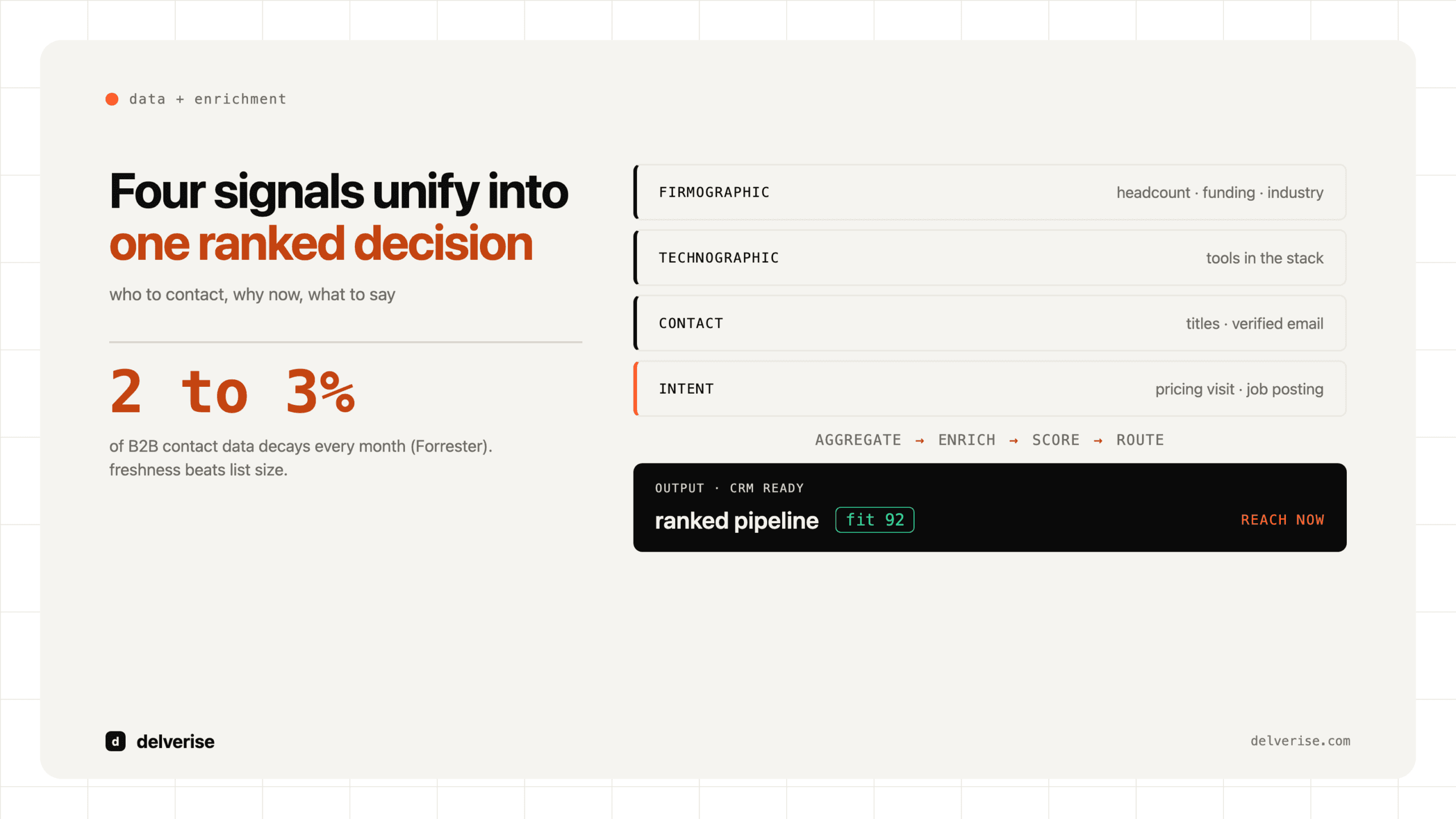
A lead intelligence platform is software that collects, enriches, and scores data about your prospects, contacts, accounts, buying signals, so revenue teams can prioritize who to contact and when. It combines firmographic data (company attributes), technographic data (tools a company uses), contact records, and intent signals into one system that feeds your CRM and outbound motion with decisions, not just rows.
A lead intelligence platform is software that collects, enriches, and scores data about your prospects, contacts, accounts, buying signals, so revenue teams can prioritize who to contact and when. It combines firmographic data (company attributes), technographic data (tools a company uses), contact records, and intent signals into one system that feeds your CRM and outbound motion with decisions, not just rows.
Key takeaways
- A lead intelligence platform turns scattered prospect data into ranked, actionable pipeline by unifying firmographic, contact, technographic, and intent signals.
- The value sits in the workflow around the data: enrichment, scoring, routing, and CRM sync, not the raw database alone.
- Data decays fast. Forrester research has long shown B2B contact data degrades roughly 2 to 3 percent every month, so freshness matters more than list size.
- Most teams do not need one monolithic platform. A composable stack of a database, an enrichment engine, and a scoring layer often outperforms a single suite.
- Buy for the decision you want to automate, then work backward to the data and tooling that supports it.
What does a lead intelligence platform actually do?
At its core, the platform answers three questions your reps ask every morning: who should I contact, why now, and what do I say. To do that well it performs four jobs.

First, it aggregates data from providers, your website, product usage, and public sources. Second, it enriches thin records, taking an email or a company name and appending headcount, funding, tech stack, and job titles. Third, it applies intent and scoring, meaning it watches for behavioral signals (a pricing page visit, a job posting, a competitor mention) and ranks accounts by fit and readiness. Fourth, it routes and syncs, pushing prioritized records into your CRM and sequencing tools so the signal reaches a human before it goes stale.
Intent data deserves a plain definition. It is any observed behavior that suggests a company is researching a solution like yours, from third-party publisher activity to first-party visits on your own site. Intent is probabilistic, so treat it as a tiebreaker on top of fit rather than gospel.
Why do revenue teams need one now?
Buying has gotten harder to see. Gartner’s research on B2B buying found that customers spend only about 17 percent of the total purchase journey actually meeting with potential suppliers, and even less time with any single vendor. McKinsey’s work on omnichannel buying reached a similar conclusion, with B2B customers now moving across ten or more channels before a decision. Most of the real evaluation happens where your reps cannot watch.
A lead intelligence platform is how you regain visibility. Instead of waiting for a form fill, you detect the research behavior earlier and reach out while the buyer is still shaping their shortlist. That timing advantage is the whole game, because the vendor who helps frame the problem usually wins the deal.
The other pressure is efficiency. When every rep is expected to hit quota with a leaner team, spraying an unranked list wastes the most expensive resource you have. Ranking pipeline by real buying intent is the fastest lever most teams have to lift conversion without adding headcount. Our guide to lead scoring walks through how to build that ranking with signals you can actually trust.
What data sources feed a good platform?
The quality of the output is capped by the quality of the inputs. A strong setup blends several layers.
- Firmographics: industry, headcount, revenue, location, funding stage. This is your fit baseline.
- Contact data: verified emails, direct dials, titles, and reporting lines that identify the buying committee.
- Technographics: the tools a company already runs, useful for both fit and messaging.
- First-party signals: website visits, product usage, and event activity you own. This is your highest-trust data.
- Third-party intent: research activity aggregated across the web, useful but noisier.
No single vendor owns all five layers at high quality. That reality pushes many teams toward a waterfall approach, where you query multiple sources in sequence and keep the first good answer. Tools like Clay have made this composable model accessible, letting you chain providers, apply AI research, and enrich at scale without hard-coding a pipeline. If you are evaluating that approach, Clay is a sensible place to start, and our breakdown of Clay versus its alternatives compares the tradeoffs honestly.
Platform suite or composable stack?
This is the real buying decision, and it hinges on your stage and team. Here is a direct comparison.

| Dimension | All-in-one suite | Composable stack |
|---|---|---|
| Setup speed | Fast, opinionated defaults | Slower, needs configuration |
| Data flexibility | Locked to the vendor’s sources | Any provider, waterfall logic |
| Cost at scale | Per-seat, climbs quickly | Usage-based, tunable |
| Best fit | Teams wanting one login and support line | Teams with a RevOps owner and specific ICP logic |
| Risk | Vendor lock-in, generic scoring | Requires engineering discipline to maintain |
Neither wins universally. A five-person sales team without a data owner is usually better served by a suite. A Series A company with a defined ideal customer profile and a RevOps hire will get more from a composable stack it controls. For a wider view of the market, our comparison of lead generation platforms maps the field by use case.
A worked example: from raw list to ranked pipeline
Say you sell a compliance tool to fintech companies between 50 and 500 employees. A lead intelligence workflow might run like this.

- Pull all fintech companies in that headcount band from a firmographic source.
- Enrich each with tech stack, filtering to those running a payments processor your product integrates with.
- Layer intent, flagging accounts that recently posted compliance or risk roles, or that visited your pricing page.
- Score fit plus intent into three tiers, then route Tier 1 to reps and Tier 2 to a nurture sequence.
- Sync everything to your CRM with the reason for the score attached, so the rep opens with context.
The output is not a bigger list. It is a shorter, sharper one where every account carries a reason to be contacted. That is what separates intelligence from a data dump, and it is why the workflow layer matters more than the database underneath. Getting segmentation right upstream makes each of these steps cleaner.
What does a lead intelligence platform cost?
Pricing splits into two models. Suites typically charge per seat plus a data credit allowance, landing many mid-market teams between 15,000 and 60,000 dollars a year. Composable stacks charge for usage, meaning you pay for enrichment volume and API calls, which can be cheaper for targeted programs and more expensive for broad ones.
The hidden cost in both cases is integration and maintenance. A platform that does not sync cleanly to your CRM or that produces scores nobody trusts becomes shelfware. Budget for the operational work of wiring it into your revenue system, because that is where most of the value is won or lost. This is the kind of build we handle inside GTM engineering engagements, and our CRM enrichment page covers how the data layer connects to the rest of your stack.
How do you know it is working?
Judge the platform by pipeline quality, not activity volume. Track the conversion rate of platform-sourced leads against your baseline, the percentage of contacted accounts that were correctly ranked as high fit, and the freshness of your data. If reps trust the scores enough to change who they call first, the system is earning its cost. If they quietly ignore it and work their own lists, you have bought an expensive database.
For the full metric set, our sales funnel metrics guide lays out the KPIs worth watching, and if you want implementation help wiring Clay into a working intelligence engine, our Clay partner page explains how we approach it.
Frequently Asked Questions
What is the difference between a lead intelligence platform and a CRM?
A CRM stores and manages relationships you already have. A lead intelligence platform enriches and ranks prospects, then feeds the best ones into your CRM. They are complementary. The intelligence layer decides who deserves attention, and the CRM records what happens next.
Is intent data reliable enough to act on?
Intent data is a strong tiebreaker, not a standalone trigger. First-party signals from your own site and product are the most reliable. Third-party intent is noisier and works best when combined with firmographic fit. Use it to reprioritize accounts you already qualify, and treat any single signal with healthy skepticism.
Do we need a data platform if we already use Apollo or a similar tool?
Databases like Apollo cover aggregation and basic enrichment well, and they may be enough early on. The gap usually appears in scoring, multi-source enrichment, and routing logic tailored to your ICP. Many teams start with one provider and add a composable layer as their targeting gets more specific.
How fast does B2B contact data decay?
Quickly. Forrester research has shown contact data degrading in the range of 2 to 3 percent per month as people change roles and companies restructure. That compounds to a significant share of any list per year, which is why continuous enrichment beats a one-time data purchase.
Should a Seed or Series A company build a composable stack?
Only if you have someone who owns RevOps and a clearly defined ideal customer profile. Without that ownership, a composable stack drifts and breaks. Early teams often get more value starting simpler and graduating to a composable model once their targeting logic is proven and worth automating.
Read next