←Back to blog
Revenue Intelligence & Data ToolingGuideJuly 28, 20268 min read
GTM Operations: What It Is, Who Owns It, and How to Build It
GTM operations is the discipline that keeps your go-to-market motion running as one connected system: shared data, clean handoffs, and a single source of truth for pipeline. It spans revenue operations, marketing operations, and outbound engineering, and its job is to convert scattered tools and teams into a repeatable, measurable revenue engine.
GTM operations is the discipline that keeps your go-to-market motion running as one connected system: shared data, clean handoffs, and a single source of truth for pipeline. It spans revenue operations, marketing operations, and outbound engineering, and its job is to convert scattered tools and teams into a repeatable, measurable revenue engine.
What is GTM operations, in plain terms?
GTM operations (often shortened to GTM ops) is the operational layer beneath sales, marketing, and customer success. It owns the systems, data, and processes that let those teams work off the same numbers and the same definitions. Think of it as the plumbing and wiring of revenue: the CRM configuration, the enrichment pipelines, the routing rules, the reporting, and the automation that moves a lead from first touch to closed-won without falling through a crack.
The term overlaps with RevOps, and the two are often used interchangeably. A useful distinction: RevOps is the organizational model that unifies operations across the revenue teams, while GTM operations describes the actual work of designing and running the go-to-market machine. If you want the full breakdown of who owns what across the revenue org, our guide on the GTM role maps each job to a concrete responsibility.
Key takeaways
- GTM operations is the connective system across sales, marketing, and CS, not a single tool or a single hire.
- Its core deliverables are a trusted data foundation, clean lead-to-revenue routing, and reporting that leadership actually believes.
- Most fragmentation problems trace back to definitions and data, so fix those before buying more software.
- Poor operational hygiene is expensive: sales reps lose real selling time to bad data and manual work.
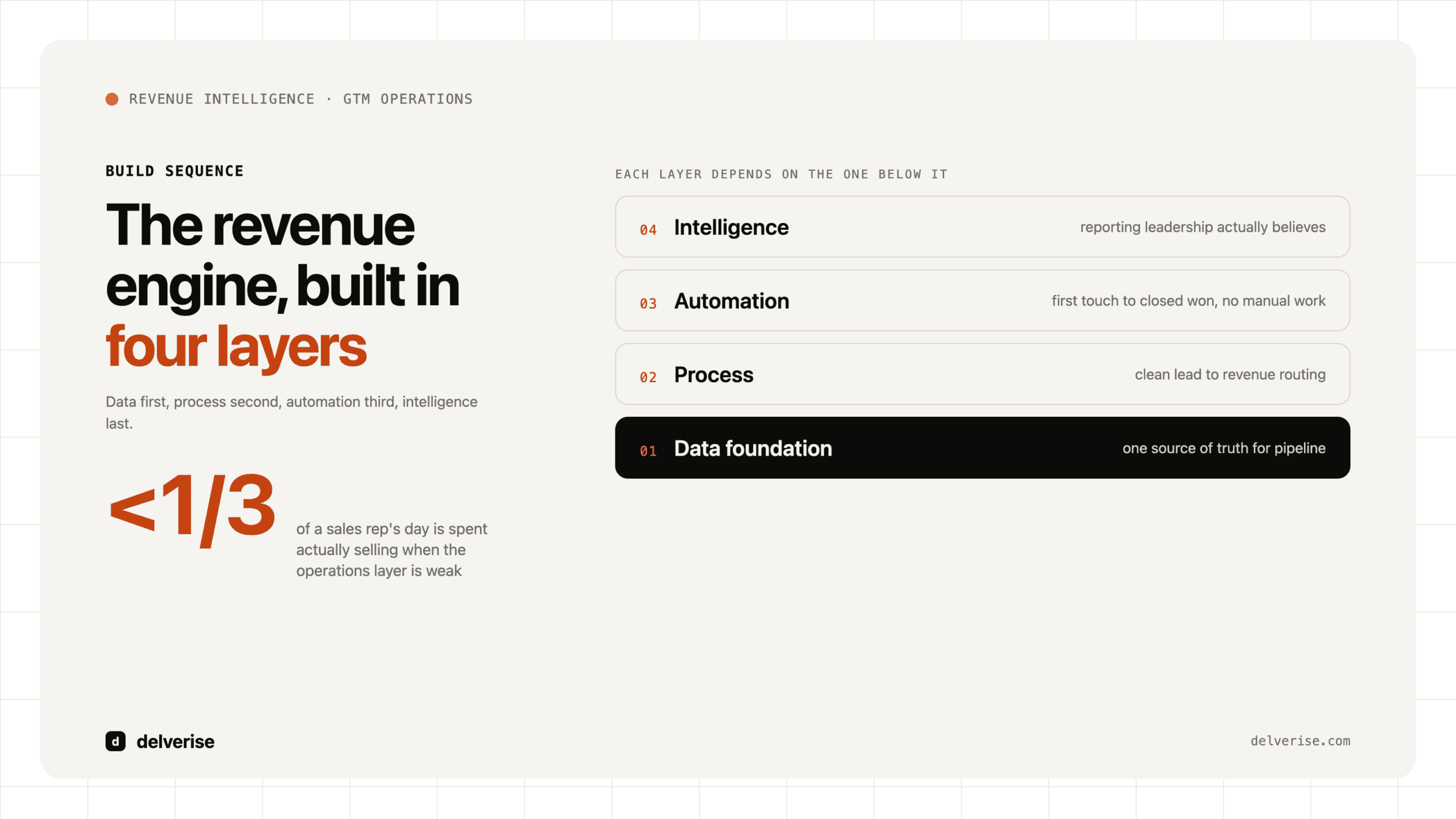
- You can build it in a sequence: data first, process second, automation third, intelligence last.
Why does GTM operations matter now?
The average B2B revenue team runs on a stack that has grown by accretion. A CRM here, an enrichment vendor there, a sequencer bolted on, a BI tool that nobody fully trusts. Each was bought to solve one problem, and together they create a new one: no shared view of the truth.

The cost shows up in productivity. Salesforce’s State of Sales research has repeatedly found that reps spend well under a third of their time actually selling, with the rest lost to administrative work, manual data entry, and hunting for information. When your operations layer is weak, that ratio gets worse, because every rep quietly builds their own spreadsheets and their own workarounds.
The demand side has shifted too. Gartner’s research on B2B buying found that buyers spend only a small fraction of their journey with any given sales rep, and the majority of that journey happens across independent research and digital channels. That means your GTM systems have to capture intent, enrich it, and route it fast, because the window where a buyer is receptive is short and largely invisible. Getting AI into that motion the right way is its own topic, covered in AI in marketing and sales.
What does a GTM operations function actually own?
It helps to separate the work into four layers. Each one depends on the one below it, which is why skipping a layer creates the mess most teams live in.

1. The data foundation
This is account and contact data, enrichment, deduplication, and the field definitions that everything else reads from. If two teams define an “MQL” or an “ICP account” differently, no downstream report can be trusted. A common pattern here is a waterfall enrichment setup, where you chain multiple data providers so that when one misses a contact, the next fills the gap. We break down how to design one in the waterfall map guide.
2. Process and routing
Lead scoring, assignment rules, stage definitions, and the handoffs between marketing, SDR, AE, and CS. This is where deals leak. A lead that sits unrouted for a day, or an account that gets worked by two reps, is a process failure, not a people failure. Scoring is the backbone here, and our lead scoring guide covers how to rank pipeline by real buying intent rather than vanity signals.
3. Automation and orchestration
The connective tissue: syncing data between systems, triggering enrichment, and firing the right action at the right moment. This is where a tool like Clay earns its place, because it lets you assemble enrichment, scoring, and outbound logic in one orchestration layer instead of gluing five point tools together. Be honest about the tradeoff: orchestration platforms are powerful, and they also require someone who can maintain the logic as your motion changes. If you want that built and owned properly, our Clay partner page covers implementation.
4. Revenue intelligence
Reporting, forecasting, and the analysis that tells leadership what is working. This layer only produces trustworthy numbers when the three below it are clean. A forecast built on inconsistent stage definitions is a guess with a dashboard.
GTM operations vs. RevOps vs. sales ops: how do they compare?
| Function | Primary scope | Owns | Best when |
|---|---|---|---|
| Sales ops | The sales team only | CRM hygiene, quotas, territories, rep enablement | Sales is your dominant motion and other teams are small |
| Marketing ops | The marketing team only | MAP, attribution, campaign data, lead flow into CRM | Demand gen is complex and needs its own operational owner |
| RevOps | All revenue teams as one org | Shared systems, unified reporting, cross-team process | You want one number and one operating model across GTM |
| GTM operations | The end-to-end go-to-market machine | Data, process, automation, and intelligence as a system | Your bottleneck is fragmentation across tools and handoffs |
These are not competing choices so much as different altitudes of the same work. A Seed-stage company might have one person doing all of it part-time. By Series B, the layers usually need dedicated owners. For a fuller picture of building the underlying stack, marketing operations for startup growth is a useful companion read.

A worked example: fixing a leaky lead-to-revenue flow
Picture a Series A SaaS company generating 400 inbound leads a month. On paper the funnel looks fine. In reality, conversion from lead to meeting is stuck at 4 percent, and the VP Sales blames lead quality.
A GTM operations review would work the layers in order. First, the data: 30 percent of leads have no firmographic enrichment, so the routing engine cannot tell an ICP account from a student signup. Fix enrichment, and now scoring has something to read. Second, process: high-fit leads are routed to a shared queue that reps check twice a day, so the median response time is nine hours. Add real-time routing and alerting, and speed-to-lead drops to minutes. Third, automation: the enrichment and routing now fire automatically on form submit instead of a nightly batch. Fourth, intelligence: a clean funnel report finally shows that the problem was never lead quality, it was a two-layer operational gap.
None of this required new demand. It required the operational system to actually function. That is the work GTM operations owns, and it is often the highest-ROI investment a revenue leader can make before spending more on top-of-funnel. If pipeline volume is the real constraint, sales lead gen for B2B SaaS covers the demand side.
When should you hire or build for GTM operations?
The trigger is usually pain, not headcount math. You need dedicated GTM ops capacity when any of these are true:
- Leadership argues about whose number is correct in the same meeting.
- Reps maintain private spreadsheets because they do not trust the CRM.
- A new tool takes months to integrate, or never fully does.
- You cannot answer “where did this closed deal originate?” with confidence.
- Handoffs between marketing, sales, and CS rely on someone remembering to act.
Many teams reach for a lead intelligence platform at this stage to consolidate signals, and that can help once the foundation is sound. Our lead intelligence platform buying guide walks through what to evaluate. The sequencing matters: buying intelligence tooling before your data and process layers are clean just gives you faster access to unreliable numbers.
How do you build GTM operations without over-hiring?
Most Seed to Series B companies do not need a large ops team. They need the right sequence and someone accountable for the system as a whole. A practical order of operations:
- Define your ICP, stages, and lead definitions in writing, and get sales and marketing to sign off.
- Audit and clean the CRM data these definitions depend on.
- Stand up enrichment so every new record arrives usable.
- Automate routing and handoffs so nothing waits on human memory.
- Build one reporting view leadership agrees to treat as the source of truth.
- Only then layer in intelligence and AI-driven signals on top.
This is the systems work that GTM engineering exists to do: designing the revenue machine as an integrated system rather than a pile of tools. Whether you build it in-house or bring in outside depth, the goal is the same: an operation that produces trustworthy pipeline without heroics.
Frequently Asked Questions
Is GTM operations the same as RevOps?
They overlap heavily. RevOps describes the organizational model that unifies operations across sales, marketing, and customer success under one function. GTM operations describes the actual system and work of running the go-to-market motion: data, process, automation, and reporting. In a small company one person often owns both.
When is a company too early for GTM operations?
You are never too early for the discipline, only for the headcount. At Seed stage, GTM ops might be a founder maintaining clean definitions and a tidy CRM. The systems thinking should start on day one, because it is far cheaper to keep data clean than to untangle years of accumulated mess later.
What tools does a GTM operations function rely on?
The core is a CRM such as Salesforce or HubSpot, plus enrichment providers, a marketing automation platform, and a reporting or BI layer. Orchestration tools like Clay increasingly sit in the middle to connect data and trigger actions. The specific stack matters less than whether the pieces share consistent data and definitions.
How do I measure whether GTM operations is working?
Watch operational metrics, not just revenue: speed-to-lead, routing accuracy, data completeness on new records, forecast accuracy, and the percentage of rep time spent selling versus on admin. If these improve, your pipeline reporting becomes more trustworthy and your funnel conversion tends to follow.
Should I hire a GTM ops person or work with an external partner?
It depends on the stage of the problem. A dedicated hire makes sense when the work is continuous and deeply tied to your product and motion. An external partner makes sense when you need to design and stand up the system quickly, or bring in depth you cannot yet justify hiring full-time. Many teams do both: a partner builds the foundation, and an internal owner runs it.
Read next