←Back to blog
Growth & Demand GenerationPlaybookMay 20, 202621 min read
AI Lead Generation Automation: How to 10X Your Pipeline with Artificial Intelligence
AI lead generation automation uses enrichment, scoring, AI outbound, CRM routing, and feedback loops to turn target accounts into qualified pipeline.
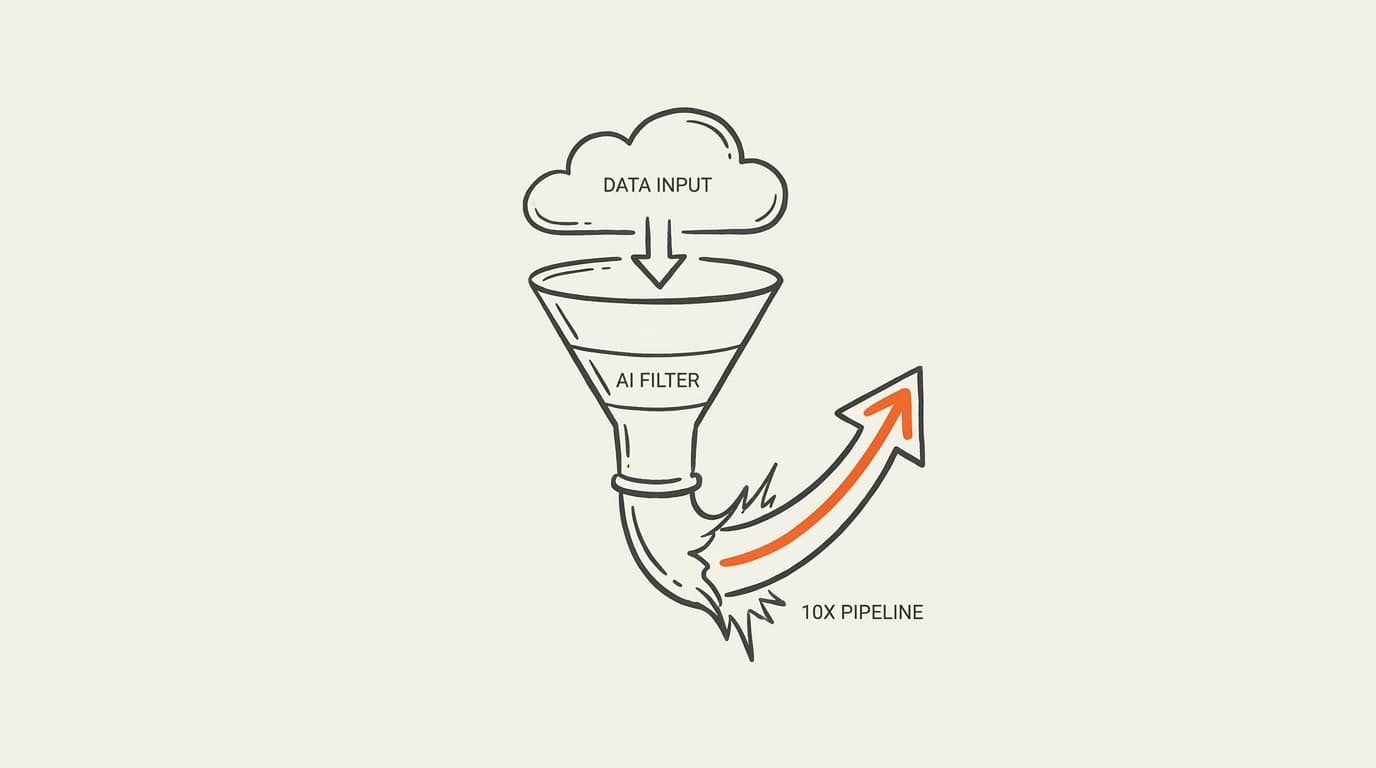
The economics of B2B lead generation have shifted. Manual prospecting, spray-and-pray outreach, and long lists of unqualified leads now cost more than they return. Artificial intelligence has reset what a working pipeline system looks like, and the performance gap between teams running on it and teams running on manual effort widens every quarter. For revenue and GTM leaders, the live question is how to tell whether a given system is built well. This guide lays out what effective AI lead generation automation looks like and what to evaluate before you trust it with your number.
Short answer: AI lead generation automation is a GTM system that uses AI, enrichment, scoring, routing, and outbound activation to identify the right accounts and move them into pipeline with less manual prospecting. It works when it is connected to the CRM, sequencer, data providers, and feedback loops, not when it is treated as another lead list tool.
For Delverise, this sits closest to AI Outbound and GTM Engineering: AI finds and prioritizes the opportunity, while the system handles CRM enrichment, activation, QA, attribution, and the growth engineering loop that keeps improving the motion. For concise definitions across these categories, use the Delverise answers hub.
The real constraint on modern growth teams is precision, relevance, and timing rather than raw volume. Enterprise deals now regularly stretch across one to two quarters, with buying committees that keep expanding and scrutinize every interaction. In that environment, traditional volume tactics produce motion without pipeline. A system worth its budget treats lead generation as a discipline of intelligent, scalable, personalized engagement, and the markers of one that actually works are specific enough to inspect.
Research from Gartner confirms the shift: ‘the typical buying group for a complex B2B solution involves six to 10 decision makers, each armed with four or five pieces of information they’ve gathered independently.’ That fragmentation is exactly why delverise designs AI lead generation systems around precision signals per persona, not blast volume across an account.
What follows breaks the system into its parts so you can judge each one: the impact of AI on how buyers are found and engaged, the components of a modern tech stack, the use cases that move pipeline, and the implementation choices that separate a system capable of 10X growth from one that simply automates busywork.
The AI Lead Gen Revolution: From Manual Grind to Intelligent Growth

For decades, lead generation was a labor-intensive process defined by its limitations. Sales and marketing teams spent countless hours on manual research, list building, and crafting generic outreach messages, yielding minimal returns. The process was inefficient, difficult to scale, and often resulted in a pipeline filled with low-quality leads. The result? High burnout, low conversion rates, and a constant struggle to meet revenue targets.
AI-powered lead generation flips this model on its head. By offloading the repetitive, data-heavy tasks to intelligent agents, AI frees up your team to focus on what they do best: building relationships and closing deals. The difference is exponential rather than incremental. Where a manual process might generate 50 leads and one qualified deal a month, an AI-driven system can produce over 500 leads and 75 qualified deals in the same timeframe, all while increasing efficiency and reducing costs.

This transformation is powered by AI’s ability to analyze vast datasets, identify subtle patterns, and execute complex workflows at a scale and speed impossible for humans. According to recent studies, using AI in lead generation can increase conversion rates by 25% and reduce manual work by 15% or more. Furthermore, businesses that adopt AI for lead generation have seen a reduction in cost per lead by up to 60%. The message is clear: AI lead generation automation is no longer a futuristic concept but a present-day necessity for competitive advantage.
The AI Lead Gen Tech Stack: An Architecture for Growth

Successfully implementing AI-powered lead generation requires a modern, layered tech stack. Gone are the days of relying on a single, monolithic CRM. Today’s growth teams need a flexible, integrated ecosystem of specialized tools that work together to identify, enrich, score, and engage leads with unparalleled precision. This architecture is not about adding more tools for the sake of it; it’s about creating a synergistic system where each layer builds upon the last, creating a powerful engine for pipeline growth.
‘Companies that lead in AI-driven personalization generate 40 percent more revenue from those activities than average players,’ notes McKinsey in its research on personalization at scale. delverise builds the identification, enrichment, and scoring layers as one connected system precisely because the revenue lift only shows up when the layers feed each other cleanly.
We can visualize this modern tech stack as a series of five interconnected layers, each with a distinct function but all working towards the same goal of turning raw data into revenue.

Layer 1: Identification
This foundational layer is all about finding potential leads from across the vast expanse of the internet. The goal is to cast a wide yet intelligent net. Tools in this layer are the starting point of the entire lead generation process.
- AI Search Engines (Exa): These next-generation search tools go beyond simple keyword matching, using AI to understand intent and context to find highly relevant companies, people, and information in real-time.
- Web Scrapers (Firecrawl): AI-powered crawlers can extract clean, structured data from any website, turning the unstructured web into a rich source of leads and company information.
- Contact Databases (Apollo.io): These platforms provide access to millions of verified B2B contacts, allowing you to build targeted lists based on firmographics, job titles, and more.
Layer 2: Enrichment
When Clay is part of the workflow, the work is not just buying data. It is designing the enrichment logic, dedupe rules, provider waterfall, credit controls, and CRM sync. Our Clay systems page covers that implementation layer; first-time Clay evaluators can review Clay here.
Once a potential lead is identified, the next step is to enrich their profile with as much relevant data as possible. This layer provides the context needed for effective personalization and scoring. Clay, a central tool in this layer, helped OpenAI double its enrichment coverage from the low 40s to the high 80s.
- Data Enrichment Platforms (Clay): These tools aggregate data from hundreds of sources, providing a 360-degree view of your prospects by combining firmographic, technographic, and personal data.
- Intent Data Providers (6sense): These platforms track online buying signals, identifying accounts that are actively researching solutions like yours.
- AI Research Agents (Claygent): These autonomous agents can perform real-time research on your behalf, finding unique data points that aren’t available in traditional databases.
Layer 3: Scoring & Prioritization
With enriched lead profiles, this layer uses AI to analyze the data and predict which leads are most likely to become customers. This is where you separate the signal from the noise, allowing your team to focus their efforts on the highest-potential opportunities.
- Predictive AI Models: Custom machine learning models can be trained on your historical data to identify the key characteristics of your best customers and score new leads accordingly.
- Intent Signal Analysis: By analyzing the topics and keywords a company is researching, you can gauge their level of interest and readiness to buy.
- Lookalike Modeling: AI can identify new companies that share the same attributes as your ideal customer profile (ICP), helping you discover new markets and expand your reach.
Layer 4: Engagement
This is where the rubber meets the road. With a prioritized list of high-quality leads, this layer focuses on engaging them with personalized, relevant outreach across multiple channels.
- Workflow Automation (n8n): These platforms act as the central nervous system of your tech stack, connecting all your tools and automating complex workflows without needing to write code.
- Email & Sales Engagement (Clay Sequencer, Outreach): These tools allow you to build and automate multi-step, multi-channel outreach sequences, ensuring timely and consistent follow-up.
- AI Personalization: AI models like Claude and GPT can generate hyper-personalized email copy, LinkedIn messages, and even call scripts at scale, ensuring every touchpoint is relevant to the recipient.
Layer 5: Optimization
This final layer is a continuous feedback loop that ensures your AI lead generation engine is always learning and improving. It involves analyzing performance data, refining your models, and optimizing your workflows.
- AI Content Generation (Claude/GPT): Use generative AI to A/B test different messaging approaches and identify what resonates most with your audience.
- Custom Automation (Cursor): Build custom scripts and tools to further automate your unique workflows and address specific challenges.
- Analytics & Feedback: Continuously monitor your key performance indicators (KPIs) to identify areas for improvement and ensure you’re on track to meet your goals.
By structuring your tech stack in this layered manner, you create a powerful, scalable, and intelligent system that can drive sustainable pipeline growth.
Use Case Deep Dives: AI Lead Gen in Action
Theory and architecture are important, but the true power of AI lead generation automation is revealed through its practical applications. By applying AI to specific challenges within the lead generation process, B2B companies can unlock significant improvements in efficiency, targeting, and conversion rates. Below, we explore five critical use cases that demonstrate how AI is revolutionizing the way growth teams operate.

1. Intent-Based Lead Generation
The Challenge: Identifying prospects who are actively in-market for your solution right now.
The AI Solution: Intent-based lead generation moves beyond static firmographic data to focus on dynamic buying signals. AI platforms like 6sense and Bombora monitor the web for signals that indicate an account is researching specific topics, visiting competitor websites, or showing other signs of purchase intent. When a target account shows a spike in relevant intent, an automated workflow can be triggered.
Example Workflow:
1. Monitor: 6sense detects that multiple stakeholders from a target account are researching “AI-powered sales forecasting tools.”
2. Identify: The system flags this account as having high purchase intent and verifies it matches your Ideal Customer Profile (ICP).
3. Trigger: An n8n workflow is automatically initiated. It uses Clay to enrich the contacts at that account with the latest data, then pushes them into a hyper-personalized outreach sequence in Outreach or Clay’s native sequencer.
4. Result: Your sales team engages a genuinely interested account with a perfectly timed, relevant message, resulting in conversion rates that can be 3x higher than traditional outbound.
2. Lookalike Targeting at Scale
The Challenge: Your best customers are your best source of future customers, but how do you find more companies just like them?
The AI Solution: AI-powered lookalike modeling analyzes the characteristics of your top-performing customers, from firmographics and technographics to more nuanced attributes like online behavior and growth trajectories. It then scours databases and the open web to find other companies that share these “success traits.”
Example Workflow:
1. Analyze: You provide your AI tool with a “seed audience” of your 50 best customers.
2. Find Similar: The AI model identifies hundreds of common data points across these customers and builds a predictive model of your ICP.
3. Build Audience: The model then runs against a massive database (like Apollo.io’s) to generate a new list of thousands of lookalike accounts that have a high statistical probability of being a great fit.
4. Result: You uncover new, high-potential accounts that your team would have never found manually, expanding your total addressable market (TAM) and potentially 5x-ing your pipeline.
3. Dynamic Behavioral Scoring
The Challenge: Not all leads are created equal. How do you prioritize your team’s time on the leads that are most likely to close?
The AI Solution: Traditional lead scoring relies on simple point systems (e.g., +5 for a title, +10 for a webinar view). AI introduces dynamic, behavioral scoring that analyzes the entirety of a prospect’s engagement. It looks at the frequency, recency, and depth of interactions across your website, emails, and social channels to generate a predictive score.
Example Workflow:
1. Track: An anonymous visitor from a target account visits your pricing page, then reads two case studies.
2. Score: The AI model recognizes this pattern of behavior as highly indicative of purchase intent and assigns the account a high behavioral score.
3. Prioritize: The account is automatically moved to the top of your sales team’s priority list, and an alert is sent via Slack.
4. Result: Your sales team focuses on “hot leads” that are actively engaged, leading to shorter sales cycles and win rates that can exceed 40%.
4. Predictive Outreach Timing
The Challenge: You have the right message and the right person, but you send it at the wrong time, and it gets lost in the noise.
The AI Solution: AI can analyze historical data from millions of interactions to predict the optimal time to engage a prospect. It considers factors like the prospect’s time zone, their typical email-opening habits, industry-specific engagement patterns, and even the day of the week.
Example Workflow:
1. Analyze: Your sales engagement platform analyzes past email interactions with prospects in the manufacturing industry.
2. Predict: The model determines that VPs of Operations in this sector are most likely to open and respond to emails between 7:30 AM and 8:30 AM on Tuesdays.
3. Auto-Send: Instead of sending your outreach sequence immediately, the system schedules it to be delivered within that optimal window for each prospect.
4. Result: Your messages land at the top of the inbox at the moment of highest engagement, significantly boosting open and response rates, often achieving over a 35% response rate.
5. Automated Social & News-Based Triggers
The Challenge: A prospect who wasn’t a good fit last quarter might be the perfect fit today due to a change in their role or company situation.
The AI Solution: AI agents can continuously monitor the web for trigger events related to your target accounts and contacts. These triggers can include job changes, company funding announcements, new technology adoption, or negative press about a competitor.
Example Workflow:
1. Monitor: An AI agent tracks LinkedIn and news sites for job changes at your target accounts.
2. Track: It detects that a contact you previously engaged has been promoted to “Director of Demand Generation.”
3. Trigger: This event automatically triggers a congratulatory outreach sequence, referencing their new role and suggesting how your solution can help them achieve their new goals.
4. Result: You re-engage a prospect with a timely, highly contextual message that demonstrates you’re paying attention, leading to open rates that can be as high as 60%.
These use cases are just the beginning. By combining these strategies and tools, growth teams can build a sophisticated, multi-faceted AI lead generation engine that consistently delivers high-quality leads.
AI Tool Comparison: Building Your Modern Lead Gen Toolkit
Choosing the right tools is critical to the success of your AI lead generation automation strategy. The market is crowded with options, each with its own strengths and weaknesses. It’s essential to select a combination of tools that aligns with your budget, team size, and specific goals. Below is a feature matrix comparing some of the leading tools in the modern AI lead gen stack, followed by a detailed breakdown of their capabilities.
Feature Matrix: 10 Key AI Lead Gen Tools
| Tool | Primary Function | Key Capabilities | Pricing Tier | Best For | Integration |
|---|---|---|---|---|---|
| 6sense | Intent Data | Account-level intent tracking, buyer journey mapping, 40+ languages | Enterprise | Large B2B teams identifying ready-to-buy accounts | CRM, MAP, Sales tools |
| Clay | Enrichment + AI | 150+ data sources, Claygent AI research, waterfall enrichment | $149-800+/mo | Growth teams needing flexible data workflows | Salesforce, HubSpot, APIs |
| Apollo.io | Contact Database | 275M+ contacts, email finder, sequences, lead scoring | $49-79/user/mo | SMB sales teams on budget | CRM, Chrome, Zapier |
| n8n | Workflow Automation | 400+ integrations, visual workflows, self-hosted option | Free-$20/mo | Technical teams building custom automation | Everything via API |
| Firecrawl | Web Scraping | AI-powered scraping, LLM-ready data, handles JavaScript | API pricing | Developers extracting web data at scale | Python, Node.js, APIs |
| Exa | AI Search | Real-time search API, <500ms latency, semantic search | API pricing | AI agents needing fast web search | API, Python SDK |
| Cursor | AI Coding | Code generation, automation scripts, workflow building | $20/mo | Teams building custom lead gen tools | VS Code, GitHub |
| Claude/GPT | Content Gen | Personalization, research, copywriting, analysis | $20-200/mo | Content personalization at scale | API, n8n, Clay |
| Outreach | Sales Engagement | AI agents, multi-channel sequences, analytics | Enterprise | Enterprise sales teams | Full GTM stack |
| HubSpot AI | All-in-One | Lead scoring, chatbots, content assistant, workflows | $800-3600/mo | Mid-market needing unified platform | Native ecosystem |
Addressing Quality vs. Quantity
One of the most common concerns when implementing automation is the potential to sacrifice quality for quantity. Traditional automation often led to a “spray and pray” approach, flooding prospects with generic messaging and damaging brand reputation. However, the paradigm of AI lead generation automation is fundamentally different. It enables a higher level of precision and personalization at scale, rather than simply doing more of the same.
AI-driven systems enhance lead quality in several key ways:
- Predictive Targeting: Instead of chasing every possible lead, AI focuses your efforts on accounts that exhibit the characteristics of your best customers. This dramatically increases the likelihood of conversion.
- Intent-Based Prioritization: By identifying accounts that are actively researching your solution, AI ensures you’re engaging with prospects who have a genuine, immediate need.
- Hyper-Personalization: AI allows you to move beyond simple
{{first_name}}tokens. It can reference a prospect’s recent LinkedIn post, a company’s new funding announcement, or a challenge mentioned in their annual report, creating truly one-to-one messaging at scale.
Ultimately, AI resolves the quality vs. quantity debate by enabling both. You can increase the volume of your outreach while simultaneously improving its relevance and effectiveness, leading to a pipeline that is both larger and more valuable.
Build vs. Buy: Standing Up an AI Lead Generation Engine

Standing up AI lead generation automation is a strategic initiative that demands careful planning, real budget, and specialized skills. A 10x pipeline is achievable, and getting there takes time. The question every demand gen leader, marketing ops lead, and growth team faces is whether to build this capability in-house or bring in a partner who already operates it day to day. This section breaks down what the function actually requires across three stages, so you can weigh the build-versus-buy decision with clear inputs.

Foundation (Roughly the First Month)
The foundation stage covers auditing your existing process, selecting the right tools, and putting the core technical infrastructure in place. Done well, it runs about a month of focused work and ends with your core tools configured and an initial lift in lead volume. Here is what the function requires at this stage.
- Audit & Select: Thoroughly document your current lead generation process, identify bottlenecks and manual tasks, and define the KPIs for the initiative such as lead volume, lead quality, conversion rate, and cost per lead. From that analysis, evaluate and select the AI tools that fit your needs and budget.
- Configure & Integrate: Connect your data sources (CRM, marketing automation platform) to the new AI tools, configure core platforms like Clay and n8n, and establish a clean flow of data between every system.
- Train & Test: Run initial training so your team can use the new tools and workflows, build first simple automations such as data enrichment and lead routing, and test all connections for stability.
Build it in-house and your team owns the tool evaluation, the integrations, and the learning curve. Bring in a partner and the stack arrives already chosen, integrated, and proven, which removes the slowest and most error-prone part of this stage.
Build and Test (The Second Month)
With the foundation in place, the next stage builds out the core AI-powered workflows and tests them in a controlled environment. The work moves from basic automation to more sophisticated AI-driven processes and ends with your first AI-powered campaigns live. Here is what the function requires.
- Build Workflows: Develop lead enrichment workflows in Clay, implement an initial predictive scoring model, and set up intent data monitoring to track buying signals.
- Create & Personalize: Build the engagement layer with personalized email templates using generative AI, configured outreach sequences, and the logic for multi-channel campaigns.
- Pilot & Measure: Launch a pilot with a small segment of your target market (around 100 leads), monitor open rates, response rates, and conversion rates closely, and use the data to find what works.
This stage rewards people who can build scoring models and prompt generative AI well, and that skill set is scarce and expensive to hire and retain. A partner brings practitioners who have run these playbooks across many accounts, so the pilot reflects tested patterns from the first campaign onward.
Scale and Optimize (The Third Month)
The final stage scales what works and embeds AI into the way the growth team operates. The work moves from a pilot to a fully scaled, optimized engine and puts you on track for a 10x increase in qualified pipeline. Here is what the function requires.
- Scale & Automate: Roll successful pilot campaigns out to the full lead database, implement advanced multi-channel sequences across email, LinkedIn, and phone, and scale data processing and enrichment to handle the higher volume.
- Optimize & Refine: Refine predictive scoring models with new data, A/B test AI-generated messages to lift response rates, and build custom lookalike models to uncover new target accounts.
- Certify & Document: Create a certification program for the new workflows, document processes and best practices for consistency, and establish a routine for continuous optimization.
Scaling tests whether an in-house team can keep optimizing once the novelty fades and other priorities compete for their attention. A partner is staffed for ongoing optimization, and their incentives stay tied to your pipeline results long after launch.
Use these three stages as the checklist for your build-versus-buy decision. Building in-house gives you full control and a permanent internal asset, and it carries real cost in hiring, tooling, and the months before the engine produces. Partnering with a team that already runs this function compresses the timeline, removes the hiring risk, and is often the better path for Series A to C companies that need pipeline now. Either way, you now know exactly what an AI lead generation engine requires to deliver transformative results for your business.
Prompt Templates: Your AI Command Center
Generative AI tools like Claude and GPT are a core component of the modern lead generation stack, but their effectiveness depends entirely on the quality of your prompts. A well-crafted prompt can be the difference between a generic, uninspired message and a hyper-personalized outreach that resonates with your prospect. Below are some prompt templates you can adapt for various lead generation tasks.
Prompt 1: The AI Research Agent (Claygent/GPT)
Goal: To research a target account and identify key personalization points for outreach.
Act as a world-class B2B market research analyst. Your goal is to provide me with 3-5 unique and compelling talking points I can use to personalize my outreach to the company: {{company_name}}.

Here is the company website: {{company_website}}
Here is their LinkedIn page: {{company_linkedin_url}}

Your research should focus on the following areas:
1.  **Recent Company News:** Any funding rounds, product launches, executive hires, or significant partnerships in the last 6 months.
2.  **Key Business Challenges:** Based on their 10-K report, recent news, and industry trends, what are the primary challenges this company is likely facing?
3.  **Strategic Initiatives:** What are their stated goals for the next year? Look for terms like "strategic priorities," "2026 goals," or "annual report focus."
4.  **Competitor Mentions:** Have they recently been compared to a competitor or mentioned in an article alongside a competitor?

Provide the output in a structured JSON format with a "talking_point" and a "source_url" for each item.
Prompt 2: The Hyper-Personalized Email (Claude/GPT)
Goal: To draft a highly personalized cold outreach email based on research.
Act as an expert B2B copywriter specializing in high-conversion cold emails. Your task is to write a short, compelling, and highly personalized email to {{prospect_name}}, the {{prospect_title}} at {{company_name}}.

My product is an AI-powered sales forecasting tool that helps companies improve forecast accuracy by 50%.

Here is the research I have on the company and prospect:
- **Company Name:** {{company_name}}
- **Prospect Name:** {{prospect_name}}
- **Prospect Title:** {{prospect_title}}
- **Personalization Point 1 (Recent News):** {{talking_point_1}}
- **Personalization Point 2 (Stated Goal):** {{talking_point_2}}

Your email should adhere to the following principles:
1.  **Subject Line:** Make it intriguing and relevant to the prospect. Do not use generic clickbait.
2.  **Opening Line:** Immediately reference one of the personalization points to show this is not a generic email.
3.  **Problem Statement:** Briefly connect their situation (based on the research) to a problem our product solves.
4.  **Value Proposition:** State our key benefit clearly and concisely.
5.  **Call to Action (CTA):** End with a low-friction CTA, like asking for their thoughts or if they're open to learning more.

Keep the email under 120 words. The tone should be professional, respectful, and helpful.
Prompt 3: The Lookalike Audience Definition (Claude/GPT)
Goal: To define the parameters for building a lookalike audience.
Act as a data scientist specializing in B2B marketing. I am providing you with a list of our top 20 customers. Your task is to analyze this list and generate a detailed Ideal Customer Profile (ICP) that we can use to build a lookalike audience.

Here is the data on our top customers (in CSV format):

"company_name", "industry", "employee_count", "hq_location", "technologies_used", "annual_revenue"
{{csv_data_of_top_customers}}

Based on this data, please provide the following:
1.  **Primary Attributes:** Identify the most common attributes across these customers (e.g., Industry, Employee Range, HQ Region).
2.  **Secondary Attributes:** Identify any less obvious patterns or commonalities (e.g., specific technologies used, recent funding, high growth rate).
3.  **Negative Attributes:** What attributes should we exclude to avoid targeting poor-fit companies?
4.  **Lookalike Profile Summary:** Write a 2-3 sentence summary of the ideal lookalike profile we should target.

This output will be used to configure our search parameters in tools like Apollo.io and Clay.
The Future of Growth is Intelligent
The transition to AI lead generation automation represents the single greatest opportunity for B2B growth teams in the modern era. It is a fundamental shift from a paradigm of manual effort and guesswork to one of intelligent, data-driven precision. The companies that embrace this transformation will see more than an incremental improvement in their metrics. They will build a sustainable, scalable engine for predictable revenue growth that leaves their competition far behind.
We have explored the profound impact of AI on lead generation, dissected the modern tech stack, and provided a clear roadmap for implementation. We have seen how AI can solve the age-old dilemma of quality versus quantity, enabling you to increase both simultaneously. The tools and strategies are available, and the path forward is clear.
The question is no longer if you should adopt AI for lead generation. The real question is how quickly you can do it. The 90-day plan outlined in this guide provides a blueprint for success. It will require investment, focus, and a willingness to rethink old processes, but the reward (a 10x pipeline and a dominant market position) is well worth the effort.
Build an AI Lead Generation System
If your current lead generation motion creates volume without qualified pipeline, the issue is usually system design: weak data, loose scoring, disconnected enrichment, poor routing, or no feedback loop from replies and revenue. Start with the operating model before adding more tools.
Delverise builds AI outbound and GTM Engineering systems that connect data, activation, CRM workflows, QA, and attribution. Apply to work with us if you want a practical read on what should be built, simplified, or retired.
Frequently Asked Questions
What is AI lead generation automation?
AI lead generation automation uses artificial intelligence to identify, enrich, score, and engage potential customers at scale. It replaces manual prospecting and generic outreach with intelligent agents that analyze vast datasets, detect patterns, and execute personalized workflows. Studies show it can increase conversion rates by 25%, reduce manual work by 15% or more, and cut cost per lead by up to 60%, transforming lead generation from a numbers game into a science of precision engagement.
How much can AI improve B2B pipeline results?
AI-driven lead generation can deliver exponential gains over manual processes. Where a manual approach might generate 50 leads and one qualified deal per month, an AI-driven system can produce over 500 leads and 75 qualified deals in the same timeframe. This 10X improvement comes from offloading repetitive research and outreach tasks to intelligent agents, freeing sales teams to focus on relationship-building and closing while reducing costs and burnout.
What are the layers of an AI lead gen tech stack?
The modern AI lead gen tech stack has five interconnected layers. Layer 1 (Identification) uses tools like Exa, Firecrawl, and Apollo.io to find prospects. Layer 2 (Enrichment) uses platforms like Clay, 6sense, and Claygent to add context. Layer 3 (Scoring & Prioritization) applies predictive AI models and intent signal analysis to rank leads. Together these layers form a synergistic system that turns raw data into revenue.
Which tools are best for B2B lead enrichment?
Clay is a central enrichment platform that aggregates data from hundreds of sources to deliver a 360-degree prospect view combining firmographic, technographic, and personal data. It helped OpenAI double enrichment coverage from the low 40s to the high 80s. Complementary tools include 6sense for intent data tracking buying signals and Claygent, an AI research agent that performs real-time research to surface unique data points unavailable in traditional databases.
Why are buying committees making traditional outreach fail?
Enterprise deals now regularly stretch across one to two quarters and involve ever-expanding buying committees that scrutinize every interaction. In this environment, spray-and-pray outreach and generic messaging fall flat because they lack the precision, relevance, and timing modern buyers demand. AI lead generation solves this by analyzing intent signals, enriching prospect profiles, and personalizing engagement at scale, transforming volume-based tactics into intelligent, science-driven pipeline building.
Read next