←Back to blog
Outbound & Pipeline EngineeringGuideMay 20, 202650 min read
The Complete Guide to Scaling Outbound with AI: Our Proven Framework for 10x Growth
Scale outbound with AI by connecting deliverability, enrichment, personalization, sequencing, CRM handoff, QA, and feedback loops into one GTM system.
Across thousands of campaigns and millions of emails, one pattern holds: roughly 90% of outbound efforts fail because of a flawed approach to the human psychology behind B2B communication, and only a fraction fail because of bad technology. For revenue leaders deciding whether to build an outbound engine in-house or have it built, that distinction is the first thing worth evaluating.
Short answer: Scaling outbound with AI means building a connected outbound system that combines deliverability infrastructure, account data, enrichment, AI research, personalization, sequencing, reply handling, CRM handoff, and performance feedback. AI improves the motion only when the system protects sender reputation, targets the right accounts, and learns from replies and pipeline outcomes.
For delverise, this sits inside AI Outbound and GTM Engineering: the outbound motion depends on CRM enrichment, Clay-style workflow systems, offer testing, QA, and the growth engineering loop that compounds what works. For concise definitions across these categories, use the delverise answers hub.
When Clay is part of the outbound stack, it usually handles account research, enrichment waterfalls, scoring inputs, and AI-assisted personalization before records move into a sequencer or CRM. Our Clay systems page covers that implementation layer; first-time Clay evaluators can review Clay here.
This guide lays out what an effective AI-scaled outbound system actually looks like, drawn from years of developing and stress-testing methodologies with Fortune 500 clients and high-growth startups. The frameworks below separate the 10% of outbound operations that generate predictable, scalable revenue from the 90% that burn through budgets and destroy sender reputations.
The systematic approach described here has produced over $50 million in pipeline for clients: enterprise SaaS platforms booking 250+ qualified meetings per month, e-commerce brands securing 150+ strategic partnerships, and nine-figure organizations closing deals worth millions. The point of sharing it is to give you a benchmark for what good looks like.
What sets an effective system apart goes beyond the AI integration, though a mature AI training methodology matters. The real differentiator is treating scaling outbound with AI as a complete system: infrastructure architecture that holds deliverability at volume, personalization frameworks that create genuine relevance, and conversion protocols that turn cold prospects into qualified pipeline. Each of those is a component you can assess on its own.
The strategies in this guide reflect methodologies used internally and with high-paying clients, refined through millions of emails, thousands of A/B tests, and continual iteration against real market feedback. As you read, treat each section as a checklist for what to look for in any outbound operation, whether you run it or someone runs it for you.
The system is also designed to be evergreen. Tactics and platforms shift, while the psychological principles and systematic structure stay constant. For a founder building a first outbound motion or a VP of Sales weighing a rebuild, this guide is a standard to measure against.
Outbound that scales and outbound that fails come down to the system behind them. Here is what that system looks like.
A proprietary dashboard showing real client results: 3.2% reply rates, 22% meeting booking rates, and 87% deliverability at scale
Our Foundation: Why Most Outbound Fails (And How We Fixed It)
Through our analysis of thousands of failed outbound campaigns, we’ve identified the fundamental disconnect that destroys most scaling efforts before they begin. The problem is psychological, not technical. Most agencies and founders approach outbound as a broadcasting exercise when it should be a relevance-creation system.
Research from Harvard Business Review reinforces this: ‘The most effective B2B sellers don’t just communicate value, they create relevance by demonstrating they understand the buyer’s specific situation before pitching anything.’ That is exactly the gap most outbound programs fail to close, and it is why technology alone never fixes a broken approach.
Our 15-Second Relevance Framework
We’ve discovered what we call the “elevator principle” through extensive testing with our Fortune 500 clients. Imagine you’re in an elevator with your ideal prospect. They have a name tag showing their company (your ICP), you know their name, they push floor 4, you push floor 5. You have literally 15 seconds before they’re gone forever.
Our proprietary framework asks: If they had a ketchup stain on their shirt and you had a stain remover, would you say “Hey [First Name], I notice you have a ketchup stain on your shirt. I actually have a stain remover, would you like to try it?”
This works because it’s:
- Urgent and to the point (respects their time)
- Not awkward (addresses a real, visible need)
- Relevant to their immediate situation (solves an actual problem)
- Offers immediate value (provides a solution, not a sales pitch)
We’ve applied this principle across millions of emails and discovered that relevance beats personalization every time. Most agencies focus on knowing their name and company. We focus on identifying their “ketchup stain”, the specific, immediate challenge our solution addresses.
Why We Chose Email as Our Primary Channel
After testing every outbound channel available, we’ve concluded that email remains the most powerful B2B communication medium for one simple reason: it’s an agnostic protocol. Unlike social platforms or messaging apps, nobody owns the MX protocol. Email will exist as long as business exists.
McKinsey has reached a similar conclusion in its work on B2B buyer behavior: ‘Email remains the highest-ROI channel for B2B outreach, outperforming social and display by a wide margin when paired with disciplined targeting.’ The channel choice is not nostalgia, it is what the data on decision-maker behavior continues to support.
Our analysis reveals why email outperforms every other channel:
Universal Accessibility: Every B2B professional has email on every device and checks their inbox multiple times daily. We’ve never encountered a decision-maker who doesn’t use email.
Pure Communication Medium: Like phone calls or text messages, email is designed for direct communication, not content consumption. This creates higher engagement rates when done correctly.
Professional Context: Email is where business gets done. When someone opens your email, they’re already in a business mindset, making them more receptive to relevant business solutions.
Our Infrastructure Integrity Principle
We’ve developed what we call the “pool analogy” to explain why most outbound operations fail at scale. Think of email infrastructure like a swimming pool. There are two types of people: those who pee in the pool, and those who pee in the pool but don’t admit it.
Bad offers and poor targeting are like peeing in the pool. They ruin deliverability for everyone. Through our extensive testing, we’ve discovered that infrastructure integrity goes beyond technical setup; it requires maintaining the quality of every email that touches your domains.
Our principle: Every email must provide genuine value to the recipient, or it damages the entire system.
This is why we’ve developed strict qualification criteria for every campaign we launch. We don’t just ask “Can we send this email?” We ask “Does this email make the recipient’s day better?” If the answer is no, we don’t send it.
Our Sustainable Scaling Methodology
Most agencies approach outbound like a sprint. They redline their infrastructure trying to send maximum volume as quickly as possible. We’ve discovered through painful experience that this approach always fails.
Our methodology follows what we call the “marathon principle”: fly low and slow like a diesel engine on the highway. We scale with more infrastructure, not higher volume per inbox.
The Mathematics of Sustainable Scaling:
- 15-20 emails per inbox per day (our safe zone)
- 3 inboxes per domain (our optimization ratio)
- Minimum 1,000 emails total per day (for statistical significance)
- Batch redundancy system (our failsafe protocol)
We’ve learned that sustainable scaling requires thinking like a marathon runner, not a sprinter. The agencies that burn out their infrastructure in 30 days never build the systematic, predictable revenue generation that creates long-term success.
Through this foundation, we’ve built outbound operations that run consistently for years, not weeks. Our clients don’t worry about their campaigns “burning out” because we’ve designed systems that get stronger over time, not weaker.
The Deliverability Mastery Framework We Developed
Deliverability is where most scaling efforts die. After managing millions of emails across hundreds of domains, we’ve developed a systematic approach that maintains inbox placement even at enterprise volume. Our framework treats deliverability not as a technical afterthought, but as the foundation of every successful outbound operation.
Our Deliverability Foundation System
Through extensive testing with our Fortune 500 clients, we’ve identified the non-negotiable technical requirements that separate professional operations from amateur efforts:
Authentication Essentials (Our Minimum Standard):
- DKIM Setup: Cryptographic signature verification for every domain
- DMARC Configuration: Policy enforcement that tells receiving servers how to handle our emails
- SPF Records: Authorized sender verification that prevents spoofing
- Domain Authentication: Complete verification chain that establishes sender legitimacy
We’ve discovered that partial authentication is worse than no authentication. Receiving servers interpret incomplete setups as suspicious, which destroys deliverability faster than having no authentication at all.
Our Clean Reputation Protocol: Every domain in our infrastructure must maintain what we call “reputation hygiene.” This means:
- Zero spam complaints (we monitor this in real-time)
- Consistent sending patterns (no volume spikes that trigger suspicion)
- Engagement-based sending (we only send to engaged segments)
- Immediate bounce handling (bad addresses are removed within 24 hours)
Our Volume Optimization Formula
Most agencies fail because they don’t understand the mathematics of sustainable volume. We’ve developed a precise formula through years of testing:
The 15-20 Rule: Our data from millions of emails shows that 15-20 emails per inbox per day represents the optimal balance between volume and deliverability. We can push to 30-50 emails when needed, but this increases risk exponentially.
The 3-Inbox Optimization: We’ve discovered that 3 inboxes per domain is the magic number. Fewer inboxes waste domain potential; more inboxes create suspicious sending patterns that trigger spam filters.
The 1,000 Email Minimum: For statistical significance in our testing, we require minimum 1,000 emails per day total volume. Below this threshold, we can’t gather reliable data for optimization decisions.
Our Volume Distribution Strategy:
Total Daily Volume: 1,000+ emails Minimum Infrastructure: 17 domains (51 inboxes) Optimal Infrastructure: 33+ domains (100+ inboxes) Volume per Inbox: 15-20 emails maximum Our Redundancy Architecture
We’ve learned through painful experience that infrastructure failure is inevitable. Domains will burn; the only question is when. Our redundancy architecture ensures campaign continuity regardless of infrastructure issues.
Our Batch System:
- Batch A: 60 inboxes (primary sending infrastructure)
- Batch B: 60 inboxes (backup infrastructure, always warming)
- Total Capacity: 120 inboxes for enterprise operations
When Batch A experiences deliverability issues, we seamlessly transition to Batch B while rebuilding Batch A infrastructure. This system has allowed our clients to maintain consistent outbound operations for years without interruption.
Our Domain Diversification Method
Through our analysis of thousands of campaigns, we’ve developed a sophisticated approach to domain and provider diversification that adapts to target market characteristics.
Provider Selection Based on Target Market:
Enterprise Targets (Microsoft-Heavy Organizations):
- 60% Private Infrastructure (best for Microsoft inboxing)
- 20% Microsoft Accounts (ESP matching optimization)
- 20% Google Workspace (diversification)
SMB/E-commerce Targets (Google-Heavy Organizations):
- 60% Google Workspace (ESP matching optimization)
- 20% Microsoft Accounts (diversification)
- 20% Private Infrastructure (premium deliverability)
Our Provider Performance Analysis (December 2024): Based on our current testing across client campaigns:
- Google Workspace: Highest deliverability (current leader)
- Microsoft: Moderate performance, IP-focused filtering
- Private Infrastructure: Consistent performance, requires proper setup
Note: These rankings change quarterly based on ESP policy updates. We continuously monitor and adjust our recommendations.
Our Infrastructure Monitoring System
We’ve developed proprietary monitoring that tracks deliverability metrics in real-time:
Daily Monitoring Metrics:
- Inbox placement rates by provider
- Spam folder placement tracking
- Bounce rate analysis
- Engagement rate monitoring
- Domain reputation scoring
Weekly Infrastructure Health Reports:
- Provider performance comparison
- Domain aging status
- Volume distribution analysis
- Redundancy system status
Monthly Strategic Reviews:
- Provider strategy optimization
- Infrastructure scaling planning
- Deliverability trend analysis
- Competitive landscape updates
This monitoring system allows us to identify and resolve deliverability issues before they impact campaign performance. Most agencies discover problems after their campaigns have already failed. We prevent problems before they occur.
Our Domain Aging Protocol
One of our most important discoveries is that domain age matters more than most agencies realize. We’ve seen countless campaigns fail simply because domains weren’t properly aged before sending.

Our Minimum Aging Requirements:
- 2 weeks minimum: Absolute minimum before any cold sending
- 1 month optimal: Preferred aging period for best results
- 2+ months ideal: Premium aging for high-volume operations
During the Aging Period:
- Email warmup across all inboxes
- Gradual volume increases
- Engagement pattern establishment
- Reputation building activities
Our Aging Acceleration Strategy: For clients who need faster deployment, we maintain a inventory of pre-aged domains through our partner network. This allows immediate deployment of properly aged infrastructure without waiting periods.
Through this comprehensive deliverability framework, we’ve maintained consistent inbox placement rates above 85% even at enterprise volume. Our clients don’t experience the deliverability degradation that destroys most scaling efforts because we’ve built systematic protection into every aspect of our infrastructure.
Our proven infrastructure architecture: diversified providers, batch redundancy, and volume optimization
Our AI Integration System: Beyond Basic Personalization
Most agencies use AI like a fancy mail merge, inserting names and company details into templates. We’ve developed something fundamentally different: a context amplification framework that creates genuine relevance at scale. Our AI integration goes beyond personalization to create conversations that prospects actually want to have.
Our Context Amplification Framework
Through extensive testing across thousands of campaigns, we’ve discovered that AI models are only as good as the context you provide them. The breakthrough came when we stopped thinking about AI as a writing tool and started treating it as a research analyst that understands our prospects better than they understand themselves.
Our Core Principle: AI models give you output, but they don’t inherently know what’s right or wrong. The more specific, relevant context you provide, the more valuable the output becomes.
Our Context Loading Strategy:
We’ve discovered that most agencies provide AI with surface-level information (name, company, title) and expect meaningful output. We provide our AI systems with the same depth of context a top sales rep would gather before making a call.
Our Signal Intelligence System
We’ve developed a proprietary three-trigger personalization system that identifies the specific moments when prospects are most receptive to outreach. These aren’t generic “personalization tokens.” They’re genuine business signals that indicate immediate relevance.
Trigger 1: Job Posting Intelligence Our system continuously monitors job postings from target companies to identify specific skill gaps and immediate needs.
Signal Identification: Company posting for “Senior DevOps Engineer with Kubernetes experience” Our Response Strategy: Offer solution that delivers exactly that skill set or addresses the underlying need Relevance Factor: Immediate, identified need with budget already allocated
Example Application: “I noticed you’re hiring for a Senior DevOps Engineer with Kubernetes expertise. We’ve helped similar companies bridge this exact skill gap while they’re recruiting by providing [specific solution]. Would you be interested in exploring how this could accelerate your timeline?”
Trigger 2: Website Intelligence Extraction We’ve developed sophisticated website scraping protocols that extract meaningful business context beyond surface-level information.
Data Points We Extract:
- Case studies and success metrics
- Technology stack and integrations
- Product roadmap indicators
- Team structure and growth patterns
- Content themes and strategic priorities
Our Analysis Process: We apply AI to analyze this data contextually, identifying specific areas where our solutions create immediate value.
Trigger 3: Social Media Signal Processing We monitor multiple social platforms for real-time business signals that indicate immediate opportunities.
LinkedIn Monitoring: Longer-form professional content that reveals strategic priorities and challenges X/Twitter Tracking: Short-form, immediate signals like funding announcements, product launches, team updates Blog Content Analysis: Sequential website analysis for deeper strategic understanding
Our AI Training Methodology
We’ve developed a systematic approach to training AI models that transforms them from generic writing tools into specialized sales intelligence systems.
Step 1: Role Definition and Context Setting
You are a [sales development representative] for [our company]. This is our offer: [detailed solution description with specific benefits] This is our solution methodology: [how we deliver results] This is our ideal customer profile: [detailed ICP with pain points and goals] This is our competitive advantage: [what makes us different and better] Step 2: Context Parameter Loading We provide our AI systems with comprehensive prospect intelligence:
- Complete website analysis and content extraction
- Social media content and engagement patterns
- Technology stack and integration requirements
- Recent company news and strategic announcements
- Competitive landscape and market positioning
Step 3: Task Assignment and Output Optimization
Analyze this prospect data and identify the most relevant business challenge that our solution addresses. Create a conversation starter that: Our AI Model Selection Strategy
Through extensive testing across different AI platforms, we’ve developed specific use cases for each model based on their unique strengths.
ChatGPT (GPT-4) : Our primary model for general analysis and initial content generation
- Strengths: Broad knowledge base, consistent output quality
- Best Use Cases: Initial prospect research, basic personalization, data analysis
- Limitations: Can be generic without sufficient context
Claude (Anthropic) : Our preferred model for creative and copywriting tasks
- Strengths: Superior creative writing, nuanced tone control, complex reasoning
- Best Use Cases: Email copywriting, message optimization, creative problem-solving
- Advantages: Better understanding of business context and professional communication
Platform-Specific AI (Instantly Co-pilot) : Our specialized tool for campaign-specific optimization
- Strengths: Cold email specific training, campaign memory, integration capabilities
- Best Use Cases: Campaign optimization, sequence development, reply handling
- Unique Features: Maintains context across entire campaigns, learns from performance data
Our Model Selection Protocol:
Our Prompt Engineering System
We treat prompts as intellectual property assets that we continuously refine and optimize. Our prompt library contains over 200 tested, proven prompts for different scenarios and industries.
Our Prompt Development Process:
Example: Our Proprietary Prospect Analysis Prompt
You are analyzing a prospect for our [specific solution] that helps [specific ICP] achieve [specific outcome]. Prospect Context: Analysis Framework: Output Requirements: Our Memory Optimization Protocol
We’ve developed sophisticated systems for maintaining context and learning across campaigns, treating our AI systems like specialized team members who get better over time.
- Company: [company data]
- Website Content: [extracted content]
- Recent Activity: [social/news signals]
- Technology Stack: [identified technologies]
- Specific, not generic
- Evidence-based, not assumed
- Value-focused, not feature-focused
- Conversational, not salesy

Campaign Memory System:
- ICP Intelligence: Detailed profiles of ideal customer characteristics
- Offer Variations: Different ways to present our solution based on prospect type
- Performance Data: What messages work best for different segments
- Objection Handling: Proven responses to common concerns
- Success Patterns: Characteristics of prospects who become customers
Our AI Training Protocol: We “train” our AI systems like new employees, providing them with:
- Standard Operating Procedures (SOPs) for different scenarios
- Company knowledge base and methodology documentation
- Historical performance data and success patterns
- Competitive intelligence and market positioning
- Client case studies and success metrics
This systematic approach to AI integration has allowed us to achieve personalization at scale that feels genuinely human while maintaining the efficiency advantages of automation. Our AI-generated messages consistently outperform human-written templates because they’re based on deeper prospect intelligence and systematic optimization.
Our AI integration system: from signal intelligence to personalized output with continuous optimization
Technical Implementation: Our Infrastructure Blueprint
The difference between outbound operations that scale and those that fail lies in the technical foundation. We’ve developed a comprehensive infrastructure blueprint that supports enterprise-level volume while maintaining deliverability and operational efficiency. Buying domains and setting up email accounts is only part of the work. The real goal is building a systematic, scalable infrastructure that gets stronger over time.
Our Domain Generation and Acquisition System
Most agencies approach domain acquisition randomly, buying whatever’s available and hoping for the best. We’ve developed a systematic approach that ensures professional, trustworthy domains that support long-term deliverability.
Our Domain Generation Process:
Our Domain Generation Prompt:
Generate 50 professional domain variations for [business name] that could be used for business email. Requirements: Recommended Registrars (Based on Our Testing):
- Professional and trustworthy appearance
- Easy to remember and type
- No hyphens or numbers
- Variations should include: abbreviations, synonyms, industry terms
- Must sound like legitimate business domains
- GoDaddy: Best for bulk checking and enterprise features
- Pork Bun: Competitive pricing and good bulk management
- Multiple Registrar Strategy: We check pricing across platforms for optimal costs
Our Email Account Configuration Standards
We’ve developed precise specifications for email account setup that maximize deliverability while maintaining operational efficiency.
Our Infrastructure Mathematics:
Target Volume: 1,000 emails/day minimum Emails per Inbox: 15-20 maximum (safe zone) Inboxes per Domain: 3 (optimal ratio) Minimum Domains Required: 17 domains (51 inboxes) Recommended Infrastructure: 33+ domains (100+ inboxes) Our Account Setup Protocol:
Our Authentication Implementation Checklist
Proper authentication is non-negotiable for professional outbound operations. We’ve developed a comprehensive checklist that ensures complete authentication setup.
DKIM Configuration:
- Generate unique DKIM keys for each domain
- Implement 2048-bit key length minimum
- Configure proper selector naming convention
- Verify DKIM signature validation
- Test across multiple email providers
DMARC Policy Setup:
- Start with p=none for monitoring
- Configure aggregate reporting
- Set up forensic reporting for failures
- Gradually move to p=quarantine then p=reject
- Monitor policy effectiveness continuously
SPF Record Implementation:
- Include all authorized sending sources
- Use proper include mechanisms
- Implement hard fail (-all) for security
- Avoid exceeding DNS lookup limits
- Regular validation and updates
Our Infrastructure Monitoring Systems
We’ve built comprehensive monitoring that tracks infrastructure health in real-time, allowing us to identify and resolve issues before they impact campaign performance.
Real-Time Monitoring Metrics:
- Deliverability Rates: Inbox placement by provider and domain
- Authentication Status: DKIM, DMARC, SPF validation across all domains
- Sending Volume: Distribution and patterns across infrastructure
- Bounce Rates: Hard and soft bounces by domain and provider
- Engagement Metrics: Open and reply rates by infrastructure segment
Our Monitoring Dashboard Includes:
- Domain health scores and aging status
- Provider performance comparison
- Volume distribution analysis
- Authentication compliance status
- Deliverability trend analysis
Automated Alert System:
- Deliverability drops below threshold
- Authentication failures detected
- Unusual bounce rate patterns
- Volume distribution imbalances
- Domain reputation issues
Our Email Optimization Protocol
We’ve discovered specific technical optimizations that significantly impact deliverability and engagement rates.
Subject Line Technical Optimization:
- Maximum 40 characters: Mobile optimization requirement
- Average 33 characters: Our tested optimal length
- Mobile-first approach: 70% of emails opened on mobile devices
- No spam trigger words: Comprehensive blacklist based on testing
- A/B testing framework: Systematic testing of subject line variations
Content Structure Optimization: Based on our analysis of engagement patterns, we’ve optimized for F-shaped reading behavior:
- First line critical: 2-3 seconds to capture attention
- Front-loaded information: Most important content in first paragraph
- Scannable format: Short paragraphs and clear structure
- Mobile optimization: Readable on small screens
Critical Technical Settings:
- Open tracking disabled: Improves deliverability significantly
- Link tracking optimized: Minimal tracking for better reputation
- Image optimization: Proper alt text and sizing
- HTML/text ratio: Balanced content for spam filter compliance
Our Platform Integration Strategy
We’ve developed sophisticated integrations that automate our entire outbound process while maintaining quality and personalization.
Primary Platform Stack:
- Instantly: Our primary sending platform with AI integration
- Clay: Unlimited data manipulation and enrichment
- Multiple CRM Integration: Seamless lead management
- Webhook Automation: Real-time data synchronization
Our Integration Architecture:
Data Sources → Clay (Processing) → Instantly (Sending) → CRM (Management) ↓ ↓ ↓ ↓ AI Analysis → Personalization → Campaign Execution → Lead Nurturing Automation Workflows:
Our Security and Compliance Framework
Professional outbound operations require enterprise-level security and compliance measures.
Security Measures:
- Two-factor authentication: Required on all accounts
- IP whitelisting: Restricted access to authorized locations
- Regular password rotation: Automated security updates
- Access logging: Complete audit trail of all activities
- Data encryption: All prospect data encrypted at rest and in transit
Compliance Protocols:
- CAN-SPAM compliance: Proper identification and unsubscribe mechanisms
- GDPR compliance: Data protection and privacy requirements
- Industry-specific regulations: Healthcare, financial services, etc.
- Opt-out management: Immediate and permanent removal systems
- Data retention policies: Systematic data lifecycle management
Our Backup and Recovery Systems
Infrastructure failure is inevitable at scale. We’ve built comprehensive backup and recovery systems that ensure campaign continuity.
Infrastructure Redundancy:
- Primary Infrastructure: Active sending domains and accounts
- Backup Infrastructure: Warmed backup ready for immediate deployment
- Emergency Infrastructure: Cold backup for catastrophic failures
- Geographic Distribution: Infrastructure spread across multiple regions
Recovery Protocols:
- Immediate Failover: Automatic switching to backup infrastructure
- Performance Monitoring: Continuous health checks and alerts
- Rapid Deployment: New infrastructure deployment within 24 hours
- Data Synchronization: Real-time backup of all campaign data
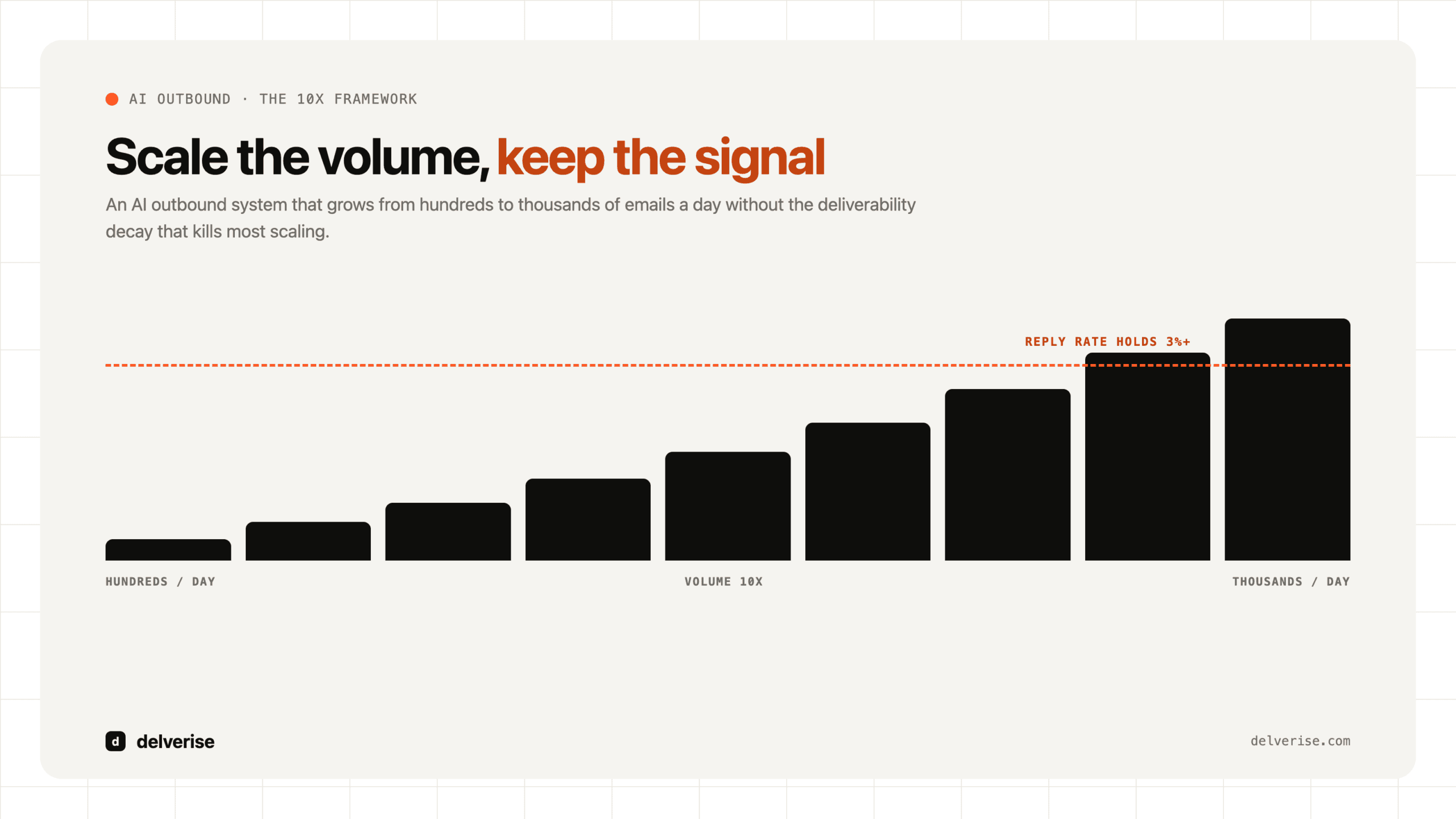
This technical infrastructure blueprint has enabled our clients to scale from hundreds to thousands of emails per day without experiencing the deliverability degradation that destroys most scaling efforts. The key is treating infrastructure as a strategic asset that requires systematic planning, implementation, and maintenance.
The Offer Architecture That Converts
Most outbound campaigns fail because they lead with features instead of outcomes. Through our analysis of thousands of successful campaigns, we’ve developed a systematic approach to offer architecture that transforms cold prospects into engaged conversations. Our framework is about how you present solutions to problems prospects didn’t even know they had.
Our Value Proposition Trinity
After analyzing every successful B2B purchase decision across our client base, we’ve discovered that every buying decision ultimately comes down to three fundamental drivers. We call this our Value Proposition Trinity:

1. Save Time (Efficiency Optimization)
- Eliminate manual processes that consume valuable resources
- Accelerate existing workflows and decision-making
- Reduce time-to-market for products, services, or initiatives
- Automate repetitive tasks that drain team productivity
2. Save Money (Cost Reduction)
- Reduce operational expenses and overhead costs
- Eliminate unnecessary tools, services, or processes
- Optimize resource allocation and utilization
- Prevent costly mistakes or compliance issues
3. Make Money (Revenue Generation)
- Increase sales, conversions, or customer lifetime value
- Expand market reach or customer acquisition
- Improve pricing power or profit margins
- Create new revenue streams or business opportunities
Our Trinity Application Framework: Every offer we create must clearly address at least one of these drivers with specific, measurable outcomes. If an offer doesn’t clearly save time, save money, or make money, we don’t send it.
Our foundational framework: every B2B buying decision comes down to these three drivers
Example Trinity Application:
- Generic Offer: “We provide marketing automation services”
- Trinity-Optimized Offer: “We help SaaS companies reduce customer acquisition costs by 40% while increasing lead conversion rates by 60% through our automated nurture sequences”
Our Gateway Offer System
We’ve developed what we call the “Costco Sample Strategy”: micro-offers that provide immediate value at minimal cost while creating a pathway to larger engagements.
Our Gateway Offer Principles:
- High Perceived Value: Prospects see significant benefit
- Low Delivery Cost: Minimal resource investment for us
- Clear Connection: Obvious pathway to larger solution
- Immediate Relevance: Addresses current, specific need
Gateway Offer Examples by Industry:
Real Estate Services:
- Main Offer: Complete property sale management
- Gateway Offer: “I noticed your lawn needs attention. We can handle the landscaping to increase your property’s curb appeal and sale value at minimal cost.”
E-commerce Solutions:
- Main Offer: Complete marketing automation platform
- Gateway Offer: “I noticed you’re using Shopify. We have a conversion optimization app that can increase your checkout completion rate. Would you like to try it free for 30 days?”
B2B Software:
- Main Offer: Enterprise software implementation
- Gateway Offer: “I noticed you’re manually tracking [specific process]. We can automate this specific workflow for you as a pilot project.”
Our Relevance-First Messaging Framework
We’ve discovered that relevance beats personalization every time. Our messaging framework creates genuine relevance by connecting observed business situations to specific business outcomes.
Our Message Architecture:
Our Proven Message Template:
Hey [First Name], I noticed [specific, relevant observation about their business situation]. This typically [indicates/suggests/creates] [specific business challenge or opportunity]. We've helped similar [industry/company type] companies [achieve specific outcome] by [brief solution description]. Would you be interested in exploring how this could work for [their company]? Best regards, [Name] Example Implementation:
Hey Sarah, I noticed you're hiring for a Senior DevOps Engineer with Kubernetes expertise. This typically indicates you're scaling your infrastructure but need specialized skills while you're recruiting. We've helped similar SaaS companies bridge this exact skill gap by providing dedicated DevOps support during their hiring process, allowing them to maintain their growth trajectory without delays. Would you be interested in exploring how this could accelerate your timeline while you're building your team? Best regards, Alex Our Market Validation Protocol
When our Trinity framework doesn’t generate responses, we deploy our market validation protocol, a systematic approach to gathering feedback that often converts into opportunities.
Our Feedback Strategy Framework: “Hey [Name], I’m actually offering [specific service/solution]. I’m not sure if it’s valuable to [their industry/situation] or not, but can I get your feedback to see if this is actually valuable to you?”
Why This Works:
- People love giving feedback: It positions them as experts
- Removes sales pressure: No immediate commitment required
- Creates engagement: They have to think about your solution
- Generates insights: Real market feedback for optimization
- Opens conversations: Often leads to discovery calls
Our Feedback Conversion Process:
Our Offer Hierarchy System
We’ve developed a systematic approach to structuring offers that creates clear progression from initial engagement to full solution adoption.
Tier 1: Awareness Offers (Gateway)
- Free assessments or audits
- Educational content or resources
- Quick wins or immediate value
- Low commitment, high value
Tier 2: Consideration Offers (Bridge)
- Pilot projects or limited engagements
- Proof-of-concept implementations
- Specific problem-solving initiatives
- Medium commitment, proven value
Tier 3: Decision Offers (Full Solution)
- Complete solution implementation
- Long-term partnership agreements
- Comprehensive service packages
- High commitment, transformational value
Our Progression Strategy: Each tier is designed to naturally lead to the next level while providing standalone value. Prospects can enter at any tier based on their readiness and situation.
Our Industry-Specific Offer Adaptation
We’ve discovered that the same core solution must be presented differently across industries to maximize relevance and conversion rates.
Healthcare Industry Adaptation:
- Language: Compliance, patient outcomes, regulatory requirements
- Metrics: Patient satisfaction, operational efficiency, cost per patient
- Concerns: HIPAA compliance, data security, workflow disruption
- Decision Makers: Chief Medical Officers, Practice Administrators
Financial Services Adaptation:
- Language: Risk management, regulatory compliance, competitive advantage
- Metrics: ROI, risk reduction, operational efficiency, customer acquisition
- Concerns: Security, compliance, integration complexity
- Decision Makers: Chief Risk Officers, Operations Directors
Technology Industry Adaptation:
- Language: Scalability, innovation, competitive differentiation
- Metrics: Performance improvements, development velocity, user engagement
- Concerns: Technical integration, scalability, team adoption
- Decision Makers: CTOs, Engineering Directors, Product Managers
Our Objection Prevention Framework
Rather than handling objections after they arise, we’ve developed systematic approaches to prevent common objections before they occur.
Common Objection Categories:
Our Prevention Strategies:
Timing Objections:
- Lead with immediate, relevant business situations
- Offer flexible implementation timelines
- Provide quick wins that demonstrate value
Budget Objections:
- Focus on ROI and cost savings rather than price
- Offer pilot projects or phased implementations
- Demonstrate clear financial impact
Authority Objections:
- Target actual decision-makers through research
- Provide materials designed for sharing with stakeholders
- Offer to present to decision-making groups
Need Objections:
- Use specific, relevant business observations
- Connect to measurable business outcomes
- Provide industry-specific case studies
Trust Objections:
- Reference similar companies and results
- Provide social proof and testimonials
- Offer low-risk ways to experience our expertise
This offer architecture framework has enabled our clients to achieve reply rates consistently above industry benchmarks because every message provides genuine value and relevance to the recipient’s specific business situation.
Our List Building & Targeting Methodology
Most agencies build lists like they’re buying a phone book. They gather as many contacts as possible and blast the same message to everyone. We’ve developed a systematic approach that treats list building as strategic intelligence gathering. Our methodology ensures every prospect on our lists has been qualified for relevance, reachability, and revenue potential before we ever send the first email.
Our ICP Definition Protocol
Before building any list, we complete our three-foundation framework that ensures every subsequent decision is strategically aligned.
Our Three-Foundation Questions:
Our ICP Research Methodology Using AI: We’ve developed a systematic approach to ICP definition that combines AI analysis with market intelligence.
Step 1: Current Customer Analysis
AI Prompt: "Analyze our current customer base and identify the common characteristics of our highest-value clients. Include: Step 2: Market Opportunity Assessment We use AI to analyze broader market opportunities and identify underserved segments:
- Industry and company size patterns
- Decision-maker titles and departments
- Common pain points and challenges
- Technology stack and tool usage
- Geographic and demographic patterns
AI Prompt: "Based on our solution [description], identify potential market
segments that would benefit from our offer. Consider:
- Industries with relevant pain points
- Company growth stages and characteristics
- Technology adoption patterns
- Regulatory or market pressures
- Competitive landscape gaps
Step 3: Persona Validation and Refinement We validate our ICP assumptions through systematic market research and feedback collection.
Our Decision-Maker Mapping System
We’ve discovered that the same message delivered to different decision-makers within the same company produces dramatically different results. Our mapping system ensures we’re speaking the right language to the right person.
Our Persona-Specific Language Framework:
CEO/Founder Targeting:
- Language Focus: Vision, growth, competitive advantage, market opportunity
- Metrics That Matter: Revenue growth, market share, strategic positioning
- Pain Points: Scaling challenges, competitive threats, strategic decisions
- Message Angle: Big picture impact and transformational outcomes
CTO/Technical Leadership:
- Language Focus: Technical specifications, security, scalability, integration
- Metrics That Matter: Performance improvements, security compliance, system reliability
- Pain Points: Technical debt, security vulnerabilities, scalability limitations
- Message Angle: Technical solutions and implementation details
CFO/Financial Leadership:
- Language Focus: ROI, cost savings, financial impact, risk management
- Metrics That Matter: Cost reduction, revenue impact, operational efficiency
- Pain Points: Budget constraints, financial reporting, cost optimization
- Message Angle: Financial benefits and risk mitigation
CMO/Marketing Leadership:
- Language Focus: Customer acquisition, brand growth, marketing efficiency
- Metrics That Matter: Customer acquisition cost, conversion rates, brand awareness
- Pain Points: Lead generation, attribution, marketing ROI
- Message Angle: Marketing performance and customer growth
Our Solution-Centric Targeting Method
Rather than starting with demographics and hoping to find relevant prospects, we start with our solution and work backward to identify who would most likely respond.
Our Reverse-Engineering Process:
Example Application:
- Our Solution: Marketing automation for SaaS companies
- Specific Problem: Low trial-to-paid conversion rates
- Who Experiences This: SaaS companies with freemium models
- Decision Makers: Head of Growth, VP Marketing, Founder
- Timing Indicators: Recent funding, product launches, hiring growth marketers
- Targeting Strategy: SaaS companies with freemium models, recent funding, hiring for growth roles
Our Market Sizing Framework
We’ve developed a systematic approach to Total Addressable Market (TAM) assessment that ensures we have sufficient volume for statistical significance while maintaining quality standards.
Our TAM Assessment Process:
Step 1: Initial Market Sizing Using Apollo or similar platforms, we apply basic filters to estimate our addressable market:
- Industry and company size parameters
- Geographic limitations
- Technology stack requirements
- Employee count and revenue indicators
Step 2: Enrichment Rate Calculation We apply our proven enrichment rate formula to determine realistic contact volume:
Realistic TAM = Initial TAM × 70% (typical enrichment rate) Step 3: Monthly Volume Planning We calculate sustainable monthly outreach volume:
Monthly Volume = (Realistic TAM ÷ 3 months) × 2 emails per sequence Example Calculation:
- Initial Apollo TAM: 100,000 companies
- Realistic TAM (70% enrichment): 70,000 contacts
- 3-month cycle: 23,333 contacts per month
- 2 emails per sequence: 46,666 emails per month
Our Waterfall Enrichment Process
We’ve developed a sophisticated enrichment process that maximizes contact discovery while maintaining data quality.
Our Multi-Source Enrichment Strategy:
Our Enrichment Quality Standards:
- Minimum 70% enrichment rate: Below this threshold indicates targeting issues
- Maximum 5% bounce rate: Higher rates suggest data quality problems
- Verification confidence: Minimum 95% confidence on verified emails
- Catch-all handling: Separate treatment for catch-all domains
Our TAM Scoring and Segmentation System
Rather than treating all prospects equally, we’ve developed a scoring system that prioritizes outreach based on likelihood to convert and potential value.
Our Scoring Criteria:
Intent Signals (High Priority):
- Recent job postings for relevant roles
- Technology changes or implementations
- Funding announcements or growth indicators
- Content engagement or website activity
Firmographic Indicators (Medium Priority):
- Company size and growth stage
- Industry and market position
- Technology stack compatibility
- Geographic and cultural alignment
Demographic Factors (Lower Priority):
- Decision-maker title and seniority
- Department and reporting structure
- Professional background and experience
- Social media activity and engagement
Our Segmentation Strategy:
- Tier 1 (Hot Prospects): High intent signals + ideal firmographics
- Tier 2 (Warm Prospects): Some intent signals + good firmographics
- Tier 3 (Cold Prospects): Ideal firmographics + right demographics
Our Department-Based Targeting Approach
We’ve discovered that targeting by department rather than just title produces significantly better results because it accounts for organizational structure variations.
Our Department Mapping:
- Technology Department: CTOs, Engineering Directors, DevOps Managers
- Sales Department: VPs of Sales, Sales Directors, Revenue Operations
- Marketing Department: CMOs, Marketing Directors, Growth Managers
- Operations Department: COOs, Operations Directors, Process Managers
Department-Specific Messaging Strategies: Each department has unique priorities, challenges, and success metrics that require tailored messaging approaches.
Our Sub-Industry Specialization Method
Within broad industry categories, we’ve identified sub-industries that respond differently to our messaging and require specialized approaches.
E-commerce Sub-Industries:
- Fashion/Apparel: Seasonal trends, inventory management, customer retention
- Electronics: Technical specifications, warranty management, supply chain
- Health/Beauty: Regulatory compliance, ingredient transparency, customer education
SaaS Sub-Industries:
- HR Technology: Compliance requirements, employee experience, data security
- Marketing Technology: Integration capabilities, data attribution, ROI measurement
- Financial Technology: Regulatory compliance, security standards, audit requirements
Our Sub-Industry Adaptation Process:
Our List Quality Assurance Protocol
We’ve implemented systematic quality checks that ensure every list meets our standards before any outreach begins.
Our Quality Checklist:
- Enrichment rate above 70%
- Verification confidence above 95%
- Bounce rate projection below 5%
- Decision-maker title accuracy verified
- Company information current and accurate
- Duplicate removal completed
- Suppression list applied
- Segmentation logic validated
Our Continuous Optimization Process:
- Weekly Performance Review: Analyze reply rates and engagement by segment
- Monthly List Refresh: Update contact information and company data
- Quarterly Strategy Review: Assess targeting effectiveness and adjust criteria
- Annual ICP Refinement: Update ideal customer profile based on results
This systematic approach to list building and targeting has enabled our clients to achieve reply rates consistently above industry benchmarks because every prospect receives messaging that’s specifically relevant to their situation, challenges, and goals.
Reply Handling & Conversion Optimization
The difference between outbound campaigns that generate meetings and those that generate replies lies in what happens after someone responds. We’ve developed a systematic approach to reply handling that converts interested prospects into qualified pipeline while maintaining the human connection that drives business relationships.
Our Response Time Optimization System
Through our analysis of thousands of reply conversations, we’ve discovered that response timing dramatically impacts conversion rates. Our data shows that the window for maintaining prospect engagement is much smaller than most agencies realize.
Our Response Time Framework:
- Ideal Response Time: 10-15 minutes after reply received
- Maximum Acceptable: 4 hours during business hours
- After-Hours Protocol: First thing next business morning
- Weekend Strategy: Monday morning priority response
Why 10-15 Minutes is Optimal:
- Too Fast (Under 5 minutes): Appears automated or overly aggressive
- Optimal Range (10-15 minutes): Shows attentiveness without seeming robotic
- Too Slow (Over 4 hours): Prospect attention shifts to other priorities
- Critical Threshold: After 24 hours, conversion rates drop by 60%
Our Speed-to-Lead Infrastructure:
- Webhook Integration: Real-time reply notifications across platforms
- Mobile Alerts: Instant notifications to response team
- Backup Systems: Multiple team members receive alerts
- Response Templates: Pre-approved responses for common scenarios
- Escalation Protocols: Clear handoff procedures for complex responses
Our Video Engagement Protocol
We’ve discovered that video responses create significantly higher engagement and conversion rates than text-only replies. Our video protocol transforms cold email responses into warm, personal conversations.
Our Loom Video Strategy: When prospects request more information or show interest, we immediately deploy our video response protocol:
Step 1: Immediate Website Research (2-3 minutes)
- Visit their company website
- Identify specific business context
- Look for personal connection opportunities
- Note recent company news or updates
Step 2: Personalized Video Creation (30-60 seconds maximum)
- Reference specific observations about their company
- Build rapport through genuine personal connections
- Demonstrate understanding of their business
- Include pattern disruptors (shared experiences, locations, interests)
Our Video Script Framework:
"Hey [Name], I actually just visited [company website] and saw [specific observation]. That's really interesting! I was actually just in [their location] last week. I'd love to learn more about [specific aspect of their business] and see if we can partner together on [relevant objective]. Let me know if [specific time suggestion] works for you, or feel free to suggest a time that's better." Video Performance Optimization:
- Length: 30-60 seconds maximum (attention span optimization)
- Quality: Professional but not overly produced
- Background: Clean, professional environment
- Energy: Enthusiastic but not overwhelming
- Call-to-Action: Specific, easy next step
Our Follow-Up Persistence Framework
We’ve developed what we call the “Fortune Formula”, a systematic approach to follow-up that maximizes conversion while respecting prospect preferences.
Our Core Follow-Up Principles:
- Fortune’s in the follow-up: Most conversions happen after multiple touchpoints
- Follow up until they say no: Persistence beats premature abandonment
- Add value in every interaction: Never just “bump” or “circle back”
- Match their communication style: Respond in their preferred medium
Our Follow-Up Sequence Strategy:
Value-Added Follow-Up Examples:
- Industry Insights: “I just saw this article about [their industry] and thought you’d find it relevant…”
- Case Studies: “I was just working with another [similar company] who had a similar challenge…”
- Tools/Resources: “I came across this tool that might help with [their mentioned challenge]…”
- Market Intelligence: “I noticed [competitor/industry trend] and thought you should know…”
Our Conversation Architecture System
We’ve developed specific language patterns that guide conversations toward productive outcomes while maintaining a collaborative, non-salesy tone.
Our Collaborative Language Framework: Instead of traditional sales language, we use collaborative phrases that invite partnership:
Traditional: “Are you available tomorrow at 9 AM?” Our Approach: “Can we explore this together?” or “Would you be open to discussing how we can solve this problem?”
Traditional: “Let me show you our solution” Our Approach: “Let’s look at how this might work for your specific situation”
Traditional: “I’d like to schedule a demo” Our Approach: “Would it be helpful to walk through how this could impact your [specific challenge]?”
Our Conversation Flow Strategy:
Our Objection Transformation Protocol
Rather than handling objections defensively, we’ve developed a system that transforms objections into opportunities for deeper engagement.
Common Objections and Our Transformation Strategies:
“Not the right time”
- Traditional Response: “When would be a better time?”
- Our Transformation: “I understand timing is important. What would need to change for this to become a priority?”
“Too expensive”
- Traditional Response: “We have different pricing options”
- Our Transformation: “Cost is definitely a consideration. What kind of ROI would make this a no-brainer investment?”
“Need to think about it”
- Traditional Response: “How long do you need?”
- Our Transformation: “What specific aspects would be most helpful to explore further?”
“Already have a solution”
- Traditional Response: “How is that working for you?”
- Our Transformation: “That’s great! What would make you consider an alternative approach?”
Our Qualification and Scoring System
We’ve developed a systematic approach to qualifying prospects during reply conversations that ensures we focus our time on the highest-potential opportunities.
Our BANT+ Qualification Framework:
- Budget: Do they have financial resources allocated?
- Authority: Are we speaking with decision-makers?
- Need: Do they have a genuine business challenge we can solve?
- Timeline: When do they need to implement a solution?
- Plus Factors: Strategic fit, growth potential, reference value
Our Scoring Methodology:
- Hot Prospect (8-10 points): Immediate follow-up, priority scheduling
- Warm Prospect (5-7 points): Nurture sequence, regular check-ins
- Cold Prospect (1-4 points): Long-term nurture, quarterly outreach
Qualification Questions That Work:
- “What’s driving the need to solve this now?”
- “How are you currently handling [specific challenge]?”
- “What would success look like for you?”
- “Who else would be involved in evaluating solutions?”
- “What’s your timeline for making a decision?”
Our CRM Integration and Handoff Protocol
We’ve developed seamless integration between our outbound operations and sales processes that ensures no opportunities are lost in transition.
Our Lead Handoff Checklist:
- Complete prospect qualification scoring
- Document all conversation history and context
- Identify key stakeholders and decision-makers
- Note specific pain points and priorities mentioned
- Include relevant company research and insights
- Set clear expectations for next steps
- Schedule appropriate follow-up timeline
Our CRM Data Standards:
- Contact Information: Complete and verified details
- Company Intelligence: Size, industry, technology stack, recent news
- Conversation History: Complete thread of all interactions
- Qualification Status: BANT+ scoring and notes
- Next Steps: Clear action items and timeline
- Stakeholder Mapping: All identified decision-makers and influencers
Our Conversion Rate Optimization System
We continuously optimize our reply handling process based on performance data and conversion metrics.
Key Performance Indicators:
- Reply-to-Meeting Rate: Percentage of replies that convert to meetings
- Meeting-to-Opportunity Rate: Percentage of meetings that become qualified opportunities
- Response Time Impact: Correlation between response speed and conversion
- Follow-Up Effectiveness: Conversion rates by follow-up sequence position
- Video vs. Text Performance: Engagement rates by response type
Our Optimization Process:
This systematic approach to reply handling has enabled our clients to achieve meeting booking rates of 15-25% from positive replies, significantly above industry averages of 5-10%. The key is treating every reply as an opportunity to build a genuine business relationship rather than complete a transaction.
Scaling Operations: Our Agency-Tested Approach
Scaling outbound operations is where most agencies fail. They assume that doubling volume will double results, but we’ve discovered that scaling requires fundamentally different approaches to campaign management, team structure, and performance optimization. Our scaling methodology has enabled clients to grow from hundreds to thousands of emails per day while maintaining or improving performance metrics.
Our Volume Threshold Principle
Through extensive testing across client campaigns, we’ve identified the minimum volume requirements for reliable performance data and optimization decisions.
Our 1,000 Email Minimum Rule: We require minimum 1,000 emails per day for several critical reasons:
- Statistical Significance: Below 1,000 emails, performance data is unreliable
- Optimization Capability: Insufficient data for meaningful A/B testing
- Market Feedback: Not enough responses to identify patterns
- Benchmark Comparison: Industry standards require minimum volume for comparison
Our Volume Scaling Mathematics:
Minimum Viable Volume: 1,000 emails/day Industry Benchmark Reply Rate: 1.5-3% Expected Daily Replies: 15-30 responses Weekly Optimization Data: 105-210 data points Monthly Performance Analysis: 450-900 data points Below Threshold Consequences:
- Unreliable performance metrics
- Inability to identify successful patterns
- Insufficient data for optimization decisions
- Extended testing periods for campaign improvements
- Difficulty benchmarking against industry standards
Our Always-On Campaign Strategy
Most agencies pause campaigns when they get overwhelmed with responses. We’ve developed an always-on approach that balances supply and demand while maintaining consistent pipeline generation.
Our Always-On Principles:
- Default to Running: Campaigns run continuously unless specifically paused
- Supply-Demand Balance: Adjust volume based on response handling capacity
- Performance-Based Pausing: Only pause campaigns that consistently underperform
- Systematic Optimization: Continuous improvement while campaigns run
When We Pause Campaigns:
Our Volume Adjustment Protocol: Rather than pausing entire campaigns, we adjust volume based on capacity:
- High Response Volume: Reduce daily sending by 25-50%
- Optimal Response Volume: Maintain current sending levels
- Low Response Volume: Increase volume or optimize messaging
- No Response Volume: Pause for strategic review and optimization
Our Performance Optimization System
We’ve developed systematic approaches to campaign optimization that ensure continuous improvement without disrupting successful operations.
Our Testing Framework: We follow a strict testing protocol that provides reliable data for optimization decisions:
The Three-Approach Rule: Before declaring a market or campaign unsuccessful, we test three different approaches:
Our A/B Testing Standards:
- Minimum Test Duration: 2 weeks for statistical significance
- Minimum Volume: 500 emails per variation
- Single Variable Testing: Change only one element per test
- Performance Threshold: 20% improvement required for implementation
- Documentation Requirements: Complete test results and learnings recorded
Reply Rate Benchmarks and Actions:
- Above 3%: Excellent performance, scale volume and replicate approach
- 1.5-3%: Acceptable performance, optimize for improvement
- Below 1%: Poor performance, implement three-approach testing
- Below 0.5%: Campaign failure, complete strategic review required
Our Team Structure for Scale
Scaling outbound operations requires specialized team roles and clear responsibility distribution. We’ve developed organizational structures that support growth without sacrificing quality.
Our Core Team Roles:
Campaign Strategist:
- ICP research and definition
- Message strategy and optimization
- Performance analysis and reporting
- Strategic planning and adjustments
Technical Operations Manager:
- Infrastructure setup and maintenance
- Deliverability monitoring and optimization
- Platform management and integration
- Technical troubleshooting and support
Reply Handler/Sales Development:
- Response management and qualification
- Meeting scheduling and coordination
- Follow-up sequence management
- Lead handoff to sales team
Data Analyst:
- Performance tracking and reporting
- A/B testing design and analysis
- Market research and intelligence
- Optimization recommendations
Our Scaling Team Structure:
- 0-1,000 emails/day: 1-2 person team (strategist + reply handler)
- 1,000-5,000 emails/day: 3-4 person team (add technical operations)
- 5,000+ emails/day: 5+ person team (add dedicated data analyst)
Our Quality Control at Scale
Maintaining quality while scaling volume requires systematic quality control processes that prevent degradation of performance or brand reputation.
Our Quality Assurance Checklist:
- Message relevance and personalization quality
- Technical setup and authentication compliance
- List quality and targeting accuracy
- Response handling speed and quality
- Brand consistency across all communications
- Compliance with regulations and best practices
Our Monitoring Systems:
- Daily Performance Dashboards: Key metrics and trend analysis
- Weekly Quality Reviews: Message quality and response analysis
- Monthly Strategic Reviews: Campaign performance and optimization opportunities
- Quarterly Business Reviews: Overall strategy and goal alignment
Our Infrastructure Scaling Protocol
As volume increases, infrastructure requirements change dramatically. We’ve developed systematic approaches to infrastructure scaling that maintain deliverability and performance.
Our Infrastructure Scaling Milestones:
- 1,000 emails/day: 17 domains, 51 inboxes minimum
- 3,000 emails/day: 50 domains, 150 inboxes recommended
- 5,000 emails/day: 83 domains, 250 inboxes required
- 10,000+ emails/day: 167+ domains, 500+ inboxes enterprise level
Our Scaling Infrastructure Strategy:
Our Automation and Efficiency Systems
Scaling requires systematic automation of repetitive processes while maintaining the human touch where it matters most.
Our Automation Priority Framework:
Processes We Automate:
- Data Collection: Prospect research and enrichment
- List Building: Contact discovery and verification
- Campaign Setup: Sequence creation and scheduling
- Performance Tracking: Metrics collection and reporting
- Infrastructure Monitoring: Deliverability and health checks
Processes We Keep Human:
- Strategy Development: ICP definition and message strategy
- Quality Control: Message review and optimization
- Reply Handling: Response management and qualification
- Relationship Building: Meeting facilitation and follow-up
- Strategic Analysis: Performance analysis and optimization planning
Our Performance Benchmarking System
We maintain comprehensive benchmarking that allows us to identify optimization opportunities and ensure our clients achieve industry-leading results.

Our Benchmark Categories:
- Industry Standards: Performance compared to industry averages
- Client Historical: Performance compared to previous periods
- Campaign Comparison: Performance across different campaigns
- Competitive Analysis: Performance compared to known competitors
Key Performance Benchmarks:
- Reply Rate: 1.5-3% industry standard, 3%+ excellent
- Meeting Booking Rate: 15-25% of positive replies
- Response Time: 10-15 minutes average
- Infrastructure Longevity: 6+ months average domain lifespan
- Cost Efficiency: Cost per meeting booked trending downward
This systematic approach to scaling has enabled our clients to achieve sustainable growth in their outbound operations without the performance degradation that typically accompanies volume increases. The key is treating scaling as a strategic process that requires systematic planning, execution, and optimization rather than simply increasing volume and hoping for the best.
Typical client transformation: from failing campaigns to industry-leading performance through our systematic approach
Advanced AI Tactics We Use for Fortune 500 Clients
Our most sophisticated clients require advanced AI strategies that go far beyond basic personalization. These are the proprietary tactics we’ve developed through years of working with enterprise organizations that demand exceptional results and have the resources to implement cutting-edge approaches.
Our Intellectual Property Management System
We treat AI prompts as valuable intellectual property assets that require systematic development, testing, and protection. Our prompt library represents years of optimization and refinement.
Our Prompt Asset Development Process:
Our Prompt Library Organization:
- Industry-Specific Prompts: Customized for healthcare, finance, technology, etc.
- Persona-Specific Prompts: Tailored for CEOs, CTOs, CFOs, etc.
- Use Case Prompts: Research, personalization, follow-up, objection handling
- Performance Tiers: Ranked by effectiveness and conversion rates
- Version Control: Historical tracking of prompt evolution and improvements
Example: Our Proprietary Enterprise Research Prompt
You are conducting executive-level research for outreach to [TITLE] at [COMPANY]. Context Requirements: Analysis Framework: Output Requirements: Our AI Training and Memory Optimization Protocol
We’ve developed sophisticated systems for training AI models to understand our clients’ businesses as deeply as their internal teams.
- Company: [Company data, recent news, strategic initiatives]
- Industry: [Market trends, regulatory changes, competitive landscape]
- Executive: [Background, recent activities, published content]
- Our Solution: [Specific value proposition for this persona/industry]
- Strategic level (not tactical)
- Evidence-based (not assumed)
- Outcome-focused (not feature-focused)
- Executive language (not sales language)
- Specific to their situation (not generic)
Our AI Memory Loading Strategy: We systematically load our AI systems with comprehensive context that enables them to operate like specialized team members:
Company Intelligence Database:
- Complete solution descriptions and methodologies
- Detailed ICP profiles and characteristics
- Historical campaign performance data
- Competitive positioning and advantages
- Case studies and success metrics
- Team expertise and specializations
Market Intelligence Integration:
- Industry trends and regulatory changes
- Competitive landscape analysis
- Technology adoption patterns
- Economic factors affecting target markets
- Seasonal and cyclical business patterns
Our AI Training Protocol:
You are now a specialized sales development representative for [COMPANY]. Your Role: Your Knowledge Base: Your Standards: Our Technographic Intelligence Framework
For enterprise clients, we’ve developed sophisticated technographic targeting that identifies prospects based on their technology infrastructure and digital maturity.
- Company: [Detailed company description and mission]
- Solution: [Comprehensive solution overview and benefits]
- ICP: [Detailed ideal customer profile with pain points]
- Methodology: [How we deliver results and create value]
- Competitive Advantage: [What makes us unique and better]
- [Complete case studies and success stories]
- [Industry expertise and specializations]
- [Common objections and proven responses]
- [Pricing and packaging information]
- [Implementation process and timeline]
- Always provide specific, relevant value
- Reference concrete business outcomes
- Use collaborative, consultative language
- Focus on business impact, not features
- Maintain professional, expert positioning
Our Technology Stack Analysis: We systematically analyze prospect technology environments to identify specific opportunities and challenges:
Infrastructure Assessment:
- Cloud platforms and hosting environments
- Security tools and compliance frameworks
- Integration platforms and middleware
- Analytics and business intelligence tools
- Communication and collaboration platforms
Digital Maturity Scoring:
- Technology adoption patterns
- Innovation indicators
- Digital transformation initiatives
- Automation and AI implementation
- Data management sophistication
Our Technographic Targeting Strategy:
Target: Companies using Shopify Plus with Klaviyo integration Analysis Framework: Message Strategy: Reference their specific technology stack and offer solutions that enhance their existing investments rather than replacing them. Our Small TAM High-Value Strategy
When working with clients who have limited target markets, we’ve developed intensive research approaches that achieve exceptional results through depth rather than breadth.
- Platform: Shopify Plus indicates enterprise e-commerce operation
- Integration: Klaviyo suggests sophisticated email marketing
- Opportunity: Advanced automation and personalization capabilities
- Challenge: Likely struggling with cross-platform data integration
- Our Solution: Unified customer data platform with advanced segmentation
Our High-Touch Research Protocol: For markets with fewer than 1,000 total prospects, we implement our “masses of research” approach:
Individual Prospect Intelligence:
- Complete company analysis and strategic assessment
- Executive background research and recent activities
- Competitive landscape and market positioning
- Recent news, funding, and strategic announcements
- Technology stack and digital infrastructure analysis
- Social media activity and content engagement patterns
Our Deep Research Framework: 1. Company Analysis (30 minutes per prospect):
- Website content analysis and strategic messaging
- Recent press releases and company announcements
- Leadership team backgrounds and expertise
- Product roadmap and strategic initiatives
- Customer case studies and success stories
-
Market Context Research (15 minutes per prospect):
- Industry trends affecting their business
- Competitive pressures and opportunities
- Regulatory or compliance requirements
- Technology adoption patterns in their sector
-
Personalization Development (15 minutes per prospect):
- Specific business challenges identification
- Relevant case studies and success stories
- Customized value proposition development
- Strategic conversation starter creation
Our Small TAM Performance Standards:
- Reply Rate Target: 8-15% (significantly above standard 1.5-3%)
- Research Investment: 60+ minutes per prospect
- Message Customization: 100% unique messaging
- Follow-Up Intensity: 5-7 touchpoints over 3 months
- Relationship Building: Long-term nurture and relationship development
Our Content Trigger Mining System
We’ve developed sophisticated systems for identifying and leveraging real-time business triggers that indicate immediate opportunity.
Our Trigger Source Monitoring:
- Funding Announcements: Series A, B, C funding rounds
- Executive Changes: New hires, promotions, departures
- Product Launches: New products, features, or services
- Market Expansion: New locations, markets, or segments
- Technology Changes: Platform migrations, new tool adoptions
- Regulatory Changes: Compliance requirements, industry regulations
- Partnership Announcements: Strategic alliances, acquisitions
- Content Publication: Blog posts, whitepapers, case studies
Our Trigger Response Framework:
Trigger Identified: [Company] just announced Series B funding of $50M Analysis Process: Message Strategy: "Congratulations on your Series B! I noticed [specific detail about funding use]. We've helped similar companies at this growth stage [specific relevant outcome]. Would you be interested in exploring how this could accelerate your [specific goal]?" Our Automation Justification and ROI Framework
For enterprise clients, we’ve developed sophisticated ROI calculations that justify advanced automation investments.
Our Time-Value Calculation System:
Task: Prospect research and personalization Manual Time: 15 minutes per prospect Automation Time: 2 minutes per prospect Time Savings: 13 minutes per prospect Volume Analysis: ROI Calculation: Our Automation Priority Matrix:
- 1,000 prospects per month
- Manual approach: 250 hours per month
- Automated approach: 33 hours per month
- Time savings: 217 hours per month
- Executive hourly rate: $200/hour
- Monthly savings: 217 hours × $200 = $43,400
- Annual savings: $520,800
- Automation investment: $50,000
- ROI: 940% first-year return
- High-Volume, Low-Complexity: Immediate automation priority
- High-Volume, High-Complexity: Systematic automation with human oversight
- Low-Volume, High-Value: Selective automation with manual quality control
- Low-Volume, Low-Value: Consider elimination rather than automation
Our Competitive Intelligence Integration
We’ve developed systems that integrate competitive intelligence into our AI-powered outreach strategies.
Our Competitive Analysis Framework:
- Direct Competitors: Companies offering similar solutions
- Indirect Competitors: Alternative approaches to solving the same problem
- Status Quo: Current methods prospects use to address challenges
- Emerging Threats: New technologies or approaches entering the market
Our Competitive Positioning Strategy: Rather than attacking competitors, we position our solutions as complementary or evolutionary improvements:
Competitive Situation: Prospect currently uses [Competitor Solution] Our Approach: "I noticed you're using [Competitor] for [specific use case]. That's a solid choice for [specific strength]. We've actually helped companies enhance their [Competitor] implementation by [specific improvement]. Would you be interested in exploring how this could optimize your current setup?" Our Enterprise-Level Personalization at Scale
For Fortune 500 clients, we’ve developed personalization approaches that maintain enterprise-level quality while achieving scale efficiency.
Our Tiered Personalization Strategy:
- Tier 1 (C-Suite): Maximum personalization, individual research
- Tier 2 (VP Level): High personalization, department-specific research
- Tier 3 (Director Level): Moderate personalization, role-specific messaging
- Tier 4 (Manager Level): Standard personalization, industry-specific content
Our Enterprise Personalization Framework:
Executive Level: CEO/President Research Depth: 45-60 minutes per prospect Personalization Elements: Message Strategy: Focus on strategic outcomes, competitive advantage, and transformational impact rather than tactical benefits or operational improvements. These advanced AI tactics have enabled our Fortune 500 clients to achieve reply rates of 5-12% and meeting booking rates of 25-40% from positive replies, performance levels that justify premium pricing and long-term strategic partnerships.
- Recent strategic announcements or initiatives
- Industry leadership activities (speaking, writing, awards)
- Company performance and market positioning
- Personal background and career progression
- Shared connections or experiences
- Strategic challenges and opportunities
The 90-Day Outbound Build: A Build-vs-Buy Decision Map
Standing up a complete outbound scaling system takes systematic execution across multiple phases. The 90-day scope below comes from deploying these systems with hundreds of clients. Read it as a decision tool rather than a to-do list: it shows exactly what the function requires across infrastructure, AI, content, and team, so you can weigh building it in-house against bringing in a partner who already runs it. Each phase is a real cost and capability commitment. Sizing the full picture first is how revenue leaders avoid committing a team to a build that stalls at week six.
The full 90-day scope of work, laid out so you can size the build before you commit a team to it
Foundation and Infrastructure (Days 1-30)
Phase 1 is the heaviest lift and the clearest place a build-vs-buy gap shows. The work below is the foundation cost of owning this function. As you read it, weigh the calendar time, the specialist skills, and the upfront infrastructure spend against the same outcome arriving pre-built through a partner.
Week 1: Strategic Planning and Setup
Days 1-3: Strategic Foundation
- Complete ICP definition using our three-foundation framework
- Conduct AI-powered market research and opportunity assessment
- Define value proposition using our Trinity framework (Save Time/Save Money/Make Money)
- Establish success metrics and performance benchmarks
- Set up project management and tracking systems
Days 4-7: Infrastructure Planning
- Calculate required infrastructure using our volume optimization formula
- Generate domain variations using our AI-powered domain generation process
- Purchase domains across multiple registrars for optimal pricing
- Plan provider distribution strategy based on target market characteristics
- Set up authentication requirements (DKIM, DMARC, SPF)
Week 2: Technical Implementation
Days 8-10: Email Infrastructure Setup
- Configure email accounts across Google, Microsoft, and private infrastructure
- Implement complete authentication setup for all domains
- Establish our 3-inbox per domain optimization ratio
- Configure backup and redundancy systems (Batch A/B architecture)
- Set up monitoring and alerting systems
Days 11-14: Platform Integration
- Configure primary sending platform (Instantly or equivalent)
- Set up data enrichment platform (Clay or equivalent)
- Implement CRM integration and lead handoff protocols
- Configure webhook automation for real-time notifications
- Test all integrations and data flow processes
Week 3: AI System Development
Days 15-17: AI Training and Setup
- Implement our AI training methodology with complete context loading
- Develop initial prompt library using our proprietary frameworks
- Configure AI model selection strategy (ChatGPT, Claude, platform-specific)
- Set up memory optimization protocols for campaign context
- Test AI output quality and relevance across different scenarios
Days 18-21: Content and Messaging Development
- Create persona-specific messaging using our relevance-first framework
- Develop gateway offers using our Costco sample strategy
- Build industry-specific message variations
- Create objection prevention frameworks
- Establish follow-up sequences and templates
Week 4: Quality Assurance and Testing
Days 22-24: Infrastructure Testing
- Complete domain aging and warmup protocols (minimum 2 weeks)
- Test deliverability across all provider combinations
- Verify authentication and reputation systems
- Conduct small-scale sending tests (50-100 emails)
- Monitor and optimize initial performance metrics
Days 25-28: System Integration Testing
- Test complete workflow from list building to CRM integration
- Verify AI personalization quality and relevance
- Test reply handling and response time protocols
- Conduct team training on all systems and processes
- Document standard operating procedures
Days 29-30: Launch Preparation
- Final quality assurance checklist completion
- Team role assignments and responsibility clarification
- Performance monitoring dashboard setup
- Backup and contingency plan verification
- Go-live approval and launch scheduling
Campaign Launch and Optimization (Days 31-60)
Phase 2 is where the function starts producing pipeline, and where it demands daily operating attention. If you build in-house, this is the point your team shifts from setup to a recurring optimization load. If you partner, this is the point you would already be reviewing live results. The work below is the input for that timing decision.
Week 5-6: Initial Campaign Deployment
Days 31-35: Soft Launch
- Launch with 500-1,000 emails per day (below full volume)
- Monitor deliverability and infrastructure performance
- Track initial reply rates and engagement metrics
- Implement our 10-15 minute response time protocol
- Document initial performance and optimization opportunities
Days 36-42: Volume Scaling
- Gradually increase to full volume (1,000+ emails per day)
- Monitor infrastructure health and deliverability impact
- Optimize sending patterns and timing
- Refine AI personalization based on initial feedback
- Implement our always-on campaign strategy
Week 7-8: Performance Optimization
Days 43-49: A/B Testing Implementation
- Test different subject line variations (mobile-optimized, <40 characters)
- Compare AI model performance (ChatGPT vs Claude vs platform-specific)
- Test different trigger types (job postings vs website data vs social signals)
- Optimize message structure using F-shaped reading principles
- Analyze and implement winning variations
Days 50-56: Conversion Optimization
- Optimize reply handling processes and response templates
- Implement video response protocols using our Loom strategy
- Refine follow-up sequences using our persistence framework
- Optimize meeting booking and qualification processes
- Enhance CRM integration and lead handoff procedures
Scaling and Advanced Implementation (Days 61-90)
Phase 3 is the specialist tier. The tactics below separate an outbound function that clears 3% from one that drifts at the industry average. They also concentrate the rarest skills in the build, which is why this phase is the strongest argument for weighing a partner who has already pressure-tested these plays.
Week 9-10: Advanced AI Implementation
Days 57-63: Sophisticated Personalization
- Implement our three-trigger personalization system
- Deploy technographic targeting for relevant prospects
- Enhance prompt library with performance-optimized variations
- Implement competitive intelligence integration
- Deploy content trigger mining for real-time opportunities
Days 64-70: Enterprise-Level Optimization
- Implement tiered personalization strategy for different prospect levels
- Deploy our small TAM high-value strategy where applicable
- Enhance automation and efficiency systems
- Implement advanced performance benchmarking
- Optimize team structure and role specialization
Week 11-12: Scale Preparation and Advanced Tactics
Days 71-77: Infrastructure Scaling
- Assess infrastructure capacity for increased volume
- Plan additional infrastructure acquisition and setup
- Implement advanced monitoring and quality control systems
- Optimize provider distribution based on performance data
- Prepare backup and redundancy systems for scale
Days 78-84: Advanced Campaign Strategies
- Implement industry-specific campaign variations
- Deploy account-based outreach for high-value prospects
- Enhance market intelligence and trigger identification
- Optimize multi-touch attribution and performance tracking
- Implement advanced segmentation and targeting strategies
Week 13: Performance Review and Strategic Planning
Days 85-90: Comprehensive Analysis and Future Planning
- Complete 90-day performance analysis and benchmarking
- Identify top-performing strategies and scale opportunities
- Document lessons learned and optimization opportunities
- Plan next 90-day strategic initiatives and improvements
- Establish long-term scaling and growth strategies
Success Metrics and Benchmarks: What “On Track” Looks Like
These milestones give you the yardstick for either path. If you build, they are your internal checkpoints. If you partner, they are what you should expect a credible provider to hit on your behalf.
30-Day Milestones:
- Infrastructure setup complete and operational
- AI systems trained and producing quality output
- Team trained and processes documented
- Initial campaigns ready for launch
60-Day Milestones:
- Minimum 1,000 emails per day volume achieved
- Reply rates within 1.5-3% benchmark range
- Response time averaging 10-15 minutes
- Meeting booking rate of 15-25% from positive replies
90-Day Milestones:
- Consistent performance above industry benchmarks
- Scalable systems and processes fully operational
- Outbound function operating efficiently with clear role specialization
- Strategic plan for continued growth and optimization
The Operating Rhythm This Function Needs
Once live, outbound is an ongoing operation, not a one-time setup. The cadence below is what keeps performance from decaying. A core build-vs-buy question is who owns this rhythm every week: an in-house team you staff and manage, or a partner for whom this rhythm is the standard service.
Weekly Check-ins:
- Performance metrics review and analysis
- Challenge identification and problem-solving
- Optimization opportunities and implementation planning
- Team coordination and responsibility clarification
Monthly Strategic Reviews:
- Comprehensive performance analysis and benchmarking
- Strategic adjustments and optimization planning
- Infrastructure scaling and capacity planning
- Market intelligence and competitive analysis updates
Quarterly Business Reviews:
- Overall strategy assessment and refinement
- Long-term growth planning and goal setting
- Team development and capability enhancement
- Technology and platform optimization opportunities
Where In-House Builds Commonly Stall
These are the recurring failure points across hundreds of deployments. Each one is a decision input: it tells you the depth of expertise and operating maturity the function demands, and it is honest about what an under-resourced build runs into.
Challenge: Low Initial Reply Rates What it takes: a three-approach testing framework (Save Time/Save Money/Make Money angles) applied with discipline. A partner brings tested angles on day one; a build learns them over weeks.
Challenge: Deliverability Issues What it takes: deep authentication knowledge, volume control, and infrastructure redundancy protocols. This is the single skill gap most likely to sink an in-house build.
Challenge: Response Overwhelm What it takes: a volume adjustment protocol plus reply-handling capacity. This is a clear staffing decision point: expand the in-house team or route volume through a partner who already staffs it.
Challenge: Team Coordination Issues What it takes: a defined scaling team structure and clear communication protocols, which is real management overhead for an in-house owner.
Challenge: Technology Integration Problems What it takes: working through a technical implementation checklist and correct platform configuration, an effort a partner has already absorbed.
This 90-day scope has been tested and refined through hundreds of deployments. The sequence is the same whether you run it in-house or with a partner. The decision is who carries the load and how quickly you reach a motion that produces measurable results.
Core Principles: True for Whoever Runs It
1. Relevance Over Personalization The 15-Second Relevance Framework shows that genuine business relevance beats surface-level personalization every time. Focus on solving visible problems rather than surface details like a prospect’s name and company.
2. Infrastructure as Strategic Asset The Deliverability Mastery Framework treats infrastructure as the foundation of all success. Proper authentication, volume optimization, and redundancy systems are non-negotiable for sustainable scaling.
3. AI as Intelligence Amplifier The AI Integration System goes beyond basic automation to create genuine business intelligence. The more context the AI systems receive, the more valuable their output becomes.
4. Systematic Approach to Scale A scaling methodology that grows through proven frameworks beats hoping volume increases will improve results.
Critical Success Factors
- Minimum 1,000 emails per day for statistical significance and optimization capability
- 15-20 emails per inbox maximum to maintain deliverability and sender reputation
- 10-15 minute response time to maximize conversion from interested prospects
- Three-approach testing before declaring any market or campaign unsuccessful
- Always-on campaign strategy with volume adjustment rather than pausing
Investment Requirements: The True Cost of the Build
This is the line-item cost of owning the function in-house, and the baseline you can compare a partner against.
Infrastructure: 33+ domains, 100+ inboxes for enterprise-level operations Technology: Professional platforms for sending, data enrichment, and AI integration Team: Specialized roles for strategy, operations, reply handling, and analysis Time: 90-day implementation timeline for complete system deployment
Expected Outcomes
These are the outcomes a working outbound function delivers, and the standard to hold either path to.
Performance Benchmarks:
- Reply rates: 1.5-3% (industry standard), 3%+ (excellent performance)
- Meeting booking: 15-25% of positive replies
- Infrastructure longevity: 6+ months average domain lifespan
- Response time: 10-15 minutes average
Business Impact:
- Predictable, scalable pipeline generation
- Reduced customer acquisition costs
- Improved sales team efficiency
- Enhanced market intelligence and competitive positioning
You can run this framework in-house, and a revenue team that genuinely commits to the human psychology behind it can build outbound that reaches the 10%. The other path is to bring in a partner who has already pressure-tested these plays across thousands of campaigns, so the system arrives built and your team starts from a motion that already works. If having someone handle that build sounds useful, that is the kind of work we do at delverise.
Frequently Asked Questions
What does it mean to scale outbound with AI?
Scaling outbound with AI means using automation, enrichment, AI research, personalization, sequencing, and CRM feedback loops to increase qualified pipeline without simply increasing send volume. The system has to protect deliverability, target the right accounts, personalize from real signals, and improve based on replies, meetings, and revenue outcomes.
What breaks most AI outbound programs?
Most AI outbound programs break because they treat AI as a copy generator instead of a system layer. Weak data, poor account fit, generic prompts, bad deliverability infrastructure, loose QA, and no CRM feedback loop usually cause the failure before the AI model does.
How does AI outbound connect to GTM Engineering?
AI outbound is one workflow inside GTM Engineering. GTM Engineering designs the surrounding system: data model, enrichment, scoring, routing, sequencing, QA, reporting, and attribution. AI outbound uses that system to turn account signals and prospect research into relevant outreach at scale.
Where does Clay fit in an AI outbound system?
Clay often acts as the workflow layer for account sourcing, enrichment waterfalls, AI research, fit scoring, and personalization inputs. It becomes more valuable when connected to the CRM, sequencer, QA rules, and reporting layer instead of being used only as a table of enriched contacts.
When should a team hire help for AI outbound?
A team should hire help when the bottleneck is system design rather than writing more emails. If deliverability, enrichment, scoring, CRM handoff, reply handling, QA, or attribution are unclear, an outside build partner can often create the operating model before the company adds permanent headcount.
Access Our Campaign Templates and Resources
Get immediate access to our battle-tested resources:
- Industry-specific message templates and sequences
- ICP research frameworks and questionnaires
- Deliverability optimization checklists
- AI prompt libraries for different use cases
- Performance benchmarking and analysis tools
This guide represents our complete methodology for scaling outbound operations with AI. We continuously update and refine these frameworks based on ongoing testing and market feedback. For the latest updates and additional resources, visit our resource center or contact our team directly.
About Our Agency: We are the leading revenue operations agency specializing in AI-powered outbound scaling. Our proprietary methodologies have generated over $50 million in pipeline for our clients across industries including SaaS, e-commerce, professional services, and enterprise technology. We work exclusively with growth-focused organizations that demand exceptional results and have the resources to implement cutting-edge strategies.
Read next