←Back to blog
Revenue Intelligence & Data ToolingGuideSeptember 12, 20268 min read
Best AI Cold Calling Software: A Revenue Leader’s Buying Guide
The best AI cold calling software depends on which job you are buying: autonomous voice agents that hold the conversation, parallel dialers that multiply human connects, or conversation intelligence that makes reps better. For most B2B SaaS teams between Seed and Series B, AI-assisted dialing on verified mobile data produces better meeting quality than fully autonomous calling.
The best AI cold calling software depends on which job you are buying: autonomous voice agents that hold the conversation, parallel dialers that multiply human connects, or conversation intelligence that makes reps better. For most B2B SaaS teams between Seed and Series B, AI-assisted dialing on verified mobile data produces better meeting quality than fully autonomous calling.
Key takeaways
- Three product categories share one keyword. Voice agents, AI dialers, and call coaching tools solve different problems and have different failure modes.
- Data quality caps your results. A dialer calling stale office lines will underperform a basic phone plus verified mobile numbers.
- Connect rate is the metric that moves. Most AI dialing gains come from more conversations per hour, not from better conversations.
- Compliance is a real buying constraint. In February 2024 the FCC confirmed that AI-generated voices in outbound calls count as artificial under the TCPA, which changes consent requirements.
- Buy the system, not the seat. The dialer is one component inside data, routing, sequencing, and reporting.
What does AI cold calling software actually do?
The category covers software that uses machine learning or generative AI to increase the volume, quality, or measurability of outbound phone calls. In practice it splits into four things.
AI voice agents place calls and hold a spoken conversation using synthetic speech and a language model. They qualify, answer basic questions, and book meetings without a human on the line. We covered the mechanics and the honest limits in our breakdown of the AI cold calling agent.
Parallel dialers (also called power or multi-line dialers) ring several numbers at once and connect a human rep only when someone picks up. AI shows up in voicemail detection, answering-machine filtering, and number prioritization.
Conversation intelligence records and transcribes calls, then scores talk ratio, objection handling, and next-step commitment. This is where most measurable rep improvement comes from, and it pairs well with AI cold call practice tools that let reps rehearse against a simulated buyer.
Dialers inside sales engagement platforms. Outreach, Salesloft, Apollo, and HubSpot all ship calling as part of a sequencing product, so the call is one step in a multi-channel play instead of a standalone activity.
Which category should you buy?
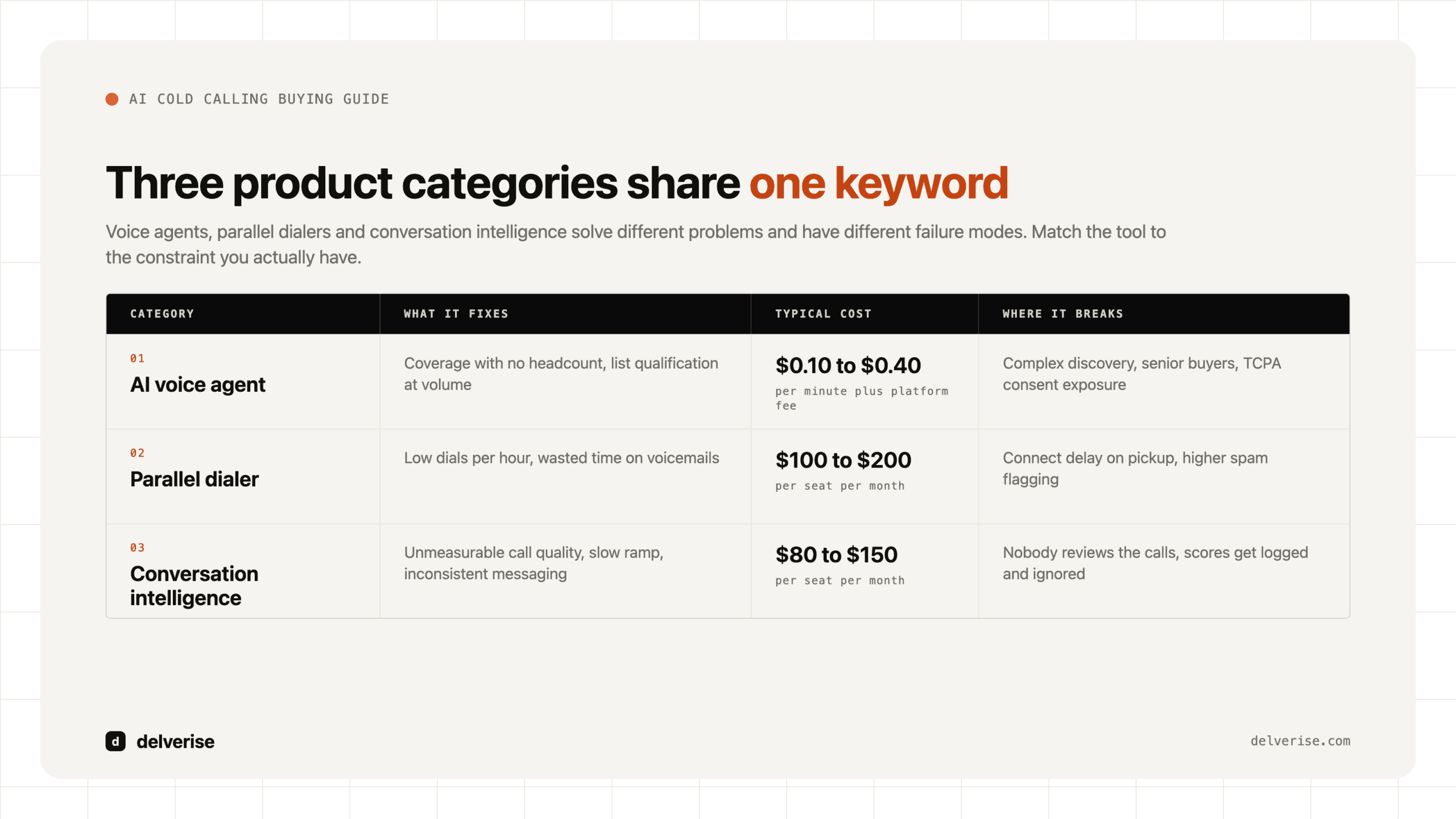
Match the tool to the constraint you actually have. If reps spend their day listening to ringtones, buy dial efficiency. If reps get connects and lose them in the first fifteen seconds, buy coaching. If you have no reps at all, a voice agent is the only option on this list, and you should size expectations accordingly.

| Category | What it fixes | Typical cost | Where it breaks |
|---|---|---|---|
| AI voice agent | Coverage with no headcount, inbound speed-to-lead, list qualification at volume | $0.10 to $0.40 per minute plus platform fee | Complex discovery, senior buyers, brand risk, TCPA consent exposure |
| Parallel dialer | Low dials per hour, wasted time on voicemails | $100 to $200 per seat per month | Connect delay on pickup, higher spam flagging, quality drops if research is skipped |
| Conversation intelligence | Unmeasurable call quality, slow ramp, inconsistent messaging | $80 to $150 per seat per month | Nobody reviews the calls, scores get logged and ignored |
| Engagement platform dialer | Calls disconnected from email and LinkedIn touches | Bundled, $100 to $180 per seat per month | Weaker dialing depth than a specialist tool |
If you are already choosing between the big sequencing vendors, our Outreach vs Salesloft comparison covers how the calling module fits each one.
Why does data matter more than the dialer?
Connect rate is the percentage of dials that reach a live human. It is the single biggest lever in cold calling, and it is mostly a function of phone number quality, not software. A direct mobile number connects several times more often than a main office line, and no amount of AI compensates for calling a switchboard.

That makes the data layer the first thing to fix. Waterfall enrichment, where you query one phone provider and fall back to the next when it returns nothing, typically lifts mobile coverage well beyond what any single vendor gives you. Clay is the most common place teams build this, because it lets you chain providers, verify numbers, and push only the verified records into the dialer. delverise is a Clay Solutions Partner and builds these enrichment pipelines for revenue teams; if you want the build rather than the tour, start at our Clay page.
Gartner’s research on B2B buying is a useful reality check here. Buyers spend a small minority of their purchase journey with sales reps at all, and that time is split across every vendor they consider. Your call is competing for a slice of an already thin allocation, which is why reaching the right person on the right number matters more than call volume.
What return should you expect? A worked example
Assume two SDRs on manual dialing, using purchased data with mixed number quality.

- 60 dials per rep per day, 20 selling days: 2,400 dials per month
- 5% connect rate: 120 conversations
- 15% of conversations become meetings: 18 meetings per month
Now add a parallel dialer and waterfall-verified mobile numbers.
- Dial capacity roughly triples: 7,200 dials per month
- Connect rate rises to 6% on verified mobiles: 432 conversations
- Meeting conversion drops to 12%, because higher volume means less pre-call research: 52 meetings per month
Incremental cost: about $300 per month in dialer seats and roughly $450 per month in phone enrichment across 3,000 unique contacts. That is 34 extra meetings for about $750, under $25 per incremental meeting. Compare that against a fully loaded SDR, where the same 18 meetings cost several thousand dollars a month once salary, tooling, and management time are counted. Our piece on what one outbound SDR actually produces has the full cost model.
Two honest caveats. Conversion drops when volume rises, so the meeting-to-opportunity rate needs monitoring, and spam labeling gets worse as dial volume climbs unless you rotate numbers and register them properly.
Where does AI cold calling break?
Compliance. The FCC’s 2024 declaratory ruling made clear that AI-generated voices in outbound calls fall under existing TCPA restrictions on artificial and prerecorded voices, which generally require prior express consent. Several states have added their own disclosure requirements, and call recording consent rules vary by state. Get counsel involved before a voice agent dials a cold list.
Buyer tolerance. A VP of Engineering who realizes they are talking to a bot usually hangs up and remembers the brand. McKinsey’s B2B Pulse research consistently finds buyers moving across ten or more channels and rewarding vendors who respond well in each one. A synthetic voice on a cold dial is a poor first impression for an enterprise ACV.
The measurement gap. Teams buy a dialer and never instrument what happens after the meeting is booked. Connects and meetings look great while opportunity creation stays flat. Instrument the whole path from dial to closed revenue before you scale spend, which is the same discipline we apply across the outbound funnel.
Speed to lead is the exception worth automating. Classic Harvard Business Review research on online sales leads found that firms responding within an hour were dramatically more likely to qualify the lead than those responding later. A voice agent that dials an inbound form fill in 60 seconds is a strong use of the technology, because consent and intent already exist.
How should you run the evaluation?
- Measure your current connect rate and dials per rep per hour before you look at any vendor
- Test mobile number coverage on 200 real ICP contacts across two or three data providers
- Ask each vendor for connect rate and spam-flag data from accounts in your ACV band, not their headline case study
- Run a two-week pilot with one rep and one control rep on the same list
- Confirm CRM write-back: call disposition, recording link, and next step must land on the record automatically
- Get a written answer on TCPA consent handling, call recording disclosure, and data residency
- Price the full stack: seats, minutes, enrichment, number registration, and implementation time
Most teams that struggle here bought a tool when they needed a system. The dialer only pays back when list building, enrichment, routing, sequencing, and reporting all connect. That is the work delverise does inside AI outbound systems, and it is the same principle we argue across AI in B2B sales: the model is one component, and the pipeline around it decides whether it produces revenue.
Frequently Asked Questions
What is the best AI cold calling software for a small B2B SaaS team?
For teams with one to five reps, a parallel dialer inside your existing engagement platform plus a strong phone enrichment layer usually returns the most per dollar. It requires no new vendor relationship, keeps activity in one system of record, and improves the metric that actually constrains you, which is conversations per hour.
Can AI voice agents replace SDRs?
They handle a narrow slice of the SDR job well: inbound speed to lead, list qualification, no-show recovery, and simple appointment setting on high-consent lists. Discovery, objection handling with senior buyers, and multi-threading across a buying committee still need a human. Most teams that try full replacement end up running a hybrid.
How much does AI cold calling software cost?
Budget $100 to $200 per seat per month for dialers and conversation intelligence, and $0.10 to $0.40 per minute plus a platform fee for voice agents. Phone enrichment typically runs $0.10 to $0.30 per verified mobile. Data is often the largest line item once you are dialing at volume.
Does AI cold calling get flagged as spam?
High-volume dialing from unregistered numbers gets flagged quickly by carrier analytics, and flagged numbers see connect rates collapse. Register your numbers with the carrier branded calling programs, rotate local presence numbers, keep per-number daily volume moderate, and monitor your spam-label status weekly.
What should we fix before buying any of this?
Fix data and measurement first. Confirm your list matches your ICP, verify mobile coverage, and make sure call outcomes write back to the CRM automatically so you can trace dials through to closed revenue. Software applied to a bad list produces more bad calls faster.
Read next