←Back to blog
Revenue Intelligence & Data ToolingGuideJuly 28, 20268 min read
Lead Nurturing Software: What to Buy, What to Build, and What Actually Moves Pipeline
Lead nurturing software automates the sequencing, timing, and routing that carry a lead from first touch to sales-ready. In B2B SaaS it usually combines marketing automation, CRM workflows, lead scoring, and data enrichment. Buying the platform is the easy part. The return comes from the data model and trigger logic you feed into it.
Lead nurturing software automates the sequencing, timing, and routing that carry a lead from first touch to sales-ready. In B2B SaaS it usually combines marketing automation, CRM workflows, lead scoring, and data enrichment. Buying the platform is the easy part. The return comes from the data model and trigger logic you feed into it.
Key takeaways
- Most nurture platforms do roughly the same four things: segment, send, score, and hand off. Differentiation lives in how well they connect to your CRM and product data.
- Nurture failures are usually data failures. Stale titles, missing account context, and a scoring model nobody trusts will sink any tool you buy.
- Series A teams rarely need a second platform. They need the one they own to be wired correctly, with clean triggers and a defined sales handoff.
- Buying groups have grown to six or more people, so single-contact nurture leaves most of the committee untouched.
- Measure nurture on stage-to-stage conversion and speed to opportunity, not on email open rates.
What is lead nurturing software, exactly?
Lead nurturing software is any system that keeps a relationship warm and progressing between the moment someone raises a hand and the moment they are ready to talk price. In practice that means four functions: segmentation (deciding who gets what), orchestration (deciding when and through which channel), scoring (deciding who is ready), and handoff (deciding which human takes it and with what context).

The category label is loose. HubSpot calls it marketing automation. Salesforce calls it engagement. Outreach and Apollo call it sequences. Customer.io calls it lifecycle messaging. They overlap heavily, and the buying question is which layer of your stack should own the logic.
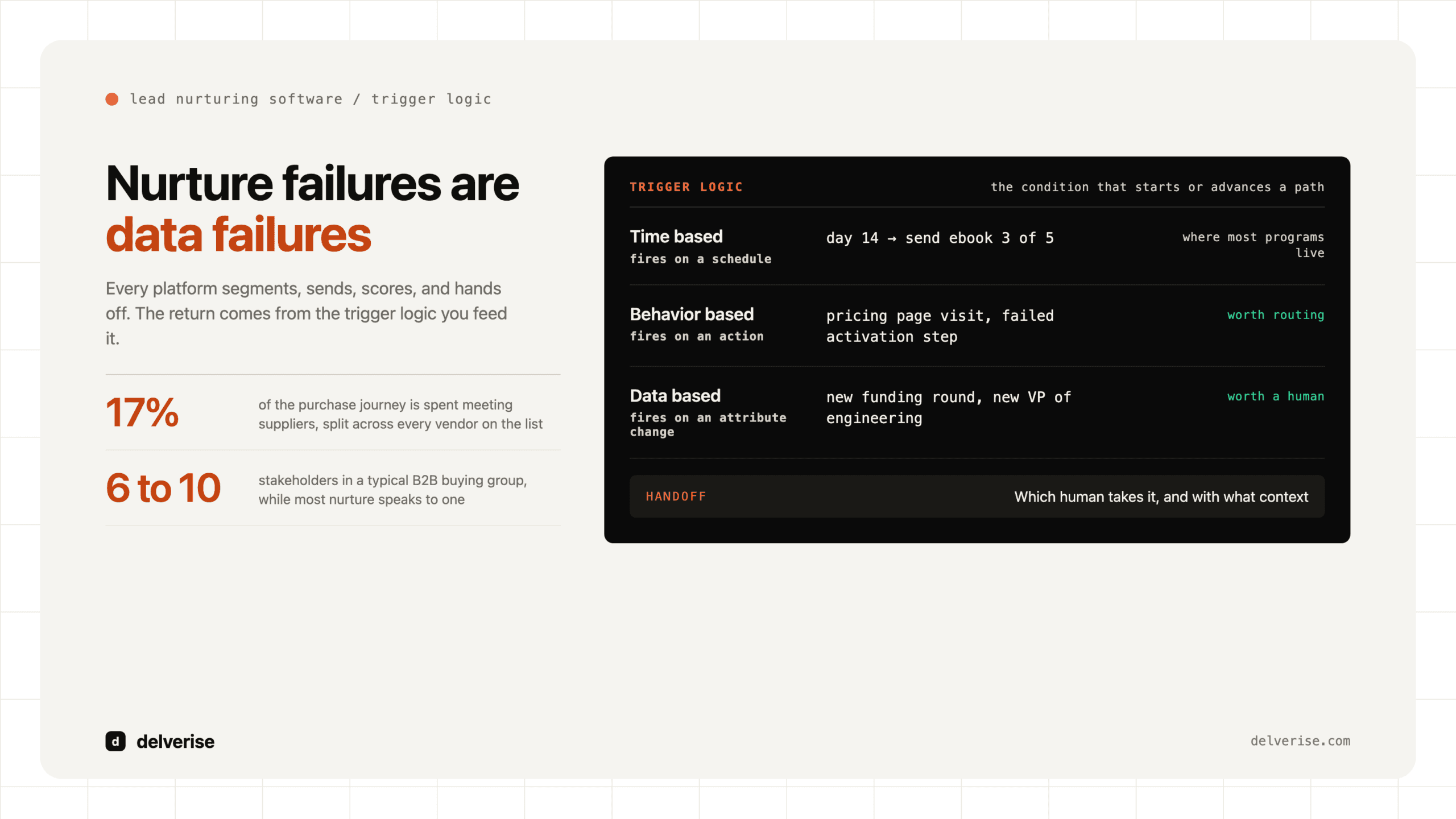
Worth defining one term now, because it causes most of the confusion in vendor demos: a trigger is the condition that starts or advances a nurture path. A time-based trigger fires on a schedule. A behavior-based trigger fires on an action, like a pricing page visit or a failed activation step. A data-based trigger fires when an attribute changes, like a new funding round or a new VP of Engineering joining the account. Most disappointing nurture programs are built almost entirely on the first kind.
Why do most B2B nurture programs stall?
Gartner’s B2B buying research found that buyers spend only about 17 percent of their total purchase journey meeting with potential suppliers, and that time gets split across every vendor on the list. So the practical window with any one seller is small. Nurture is your attempt to be useful during the other 83 percent, when the committee is reading, arguing internally, and building a business case without you in the room.

That framing exposes why generic drip sequences underperform. Three failure patterns show up repeatedly:
- The list is a person, but the deal is a committee. Research published in Harvard Business Review from the CEB (now Gartner) team put the typical B2B buying group at roughly six to ten stakeholders. Nurturing one contact while five others form opinions in a Slack channel is a structural gap.
- The content answers marketing’s question, not the buyer’s. Ebook three in a five-part series rarely maps to a real objection like security review, integration effort, or who gets fired if this fails.
- Nobody trusts the score. When sales gets a “hot” lead that turns out to be a student, they stop working the queue. Every routing rule downstream of that score becomes theater. This is fixable, and it starts with rebuilding the model against closed-won data rather than intuition. Our guide to lead scoring for B2B SaaS walks through that rebuild.
McKinsey’s B2B Pulse research consistently finds that buyers now move across roughly ten channels during a decision journey and expect consistency across all of them. A nurture program confined to email is covering one lane of a ten-lane road.
What categories of lead nurturing software should you compare?
Vendors will position themselves as complete. They are complete for different jobs. Here is how the categories actually divide:

| Category | Representative tools | Best for | Where it breaks |
|---|---|---|---|
| All-in-one marketing automation | HubSpot Marketing Hub, ActiveCampaign | Seed to Series A teams that want forms, email, workflows, and CRM in one contract | Complex account-level logic and product usage triggers; costs climb fast with contact volume |
| CRM-native engagement | Salesforce Marketing Cloud Account Engagement, Dynamics Customer Insights | Companies already standardized on the CRM with a dedicated ops owner | Slow to change; usually requires admin time for every new play |
| Sales engagement | Outreach, Salesloft, Apollo | Rep-driven follow-up, multichannel sequences, post-demo persistence | Marketing-side segmentation and long-horizon education; easy to turn into spray-and-pray |
| Lifecycle and product-led messaging | Customer.io, Braze, Intercom | PLG motions where in-product behavior is the strongest buying signal | Traditional sales-led funnels and account-based coordination |
| Orchestration and data layer | Clay, n8n, reverse ETL tools | Building the enrichment, research, and trigger logic that feeds every tool above | Sending at scale and native campaign reporting; it is plumbing, not a campaign UI |
That last row is the one buyers skip and later regret. Sending is a commodity. Knowing which 40 accounts changed this week, why, and what to say about it is the hard part. Tools like Clay sit upstream of the email platform: they enrich records, chain data providers, run research prompts, and write the result back to your CRM so the nurture path can branch on something real. The honest tradeoff is that Clay adds a system to maintain and a credit budget to manage, so it earns its place when your segmentation depends on data your CRM does not hold. Teams that want that layer built rather than staffed can start with our Clay implementation work.
How do you pick the right tier for your stage?
Stage is the cleanest selection heuristic available.
Seed to early Series A, under roughly 2,000 net-new leads per quarter. One platform. Whatever your CRM already includes. Spend the budget on getting form data, lifecycle stages, and routing right instead of on a second license. Most teams at this stage have four workflows doing the work of forty and do not know it because nobody has audited the account.
Series A to B with a defined ICP and a real SDR or AE team. Add a sales engagement layer and an enrichment layer. This is where account-level nurture starts to pay, because you can finally afford to treat a 200-account target list differently from inbound long tail. It is also where marketing operations becomes a named responsibility rather than a shared afterthought.
Series B and beyond. The question shifts from tools to governance: who owns the trigger library, how changes get tested, and how attribution reconciles across systems. Adding software here usually makes things worse before it makes them better.
If you are still assembling the surrounding stack, our breakdown of the MarTech stack for Series A startups covers what sits around the nurture layer.
What does a working nurture system look like end to end?
Here is a concrete illustration. Take a Series A company selling a $24,000 ACV product to operations leaders, generating 600 inbound leads a quarter, with two AEs.
- Capture and enrich. A demo request comes in with email and company only. Within seconds, enrichment appends firmographics, tech stack, headcount growth, and current job openings. Anyone below 25 employees routes to a self-serve path.
- Branch on fit and intent together. Fit comes from the enriched record. Intent comes from behavior: pricing page views, doc site visits, and repeat sessions from the same domain. A lead that is high fit and high intent skips nurture entirely and books directly.
- Nurture the account, not the contact. When one person from an account converts, the system flags the other known stakeholders and starts a parallel, role-specific path. The security lead gets the compliance material. The finance stakeholder gets the ROI model.
- Escalate on signal, not on schedule. A funding announcement, a relevant new hire, or three pricing page visits in a week pushes the account into a live sales task with the reason attached, so the rep opens with context.
- Recycle honestly. Leads that go quiet move to a low-frequency path with a clear exit. No lead sits in an active sequence for eleven months.
Nothing in that sequence requires exotic software. It requires a data model where fit and intent are separate fields, a trigger library someone owns, and a handoff contract sales agreed to in writing. That is the actual deliverable when we build these systems as part of GTM engineering work.
What should you measure?
Open rates tell you about subject lines. They say almost nothing about revenue. Four metrics carry real information:
- Nurtured-to-SQL rate compared against leads that bypassed nurture. If they are equal, your nurture is decorative.
- Time from first touch to opportunity created. Good nurture compresses this. Watch it monthly.
- Recycled lead conversion. The share of closed-won deals that passed through a recycle path at least once. In most B2B SaaS funnels this is a meaningful double-digit percentage and it is routinely under-credited.
- Sales acceptance rate. The percentage of nurture-graduated leads that reps actually work. Anything under 80 percent means the score has lost credibility.
For the wider set of funnel measures these sit inside, see our B2B sales funnel conversion benchmarks.
Buy or build: a pre-purchase checklist
- We can name the three triggers that will drive the majority of nurture volume
- Our CRM has separate fields for fit score and intent score
- We know our current lead-to-SQL rate and can measure it after the change
- Sales has agreed in writing what a nurture-graduated lead means
- One named person owns the workflow library after launch
- We have audited existing automations before adding new ones
- Our enrichment data is fresh enough to branch on with confidence
Fewer than five boxes checked means the tool is not your constraint yet.
Frequently Asked Questions
Is lead nurturing software different from marketing automation?
Marketing automation is the broader platform category covering email, forms, landing pages, and workflows. Lead nurturing is one job that platform performs. Most vendors sell the platform and describe nurturing as a use case, which is why demos often show features you will never configure.
How much should a Series A company spend on this?
Most Series A B2B SaaS teams land somewhere between $1,500 and $6,000 per month across nurture, enrichment, and sales engagement combined, scaling with contact volume. The larger cost is usually the operator time to build and maintain the logic, which teams consistently underestimate by a wide margin.
Can AI write the nurture content for us?
It can draft and personalize at volume, and it works well for research-backed first lines and account-specific framing. It performs poorly at judgment: which objection to address, when to stop, and when to escalate to a human. Our take on AI in marketing and sales covers where the line currently sits.
How long before nurture shows results?
Expect one full sales cycle before conversion data means anything, so 60 to 120 days for most B2B SaaS motions. Leading indicators appear sooner: sales acceptance rate and time-to-first-meeting usually move within three to four weeks of a rebuilt handoff.
Should nurture be owned by marketing or sales?
Marketing typically owns the content and segmentation, sales owns the escalation path, and RevOps owns the system connecting them. When no single function owns the trigger library, it decays within two quarters. Clarifying that ownership early prevents most of the drift.
Read next